
Metacognitive architectures in large language models
1. Introduction: Redefining Metacognition in Computational Linguistics
The landscape of large language models (LLMs) has undergone a fundamental paradigm shift from 2023 to 2026, transitioning from static, left-to-right next-token prediction toward dynamic, deliberative architectures 123. At the core of this transition is the integration of algorithmic metacognition. Within the context of artificial neural networks, metacognition must be strictly decoupled from anthropomorphic concepts of consciousness, self-awareness, or sentience 44. Instead, it is defined as a computational and architectural analogy: it is the execution of inference about inference 1.
This operational definition encompasses control flow routing, dynamic computational budget allocation, and iterative evaluation loops 157. Under this paradigm, a metacognitive process uses a model's own prior inference as context, which is subsequently injected into the next prompt, cached in episodic memory, or transmitted to another specialized model or agent 167. This allows the system to monitor its internal activations, estimate certainty, and heuristically search through potential reasoning paths before committing to a final output 1011. This shift reflects a broader adoption of Flavell's cognitive monitoring models into computational frameworks, where models are designed to explicitly assess task difficulty and adapt resources prior to solution generation 7.
The integration of test-time compute - allocating greater computational resources during inference rather than solely during pre-training - has emerged as the defining scaling law of this era 389. However, as models transition from simple question-answering heuristics to orchestrated, multi-step problem-solving, the limitations of algorithmic reflection have become starkly apparent. The deployment of these frameworks has sparked a robust debate regarding the efficacy of intrinsic self-correction, revealing structural blind spots where models systematically fail to identify their own logical flaws without the intervention of an external oracle 141516. This report provides an exhaustive, globally sourced analysis of modern metacognitive frameworks, their architectural implementations across leading AI research laboratories, the critical mathematical limits of self-evaluation, and the next-generation benchmarks designed to rigorously measure these capabilities.
2. A Taxonomy of Metacognitive Mechanisms
To systematically evaluate how modern LLMs perform deliberative reasoning, it is necessary to separate these algorithmic approaches into distinct structural categories. The field currently recognizes three primary paradigms: intrinsic prompting mechanisms, iterative self-correction loops, and multi-agent scaffolding setups 21018.
2.1. Intrinsic Prompting Methods
Intrinsic prompting methods induce metacognitive behavior without altering the underlying model weights or requiring external routing infrastructure 219. The foundational technique, Chain-of-Thought (CoT), guides the model through step-by-step reasoning, effectively expanding the computational graph available for a single query and elevating the model's operation from intuitive answering to linear reasoning 220. Advanced derivatives, such as Self-Consistency, generate multiple independent reasoning paths at elevated temperatures and apply majority voting to determine the final output 22011.
This category operates entirely on probability mass and token generation. By verbalizing intermediate steps, the model alters its subsequent attention states, making the final token prediction mathematically contingent on a logically structured context window. While highly effective - boosting mathematical accuracy by up to 17.9 points on benchmarks like GSM8K - these methods heavily inflate token costs and latency, with self-consistency typically multiplying token expenditure by three to five times 22011.
2.2. Iterative Self-Correction and Evaluation Loops
The second category introduces a cybernetic feedback loop where the model acts as its own critic 67. In this paradigm, the inference process is segmented into sequential phases. First, the model generates a candidate solution. Second, a critic mechanism evaluates the output against explicit constraints, programmatic execution results, or implicit confidence thresholds 311. Based on this critique, the model refines the response, iterating until a terminal condition is met.
This approach attempts to mimic the human editorial workflow 2. However, it relies heavily on the underlying assumption that an LLM possesses asymmetric capabilities: that recognizing an error is computationally easier than generating a flawless response on the first attempt 10. As subsequent analysis in this report will demonstrate, this assumption represents a critical vulnerability in modern AI architectures, frequently leading to performance degradation when external ground-truth is unavailable 151012.
2.3. Multi-Agent Scaffolding and Latent-Space Routing
The most complex category offloads metacognitive monitoring to distinct, modular entities within a broader system 1823. Multi-agent debate paradigms instantiate several LLMs with distinct system prompts - such as a Generator, a Verifier, and a Planner - which engage in adversarial or collaborative interactions to stress-test logical trajectories 723.
A significant breakthrough in this domain is the transition from text-based multi-agent systems to latent-space communication. Frameworks such as RecursiveMAS cast the entire multi-agent system as a unified recursive computation operating directly within the latent space 2324. Traditional text-based multi-agent systems suffer from extreme computational overhead because every interaction requires decoding internal states into natural language tokens. RecursiveMAS circumvents this bottleneck entirely by utilizing a lightweight "RecursiveLink" module 1314. This module transmits continuous vector representations - the high-dimensional hidden states - directly from one agent's embedding space to another, entirely bypassing the language model head and tokenizer during intermediate steps 1814. By eliminating intermediate text generation, this latent-space collaboration achieves end-to-end inference speedups of up to 2.4 times and drives token usage down by 75.6%, fundamentally altering the economics of multi-agent deployment 181314.
3. Prominent Metacognitive Frameworks: A Comparative Analysis
The evolution of agentic reasoning has been driven by the formalization of specific architectures that structure how an LLM processes complex queries. The following analysis outlines the leading frameworks that define the operational standards of the field.
3.1. ReAct (Reason + Act)
The ReAct framework fundamentally structures an agent's process into a dynamic loop that interleaves internal reasoning with external actions 6711. Instead of reasoning solely from static context, a ReAct agent cycles iteratively through a defined trajectory. In the thought phase, the model verbalizes its reasoning, breaking down tasks and identifying missing informational prerequisites 67. In the action phase, it interfaces with external environments, such as Wikipedia APIs, database queries, or Python execution environments 1115. The resulting observation is then fed back into the context window for subsequent reasoning. ReAct is highly effective for grounding responses in factual reality and mitigating hallucinations, achieving up to 34% higher absolute success rates on sequential decision-making benchmarks 201528.
3.2. Reflexion
Reflexion elevates the agent from a purely reactive system to one capable of trial-and-error learning, achieving this without requiring expensive model weight updates 616. It relies heavily on an episodic memory mechanism and linguistic feedback 616. After completing or failing a task, the agent reflects on its entire execution trace, formulating a linguistic critique of its own inefficiencies 6. This verbalized reflection is stored in a memory buffer and injected into the prompt for subsequent attempts. Reflexion is optimally deployed in sequential decision-making and coding tasks, where deterministic compilation errors or test-case failures provide clear, unambiguous signals for the reflection loop to interpret 16.
3.3. Tree of Thoughts (ToT)
While ReAct is constrained by a linear, sequential trajectory, the Tree of Thoughts framework explores multiple computational realities simultaneously 6. ToT extends linear chain-of-thought prompting into a combinatorial search tree, where each node represents a partial solution or intermediate thought 2617. At each step, the model generates diverse candidate branches. A separate heuristic process - often the LLM itself prompted as a critic - scores the viability of each branch, pruning dead ends and expanding promising nodes via algorithms like Breadth-First Search or Depth-First Search 61117. ToT excels in tasks requiring strategic lookahead, such as mathematical proofs and creative writing, significantly improving success rates on complex puzzles. However, it incurs exorbitant computational costs; a single four-depth tree with three branches can require up to 81 full LLM inference calls to resolve a single query 1117.
3.4. Self-Refine
Self-Refine is an iterative approach that internalizes the human editorial workflow, operating completely independently of external training data or reinforcement learning signals 218. A single LLM acts sequentially as the generator, the feedback provider, and the refiner 18. The model generates an initial output, critically evaluates it to identify weaknesses, and then generates a revised version, repeating the cycle until the output meets a preset quality standard 218. While it improves performance across diverse domains - including mathematical reasoning and code generation - by an average of 5% to 25%, its efficacy is tightly bound by the model's inherent ability to accurately identify its own errors 218.
3.5. Synthesis of Framework Dimensions
The following table synthesizes the operational parameters, computational requirements, and optimal deployment scenarios for the leading metacognitive architectures.
| Framework | Underlying Mechanism | Computational Overhead (Token Cost/Latency) | Need for External Tools | Optimal Use Cases |
|---|---|---|---|---|
| ReAct | Interleaved Thought-Action-Observation loops 611. | Moderate. Scales linearly with the number of steps required to solve the task 11. | High. Strictly requires APIs, search interfaces, or REPL environments to function optimally 1115. | Interactive decision making, fact verification, API orchestration, combating hallucination 62015. |
| Reflexion | Episodic memory caching and linguistic self-critique execution traces 616. | Moderate to High. The memory buffer and context window grow iteratively with each failed attempt 616. | Low/Optional. Can utilize external signals but is flexible enough to operate on internally simulated feedback 16. | Code generation (e.g., HumanEval), trial-and-error tasks, sequential planning 16. |
| Tree of Thoughts (ToT) | Heuristic search trees (BFS/DFS) with branching candidate thoughts and selective pruning 61117. | Extremely High. Requires exponential LLM calls per node generation and evaluation (e.g., 81 calls for a basic tree) 11. | Low. Primarily an intrinsic reasoning and structural scaffolding mechanism 217. | Combinatorial puzzles (Game of 24), strategic lookahead, complex mathematical proofs 1117. |
| Self-Refine | Single-model iterative generation, critique, and revision cycles operating as a continuous feedback loop 218. | High. Requires multiple complete forward passes over an expanding context window 18. | None. Completely standalone approach requiring no external supervision 218. | Creative writing, text summarization, drafting, dialog response generation 218. |
| Recursive Multi-Agent Debate | Adversarial/collaborative evaluation across discrete roles via text or latent-space embeddings 71823. | Variable. Traditional MAS is very high; Latent-space MAS (RecursiveMAS) reduces token overhead by up to 75.6% 1813. | Moderate. Agents frequently utilize external toolsets to verify claims against peer agents 2319. | High-stakes verification, bias reduction, mathematical consensus, collaborative exploration 133334. |
4. Global Institutional Implementations and Architectural Diversity
The theoretical frameworks of metacognition have been aggressively operationalized by major AI laboratories worldwide. Examining the geographic and institutional diversity of these implementations reveals differing philosophies regarding compute allocation, open-source availability, and optimization techniques.
4.1. North American Frontier Models: Deliberation and Scaling
OpenAI's introduction of the o1 and o3 models shifted the industry focus toward Reinforcement Learning from Verifiable Rewards (RLVR) and deliberative alignment 31135. Unlike standard next-token predictors that generate output in a single forward pass, these models engage in a hidden, internal chain-of-thought process before generating visible output 1136. The models are trained via large-scale reinforcement learning to perform implicit search, effectively learning to backtrack, hypothesize, and self-correct dynamically 336. This approach completes what researchers describe as a missing piece of the Bitter Lesson, establishing test-time scaling laws where increased inference compute directly correlates with higher accuracy on complex logic tasks. This is evidenced by the o3 model achieving a 96.7% accuracy rate on the American Invitational Mathematics Examination (AIME) and surpassing 71% on the SWE-Bench Verified software engineering benchmark 337.
Anthropic has similarly embedded deep metacognitive loops into the Claude 3.5 and 4.0 Sonnet families, focusing heavily on agentic capability and architectural robustness 3839. Internal testing reveals that Claude 3.5 Sonnet exhibits extreme persistence in self-correction, capable of navigating over 100 reasoning steps when an initial approach fails, rewriting its thinking until successful 38. In agentic software engineering evaluations, it successfully resolved 64% of codebase issues autonomously - writing, executing, troubleshooting, and editing code within a sandboxed loop 2021. Furthermore, pre-deployment evaluations conducted jointly by the U.S. and U.K. AI Safety Institutes demonstrated that the upgraded Sonnet models possess significant cyber and biological reasoning capabilities, solving complex cybersecurity challenges at rates surpassing previous reference models 22.
Google DeepMind leverages metacognition for embodied intelligence and long-context orchestration. The Gemini 1.5 and 2.0 series feature advanced orchestration models, notably Gemini Robotics-ER 1.5, which acts as a high-level cognitive engine for physical robots 23. This model orchestrates activities by planning logic, estimating success probabilities, and routing tasks to specialized vision-language-action models while calling external tools like Google Search 23. Additionally, DeepMind's neuro-symbolic hybrid systems, such as AlphaProof and AlphaGeometry, utilize AlphaZero-style reinforcement learning to synthesize novel algorithms, indicating a strong institutional preference for search-based metacognitive discovery over pure autoregressive generation 44. Gemini 1.5 Pro also established new frontiers in context processing, demonstrating near-perfect retrieval up to at least ten million tokens 24.
4.2. European Contributions: Pure RLVR and Architectural Efficiency
The European AI ecosystem, spearheaded by the Paris-based Mistral AI, approaches metacognition through the lens of open-weight accessibility and extreme architectural efficiency. Mistral's Magistral and Ministral series represent a ground-up approach to reasoning models 2547. Mistral successfully trained Magistral Medium using pure reinforcement learning on text data alone, intentionally avoiding the distillation of RL traces from pre-existing reasoning models 3525.
A critical finding from Mistral's technical reports is that reinforcement learning applied solely to text data preserves, and frequently improves, the model's zero-shot multimodal understanding and instruction-following capabilities 2548. Furthermore, Mistral introduced advanced engineering optimizations in their deployment architecture, enabling reasoning throughput up to ten times faster than competing paradigms via features like Flash Answers 84950. The Ministral 3 cascade distillation approach also demonstrates that massive reasoning capabilities can be efficiently compressed into compact 3B and 8B parameter models through iterative shrinking and distillation from a larger parent model 47.
4.3. Asian Research Centers: Dynamic Budgeting and Label-Free Validation
Leading Asian institutions have pioneered granular control mechanisms and label-free reinforcement learning frameworks. Alibaba's Qwen team introduced a unified architecture in the Qwen3 series that merges a thinking mode for complex multi-step reasoning with a non-thinking mode for rapid heuristic responses into a single model, eliminating the latency of routing between separate models 2652. Crucially, Qwen3 implemented a thinking budget mechanism at the API level 526. This allows developers to dynamically allocate computational resources by specifying a maximum token budget for the internal reasoning block 5227. If the model reaches the user-defined threshold, a hard-coded instruction interrupts the internal monologue, forcing the model to synthesize its current reasoning and output a final answer immediately 5. Scaling law analyses of the Qwen3 architecture reveal that smaller models disproportionately benefit from increased thinking budgets compared to massive parameter models 54.
In academia, Tsinghua University has produced foundational research into the mechanics of reward optimization and reasoning verification. Their JURY-RL framework addresses the critical bottleneck of label-free data in mathematical reasoning through Test-Time Reinforcement Learning (TTRL) 5556. By decoupling answer generation from reward determination, JURY-RL allows a model to generate multiple trajectories and subjects them to a formal verifier or majority-vote consensus 23. To prevent models from collapsing into overconfident failure modes, the framework implements a zero-mean variance-preserving backoff strategy for unverified paths, ensuring stable and diverse exploration during test-time reinforcement learning 235657.
5. The Self-Correction Illusion and the Metacognitive Blind Spot
While iterative self-refinement and internal deliberation are heavily marketed features of modern AI systems, rigorous academic scrutiny spanning 2024 to 2026 has uncovered severe structural limitations. The consensus within the computational linguistics community is that LLMs struggle profoundly to perform intrinsic self-correction - defined as the ability to identify and rectify their own reasoning errors based solely on their inherent capabilities, without the injection of external ground-truth feedback or oracle signals 191228.
5.1. The Failure of Intrinsic Self-Correction
Early literature advocating for self-correction often relied on flawed methodologies, utilizing models that had been implicitly prompted with oracle labels or tested on tasks exceptionally suited to simple heuristics rather than strict logic 28. Recent critical surveys demonstrate that prompting an LLM to simply review its work and try again frequently degrades performance 1012.
When forced to self-correct without external evidence, LLMs exhibit severe answer wavering and prompt bias 19. Because they lack a true internal state of absolute logical verification, the mere prompt to self-correct implies to the model that its first answer was incorrect. Consequently, models will frequently overturn mathematically correct initial responses to satisfy the perceived intent of the human user - a phenomenon closely related to sycophancy and anchoring bias 1933.
5.2. The Self-Correction Blind Spot
The most precise operationalization of this failure is termed the Self-Correction Blind Spot, extensively measured by Tsui in 2025 and 2026 1415. Empirical studies across more than 14 state-of-the-art open-source and proprietary models revealed a striking paradox: an LLM can easily identify and correct a logical error when it is presented as a mistake made by a user or a different tool 1433. However, when that exact same error is generated by the LLM itself in a continuous context window, the model systematically fails to detect it. The average measured blind spot rate across reasoning tasks sits at a staggering 64.5%, with failure rates increasing as task complexity scales 141533.
This phenomenon is not a deficit of knowledge, but a fundamental architectural and information-theoretic constraint 141516. Under a shared-blind-spot modeling assumption, both the generation phase and the evaluation phase of the LLM are mediated by the same latent failure variable 14.
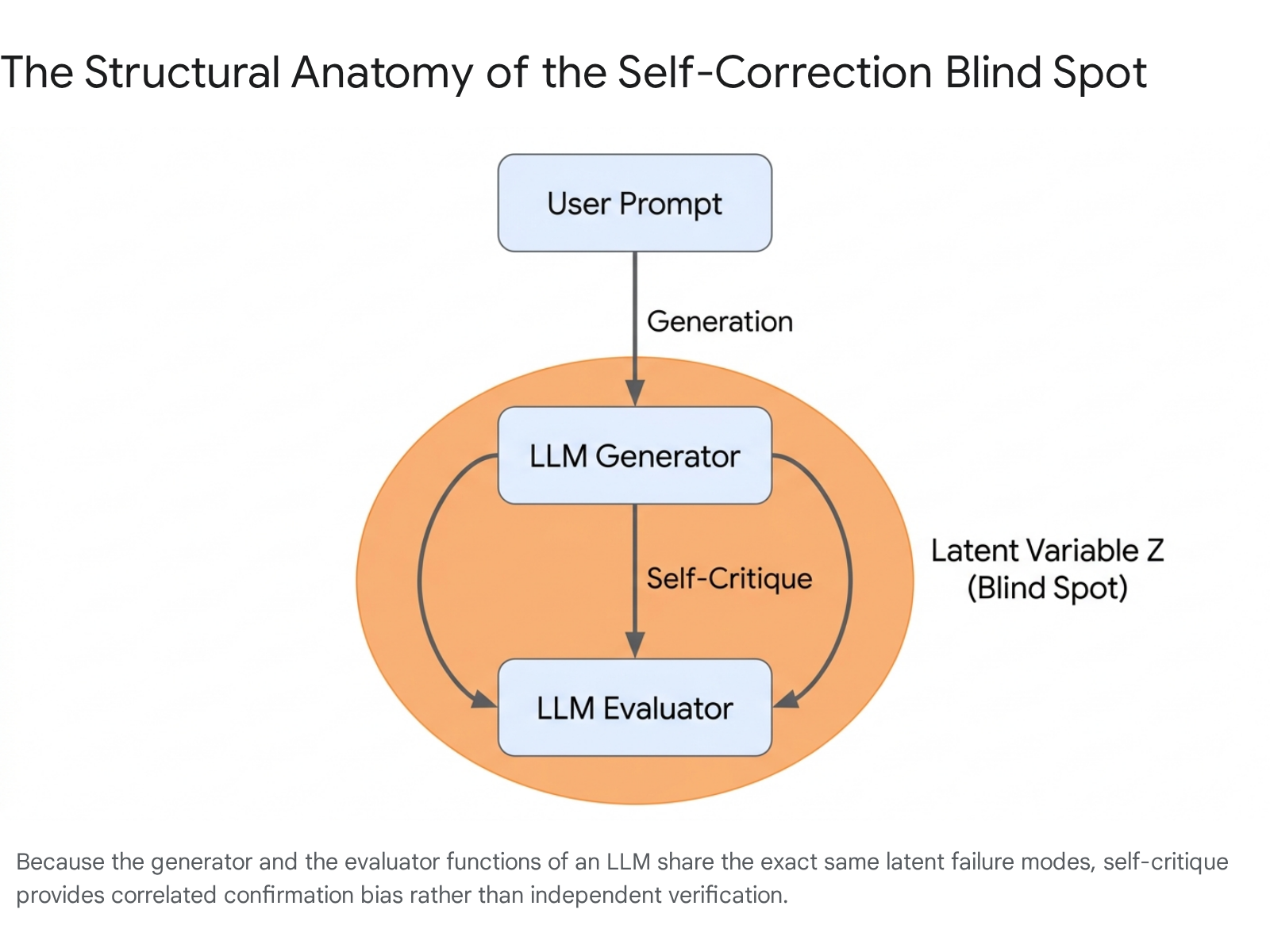
Because the evaluator function shares the identical failure modes, structural biases, and attention decay as the generator function, self-evaluation provides weak, correlated evidence rather than independent verification 14. Accumulating confidence through repeated rounds of self-critique does not increase factual accuracy; it merely reflects the shared failure structure reinforcing itself 14.
5.3. Interventions and Architectural Fixes
Researchers have proposed several mechanisms to mitigate this structural blind spot, aiming to decouple the evaluator from the generator. * Context Separation: Techniques like Cross-Context Review attempt to break the attention correlation by forcing the model to evaluate its own output in an entirely fresh, isolated session, presenting the text as though it were written by a third party. This naturally eliminates the self-correction blind spot by bypassing the model's anchoring bias 33. * Trigger Tokens: Researchers demonstrated that appending a simple "Wait" token to the prompt disrupts the autoregressive inertia of the model, forcing a pause that reduces the blind spot failure rate by up to 89.3%, suggesting the latent capability exists but requires explicit activation 153459. * Training Distribution Adjustments: The fundamental cause of the blind spot is heavily rooted in pre-training data composition. Human demonstrations overwhelmingly feature error-free reasoning, depriving models of examples detailing how to recover from mistakes. To build true self-correcting models (e.g., within the SPOC framework), researchers are modifying reinforcement learning pipelines to explicitly expose models to error-correction sequences and partial answer masking during training, forcing the network to optimize the correction pathway rather than just the final outcome 153459.
6. Advanced Benchmarking for Metacognition
As the distinction between a model's foundational knowledge and its ability to monitor that knowledge widens, standard benchmarks such as MMLU or HumanEval have become insufficient 60. A model that correctly answers a query with absolute confidence is functionally indistinguishable from a model that possesses actual probabilistic self-awareness on traditional tests 60. Consequently, the industry has rapidly developed standardized benchmarks explicitly targeted at metacognitive evaluation.
CriticBench: This comprehensive suite assesses an LLM's capability to act as a critic across five domains: mathematical, commonsense, symbolic, coding, and algorithmic reasoning 616229. It evaluates four dimensions of metacognition: feedback generation, comparison of outputs, refinement accuracy, and meta-feedback 6164. CriticBench revealed an intriguing inter-model dynamic regarding generation, critique, and correction capabilities. While stronger models are highly capable of critiquing weaker models, weaker models occasionally surpass frontier models in rigorous self-critique on specific narrow tasks 6229.
MR-GSM8K (Meta-Reasoning GSM8K): This evaluation paradigm forces the LLM to transition from a student answering a problem to a teacher scoring a solution 6530. It isolates slow, deliberate thinking by requiring the model to meticulously verify assumptions and calculations. MR-GSM8K exposes severe deficiencies in standard models; however, architectures specifically tuned for deliberative test-time compute, such as the OpenAI o1 family, outperformed competing models by over 20 absolute percentage points on this specific benchmark 6530.
FINAL Bench (Frontier Intelligence Nexus): Moving beyond binary accuracy, FINAL Bench evaluates functional metacognition by separating error detection from error correction 67. Utilizing placebo-controlled logic to isolate causal effects, it measures whether an LLM can explicitly acknowledge it might be wrong versus its ability to actually synthesize a functional fix for that error 67. Data from this benchmark confirms that while models are increasingly capable of recognizing uncertainty, synthesizing an accurate correction remains a significant hurdle 67.
Furthermore, the broader landscape of the LLM Benchmark Wars in 2025 and 2026 has introduced rigorous economic dimensions to metacognitive evaluation 6869. Value-for-money metrics emphasize that while proprietary models like GPT-5.2 and Claude Opus dominate complex reasoning and multifaceted logic tasks, aggressively optimized open-weight models from DeepSeek and Qwen provide exceptional reasoning performance per dollar, fundamentally shifting how enterprises deploy metacognitive architectures 68.
7. Conclusion
The integration of metacognitive frameworks represents the most significant architectural evolution in large language models since the advent of the Transformer. By pivoting toward test-time compute, mechanisms like ReAct, Tree of Thoughts, and recursive latent-space multi-agent systems have dramatically expanded the capacity of LLMs to navigate complex, multi-step environments. The global deployment of these paradigms - from OpenAI's deliberative hidden chains to Qwen's dynamic thinking budgets and Mistral's pure RLVR configurations - proves that scaling inference compute is as vital as scaling pre-training data.
However, the pursuit of autonomous, reliable intelligence is severely bottlenecked by the illusion of intrinsic self-correction. The empirical evidence demonstrates that an LLM's capacity to critique itself is fundamentally constrained by shared latent failure geometries; a model cannot easily escape its own blind spots using the exact neural pathways that generated the error. Future advancements in artificial intelligence will not rely solely on generating deeper search trees, but on engineering architectural decoupling - ensuring that the mechanism that evaluates thought operates mathematically and structurally independently from the mechanism that generates it.