
Mathematics of emergence and the physical reduction of consciousness
The Problem of Reduction in Consciousness Studies
The question of whether consciousness can be reduced to physical processes represents a central challenge across the philosophy of mind, theoretical physics, and computational neuroscience. Historically framed as the "hard problem," this inquiry seeks to understand how subjective, qualitative experience arises from the objective, quantitative interactions of physical matter 11. For decades, the debate relied heavily on philosophical intuition, utilizing thought experiments and conceptual analyses to argue either for physicalist reductionism or for various forms of dualism and panpsychism. However, contemporary scientific domains have increasingly shifted this discourse toward formal, quantitative frameworks through the mathematics of complex systems and emergence 24.
By formalizing the dynamics of neural networks, information integration, state-space topology, and thermodynamic constraints, mathematical models provide concrete, testable hypotheses regarding the ontological status of subjective experience. These models are utilized to test whether conscious states are entirely deducible from micro-level physical laws, or whether they represent an irreducible, fundamental property of nature that exerts its own causal power 56. The mathematics of emergence offers a precise language for analyzing system behavior across different spatiotemporal scales. Emergent properties occur when a complex entity exhibits behaviors, functional capacities, or organizational features that its constituent parts lack in isolation 2. In the specific context of consciousness, mathematical formalisms are deployed to distinguish between behaviors that are merely computationally opaque to external observers (but ultimately reducible) and those that represent genuine ontological novelty 15.
Evaluating these phenomena requires a deep synthesis of multiple quantitative frameworks. The mathematical models currently dominating this discourse include Integrated Information Theory (IIT), Global Neuronal Workspace (GNW) theory, the Free Energy Principle (FEP), Topological Data Analysis (TDA), the Information Bottleneck (IB) method, Constructor Theory, and theorems based on formal uncomputability 63841056. By exploring how these disparate theories treat causality, information geometry, and computational limits, researchers can quantitatively assess the boundary between reducible physical mechanisms and potentially irreducible conscious states.
Mathematical Formalisms of Weak and Strong Emergence
To understand what mathematics reveals about the reducibility of consciousness, it is necessary to establish how the phenomenon of emergence is formalized in physical and computational systems. The conceptual distinction between "weak" and "strong" emergence dictates whether a macro-state can be causally reduced to its micro-level components, which subsequently determines the mathematical tools required to describe the system 157.
Weak Emergence and Computational Irreducibility
Weak emergence describes macro-level phenomena that arise exclusively from the fundamental interactions of lower-level components, yet manifest in ways that are practically unpredictable without simulating the system's exact chronological evolution. According to standard definitions in complexity theory, a macroscopic state of a physical system with specific microdynamics is weakly emergent if and only if it can be derived from the system's initial conditions and micro-level laws, but strictly through step-by-step simulation rather than a priori analytical deduction 12.
Mathematically, weak emergence is deeply intertwined with the concept of computational irreducibility, a principle advanced heavily in the study of cellular automata and non-linear dynamic systems 28. In such systems, the macroscopic behavior - such as the formation of coherent neural oscillations, chaotic weather patterns, or self-organizing biological structures - is entirely encapsulated by the microscopic rules governing its elemental units. However, the lack of a mathematical shortcut or closed-form solution forces the observer to compute the system's progression exhaustively 12.
In the context of consciousness, theories that rely on weak emergence posit that subjective experience is the result of highly complex, non-linear neural processing 1. Under this paradigm, consciousness is ultimately reducible to physical processes. The apparent mystery or "hardness" of the problem is merely an artifact of epistemic limitation; human observers currently lack the computational power and mathematical shortcuts to deduce the exact phenomenological output from a high-dimensional map of localized neural firings 19. Theories rooted in weak emergence generally suggest that consciousness is an observer-relative property, defined by the cognitive difficulty an observer faces when attempting to predict high-level features from low-level mechanics 7.
Strong Emergence and Downward Causation
Strong emergence, in stark contrast, posits that macroscopic phenomena are fundamentally irreducible to microscopic laws, even in principle with infinite computational resources. A strongly emergent property is one that cannot be deduced or simulated strictly from the exact distribution of particles, forces, and fields across space and time 27. If consciousness is strongly emergent, the mathematical implication is profound: it requires the existence of novel fundamental laws of nature that govern the macro-level system independently of the micro-level physics 7.
Mathematically, strong emergence implies the presence of downward causation, a process in which the macro-state imposes constraints on the micro-state that the micro-level laws alone do not dictate or predict. Frameworks exploring this concept often utilize an ensemble perspective, demonstrating mathematically that physical systems hold properties that are meaningful only as an ensemble rather than as isolated individual states 10. For instance, a mathematical constraint like a parity bit across a string of binary data represents a collective property of the entire system. This parity constraint cannot be identified by observing the states of isolated, local subsystems; it is an organizational law that dictates the allowable states of the whole 10.
In complex biological systems, diachronic emergence - emergence that unfolds dynamically over time - paired with the thermodynamic openness of the system means that microphysics is not causally closed 9. From this perspective, the initial physics data for an organism cannot inherently determine specific later outcomes because of interactions with the environment and the resulting higher-level organizing principles. These macro-level principles, such as dynamical basins of attraction, determine the specific outcomes of individual microphysical brain states, forcing the micro-components to align with the macro-system's imperatives 9. If the mathematics of the human brain reflect strong emergence, then consciousness cannot be reduced to local physical processes, as the ultimate causal power resides in the irreducible global architecture.
Integrated Information Theory and Causal Structure
Integrated Information Theory (IIT) represents the most mathematically ambitious and rigorously formalized attempt to capture the strong irreducibility of consciousness. Distinct from purely functionalist approaches, IIT posits that consciousness is not merely a computation, a behavioral output, or a cognitive capacity. Instead, consciousness is fundamentally identical to the intrinsic, irreducible cause-effect structure of a physical system 1112.
The Mathematics of System Irreducibility
IIT 4.0 utilizes a comprehensive mathematical formalism designed to quantify the exact extent to which a system generates information as a unified, irreducible whole. The theory is constructed upon a foundation of phenomenological axioms - such as the intrinsic, specific, unitary, and definite nature of experience - which are translated directly into physical postulates evaluated through transition probability matrices 313.
The central variable of the theory is system integrated information, denoted as $\phi_s$ (small phi). This value quantifies the cause-effect power a system exerts over itself in a specific state, relative to its parts 3. To evaluate this, the mathematical framework requires calculating how a system's causal power is altered when it is artificially partitioned. A partition ($\theta$) divides the system into independent, non-overlapping parts, conceptually injecting "noise" to sever causal connections 3.
The integrated cause information ($\phi_c$) and integrated effect information ($\phi_e$) are calculated by assessing how the partition reduces the probability that the system specifies its specific past (cause) and future (effect) states. The equations rely on calculating the intrinsic difference between the intact system's probability distribution and the partitioned system's probability distribution. The integrated effect information is formalized as: $$\phi_e(s, \theta) = |ii_e(s, s') - ii_e(s, s' | \theta)|+$$ Similarly, the integrated cause information is evaluated as: $$\phi_c(s, \theta) = |ii_c(s, \hat{s}) - ii_c(s, \hat{s} | \theta)|+$$ where $s$ is the current state, $s'$ is the maximal effect state, $\hat{s}$ is the maximal cause state, and $ii$ represents intrinsic information (the product of selectivity and informativeness). The $|.|_+$ operator ensures that any negative values, representing a net loss of information upon integration, are zeroed out 3.
System integrated information is then defined strictly as the minimum of the irreducibility on both the cause and effect sides: $$\phi_s(s, \theta) = \min(\phi_c(s, \theta), \phi_e(s, \theta))$$ Crucially, IIT evaluates this irreducibility across the Minimum Information Partition (MIP). Following the principle of minimal existence, a system's true irreducibility is defined by its "weakest link." The final $\phi_s$ value for a candidate system is evaluated over the specific partition $\theta'$ that minimizes the system's integrated information relative to the maximum possible value it could take, essentially searching for the fault line where the system is most easily severed into independent parts 32014.
If the system demonstrates a positive $\phi_s$ over its MIP, it is considered a candidate for consciousness. The macroscopic quantity of consciousness for the entire system, known as Structure Integrated Information ($\Phi$, or "big Phi"), is the sum of the integrated information of all individual distinctions ($D$) and causal relations ($R$) within a maximally irreducible conceptual structure ($\Phi$-structure) 320.
Ontological Claims of Physical Irreducibility
The mathematical architecture of IIT enforces strict physical irreducibility as an absolute prerequisite for consciousness. According to the Integration postulate, a substrate can only support consciousness if it specifies its cause-effect state as a unitary whole that cannot be reduced to independent subsets without information loss 315.
This leads to radical ontological claims regarding reductionism. Because purely feed-forward neural architectures or simple functional processing chains possess a $\phi_s$ value of exactly 0, they are mathematically barred from consciousness under IIT. This holds true regardless of the complexity of their functional outputs, their behavioral mimicry of conscious agents, or their computational power 316. IIT claims that an experience is explicitly identical to the cause-effect structure ($\Phi$-structure) unfolded from a complex in its current state 11.
This framework establishes what has been termed the "Great Divide of Being." Under IIT's realist idealism, physical entities that maximize $\phi_s$ truly exist in an absolute, intrinsic sense. In contrast, reducible aggregates, which fail to maximize $\phi_s$ (such as standard digital computers, feedforward networks, or inanimate objects lacking reentrant architecture), do not truly exist for themselves; their existence is merely relative to external conscious observers who perceive them 14.
However, this strict mathematical framework faces immense computational and empirical hurdles. Evaluating the integration measure for large, complex biological systems is computationally intractable. As noted by critics, the required calculations grow super-exponentially with the system's information content and the number of candidate partitions 11. Consequently, exact measurements of $\Phi$ for biological brains are currently impossible. Researchers must rely on proxies and approximations, which often yield radically different results depending on the mathematical assumptions utilized, fueling debates over whether the theory is practically falsifiable 1124.
Global Neuronal Workspace and Non-Linear Phase Transitions
Contrasting sharply with the intrinsic structural irreducibility of IIT, the Global Neuronal Workspace (GNW) theory models consciousness through the mathematics of non-linear dynamics, stochastic network activity, and information broadcasting. Developed heavily by Stanislas Dehaene, Jean-Pierre Changeux, and Lionel Naccache (building on Bernard Baars' psychological models), GNW frames consciousness not as an intrinsic property of matter, but as a discrete, global functional state of information sharing 82517.
Ignition Dynamics and Threshold Equations
GNW represents the human brain as a massive, complex meta-neural network featuring specialized, unconscious local modules (e.g., vision, memory, motor control) linked by a central "workspace." This workspace is anatomically instantiated by a distributed network of long-range pyramidal neurons located primarily in the prefrontal, parietal, and cingulate cortices, integrated with relevant thalamocortical circuits 81718. The mathematical cornerstone of GNW is the dynamic phenomenon of "neuronal ignition."
When a sensory stimulus is processed, it initially triggers linear, feedforward activity within localized, modular sensory regions. If the signal's strength is weak, or if top-down attentional modulation is absent, the signal decays and remains subliminal. However, if the stimulus reaches a critical threshold (driven by stimulus strength, novelty, or directed attention), the network undergoes a sudden, non-linear phase transition 819.
This ignition is computationally modeled using stochastic integrate-and-fire neurons and Hopfield network attractor dynamics 172930. The state-space transitions observed during ignition are mathematically akin to continuous second-order phase transitions in statistical physics, where the neural system resides in a state of self-organized criticality poised precisely between order and disorder 2021.
In these computational simulations, a brief wave of excitation progresses into the cortical hierarchy through fast, AMPA-mediated feedforward connections. In a subsequent stage, slower NMDA-mediated feedback connections amplify the signal in a cascading, reentrant manner 1822. If these feedforward signals are sufficiently strong to overcome local inhibitory interneurons, the entire stimulus-relevant network falls into a globally self-sustained, reverberating state. This state acts as a global blackboard, characterized mathematically by synchronized, high-frequency oscillatory activity (typically in the gamma band around 40 Hz) across distant cortical areas 2922. The ignition event effectively suppresses competing stimuli, maintaining the dominant signal independently of the time and place of the initial perception, thereby allowing it to be accessed by executive functions for memory, planning, and verbal report 34.
Functionalism and the Stance on Weak Emergence
Mathematically and philosophically, the Global Neuronal Workspace model aligns closely with weak emergence. The "ignition" that constitutes conscious access is viewed as an emergent macroscopic property resulting from the highly complex, recurrent, and stochastic interactions of microscopic neurons 118.
Because global broadcasting is fundamentally an information-processing event - an evolved biological algorithm for routing salient data so it becomes globally available to high-level decision systems - GNW implies that consciousness is ultimately reducible to physical, computational mechanics 34. Unlike IIT, which claims consciousness is intrinsic to specific causal structures even if those structures are functionally silent, GNW equates consciousness exclusively with the functional act of broadcasting and amplification 1835.
Consequently, according to the mathematics of GNW, a sufficiently sophisticated artificial neural network featuring an ignition threshold, dense long-range connectivity, and a centralized global workspace architecture could fully instantiate consciousness 817. The emergent property of subjective awareness in GNW is not an ontological novelty, but a predictable (albeit computationally complex) output of biological network topology.
Bayesian Mechanics and the Free Energy Principle
The Free Energy Principle (FEP), spearheaded by Karl Friston, leverages the mathematics of thermodynamics, information geometry, and Bayesian inference to model how living systems maintain their structural integrity and exhibit sentience. While originally formulated as a theory of biological self-organization and predictive coding, the FEP has evolved into a formalized physical and epistemological approach to understanding the boundaries between a conscious system and its environment 623.
Markov Blankets and State-Space Partitions
The FEP models a system using random dynamical systems expressed through Langevin equations ($x = f(x, \tau) + \omega(\tau)$), which describe systemic states through a combination of state-dependent deterministic flow and random fluctuations. This is complemented by the Fokker-Planck equation, which tracks the temporal evolution of probability densities 6. The core mathematical mechanism of individuation and identity in the FEP is the Markov Blanket.
A Markovian partition divides a complex system's states into four distinct categories: internal states ($\mu$), external states ($\eta$), and the intervening blanket states consisting of sensory states ($s$) and active states ($a$) 6. The Markov blanket renders the internal states conditionally independent of the external states; the internal states can only "know" about the external world through the mediation of the sensory states, and can only influence the external world through the active states 637.
From this topological boundary, Bayesian mechanics naturally emerge. The internal states parameterize a variational density ($q_\mu(\eta)$), which represents the system's probabilistic beliefs about the hidden external causes of its sensory input 6. The dynamics of the conscious system are driven by the continuous mathematical minimization of Variational Free Energy ($F$). This functional acts as a mathematical upper bound on surprisal (the negative log-probability of a state, $\Im$) 623. The free energy equation is defined as: $$F(b, \mu) = E_q[\Im(\eta, b)] - H[q_\mu(\eta)]$$ Through the process of active inference, sentient systems act on their environment to minimize expected free energy, ensuring they remain within the narrow band of non-equilibrium steady states (NESS) necessary for biological survival 612.
Implications for Ontological Emergence
The strict mathematics of the FEP pose a significant challenge to theories of strong ontological emergence. The framework operates on the mathematical principle of "recursive composition," implying that systems consist of Markov blankets nested within Markov blankets at increasingly higher spatiotemporal scales (e.g., from organelles to cells, organs, brains, and societies) 623.
Through mathematical techniques of adiabatic reduction and renormalization, fast micro-level fluctuations are eliminated at each scale. This process leaves only the slow, macroscopic blanket states, which subsequently form the interacting particles of the next hierarchical level 6. Because these mechanics represent complementary, scale-dependent characterizations of the same underlying behavioral flows, the higher-level descriptions capture dynamics that are causally inert relative to the base physics. They merely cast the identical physical system under a different statistical and informational light 6.
Therefore, the FEP fundamentally commits to an epistemological view of emergence (weak emergence) 6. It models sentience and consciousness as the conditional synchronization of chaos between internal generative models and external reality. Under this mathematical lens, conscious behavior is reduced to a fundamental thermodynamic and statistical imperative - self-evidencing - without requiring novel, irreducible fundamental laws of nature 612.
Topology, Bottlenecks, and State-Space Geometry
Beyond the specific overarching theories of IIT, GNW, and FEP, researchers increasingly apply domain-general mathematical tools to understand how information is physically constrained within networks and how neural topologies map to distinct subjective states.
Topological Data Analysis (TDA)
Topological Data Analysis (TDA) leverages the principles of algebraic topology to extract global, high-dimensional features from complex, noisy datasets. TDA is particularly valuable because it is invariant to localized geometric distortions, focusing instead on the intrinsic shape of the data. In consciousness science, TDA is increasingly utilized to track the continuous reconfiguration of brain functional connectomes during state-space transitions 538.
In TDA, the functional connectome of the brain is modeled as a topological space using the Vietoris-Rips complex, parameterized by a filtration value ($\epsilon$) representing the connection distance or threshold. As $\epsilon$ changes from zero to infinity, researchers track the birth and death of topological invariants known as Betti numbers 538. * $\beta_0$ (Betti-0): Represents the number of distinct connected components. * $\beta_1$ (Betti-1): Represents the number of one-dimensional holes or cycles in the network. * $\beta_2$ (Betti-2): Represents the number of two-dimensional voids enclosed by surfaces 53839.
The persistence of these topological features across varying scales is recorded in persistence diagrams and Betti curves 3824. Empirical research utilizing TDA on EEG and fMRI data demonstrates that the transition from an unconscious resting state to an active, conscious cognitive load (such as working memory tasks) involves highly distinct topological reconfigurations 38.
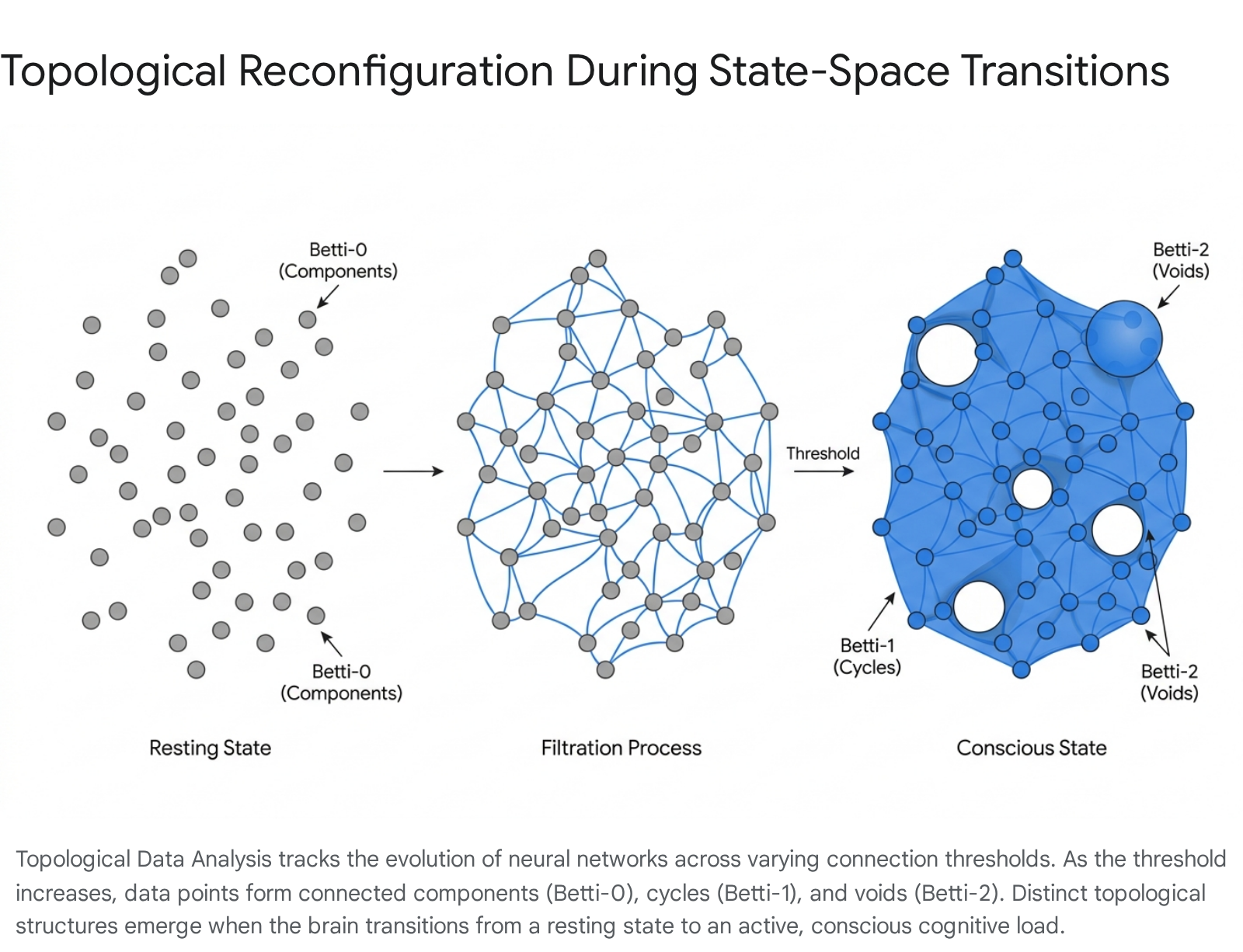
During high cognitive load, networks exhibit significantly higher topological integration, marked by specific shifts in the persistence of one-dimensional cycles ($\beta_1$) 3841.
While TDA does not inherently solve the philosophical hard problem, it provides rigorous mathematical evidence that conscious states are physically distinguishable by their macroscopic topological invariants. This aligns closely with frameworks that view consciousness as an irreducibly global, structural phenomenon spanning high-dimensional manifolds 542.
The Information Bottleneck Method
Another vital mathematical perspective is provided by the Information Bottleneck (IB) method, pioneered by Naftali Tishby, Fernando Pereira, and William Bialek. The IB method provides an information-theoretic optimization framework to understand how complex systems effectively discard irrelevant noise while preserving highly predictive signals 643.
The bottleneck mechanism optimizes the inherent tradeoff between data compression and predictive accuracy. Given an input variable $X$ (e.g., high-dimensional sensory data) and a relevant target variable $Y$, the goal is to discover a compressed latent representation $T$ that minimizes the functional: $$\inf_{p(t|x)} \Big( I(X;T) - \beta I(T;Y) \Big)$$ where $I$ denotes mutual information, and $\beta$ is a Lagrange multiplier controlling the tradeoff between the compression of the input and the preservation of relevant information 644.
In biological neuroscience, informational bottlenecks represent strict physical and metabolic limitations on channel capacity. Tishby theorized that biological learning, predictive coding, and the eventual emergence of macroscopic features (including conscious awareness) rely fundamentally on "forgetting" 4325. By mathematically forcing high-dimensional, noisy sensory inputs into low-dimensional, highly predictive latent spaces, the brain distills actionable concepts. Within the context of physical reduction, the Information Bottleneck method demonstrates how macro-level abstract concepts and conscious phenomena can be mathematically derived from micro-level physical data 2627. This lends significant credence to models like GNW, where widespread conscious integration requires severe, lossy data constriction before signals can be successfully broadcast across the global workspace 2628.
Physics of Information and Uncomputability
While theories based on weak emergence rely heavily on the computational tractability of physical systems, alternative mathematical frameworks suggest that consciousness involves structural dynamics or self-referential properties that strictly transcend standard Turing computation.
Constructor Theory and Physical Transformations
Constructor Theory, proposed by quantum physicists David Deutsch and Chiara Marletto, attempts a radical philosophical and mathematical revision of fundamental physics. It shifts the primary focus away from traditional dynamical laws and initial conditions, focusing instead on the dichotomy of possible versus impossible tasks 44950.
Rather than predicting state trajectories over time using differential equations, Constructor Theory expresses fundamental laws by identifying which physical transformations can be caused to happen (and repeated indefinitely by an entity known as a "constructor") and which are forbidden by physics 449. A task is defined abstractly by input-output pairs of attributes on physical substrates 51.
This framework is highly relevant to the debate on the irreducibility of consciousness because it treats information not as an a priori abstract mathematical concept, but as a tangible physical property determined entirely by what transformations are physically possible 4952. Constructor theory reveals exact laws of emergent properties - such as the instantiation of knowledge and the second law of thermodynamics - that do not suffer from the approximations inherent in standard statistical mechanics 451. By embedding counterfactual statements directly into the laws of physics (e.g., "this substrate could hold alternate information, and this transformation could be reliably reversed"), it formally bridges the gap between quantum mechanics, information theory, and macroscopic reality 5152.
While Constructor Theory has not yet yielded a specific predictive equation for qualia, its proponents suggest it provides a non-reductionist ontological bedrock. Because it views the theory of computation as merely a subsidiary branch of physics, it leaves open the distinct mathematical possibility that conscious states might represent specific classes of physically possible tasks - or counterfactuals - that are impossible to simulate sequentially via a standard Universal Turing Machine 505354.
Formal Limits of Computation and the Process-Paradox Framework
The argument against the computational reducibility of consciousness is further bolstered by mathematical frameworks focused on the formal limits of self-reference. Researchers such as Alex Lin have advanced arguments grounded in Gödel's Incompleteness Theorems, Turing uncomputability, and Chaitin's Omega constant to argue that artificial intelligence and standard digital computational systems are structurally barred from phenomenal consciousness 1055.
Lin's Process-Paradox Framework identifies profound "structural absences" in standard computation. Most notably, standard computation lacks true irreversibility and an "ontological death threshold" - features that biological consciousness possesses as fundamental boundary conditions 1055. When genuine self-reference is introduced into a deterministic, algorithmic formal system, it inevitably results in logical paradoxes or uncomputability (as demonstrated famously by the Halting Problem) 2957.
The NEMS (Non-Equilibrium Markov Synthesis) theorems, verified through formal machine-checked logic proofs, establish that no Turing-computable system can satisfy the structural conditions necessary for true phenomenal self-reference 5558. If human consciousness involves an experiential awareness of its own awareness - constituting a structural $N+1$ dimensional perspective - then a standard $N$-bit computational system cannot internally derive or perfectly replicate it 1029. These rigorous mathematical proofs argue strongly for the ontological irreducibility of consciousness to standard digital computation, suggesting that consciousness requires what some theorists term "transputation" or higher-order structural integration fundamentally distinct from algorithmic processing 5759.
Comparative Evaluation of Mathematical Models
The mathematical models of emergence present highly divergent hypotheses regarding whether consciousness can be reduced to physical mechanics. The table below summarizes how the leading mathematical models treat emergence, computational tractability, and physical irreducibility.
| Theory | Core Mathematical Framework | Type of Emergence | Stance on Physical Irreducibility |
|---|---|---|---|
| Integrated Information Theory (IIT) | Subsystem partitions, intrinsic information calculation ($\phi_s$, $\Phi$), transition probability matrices 313. | Strong Emergence (Ontological) | Consciousness is intrinsically irreducible. It is identical to the maximal cause-effect power of a physical system; feedforward systems possess no consciousness 31415. |
| Global Neuronal Workspace (GNW) | Non-linear dynamics, stochastic integrate-and-fire models, Hopfield attractors, threshold equations 172930. | Weak Emergence (Epistemological) | Consciousness is an emergent macro-state (ignition/broadcast) that is fundamentally reducible to complex computational and neural interactions 11834. |
| Free Energy Principle (FEP) | Bayesian mechanics, Variational Free Energy, Langevin equations, Markov Blankets 623. | Weak Emergence (Epistemological) | Sentience is statistical active inference. Hierarchical Markov blankets and adiabatic reduction imply nested reducibility without novel macro-laws 612. |
| Process-Paradox Framework / NEMS | Gödelian limits, Chaitin's Omega, Turing non-computability theorems 105758. | Strong Emergence (Structural) | Genuine self-reference is Turing-uncomputable. AI is ontologically barred from consciousness due to structural absences like irreversibility 105529. |
Empirical Testing and the Limits of Current Models
The abstract mathematical predictions generated by these theories have recently been subjected to rigorous empirical scrutiny, highlighting the immense difficulty of definitively proving physical irreducibility in biological systems. The Cogitate Consortium recently conducted a highly publicized adversarial collaboration, directly testing the opposing mathematical predictions of IIT against GNW using multimodal neuroimaging, including fMRI, MEG, and intracranial EEG 1630.
The results of this adversarial collaboration substantially challenged key mathematical predictions of both theories. Based on its formalism of maximal irreducibility, IIT predicts that conscious experience corresponds to sustained synchronization within a posterior cortical "hot zone." However, the expected sustained interregional connectivity in the posterior cortex was not reliably observed during the duration of conscious perception, undermining the claim that specific network connectivity directly specifies consciousness 353061.
Conversely, GNW's mathematical models predict a clear, non-linear neural "ignition" in the prefrontal cortex specifically during the onset and offset of conscious perception, functioning as the mechanism of global broadcasting. The empirical data revealed a general lack of ignition at stimulus offset, and weaker than expected representations of conscious dimensions in the prefrontal cortex, significantly challenging GNW's assumed temporal dynamics 3061.
These mixed findings underscore the immense difficulty in linking high-level, idealized mathematical formalisms to the noisy, adaptive reality of biological brain data. The failures of both models to perfectly predict neural correlates suggest that neither the pure computational functionalism of GNW nor the radical, structural irreducibility of IIT fully captures the physical reality of human consciousness 3061. To bridge this gap, newer frameworks such as Persistence Theory attempt to reframe the mathematics. By integrating principles from Landauer's limit of thermodynamic erasure and tracking mutual information across time, Persistence Theory suggests that consciousness is not merely localized integration (IIT) or broadcasting (GNW), but the thermodynamic survivability of informational structures under entropic stress, adding necessary dynamic variables to the static equations of previous theories 62.
Conclusion
The mathematics of emergence reframes the longstanding philosophical debate over the physical reduction of consciousness, moving the discourse from metaphysical speculation to formal, quantitative analysis. If consciousness operates strictly under the mechanics of weak emergence - as modeled by the stochastic bifurcations of the Global Neuronal Workspace, the data compression algorithms of the Information Bottleneck, or the Bayesian optimization of the Free Energy Principle - then subjective experience is fundamentally a computational event. Under this paradigm, consciousness is a highly complex, non-linear property of matter, but one that is ultimately reducible to localized, deterministic interactions that require no new laws of physics 1617.
However, the mathematics of strong emergence point toward a radically different reality. The stringent formalisms of Integrated Information Theory, the topology of state-space geometry, and the strict uncomputability proofs associated with self-referential systems suggest that consciousness might require physical substrates that actively resist causal reduction 31058. If true self-awareness is bound by Gödelian limits that restrict Turing-computability, or if physical existence itself demands an irreducible, unified cause-effect power ($\Phi$), then the physics of consciousness requires laws that operate genuinely at the global level, restricting local micro-dynamics through downward causation 3109. Ultimately, the mathematical exploration of emergence dictates that resolving the hard problem of consciousness relies not merely on mapping the brain's biological circuitry, but on deciphering the fundamental geometry, physical constraints, and causal topology of information processing itself.