
Consciousness and brain network complexity
The precise neurobiological mechanisms that govern human consciousness remain one of the most profound challenges in contemporary science. Historically, clinical and theoretical assessments of consciousness have relied heavily on behavioral paradigms - specifically, observing purposeful and reproducible motor responses to sensory inputs or verbal commands. However, this behavioral observation approach is fundamentally constrained by its reliance on intact sensory-motor pathways. In conditions such as the vegetative state (now commonly referred to as unresponsive wakefulness syndrome), locked-in syndrome, or during the administration of general anesthesia, severe blockages of sensory and motor functions can mask the underlying presence of conscious experience. A brain may be entirely conscious yet disconnected and inaccessible from the outside world, a phenomenon that contributes to a clinical misdiagnosis rate estimated to be between 20% and 40% 123.
To bypass the requirement for sensory-motor integrity, modern neuroscience has shifted toward evaluating the intrinsic dynamical complexity of the brain. This approach operates on the theoretical premise that conscious experience does not merely arise from localized neural activity, but rather relies on specific large-scale network topologies. Most notably, consciousness is thought to require a highly orchestrated, dynamic balance between information integration and functional segregation. Driven by principles derived from major theories of consciousness - such as the Integrated Information Theory (IIT) and the Global Neuronal Workspace Theory (GNWT) - researchers have formalized computational and perturbational methods to measure brain complexity empirically.
Clinical and Theoretical Foundations
The limitations inherent in behavioral diagnostics present a formidable clinical and ethical challenge. Prolonged disorders of consciousness (DoC) affect millions of individuals worldwide following severe traumatic or non-traumatic brain injuries 14. The inability to definitively detect covert consciousness heavily impacts rehabilitation trajectories and plays a critical role in end-of-life decisions, such as the withdrawal of life-sustaining therapy (WLST) in intensive care units 45.
Standardized diagnostic scales, such as the Glasgow Coma Scale (GCS) or the Coma Recovery Scale-Revised (CRS-R), rank consciousness based on an array of behavioral criteria 56. Yet, philosophical and empirical research suggests that the concept of strictly definable "levels" of consciousness may be structurally flawed. Philosophers and cognitive scientists argue that subjective experience cannot be partial; it possesses multiple dimensions rather than operating on a single sliding scale 5. For example, functional magnetic resonance imaging (fMRI) studies have demonstrated that patients behaviorally classified as vegetative can successfully perform complex mental imagery tasks, such as imagining playing tennis, revealing brain activation patterns indistinguishable from healthy controls 57.
This cognitive-motor dissociation necessitates brain-based objective measures. If consciousness is entirely generated within the brain - as occurs nightly during dreaming - then assessing it requires a methodology capable of directly interrogating the brain's internal causal architecture 1. The contemporary paradigm posits that instead of judging consciousness by the complexity of external behavior, clinicians must measure the dynamic complexity of the brain's internal response to targeted perturbations 1.
Neurobiological Principles of Integration and Segregation
A central framework for understanding the physical substrate of consciousness posits that waking awareness requires an optimal, metastable balance between neural integration and neural segregation 89. This balance allows the brain to seamlessly bind a continuous, complex stream of multisensory information into unified internal representations while simultaneously maintaining the specialized local processing necessary to differentiate vast arrays of sensory inputs 1011.
Defining Neural Integration and Segregation
In functional brain networks, these two phenomena map onto distinct network topology characteristics that can be mathematically derived from graph theory:
- Neural Integration: This parameter reflects the capacity of the network to rapidly exchange information across spatially distributed, globally distant brain regions. It is primarily quantified by global efficiency, a metric defined as the inverse of the average shortest path length between all pairs of nodes in the network 8912. Neural integration is typically supported by low-frequency oscillations, such as the theta and alpha rhythms, which are capable of coordinating activity across vast anatomical distances 13.
- Neural Segregation: This characteristic defines the degree to which network nodes form localized, tightly interconnected, and functionally specialized communities. It is mathematically indexed by the clustering coefficient or modularity, which measures the prevalence of mutual connections within a localized neural neighborhood 8912. Segregation relies heavily on local information processing and is predominantly mediated by high-frequency synchronization, such as beta (13 - 30 Hz) and gamma (~30 - 80 Hz) oscillations 1314.
In the healthy, awake human brain, these parameters interact within a "small-world" network architecture. The brain explores a dynamical repertoire that continuously alternates between states of high modularity (segregation-dominated local processing) and states of high global efficiency (integration across boundaries). This rapid temporal fluctuation is known as metastability 81011. Empirical data indicates that metastability serves as a neural signature of system dynamics associated with the emergence of consciousness, facilitating the flexible switching required for complex, higher-order cognition 89.
Frequency Band Correlates and Cognitive Task Variations
The dynamic reconfiguration of network structure is heavily dependent on specific cognitive demands. Experimental models demonstrate that different tasks inherently favor either integration or segregation. For instance, sequence tapping tasks, which require focused motor execution, drive the brain toward higher network segregation (increased modularity, system segregation, and local efficiency) 12. In contrast, working memory tasks, such as the n-back paradigm, require coordination across multiple cognitive domains and thus drive the network toward higher integration (increased global efficiency and an increased number of connector hub nodes) 12.
Furthermore, these shifts are reflected in the dimensionality of the brain's latent space. Computations utilizing deep autoencoders on fMRI datasets reveal that integration serves as a form of data compression within the brain. By compressing signals, the brain reduces the necessary storage space and energy required for information transfer, filtering out noise and preserving critical features that give rise to the unity of conscious experience 15.
The Synergistic Global Workspace
Recent advances in functional neuroimaging have mapped how integration and segregation operate within a defined "synergistic global workspace." Using a mathematical framework known as partial information decomposition (PID), researchers can quantify both the redundant and synergistic interactions between hundreds of cortical and subcortical brain regions 161718. Within this architecture, specific regions assume distinct topological roles: * Gateways: These regions are responsible for gathering and combining multi-scale synergistic information from specialized local modules across the brain. Gateway regions heavily overlap with the Default Mode Network (DMN), acting as the primary synthesizers of internal and external stimuli 161718. * Broadcasters: Once information is synthesized, broadcaster regions take the integrated synergistic data and distribute it globally across the cortex. Broadcasters generally coincide with the Executive Control Network (ECN) 161718.
| Network Topology Parameter | Primary Metric | Oscillatory Correlate | Functional Role | Workspace Component |
|---|---|---|---|---|
| Integration | Global Efficiency | Theta, Alpha (low frequency) | Long-range communication, binding | Broadcasters (ECN) |
| Segregation | Clustering Coefficient | Beta, Gamma (high frequency) | Localized processing, differentiation | Modules / Nodes |
| Metastability | Variance of state transitions | Cross-frequency coupling | Flexible cognitive switching | Gateways (DMN) |
Network Alterations During Unconsciousness
The delicate balance between integration and segregation is exquisitely sensitive to pharmacological and pathological perturbations 19. The transition from conscious wakefulness to unconsciousness - whether induced by physiological deep sleep, pharmacological general anesthesia (e.g., propofol, xenon), or traumatic brain injury - consistently involves a severe breakdown of this metastable balance 891620.
Research utilizing the newly developed Integration-Segregation Difference (ISD) metric demonstrates a profound shift toward hyper-segregation during propofol-induced loss of responsiveness 89. Dynamic functional connectivity analyses reveal that long-range communication (integration) plummets, causing the network to fragment into isolated, highly clustered local modules 13.
Crucially, this disintegration is not uniform across the cortex. The reduction in information integration occurs predominantly in the DMN "gateway" regions rather than the ECN "broadcaster" regions. This indicates a specific failure in the brain's ability to synthesize and bind information before it can be distributed 1618. Consequently, when consciousness is lost, the causal interactions among cortical areas are reduced, yielding localized, stereotypical dynamics that are computationally incapable of sustaining complex subjective experience 1921.
The Perturbational Complexity Index
The theoretical understanding of integration and segregation directly birthed the most robust empirical metric for assessing consciousness to date: the Perturbational Complexity Index (PCI). Conceived by Marcello Massimini, Adenauer Casali, and colleagues in 2013, PCI operationalizes the core axioms of Integrated Information Theory. IIT mathematically posits that any conscious system must exhibit simultaneously high integration (the system behaves as a unified entity) and high differentiation (the system possesses the capacity to adopt a vast repertoire of distinct, specific states) 222.
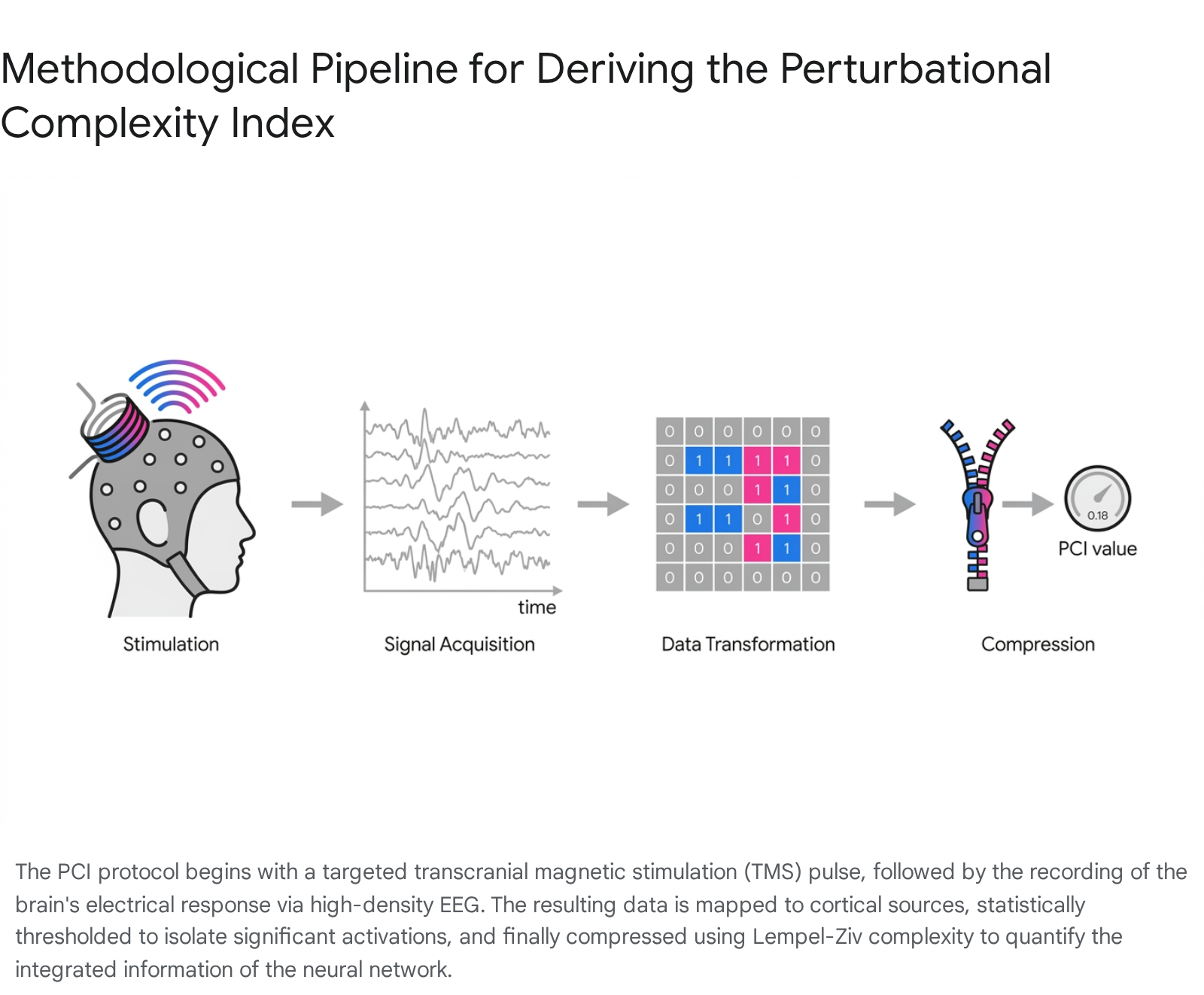
To measure this, the PCI paradigm abandons spontaneous resting-state metrics in favor of a perturbational "zap and zip" methodology. By directly stimulating the cortex and algorithmically compressing the subsequent electrocortical response, PCI objectively quantifies the brain's baseline capacity for causal neural interactions 121.
The Zap and Zip Methodology
The data acquisition phase of the PCI protocol relies on transcranial magnetic stimulation (TMS) coupled with high-density electroencephalography (hd-EEG) 22. A brief, targeted, and high-intensity TMS pulse is delivered directly to the cerebral cortex - commonly targeting premotor, motor, or parietal cortical regions - to induce a deterministic, non-invasive perturbation 2223. The target stimulation intensity is individually titrated for each subject, typically set at 120% of the resting motor threshold (rMT), often incorporating auditory noise masking to prevent sensory confounds from the audible "click" of the TMS coil 23.
Following the perturbation, the early electrocortical reaction (specifically within the first 300 to 600 milliseconds) is recorded across 64 or more EEG channels 2323.
Spatiotemporal Binarization and Source Modeling
Extensive preprocessing is required to isolate the true neural response from electrical artifacts. The raw data undergoes band-pass filtering (e.g., 0.1 to 45 Hz), downsampling, and Independent Component Analysis (ICA) for artifact rejection 3623. The cleaned scalp signals are then mapped to underlying cortical currents using sophisticated source modeling techniques, such as the 3-sphere BERG method or similar minimum-norm inverse solutions 223.
Once the cortical current density is estimated, non-parametric statistical thresholds are applied to extract the deterministic pattern of the TMS-evoked responses at the source level. The activity of each individual cortical channel is evaluated against baseline periods to isolate statistically robust spatiotemporal activations 23.
This thresholding procedure yields a binary spatiotemporal matrix, formally denoted as $S(x, t)$, where the columns represent temporal bins and the rows represent anatomical cortical sources. An element within the matrix is assigned a discrete value of 1 if the source exhibits statistically significant activation at that specific time bin, and a value of 0 if it remains at baseline 222. This binarization step is paramount, as it accurately translates continuous, analog biological voltage fluctuations into a discrete, digital representation suitable for rigorous information-theoretic analysis 22.
Lempel-Ziv Algorithmic Compression
The core calculation of PCI relies on quantifying the algorithmic complexity of the binarized matrix $S$. To achieve this, the two-dimensional matrix is "flattened" into a one-dimensional binary sequence and fed into a lossless compression algorithm, specifically the Lempel-Ziv (LZ) algorithmic complexity measure 122224.
Lempel-Ziv complexity evaluates the generation rate of novel patterns along a digital sequence 25. As the algorithm (frequently the LZ76 or LZ78 variant) parses the sequence from beginning to end, it counts the number of distinct, non-redundant substrings, denoted as $c(n)$ 2627. If a neural sequence is highly repetitive or stereotypical - such as a localized response failing to propagate, or a global response that simply oscillates uniformly - the LZ complexity will be extremely low, indicating an absence of differentiation. Conversely, a spatiotemporal response that is highly differentiated and globally integrated yields a sequence that is difficult to compress, resulting in a high LZ complexity 2528.
Mathematical Normalization and Source Entropy
For LZ complexity to serve as a standardized, universal index across different subjects, clinical conditions, and recording lengths, the raw compression value must be normalized 2629. Raw LZ complexity is intrinsically correlated with the total sequence length $n$; longer recordings naturally produce higher raw complexity counts. To resolve this, normalization accounts for the intrinsic source entropy ($H$) of the specific matrix 23.
The maximum possible complexity for a sequence of length $n$ generated from an alphabet of $b$ unique characters asymptotically approaches the upper bound of $n \cdot H / \log_b(n)$ 2627.
Therefore, the formal Perturbational Complexity Index is defined as:
$$PCI = \frac{C(S)}{N_{max}}$$
where $C(S)$ is the raw Lempel-Ziv complexity of the binarized matrix $S$, and $N_{max}$ represents the normalization constant dictating the theoretical maximum complexity for that specific matrix structure 22. If the percentage of spatiotemporal activations surviving statistical analysis is less than 1% (the maximum rate of false positives), the PCI is strictly set to 0, indicating a complete failure of cortical neurons to engage in any deterministic activation pattern 3. The resulting calculated PCI is always a positive real number ranging from 0 (minimally complex) to 1 (maximally complex) 3.
Empirical Validation and Thresholds
Extensive clinical validation across a vast array of physiological states has established highly reliable cut-offs for the Perturbational Complexity Index. The benchmark threshold reliably separating conscious states from unconscious states (including deep sleep, general anesthesia, and coma) has been empirically identified as $PCI^* = 0.31$ 23031.
- High Complexity ($PCI > 0.31$): Indicates that the perturbation triggered an integrated (spatially broad) and differentiated (algorithmically complex) cascade of network interactions, signifying the capacity for consciousness. Healthy wakeful subjects typically exhibit PCI values ranging between 0.44 and 0.67 2. Notably, REM sleep (dreaming) and ketamine-induced hallucinatory anesthesia also yield PCI values above the threshold, successfully detecting covert consciousness despite behavioral unresponsiveness 20.
- Low Complexity ($PCI \le 0.31$): Indicates a critical breakdown of causal interactions. The response is either localized (failing to integrate) or widespread but highly stereotypical (failing to differentiate). Deep NREM sleep, as well as propofol, xenon, and midazolam anesthesia, consistently push PCI below this threshold 122131.
In benchmark testing across independent cohorts of brain-injured patients, PCI correctly discriminated between Unresponsive Wakefulness Syndrome (UWS) and Minimally Conscious State (MCS) with an unprecedented sensitivity of 94.7% 32. In subsequent independent replications, it maintained a sensitivity of 92%, while also identifying a critical subset of UWS patients who possessed high-complexity PCI values, suggesting a covert capacity for consciousness not expressed in behavior 32.
To circumvent the intensive computational time and highly specialized equipment demands of traditional LZ compression, researchers have developed mathematical variants. The most notable is $PCI^{st}$ (State-Transition), a streamlined algorithm based on the dimensionality of state-transition analysis of the EEG signal rather than full source-modeled LZ compression 2233. $PCI^{st}$ computes significantly faster, does not require complex source modeling, and maintains comparable diagnostic and prognostic power 2233. Furthermore, optimal parameters for $PCI^{st}$ have been established at 5-8 Hz and 9-12 Hz frequency bands, proving robust even when down-sampled to 250 Hz 33.
| State of Subject | Behavioral Output | Phenomenal Experience | PCI Value Range | Complexity Interpretation |
|---|---|---|---|---|
| Wakeful Baseline | Present | Present | 0.44 - 0.67 | High Integration & Differentiation |
| REM Sleep (Dreaming) | Absent | Present | > 0.31 | Covert Consciousness Detected |
| Ketamine Anesthesia | Absent | Present (Hallucinatory) | > 0.31 | Covert Consciousness Detected |
| Propofol/Xenon Sedation | Absent | Absent | 0.12 - 0.30 | Loss of Network Integration |
| NREM Deep Sleep | Absent | Absent | 0.18 - 0.28 | Stereotypical/Local Responses |
| Minimally Conscious | Fluctuating | Likely Present | > 0.31 (Highly Sensitive) | Partial Network Preservation |
Global Implementation and Clinical Hubs
The transition of complexity measures from theoretical neuroscience into active clinical application has been driven by the urgent need for objective diagnostic tools. The incorporation of PCI has fundamentally altered the neuro-rehabilitative landscape, and complexity measures are now explicitly recommended in international practice guidelines to assist in the disambiguation of MCS and UWS 303234. This decentralization has resulted in the establishment of prominent research and clinical testing hubs across Asia, Australia, and South America, advancing large-scale validation and therapeutic intervention.
Australasian Research Networks
Australian institutions operate at the forefront of consciousness theory and clinical translation. Monash University in Melbourne hosts an intensive concentration of consciousness researchers. The Monash Neuroscience of Consciousness (MoNoC) laboratory, led by Naotsugu Tsuchiya, explores the boundary conditions of conscious processing by empirically testing theories like IIT in both humans and animal models (such as tracking time-complexity signals in anesthetized fruit flies) 3536. Concurrently, ARC Future Fellow Tim Bayne and Jakob Hohwy investigate the philosophical and measurement dimensions of consciousness, integrating multidisciplinary approaches to map the dimensions of brain damage and vegetative states 5737. Monash also leads translational research via Patrick Kwan's group, applying advanced EEG and machine learning to personalized neurodiagnostics 38.
Clinical trials and standardization are widely facilitated by the Clinical and Research Excellence (CARE) network, directed by Colleen Loo at UNSW Sydney. CARE aggregates data from over 50 hospitals globally to standardize neurostimulation and interventional psychiatry 39. Similarly, large trial networks like Momentum Clinical Research and computational neurogenomics labs like QIMR Berghofer build whole-brain models to understand complex psychiatric dynamics and deploy novel interventions 4041.
Clinical Advancements in Asia
In Asia, clinical applications of PCI are heavily linked with interventional neuromodulation trials aimed at actively restoring consciousness. At Zhujiang Hospital of Southern Medical University in Guangzhou, China, researchers are conducting advanced cross-over randomized controlled trials. These studies utilize Repetitive Transcranial Magnetic Stimulation (rTMS) targeted at the left dorsolateral prefrontal cortex (L-DLPFC), delivering 2,000 pulses per day at 10 Hz 6. To evaluate the efficacy of the interventions, clinical teams measure $PCI^{st}$ concurrently with resting-state EEG, demonstrating that PCI acts as a highly sensitive, objective biomarker for consciousness recovery compared to standard clinical scales 6.
In India, the National Institute of Mental Health and Neurosciences (NIMHANS) in Bangalore operates the Center for Consciousness Studies under Dr. Bindu Kutty. The center employs multi-modal brain imaging to investigate neurodynamic features spanning from complex psychiatric disorders to highly integrated meditative states across diverse traditions (e.g., Vipassana, Heartfulness) 42. Conversely, Indian epidemiological data regarding DoC remains nascent; pilot surveys in regions like Maharashtra suggest a significant clinical burden (estimated at 4 hospitalized DoC patients per million population), highlighting an urgent infrastructure need for scalable complexity diagnostic tools 43. Further east, Japanese researchers at Nagasaki University are conducting rigorous randomized controlled trials utilizing multisensory stimulation to improve clinical outcomes in acute stroke patients suffering from DoC 44.
Computational Neuroscience in South America
South America has cultivated robust computational neuroscience hubs focusing on the mathematics of complexity and functional connectivity. In Argentina, the COCUCO (Cognitive and Computational Neuroscience) Lab in Buenos Aires integrates deep learning, continuous dynamical systems, and the physics of complex systems to model ordinary and non-ordinary states of consciousness, including psychedelic interventions 45.
In Brazil, researchers at the Federal University of São Paulo and the University of São Paulo contribute extensively to the literature validating PCI and general complexity indices across anesthesia and sleep paradigms 2046. Furthermore, the Chilean scientific diaspora has produced highly influential research; Chilean-born researchers such as Andrea Luppi (based at Cambridge and Oxford) have pioneered some of the most advanced partial information decomposition techniques, mathematically mapping the synergistic global workspace across pharmacological perturbations, DoC, and psychedelic states 16474849.
Adversarial Testing of Consciousness Theories
As the clinical utility of PCI cemented its reputation, the theoretical framework that birthed it - Integrated Information Theory (IIT) - faced mounting, rigorous scrutiny. The proliferation of neurobiological theories of consciousness, which exceeded 200 distinct theories by 2024, necessitated direct, empirical comparisons to prevent the field from stalling in philosophical gridlock 5053.
In 2025, the journal Nature published the landmark results of the Cogitate Consortium. This project utilized an "adversarial collaboration" methodology - an open-science framework originally proposed by psychologist Daniel Kahneman, wherein rival theorists agree in advance on an experimental design capable of proving one theory over the other 5354. The consortium directly juxtaposed the predictions of IIT against the Global Neuronal Workspace Theory (GNWT) using a theory-neutral experimental pipeline involving 256 human subjects across 12 independent laboratories 5455.
Divergent Theoretical Predictions
The two theories put forward explicitly incompatible, pre-registered predictions regarding the neural correlates of conscious visual perception:
- Topological Location of Content: IIT predicted that conscious content decoding would be maximal in a posterior "hot zone" (parieto-occipital and sensory regions) and that the prefrontal cortex (PFC) was unnecessary. In stark contrast, GNWT predicted that consciousness necessitates global broadcasting, demanding robust and essential involvement of the PFC 545152.
- Temporal Dynamics: IIT predicted that neural activity in the posterior regions would be actively sustained for the entire duration a stimulus was consciously perceived, because the physical cause-effect structure must persist as long as the experience persists. GNWT predicted brief neural "ignitions" (activity peaks) specifically at the onset and offset of the stimulus, followed by a maintenance phase mediated by broader frontal regions 555152.
- Network Synchrony: IIT required sustained short-range synchrony within the posterior cortex. GNWT required transient long-range synchrony between distant regions, specifically between early sensory areas and the PFC 5152.
Empirical Findings and Theoretical Re-evaluations
The 2025 results were a decisive victory for open science but deeply challenging for the theories themselves, as neither framework emerged entirely victorious 53.
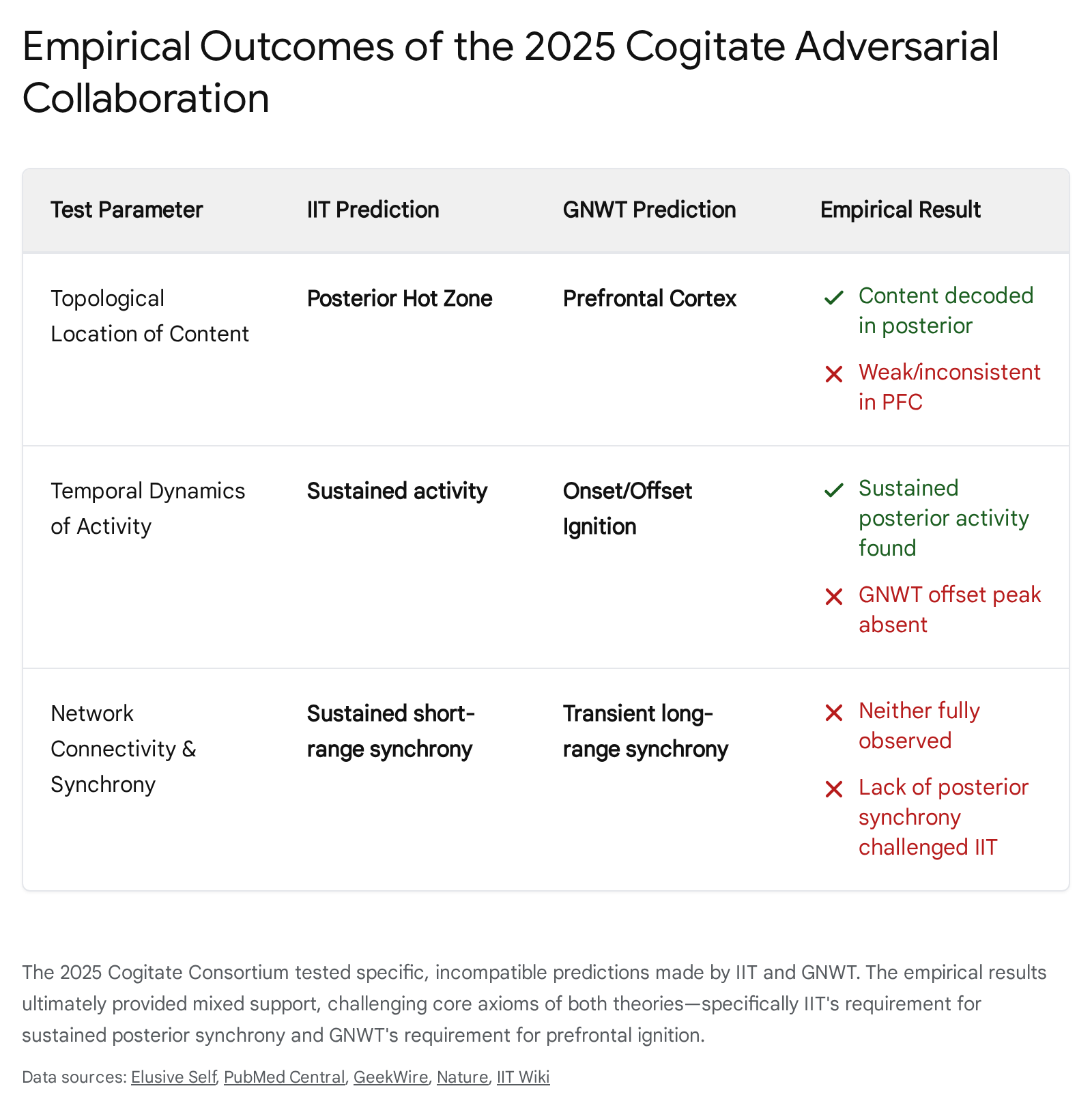
Regarding IIT, conscious content was indeed robustly decoded from posterior brain regions, and the neurophysiological responses in the occipital and lateral temporal cortex were sustained for the duration of the stimulus, aligning perfectly with IIT's first two predictions 545553. However, IIT's core mechanistic claim regarding causal relationships - which mathematically requires sustained, content-specific synchrony among the posterior regions (to fulfill the integration axiom) - was not reliably observed 5459. The absence of this synchronous functional connectivity severely undermines the physical plausibility of IIT's $\Phi$ computation 5954.
Conversely, GNWT faced equally significant failures. Decoding in the prefrontal cortex was highly inconsistent across trials, failing to provide evidence for necessary global frontal broadcasting. Furthermore, the predicted GNWT "ignition" peak at stimulus offset was entirely absent 555359. While some transient long-range synchronization between frontal and early visual areas offered mild support for GNWT, it was markedly weaker than the theory demanded 59.
Complexity Measures and the "Hard Problem"
The mixed results of the Cogitate consortium echo much deeper philosophical debates regarding the true nature of complexity measures. While PCI is an undeniably accurate clinical tool for detecting states of wakefulness, its status as a direct, explanatory metric of phenomenal consciousness is highly contested. This epistemological friction lies at the very heart of philosopher David Chalmers' formulation of the "Hard Problem of Consciousness" - the question of why and how any physical, structural, or computational process in the brain is accompanied by a subjective, inner phenomenal experience (qualia) 555657.
The Explanatory Gap and Mechanism-First Methodologies
Theories like IIT employ a "mechanism-first" methodology, attempting to mathematically deduce the phenomenology of experience directly from physical network properties 64. Operationally, PCI measures the algorithmic complexity of a deterministic perturbation. However, critics note that complexity, whether measured by Lempel-Ziv algorithms or graph-theoretic global efficiency, remains a measure of functional, dynamical, and structural organization. Explaining how a system integrates information or changes state over time belongs squarely to the domain of the "easy problems" of consciousness 5556.
The epistemological basis of complexity measures relies heavily on nomological modality (natural necessity based on the laws of physics) rather than strict logical or metaphysical necessity 64. Consequently, PCI acts as an exceptionally reliable non-causal correlate of consciousness 3264. It flawlessly tracks the brain's baseline hardware capacity to sustain complex states, but it does not conceptually bridge the explanatory gap regarding the qualitative content of those states 223258. An integrated, highly complex matrix of binarized EEG data tells a clinician that the brain is capable of generating consciousness, but it cannot logically deduce why that specific neural matrix configuration generates the subjective feeling of seeing the color red or experiencing pain.
Reductionist Responses and Transpersonal Perspectives
The recognition that neural correlates - even highly sophisticated ones like PCI - do not bridge the explanatory gap has prompted a bifurcation in consciousness research through 2025 and 2026.
On one hand, weak reductionists employ the Phenomenal Concepts Strategy (PCS), arguing that the hard problem is an illusion born of a dualism of concepts rather than a dualism of actual physical facts 55. According to this physicalist view, the integration-segregation balance is the conscious experience, merely accessed through different conceptual pathways (third-person observation vs. first-person experience) 55.
On the other hand, non-reductionist and transpersonal frameworks have gained unprecedented academic traction. Proponents argue that standard materialist approaches, which view consciousness purely as an emergent property of network complexity, stall when asked to explain how computation crosses the metaphysical threshold into subjectivity 576667. Critics of emergentism highlight that if consciousness were merely a product of integrated computation, it would logically imply that any sufficiently complex algorithmic network (including artificial neural networks or large language models) must harbor phenomenal experience 5267.
An increasingly debated perspective suggests a fundamental shift: rather than generating consciousness, the brain's complex integration and segregation networks might act as a highly evolved filter, interface, or constraint for a more fundamental, nonlocal consciousness 5057. From this perspective, PCI and the measurement of the integration-segregation balance do not solve the hard problem; instead, they successfully and mathematically map the optimal physical conditions required for the biological brain to interface with or channel the conscious state.
Synthesis of the Complexity Approach
The pursuit of understanding consciousness through the lens of brain network complexity represents a triumph of translational neuroscience and computational biology. By redefining consciousness not as a behavioral output, but as the intrinsic capacity of the brain to balance global integration with local segregation, researchers have successfully bypassed the profound limitations of sensory-motor diagnostics.
The operationalization of this balance through the Perturbational Complexity Index has delivered a robust, highly sensitive clinical biomarker that accurately discriminates conscious awareness from coma, vegetative states, and general anesthesia. This clinical utility is reflected in the rapid adoption of complexity measures by international medical guidelines and the flourishing of advanced clinical research hubs across Asia, Australia, and South America.
However, as highlighted by the adversarial collaborations of 2025, the theoretical frameworks underpinning these complexity measures remain imperfect. Empirical neuroimaging data challenges the absolute structural axioms of integrated information, suggesting that while complexity correlates exceptionally well with the presence of conscious states, it may not causally specify the exact mechanisms of phenomenal experience. Ultimately, measures of integrated and segregated brain activity provide an unparalleled, objective window into the necessary functional architecture of the mind, even as the fundamental philosophical mystery of the "hard problem" remains unresolved.