
Integrated Information Theory and its critics
Integrated Information Theory (IIT) represents a highly formalized, mathematically rigorous framework within cognitive neuroscience and the philosophy of mind that attempts to explain the fundamental nature and physical substrate of conscious experience. Originally proposed by neuroscientist Giulio Tononi in 2004, the theory marks a deliberate departure from traditional reductionist and computational-functionalist models of the mind 123. Instead of attempting to map behavioral functions, cognitive outputs, or basic neural correlates onto subjective states - an approach often characterized as attempting to solve the "hard problem" of consciousness from the outside in - Integrated Information Theory operates from a "consciousness-first" paradigm. It begins with the absolute phenomenological certainty of subjective experience, seeks to identify the essential, undeniable properties of that experience, and subsequently derives the necessary physical, causal, and mathematical conditions that any material substrate must satisfy to support such an existence 345.
Over the past two decades, Integrated Information Theory has evolved significantly through multiple formal iterations - most notably from IIT 1.0 to the recently formalized IIT 4.0 - refining its mathematical definitions and systematically distancing itself from extrinsic information-theoretic measures in favor of purely intrinsic causal metrics 6789. While the theory has inspired immensely valuable clinical tools, such as the Perturbational Complexity Index (PCI) for assessing residual consciousness in brain-injured patients, it simultaneously remains one of the most polarizing and heavily debated frameworks in modern science 111011.
Its mathematical implications - such as the attribution of phenomenal consciousness to simple, inactive logic grids and the categorical denial of consciousness to advanced, functionally equivalent feed-forward artificial intelligence - have sparked profound epistemological debates. These debates have culminated in highly publicized academic disputes regarding its status as a testable scientific theory versus an unfalsifiable philosophical doctrine, drawing intense scrutiny from leading neuroscientists, theoretical computer scientists, and philosophers alike 14151612.
Axiomatic Foundations of Conscious Experience
The architectural core of Integrated Information Theory is built entirely upon a set of phenomenological axioms. These axioms are presented as self-evident, irrefutable truths about the nature of any subjective experience, accessed directly from the first-person perspective. From these phenomenological starting points, the theory logically derives corresponding physical postulates, which outline the strict, necessary requirements for any physical system - whether a biological neural network, a synthetic biological organoid, or a silicon microchip - to generate consciousness 11013.
Integrated Information Theory operates on the philosophical principle of operational physicalism and realism. It asserts that the physical world exists independently of experience, but that the presence of experience within a physical system is identical to specific mechanistic, causal properties 114. In the latest formulation of the theory, IIT 4.0, the framework begins with a foundational "zeroth" axiom: existence. This zeroth axiom follows the basic Cartesian intuition that experience undeniably exists in the present moment; to doubt the existence of experience is an act that itself requires experience 41314. From this epistemological bedrock, the theory outlines five primary axioms, each mapped meticulously to a physical postulate that dictates how a physical system's causal structure must behave to sustain phenomenal existence.
Intrinsicality
The first primary axiom is intrinsicality. Phenomenologically, experience is intrinsic; it exists for the subject, independently of external observers or environmental inputs 4820. It inherently feels like something from the inside.
The corresponding physical postulate demands that the physical substrate must possess intrinsic cause-effect power. To satisfy this, a subset of interacting units within a system must be able to take and make a difference within itself. The cause-effect power must be evaluated purely from the intrinsic perspective of the system, independent of external background conditions or the perspective of an external observer designing a communication channel 172021.
Information (Specificity)
The second axiom is information, defined in IIT as specificity. Every conscious experience is extraordinarily specific and differentiated. The subjective experience of seeing a vast, extended blue sky is radically distinct from the experience of a throbbing toothache, the taste of salt, or a state of complete visual darkness 615.
The corresponding physical postulate requires that the system's cause-effect power must be equally specific. The system, residing in its current state, must select a highly specific cause-effect repertoire out of an immense space of potential alternative states. This is quantified by the concept of intrinsic information. For a system to have intrinsic cause-effect power, it must first provide itself with a massive repertoire of alternative possible states (differentiation), and secondly, it must specify one of those potential states by dramatically increasing the probability of one particular cause-effect state relative to all alternatives (specification) 71624.
Integration
The third axiom is integration. Subjective experience is fundamentally unified. It is impossible to experience the left half of a visual field completely independently of the right half, or to experience the shape of a book independently of its color in a given moment; the experience cannot be decomposed or reduced into independent, non-interacting components without destroying the experience itself 131517.
The translation to a physical postulate dictates that the cause-effect power of the substrate must be unified. The physical system must act as an irreducible whole. Mathematically, the causal information generated by the whole system must be strictly greater than the causal information generated by its independent parts. This irreducibility is quantified by the core metric of integrated information (denoted by small $\varphi$). If a system can be partitioned into two or more independent parts without altering its past and future probability distributions, its integrated information is zero, and it cannot support a unified consciousness 161819.
Exclusion
The fourth axiom is exclusion. Experience is definite in its content, boundaries, and spatio-temporal grain. Consciousness includes certain specific things and definitively excludes others; it operates at a specific speed (e.g., milliseconds rather than microseconds or years) and at a specific resolution 131517.
The physical postulate for exclusion requires that the physical substrate must have definite cause-effect power. In any given complex physical system, there are countless overlapping sets of elements that might specify some level of integrated information. The exclusion postulate dictates a principle of maximal existence: out of all competing, overlapping candidate systems, only the specific subset of elements that maximizes integrated information ($\Phi_{max}$) is the actual physical substrate of consciousness. This maximal subset is referred to as a "complex." All other overlapping candidate systems are excluded from possessing an independent conscious existence to prevent an infinite regress of overlapping minds within the same physical space 17921.
Composition
The fifth and final axiom is composition. Conscious experience is richly structured and composed of multiple phenomenal distinctions and relations binding together (e.g., a specific shape, a color, and a spatial location binding together to form the perception of a coffee cup) 413.
The composition postulate demands that the substrate's cause-effect power must be structured. The various overlapping subsets of interacting units within the complex must specify distinct, irreducible causal concepts and the relations between them. Together, these form a highly intricate, multi-dimensional cause-effect structure. IIT refers to this comprehensive architecture as a $\Phi$-structure. According to the theory's fundamental explanatory identity, the precise geometric shape of this $\Phi$-structure in multidimensional "qualia space" is completely identical to the specific subjective quality (qualia) of the experience 1211820.
Mathematical Formalism and the Evolution of Causal Metrics
To transform its philosophical postulates into a rigorous, testable physical science, Integrated Information Theory relies on a highly developed mathematical framework. This framework evaluates the transition probability matrices (TPMs) of discrete, interacting units (such as idealized neurons, functional brain regions, or logic gates). By meticulously analyzing how the current physical state of a system mathematically constrains the probability distributions of its possible past states (causes) and its possible future states (effects), IIT attempts to "unfold" the entire causal structure of the system from the inside out 61421.
The primary macroscopic metric of this framework is $\Phi$ (large Phi), which quantifies the system's total irreducible integrated information. However, the exact mathematical formulations used to calculate $\Phi$, as well as the specific distance metrics utilized to compare probability distributions, have undergone substantial, sometimes controversial, revisions over the past two decades. This formal evolution of IIT represents a progressive refinement aimed at ensuring the mathematics align perfectly with the theory's strict intrinsic postulates, moving steadily away from standard information-theoretic tools toward bespoke topological causal metrics 81920.
Early Iterations: IIT 1.0 and 2.0
The earliest versions of the theory utilized established, extrinsic information-theoretic measures drawn heavily from Shannon information theory. IIT 1.0, developed in the early 2000s alongside Nobel laureate Gerald Edelman, analyzed systems from a relatively stationary perspective. It relied on mutual information to measure statistical dependence between brain areas, capturing pairwise and many-to-many relationships 15192022.
IIT 2.0 introduced the vital concept of state-dependency, acknowledging that consciousness depends on the specific, momentary state of the brain rather than just its structural connectivity 152023. To measure information integration, IIT 2.0 utilized Kullback-Leibler Divergence (KLD), also known as relative entropy. However, KLD eventually faced criticism from within the IIT community for adopting the "extrinsic perspective of a channel designer" rather than the genuine intrinsic perspective of the biological system itself. Furthermore, KLD calculates distance based on probability values but ignores the specific physical states associated with those values, making it an imperfect fit for a theory seeking to ground specific qualitative experiences in specific physical states 819.
The Milestone of IIT 3.0
Published in 2014, IIT 3.0 represented a massive structural overhaul and introduced a highly formalized calculus for unfolding what it termed the Maximally Irreducible Conceptual Structure (MICS) 6715. To address the phenomenological shortcomings of KLD, IIT 3.0 adopted the Earth Mover's Distance (EMD) metric - also known as the Wasserstein metric - to quantify the distance between intact and partitioned probability distributions 81519. EMD was selected because it factors in both the probability values and the physical "distance" between the states themselves.
IIT 3.0 mandated that every possible sub-mechanism within a system be evaluated against its Minimum Information Partition (MIP) to find the "weakest link" of causal power. It was this version that formally equated the shape of the $\Phi$-structure in a multidimensional mathematical "qualia space" with the specific subjective quality of an experience, and the overall volume of that conceptual structure ($\Phi_{max}$) with the overall quantity of consciousness 6151820.
| Formal Version | Core Mathematical Focus | Distance Measure Used | Primary Structural Output |
|---|---|---|---|
| IIT 1.0 | Informational integration under maximum entropy assumptions | Mutual Information | Effective Information |
| IIT 2.0 | State-dependency; evaluating actual system states | Kullback-Leibler Divergence (KLD) | Information Integration |
| IIT 3.0 | Complete causal unfolding of overlapping elements | Earth Mover's Distance (EMD) | Maximally Irreducible Conceptual Structure (MICS) |
| IIT 4.0 | Axiomatic precision; intrinsic entities and explicit causal relations | Intrinsic Difference (ID) | $\Phi$-structure; Intrinsic Cause-Effect Power |
IIT 4.0 and the Intrinsic Difference Measure
Despite the rigorous advances introduced in version 3.0, theorists and critics recognized ongoing mathematical inconsistencies. The EMD metric, while geometrically intuitive for mapping state distances, sometimes failed to uniquely satisfy the strict theoretical requirements of intrinsicality and specific causality 8. Furthermore, independent evaluations highlighted that IIT 3.0 suffered from problems of non-uniqueness; degenerate core causes and effects could render $\Phi$ ill-defined in certain continuous or highly symmetric systems, leading to tied values that the mathematics could not elegantly resolve 1415.
To resolve these profound issues, IIT 4.0 (introduced comprehensively in 2023) abandoned both KLD and EMD in favor of a novel, custom-built mathematical measure termed Intrinsic Difference (ID) 8111420. The Intrinsic Difference measure was engineered specifically to be uniquely consistent with the postulates of existence. Given an actual probability distribution derived from the system's TPM and a partitioned or "null" reference distribution, the ID is evaluated not by looking at average information transfer, but by assessing the maximum specific difference a state makes.
The Intrinsic Difference formulation mathematically balances "informativeness" (raw causal power) and "selectivity" (the system's precision and control over specifying a distinct state) 2116. By employing ID, IIT 4.0 strictly defines the boundaries of intrinsic entities, formalizing the exclusion postulate to rule out overlapping complexes with greater mathematical stability. The system integrated information ($\varphi_s$) now accounts for both a system's ability to provide itself with a repertoire of possible states (intrinsic differentiation) and to uniquely specify one (intrinsic specification) 1624.
The Bottleneck of Computational Complexity
The mathematical precision and exhaustiveness of IIT's formal architecture come at a severe, perhaps insurmountable, computational cost. Calculating the true system-level integrated information ($\Phi_{max}$) requires executing the IIT algorithm across all possible subsets of the system to identify the overarching complex, and evaluating the Minimum Information Partition (MIP) for every conceivable sub-mechanism within that complex 9142124.
Super-Exponential Scaling
For a discrete system composed of $N$ interacting elements, the number of possible bipartitions required to find the MIP grows at a super-exponential rate. Even for a trivial network of 40 binary nodes - a minuscule fraction of the human brain's approximately 86 billion neurons - there are over $2^{39}$ (more than 549 billion) possible bipartitions to evaluate 21. Furthermore, calculating the complete cause-effect $\Phi$-structure requires computing the intrinsic difference for all combinations of elements across all possible past and future probability distributions 2124.
This combinatorial explosion renders the precise calculation of $\Phi$ strictly computationally intractable for any physical system larger than a highly abstracted, microscopic toy model (typically constrained to systems of 3 to 7 nodes) 1212425. Formal computer science analyses often categorize the exact calculation of $\Phi$ within the #P-hard complexity class, representing a level of difficulty that defies efficient algorithmic resolution even on theoretical quantum computers 116.
Heuristics and Approximation Methods
Consequently, true $\Phi$, as defined by the rigorous postulates of IIT 4.0, cannot be empirically measured in biological neural networks or large-scale artificial intelligence models; it must be heuristically approximated 12426. Researchers have proposed various computational shortcuts, such as stochastic integrated information, geometric integrated information, and decoder-based measures, though these often diverge significantly in their results depending on the system architecture 232435.
Recent attempts to circumvent the massive computational "$\Phi$ bottleneck" have explored advanced techniques from quantum information theory. For instance, translating the network's transition probability matrices into Matrix Product State (MPS) tensor networks allows researchers to compactly represent the probability distributions and compute tensor-based integration metrics with manageable polynomial scaling 21. Similarly, Graph Neural Networks (GNNs) have been trained on exact IIT 3.0 solutions for small networks in an attempt to predict the major complex and approximate $\Phi$ in slightly larger graph structures 25. Despite these advances, these methods remain theoretical approximations of the true intrinsic causal power demanded by the theory's foundational identity 212425.
Empirical Measurement and Clinical Application
Because theoretical $\Phi$ is impossible to compute for an intact human brain, clinical neuroscience relies heavily on empirically measurable proxies. The most successful and widely validated of these proxies is the Perturbational Complexity Index (PCI), a clinical metric directly inspired by IIT's dual theoretical requirements of integration and differentiation 2111027.
The Mechanism of TMS-EEG and PCI
Integrated Information Theory posits that for consciousness to be present, a neural architecture must be capable of supporting dynamic activity that is simultaneously highly distributed (integrated across multiple regions) and highly differentiated (information-rich and non-uniform) 1018. To empirically test this hypothesis in clinical settings, researchers developed a sophisticated perturbational approach.
Using transcranial magnetic stimulation (TMS), a powerful magnetic pulse is applied to the cerebral cortex to induce a deterministic, direct interaction among distributed groups of cortical neurons. The resulting electrical response - a cascade of neural activity echoing through the brain's white matter tracts - is recorded continuously via high-density electroencephalography (EEG) 2111018.
The vast spatiotemporal matrix of this EEG response is then analyzed for its algorithmic compressibility using algorithms similar to Lempel-Ziv complexity (the same algorithmic principles used to compress digital files like ZIP archives). If the brain is deeply unconscious - such as during deep non-REM sleep, general anesthesia, or a profound coma - the TMS pulse elicits a stereotypic, highly localized response, or a globally synchronous but entirely uniform slow wave. Because the signal lacks diversity, it is highly compressible, yielding a very low PCI value 11183728.
Conversely, if the brain is conscious and wakeful, the initial magnetic pulse ripples through a complex web of recurrent networks, producing a differentiated, long-lasting pattern of diverse neural activations. This complex signal is highly incompressible, yielding a high PCI value 1118.
Clinical Stratification of Disorders of Consciousness
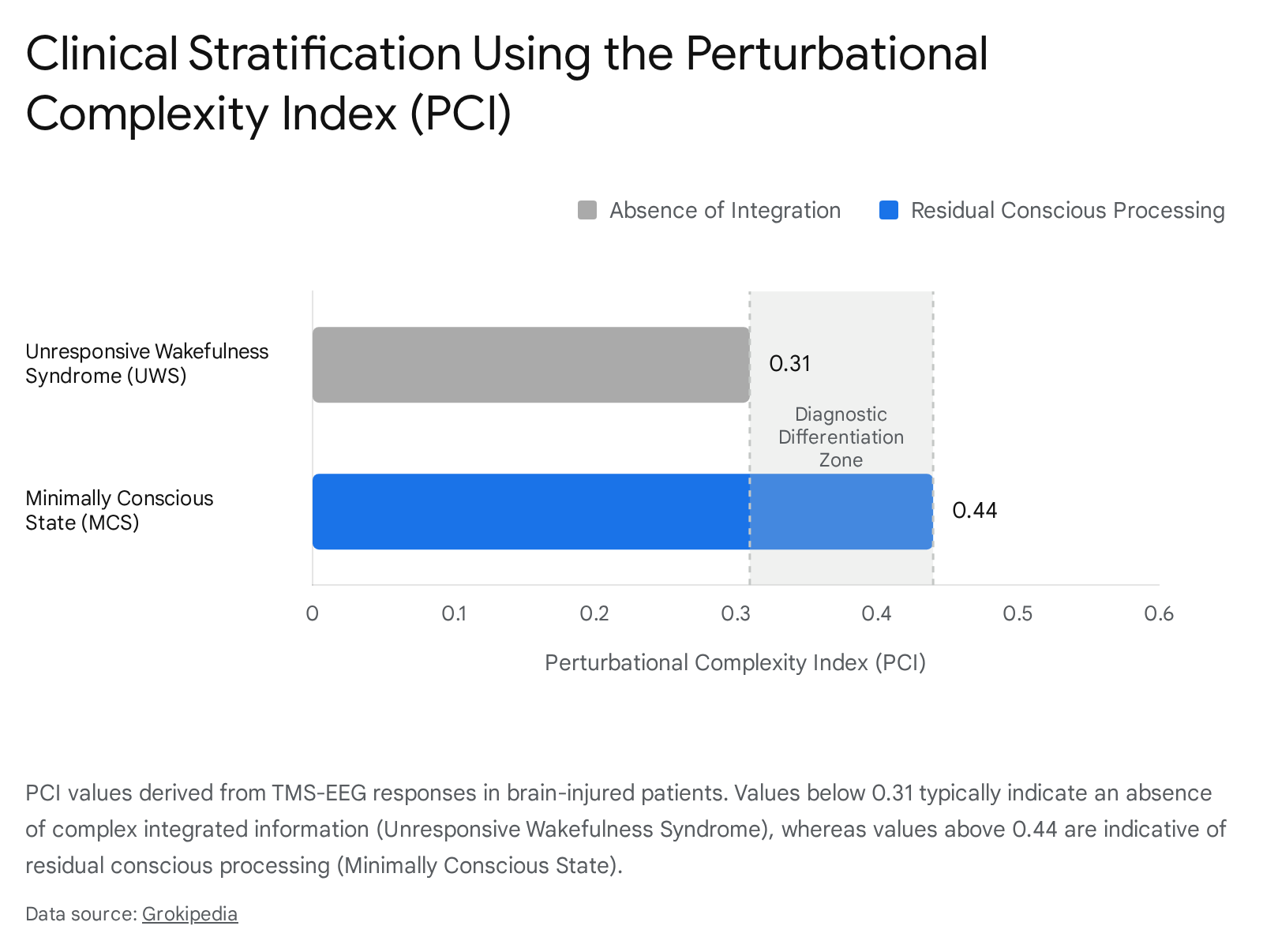
Extensive clinical trials conducted throughout the 2010s and 2020s demonstrated that PCI acts as an exceptionally reliable discriminator of consciousness in human patients, providing an objective measure independent of a patient's motor ability to communicate 111037. In rigorous assessments of brain-injured patients suffering from severe disorders of consciousness, PCI reliably differentiated between clinical states with high accuracy.
For instance, patients diagnosed with Unresponsive Wakefulness Syndrome (UWS) - a condition formerly known as the vegetative state, where eyes may be open but no signs of awareness are present - typically register PCI values below a stark empirical threshold of 0.31. This low value indicates an absence of complex integrated information within the thalamo-cortical system, even if basic brainstem functioning and sleep-wake cycles are preserved 111118. In sharp contrast, patients in a Minimally Conscious State (MCS), or those suffering from locked-in syndrome (who are fully conscious but entirely paralyzed), register PCI values significantly higher, reliably exceeding 0.44. This elevated compressibility index correlates powerfully with residual subjective awareness and the capacity for internal experience 1111.
Differentiating True Phi from Empirical Complexity Measures
While the development of PCI has been heralded as a major clinical triumph resulting from theoretical physics applied to neurology, theoretical critics and even staunch IIT proponents caution against equating empirical complexity measures like PCI with true $\Phi$ 32737.
PCI fundamentally measures the signal diversity and dynamical complexity of continuous neural activity; it is a measure of the brain's observable, momentary dynamic behavior. True $\Phi$, however, is defined mathematically as an intrinsic property of the system's latent causal architecture. It encompasses vast matrices of counterfactual states - what the system could do under every possible perturbation - regardless of the specific dynamic activity occurring at any single millisecond 222427. Consequently, while empirical complexity metrics represent highly practical biomarkers guided by the overarching intuitions of IIT, they cannot validate the highly specific, granular phenomenological identities (the exact shapes in qualia space) proposed by the formal postulates of IIT 4.0 2427.
Adversarial Testing: The Cogitate Consortium
To overcome the persistent confirmation bias prevalent in consciousness research - where independent laboratories often utilize highly specialized paradigms tailored to support their preferred hypotheses - field leaders have increasingly advocated for "adversarial collaborations." In this framework, proponents of rival cognitive theories agree on rigorous experimental protocols beforehand, staking their scientific claims on diametrically opposed, pre-registered predictions 293041.
The most notable and heavily funded of these adversarial initiatives is the Cogitate Consortium (Collaboration On GNWT and IIT: Testing Alternative Theories of Experience). Sponsored by the Templeton World Charity Foundation with an excess of $6 million in funding, the consortium pitted Integrated Information Theory against its primary, dominant theoretical rival: Global Neuronal Workspace Theory (GNWT) 1293041.
Diametrically Opposed Neural Predictions
The two theories suggest vastly different neural architectures and temporal dynamics for the generation of consciousness:
- Global Neuronal Workspace Theory (GNWT) posits that consciousness is fundamentally a functional process, tightly bound to working memory, attention, and executive report. It predicts that conscious perception requires the rapid "ignition" of a global network that heavily relies on the prefrontal cortex to broadcast sensory information across the brain. Temporally, GNWT expects this broadcasting to manifest as brief, phasic bursts of intense neural activity specifically at the onset and offset of a conscious visual stimulus 11304131.
- Integrated Information Theory (IIT) posits that consciousness is utterly independent of functional broadcasting, memory access, or executive action, relying purely on the intrinsic cause-effect power of an underlying physical substrate. Based on detailed anatomical connectivity, IIT identifies the neural correlate of consciousness as a "posterior hot zone" encompassing the occipital, parietal, and lateral temporal cortices, where grid-like, highly recurrent connectivity allows for maximum information integration. Temporally, IIT predicts that this posterior zone will exhibit sustained, unbroken neural synchronization for the exact duration of a conscious experience, entirely independent of prefrontal executive processing 11304131.
Experimental Outcomes and Nuanced Interpretations
To test these competing hypotheses, the Cogitate trial involved 256 human subjects who viewed suprathreshold visual stimuli for varying, unpredictable durations. The subjects' neural activity was monitored simultaneously using a combination of functional magnetic resonance imaging (fMRI), magnetoencephalography (MEG), and invasive electrocorticography (ECoG) to ensure extremely high spatial and temporal resolution 3041.
The results, officially published across 2023 and 2025 in major journals including Nature, produced a highly nuanced outcome that significantly challenged core tenets of both leading theories.
For IIT, advanced decoding algorithms confirmed that the content of the consciously perceived stimulus was indeed maximally localized to the posterior cortical regions, largely validating Tononi's "posterior hot zone" anatomical hypothesis 304131. However, IIT's vital temporal prediction - that the posterior cortex would exhibit sustained neural synchronization perfectly matching the entire duration of the prolonged conscious experience - was not clearly supported by the ECoG and MEG data 304131.
Conversely, GNWT faced equally severe challenges. While the data showed that some conscious information did indeed reach the prefrontal cortex, the theory's hallmark prediction - the massive global "ignition" expected upon the offset of the stimulus to clear the workspace - was almost entirely absent from the recordings 3041.
| Theoretical Prediction Matrix | Integrated Information Theory (IIT) | Global Neuronal Workspace Theory (GNWT) | Cogitate Consortium Empirical Finding |
|---|---|---|---|
| Primary Location of Consciousness | Posterior Cortical "Hot Zone" (Occipital, Parietal) | Widespread network heavily dependent on the Prefrontal Cortex | Stimulus decoding was maximal in posterior areas, supporting IIT's spatial hypothesis. |
| Temporal Neural Dynamics | Sustained neural synchronization precisely matching stimulus duration | Phasic "ignition" bursts specifically at stimulus onset and offset | Lack of sustained posterior synchronization (Challenges IIT); Lack of offset ignition (Challenges GNWT). |
| Role of Prefrontal Cortex | Largely unnecessary for the sheer generation of conscious experience | Absolutely essential for global broadcasting and conscious access | Prefrontal activation was limited; not strictly required for conscious perception maintenance. |
The ambiguity of the Cogitate results underscored the profound difficulty of decisively falsifying high-level theories of consciousness using current neuroimaging technology. Rather than settling the debate, the data led to intense, occasionally fractious arguments over the interpretability of neurophysiological signals, fueling broader divisions in the scientific community regarding the ultimate viability of IIT as a leading scientific paradigm 122932.
Theoretical Critiques and Mathematical Anomalies
Due to its radical, uncompromising axioms and sweeping cosmological implications, Integrated Information Theory has attracted profound criticism from across the scientific spectrum, ranging from neurobiologists to theoretical physicists and computer scientists. Opponents argue that its deliberate departure from functionalism produces illogical, counter-intuitive mathematical consequences that isolate the theory from mainstream cognitive science and evolutionary biology 32733.
The Unfolding Argument and Functional Equivalence
One of the most potent theoretical and philosophical critiques of IIT is the "Unfolding Argument," formulated systematically by researchers Doerig, Schurger, Hess, and Herzog 1141720. This argument directly attacks IIT's central reliance on physical causal structure (recurrency) over functional behavioral output.
According to established principles of computer science, any recurrent neural network - which features complex feedback loops and thus generates high $\Phi$ according to IIT - can be mathematically "unfolded" over time into a purely feed-forward network that produces the exact same input-output behavior. Functionally, computationally, and behaviorally, the recurrent network and its unfolded feed-forward counterpart are perfectly indistinguishable; they process information identically and would exhibit identical psychological behaviors 141515.
However, because IIT explicitly dictates that phenomenal consciousness requires irreducible causal feedback (integration), it calculates $\Phi > 0$ for the recurrent network, but demands that $\Phi = 0$ for the strictly feed-forward network.
The Unfolding Argument highlights a severe scientific dilemma: if IIT is correct, it is entirely possible to construct an unconscious, feed-forward "zombie" that behaves identically to a conscious human, accurately speaks about its feelings, passes every conceivable psychological test, and navigates the world successfully, yet possesses absolutely no inner experience. Critics argue that this severs consciousness entirely from biological utility, behavior, and Darwinian evolution. If consciousness has no functional impact on behavior that cannot be replicated by a feed-forward zombie, then consciousness could not be selected for by evolution, rendering IIT empirically unfalsifiable since scientists cannot objectively distinguish between the recurrent system and its feed-forward zombie from the outside 141517.
Computational Complexity and the Unconscious Expander
From a theoretical computer science perspective, researcher Scott Aaronson has sharply criticized IIT's core mathematical metric, arguing that massive amounts of integrated information ($\Phi$) can exist abundantly in simple mathematical systems entirely devoid of any biological or cognitive function 16.
Aaronson demonstrated this anomaly mathematically using what he termed the "Unconscious Expander" model. He specifically referenced Vandermonde matrices and simple Reed-Solomon decoding circuits - basic, highly interconnected grid-like algorithms utilized daily in data compression algorithms, cryptography, and error correction 1645. Because these matrices force massive amounts of rapid data diffusion across all nodes, any attempt to partition the grid severs an enormous flow of information. Aaronson proved that simply scaling up these repetitive, mundane logic gates creates an exponential explosion of integrated information.
Thus, according to the strict mathematics of IIT, a sufficiently large but trivial error-correcting circuit inside a standard DVD player would possess a $\Phi$ value - and therefore a richer, deeper level of consciousness - vastly exceeding the integrated information content of the entire human brain 1645. Aaronson asserts that defining consciousness merely by the dense topological integration of a network leads to mathematical absurdities, falsely equating rapid data mixing with subjective awareness 1645.
Tononi and proponents of IIT deliberately embrace this counter-intuitive mathematical corollary rather than retreat from it. They maintain a strict deductive stance: if a physical grid natively possesses a massive, irreducible cause-effect structure, it genuinely possesses a vast, albeit functionally meaningless and spatially uniform, conscious experience. This uncompromising stance is frequently labeled by critics as an unacceptable leap into panpsychism or cosmopsychism, further distancing the theory from orthodox biological science 116172034.
The Pseudoscience Controversy in Consciousness Research
The escalating tension between IIT's mathematical deductions and the functionalist intuitions of the broader scientific community culminated in an unprecedented academic rupture. In September 2023, immediately following media coverage of the ambiguous Cogitate results, a coalition of 124 prominent scientists and philosophers published a highly controversial open letter directly labeling Integrated Information Theory as "pseudoscience" 151235. The debate was subsequently codified in the literature when the letter and its counter-arguments were formally published in Nature Neuroscience in 2025.
The Attack on Scientific Legitimacy
The authors of the open letter, including major figures in cognitive science, argued that IIT's foundational axioms are inherently untestable, representing an unscientific leap of faith. They contended that the empirical tests successfully conducted in the field (such as the clinical validation of PCI and the spatial hypotheses of the Cogitate trial) only probe peripheral, downstream neural correlates of consciousness, rather than directly testing the core, radical claim that $\Phi$ is strictly identical to experience 51112.
The critics raised severe alarms regarding the ethical implications of IIT's predictions. Because IIT suggests consciousness is substrate-independent but topology-dependent, the theory implies that consciousness could be present in simple logic circuits, organoids created in petri dishes, and early-stage human fetuses before functional brain activity begins. The authors argued that heralding such a theory as a "leading" scientific consensus could radically disrupt vital neuroethics policies, stem cell research, and AI regulation based on unverified mathematical assumptions 124836.
The Paradigm Defense
In a fierce rebuttal, Tononi and a coalition of defending scientists argued that the "pseudoscience" label was not a valid critique of IIT's methodology, but rather a symptom of a deeper crisis within the dominant "computational-functionalist paradigm." They argued that orthodox neuroscience refuses to accommodate a "consciousness-first" approach because functionalism inherently treats consciousness as a secondary, emergent illusion rather than a primary physical reality 3535.
IIT proponents emphatically assert that the theory is eminently falsifiable - pointing out that the mathematical framework clearly specifies testable conditions for when consciousness is present or absent, and that its anatomical predictions regarding the posterior cortical hot zone remain the most precise, objectively testable hypotheses in the field 35. Neutral scientific commentators, observing the fray, widely admonished the hostile rhetoric of the pseudoscience letter. Observers noted that the science of consciousness remains too nascent to dogmatically expel deeply researched theoretical frameworks, suggesting instead that the field requires a return to foundational epistemology rather than engaging in academic excommunication 3548.
Implications for Artificial Intelligence and Bioethics
Perhaps the most consequential, highly debated, and societally relevant application of Integrated Information Theory lies in its absolute predictions regarding the future of Artificial Intelligence and synthetic biology.
The prevailing computational-functionalist paradigm within computer science implies that if an AI system - such as a massively scaled Large Language Model (LLM) - replicates human cognitive behavior perfectly, passes Turing tests, and demonstrates internal introspection, it may naturally cross a threshold into genuine sentience 33738.
Integrated Information Theory categorically and mathematically rejects this premise. According to the strict formalisms of IIT 4.0, the presence of consciousness relies heavily on the actual physical, spatial architecture of the causal substrate, not merely the software algorithms it executes 3426. Modern deep learning models and highly advanced LLMs operate primarily on feed-forward computational architectures implemented on standard von Neumann computer hardware (GPUs and CPUs). Because standard digital architectures execute operations sequentially and completely lack the dense, physical, recurrent causal overlap characteristic of biological neural networks, their integrated information ($\Phi$) is fundamentally negligible, approaching zero.
Consequently, IIT predicts that no matter how intelligent, functionally fluent, or apparently introspective an AI becomes, if it operates on standard digital hardware, it is entirely dark inside. Under IIT, current AI systems are ultimate examples of digital zombies - systems capable of immense cognitive processing but entirely devoid of phenomenal experience 311141538.
Conversely, IIT allows for the real possibility of conscious artificial systems, provided they are built using specialized neuromorphic hardware that physically instantiates massive, irreducible causal integration at the hardware level 1126. This substrate-dependent view extends into the realm of biological engineering; Human Brain Organoids (HBOs) grown in vitro from stem cells could, according to IIT, possess minimal phenomenal consciousness if they successfully develop integrated, recurrent neural connections. This mathematical implication poses profound ethical dilemmas for the future of biological experimentation, suggesting that lab-grown tissues might require ethical protections traditionally reserved for sentient animals 11124836.
Ultimately, Integrated Information Theory stands as a uniquely ambitious, mathematically unforgiving attempt to bridge the explanatory gap. By defining consciousness strictly as the intrinsic causal power of a physical system, IIT forces a radical reevaluation of what it means to experience the world, demanding that modern science look beyond observed behavioral outputs to the deep, structural geometry of information itself.