
Is Jobs-to-Be-Done or Personas Better for Product Teams
The debate over whether product teams should use the Jobs-to-be-Done framework or customer personas presents a false choice, as neither framework is universally superior on its own. The Jobs-to-be-Done framework is a decision-making tool that reveals the root causes of customer behavior, making it highly effective for feature prioritization and innovation. Conversely, personas act as communication tools that illustrate target audiences, providing the contextual framing necessary for marketing, sales, and user experience design.
The Great Product Management Debate
Spend enough time in product management circles, and a familiar refrain inevitably emerges: traditional customer personas are dead, and the Jobs-to-be-Done framework is the only valid path to product-market fit. This shift in sentiment stems from a genuine frustration with how consumer research has historically been applied in corporate environments. For years, teams relied heavily on demographic-heavy buyer personas that offered fictional backstories but failed to provide actionable direction for engineers, designers, and marketers. As a result, the Jobs-to-be-Done framework gained immense popularity as a seemingly superior, evidence-based alternative that could cut through the noise and deliver predictable revenue growth.
However, positioning these two methodologies as adversaries fundamentally misunderstands their distinct functions. Arguing between personas and the Jobs-to-be-Done framework is akin to debating whether a map or a compass is more useful when navigating a dense forest. Personas represent the map, detailing the terrain, constraints, and reality of the customer. The Jobs-to-be-Done framework represents the compass, indicating the exact direction of progress the customer is desperate to make. To build a product that people actually want to buy, and to market it in a way that they actually hear, modern product teams absolutely need both.
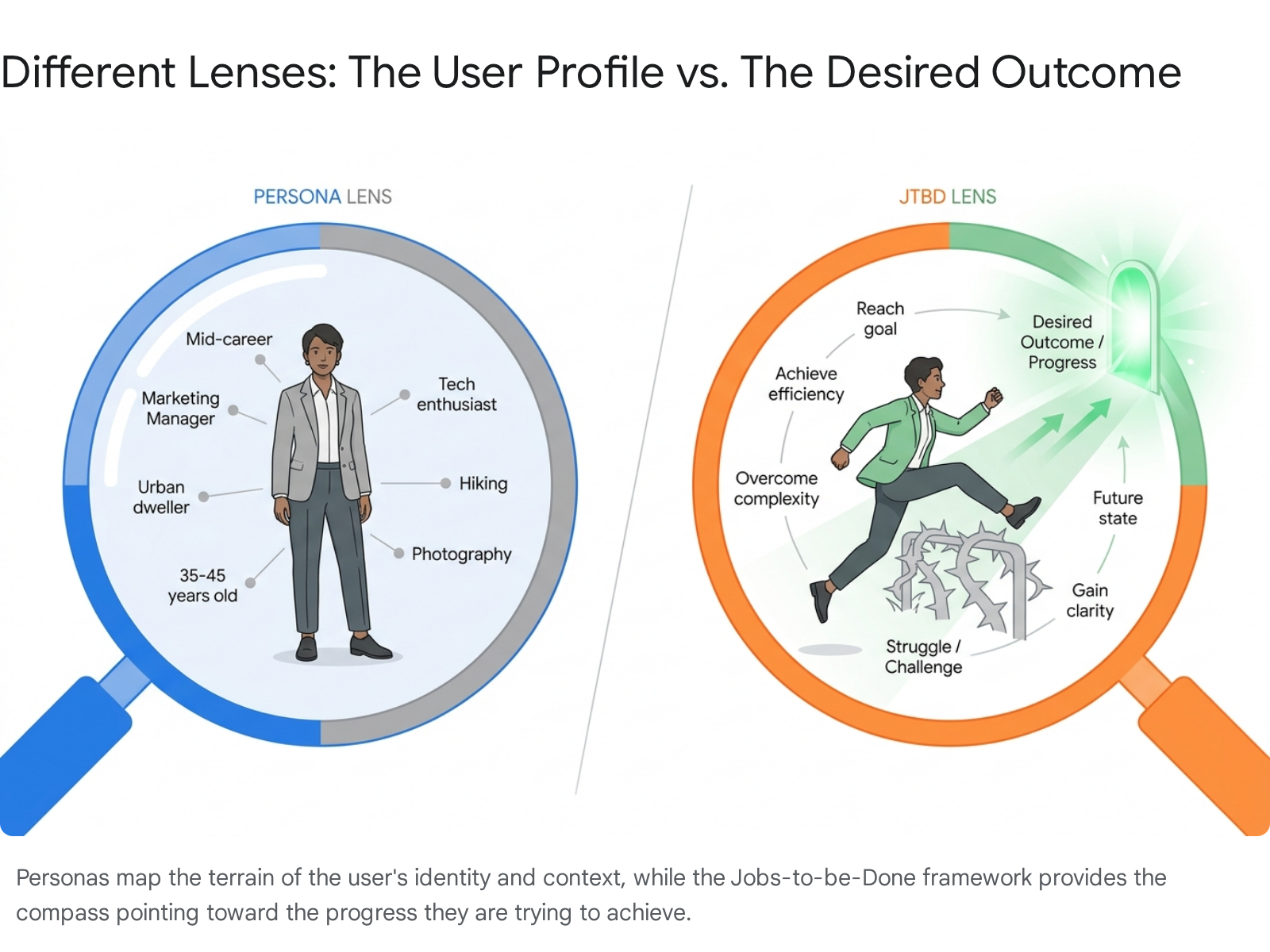
Understanding how to effectively leverage both tools requires a deep dive into what each framework actually measures, where they traditionally fail, and how modern product organizations synthesize them to build highly successful software ecosystems.
Decoding the Jobs-to-be-Done Framework
The core premise of the Jobs-to-be-Done (JTBD) framework is elegantly straightforward: people do not simply buy products; they "hire" them to make progress in a specific situation. When a product successfully completes the desired job, the customer will eagerly hire it again in the future. Conversely, if it fails to deliver the expected outcome, the customer will fire it and look for an alternative. This theoretical construct reframes consumer decision-making through the lens of circumstantial motivation rather than static identity.
The framework traces its philosophical roots to the late 20th century, heavily influenced by Theodore Levitt's famous marketing adage that consumers do not want to buy a quarter-inch drill; they want a quarter-inch hole. This concept was rigorously formalized by Harvard Business School Professor Clayton Christensen during his exploration of disruptive innovation, where he shifted the focus of product development away from feature sets and toward the underlying reasons behind consumer choices. Key contributors like Tony Ulwick further refined the framework into actionable methodologies, such as Outcome-Driven Innovation, which directly ties JTBD to corporate innovation strategies by quantifying desired outcomes. Meanwhile, practitioners like Bob Moesta expanded its application into product design, emphasizing the psychological forces that drive a consumer to switch from one solution to another.
The Shift from Correlation to Causality
Traditional market research often relies on correlation. Analysts might note that a specific demographic, such as urban professionals aged twenty-five to thirty-four, frequently purchases a specific software tool. The JTBD framework, however, argues that correlation does not equal causation. It posits that situational struggles drive consumer purchases far more than static demographic traits ever could.
A foundational example often cited in the literature involves a fast-food chain attempting to increase milkshake sales. After running traditional demographic focus groups and taste tests to make the milkshakes thicker, thinner, or sweeter, the company found that nothing moved the needle on sales. Researchers subsequently abandoned demographics and instead observed exactly when and why the shakes were being purchased. They discovered a massive, unexpected spike in early morning sales to solitary commuters. These customers were not buying a milkshake because of their age, gender, or income bracket; they were hiring the milkshake to do a highly specific job. They needed a neat, single-handed breakfast that would keep them full until noon and give them something to do during a long, boring drive to work. In this specific situational context, the milkshake's true competitors were not other milkshakes. The true competitors were bananas, bagels, and Snickers bars. By understanding the causal mechanism of the purchase, the chain could optimize the milkshake specifically for the morning commute, vastly increasing sales.
The Three Dimensions of a Job
Consumer jobs are rarely purely functional. A comprehensive JTBD analysis evaluates three distinct, overlapping dimensions of the customer's need. The functional dimension encompasses the practical, objective task the customer is trying to complete, such as cutting a piece of wood, analyzing a spreadsheet, or tracking inventory. The emotional dimension involves how the customer wants to feel, or conversely, what negative feelings they desperately want to avoid while executing the task. This could include feeling secure, avoiding the frustration of complex interfaces, or feeling technologically advanced. Finally, the social dimension reflects how the customer wants to be perceived by their peers, managers, or society at large. Buying a luxury smartphone, for instance, is rarely just about making calls; it is heavily influenced by the social job of gaining status or appearing culturally relevant.
The Four Forces of Progress
When a customer considers switching from their old, familiar solution to a new product, the JTBD framework identifies four distinct psychological forces at play. Purchases only occur when the promoting forces of change mathematically outweigh the blocking forces of the status quo.
The first promoting force is the "push" of the current situation. This represents the pain points, struggles, and frustrations the customer experiences with their existing solution. The second promoting force is the "pull" of the new solution, representing the magnetic appeal, promised benefits, and improved outcomes offered by the new product. Arrayed against these are the blocking forces. The first blocking force is the anxiety of the new. This encompasses the psychological friction, the fear of the unknown, and the perceived switching costs associated with adopting a new product. The final blocking force is the habit of the present. This represents the powerful inertia of existing behaviors, established workflows, and the comfortable familiarity that keeps the customer tied to their current way of doing things, even if that way is objectively flawed.
By focusing intensely on these forces rather than the user's identity, JTBD allows product teams to define clear, outcome-based success metrics, strip away unnecessary vanity features, and uncover non-obvious, asymmetric competitors.
The Enduring Map: Why Personas Survive
Given the immense strategic power of the Jobs-to-be-Done framework, it is tempting to ask why customer personas continue to exist in modern product management. The answer lies in the fundamental difference between building a functional product and building a sustainable business.
A persona is a research-based archetype that represents a cluster of users with shared behaviors, needs, and goals. While JTBD excels at explaining why a purchase happens, it is intentionally abstract and solution-agnostic. It strips away the human element to focus purely on the mechanics of the struggle. Personas reintroduce the vital human context necessary for a company to actually reach, speak to, and serve that buyer in a crowded marketplace.
The "Jessica, 35" Problem
The intense backlash against personas in recent years is largely a backlash against poorly constructed, superficial ones. In many organizations, marketing and product teams burn weeks crafting elaborate persona slide decks that package untested assumptions as profound insights. A standard, deeply flawed persona might read: "Jessica, 35, urban professional, tech-savvy. She drinks oat milk lattes and enjoys weekend hiking."
Software engineers and product managers routinely reject these documents, and for good reason. They offer incredibly low-signal data. Knowing a user's fictional first name, favorite coffee order, or weekend hobbies provides zero actionable guidance on how to architect a backend database, prioritize an onboarding user flow, or reduce latency in a critical feature. These details create an illusion of intimacy without adding any decision-relevant information to the product development cycle. Consequently, these persona documents often gather dust in shared corporate drives while product decisions default back to executive intuition or roadmap inertia.
Humanizing the User: Empathy and Alignment
However, abandoning personas entirely based on poor implementations is a strategic error. According to research from the Nielsen Norman Group, well-executed personas do not rely on superficial demographics. High-quality personas are built on rich behavioral characteristics, attitudinal data, and deep insights about the user's mental models.
When engineered correctly, personas provide massive value by humanizing the user. They allow diverse, cross-functional teams - spanning engineering, user interface design, marketing, and customer support - to share a common mental model and a unified language when discussing the audience. Personas help teams balance competing priorities and evaluate design decisions through a highly empathetic human lens. A team that deeply understands the constraints and digital literacy of their specific user archetype is far less likely to build an overly complex interface that alienates their core market.
Bridging the Gap to Go-to-Market Strategy
Furthermore, personas are absolutely critical for go-to-market execution. While the JTBD framework perfectly explains the internal trigger for a purchase, the entire global advertising ecosystem - from social media networks to enterprise media buying - operates almost exclusively on demographics, firmographics, and behavioral targeting. Marketing teams must know the persona's job titles, geographical locations, preferred digital channels, and professional watering holes to place advertisements and thought leadership content effectively.
Personas also dictate the voice, tone, and accessibility requirements of a brand. A financial technology dashboard designed for a high-frequency, aggressive day trader will look, feel, and speak entirely differently than a retirement planning dashboard designed for a cautious pensioner. Even if both products are technically fulfilling the exact same functional job of wealth management, the interaction patterns, content strategies, and service scripts must be radically tailored to fit the distinct persona.
Comparative Analysis: Strengths and Blind Spots
To determine which framework to apply at any given moment, product leaders must possess a clear understanding of the core focus, required data inputs, and natural weaknesses of each methodology.
| Feature | Jobs-to-be-Done (JTBD) | Customer Personas |
|---|---|---|
| Core Focus | The situational progress someone is trying to make. | The actual person trying to make the progress. |
| Primary Question | "What specific job is this product being hired to do?" | "Who exactly are we building this product for?" |
| Unit of Analysis | The struggling moment, situational context, and outcome. | The user archetype, segment, and shared behavioral traits. |
| Ideal Lifecycle Stage | Early product discovery, disruptive innovation, and feature prioritization. | Post-launch optimization, marketing messaging, and user experience design. |
| Primary Strengths | Exposes root causality, identifies true competitors, and guides roadmap decisions with evidence. | Fosters deep empathy, guides brand voice, aids in media targeting, and aligns cross-functional communication. |
| Inherent Risks | Can become overly abstract; fails to account for how different groups interpret the same solution. | Frequently degrades into useless demographic stereotypes based on assumptions rather than empirical data. |
When product teams must uncover nonobvious demand, reframe the scope of their product, or prioritize features based on their impact on user success, the JTBD framework provides the optimal lens. Conversely, when teams must tailor interaction patterns, orchestrate channel strategies, or build a shared mental model for customer support scripts, personas offer the necessary operational codification.
Strategic Application in Diverse Markets
The application of these frameworks shifts dramatically depending on the underlying business model. In Business-to-Consumer (B2C) markets, purchasing decisions are often rapid, highly emotional, and made by a single individual acting autonomously. In this environment, JTBD is highly effective at uncovering the deep emotional and social triggers that cause a consumer to abandon one brand for another instantaneously.
In Business-to-Business (B2B) environments, the dynamic becomes vastly more complex. B2B purchases involve convoluted buying committees, lengthy procurement cycles, and strict, measurable return-on-investment requirements. In B2B enterprise software, a single platform is often hired to perform radically different jobs simultaneously, depending entirely on the user's specific role within the organization.
For example, a modern project management tool might be hired by an individual contributor to organize daily tasks and automate updates so they can leave work on time - a highly personal, functional job. That exact same tool is hired by a mid-level manager to easily communicate capacity constraints to leadership. Finally, the tool is hired by an executive to generate predictable delivery reports that appease the board of directors. In B2B product management, teams frequently treat the target company size and industry as the primary overarching persona, and then utilize JTBD to meticulously map the specific struggles of each distinct role - administrator, buyer, champion, and end-user - within that corporate structure.
The theoretical debate between these frameworks is best resolved not by academic posturing, but by examining how major technology companies actively apply them in the real world. This is particularly evident in rapidly growing emerging markets, where scaling a business demands a deep, localized understanding of shifting consumer behavior.
Paystack: Personas for Developer Experience in Africa
Paystack, a prominent Nigerian financial technology platform acquired by Stripe for a reported $200 million in 2020, fundamentally revolutionized online payments across the African continent. They achieved this by tearing down the high costs and immense friction that previously crippled online commerce in the region. Because Paystack's core product is a payments application programming interface (API), their primary end-user is not a traditional consumer, but a software developer.
To systematically improve their developer experience across the continent, Paystack utilized robust user research. They engaged over 200 developers across Nigeria, Ghana, South Africa, and Kenya to build highly specific, data-driven developer personas. Rather than focusing purely on the functional job of processing a digital payment, they mapped the emotional, educational, and professional journeys of distinct archetypes.
One such archetype was the "Manager" persona. Through their research, Paystack recognized that engineering leaders in Africa were struggling with massive peripheral challenges, such as recruiting senior engineering talent and managing spiraling cloud infrastructure costs. Paystack utilized this specific persona data to host targeted, highly tactical CTO roundtables in Lagos, partnering with global providers like AWS to help these leaders scale efficiently. By deeply understanding exactly who the developers were and what profound professional challenges they faced outside of their immediate codebases, Paystack built immense brand trust. This empathetic, persona-driven approach fueled a predictable, developer-first, bottom-up go-to-market motion that allowed them to process the majority of Nigeria's online transactions and rapidly expand across the continent.
Grab and Gojek: JTBD for Super-App Expansion in Southeast Asia
In Southeast Asia, ride-hailing and delivery decacorns like Grab and Gojek utilized the Jobs-to-be-Done framework to evolve from simple transportation utilities into indispensable, regional "super-apps."
When Gojek originally launched as a motorcycle taxi call center in Indonesia, the functional service was strictly transportation. However, through rapid experimentation and lean startup methodologies, leadership discovered that the underlying job customers were desperately trying to accomplish was simply saving time and avoiding the massive friction of Jakarta's legendary traffic congestion. This realization allowed Gojek to test a deliberately open-ended delivery service called Go-Shop, which promised to deliver anything from anywhere. By observing the data generated by this minimum viable product, they discovered that an overwhelming 80% of users were hiring the service specifically to deliver food. This direct JTBD insight led to the creation of Go-Food, which rapidly captured a massive 75% market share in Indonesia and catalyzed the company's transformation into a multi-service ecosystem.
Similarly, the product development team at GrabFood utilized a JTBD force diagram to understand the deep, underlying motivations of their consumers. Through rigorous interview sessions, they uncovered a hidden, highly lucrative job: working parents needed a way to feed their entire families without the immense friction of ordering from multiple, disparate food vendors after a long, exhausting day. In this context, Grab's true competitors were not just other delivery applications, but the incredibly time-consuming process of direct vendor purchasing. In response to this specific struggle, Grab engineered an algorithm that allowed merchants to instantly match complementary items and create bundled family meals with a single tap. By removing the specific friction blocking that job, thousands of restaurants rapidly adopted the feature. Grab successfully addressed the underlying struggle of working parents, proving that aligning product development with a deeply understood job directly drives exponential growth.
Target Registry: The Battle Against Amazon
The application of JTBD is equally powerful for legacy enterprises facing existential threats from digital behemoths. When the leadership at Target Registry partnered with innovation consultants, they faced a stark reality: their revenue was steadily declining, they were trapped in an endless game of feature catch-up with Amazon, and they were bleeding market share.
By running a specialized Jobs-to-be-Done sprint, the Target team shifted their focus entirely away from demographic profiling and toward uncovering the hidden, agonizing struggles of their customers. Through this process, they discovered that their customers frequently struggled with a massive, previously unknown job: coordinating gift selection across multiple, disparate family members without causing social friction. This profound insight allowed Target to step off the feature-parity treadmill with Amazon. Instead of copying their competitor, Target developed unique coordination capabilities that directly addressed this highly specific, highly emotional job. The result was a total reversal of their revenue decline, the recapture of lost market share, and a shift in market dynamics where Amazon was suddenly forced to try and copy Target's innovations.
The Synthetic Era: AI in Product Discovery (2025 - 2026)
The most significant historical barrier to the widespread adoption of both the Jobs-to-be-Done framework and robust persona development has been the sheer volume of time, labor, and capital required for deep qualitative research. Conducting a rigorous cohort of "switch interviews" - the specialized, psychological interviewing technique required to reconstruct the exact timeline of a purchase for JTBD - generates hundreds of pages of unstructured transcript data. Identifying cross-cutting narrative themes, mapping the distinct forces of progress for each user, and clustering specific hiring criteria across multiple interviews traditionally required weeks of intensive manual coding by expert researchers.
Entering 2025 and 2026, the rapid integration of Large Language Models (LLMs) and artificial intelligence has fundamentally altered the economics, velocity, and scale of qualitative product discovery.
Automated Synthesis and the LLM Advantage
Product managers and user experience researchers are increasingly relying on specialized AI research platforms to process the vast oceans of customer intelligence scattered across support tickets, sales call transcripts, intercept surveys, and app reviews. Platforms like Dovetail, Sprig, and Kraftful can ingest thousands of unstructured qualitative data points and automatically cluster them into actionable themes in a matter of minutes. These systems are highly adept at highlighting emotional intensity, identifying recurring language, and surfacing contradictions that human analysts might easily overlook in a massive dataset.
Artificial intelligence is particularly powerful in the initial, exploratory stages of JTBD analysis. Generative AI can be leveraged to rapidly formulate initial job maps, explore alternative job performers, and draft preliminary outcome statements. This allows researchers to accelerate their understanding of unfamiliar market domains before they even conduct a single human interview. Furthermore, a new category of "AI customer interview software," exemplified by platforms like Perspective AI, has emerged to replace static web forms. These tools utilize language models to conduct AI-moderated conversations at scale, probing vague answers in real-time and capturing the crucial "why" behind every response - a feat previously impossible for traditional survey instruments.
The Rise of Synthetic Audiences and Digital Twins
Perhaps the most disruptive and controversial trend in modern market research is the rapid advent of "synthetic personas" or digital twins. According to a landmark 2025 market research trends report by Qualtrics, seventy-one percent of market researchers agree that within three years, synthetic responses will account for more than half of all data collection in the industry.
Groundbreaking academic research from institutions like UC San Diego and KU Leuven has demonstrated that AI can now generate highly complex synthetic human profiles trained on vast repositories of human behavioral data. These artificial constructs can encompass hundreds of structured attributes and average roughly one megabyte of narrative text per profile, achieving a staggering ninety-five percent correlation with real human survey data.
These interactive "digital twins" allow product and marketing teams to conduct simulated user interviews, execute rapid message testing, and explore hidden motivations without the immense cost and logistical friction of recruiting human participants. This synthetic methodology solves massive privacy compliance issues and budgetary constraints, allowing teams to test product hypotheses against diverse, simulated global demographics instantly. It is widely predicted that these continuous learning mechanisms will soon enable synthetic personas to evolve dynamically over time, capturing shifting market preferences and emerging behaviors in real-time.
Where Artificial Intelligence Falls Short
However, despite the breathtaking speed of automation, industry experts acknowledge strict, fundamental limitations to artificial intelligence in product discovery. While AI systems excel at executing mechanical synthesis, transcribing audio, and identifying broad semantic patterns, they remain fundamentally incapable of authentic empathy. AI cannot feel the weight of user frustration, nor can it reliably sense when a casual interview comment reveals something genuinely novel and disruptive.
Most critically, artificial intelligence struggles with the nuanced leaps of judgment required in advanced Jobs-to-be-Done analysis. A core tenet of JTBD is noticing what users explicitly fail to say during an interview, or connecting seemingly disparate behaviors across multiple sessions to reveal a deeply hidden, underlying motivation. The gap between stated preference and revealed preference - between what a user claims in a survey and what they actually do in reality - requires human intuition to bridge. Consequently, top-tier product teams are adopting a hybrid approach. They utilize AI to handle the grueling, tedious grunt work of data synthesis, deliberately reserving human intellect, judgment, and strategic interpretation for the final translation of that data into actionable product roadmaps.
Synthesis: Building JTBD-Infused Personas
The most sophisticated and successful product organizations have completely moved past the academic either/or debate. They recognize that choosing between a map and a compass is a fool's errand. Instead, they have opted to create "JTBD-infused personas" - a powerful hybrid model that seamlessly captures both the demographic precision of traditional market targeting and the profound motivational clarity of job-based research.
Developing this highly actionable, synthesized model requires a disciplined, sequential approach that guards against the introduction of fictional fluff.
Segmenting by Job Performance
The process begins not with demographics, but with rigorous job identification. Before looking at any demographic data, researchers must conduct deep qualitative interviews to identify the primary, underlying jobs that customers are desperately trying to accomplish. This involves meticulously mapping the specific pushes, pulls, anxieties, and habits involved in the purchase decision.
Crucially, the customer base must then be segmented by the jobs they share, rather than by traditional demographic buckets. This is a vital paradigm shift. Customers who share nearly identical demographic profiles often have entirely different jobs they need done, while wildly different demographics - spanning different ages, income brackets, and geographies - might share the exact same situational struggle. By segmenting the audience based on the progress they are trying to make, the product team ensures that every resulting persona is anchored in observable market reality rather than statistical assumptions.
Layering Context and Demographics
Only after the robust, job-based segments are firmly established does the team layer behavioral, attitudinal, and demographic data back into the profile. This step is essential for bridging the gap between product development and go-to-market execution. Adding this contextual layer provides marketing, sales, and design teams with the critical information they need: the persona's professional tone, their channel preferences, their technical constraints, and their specific accessibility requirements. It transforms an abstract sociological theory into a tangible, relatable human archetype that the entire company can rally behind.
Enforcing an Evidence Chain
Finally, to prevent the newly synthesized persona from degrading back into a useless piece of corporate fiction over time, the organization must ruthlessly enforce an evidence chain. Every single attribute listed on the persona document must be inextricably tied to a specific job, which must in turn be tied directly to hard, empirical evidence. This evidence could take the form of direct user quotes from switch interviews, quantitative analytics logs showing current workaround behaviors, or transcripts from frustrated customer support tickets.
When evaluating a newly proposed feature request, product leaders equipped with JTBD-infused personas no longer rely on subjective debate. Instead, they can ask a highly specific, devastatingly effective question: "Exactly which job does this serve for which persona, and what empirical evidence proves this job matters enough to justify the engineering effort required to build it?" This rigorous framework immediately shifts internal disagreements away from matters of personal taste and executive intuition, grounding them firmly in observable, quantifiable market reality.
Bottom line
The assertion that customer personas are obsolete ignores the fundamental reality of how technology products are actually taken to market and sold. The Jobs-to-be-Done framework is undeniably unparalleled for driving disruptive product innovation, establishing clear feature prioritization, and understanding the causal mechanisms behind a purchase decision. However, well-crafted personas remain absolutely essential for generating organizational empathy, defining brand voice, and executing targeted, high-conversion marketing campaigns. As artificial intelligence continues to massively accelerate our ability to process qualitative data and simulate user behavior, the most successful organizations will be those that abandon dogmatic loyalty to a single framework. By synthesizing the functional, evidence-based clarity of JTBD with the human, contextual empathy of personas, teams can build profound solutions that users actively seek out, adopt, and champion.