
Impromptu speaking and cognitive flexibility in Table Topics
Spontaneous speech generation represents one of the most formidable cognitive challenges undertaken by the human central nervous system. The architecture of impromptu speaking requires the simultaneous, real-time integration of auditory comprehension, rapid semantic retrieval, syntactic framing, and precise motor execution. Unlike prepared oratory, where the cognitive burden is mitigated by procedural memory and rehearsed motor sequencing, impromptu speaking thrusts the brain into a state of acute cognitive load, exacerbated by psychosocial stress and severe temporal constraints. To systematically train this faculty, structured impromptu speaking paradigms have been utilized for decades, most universally recognized in the Toastmasters International "Table Topics" framework.
This comprehensive report provides a rigorous neurocognitive analysis of impromptu speaking. It begins by establishing the exact organizational parameters, rules, and institutional objectives of Table Topics. It subsequently contrasts the cognitive demands of impromptu versus prepared speaking, before delving deeply into the neurobiological mechanisms that govern rapid speech formulation. The analysis rigorously differentiates between the attenuation of public speaking anxiety (affective habituation) and the actual neuroplastic augmentation of executive functioning (cognitive enhancement). Finally, the report explores the boundaries of cognitive flexibility adaptations - assessing whether neurological gains are generalized or task-specific - and analyzes the unique cognitive load burdens placed on English as a Second Language (ESL) speakers compared to native communicators.
Part I: The Institutional Architecture of Impromptu Speaking
To accurately assess the cognitive stimuli applied during structured impromptu speaking, one must first examine the environmental, procedural, and organizational constraints placed upon the speaker. Within the Toastmasters International framework, the Table Topics session is a long-standing, foundational tradition meticulously designed to force members to organize their thoughts rapidly and articulate them clearly in an extemporaneous setting 12. The exercise traces its origins to the 1936 club officer training manual, which defined the practice as an informal discussion aimed at ensuring every member actively participated and spoke at every meeting 2. Decades later, the institutional philosophy remains centered on developing four essential, interconnected communicative skills: listening, thinking, organizing, and speaking 3.
Procedural Format and Temporal Constraints
The procedural format of Table Topics is strictly governed by institutional rules designed to standardize the cognitive challenge across all participants. The session is managed by an designated individual known as the Topicsmaster. To maximize the time available for participants, the Topicsmaster is strictly instructed to keep their introductory remarks brief, generally limited to less than one minute, and to refrain from delivering mini-speeches or time-consuming opinions between participants 4566. The Topicsmaster prepares a series of unannounced topics or questions, often organized around a central theme, though the prompts are explicitly mandated to be of "general knowledge" (ranging from current events to hobbies) 37. This constraint ensures that the cognitive load is directed toward structural linguistic formulation and delivery, rather than specialized factual retrieval or esoteric knowledge recall 3.
To maximize the element of spontaneity and force universal cognitive engagement, the Topicsmaster must state the question clearly to the entire audience before randomly calling upon a specific respondent 7. This methodological sequence ensures that every attendee briefly engages in the mental ideation and planning process before the actual speaker is identified, thereby democratizing the cognitive exercise 7.
The temporal boundaries of the response are rigid, functioning as a primary stressor that tests executive control and working memory. Responses must last between one and two minutes 1810. During formal contest conditions, the pressure is formalized through a visual timing system: a green light is activated at exactly one minute, an amber light at one minute and thirty seconds, and a red light at two minutes, which remains illuminated until the speech concludes 810. A speaker is strictly disqualified if their response falls under one minute or exceeds two minutes and thirty seconds 89. Furthermore, timing commences upon the speaker's very first verbal or non-verbal attempt to communicate with the audience, leaving absolutely no buffer for silent cognitive preparation once the speaker acknowledges the prompt 9.
Organizational Objectives and Judging Criteria
The verbatim institutional purpose of the Table Topics exercise, as outlined in official contest guides, is twofold: to provide an opportunity to learn by observing more proficient speakers who have benefited from their training, and to encourage the development of impromptu and extemporaneous speaking skills, recognizing the best as encouragement to all 10.
The evaluation of these spontaneous responses relies on a heavily weighted rubric that directly reflects the cognitive organization of the speaker. The judging criteria are divided into three core domains: 1. Content (55%): The primary focus is on "Speech Development," measuring how effectively the speaker assembles abstract ideas into a coherent, easily understandable structure comprising a distinct opening, body, and conclusion. The response must be logically presented, supported by relevant examples or illustrations, and relate directly to the prompt 11. 2. Delivery (30%): This assesses the physical and vocal execution. Judges evaluate whether the speaker's body language (gestures, expressions) supports their points, their effective use of the designated speaking area, and their vocal flexibility. A successful response requires moving from one pitch level to another for emphasis and varying rate and volume 11. 3. Language (15%): This domain measures the appropriateness and correctness of lexical choices. Language must promote clear understanding, fit the occasion precisely, and utilize proper grammar and pronunciation, signaling the speaker's mastery over rapid semantic retrieval 811.
Judges are bound by a strict code of ethics to demonstrate the utmost objectivity, consciously avoiding bias of any kind regarding age, race, gender, national origin, or club affiliation 811.
Part II: Cognitive Demands: Impromptu vs. Prepared Speaking
The cognitive architecture required to deliver an impromptu response diverges fundamentally from that of a prepared speech. Prepared speaking relies heavily on procedural memory, long-term declarative memory retrieval, and practiced motor sequencing. The speaker has the luxury of optimizing lexical choices during a drafting phase and compiling complex motor plans for articulation prior to the event. Conversely, impromptu speaking taxes the working memory system to its absolute physiological limits. It requires concurrent acoustic processing, ideation, structural formulation, and motor execution without the buffer of rehearsal.
The following structured table contrasts the distinct cognitive and neurobiological demands of the two speaking modalities, highlighting the immense load placed on executive functioning during spontaneous speech:
| Cognitive Domain | Prepared Speaking (Extemporaneous/Manuscript) | Impromptu Speaking (Table Topics) |
|---|---|---|
| Working Memory Allocation | Low to Moderate. Cognitive resources are primarily dedicated to recalling pre-structured outlines, rehearsed transitions, and managing presentation technology. | Exceptionally High. The speaker must simultaneously hold the prompt in mind, formulate the ongoing argument, and monitor strict temporal constraints. |
| Semantic Retrieval | Slower, conscious retrieval during the preliminary drafting phase. Lexical choices are optimized, refined, and stored in declarative memory over time. | Rapid, pressure-driven heuristic retrieval. Heavy reliance on highly accessible vocabulary, dominant semantic networks, and immediate word-association pathways. |
| Executive Control & Inhibition | Focused on environmental pacing, audience monitoring, and suppressing external auditory or visual distractions. | Intense demand on cognitive flexibility. The speaker must continuously suppress tangential ideas, inhibit the acute physiological "freeze" response, and rapidly switch task-sets if an initial idea fails. |
| Affective Load (Anxiety) | Anticipatory anxiety peaks prior to the event; however, arousal dissipates steadily upon initiating the highly rehearsed script. | Acute spike in physiological arousal upon unexpected prompt delivery. Requires immediate, real-time emotion regulation to prevent cognitive overload and working memory depletion. |
| Motor Sequencing | Pre-compiled motor plans allow for complex, fluid articulation and deliberately planned, synchronized gestures. | "On-the-fly" assembly of phonological frames. Higher likelihood of dysfluencies (e.g., filler words) due to processing bottlenecks between the planning and execution cortices. |
| Dominant Neural Networks | Default Mode Network (during preparation) transitioning to the Sensorimotor Network (during execution). | Co-activation of the Salience Network (threat detection), Frontoparietal Network (cognitive control), and rapid cross-stream integration in the left Inferior Frontal Gyrus. |
Part III: The Neurobiology of the Impromptu Response
The transition from hearing an unannounced prompt to delivering a structured, coherent response involves a rapid, complex cascade of neurobiological events. Recent high-resolution neuroimaging and stereo-electroencephalography (sEEG) studies have significantly advanced our understanding of how the brain shifts from abstract linguistic planning to motor execution across prefrontal and premotor cortices in a matter of milliseconds 1412.
The dual-stream model of speech processing dictates that upon hearing the Topicsmaster's prompt, the acoustic input is processed via the ventral pathway. Here, expectations and sound-to-meaning mapping elicit strong activations in the left anterior superior temporal gyrus (aSTG) and the ventral inferior frontal gyrus (IFG) 13. In predictive processing frameworks, the human brain constantly attempts to anticipate incoming linguistic structures. When an impromptu prompt violates an expected conversational trajectory or presents a novel challenge, cross-stream integration is heavily enhanced through strengthened connections between different subregions of the left IFG to resolve the ambiguity 13. The speaker must comprehend the prompt, search for semantic associations, frame a syntactic structure, and articulate it simultaneously.
To fully dissect this phenomenon, the continuous flow of an impromptu response can be structurally broken down into distinct temporal phases, each governed by specific cognitive mechanisms and localized neural substrates.
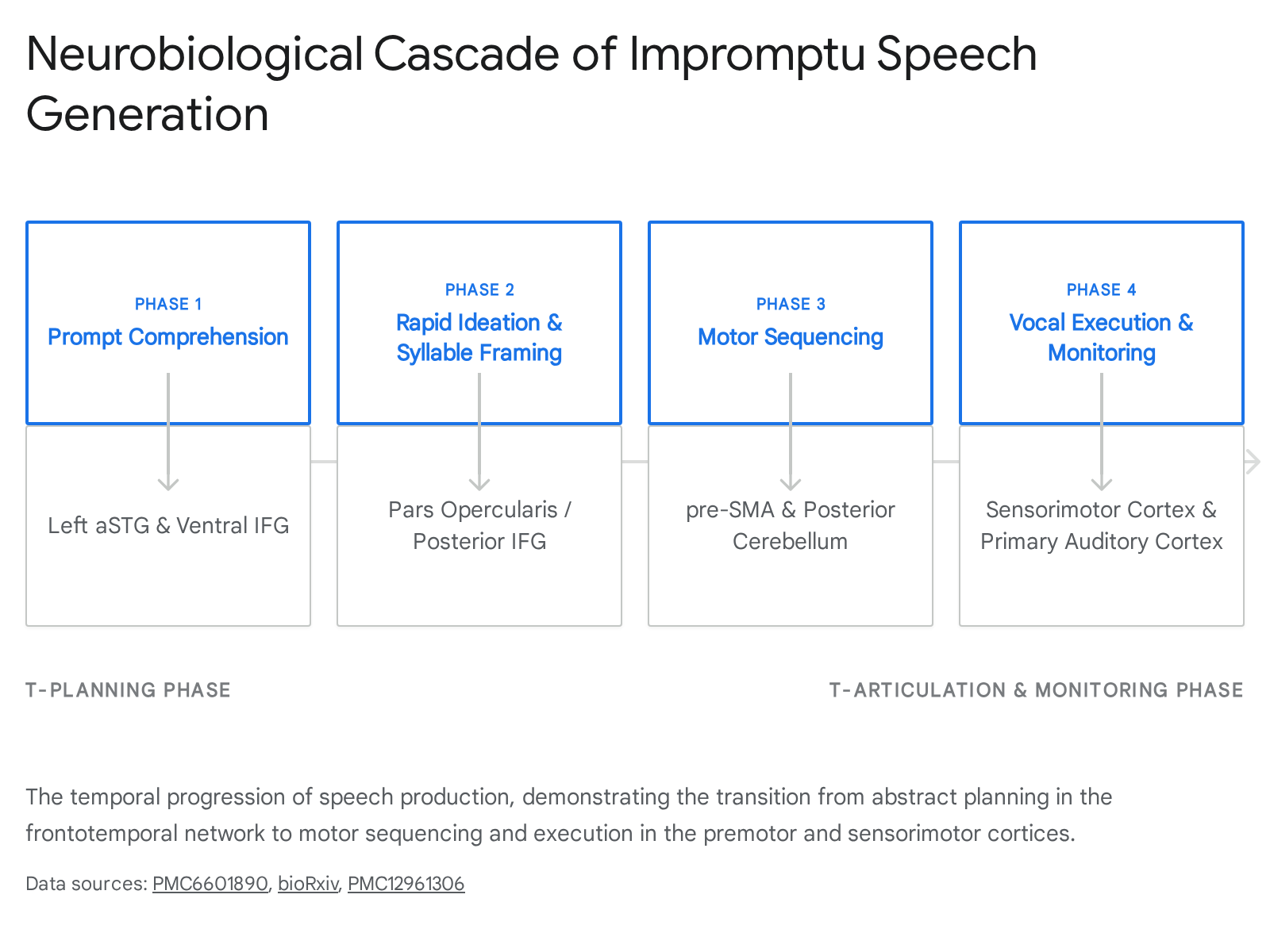
The following table maps the distinct phases of a Table Topics response directly to their underlying neurobiological mechanisms:
| Impromptu Response Phase | Cognitive Mechanism | Dominant Neurobiological Substrates |
|---|---|---|
| 1. Prompt Comprehension & Perception | Acoustic processing, sound-to-meaning mapping, and violation of predictive linguistic expectations. | Left anterior Superior Temporal Gyrus (aSTG) and ventral Inferior Frontal Gyrus (IFG) via the ventral pathway. |
| 2. Rapid Ideation & Executive Control | Mobilization of top-down attentional control to resolve conflict, generate an abstract thesis, and suppress the acute physiological stress response. | Frontoparietal Network (FPN), Salience Network (SN), and Midfrontal Cortex (characterized by robust theta wave synchronization). |
| 3. Structural Formulation (T-Planning) | Constructing the syntactic and "syllable frame," sequencing abstract phonological units before motor assignment. | Left posterior Inferior Frontal Gyrus (specifically the pars opercularis) and rostral Middle Frontal Gyrus. |
| 4. Motor Sequencing (T-Articulation) | Translating phonological frames into precise motor commands to control vocal tract gestures for articulation. | Pre-Supplementary Motor Area (pre-SMA), Motor Cortex, and Posterior Cerebellum. |
| 5. Vocal Execution & Self-Monitoring | Real-time analysis of self-produced speech to correct semantic drift or phonological dysfluencies dynamically. | Sensorimotor Cortex, Primary Auditory Cortex, and Superior Temporal regions. |
The generation of the impromptu response operates on a precise, measurable temporal progression. Initially, in the T-planning phase, the left inferior frontal gyrus (particularly the pars opercularis) is heavily engaged to construct the "syllable frame" and sequence abstract phonological units 1412. Because impromptu speaking fundamentally lacks a pre-compiled script, the brain must continuously generate new frames. This continuous generation relies heavily on midfrontal theta wave synchronization. High-density electroencephalography (EEG) studies reveal that individuals exhibiting superior cognitive control demonstrate highly flexible synchronization of these midfrontal theta waves 14. These neural signals act as dynamic coordinators, essentially behaving like an adaptable conductor rather than a rigid metronome, allowing the speaker to maintain focus, adapt to changing rules, and execute decision-making under stress 14.
As the speaker transitions from abstract planning to the T-articulation phase, neuroanatomical activation shifts posteriorly. The pre-supplementary motor area (pre-SMA), the motor cortex, and the posterior cerebellum take over to sequence fine-grained auditory imagery and facilitate the precise muscular adjustments required for vocal tract gestures 1418. Concurrently, the brain must ensure that the output matches the intended thesis. This occurs during the T-monitoring phase, which engages the primary auditory cortex and superior temporal regions to analyze the self-produced speech, allowing the speaker to correct dysfluencies, repair sentences, and adjust semantic trajectories in real-time 1412.
Part IV: Affective Habituation vs. Cognitive Enhancement
A critical distinction in the psychological and neurological study of impromptu speaking interventions is the necessary differentiation between affective habituation (the reduction of psychological and physiological anxiety) and cognitive enhancement (the actual neuroplastic improvement in executive functions, cognitive flexibility, and working memory). Historically, communication studies have conflated these two phenomena. While they are deeply interconnected, treating them as synonymous obscures the distinct neural pathways and adaptive mechanisms at play.
Affective Habituation (Anxiety Reduction)
Public speaking anxiety (PSA) is a widespread condition characterized by a hyper-activation of the body's threat-response system, often leading to negative cognitive biases, avoidance, and heightened physiological stress 151617. Research tracking state anxiety during speech tasks reveals distinct, quantifiable temporal patterns: psychological anxiety peaks early in the anticipatory phase (pre-speaking sensitization), while physiological arousal - such as heart rate acceleration and skin conductance - peaks at the exact moment of confrontation, when the speaker first faces the audience and begins to vocalize 22.
Repeated exposure to impromptu speaking tasks - such as a sustained weekly Table Topics regimen - has been shown to significantly diminish these anxiety levels, leading to profound affective habituation 23. During successful habituation, the acute stress response is modulated, allowing the speaker's physiological arousal to subside rapidly within the first minute of the speech 18. The Contrast Avoidance Model of Worry provides insight into this phenomenon: individuals with chronic anxiety often use worry as a mechanism to prolong a negative emotional state to avoid a sudden, unexpected emotional shift or "contrast" experience 25. Impromptu speaking forces the individual into the contrast experience repeatedly, ultimately desensitizing the neurological trigger.
Notably, this stress modulation is highly valence-dependent and interacts heavily with cortisol reactivity. Neuroendocrine studies indicate that individuals with blunted cortisol responses show different patterns of affective habituation to unpleasant or stressful stimuli, suggesting that healthy hypothalamic-pituitary-adrenal (HPA) axis activity is required for optimal emotional regulation 26. From a network connectivity perspective, acute stress initially causes the Salience Network (SN) and Default Mode Network (DMN) to dominate global brain activity, a state that inherently impairs higher-order cognitive functions 27. Habituation through repeated impromptu exposure effectively downregulates this threat-salience mechanism, allowing the speaker to transition from a state of autonomic panic to a state of manageable, performance-enhancing arousal.
Cognitive Enhancement (Neurological Improvement)
While affective habituation merely clears the neurological "noise" generated by anxiety, true cognitive enhancement involves the physical strengthening and optimization of the cognitive control network (CCN) and the frontoparietal network (FPN) 27.
Engaging in the rapid task-switching, semantic retrieval, and error monitoring required by impromptu speaking acts as a rigorous form of cognitive training. Studies utilizing electroencephalography have successfully identified the theta/beta ratio as a highly reliable biomarker for top-down attentional control 19. Engaging in stressful cognitive tasks, such as public speaking (which induces cognitive performance anxiety, or CPA), while successfully maintaining executive control, actually enhances the prefrontal cortex's ability to resist the deleterious effects of stress on attention over time 19.
Therefore, the structural formulation required in a Table Topics response - such as maintaining the overarching thread of a thesis statement while actively suppressing tangential thoughts and monitoring time - genuinely exercises working memory, inhibitory control, and cognitive flexibility 2030. This pushes the neurobiological adaptation far beyond mere anxiety reduction into the realm of structural cognitive enhancement, effectively increasing the brain's resilience against stress-induced deterioration of executive function 1921.
Part V: Generalized Cognitive Flexibility vs. Task-Specific Adaptations
A central, ongoing debate within developmental and cognitive neuroscience is whether rigorous training in a specific domain of cognitive flexibility - such as spontaneous verbal generation - results in a generalized enhancement of broad executive function, or if the neurological adaptations remain strictly task-specific.
Cognitive flexibility is operationally defined as the ability to effectively disengage from a current task, mindset, or strategy and shift focus to a different activity, essentially replacing one rule-set in working memory with another 22. In the context of impromptu speaking, the speaker must flexibly adapt to a highly unpredictable prompt, pivot their mental schema instantaneously, and synthesize disparate pieces of information into a cohesive narrative.
Evidence derived from task-switching paradigms suggests that adaptations in cognitive flexibility are often bound by strict contextual boundary conditions 22. When individuals are trained in experimental environments characterized by high switch rates, they become highly efficient at switching tasks within that specific task-set. However, this enhanced readiness to switch does not necessarily transfer to completely novel, unrelated tasks 22. Some researchers argue that cognitive flexibility may not be a single, generalized executive function, but rather a collection of domain-specific skills acquired through learned mappings 3323. This task-specific view implies that repeated impromptu speaking practice primarily makes the brain highly efficient at the specific act of rapid linguistic formulation and delivery under social pressure, rather than universally boosting fluid intelligence or performance on unrelated cognitive tests (e.g., mathematical rule-switching).
Conversely, broader neurophysiological evidence provides a compelling counterweight, suggesting generalized gains. As previously established, midfrontal theta wave synchronization is a core mechanism of cognitive control engaged during complex reasoning, decision-making, and shifting 14. Recent longitudinal EEG mapping reveals that this midfrontal theta connectivity behaves as a consistent, trait-like latent variable across diverse cognitive tasks 14. Because impromptu speaking forces the brain to repeatedly engage and coordinate this midfrontal theta activity under severe temporal pressure, it inevitably strengthens the underlying neural architecture utilized for general cognitive control.
Furthermore, neurocognitive studies demonstrate that stress typically disrupts the brain's ability to form memory inferences - the ability to link related events to generate novel insights 35. However, engaging in repeated retrieval practice (a core component of answering impromptu prompts) reactivates prior memory traces, restoring the ability to make inferences and protecting general cognitive flexibility even under acute stress protocols involving public speaking tasks 35. Thus, while the overt behavioral manifestation of flexibility may show limited direct transfer to entirely divergent academic tasks, the neural efficiency and stress-resilience developed through managing executive function under the pressure of impromptu speaking is highly generalized. The speaker develops a robust, generalized capacity for response inhibition and top-down attentional control that shields their working memory from stress-induced degradation across multiple life domains 141921.
Part VI: Impromptu Speaking in ESL vs. Native Populations
The cognitive demands of impromptu speaking, while immense for native communicators, are profoundly magnified for individuals communicating in a non-native language. Applying Cognitive Load Theory to English as a Second Language (ESL) speakers reveals stark disparities in the neurological burden of spontaneous speech generation compared to native speakers 2425.
Cognitive Load and Semantic Retrieval Disparities
Working memory is inherently limited, capable of holding only a small number of items (typically three to four) for brief durations without active rehearsal 25. For native speakers, fundamental grammar, syntax, and common vocabulary are "biologically primary" or highly automated, relying almost entirely on unconscious procedural memory 25. This automation severely minimizes the intrinsic cognitive load required for basic sentence construction. Consequently, native speakers can dedicate the vast majority of their working memory and executive resources to higher-level narrative structuring, thematic coherence, and audience engagement.
For ESL learners, however, real-time speaking imposes an exceptionally high intrinsic cognitive load 2438. The ESL speaker must simultaneously retrieve L2 (second language) vocabulary, consciously apply and verify grammatical rules, and monitor their phonetic articulation 24. This simultaneous processing leads to rapid working memory depletion. When this cognitive capacity is exceeded, ESL speakers exhibit heightened physiological stress responses, disfluent speech, and a strategic shift toward basic error avoidance over complex communicative intent 39.
Under the intense temporal pressure of an impromptu prompt, ESL speakers frequently experience severe semantic retrieval friction. This divided attention and high cognitive load often disrupt the brain's ability to inhibit the native language (L1). Consequently, studies of bilingual speech production reveal a consistent trend: as cognitive load increases (such as during a dual-task impromptu exercise), there is a significant increase in L1 transfer and phonetic deviations, as the brain defaults to the more deeply ingrained, highly automated neural pathways of the native tongue 26. Error analysis of ESL impromptu speeches indicates that the overwhelming cognitive load manifests in specific, predictable grammatical failures, predominantly addition errors (e.g., adding unnecessary morphemes) and selection errors (incorrect lexical choices), emphasizing the breakdown of rule application under spontaneous pressure 41.
The Listener's Cognitive Adaptation
Interestingly, the cognitive load dynamic in cross-linguistic impromptu speaking is bidirectional. Psycholinguistic eye-tracking research demonstrates that native listeners fundamentally adjust their own cognitive processing when listening to non-native speakers 27. Recognizing the potentially lower linguistic reliability and fluency of the non-native speaker, listeners increase their reliance on top-down cognitive processes and contextual cues 27.
Fascinatingly, listeners with higher working memory capacity actually extract less direct lexical information from the non-native speech. Instead, they use their cognitive resources to proactively smooth over grammatical or semantic errors, heavily relying on the surrounding context to anticipate the speaker's broader intent 27. This reveals a highly adaptive neuro-social interaction: as the ESL speaker's cognitive load maximizes, forcing grammatical simplification or causing dysfluencies, the native listener actively shifts their own cognitive strategy to compensate for the anticipated linguistic deficit, ensuring that communication is maintained despite the processing bottlenecks on both sides.
Conclusion
Structured impromptu speaking, as meticulously operationalized by the institutional parameters of the Toastmasters Table Topics format, serves as far more than a pedagogical exercise in public speaking. It is a high-intensity stress test of the human brain's executive control networks. The strict temporal boundaries and structural evaluation criteria force a rapid, sequential activation of the left anterior superior temporal gyrus, the inferior frontal gyrus, and the motor cortices. This demands near-instantaneous neural transitions from abstract semantic planning to physical vocal execution.
Crucially, the neurobiological benefits derived from such practice operate on two distinct, parallel tracks. First, repeated exposure facilitates profound affective habituation, downregulating the hyper-reactivity of the salience network and mitigating the physiological panic associated with social evaluation and uncertainty. Second, and more profoundly, it drives true cognitive enhancement. By repeatedly forcing the brain to sustain working memory and exercise cognitive flexibility under acute temporal stress, impromptu speaking strengthens midfrontal theta wave synchronization and fortifies top-down attentional control.
While the behavioral transferability of this cognitive flexibility may be partially bound to linguistic task-sets, the resulting neural efficiency fortifies the brain's broader, generalized capacity to manage executive functions under pressure. For ESL populations, while the intrinsic cognitive load of this task is uniquely punishing and often results in semantic retrieval friction, it acts as a critical crucible for automating second-language processing and overcoming the rigid neural interference of the native tongue. Ultimately, the ability to "think on one's feet" is revealed not merely as a polished communication skill, but as a visible, highly trainable manifestation of optimal neurobiological synchronization and cognitive resilience.