
Leadership and listening skills in Toastmasters role rotation
Introduction
In the contemporary organizational landscape, the demand for durable professional competencies - frequently termed "soft skills," encompassing communication, active listening, critical thinking, and emotional intelligence - has reached unprecedented levels of importance 1. The nonprofit organization America Succeeds recently identified core durable competencies that are heavily sought after by employers, yet these essential human skills are rarely developed through formal, passive workplace training 12. While traditional corporate training programs often rely on episodic, lecture-based instructional models to address these competencies, empirical evidence increasingly points toward the necessity of continuous, experiential learning environments to foster genuine, long-lasting behavioral change 234. Toastmasters International has functioned as a global laboratory for this precise mode of experiential development for nearly a century, offering a structured environment for professionals to hone these critical attributes 15.
Beyond the widely recognized practice of delivering prepared speeches, the pedagogical core of the Toastmasters model is its highly structured meeting framework, which relies on rotational functionary roles 678. These roles - specifically the Toastmaster of the Day, General Evaluator, Grammarian, and Ah-Counter - serve as deliberate micro-practicums in specialized forms of leadership, cognitive processing, and auditory analysis 91011. The continuous rotation through these positions is not merely an administrative method for running a meeting; rather, it is a sophisticated educational strategy meticulously designed to cultivate a complementary matrix of durable skills that are highly transferable to external professional environments 121314.
This exhaustive report provides an analysis of how rotating through these specific operational roles systematically develops interconnected leadership and listening competencies. By examining the Toastmasters meeting architecture through the rigorous lenses of adult learning theory, cognitive psychology, and organizational behavior, the following analysis demonstrates how micro-level listening tasks and macro-level facilitation tasks synthesize to produce executive-level capabilities. The investigation explores the theoretical underpinning of the learning model, details the specific cognitive mechanics demanded by each role, and maps these developed skills to the demands of the modern multinational workplace.
Theoretical Frameworks in Adult Education
To fully grasp the efficacy of meeting role rotation, it is essential to ground the practice in established educational and psychological theories. The Toastmasters methodology operates at the intersection of experiential learning, social constructivism, and structured auditory processing, moving away from pedagogical methods suited for children toward andragogical models tailored for adult professionals.
Andragogy and Transformational Learning
Malcolm Knowles' theory of andragogy highlights the unique characteristics of adult learners, emphasizing that mature individuals require self-direction, practical relevance, and learning environments that respect their prior experiences 31516. Adult learning strategies must be oriented toward the skills necessary for the social and professional roles these individuals occupy 3. Toastmasters aligns with andragogical principles by allowing members to take responsibility for their educational pacing and by providing immediate, real-world applicability for the skills practiced during meetings 317.
Furthermore, Transformative Learning Theory, another cornerstone of adult education, focuses on changing how individuals perceive themselves and their capabilities by navigating "disorienting dilemmas" that challenge their existing frames of reference 3418. When a member steps into a highly visible, high-pressure role such as Toastmaster of the Day for the first time, they encounter a structured dilemma. They must confront their public speaking anxiety, organizational capabilities, and executive presence simultaneously 1118. Navigating this challenge in a supportive environment fosters deep critical reflection and ultimately transforms their self-efficacy and leadership identity 1819.
Kolb's Experiential Learning Theory
David Kolb's Experiential Learning Theory (ELT) posits that learning is a continuous process wherein knowledge is created through the transformation of experience 2021. The ELT framework is critical for understanding the mechanics of role rotation, as it emphasizes that cognitive development occurs through a cyclical interaction with specific tasks 152022. The cycle consists of four distinct modes: Concrete Experience, Reflective Observation, Abstract Conceptualization, and Active Experimentation 1521.
In the context of Toastmasters, members are consistently pushed through this cognitive cycle. Taking on a novel role, such as the General Evaluator, provides a Concrete Experience where the learner is actively involved in a novel, immediate situation 20. During the meeting, the member engages in Reflective Observation by stepping back to actively assess the performance of others and the overall flow of the event from multiple perspectives 2021. Following the meeting, the process of delivering and receiving feedback prompts Abstract Conceptualization, allowing the member to internalize lessons and develop actionable theories regarding effective leadership and communication 2021. Finally, Active Experimentation occurs when the member applies these synthesized theories to their next role assignment, testing their new competencies in practice 21. This continuous rotation ensures that learning is not a finite, episodic event, but a lifelong process of cognitive refinement and adaptation 2123.
Social Constructivism and the Zone of Proximal Development
Constructivist learning theory, rooted in the foundational work of Lev Vygotsky and Jean Piaget, argues that learners actively construct knowledge through social interaction, experiential problem-solving, and reflection, rather than passively receiving transmitted information 242526. The Toastmasters meeting operates explicitly as a constructivist classroom. It relies heavily on collaborative learning, where knowledge is co-constructed through peer interaction, shared observation, and continuous, structured feedback loops 252627.
Role rotation leverages Vygotsky's concept of the Zone of Proximal Development (ZPD) - the conceptual space between what a learner can accomplish independently and what they can achieve with the guidance of more capable peers 2526. When a member assumes a challenging leadership role, they are supported by the General Evaluator, experienced mentors, and the broader club ecosystem 1224. This community of practice provides the necessary scaffolding to help them succeed, gradually removing the support as the member builds independent competence 724. By reframing peers as co-educators, the environment enables adults to step into complex organizational roles safely, mitigating the risk of professional humiliation while maximizing experiential growth 2728.
The HURIER Model of Active Listening
The systematic development of listening skills in Toastmasters aligns closely with the HURIER model, a recognized academic framework developed by Judi Brownell to deconstruct the complex cognitive process of listening 62930. The HURIER model breaks listening down into a six-stage pipeline: Hearing, Understanding, Remembering, Interpreting, Evaluating, and Responding 2930. specific meeting roles within the Toastmasters agenda are designed to isolate, exercise, and train distinct phases of this cognitive pipeline, systematically upgrading a member's interpersonal auditory processing 29.
To demonstrate how the Toastmasters structure operationalizes this theoretical framework, the following table maps the specific cognitive tasks demanded by the Ah-Counter and Grammarian roles directly to the six stages of the HURIER active listening model.
| HURIER Stage | Cognitive Function | Corresponding Toastmasters Role | Practical Application in Role |
|---|---|---|---|
| Hearing | Physical reception of sound; eliminating distractions. | Ah-Counter | Isolating specific phonetic sounds (e.g., "um," "ah") amidst continuous speech 29. |
| Understanding | Parsing the message to separate core issues from surface delivery. | Ah-Counter | Comprehending the primary narrative to accurately identify when a word is used as a crutch rather than a necessary conjunction 29. |
| Remembering | Creating mental commit points to retain critical data. | Ah-Counter & Grammarian | Tracking and cataloging multiple infractions and exemplary usages across numerous speakers throughout an hour-long meeting 293132. |
| Interpreting | Analyzing emotional context, tone, and rhetorical metadata. | Grammarian | Detecting nuances in vocabulary, figurative language, and the appropriateness of word choice for the specific audience 829. |
| Evaluating | Applying critical thinking to assess validity and structure. | Grammarian | Assessing whether the speaker effectively utilized the "Word of the Day" and judging the overall grammatical structure of the presentation 3032. |
| Responding | Providing constructive, actionable feedback. | Grammarian | Delivering a concise, analytical report at the end of the meeting that highlights specific linguistic strengths and areas for improvement 3031. |
By rotating through these specific roles, members engage in targeted mental conditioning, isolating the foundational stages of discriminative listening (Hearing and Understanding) to detect anomalies, before advancing to the complex semantic analysis required by the later stages (Interpreting, Evaluating, and Responding) 2931.
Micro-Level Listening: The Ah-Counter and Grammarian
The roles of Ah-Counter and Grammarian represent the micro-level, analytical foundation of the Toastmasters experiential matrix. Rather than focusing on the broad stroke of the meeting's success, these roles demand intense, sustained cognitive focus on linguistic minutiae, serving as rigorous exercises in highly specific listening modalities 31.
The Ah-Counter and Discriminative Listening
The primary operational responsibility of the Ah-Counter is to actively track the use of crutch words - such as "and," "but," "so," "you know," and "like" - as well as phonetic filler sounds like "ah," "um," and "er" utilized by all participants during a meeting 93233. At the conclusion of the event, the Ah-Counter delivers a quantitative, objective report detailing these specific infractions for each speaker 932.
From a cognitive psychology perspective, this role forces the practitioner to engage in intense discriminative listening 34. Human auditory processing naturally seeks semantic meaning, often automatically filtering out phonetic static, hesitations, or repetitive conjunctions in order to comprehend the core narrative being delivered. The Ah-Counter must actively override this cognitive default mechanism 3536. They must sustain a dual-track attention span: comprehending the speaker's overall message while simultaneously maintaining a hyper-vigilant ear to isolate, categorize, and document specific phonetic interruptions 1031.
This sustained, unnatural auditory focus yields several profound developmental benefits. First, it fosters heightened self-awareness. By rigorously cataloging the unconscious verbal habits of others, individuals become acutely aware of their own reliance on filler words, triggering internal behavioral modification that enhances their own speaking clarity 931. Second, it increases overall auditory endurance. The requirement to actively listen to every participant - from the club president's opening remarks to extemporaneous Table Topics responses - builds an attention span that directly combats the distraction-heavy nature of the modern digital workplace 3037. Finally, delivering the final report trains the individual to provide unvarnished, objective data without emotional framing or judgment, a vital skill for neutral professional reporting 2932.
The Grammarian and Analytical Interpretation
While the Ah-Counter focuses predominantly on the phonetic mechanics of speech, the Grammarian focuses on semantic architecture and rhetorical efficacy 3138. The Grammarian is tasked with introducing a "Word of the Day" to expand members' vocabularies, tracking its usage throughout the session, and evaluating the overall use of the English language by all speakers 93132.
This role rigorously exercises the Interpreting and Evaluating stages of the HURIER listening model 29. The Grammarian must listen past the mere content of the speeches to critically analyze exactly how that content is structured and delivered. They are trained to identify exceptional uses of figurative language, elegant phrasing, and persuasive rhetorical devices, as well as grammatical missteps, awkward syntax, or the inappropriate use of exclusionary industry jargon 83138.
The cognitive demands of the Grammarian role develop advanced listening competencies essential for leadership. By analyzing word choice and phrasing, the Grammarian learns to practice active-empathic listening, detecting the subtle nuances of tone, intent, and audience reception 1431. They move beyond passive reception to a state of active linguistic analysis 1431. Furthermore, the role demands precision in feedback. The Grammarian must distill their observations into a concise, constructive report delivered to the club 31. This cultivates the ability to highlight specific areas of improvement while simultaneously reinforcing positive communication traits, ensuring the feedback is received as helpful rather than punitive 1331. Additionally, the act of selecting and teaching the "Word of the Day" reinforces the pedagogical principle that teaching a concept is the most effective method for internalizing it, directly aiding in the Grammarian's own vocabulary expansion 1439.
Transferability to the Professional Sphere
The micro-listening skills developed by serving as the Ah-Counter and Grammarian have profound implications for professional competency. In an era where corporate research indicates that 85% of job success is attributed to durable interpersonal skills rather than pure technical prowess, the ability to listen deeply and analytically is a critical market differentiator 29.
In corporate and multinational business settings, particularly those involving Non-Native English Speakers (NNES), the Grammarian and Ah-Counter roles foster high levels of cultural intelligence and intercultural empathy 144041. For instance, within corporate clubs at international organizations like the United Nations in Geneva, these roles train professionals to appreciate profound linguistic nuance and practice the patience required for effective global dialogue 42. The rigorous focus on clear enunciation, appropriate pacing, the avoidance of colloquial jargon, and the elimination of distracting filler sounds translates directly to commanding executive presence during high-stakes board meetings, virtual conferences, and complex client negotiations 1343. Professionals who have honed these skills are better equipped to run diagnostics on a conversation, parse critical information from emotional noise, and communicate with clarity across cultural boundaries 29.
Macro-Level Leadership: The Toastmaster of the Day
If the Ah-Counter and Grammarian represent the micro-level, data-gathering analysis of a meeting, the Toastmaster of the Day (TMOD) represents macro-level executive leadership and operational management 4445. The TMOD functions as the director, host, and master of ceremonies, assuming primary responsibility for the energy, pacing, structure, and overall success of the event 114445.
Facilitation Mechanics and Organizational Behavior
The TMOD role is a direct, experiential practicum in meeting facilitation and applied organizational behavior. In the professional world, poorly structured and inefficiently managed meetings are a primary source of productivity loss and employee frustration. The TMOD role provides a safe, low-stakes environment to master the mechanics of effective, goal-oriented facilitation before applying them in corporate settings 21246.
The responsibilities of the TMOD extend well beyond the scheduled hour of the meeting, requiring significant preparatory work that mirrors standard corporate project management 14. Pre-meeting coordination requires the TMOD to communicate proactively with scheduled speakers and functionaries to confirm attendance, clarify role expectations, and gather introductory materials 3248. This process develops the organizational foresight necessary to align diverse stakeholders toward a common operational goal 14.
During the meeting, the TMOD must exercise extreme adaptability and situational leadership 4750. When role-holders are unexpectedly absent or technical difficulties arise, the TMOD must rapidly reassess the situation, reassign duties, and adjust the agenda on the fly to maintain operational continuity without displaying panic 3247. Furthermore, the TMOD is responsible for bridging the gaps between disparate meeting segments, crafting a cohesive narrative flow, and ensuring smooth transitions that keep the audience engaged and the momentum high 114448.
Cultivating Psychological Safety and Inclusive Climates
A highly effective Toastmaster of the Day goes beyond mere logistical and administrative management to deliberately establish the psychological climate of the meeting 4849. Drawing on modern organizational psychology, psychological safety - defined as the shared belief that a team is safe for interpersonal risk-taking without fear of punishment or humiliation - is widely recognized as the foundation of high-performing, innovative teams 50.
The TMOD engineers this vital psychological safety by setting an encouraging, inclusive tone from the outset 124851. They lead the applause, guide audience reactions, and craft thoughtful, affirming introductions that validate the speakers' expertise and character before they even reach the lectern 124851. By proactively establishing an atmosphere of receptivity and enthusiastic support, the TMOD lowers the affective filter of the participants 124245. This emotional scaffolding is particularly vital for members overcoming severe speech anxiety, or for those delivering their highly vulnerable initial "Ice Breaker" presentations 124552. Furthermore, in modern hybrid work environments, the TMOD must skillfully balance the interpersonal dynamics between in-person attendees and remote virtual participants, ensuring equitable engagement, mitigating proximity bias, and fostering a truly inclusive organizational culture 4353.
Time Management and Executive Poise
Toastmasters meetings are renowned for operating on strict, minute-by-minute agendas, designed to respect the time of all attendees 14. While the designated Timer provides the visual cues regarding speech duration, the TMOD bears the ultimate executive responsibility for ensuring the meeting as a whole begins and ends precisely on schedule 4448.
This stringent requirement forces the TMOD to practice aggressive, yet highly tactful, time management. They must learn to organically expand or contract filler material, concisely truncate their own planned transitions if a preceding speaker runs long, and gracefully keep the proceedings moving without appearing rushed, anxious, or authoritarian 4851. This ongoing synthesis of clear authority, real-time adaptability, and unflappable poise under pressure builds a robust executive presence. This specific brand of confident, structured leadership translates seamlessly to chairing high-stakes corporate meetings, leading rapid agile stand-ups, and managing complex client presentations where time is a critical constraint 141754.
Strategic Oversight and Coaching Methodologies
The role of the General Evaluator (GE) is arguably the most complex and strategically demanding leadership function within the Toastmasters meeting structure. While the Toastmaster of the Day facilitates the execution of the meeting, the General Evaluator is responsible for analyzing its efficacy, identifying systemic issues, and coaching the team that runs it 83744.
Systems Thinking and Macro-Evaluation
The General Evaluator must exercise advanced systems thinking. They are tasked with observing absolutely everything that takes place - and critically, everything that fails to take place - throughout the entire lifecycle of the meeting 84448. The GE conducts a comprehensive audit of the organizational environment: Did the Sergeant at Arms begin the meeting with the appropriate energy? Were guests properly welcomed and integrated? Did the TMOD manage transitions smoothly and maintain the agenda? Were the individual speech evaluators aligned with the specific educational objectives of the speakers' projects? 83751.
This level of assessment requires a panoramic, holistic view of organizational operations. The GE must synthesize varied observations regarding individual performance, logistical execution, and overall group dynamics. This culminates in a comprehensive, analytical feedback report delivered from the lectern at the meeting's conclusion 89. This high-level observational and diagnostic capability is directly analogous to the role of a senior corporate manager or external organizational consultant tasked with conducting a post-mortem on a complex project, auditing team efficiency, or identifying workflow bottlenecks 143754.
Transformational and Servant Leadership
From the perspective of organizational behavior and management theory, the General Evaluator deeply embodies the principles of both Transformational and Servant Leadership, standing in stark contrast to traditional Transactional leadership models 555657.
Unlike transactional leadership, which relies on a rigid structure of rewards and punishments to maintain routine tasks, or autocratic leadership, which relies on strict command and control, Servant Leadership focuses entirely on prioritizing the needs of the team 555657. The servant leader empowers individuals to reach their full potential through empathy and support 5557. The GE enacts this by not dictating policy, but rather serving the club by providing the objective insights necessary for collective improvement, ensuring the learning environment remains robust 3758.
Concurrently, Transformational leaders inspire and motivate by acting as coaches and mentors, challenging existing assumptions, recognizing individual contributions, and fostering an environment of continuous intellectual growth 5556. The GE epitomizes this by taking on the meta-task of evaluating the evaluators. They provide targeted, constructive feedback to the speech evaluators, commending effective analytical techniques while recommending specific strategies for delivering more precise, supportive, and objective critiques in the future 83758. By guiding others on how to give better feedback, the GE exponentially multiplies the leadership and coaching capacity of the entire club 4558. They learn the delicate art of delivering corrective observations with tact and deep empathy, ensuring that members are left motivated to improve rather than discouraged by criticism 5158.
Managing the Collaborative Evaluation Matrix
The General Evaluator does not work in isolation; rather, they manage a specialized sub-team consisting of the Timer, Ah-Counter, Grammarian, and the individual Speech Evaluators 83744. Managing this collaborative evaluation matrix requires highly effective delegation, clear communication, and team coordination. The GE is responsible for introducing these team members to the audience, clearly explaining their respective functions to set expectations, and sequentially calling upon them to deliver their technical reports 6844.
This hierarchical structure teaches the GE how to empower sub-teams to handle vital micro-analytical tasks (such as timing and grammar tracking) while the GE maintains their cognitive focus on the macro-strategic picture of the meeting's overall health 4445. This dynamic serves as a highly effective, practical laboratory for the "Manager of Execution" and "Builder of Relationships" archetypes that are absolutely necessary for success in middle and senior corporate management tiers 62.
Synthesis and Professional Transferability
The true educational efficacy of the Toastmasters meeting format lies not merely in the isolation of these functional roles, but in their synergistic, cyclical interaction. The continuous rotation mechanism ensures that members do not become permanently siloed into a single narrow competency; rather, they develop a holistic, adaptable toolkit encompassing both highly tactical active listening and high-level strategic leadership 121459.
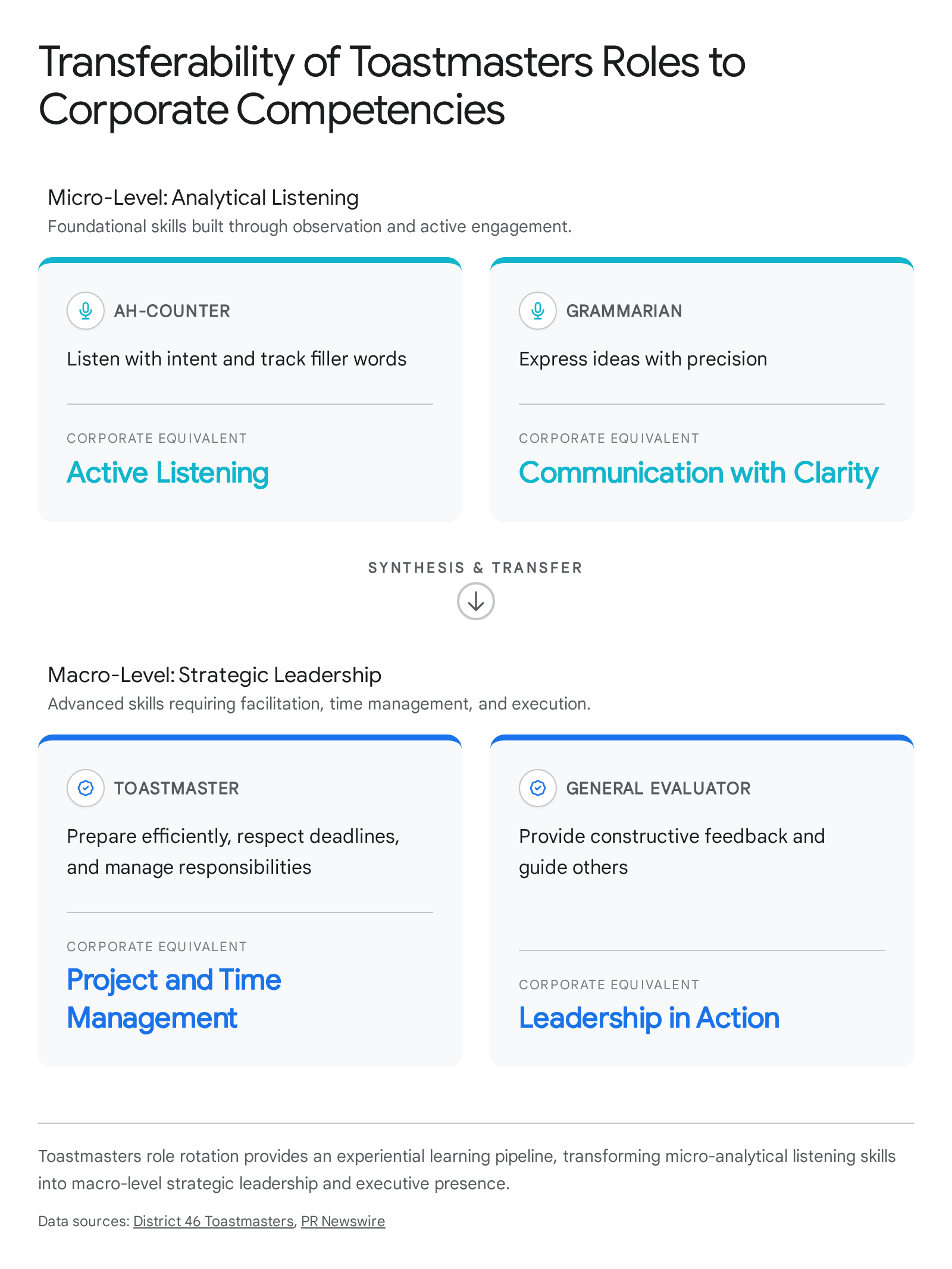
The Complementary Matrix of Organizational Behavior
The roles form a deeply interconnected educational ecosystem. The micro-analytical roles (the Ah-Counter and Grammarian) act as the sensors, feeding structured, objective linguistic data into the meeting's overarching feedback loop. The Speech Evaluators utilize active-empathic listening to process this data and provide mid-level, project-specific coaching to individual presenters. The Toastmaster of the Day provides the macro-level organizational container and psychological safety that allows this vulnerable learning process to occur smoothly. Finally, the General Evaluator observes the entire apparatus from above, synthesizing the micro-data and evaluating the efficacy of the macro-facilitation to ensure the system constantly improves 83745.
When an individual member cycles repeatedly through these varying positions over months and years, they build a deeply layered, highly versatile cognitive framework. A member who has rigorously trained their ear as an Ah-Counter will naturally be a more precise, deliberate speaker when they later take the stage to serve as the Toastmaster of the Day. Conversely, a member who has honed their emotional intelligence and empathy as a Speech Evaluator will be a far more effective and transformational General Evaluator 121460. This continuous cross-pollination of specific skills creates a well-rounded, agile communicator capable of shifting seamlessly from deep, analytical listening to commanding, authoritative leadership as the situational context demands 4461.
Corporate Efficacy and the Transfer of Durable Skills
The recognition of these highly transferable, durable skills has driven the explosive growth and integration of corporate Toastmasters clubs within global organizations, including active sponsorship by a vast majority of companies on the Fortune 500 list 262. Corporate learning and development departments increasingly recognize that technical proficiency is wholly insufficient for effective leadership; modern managers must possess the "human skills" necessary to build psychological safety, facilitate complex hybrid meetings, and deliver empathetic, constructive feedback across diverse teams 1263.
Recognizing the indispensable educational value of these specific roles, Toastmasters International updated its Pathways learning experience to officially mandate the completion of meeting roles as a strict requirement for educational advancement through the program levels 6465. Members are required to begin with foundational analytical roles and progressively advance to complex executive functions like Toastmaster of the Day and General Evaluator, ensuring a standardized development pipeline 6465.
To explicitly illustrate the direct correlation between these internal Toastmasters roles and highly sought-after professional workplace competencies, the following table maps the meeting functions to specific, actionable organizational behaviors.
| Toastmasters Role | Primary Skill Domain | Corresponding Corporate Competency | Practical Workplace Application |
|---|---|---|---|
| Ah-Counter | Discriminative Listening | Attention to Detail & Auditory Focus | Maintaining acute focus during lengthy conference calls; filtering critical signal from background noise; improving personal executive presence by eliminating verbal static. |
| Grammarian | Analytical Interpretation | Active-Empathic Listening & Clear Messaging | Analyzing tone and subtext in client negotiations; coaching direct reports on professional email etiquette; communicating clearly across multinational NNES teams. |
| Toastmaster of the Day | Macro-Facilitation | Project Management & Organizational Leadership | Chairing executive meetings and agile stand-ups; establishing psychological safety and inclusive team climates; enforcing strict time management without appearing autocratic. |
| General Evaluator | Strategic Oversight | Transformational Leadership & Coaching | Conducting objective post-project audits; mentoring mid-level managers on how to give better feedback; providing constructive, empathy-driven performance reviews. |
Conclusion
The pedagogical architecture of Toastmasters International extends far beyond the simplistic development of basic public speaking skills. Through the systematic, required rotation of highly specific meeting roles, the organization offers a sophisticated, experiential adult learning environment that effectively bridges the persistent gap between theoretical knowledge and practical behavioral change in the workplace 22166.
By isolating and repeatedly training specific cognitive functions, the micro-level roles of Ah-Counter and Grammarian forge advanced discriminative and active-empathic listening skills, forcing professionals to overcome natural cognitive biases to hear exactly what is being communicated, and how 3134. These foundational auditory competencies feed directly into the macro-level leadership roles of Toastmaster of the Day and General Evaluator. These roles serve as intensive, low-risk practicums in organizational facilitation, high-pressure time management, systems thinking, and transformational coaching 124551.
Ultimately, this rotational matrix creates a powerful, symbiotic relationship between listening and leading. A leader cannot facilitate a meeting effectively without acute situational awareness, nor can they provide transformational, servant-based coaching without the fundamental ability to listen with profound intent. By rigorously exercising both domains in a psychologically safe, collaborative, and constructivist learning environment, the Toastmasters meeting structure successfully cultivates a holistic, highly transferable suite of durable skills ideally suited for navigating the complexities of the modern global workplace 1.