
Impact of Structured Peer Feedback on Public Speaking Development
Theoretical Foundations of Skill Acquisition
The acquisition and mastery of public speaking skills represent a complex cognitive and behavioral challenge. Proficient oral communication requires the simultaneous management of physiological arousal, linguistic formulation, and nonverbal communication. Within adult education, the methodology employed to develop these competencies significantly dictates the trajectory and ceiling of skill acquisition. A foundational dichotomy exists in this domain: the reliance on unstructured practice versus the application of structured, feedback-driven methodologies.
Mechanics of Unstructured Practice
Unstructured practice, frequently categorized in performance psychology as naive practice, consists of the mere repetition of an activity without targeted goals, objective metrics, or external intervention. Research into human performance demonstrates that extended experience in a specific domain does not automatically correlate with expert performance 1. Individuals engaging in tens of thousands of hours of unstructured practice frequently exhibit negligible gains, as the repetition serves only to automate existing behaviors, thereby reinforcing both effective and ineffective habits simultaneously 12.
In the context of oral communication, unstructured practice typically manifests as rehearsing a presentation in isolation or speaking frequently in social or professional settings without receiving objective critiques. This approach lacks a critical feedback loop - a systematic mechanism that provides the practitioner with objective data regarding their performance relative to a specific target 1. Consequently, speakers relying on unstructured practice frequently plateau. They remain unaware of their reliance on vocal fillers, ineffective pacing, or closed body language, as they are incapable of accurately self-assessing these automatic physiological and cognitive responses during the act of speaking 34. Studies exploring fluency-building techniques, such as the Say All Fast Minute Every Day Shuffled (SAFMEDS) protocol, corroborate that unstructured practice may lead to faster performance but fails to produce the rate of improvement seen in purposeful, structured practice environments 5.
Principles of Deliberate Practice
In direct contrast to naive repetition, deliberate practice requires focused, goal-directed work on specific weaknesses coupled with immediate, objective feedback 12. According to psychological frameworks established by K. Anders Ericsson, deliberate practice involves full concentration, clear target metrics, and performance taking place just beyond the individual's current capability level. Under these specific conditions, measurable performance improvements can be observed in a fraction of the time required by unstructured repetition, with some studies indicating significant results in as few as twenty hours of focused work 1.
Public speaking educational models, such as the Toastmasters International methodology, attempt to operationalize deliberate practice for the general adult population. By replacing isolated repetition with recurring stage time before a live audience, followed immediately by structured peer evaluation, these models introduce the essential feedback loop necessary to break through the performance plateaus associated with unstructured speaking experience 16. Research confirms that structured practice programs, which incorporate regular speaking opportunities combined with specific skill targets and immediate feedback, consistently produce significant improvements in oral communication competency across diverse adult populations 67.
Experiential Learning and Cognitive Processing
The pedagogical architecture of the Toastmasters methodology and similar structured speech environments is deeply rooted in experiential learning theory. First formalized by educational theorist David Kolb, this framework posits that adult learning is an iterative process driven by the transformation of experience into knowledge.
Application of the Experiential Learning Cycle
The structured feedback model utilized in peer-driven public speaking forums naturally aligns with Kolb's four-stage learning cycle: Concrete Experience, Reflective Observation, Abstract Conceptualization, and Active Experimentation 89.
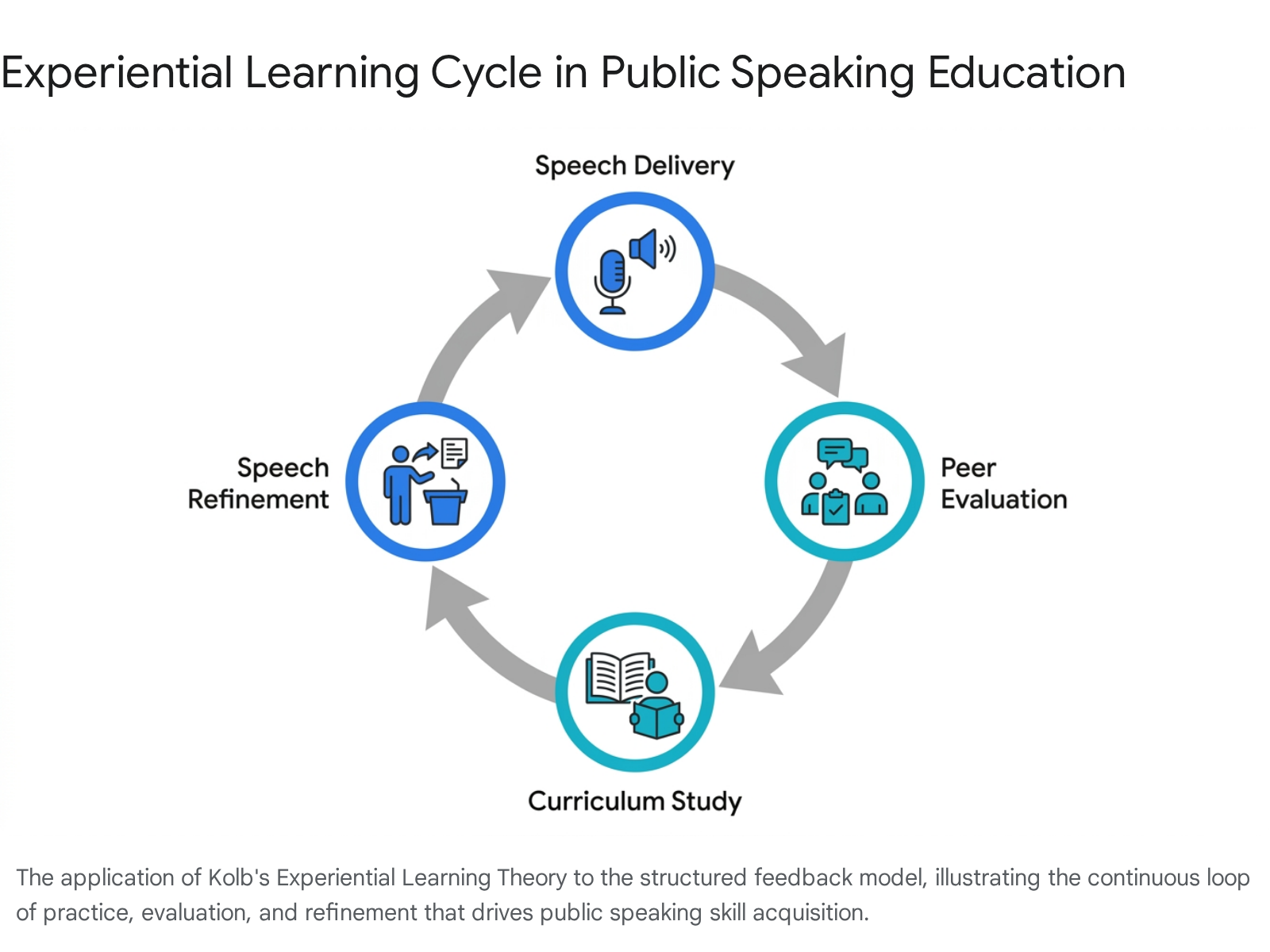
In practical application, the cycle manifests sequentially during a typical club meeting. The "Concrete Experience" occurs when a member delivers a prepared speech or participates in impromptu speaking exercises. This provides a non-threatening, supportive atmosphere for the individual to confront the physiological and cognitive demands of public speaking 8. Following the delivery, the speaker engages in "Reflective Observation" by receiving immediate, criterion-based evaluations from a designated peer evaluator. This feedback compels the speaker to critically assess their performance objectively rather than relying on their internal, often anxiety-distorted, self-perception 89.
The third stage, "Abstract Conceptualization," is facilitated through the organization's educational curriculum. Members study specific rhetorical concepts, vocal modulation techniques, and structural templates, allowing them to conceptualize the mechanics of effective communication intellectually 8. Finally, the speaker enters the "Active Experimentation" phase by applying the internalized feedback and new conceptual knowledge to the preparation and delivery of their subsequent speech 89. This iterative loop ensures that practice remains deliberate and goal-oriented, directly preventing the stagnation associated with unstructured repetition.
Cognitive Mechanisms of Immediate Feedback
The efficacy of structured public speaking environments relies heavily on the temporal immediacy and the specific nature of the feedback provided. Different feedback interventions yield varying cognitive and behavioral outcomes depending on the task's information processing requirements 10. Meta-analyses of educational feedback demonstrate that process-oriented feedback is vastly superior to vague outcome feedback (e.g., "that was good"), providing the granular detail necessary for behavioral modification 1.
Research analyzing the impact of immediate versus delayed feedback in public speaking indicates that immediate intervention is highly effective for modifying automatic, deeply ingrained behaviors. For example, the unconscious use of vocal fillers represents a persistent challenge for amateur speakers. Studies have demonstrated that immediate feedback interventions in classroom settings effectively reduce the use of distracting filler words without adversely elevating the speaker's state or trait anxiety 7. In specific longitudinal observations, participants receiving immediate feedback utilized less than half the number of filler words compared to control groups engaging in unstructured practice 7. Furthermore, immediate feedback is particularly effective when automatic processing occurs, whereas delayed feedback is generally more appropriate for tasks involving deliberative, complex cognitive processing, such as overarching narrative restructuring 10.
Psychological Safety and Communication Apprehension
A significant barrier to public speaking development is communication apprehension, which manifests as somatic anxiety, cognitive avoidance, and behavioral freezing 911. Unstructured practice, particularly when it results in negative or ambiguous audience reactions, can exacerbate this anxiety, creating a negative feedback loop that reinforces the individual's fear 413.
Anxiety Reduction and Self-Efficacy
Structured peer feedback models mitigate this apprehension through the deliberate cultivation of psychological safety 412. Operating within a community of individuals who are all engaged in the same vulnerable learning process fosters a high degree of in-group identification 13. The act of speaking within a consistently supportive environment allows the speaker to dissociate public communication from the expectation of harsh social rejection 1417.
This process of cognitive restructuring significantly lowers audience anxiousness scales over time, converting the somatic symptoms of fear into manageable arousal that can be channeled into performance energy 36. As communication apprehension decreases, self-efficacy - an individual's belief in their capacity to execute behaviors necessary to produce specific performance attainments - increases. Studies tracking university students engaging in structured peer feedback sessions reveal that participants with initially low self-efficacy demonstrate significant improvement in their oral performances after recurring feedback interactions, validating the hypothesis that collaborative environments foster baseline confidence alongside technical skill 15.
In-Group Identification and Coping Mechanisms
For adult learners, and particularly for international students or non-native speakers facing cross-cultural adaptation stressors, identifying with an inherently supportive group reduces out-group bias and physiological stress responses 13. Research exploring cross-cultural adaptation indicates that cultural adaptation stress correlates negatively with positive coping mechanisms, and that participation in group-based learning or social activities enhances in-group identification 13.
By providing a structured, predictable format for interaction, peer public speaking groups facilitate a positive coping mechanism. The feedback exchange transforms a potentially adversarial relationship between speaker and audience into a collaborative dialogue. Real-time feedback and dialogic evaluation elicit more actionable information, allowing for direct and efficient comprehension of rhetorical strengths and weaknesses, which in turn reinforces the speaker's sense of belonging and competence 16.
Evaluation Rubrics and Assessment Criteria
The reliability and utility of peer feedback are largely contingent upon the assessment instruments utilized. In the absence of structured rubrics, peer evaluations tend to devolve into generalized encouragement. While this may be emotionally supportive, vague praise fails to provide the specific, actionable data required for deliberate practice 4.
Standardization of Peer Assessment
To counteract the inherent variability in peer expertise, structured models employ standardized evaluation rubrics. The Pathways learning experience utilized by Toastmasters relies on specific, standardized criteria for every assignment. Evaluators score competencies - such as vocal variety, eye contact, gestures, and clarity - on a defined numerical scale, ensuring that subjective impressions are anchored to objective behavioral markers 1718.
These evaluation forms function similarly to the analytical rubrics utilized in higher education settings. Academic rubrics, such as the Public Speaking Competence Rubric (PSCR), decompose the presentation into specific competencies, allowing the learner to comprehend precisely which components of their delivery succeeded and which require adjustment 1920. Empirical studies on the use of public speaking competence rubrics confirm that they enhance the predictive validity of assessments and allow non-experts to deliver feedback that more closely mirrors the qualitative assessments of trained faculty 19.
Comparative Efficacy of Feedback Sources
While standardized rubrics elevate the quality of peer feedback, academic research highlights distinct hierarchies in the efficacy of different feedback sources. A comparative analysis of teacher (expert) feedback, peer feedback, and self-feedback reveals significant variations in the rate of oral presentation performance improvement.
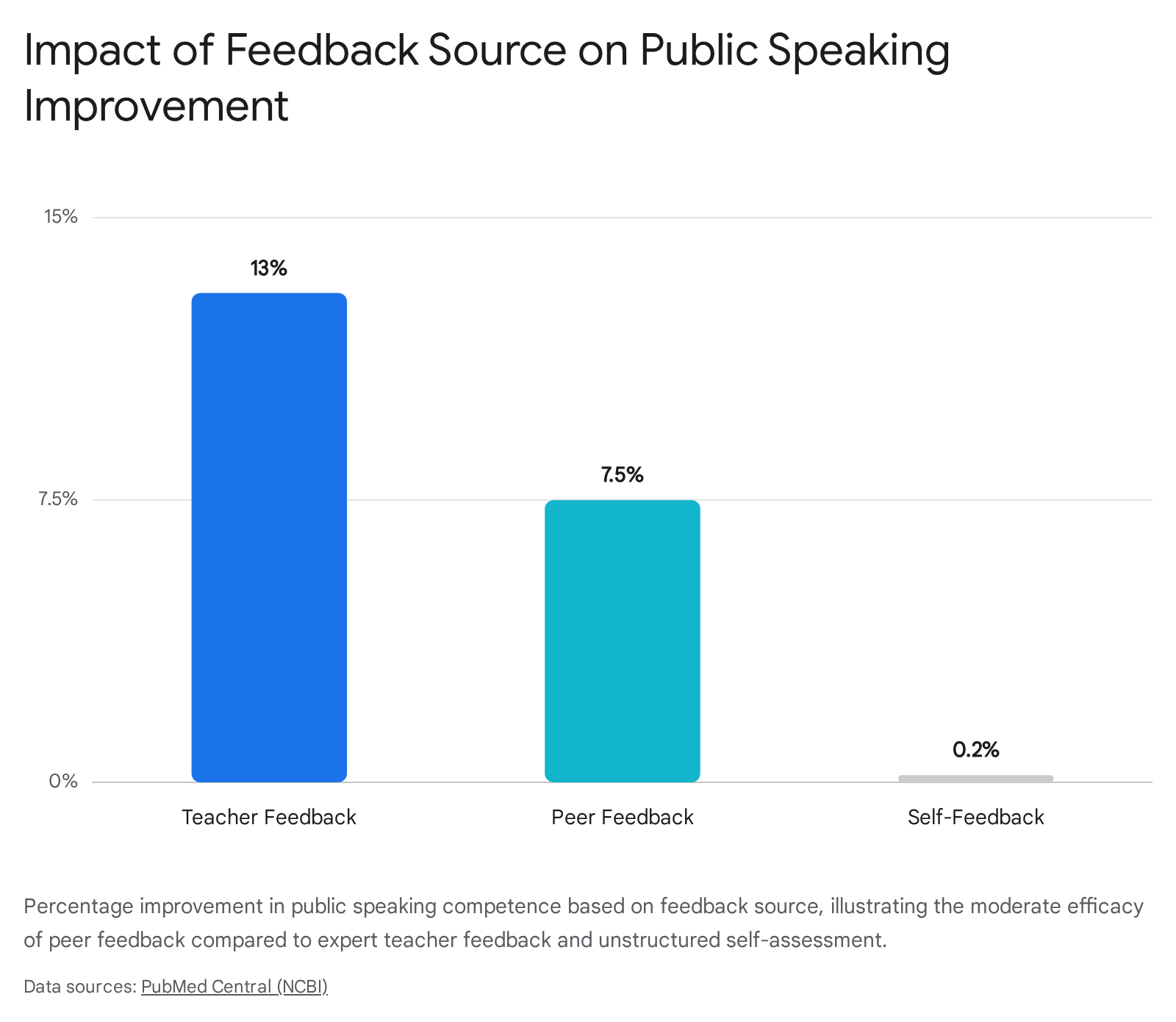
Empirical findings indicate that teacher feedback generates the highest rate of skill improvement - approximately 13% across the measured longitudinal period - due to the expert evaluator's ability to diagnose root causes and align critique with advanced pedagogical principles 16. Peer feedback, when facilitated through structured rubrics, yields a moderate but highly significant improvement of 7.5%, establishing it as a highly scalable and effective alternative when expert instruction is financially or logistically unavailable 16. Conversely, unstructured self-feedback results in statistically negligible improvements of only 0.2%, underscoring the severe limitations of self-directed practice without external evaluation mechanisms 16.
Despite the statistical superiority of expert evaluation, peer feedback offers distinct advantages in frequency, volume, and psychological accessibility. The interactive nature of dialogic peer evaluation encourages collaborative learning and self-reflection, which are critical components of long-term metacognitive development. The act of providing feedback also enhances the evaluator's own critical thought and communication skills, establishing a reciprocal learning ecosystem 162421.
Structural Comparison of Training Modalities
Adult learners seeking public speaking development generally choose between three primary modalities: unstructured self-practice, structured peer groups, and formal instruction (encompassing both university courses and professional executive coaching). Each methodology presents a distinct profile regarding cost, feedback quality, frequency of practice, and psychological environment 2622.
| Training Methodology | Frequency of Practice | Feedback Source & Quality | Psychological Environment | Primary Limitations |
|---|---|---|---|---|
| Unstructured Practice | High (Self-directed) | Internal self-assessment; highly subjective and prone to confirmation bias. | Varies; often high anxiety during actual high-stakes professional events. | Reinforces existing bad habits; lacks an external mechanism for objective behavioral correction 13. |
| University Speech Courses | Low to Moderate (Confined to academic semester) | Expert academic instructor; highly objective, standardized, and pedagogically sound. | High pressure; graded, high-stakes assessments can exacerbate baseline communication apprehension 6. | Short duration limits long-term habit formation; higher financial and scheduling barriers 6. |
| Structured Peer Groups | High (Continuous, ongoing weekly or bi-weekly meetings) | Peer evaluators utilizing standardized organizational rubrics; encouraging but occasionally generalized. | Highly supportive; focuses deliberately on psychological safety, face-saving, and community building 412. | "Blind leading the blind" risk; feedback may focus on surface delivery metrics over deep rhetorical content 2427. |
| Professional Executive Coaching | Moderate (Intensive, short-term targeted sessions) | Industry professional; highly customized, diagnosis-driven, specific, and often utilizes video review. | Challenging but structurally safe; focused heavily on immediate professional outcomes and specific events 24. | Extreme financial barrier to entry; requires significant dedicated time blocks; lacks ongoing community support 223. |
University courses offer unparalleled academic rigor and expert oversight but are inherently constrained by the academic calendar, often terminating just as students begin to acclimate to the stress of performance 6. Executive coaching offers the most rapid acceleration of specific skills, utilizing video review and highly customized tactical interventions to prepare leaders for specific, high-stakes environments 24. However, the cost and intensity of such coaching render it inaccessible for continuous, lifelong practice.
Structured peer groups occupy a unique developmental middle ground. They democratize deliberate practice by relying on standardized rubrics and the collective observation of the group. While a single peer evaluation may lack the clinical precision of an executive coach, the sheer volume of cumulative evaluations over months and years provides a reliable, long-term trajectory for skill development 222425.
Cross-Cultural Dynamics in Peer Evaluation
The globalization of business and education necessitates a nuanced understanding of how structured feedback models perform across diverse cultural paradigms. The Western-centric origin of direct peer evaluation models frequently encounters friction when exported to, or utilized by, individuals from disparate cultural backgrounds. Cross-cultural communication theory, notably Kim's adaptation model, emphasizes that the interaction between an adapting individual and their surrounding host environment significantly shapes communication success and psychological health 26.
High-Context versus Low-Context Communication
The adaptation of evaluation methodologies is heavily dependent on the cultural communication scale defined by anthropologist Edward T. Hall, which categorizes cultures along a continuum from high-context to low-context 2728.
In low-context cultures - predominantly found in the United States, Germany, the Netherlands, and Scandinavia - communication is explicit, direct, and literal. The intended message is contained almost entirely within the verbal utterance, minimizing the need to search for hidden meanings 272935. Consequently, evaluations in these cultures are typically straightforward. A low-context evaluator will directly state, "Your pacing was too fast, and your eye contact was inconsistent," valuing transparency and clarity over emotional cushioning 35.
Conversely, high-context cultures - such as those in Japan, China, Saudi Arabia, and India - rely heavily on implicit communication, shared cultural assumptions, and subtle non-verbal cues 27282936. In these environments, spelling everything out explicitly is considered unnecessary and, frequently, impolite 36. In Japan, the concept of Kuuki Yomenai ("reading the air") dictates that individuals must interpret the atmosphere and understand the relational context hiding beneath the surface of the words 3630.
Adaptation of Feedback Delivery
When the direct, low-context evaluation methodology of organizations like Toastmasters is applied within high-context environments, significant intercultural friction can occur. High-context cultures place a premium on group harmony, hierarchical respect, and "face-saving" - the preservation of an individual's public reputation and dignity 293531. Delivering direct, public criticism regarding a speaker's flaws can be deeply embarrassing, causing a loss of face that severely damages the psychological safety required for learning 2931.
| Cultural Communication Style | Characteristics | Preferred Feedback Mechanism | Application in Peer Evaluation |
|---|---|---|---|
| Low-Context (e.g., USA, Germany) | Explicit, direct, literal, simple. Value placed on transparency. | Direct critique; separation of the person from the performance. | Straightforward articulation of flaws based on rubrics 2735. |
| High-Context (e.g., Japan, China, Saudi Arabia) | Implicit, layered, relies on non-verbal cues and shared context. | Indirect, face-saving, highly nuanced delivery. | Substantial use of downgraders, sandwich methods, and private coaching to avoid public embarrassment 172936. |
To overcome these barriers, cross-cultural adaptation of the evaluation model is strictly required. In Asian and Middle Eastern clubs, peer feedback is often heavily modified to fit cultural norms. The "sandwich method" - layering a piece of critical feedback between heavy layers of praise - is utilized extensively to soften the impact of the critique 1417. Furthermore, evaluators in high-context settings may utilize downgraders (e.g., "perhaps," "it might be considered," "a minor suggestion") to further obscure the directness of the criticism, ensuring the speaker's face is protected 2932.
Language and bilingual clubs have emerged as practical laboratories for navigating these intercultural differences. Clubs operating in Japan and China frequently function bilingually, forcing members to not only translate their vocabulary but also code-switch their rhetorical and evaluative styles to match the culture of the language being spoken 33. Research indicates that participation in such environments significantly aids the cross-cultural adaptation of expatriates and international students, as it provides a structured microcosm of the host culture's communication expectations 26.
Pedagogical Limitations and Criticisms
Despite the documented efficacy of structured peer feedback in reducing communication apprehension and building baseline public speaking competency, the methodology is subject to notable academic and practical criticisms.
Constraints of Non-Expert Evaluators
The most persistent limitation of peer-driven models is the inherent lack of subject matter and pedagogical expertise among the evaluators. Because peer groups rely on members evaluating one another, novices are frequently tasked with critiquing other novices. This dynamic is colloquially referred to in communication education literature as the "blind leading the blind" phenomenon 273435.
Without the intervention of a trained communication professional or executive coach, peer evaluators may fail to identify deep-seated structural or psychological barriers in a speaker's performance, focusing instead on easily quantifiable surface metrics like time limits or filler words 4. An evaluator lacking a deeper theoretical schemata regarding rhetoric and persuasion will naturally default to assessing basic delivery mechanics 21. Furthermore, if an entire peer group suffers from the same communication deficits or misconceptions, the feedback loop can inadvertently echo chamber and reinforce incorrect practices, thereby negating the primary benefit of deliberate practice 2435. This contrasts sharply with professional coaching, where rapid, expert diagnosis directly aligns the feedback with the most optimal path for holistic improvement 2.
Risk of Formulaic Speaking Styles
A secondary consequence of relying heavily on standardized rubrics and non-expert peer evaluation is the tendency to cultivate formulaic speaking styles. In environments where conformity to a specific structural template is continuously rewarded by peer approval and high rubric scores, speakers may prioritize rigid adherence to the rules over authentic expression or subject-matter-driven rhetoric 3644.
Academic analyses of competitive forensic speaking and structured peer environments suggest that this strict adherence to formula limits the broader educational value of the activity 36. When speakers construct presentations solely to satisfy the expectations of the evaluation criteria, the speeches often sound rehearsed, inauthentic, and robotic 44. True rhetorical excellence dictates that the subject matter and the specific occasion should dictate the form of the speech 36. A rigid peer feedback system can penalize organic divergence, inadvertently training individuals to deliver highly polished but structurally homogenous presentations that fail to resonate in organic, real-world professional environments 3645.
To mitigate this constraint, advanced practitioners are encouraged to utilize peer groups for foundational skill acquisition - such as managing somatic anxiety, maintaining eye contact, and projecting vocal confidence - while eventually seeking professional coaching or diverse real-world speaking opportunities to develop a truly authentic, individualized rhetorical voice 645.
Conclusion
The acquisition of public speaking proficiency requires a deliberate departure from naive, unstructured repetition in favor of targeted, feedback-driven practice. The methodology employed by structured peer-evaluation groups successfully operationalizes experiential learning theory, providing adult learners with a continuous cycle of concrete experience, immediate evaluation, and active experimentation.
While empirical data clearly indicates that expert instruction yields higher acute performance gains than peer assessment, the structured peer feedback model effectively balances scalability, psychological safety, and continuous practice frequency. By utilizing standardized rubrics to anchor subjective peer observations, these models significantly reduce communication apprehension and effectively eliminate distracting physiological responses like vocal fillers. However, practitioners must remain vigilant against the inherent limitations of the model, particularly the risk of adopting formulaic rhetorical styles driven by non-expert consensus, and the challenges of adapting direct feedback mechanisms within high-context, face-saving cultural environments. Ultimately, structured peer evaluation serves as a highly effective foundational accelerator for communication development, bridging the gap between isolated practice and the rigors of real-world public speaking.