
6 College Essay Mistakes and How to Avoid Them
The college admissions essay represents a critical opportunity for applicants to differentiate themselves, yet many squander this chance by relying on predictable topics, redundant lists of achievements, and unnatural vocabulary. By avoiding cliché narratives, the temptation to sound overly academic, and the use of generative AI, applicants can craft an authentic story that humanizes their application and resonates with admissions committees.
The Role of the College Essay in Holistic Admissions
Before deconstructing the most common mistakes students make on their college applications, it is essential to understand what the personal statement and supplemental essays are actually meant to accomplish within the broader context of higher education. In a landscape where the majority of applicants to selective universities share remarkably similar grade point averages, course rigor, and standardized test scores, the essay serves as a primary differentiator 1.
However, a fundamental misconception drives most of the errors in this process: applicants assume the essay's primary purpose is to impress the reader with academic brilliance or sheer volume of accomplishments 2. This assumption fundamentally misaligns with how holistic admissions reviews are conducted.
When admissions officers sit down to evaluate thousands of applications, they are actively looking for signs of humanity and authentic personality. The admissions committee already has access to the applicant's transcript, standardized test scores, and an exhaustive list of extracurricular activities. The essay is the singular place where a student can give a distinct voice to the numbers and lines on their application 3. According to former admissions professionals, the true goal of the essay is to make the applicant endearing, relatable, and authentic. The reader should finish the essay and naturally think about whether the applicant would be a positive addition to a campus dormitory or an engaging presence in a seminar discussion 2.
When applicants prioritize sounding impressive over forging a genuine connection, they inevitably stumble into a series of highly predictable traps. The following analysis details the six most prevalent mistakes found in college admissions essays, the psychological drivers behind these errors, and the strategic pivots required to produce a compelling, standout application.
Mistake 1: Relying on Cliché Topics and Predictable Narratives
Experienced admissions readers review tens of thousands of essays every single application cycle 454. At institutions like the Georgia Institute of Technology, an admissions team might review over 35,000 personal statements and another 35,000 supplemental essays in a matter of months 5. Because high school students generally share similar developmental milestones and life experiences, it is incredibly easy to fall into the trap of writing a highly predictable narrative 586.
While admissions experts concede that there is virtually no such thing as a completely unique topic, there are several cliché themes that admissions officers see so frequently that it becomes nearly impossible to distinguish one applicant from the next 5. An applicant's energy should not be spent agonizing over finding a topic that has never been written about in the history of higher education, but rather on avoiding the most hackneyed tropes 5. The most common offenders are the sports challenge, the mission trip, the personal hero, and the "three Ds."
The Sports Challenge and the Big Game
Athletics form a massive part of the high school experience for many students, making sports a natural well to draw from when brainstorming essay topics. Unfortunately, the narrative arc of the "sports challenge" is universally identical across thousands of applications: a devastating injury (such as a torn ACL) or a crushing defeat in a championship game, followed by a montage of grueling physical therapy or intense practice, culminating in a triumphant return to the field or a stoic lesson in teamwork 41078.
The problem with this essay archetype is twofold. First, it requires the applicant to spend hundreds of precious words explaining the context of the game, the mechanics of the injury, or the details of the medical recovery, which leaves very little room for actual personal reflection 8. Second, the conclusions drawn from these experiences - such as humility, learning to trust teammates, or overcoming disappointment - are highly predictable and generic 10814.
If an applicant feels compelled to write about sports, the most effective strategy is to isolate a highly specific micro-moment rather than summarizing an entire season. Alternatively, the applicant should focus on an unexpected byproduct of the sport. For example, rather than writing about how an injury taught perseverance, a more compelling essay might detail how being sidelined led the student to launch a sports analytics podcast, or how the physics of a specific athletic movement inspired a deeper interest in biomechanics 410.
The Mission Trip and the Savior Complex
Essays detailing service trips to disadvantaged areas or international volunteering excursions are heavily overrepresented in elite college applications 815. On the surface, students write these essays to showcase their compassion, leadership, and global awareness. In reality, these essays often inadvertently highlight a lack of self-awareness and fail to distinguish the applicant from thousands of peers who participated in identical summer programs 15.
These essays frequently rely on what admissions officers refer to as the "light switch" narrative: the applicant travels to a developing nation expecting to change the lives of the local population, but suddenly realizes that the local population actually changed the applicant's life 917. Not only is this realization trite, but the language used to describe the communities being served can sometimes border on exclusionary, judgmental, or reek of a "savior complex" 89. Admissions officers at institutions like Tulane University explicitly note that they discuss privilege and the savior complex frequently, and they expect applicants to demonstrate a nuanced awareness of these dynamics 9.
Admissions officers deeply value community contribution, but applicants do not need to fly across the globe to prove they care about society. Writing about consistent, long-term involvement in a local community program is often much more compelling - and less prone to clichés - than summarizing a two-week summer trip 18.
The "Someone Else is My Hero" Trap
When asked by prompts to write about a significant influence or a role model, many students choose a parent, a grandparent, a beloved coach, or an historical figure 4. While the sentiment behind these essays is admirable, the execution is almost universally flawed. Students end up writing beautiful, glowing tributes to a grandfather's lifelong work ethic, a mother's resilience through illness, or a teacher's unparalleled dedication.
The fundamental issue with this approach is that the grandfather, the mother, and the teacher are not the individuals applying for college admission 48. If a vast majority of the word count is dedicated to describing someone else's life story, the admissions committee learns absolutely nothing about the applicant's critical thinking skills, personality, or fitness for their campus community.
To rectify this, the focus must remain squarely on the applicant. If a parent's resilience served as an inspiration, the applicant should briefly state that fact, and then spend the remainder of the essay detailing a specific moment where the applicant successfully applied that modeled resilience to their own life challenges 410.
The "Three Ds" (Death, Divorce, and Drugs)
Admissions counselors frequently advise students to steer clear of the "Three Ds": death, divorce, and drugs . While overcoming severe adversity is a valid and often powerful topic, these subjects present high-risk narrative challenges. Essays focused on divorce or family turmoil often inadvertently highlight the shortcomings, arguments, and toxic behaviors of other family members rather than illuminating the applicant's own strengths .
Furthermore, while universities seek resilient students, an essay that dwells entirely on trauma without a clear, actionable pivot toward growth can leave the reader feeling more concerned for the student's current well-being than confident in their readiness for rigorous collegiate academics 9. If an applicant chooses to write about significant adversity, the narrative must quickly transition from the challenging event to the specific, positive actions the student took to navigate the aftermath 19.
Summary of Cliché Pivots
| The Cliché Topic | The Pitfall | The Standout Pivot |
|---|---|---|
| The Big Game / Sports Injury | Predictable outcome; focuses too much on play-by-play details rather than the applicant's internal mindset 108. | Focus on an unconventional lesson learned off the field, or use the sport as a metaphor for a different intellectual interest 4. |
| The Mission Trip | Projects a "savior complex"; relies on trite "they changed my life" revelations; lacks uniqueness 89. | Focus on sustained, local community impact; center the essay on problem-solving rather than pity or privilege 9. |
| The Personal Hero | The essay becomes a biography of someone else who is not applying to the university 48. | Dedicate 10% of the essay to the hero and 90% to how the applicant actively embodies their traits in daily life 10. |
| The 3 Ds (Death, Divorce, Drugs) | Often highlights the shortcomings of others; risks veering into trauma without clear growth . | Focus strictly on personal agency, resilience, and the actionable steps taken to build a positive future 1. |
Mistake 2: Rehashing the Academic Resume
One of the most frequent reasons an otherwise brilliant, highly qualified applicant receives a lukewarm reception from an admissions committee is the submission of a "resume rehash" essay 6810.
Applicants often profoundly misunderstand the underlying purpose of the personal statement, operating under the assumption that the essay is a space to aggressively justify their admission by listing their various qualifications. Consequently, they will spend 650 words recounting their flawless grade point average, their presidency of the debate club, their prowess at playing a musical instrument, and their enrollment in numerous Advanced Placement classes 6820.
This approach represents a massive missed opportunity. Colleges already have the applicant's official high school transcript. They already require a dedicated Activities List or extracurricular section where the student details their clubs, hours spent, and leadership positions 891020. When an applicant uses the main essay to repeat this exact information in prose form, they are actively wasting the only blank canvas they have on the entire application 3.
The Arrogance of the Laundry List
Packing an essay with a chronological list of achievements not only wastes space, but it also makes the writing feel cramped, defensive, and occasionally arrogant 68910. As admissions directors have pointed out, universities do not need a laundry list of honors to validate an applicant's worth. At highly selective institutions, nearly every admitted student is a member of the National Honor Society or holds a club presidency 9. Reciting these facts does nothing to separate the applicant from the thousands of other high-achieving peers in the applicant pool.
Furthermore, students who attempt to weave multiple unrelated extracurriculars into a single narrative often produce jarring, disjointed essays that fail to tell a cohesive story 11. An essay that attempts to cover debate, soccer, volunteer work, and piano in 650 words will inherently lack the depth required to make a lasting impression.
Shifting from "What" to "Why"
Instead of telling the committee what was achieved, the applicant must use the essay to explain why it was pursued and how it shaped their perspective. Admissions officers are searching for the applicant's internal value system, intellectual curiosity, and capacity for self-direction 610.
If an applicant wishes to write about an extracurricular activity, they should not summarize their entire tenure in the club. Instead, they should zero in on one specific, micro-level interaction or a single challenging moment within that activity, and dive deeply into layers of reflection and meaning 18. The most memorable essays often focus on incredibly small moments - a specific conversation, a minor failure, a mundane daily routine - that reveal vast amounts of information about how the student interacts with the world around them 12.
Mistake 3: Swallowing a Thesaurus and Losing Authentic Voice
In a misguided attempt to sound mature, sophisticated, and intellectually ready for the rigors of higher education, high school seniors frequently adopt an unnatural, hyper-academic tone 11314. The result is an essay that sounds as though it were written by a mechanical algorithm or a middle-aged academic, rather than a dynamic 17-year-old student 269.
Admissions officers colloquially refer to this phenomenon as "swallowing a thesaurus" 1325. When applicants rely on words they would never use in a normal, everyday conversation, the writing immediately becomes stilted, overly formal, and pedantic 2913.
The Danger of Misused Vocabulary
The impulse to use complex vocabulary often backfires spectacularly. Students frequently misuse "ten-dollar words," which actively harms their credibility and disrupts the narrative flow. Admissions readers can easily spot inflated essay answers and unnatural phrasing 14. Using a simple word correctly is always vastly superior to using a complex word incorrectly 14.
For example, admissions officers advise applicants to permanently retire words like plethora, myriad, heretofore, lachrymose, and adumbrate from their college essays 2913. Furthermore, overly academic transition words - such as nevertheless, furthermore, and thus - often feel out of place in a personal narrative, which should ideally thrive on more conversational transitions like but, however, and so 213.
Differentiating Personal Narrative from Academic Prose
The fundamental error here stems from a misunderstanding of genre. Students spend their entire high school careers being trained on a steady diet of expository writing . The purpose of a traditional high school English essay is to inform, analyze, and maintain a formal, objective distance from the subject matter.
The college application essay, conversely, is a personal narrative. Its purpose is to illuminate the author through the art of storytelling, utilizing dialogue, action, and thematic reflection . When applicants try to merge these two conflicting genres, the result is often described by admissions officers as "philosophical word vomit" - broad, sweeping declarations about the state of the world that fail to reveal anything personal about the applicant 26.
Finding a Natural Cadence
An applicant's authentic, natural voice is their greatest asset in the admissions process 19. A highly effective strategy for capturing this voice is to bypass the keyboard entirely during the initial brainstorming phase. Admissions experts recommend that students record themselves speaking their ideas out loud using a voice memo application 911.
When a student explains a concept or tells a story aloud to a friend or mentor, they naturally utilize varying sentence lengths, emotional inflection, and accessible, plain English. By transcribing that audio recording, the applicant secures a foundational first draft that actually sounds like a teenager, rather than a textbook 251711.
Vocabulary to Retire vs. Natural Alternatives
| The "Thesaurus" Word | Why It Fails | The Authentic Alternative |
|---|---|---|
| Plethora / Myriad | Overused in academic settings; rarely used by teenagers in casual speech; sounds forced 213. | A lot, many, countless, a wide variety. |
| Utilize | Often reeks of thesaurus jargon and bureaucratic writing 13. | Use, apply, employ. |
| Lachrymose | Overly pedantic; creates emotional distance rather than vulnerability 13. | Sad, tearful, devastated, heartbreaking. |
| Nevertheless / Heretofore | Stiff, antiquated, and overly academic for a personal narrative 213. | But, still, however, even so. |
| Integral | Vague; very few things outside of food and water are truly "integral" to survival 13. | Important, essential, core to my beliefs. |
Mistake 4: Missing the "So What?" (Description Over Reflection)
A foundational tenet of creative writing is "Show, Don't Tell." While this is excellent advice for setting a scene and engaging a reader's senses, many college applicants take this directive too far. They dedicate three-quarters of their essay to flowery, poetic descriptions of their surroundings, leaving almost no word count available for internal, personal reflection 615.
Spending 200 words meticulously describing the way the moonlight danced on the surface of a lake at a summer camp certainly proves that the applicant possesses creative writing skills. However, it does not tell the admissions committee anything substantive about the applicant's character, resilience, intellectual vitality, or potential community impact 6. Similarly, dedicating massive blocks of text to recalling exact, word-for-word dialogue from a past conversation eats up precious space without offering any insight into how the applicant internalized that conversation 28.
Delivering the Takeaway Message
Every compelling college essay must answer the implicit question that the admissions officer will ask upon finishing reading: "So what?" 16.
Dean Milyon Trulove of Reed College notes that while being a captivating storyteller is vital to grabbing the committee's attention, the applicant absolutely must deliver a takeaway message 16. The admissions officer must know why they should care about the story being told. If an applicant describes a difficult moment from their childhood, they must explicitly connect that historical event to how it shaped the person they are today. If an applicant details a scientific experiment that went catastrophically wrong, they must connect that failure to their evolving philosophy on perseverance and academic risk-taking.
If an essay ends without revealing a new layer of the applicant's personality, values, or future aspirations, the story - no matter how beautifully written - is ultimately a wasted opportunity 16.
The Pitfall of the Repetitive Conclusion
Another frequent error related to reflection is the repetitive conclusion. Because students are taught in high school English classes to use the final paragraph to summarize their thesis, they often use the conclusion of their personal statement to simply regurgitate the information they have already provided 26. In a 650-word essay, summarizing what was just read ten seconds prior is highly inefficient. The conclusion of a personal narrative should not be a summary; it should be a forward-looking statement or a compelling final thought that leaves the reader with a lasting impression 926.
Mistake 5: Phoning in the Supplemental Essays
While the main personal statement (such as the Common Application essay) receives the vast majority of an applicant's time and anxiety, the supplemental essays - the school-specific short-answer questions - are often where otherwise strong applications fall apart 2617.
Many highly selective universities rely heavily on these shorter prompts to gauge "demonstrated interest" and determine whether a student is a genuine cultural fit for their specific campus. Treating these supplements as an afterthought, or rushing through them at the last minute, is a fatal error in the holistic review process.
The "Why Us?" Trap (Location, Weather, and Prestige)
The most ubiquitous supplemental prompt in higher education is the "Why This College?" essay. When faced with this question, applicants frequently make the critical mistake of writing generic emotional appeals, praising the school's prestige, or focusing heavily on the institution's geographical location 31.
For example, when applying to Tulane University in New Orleans, applicants frequently write about their love for the warm weather, the excitement of Mardi Gras, and the vibrant food culture of the city 31. This approach does absolutely nothing to separate the applicant from the tens of thousands of other high school students who also find the idea of living in a fun, warm city appealing 31. Worse, it signals to the admissions committee that the applicant has not actually researched the university's specific academic offerings, faculty, or campus resources 32.
Another massive pitfall in the supplemental essay phase is the "copy-and-paste" template strategy. Students often write one generic "Why Us" essay and simply swap out the university name for each application. Inevitably, in the rush of deadline season, students forget to swap the name, resulting in a submission that passionately details why the applicant wants to attend Harvard - sent directly to the admissions office at the Massachusetts Institute of Technology (MIT) 1417.
The Importance of Hyper-Specificity
To successfully execute the "Why Us" essay, the applicant must be hyper-specific. They must avoid generic, universally applicable statements such as, "I love the beautiful campus and the intimate, small class sizes." Instead, the applicant should name specific upper-level courses they intend to take, mention a professor whose current laboratory research aligns with the applicant's high school independent study, or discuss how a specific, unique student organization meshes perfectly with their current extracurricular profile 15173132.
The ultimate goal of this essay is to prove that the applicant's specific long-term goals and the university's specific, unique resources are an undeniable, perfect match 15.
Anatomy of a "Why Us?" Supplemental Essay
| Element | The Weak Approach (Generic) | The Strong Approach (Hyper-Specific) |
|---|---|---|
| Location | Praising the city's weather, tourist attractions, or food scene (e.g., "I can't wait to explore New Orleans") 3132. | Connecting the location to academic goals (e.g., "Tulane's proximity to the Gulf Coast offers unique fieldwork opportunities for my marine biology major"). |
| Academics | Referencing "great professors," "small class sizes," and a "challenging curriculum" 32. | Naming specific upper-level courses, unique dual-degree programs, or professors whose research aligns with the applicant's background 32. |
| Extracurriculars | Stating a desire to "attend football games" or "join Greek life" 15. | Identifying a specific, niche campus club that directly continues an activity the applicant spearheaded in high school 31. |
| Emotional Appeal | Claiming the campus "felt like home" or relying on the university's national ranking 31. | Describing a specific, positive interaction with a current student, alumnus, or faculty member that highlighted the campus culture 32. |
Misunderstanding Niche and Cultural Prompts
Beyond the standard "Why Us" question, some highly selective institutions utilize highly unconventional, niche prompts designed specifically to filter for cultural fit. MIT, for instance, famously asks applicants to write up to 200 words about something they do "simply for the pleasure of it" 43435.
The fundamental mistake applicants make here is treating this prompt as another opportunity to sound academically impressive. They write about how they read quantum physics textbooks for fun, how they relax by coding new operating systems, or how their idea of a good time is building competitive robotics 435.
The admissions committee sees right through this posturing. MIT deliberately designed this specific prompt to gauge a student's underlying humanity and their capacity for self-care in a notoriously high-stress, rigorous academic environment 3435. Whether the applicant enjoys baking sourdough bread, birdwatching, writing terrible science fiction, or perfecting a family recipe, the genuine joy of the activity must come through honestly 35. Attempting to write what the applicant thinks the admissions office wants to hear is a guaranteed way to produce a flat, uninspired essay that blends into the rejection pile 3536.
Mistake 6: Unforced Errors, Mechanics, and the Generative AI Trap
Even the most beautifully conceived, highly reflective personal narrative can be completely derailed by sloppy execution. While it is true that a single, minor typographical error will not send an application straight to the rejection pile, a discernible pattern of careless errors communicates a distinct lack of respect for the admissions process and the institution 5141819.
Spelling, Formatting, and Formatting Red Flags
Admissions officers note a few specific formatting and mechanical errors that consistently grate on their nerves, often leading them to question the applicant's readiness for college-level writing:
- Titles on Essays: Applicants should never include a title for their college essay. Word count is incredibly precious on both the main and supplemental essays, and titles are an unnecessary waste of space. Admissions officers consider them a major turn-off 2628.
- Abbreviations and Symbols: A college application is a formal, professional document. Using an ampersand (&) instead of spelling out "and," using numeric digits for numbers under ten (e.g., "4" instead of "four"), or writing "etc." to trail off a thought comes across as lazy and informal 282021.
- Spell-Check Blind Spots: Relying solely on automated software like Microsoft Word or Google Docs to proofread an essay is a critical mistake. Basic spell-check algorithms will not catch properly spelled homophones used in the wrong context. MIT admissions officers frequently joke on their blogs about applicants who claim to take "duel enrollment" classes (implying preparation for a sword fight) instead of "dual enrollment," or those who claim to study "discreet math" (math that keeps a secret) rather than "discrete math" 19.
- Misspelling Core Subjects: Misspelling the names of academic subjects - such as writing claculus, pyhsics, or stating that the applicant received an A in Engish - looks incredibly careless, especially when applying to STEM-focused institutions 18.
- Formatting Quirks: Using double spaces after a period is widely considered outdated and can subconsciously signal to an admissions officer that an older parent or consultant heavily edited or wrote the essay 26. Similarly, submitting a 650-word essay as one massive, unbroken block of text without paragraph breaks makes the piece incredibly difficult to read and completely ruins the narrative flow 21.
The Generative AI (ChatGPT) Epidemic
The rapid rise of generative Artificial Intelligence (GenAI), specifically Large Language Models (LLMs) like ChatGPT, has introduced a massive, unprecedented pitfall for modern college applicants.
In a frantic bid to sound polished, sophisticated, and grammatically flawless, a growing number of students are turning to AI to draft their personal statements. From the perspective of an admissions officer, this is arguably the single biggest mistake a contemporary applicant can make. While AI is highly capable of producing grammatically perfect, structurally sound prose, it fundamentally fails at the one essential task a college essay must accomplish: it cannot sound like a specific, unique, flawed human being 2223.
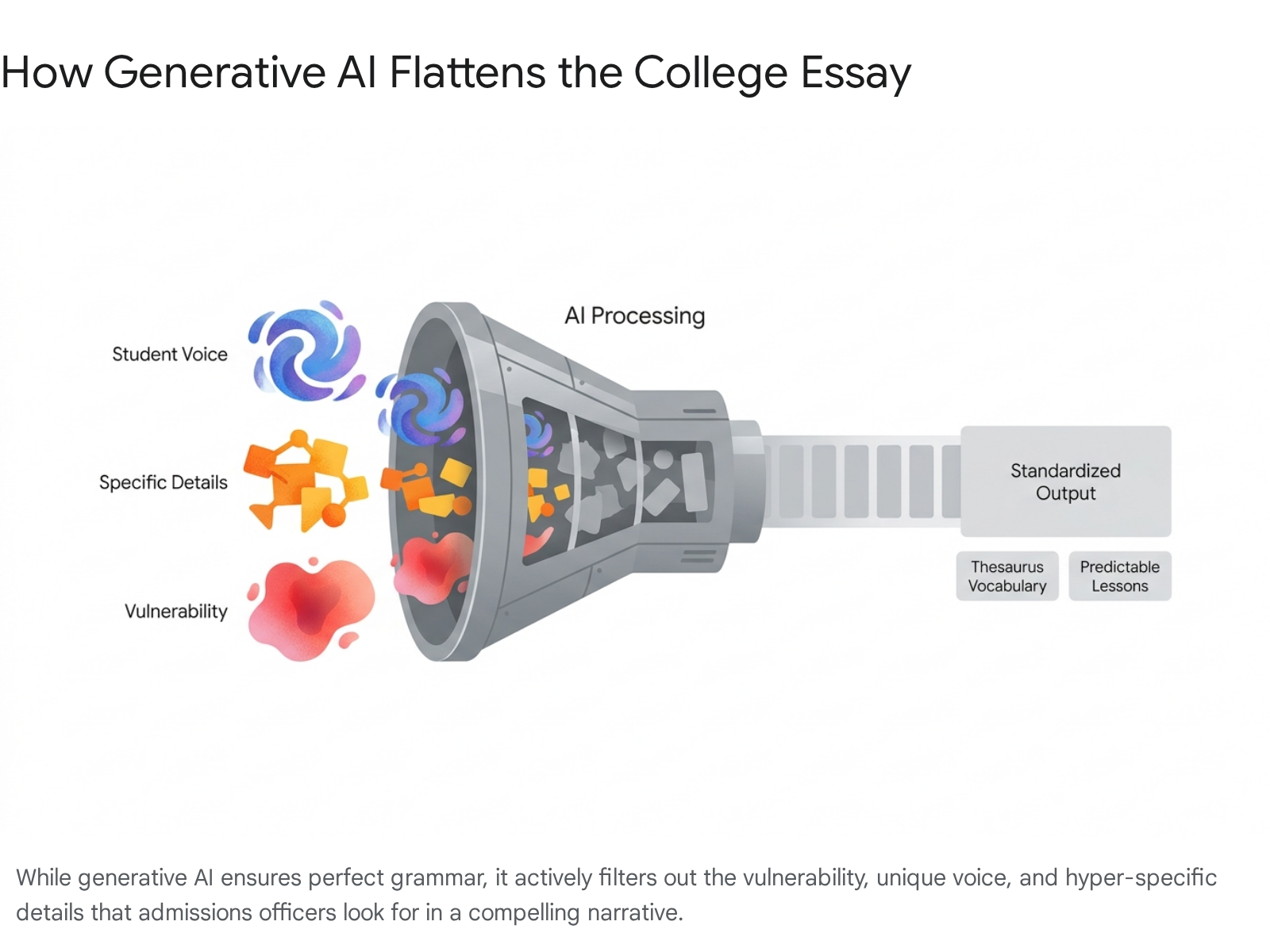
Admissions officers frequently refer to AI-generated essays as "philosophical word vomit" 26. Because generative AI operates by predicting the most statistically average and likely next word in a sequence, it naturally gravitates toward the exact clichés, sweeping generalizations, and inflated "thesaurus vocabulary" that admissions officers actively despise 262223.
According to Rick Clark, the Executive Director for Strategic Student Access at Georgia Tech, the best way for a student to bypass AI detection and write a genuinely winning essay is to lean heavily into hyper-specific, unique personal details. "That's not what ChatGPT does well," Clark notes regarding AI's inability to replicate deep personal specificity. "So, if a kid were to do what we tell them not to do [and use AI to write the essay], they're going to have a subpar essay because it's not detailed or specific enough" 23.
Navigating University AI Policies
The assertion that AI flattens the essay does not mean that artificial intelligence has absolutely no place in the modern application process. However, applicants must navigate this space with extreme caution, as university policies remain highly fragmented.
A 2026 analysis of 174 United States universities revealed that institutional approaches to GenAI vary wildly. While only a miniscule 2% of colleges have official policies allowing students to use AI to actively write their essays, 27% officially permit applicants to use GenAI for brainstorming and idea generation 2224. Furthermore, 21% of schools allow students to use AI to generate feedback on an essay they drafted independently, while a vast majority of institutions (over 68%) still have no official, codified policy regarding AI in admissions whatsoever 22.
Using a chatbot as an interactive sounding board to help outline thoughts, overcome writer's block, or check for basic grammatical flow is a valid strategy for some institutions, but the actual drafting, phrasing, and emotional reflection must originate from the applicant's own mind 232425. If an applicant's final essay reads like a flawless, dispassionate corporate memo, it serves as a massive liability rather than an asset.
Bottom line
The college essay remains the applicant's ultimate opportunity to humanize their data, offering admissions committees a vital window into their personality, values, and critical thinking processes. Applicants can maximize this opportunity by aggressively avoiding overused clichés, refusing the temptation to rehash their academic resume, writing in their natural, authentic voice, and ensuring that every narrative shared explicitly connects back to personal growth. While the landscape of university policies regarding artificial intelligence remains in flux, the fundamental truth of holistic admissions has not changed: highly selective institutions are looking to admit real, complex, and deeply reflective human beings, not perfect, robotic archetypes.