
How a Text Message Travels From Thumb to Screen
When you tap "send," your phone converts your text into a binary payload and transmits it as a radio frequency to a local cell tower, which seamlessly hands the data off to a vast, wired core network of fiber-optic cables and switching centers. Depending on the software protocol used, the message either routes through decentralized internet servers or navigates a highly specialized, legacy cellular labyrinth designed to locate the recipient's exact geographic coordinates. Within milliseconds to a few seconds, the data is pushed to the recipient's nearest cell tower and broadcasted to their antenna, illuminating their screen with your message.
The Modern Messaging Ecosystem: Choosing the Protocol
Before a message can even leave your device, your smartphone's operating system must make an invisible, split-second calculation to determine exactly how to package and transmit your data. In the early days of mobile telecommunications, there was only one universal standard for texting. Today, a "text message" is an umbrella term that encompasses several entirely distinct technological protocols, each relying on vastly different routing infrastructure and security standards.
When you open your messaging application and select a contact, your handset quietly negotiates the network capabilities of both your device and the recipient's device. If both users are operating within the Apple ecosystem with active internet connections, the device defaults to Apple's proprietary iMessage protocol. Introduced in 2011, iMessage bypasses traditional cellular routing architecture entirely. Instead, it encrypts the message end-to-end and transmits it as a standard data packet over Wi-Fi or mobile broadband to Apple's centralized servers, which then push the data payload to the receiving iPhone, iPad, or Mac 1234.
If the recipient is not utilizing an Apple device, or if iMessage servers are temporarily unreachable, modern smartphones will attempt to negotiate a connection using Rich Communication Services (RCS). Designed as the next-generation successor to standard texting, RCS is an industry standard backed by the GSM Association (GSMA) and Google. Like iMessage, RCS transmits over internet connections - either Wi-Fi or mobile data - and routes through cloud servers or carrier-operated messaging hubs 235. This protocol allows for modern messaging affordances, including high-resolution image and video sharing, real-time typing indicators, and read receipts 456.
However, if neither iMessage nor RCS can successfully establish a connection - or if one of the users is operating a legacy device or a basic feature phone - the system defaults to the original Short Message Service (SMS) or its media-capable extension, the Multimedia Messaging Service (MMS). The SMS protocol dates back to the dawn of digital cellular networks, with the first successful transmission occurring in December 1992 4. Unlike modern internet-based protocols, SMS and MMS do not require an active broadband connection. Instead, they ride along the cellular network's control channels - the underlying, low-bandwidth radio pathways that mobile operators use to manage voice calls and maintain network synchronization 247.
Comparing Core Messaging Protocols
| Technical Feature | Short Message Service (SMS) / MMS | Apple iMessage | Rich Communication Services (RCS) |
|---|---|---|---|
| Primary Network Layer | Cellular Voice/Signaling Control Channel | Internet Protocol (Wi-Fi or Mobile Data) | Internet Protocol (Wi-Fi or Mobile Data) |
| Data Payload Limits | 160 characters (SMS) | Practically Unlimited | Practically Unlimited |
| Media Resolution | Highly compressed (MMS capped ~300KB-1MB) | Uncompressed high resolution (100MB+) | Uncompressed high resolution (100MB+) |
| Cryptographic Security | None (Transmitted in plain text) | End-to-End Encrypted natively | Varies by client (E2EE native to Google Messages; pending on iOS) |
| Platform Compatibility | Universal (Functional on all mobile devices) | Exclusive to Apple hardware ecosystems | Native to Android; Supported on Apple devices (iOS 18+) |
| Delivery & Engagement Tracking | None | Real-time read receipts and typing indicators | Real-time read receipts and typing indicators |
The First Leap: From Device to Cell Tower
Once the messaging protocol is determined, your phone converts your typed characters into a binary format. If the system defaults to SMS, this binary data is encapsulated in a highly specific digital envelope known as a Protocol Data Unit (PDU) 6. The PDU contains not just the contents of your message, but vital metadata: your phone number, the recipient's phone number, a timestamp, and specific routing instructions for the network 6.
Your device's internal transmitter then translates this digital packet into analog electromagnetic radio waves. These waves are broadcast outward in all directions at the speed of light, seeking the nearest cellular base station - commonly known as a cell tower or a Base Transceiver Station (BTS). This initial wireless leap between your handset and the network hardware is referred to in telecommunications engineering as the "air interface."
While the speed of this radio transmission is practically instantaneous, the integrity and reliability of the air interface depend entirely on the physical environment and the laws of physics. Radio waves are subject to attenuation, meaning they lose strength as they travel over distance or pass through physical obstructions. If you are attempting to send a message from a concrete basement, an elevator, or a rural area far from infrastructure, your smartphone must dynamically increase its transmission power to successfully push the signal through to the tower. This is the primary reason cellular devices experience rapid battery drain in areas with marginal reception.
Entering the Core Network: The Short Message Service Center
Once the radio waves successfully strike the antennas atop the cell tower, the message makes a critical transition: it moves from the unpredictable wireless domain into the highly controlled, wired backbone of the telecommunications network. The cell tower acts as a digital bridge, capturing the radio signal, converting it back into fiber-optic light pulses or electrical data packets, and firing it into the carrier's core infrastructure.
If you transmitted an iMessage or a WhatsApp message, this data packet simply merges into the broader internet backbone, navigating through commercial routers until it reaches the respective corporate server. However, if you transmitted an SMS, the message enters a highly specialized, legacy routing maze governed by the Signaling System 7 (SS7) protocol 6910.
The first major processing stop for any SMS is the Short Message Service Center (SMSC). The SMSC can be conceptualized as the central post office and sorting facility for a mobile network operator 111213.
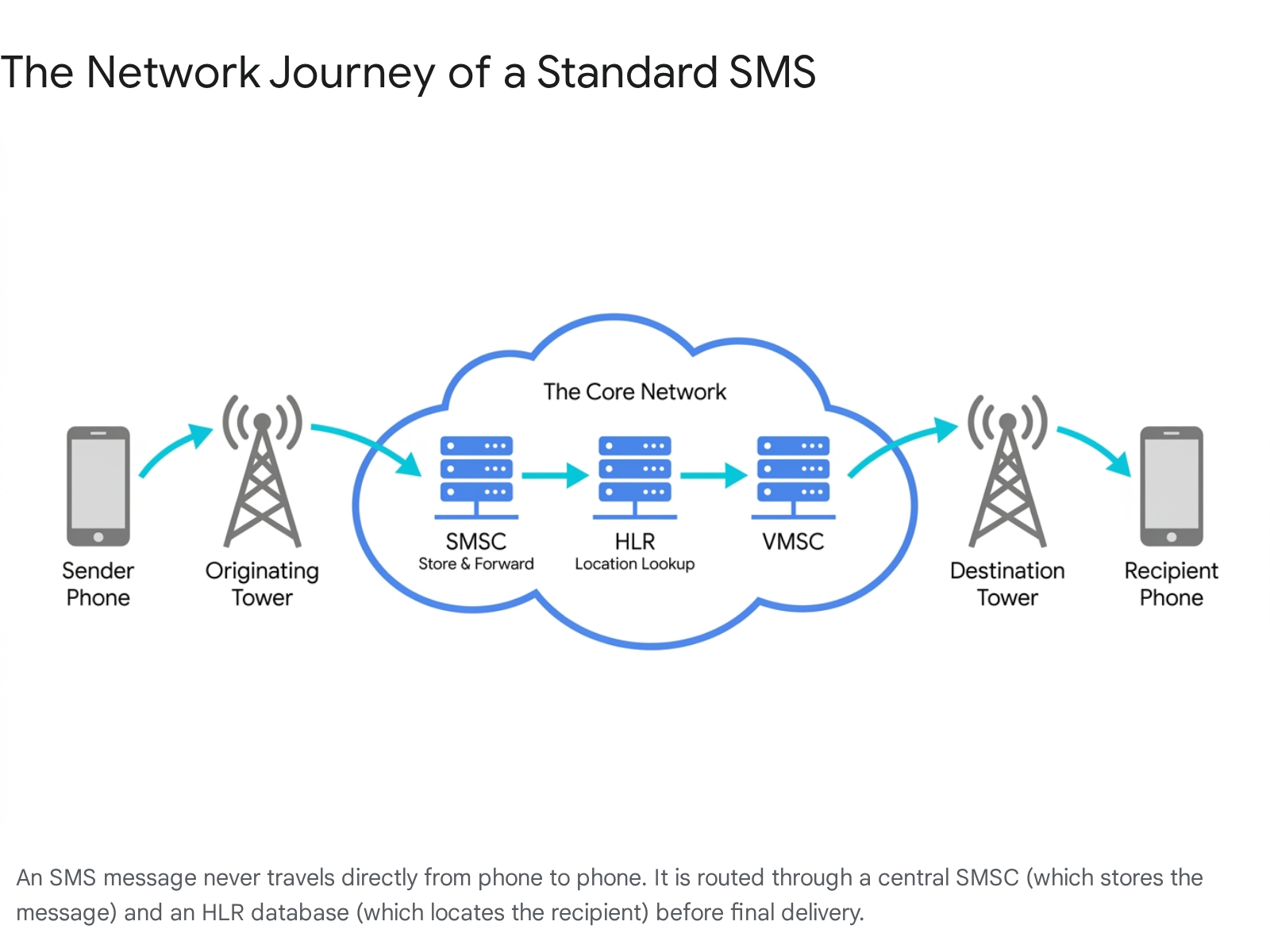
When the SMSC receives your transmission, it does not immediately attempt to blast it out to the recipient. First, the server acknowledges the successful receipt of the data back to your handset. This exact microsecond of acknowledgment is what prompts your smartphone to display the "Sent" status indicator beneath your text 1415. At this precise moment, the sender's device considers its job complete; the network now assumes total responsibility for the message payload.
The fundamental operational philosophy of the SMSC is known as "store-and-forward" architecture 111215. Upon receipt, the SMSC saves a persistent copy of your text message onto a localized server, assigns it a unique digital fingerprint and timestamp, and holds it securely. This architectural decision guarantees that the message will not simply vanish into the ether if the recipient happens to be driving through a tunnel or has a dead battery at the moment of transmission.
The Role of SMPP in Business Messaging
While human-to-human texting relies on the journey from handset to SMSC, a massive portion of global SMS traffic bypasses the human sender entirely. When a bank sends a two-factor authentication code, or an airline sends a flight delay notification, these messages originate from computer servers rather than smartphones.
To facilitate this, the telecommunications industry utilizes the Short Message Peer-to-Peer (SMPP) protocol. Developed in the 1990s, SMPP acts as a high-speed, direct digital pipeline connecting enterprise software applications - termed External Short Message Entities (ESMEs) - directly into the carrier's SMSC 9717. Rather than relying on radio towers for the initial hop, SMPP gateways allow businesses to inject thousands of messages per second directly into the core network's post office via standard TCP/IP internet connections 17. This application-to-person (A2P) messaging architecture is highly reliable and is projected to drive significant market expansion, with the broader mobile messaging industry expected to grow to nearly $295 billion by 2030 8.
The Detective Work: Locating a Moving Target
Once the SMSC has safely stored the message, its next mandate is delivery. However, cellular networks face a unique logistical challenge: cell phones are inherently mobile. Unlike a landline telephone, which corresponds to a fixed copper wire running to a specific physical address, a mobile subscriber's location changes constantly as they commute, travel, or fly across international borders.
To successfully route the data, the SMSC must function as a digital detective. It delegates this task to a specialized network node known as the Gateway Mobile Switching Center (GMSC) 620. The GMSC's sole purpose is to determine exactly where in the world the recipient is currently located.
To find the answer, the GMSC queries a massive, real-time database called the Home Location Register (HLR) 61020. The HLR serves as the master ledger for a telecom operator. It contains the service profiles, billing statuses, and real-time location data of every subscriber on the network. Because modern regulatory frameworks mandate Mobile Number Portability (MNP) - allowing users to keep their phone numbers when changing carriers - the GMSC may also need to query a dedicated MNP Database to ensure it is asking the correct carrier's HLR for the user's location 20.
When queried, the HLR checks its records to determine which specific cell tower the recipient's phone last communicated with. It replies to the GMSC with precise routing information, pointing to a Visited Mobile Switching Center (VMSC) 9. The VMSC is the localized network hub that actively manages the geographical area where the recipient is currently standing 109.
Armed with this geographic destination, the SMSC forwards the text message payload over the core network to the specific VMSC. The VMSC then pushes the data down to the local cell tower, which broadcasts the digital sequence over radio waves to the recipient's phone 6.
Upon successful decoding of the radio signal, the recipient's phone transmits an invisible, automated acknowledgment pulse back through the air interface to the cell tower, which relays it to the SMSC. Having received mathematical confirmation of delivery, the SMSC finally deletes its stored copy of the text message to free up server capacity. If the sender has "delivery receipts" enabled on their device, the SMSC simultaneously fires a tiny confirmation packet back to the sender's phone, updating the interface to display the word "Delivered" 121510.
The Store and Forward Lifecycle: When Phones Go Dark
A frequent point of friction in digital communication is understanding what happens to a message transmitted to a device that is powered down, damaged, or placed in airplane mode. Given the invisible nature of radio communication, users often wonder if these messages simply evaporate.
Thanks to the robust store-and-forward architecture of the SMSC, the message is entirely safe. When the GMSC queries the HLR to find the recipient, the database will report that the target device is currently detached from the network and unreachable 112324.
Rather than discarding the data packet, the SMSC places the message into a holding queue and initiates an automated retry cycle. The telecommunications carrier will periodically ping the network to check for the device's return over a predetermined window of time. This retry period varies significantly based on carrier policies and network congestion algorithms, but typically spans from 24 to 72 hours 1425.
The moment the recipient powers their handset back on, or drives out of a tunnel and back into a zone with cellular coverage, their device automatically transmits a registration pulse to the nearest cell tower. This pulse updates the central HLR with the device's new location coordinates. The network instantly recognizes that there are queued messages waiting in the SMSC for this specific subscriber, triggering a rapid flush of the stored texts down to the newly connected device 232526.
If, however, the target phone remains disconnected for longer than the carrier's designated retry window, the SMSC will inevitably "time out." At this juncture, the network assumes the message is undeliverable, permanently deletes the data to conserve server resources, and the message is lost forever 2527.
The Mystery of "Sent but Not Delivered"
One of the most persistent frustrations in modern telecommunications is the "silent failure" - instances where a message successfully displays as "Sent" on the originating device, but never reaches the recipient, even when their phone is powered on and actively connected to the network.
Because "Sent" only indicates that the originating carrier's SMSC successfully received the data, any breakdown in the subsequent relay chain results in a delivery failure. These failures generally fall into four distinct technical categories 1428:
1. Aggressive Carrier Filtering and Spam Detection: To combat the rising tide of SMS fraud and phishing, modern wireless carriers deploy sophisticated, automated firewalls that scan the contents of text messages in transit. If an SMS contains suspicious URLs (particularly link shorteners like bit.ly), overly promotional capitalization, or resembles known scam patterns, the recipient's carrier may silently quarantine and drop the message 293031. The sender is almost never notified that their message triggered a spam filter.
2. Device-Level Blocking and Operating System Settings: If a recipient has explicitly blocked a phone number at the operating system level, the network itself may successfully deliver the text to the handset, but the device's software will silently discard it before it can trigger a notification. Similarly, aggressive "Do Not Disturb" focus modes or improperly seated SIM cards can prevent the final rendering of the message, leaving the sender with an ambiguous non-delivery status 142931.
3. Account Deficiencies and Formatting Errors: Telecommunications routing relies on precise numerical formatting. Attempting to text a traditional landline telephone, or utilizing an incorrectly formatted international country code, will result in the routing software failing to find a valid destination HLR 282930. Furthermore, if the recipient operates on a prepaid cellular plan and has exhausted their allotted messaging balance, the carrier's billing node will intercept and reject the delivery attempt, even if the phone has a perfect signal 142930.
4. Inter-Carrier Handoff Failures: When transmitting a message to a subscriber on a different mobile network (e.g., from an AT&T user to a Vodafone user), the message payload must jump from the originating SMSC to the destination network's infrastructure. While usually seamless, temporary server outages, misconfigured short message service center numbers, or peak-time congestion during this inter-carrier handoff can result in data packets being dropped entirely 112930.
The Physics of Texting: Speed, Fiber Optics, and Latency
Users generally perceive text messaging as instantaneous, and under optimal conditions, the delay is imperceptible to human biology. However, quantifying the exact speed of a text message requires examining the intersection of physics and network engineering.
Once a radio signal is captured by a cell tower and converted into a digital pulse, it travels through the telecommunications core network primarily via fiber-optic cables. These cables transmit data utilizing rapid bursts of light. While the speed of light in a perfect vacuum is the absolute speed limit of the universe - approximately 299,792 kilometers per second - light behaves differently when traveling through a medium 1133.
Because the core of a fiber-optic cable is constructed of incredibly pure glass or plastic, the refractive index of the material slows the light down. In a fiber-optic network, data travels at roughly 200,000 kilometers per second, or roughly two-thirds the speed of light in a vacuum 113334. At this raw transmission velocity, a binary packet of information could theoretically cross the entire planet in approximately 66 to 70 milliseconds 35.
In reality, the actual "latency" - defined as the total round-trip time from sender to recipient - is dictated not by the speed of light, but by the friction of the equipment. Every time a data packet reaches a network node, a router, an SMSC, or an internet gateway, it must be electronically received, decoded, analyzed for routing logic, re-encoded, and fired back out. This processing overhead adds crucial milliseconds to the journey 11.
When analyzing enterprise-grade, internet-based messaging platforms (such as Slack or Google Chat), network benchmarking reveals that the median delivery latency typically hovers between 180 and 290 milliseconds, depending on the geographic routing complexity 36. However, "tail latency" - the time it takes for outlier messages caught in congestion to process - can stretch significantly. Data indicates that for certain platforms, like Microsoft Teams operating in the Asia-Pacific region, latency can spike to 3,100 milliseconds, resulting in a perceptible three-second delay that disrupts the real-time flow of conversation 36.
Standard SMS texts experience similar latency variables. While the radio transmission and fiber-optic transit occur in fractions of a second, the requisite database lookups at the HLR, the SS7 signaling handshakes, and potential SMSC queueing mean a standard text message typically takes one to three seconds to complete its journey from thumb to screen 1213.
Global Messaging Dynamics and the Digital Divide
While understanding the physics and architecture of a text message is critical, the manner in which human beings utilize these networks varies drastically based on geography, economics, and infrastructure.
According to the International Telecommunication Union's (ITU) 2024 global report, an estimated 5.5 billion people are now connected to the internet, representing roughly 68% of the global population 1415. This widespread connectivity has fueled a massive paradigm shift away from traditional, carrier-routed SMS toward Over-The-Top (OTT) internet messaging applications.
These third-party platforms dominate global communication. WhatsApp, owned by Meta, is the undisputed leader, boasting over 3 billion monthly active users (MAUs) and processing an estimated 150 billion messages daily 4142. In regions like China, WeChat commands 1.41 billion users, acting as both a messaging protocol and a comprehensive digital ecosystem 4142.
The World's Most Popular Messaging Platforms (2025 Estimates)
| Rank | Messaging Service | Estimated Monthly Active Users (MAUs) | Primary Regional Dominance |
|---|---|---|---|
| 1 | ~3.0 Billion | Global (Excluding US/China) | |
| 2 | WeChat / Weixin | ~1.41 Billion | China |
| 3 | Facebook Messenger | ~1.0 Billion | North America, Europe |
| 4 | Telegram | ~1.0 Billion | Eastern Europe, Middle East |
| 5 | Snapchat | ~932 Million | North America, Europe (Youth Demographic) |
Data aggregated from 2024/2025 global intelligence reports 41424316.
Despite the global ubiquity of internet messaging, a stark digital divide dictates who has access to these advanced, media-rich platforms. The ITU notes that while 93% of the population in high-income countries uses the internet, that figure plummets to just 27% in low-income nations 1415. In Africa, only 38% of the continent's population is online, heavily hampered by infrastructure gaps and extreme affordability barriers. In 2024, a basic 2GB mobile data plan cost an average of 4.2% of a user's income in Africa, placing broadband out of reach for millions 1718.
Furthermore, access to next-generation networks is highly skewed. While 84% of populations in high-income countries benefit from high-speed 5G coverage, a mere 4% of individuals in low-income nations have access to 5G infrastructure 1415. In rural and economically disadvantaged areas, populations continue to rely heavily on legacy 2G and 3G networks. For these billions of users, the traditional, 160-character SMS protocol remains an absolutely vital lifeline, as it requires virtually no data bandwidth and functions reliably on basic feature phones 710.
The Bubble Wars: Apple, RCS, and the Encryption Gap
In contrast to the global preference for WhatsApp and Telegram, the United States remains a unique technological anomaly. Due to the high domestic market share of Apple's iPhone hardware, coupled with historically cheap carrier SMS plans, American consumers rely overwhelmingly on the default messaging applications pre-installed on their devices 421920. This reliance birthed one of the most visible and socially charged phenomena in modern technology: the "blue bubble versus green bubble" divide.
Introduced in 2011, Apple's iMessage automatically intercepted texts sent between iPhones and routed them over the internet, coloring the message bubbles a distinctive blue 3421. However, when an iPhone user texted a non-Apple device (such as an Android phone), the iOS software deliberately fell back to the antiquated SMS/MMS network, coloring the resulting bubbles a stark green 42122.
Because SMS is an inherently limited technology, cross-platform conversations suffered from severe degradation. Videos sent between iOS and Android were compressed into blurry, pixelated artifacts; group chats would splinter or fail entirely; typing indicators vanished; and delivery receipts ceased to function 4623. Over the subsequent decade, this technological friction morphed into a profound social stigma. The "green bubble" became a widely recognized emblem of exclusion, particularly among younger demographics in the United States, subtly reinforcing Apple's ecosystem lock-in 222324.
The Reluctant Shift to RCS
For years, Google and the broader telecommunications industry championed the adoption of Rich Communication Services (RCS) to replace SMS as the universal baseline standard 1921. RCS offers parity with iMessage features, supporting uncompressed media, Wi-Fi routing, and dynamic conversation tools across all device manufacturers 35. Apple steadfastly refused to integrate the open standard, actively preferring the friction of SMS to maintain the perceived superiority of its proprietary platform 2122.
This paradigm shattered in late 2024. Facing intense, mounting pressure from international antitrust regulators - most notably the European Union's Digital Markets Act - and the looming threat of the U.S. Department of Justice, Apple finally capitulated. With the release of iOS 18, Apple integrated baseline support for the RCS protocol 42123.
Today, when an iPhone user texts an Android user, the message no longer defaults to the restrictive SMS network. It upgrades to RCS, allowing high-resolution photos, stable group chats, and typing indicators to flow smoothly across the smartphone divide for the first time in history 52353.
However, Apple made a highly deliberate, psychological user-interface decision: despite the massive technological upgrade under the hood, RCS messages originating from Android users remain colored green 222425. Apple explicitly confirmed that the blue bubble trust signal will remain strictly reserved for its proprietary iMessage protocol 52425. Consequently, while the technical limitations of the green bubble are largely resolved, the visual distinction separating "Apple users" from "everyone else" remains a permanent fixture of the interface 222555.
The Final Frontier: Cross-Platform Encryption
While the adoption of RCS resolves the aesthetic and media formatting issues between competing smartphone ecosystems, a critical, high-stakes technical vulnerability remains: cryptographic security.
When you transmit a blue-bubble iMessage, the data payload is protected by native End-to-End Encryption (E2EE). Only the specific devices belonging to the sender and recipient possess the digital keys required to decrypt the text. The data cannot be intercepted or read in transit by internet service providers, cellular carriers, law enforcement, or even Apple itself 1519. Similarly, when two Android users communicate via Google's implementation of RCS in the Google Messages app, their conversation is heavily encrypted end-to-end 51926.
However, Apple's initial integration of RCS into iOS 18 utilized a specific iteration of the GSMA standard known as "Universal Profile 2.4." This baseline open-industry profile does not possess native mechanisms for end-to-end encryption 272829. Consequently, as of 2025, cross-platform text messages between iPhones and Android devices are transmitted without E2EE 75327. These messages travel in plain text over carrier networks, leaving them theoretically vulnerable to interception, metadata scraping, or storage on carrier servers 727.
The global telecommunications industry is racing to close this critical security gap. The GSMA has formally introduced Universal Profile 3.0, a radically upgraded standard that incorporates the Messaging Layer Security (MLS) protocol 303162. Developed with cross-industry collaboration - including input from Apple - this standard is designed to facilitate robust, interoperable encryption regardless of the underlying operating system or device manufacturer 303162.
Code references discovered within iOS 26 beta releases strongly suggest that Apple is actively preparing to deploy Universal Profile 3.0 293032. When this implementation goes live, the text input box will likely adopt indicators such as "RCS Chat" accompanied by a lock icon, signaling a secure handshake between devices 32. Once fully deployed across the global network ecosystem, this upgrade will finally bring true, secure cryptographic parity to cross-platform messaging, ensuring that the journey from thumb to screen is not just instantaneous, but entirely private.
Bottom line
When you tap send on a text message, your device initiates a highly complex, millisecond-long relay race, transitioning analog radio waves into a globally connected web of fiber-optic cables and intelligent routing hubs. While legacy SMS infrastructure relies heavily on databases and "store and forward" architecture to guarantee delivery across fluctuating mobile environments, modern protocols like iMessage and RCS bypass cellular limits to deliver rich, internet-based media instantly. Although the long-awaited integration of RCS has successfully repaired the functional divides between competing smartphone ecosystems, the deployment of universal, cross-platform end-to-end encryption remains the final, critical milestone to secure global digital communications.