
How Teams Use AI Coding Assistants and What Research Says
By 2026, AI coding assistants have moved from experimental novelties to ubiquitous infrastructure, fundamentally transforming six distinct workflows from code generation to automated testing. However, rigorous controlled trials reveal a severe productivity paradox where developers feel faster but actually work slower, while simultaneously accumulating massive technical debt, degraded code comprehension, and novel security vulnerabilities.
The Global Adoption Landscape in 2026
If the period between 2023 and 2024 was the experimental phase for generative artificial intelligence in software development, 2026 represents the era of entrenched infrastructure. AI coding tools have transitioned from simple autocomplete plugins to autonomous agents that manage entire repositories and execute complex, event-driven workflows. Yet, the maturation of these tools has revealed a complex landscape defined by widespread usage, profound regional differences, and a widening gap between adoption and developer trust.
Mainstream Saturation and Daily Usage
Across multiple independent datasets in 2025 and 2026, AI coding tools reached near-saturation levels among professional developers. According to the JetBrains State of Developer Ecosystem report and their subsequent AI Pulse survey, up to 90% of developers regularly use at least one AI tool at work, with 74% utilizing specialized, dedicated AI coding assistants rather than general-purpose conversational models 12. The gap between casual experimentation and habitual reliance has essentially closed, with roughly 51% of professional developers reporting daily usage 134.
Enterprise deployment has mirrored this individual adoption curve. GitHub Copilot, the market leader by volume, surpassed 20 million users by mid-2025 and boasts a 90% penetration rate among Fortune 100 companies 134. When nine out of ten of the world's largest enterprises are paying for a technology, it ceases to be a competitive advantage and simply becomes the baseline cost of doing business 4. This massive deployment scale means that an estimated 41% to 46% of all new commercial code generated globally in 2026 is AI-assisted 145.
The Deepening Trust Paradox
The most counterintuitive trend in the 2026 software engineering landscape is the divergence of usage and trust. In traditional software lifecycles, familiarity breeds confidence. As developers use a framework or library more frequently, their trust in its reliability typically increases. With AI coding tools, the exact opposite is happening: increased exposure has bred profound skepticism.
Stack Overflow's year-over-year survey data illustrates this dynamic sharply. In 2023 and early 2024, positive sentiment for AI tools exceeded 70% 41. However, trust in the accuracy of AI outputs fell rapidly, plummeting to just 29% by 2026 34. Currently, more developers actively distrust AI accuracy (46%) than trust it (33%), and a mere 3% report "highly trusting" the output 1. Experienced developers express the highest rates of active distrust, indicating a widespread need for intense human verification among those holding accountability for production systems 1.
This decline is largely driven by the frustration of fixing code that is conceptually close but functionally flawed. Approximately 66% of developers cite their biggest frustration as dealing with AI solutions that are "almost right, but not quite" 34. As AI tools increasingly generate larger blocks of code, developers find that the time saved in the generation phase is often lost in debugging subtle logic errors, with 45% of developers reporting that debugging AI-generated code is more time-consuming than writing it manually from scratch 4.
| Metric | 2023/2024 Benchmark | 2026 Reality | Implication |
|---|---|---|---|
| Global Developer Adoption | ~70-76% | 84-90% | AI coding is standard infrastructure, no longer an optional experiment 23. |
| Daily Usage Rate | < 30% | 51% | High-frequency usage creates pressure to prove return on investment 134. |
| Trust in AI Accuracy | > 70% | 29% | Familiarity reveals limitations; developers trust AI less the more they use it 34. |
| Share of AI-Assisted Code | ~25% | 41-46% | A near-majority of global commercial code is now machine-generated 14. |
Regional Dynamics: North America, Asia, and Beyond
The narrative that Western markets uniformly lead the artificial intelligence revolution is contradicted by recent enterprise adoption data. While the United States remains the undisputed leader in foundational model quality, enterprise workflow maturity, and private venture capital investment (capturing 87% of global AI VC), everyday workplace AI adoption tells a markedly different story 78.
Asia has built a parallel, highly sophisticated AI ecosystem that operates at a larger scale in several critical dimensions. While 72% of workers globally use AI at least weekly, that figure jumps to 78% in the Asia-Pacific (APAC) region 8. Surprisingly, the highest workplace AI adoption rate in the world belongs to Indonesia at 92%, with Vietnam (88%) and the Philippines (86%) close behind 8. The APAC AI market, valued at approximately $102 billion in 2025, is projected to reach $735 billion by 2030, representing the fastest-growing large technology market globally 8.
In broader AI usage metrics tracked by Microsoft, the United Arab Emirates ranked first globally with a 64% adoption rate, Singapore ranked second at 60.9%, and Norway ranked third at 46.4% 7. By contrast, the United States ranked 24th overall at just 28.3% for general working-age population adoption, weighed down by high institutional skepticism and a societal trust rating in AI of only 32% 7.
However, researchers note that Asia's massive adoption is often "wide but shallow." Only 25% of APAC businesses report scaling generative AI with strong return on investment, and just 57% are actively redesigning their fundamental workflows for AI integration, compared to 70% among global leaders 8. The competitive dynamic in 2026 is not one of Asian markets catching up to North America, but rather two distinct ecosystems operating simultaneously, with China's generative AI software market projected to nearly match North America's by 2030 8.
6 Collaborative Ways Software Teams Use AI Today
In 2026, software engineering teams do not merely use AI to "write code" in a monolithic sense. The application of large language models in software development has segmented into six distinct, collaborative workflows 3. Organizations now evaluate, procure, and govern AI coding assistants based on how effectively they execute these specific functions within a broader team dynamic.
1. Code Generation and Scaffolding
Code generation remains the most prominent and easily measurable use case for AI assistants. This capability encompasses everything from simple autocomplete functionalities - predicting the next logical line or closing a standard loop - to generating entire architectural patterns from natural language prompts 39.
For greenfield development, where teams are building new features from scratch in empty or lightly populated repositories, AI assistants deliver their most undeniable value. They eliminate the initial friction of project setup by rapidly constructing the necessary scaffolding. Developers heavily utilize tools to generate routine API endpoints, standard database migration scripts, and boilerplate user interface components 110. Because boilerplate code is highly predictable and heavily represented in the training data of large language models, the generated output is usually syntactically flawless and contextually appropriate. This allows engineering teams to bypass the mechanical typing of standard CRUD (Create, Read, Update, Delete) operations and immediately focus on unique business logic 9.
2. Multi-File Refactoring and Legacy Migration
Refactoring involves restructuring existing computer code to improve its internal structure without altering its external behavior. Traditionally, this is a high-risk endeavor that requires a senior engineer to possess deep, holistic comprehension of the entire codebase to avoid breaking downstream dependencies. In 2026, advanced AI tools are increasingly deployed to execute complex, multi-file refactoring operations 13.
With the advent of massive context windows - most notably Claude Code's 1-million-token capacity and Windsurf's Cascade indexing - developers can ingest entire enterprise repositories into the model's active memory 1112. Instead of manually tracking down variable names across hundreds of files, restructuring deeply nested class hierarchies, or translating a legacy module from an outdated framework to a modern stack, developers utilize specialized interfaces like Cursor's Composer 1112. The AI processes the natural language directive, maps the dependencies, and executes sweeping changes across dozens of interconnected files simultaneously. However, researchers emphasize that while the AI manages the mechanical execution of the refactor, rigorous senior engineering oversight is required to validate that the new architectural design remains robust and coherent 2.
3. Error Resolution and Deep Debugging
Debugging has historically been one of the most cognitively demanding and time-consuming aspects of software engineering. Today, developers leverage AI assistants to accelerate the identification of root causes within stack traces, parse complex server error logs, and propose immediate patches 314.
When a continuous integration and continuous deployment (CI/CD) pipeline fails, or a local environment throws an obscure, undocumented error, the modern workflow dictates passing the raw error output directly to an AI agent. The assistant analyzes the log, cross-references it with the developer's recent file modifications, and suggests a localized fix 15. This is highly effective for catching syntax errors, missing dependencies, and common configuration mistakes. Yet, evidence indicates that AI models fundamentally lack the causal reasoning required to debug deep logical flaws that span multiple interacting microservices, often identifying correlations in the code rather than actual causal relationships 916.
4. Automated Testing and Coverage Expansion
Writing unit tests, integration tests, and end-to-end testing suites is widely considered essential for software stability, but it is frequently neglected due to time constraints and developer fatigue. AI assistants have proven remarkably adept at test generation, effectively transforming how organizations approach quality assurance 32.
Developers routinely highlight newly authored functions and prompt their IDE-integrated assistants to generate comprehensive unit tests covering standard inputs, edge cases, and expected failure modes. The AI instantly mocks external dependencies, configures the testing framework, and writes the assertions. This workflow has drastically improved baseline test coverage across the industry. In highly regulated enterprise environments, the utilization of AI-powered testing and scaffolding tools is transitioning from an optional productivity enhancement to a mandatory practice required to meet stringent compliance audits and cybersecurity insurance requirements 17.
5. Codebase Documentation and Technical Explanation
Code is read and analyzed far more frequently than it is written. Maintaining accurate, up-to-date documentation is a perennial challenge that AI is uniquely positioned to address 318.
Engineering teams utilize AI coding assistants to automatically generate standardized inline comments, author comprehensive README files for open-source repositories, and document complex API behaviors 18. Beyond generating new textual documentation, AI serves as an interactive reading aid. When a developer is onboarded to a new enterprise project or tasked with maintaining a decade-old legacy system, they can highlight dense, undocumented code blocks and ask the assistant to explain the function's purpose, its inputs, and what external data it mutates. This capability significantly lowers the cognitive barrier to entry for understanding complex, historically accrued systems 1819.
6. Seamless Research and Concept Discovery
The traditional developer workflow of leaving the Integrated Development Environment (IDE) to search search engines or community forums like Stack Overflow for technical answers has been largely disrupted by in-editor AI research 320.
Developers now rely on conversational AI agents to learn new programming paradigms, discover the optimal library for a specific architectural need, or ask highly contextual conceptual questions. Because the AI is embedded directly within the editor, the developer can ask questions rooted in their immediate reality. This seamless research loop accelerates problem-solving and minimizes context switching. However, this workflow introduces substantial risks if the developer accepts the AI's explanation without verification, as models occasionally hallucinate API capabilities or invent nonexistent technical solutions 19.
The Productivity Paradox: What Controlled Trials Reveal
The central narrative driving the rapid expansion of the multi-billion-dollar AI coding market is the promise of unparalleled developer productivity. Industry vendors and early corporate adopters have popularized staggering statistics to justify the investment. GitHub's foundational research claimed that developers using Copilot completed tasks 55% faster than control groups 3921. Annual surveys routinely show developers self-reporting that they feel 20% to 30% more productive when assisted by large language models 1722. Yet, rigorous scientific research from 2025 and 2026 suggests the reality of AI-driven productivity is vastly more complicated, highlighting a structural gap between micro-level task completion and macro-level organizational throughput 23.
Vendor Claims vs. Real-World Complexity
The initial data supporting massive productivity gains largely originated from constrained environments. Studies that recorded 55% speed improvements frequently tasked developers with building well-documented, standardized applications - such as a basic HTTP server in JavaScript - where the AI could draw upon vast reserves of nearly identical training data 21.
However, when applied to complex, proprietary enterprise codebases, the productivity metrics fracture. The BCG/Harvard "Jagged Frontier" study observed that while AI allows workers to complete tasks within its capability boundary 25% faster with 40% higher quality, the results invert when tasks fall outside that boundary. On complex tasks beyond the model's immediate training distribution, consultants using AI were 19 percentage points more likely to produce incorrect solutions than those working entirely without it 23.
The METR Randomized Controlled Trial
The most disruptive finding regarding AI productivity in software engineering emerged from a mid-2025 randomized controlled trial (RCT) conducted by METR (Model Evaluation and Threat Research) 2124. Unlike vendor-sponsored surveys or studies measuring simple coding exercises, the METR trial evaluated 16 highly experienced open-source developers working on their own familiar, large-scale repositories, which averaged over 22,000 GitHub stars and contained millions of lines of code 2124.
The developers were tasked with resolving 246 real-world issues, including complex bug fixes, feature additions, and system refactors. Each issue was randomly assigned to either allow or strictly forbid the use of early-2025 frontier AI tools, such as Cursor Pro integrated with Claude 3.5 Sonnet 2124.
The results challenged the fundamental industry consensus: researchers found that when experienced developers used AI tools to resolve real-world issues, they took 19% longer to complete the tasks than when they worked purely manually without AI assistance 223.
The Cognitive Illusion of Speed
Perhaps more startling than the objective slowdown was the massive perception gap recorded during the study. Before the trial began, developers forecasted that AI would speed up their task completion by 24%. After completing the tasks, and despite the stopwatch confirming they took 19% longer, the developers overwhelmingly self-reported that they believed the AI had made them 20% faster 213.
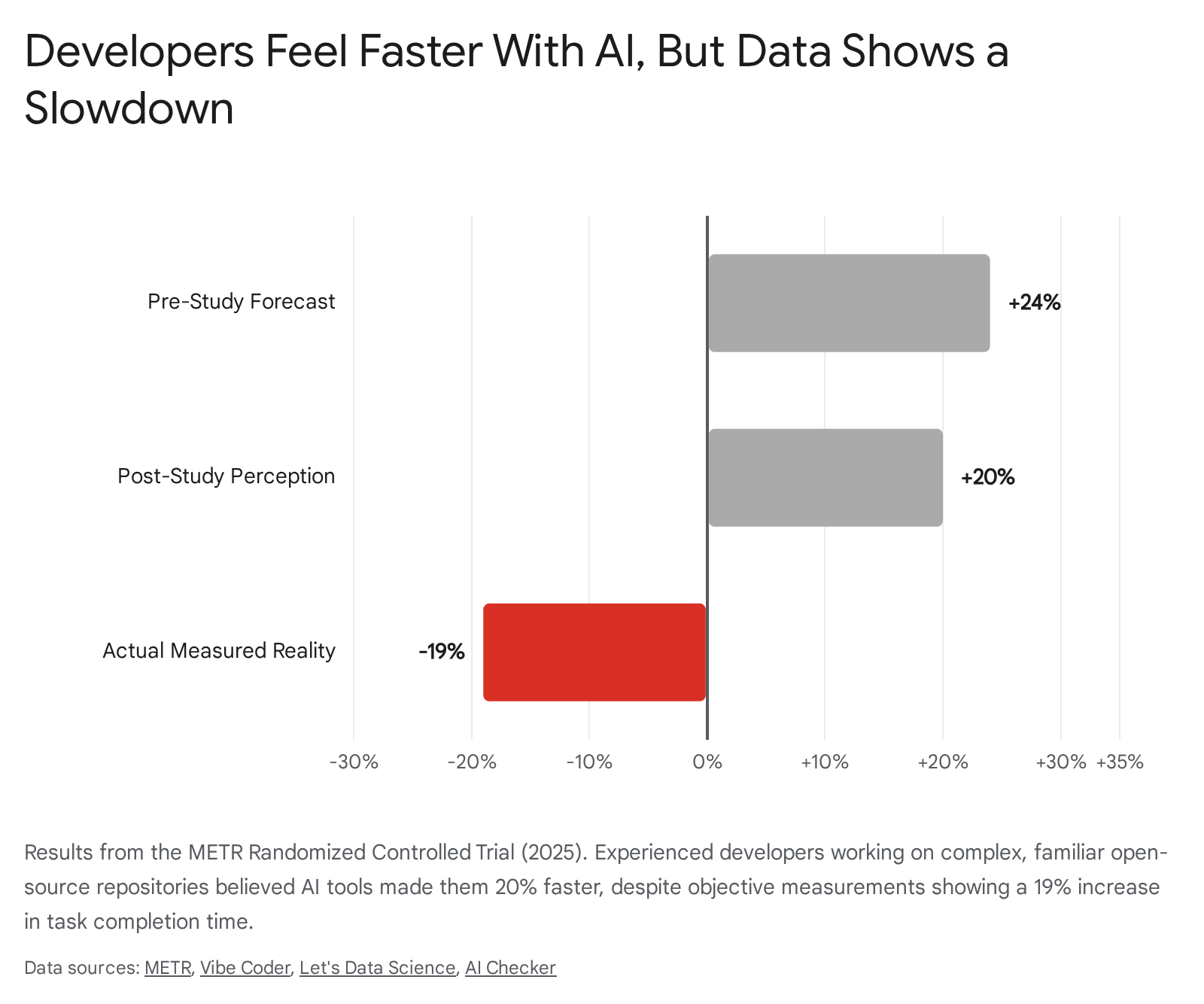
This 39-percentage-point gap between perception and reality highlights a profound cognitive illusion currently prevalent in modern software engineering 2122. Because AI handles the physical act of typing and generates massive blocks of text instantly, the process feels incredibly fast to the human operator. The developer experiences the dopamine hit of immediate output. However, the overall time-to-resolution expands because the developer must spend significant time tweaking prompts, reviewing generated logic, and debugging subtle errors introduced by the model 2122.
The Bottleneck Shift: Code Review and Rework
If AI models generate code instantly, it is crucial to understand where the development time actually goes. Research indicates that AI does not eliminate work; it shifts the bottleneck from the writing phase to the review and debugging phases.
A comprehensive Faros study analyzing over 10,000 developers found that teams utilizing AI completed 21% more tasks and merged 98% more pull requests. However, because human reviewers were overwhelmed by the sheer volume of AI-generated code, pull request review times ballooned by 91%, and the aggregate bug rate increased by 9% per developer 23. The human approval process became the primary organizational bottleneck.
Furthermore, Google's DORA (DevOps Research and Assessment) report observed that increased AI tool usage correlated with an estimated 7.2% reduction in overall delivery stability 1026. While raw throughput increased, it was accompanied by a higher "rework rate," meaning organizations suffered from more unplanned deployments, failed changes, and necessary rollbacks 2627. The velocity gains at the individual developer level were effectively neutralized by systemic instability at the organizational level.
The Erosion of Developer Comprehension and Skill
Beyond the immediate metrics of delivery speed and deployment frequency, academic researchers and industry analysts are increasingly concerned about the qualitative, long-term impact of AI on human cognition and skill acquisition. When developers allow an AI model to generate complex code logic, they frequently engage in "cognitive offloading" - outsourcing the critical mental effort required to deeply understand the underlying architecture of the systems they are building 284.
The Anthropic Study on Skill Degradation
The implications of cognitive offloading were quantified in a peer-reviewed randomized controlled trial published by Anthropic in early 2026. The study recruited 52 professional software engineers, predominantly junior developers, and tasked them with learning to implement a new, complex Python library for asynchronous programming known as Trio 2830. Participants were divided, with one group utilizing AI coding assistants and the other group relying on traditional documentation and manual coding.
The findings were stark: participants who utilized AI assistance scored 17% lower on subsequent conceptual comprehension tests than those who coded the tasks manually. This deficit is equivalent to a drop of nearly two full letter grades in an academic setting 430. Compounding the issue, the developers using AI did not experience any statistically significant speed improvement; they finished only an average of two minutes faster than the manual coders, trading deep comprehension for a negligible gain in velocity 431.
The Debugging Deficit
The 17% comprehension gap observed in the Anthropic study was not distributed evenly across all skill types; it manifested most severely in debugging scenarios 431.
During the trial, AI users initially encountered fewer raw syntax errors than manual coders. However, when complex logic errors or architectural mismatches did appear, the developers relying on AI were severely underequipped to resolve them 31. Because they had merely skimmed the AI-generated output rather than mentally parsing and constructing the logic line-by-line, they lacked the robust mental model required to troubleshoot the system effectively 3031. The research formalizes a growing industry truism: a developer cannot successfully debug a system they do not genuinely understand.
This creates what researchers term "verification debt." AI tools generate vast amounts of code that require rigorous review, but the very act of using the AI diminishes the developer's ability to review that code effectively 31.
Six Patterns of Human-AI Interaction
Anthropic researchers identified that the specific manner in which a developer interacts with an AI assistant dictates whether skill mastery is retained or destroyed. The study isolated six distinct interaction patterns, evenly split between constructive and destructive outcomes 3132.
The destructive patterns, which resulted in failing comprehension scores below 40%, included complete "AI Delegation" (where the developer entirely offloads logic generation to the model) and "Iterative AI Debugging" (where the developer blindly pastes error codes back into the AI without analyzing them) 3132.
Conversely, interaction patterns that preserved learning resulted in comprehension scores between 65% and 86%. These constructive methods involved using the AI as a tutor rather than a ghostwriter. Developers who asked conceptual questions, requested detailed explanations alongside generated code, or generated code but followed up with interrogative queries built strong mental models and retained their engineering skills 32.
Long-Term Impact on Junior Developers
The erosion of foundational skills poses a systemic risk for the software engineering industry. The junior developers of 2026 are increasingly utilizing AI to bypass the productive struggle of implementation 5. If the routine tasks that traditionally taught engineers how to architect, troubleshoot, and maintain complex systems are permanently delegated to machines, the industry pipeline that produces highly capable senior engineers threatens to collapse 5.
This theoretical risk is already reflected in macroeconomic hiring trends. According to Stanford University payroll data analyzing millions of workers, employment for software developers aged 22 to 25 fell by nearly 20% between late 2022 and early 2026, coinciding exactly with the mainstream adoption of generative AI coding tools 30. Meanwhile, employment for senior developers over the age of 26 held steady or experienced growth, indicating that organizations are prioritizing experienced oversight while hollow-out entry-level roles 1030.
The Accumulation of Technical and Architectural Debt
Technical debt is a long-standing software engineering metaphor describing the implied cost of future rework required when a team chooses an easy, short-term solution instead of a structurally sound approach. While humans have always generated technical debt, AI coding assistants have drastically accelerated the speed, volume, and stealth at which this debt accumulates, leading leading analysts to warn of an impending crisis 526.
The GitClear Findings on Code Churn
The most comprehensive data regarding the degradation of code quality stems from a 2025 study by GitClear, which analyzed over 211 million changed lines of code across corporate repositories owned by Google, Microsoft, Meta, and various enterprise C-corps between 2020 and 2024 226. The dataset revealed a structural shift in how software is authored in the AI era.
First, the prevalence of copy-pasted code rose from 8.3% of all changes in 2021 to 12.3% in 2024, a 48% relative increase. For the first time in the dataset's history, the volume of "copy/paste" code surpassed "moved" code, indicating an eightfold increase in duplicated code blocks 226. Second, traditional refactoring efforts - where developers consolidate and optimize existing logic - collapsed 526. Finally, code "churn" - defined as lines of code that are written and then entirely rewritten, reverted, or deleted within a two-week window - doubled in AI-heavy repositories, highlighting intense short-term instability 35.
The Rise of Comprehension Debt
The industry has coined a new term to describe the specific type of debt generated by large language models: "Comprehension Debt" 5. This refers to the silently growing gap between the massive volume of code pushed into production and the percentage of that code the human engineering team actually understands 5.
Because AI generates syntactically clean code that strictly follows linting rules and utilizes descriptive variable names, it easily passes superficial human code reviews. Reviewers experience acute fatigue when faced with 500-line, AI-generated pull requests. When the code looks superficially correct, the human brain tends to skim, leading to rubber-stamp approvals 527. The code merges successfully, but it may lack architectural coherence, fail to handle edge cases, or unnecessarily duplicate existing internal logic.
Multiple enterprise teams report experiencing an "18-Month Stall." In this pattern, the euphoric velocity gains achieved in the first three months of AI adoption eventually lead to delivery cycles stalling by months sixteen through eighteen, simply because the teams can no longer confidently navigate or safely modify their own bloated systems 5.
Architectural Debt at Scale
Software Improvement Group (SIG), an Amsterdam-based consultancy recognized by Gartner for technical debt management, warns that AI contributes massively to "architectural debt" 34. While AI coding assistants can reduce code-level debt by catching syntax errors or formatting issues, they operate within limited context windows. They suggest code that functions perfectly in isolated files but frequently fails to reflect the wider, holistic design logic of an organization's technology estate 3435.
SIG argues that as software teams and autonomous AI agents independently fill gaps to achieve short-term functionality, they inadvertently create highly complex, fragmented systems that become impossible to manage at scale 34. The severity of this trend is reflected in industry forecasts. Forrester researchers predict that by the end of 2026, 75% of technology decision-makers will face moderate to severe technical debt directly tied to the rushed, AI-assisted development approaches of the preceding years 3637. Furthermore, Gartner projects that 40% of all enterprise AI projects will face cancellation by 2027 due to escalating maintenance costs and weak architectural risk controls 5.
The Escalating Security Trade-Offs
The speed and output volume facilitated by AI coding assistants come at the direct expense of application security. Artificial intelligence models are trained on vast, unfiltered repositories of public and open-source code. Historically, this training data contains millions of insecure patterns, deprecated methods, and bad practices. Consequently, unless explicitly constrained, AI assistants frequently reproduce these known vulnerabilities in enterprise production environments 19.
Volume and Velocity of Vulnerabilities
The theoretical risk of AI-generated vulnerabilities materialized sharply in recent enterprise data. According to research from application security firm Apiiro published in late 2025, AI-generated code was linked to the introduction of over 10,000 new security findings per month across their studied repositories. This represented a staggering 10x spike in security incidents over a mere six-month period 19.
Further analysis reveals that AI-authored pull requests produce 1.57 times more security findings and 1.75 times more logic errors than pull requests authored entirely by humans 1019. Specific, high-risk vulnerability types are significantly exacerbated by AI usage. For example, AI-generated code is 2.74 times more likely to introduce cross-site scripting (XSS) and SQL injection vulnerabilities into applications 419. Overall, nearly 45% of AI-generated code samples fail basic security tests according to OWASP Top 10 standards, and repositories utilizing GitHub Copilot leak sensitive cryptographic secrets at a rate 40% higher than repositories without AI assistance 419.
Security analysts note that AI assistants frequently omit essential defensive programming constructs - such as robust input validation, role-based access controls, or rate limiting - unless explicitly and specifically prompted by the developer to include them 1019.
Slopsquatting and Supply Chain Attacks
Beyond traditional syntax vulnerabilities, the deployment of large language models has created a novel supply chain attack vector known as "slopsquatting" 19.
LLMs frequently "hallucinate" software packages, recommending that developers import libraries that sound highly plausible and relevant to the task at hand, but which do not actually exist in public registries like NPM, PyPI, or RubyGems. Studies show that nearly 20% of all AI-recommended software packages are nonexistent hallucinations 19.
Threat actors proactively monitor the outputs of popular AI coding models to identify these hallucinated names. They then register highly malicious packages under the exact names the AI invented. When an unsuspecting developer accepts an AI code completion containing the hallucinated package and runs their automated build process, they inadvertently download and execute the attacker's malware, instantly compromising their local machine and potentially the enterprise network 19.
The Evolution of the Tool Landscape
The landscape of AI coding tools has rapidly consolidated around a few dominant paradigms. As of 2026, the global market for AI coding assistants is highly lucrative, reaching over $7.3 billion and expanding aggressively 418.
The defining technological shift of early 2026 was the transition from passive "chat-and-edit" tools to proactive, autonomous coding agents 38. Modern tools do not simply wait for a developer to type a prompt; they run continuously in cloud sandboxes, monitor issue trackers, trigger on webhooks, and execute codebase-wide refactors autonomously 38.
GitHub Copilot: The Ubiquitous Standard
GitHub Copilot remains the undisputed market leader, holding approximately 42% of the enterprise market share and boasting near-universal deployment among Fortune 100 companies 438. Priced at a highly accessible $10 per month for individual developers, it offers the broadest integration across major Integrated Development Environments (IDEs), including VS Code, Visual Studio, Xcode, and JetBrains products 12385.
In 2026, Microsoft evolved Copilot by introducing the 'Coding Agent,' a feature that runs within GitHub Actions virtual machines to autonomously pick up issues, generate pull requests, iterate on review comments, and perform self-reviews of code without human intervention 1238. While it excels at single-issue tasks and broad accessibility, power users note it occasionally lacks the deep, holistic context awareness found in newer competitors 1240.
Cursor: The AI-Native Paradigm
Cursor represents a fundamental shift in how developers interact with AI. Rather than existing as a plugin, Cursor is an entirely standalone AI-native IDE built as a fork of VS Code. By early 2026, Cursor surpassed $2 billion in annualized recurring revenue and achieved immense popularity among professional engineers 3412.
Cursor's primary differentiator is its deep architectural integration of AI. Its 'Composer' interface handles complex, multi-file refactoring workflows seamlessly, allowing developers to manipulate entire systems visually 111. Furthermore, Cursor's 'Automations' feature launched always-on background cloud agents triggered by external events (such as a Slack message or a PagerDuty alert), allowing the AI to triage and resolve issues while the human developer is offline 1238.
Claude Code: The Terminal-Native Agent
Anthropic's Claude Code occupies a unique niche as a highly capable, terminal-native autonomous agent 540. While it offers IDE integrations, its primary strength lies in executing complex, multi-step command-line operations.
Claude Code leverages a massive 1-million-token context window, granting it unparalleled ability to ingest and understand massive enterprise codebases 1238. In 2026, Anthropic introduced the /loop command, allowing the agent to run recurring validation checks, alongside an AI-powered code review feature where specialized AI agents autonomously analyze human code for bugs, verify them, and rank them by severity 38. Consequently, Claude Code achieved a 91% customer satisfaction rating, the highest among all surveyed AI coding tools 3.
Alternative Players: Windsurf, Tabnine, and Amazon Q
While the "Big Three" dominate headlines, several alternative tools excel in specialized enterprise niches. Windsurf appeals to developers managing massive, interconnected projects by utilizing specialized 'Cascade' indexing, ensuring deep codebase awareness 1140. Tabnine remains the preferred choice for privacy-first enterprise environments, particularly in finance and healthcare, by ensuring strict data sovereignty and utilizing models trained exclusively on permissive open-source licenses 1141. Amazon Q Developer is heavily favored by organizations already entrenched in the AWS ecosystem, offering unparalleled integration with cloud infrastructure deployments 114041.
| AI Coding Assistant | Market Position & Pricing | Key Differentiators & Primary Use Cases |
|---|---|---|
| GitHub Copilot | Market Leader (42% share). $10/mo (Pro). | Unmatched ecosystem integration. Best for large teams, standard code completion, and converting GitHub issues to PRs via the Coding Agent 4385. |
| Cursor | AI-Native IDE. $20/mo (Pro). | Deepest AI editor experience. Excels at complex multi-file refactoring via Composer and background event-driven Automations 312385. |
| Claude Code | Terminal-Native Agent. $20/mo. | Highest context window (1M tokens). Best for async workflows, autonomous /loop commands, and AI-powered code reviews 31238. |
| Windsurf | AI-Native IDE. Pricing Varies. | Superior codebase indexing (Cascade). Highly effective for navigating and modifying exceptionally large repositories 1140. |
| Tabnine | Enterprise Privacy Focus. Varies. | Best for organizations requiring strict data privacy, local deployment options, and protection against IP infringement 114142. |
| Amazon Q | Cloud-Integrated Assistant. Varies. | Deep AWS integration. Best for DevOps teams managing cloud infrastructure, deployment scripts, and auto-scaling configurations 111541. |
Organizations increasingly realize that there is no single perfect tool. A hybrid workflow has become the standard among senior engineers: utilizing GitHub Copilot or Cursor for rapid, daily inline editing within the IDE, while deploying Claude Code in the terminal for complex, multi-file refactoring and autonomous architectural problem-solving 1243.
Enterprise Governance and the Path Forward
The mounting evidence regarding technical debt, security vulnerabilities, and cognitive degradation indicates that the unmanaged deployment of AI coding assistants is an unsustainable enterprise strategy. Organizations that survive the "18-Month Stall" and successfully leverage AI are actively shifting their focus from raw adoption to strict governance.
Re-evaluating Productivity Metrics
The fundamental problem facing engineering leadership in 2026 is measurement. Traditional metrics - such as lines of code written, velocity, commit counts, and sprint completion rates - are easily inflated by AI tools 527. When leaders optimize for these metrics, they inadvertently incentivize the rapid accumulation of technical debt.
Industry analysts emphasize that organizations must pivot to tracking outcomes rather than raw usage. Leading engineering teams now deprioritize feature velocity and instead rigorously measure time-to-merge, defect rates, code churn, and change failure rates 926. By tracking the "rework rate" - the frequency at which recently merged code must be fixed or rolled back - leaders gain an accurate assessment of whether AI is genuinely accelerating delivery or simply generating future maintenance burdens 2627.
Implementing Guardrails and Constrained UI
To mitigate the architectural and security risks of "vibe coding" - where developers blindly trust AI implementations without review - enterprises are enforcing robust structural guardrails 446.
First, security teams are integrating Static Application Security Testing (SAST) and Software Composition Analysis (SCA) directly into the pull request workflow, treating all AI-generated output as fundamentally untrusted code requiring automated validation before human review 19. Second, organizations are adopting "Constrained UI" frameworks. Instead of allowing an AI to hallucinate raw interface code from scratch, constrained systems like Puck or Vercel V0 force the AI to generate interfaces strictly using a predefined, heavily tested set of the organization's existing React components 6. This prevents the AI from inventing insecure patterns while maintaining high developer velocity.
Bottom line
In 2026, AI coding assistants have transcended their origins as experimental autocomplete tools, embedding themselves universally into the daily workflows of professional software engineers. While they offer undeniable velocity gains for generating boilerplate and automating testing, rigorous empirical data reveals a hidden cost: an alarming degradation of developer code comprehension, a surge in critical security vulnerabilities, and the rapid accumulation of architectural technical debt. The engineering organizations poised to succeed in the coming decade are not those generating the most AI code, but rather those enforcing strict governance, shifting performance metrics from raw speed to long-term stability, and treating AI as a highly capable but fundamentally fallible collaborator.