
Psychological drivers of B2B purchase decisions
The traditional paradigm of business-to-business procurement assumes a highly rational, data-driven process where organizational buyers strictly optimize for return on investment, efficiency, and cost reduction. However, modern behavioral economics, cognitive psychology, and procurement research reveal that organizational buying is fundamentally a human process, heavily influenced by psychological biases, emotional drivers, and social dynamics. Extensive analysis demonstrates that personal, emotional, and career-oriented factors consistently override pure business logic, fundamentally shaping how buying committees research, evaluate, and ultimately select vendors.
Foundational Behavioral Economics in Procurement
The Dichotomy of Emotion and Rationality
Despite the complex, multi-stakeholder nature of corporate procurement, professional buyers remain highly susceptible to the same cognitive heuristics and emotional triggers as everyday consumers. Research applying Nobel laureate Daniel Kahneman's behavioral economic principles to procurement contexts suggests that emotions drive approximately 90% of decision-making, with logical justifications accounting for only the remaining 10% 1. Consequently, purely emotional marketing campaigns in corporate spaces have been shown to be 31% more profitable than campaigns relying exclusively on rational, feature-based content 1.
Decision affect theory indicates that individuals, including professional buyers, make choices designed to maximize their future emotional experiences rather than merely optimizing economic utility 2. Buyers frequently select the option from which they expect to derive the maximum future psychological comfort, actively simulating future events to anticipate the emotional consequences of a purchase or a non-purchase 2. In fact, up to 80% of enterprise buyers report that emotional factors actively influence their decisions, even in multi-million dollar capital expenditures 3.
When organizational buyers initiate a supplier search, they experience a volatile psychological state characterized by a mixture of hope, anxiety, frustration, and surprise 2. Managing these emotional states becomes a critical mechanism for vendors. Positive affect facilitates heuristic, global processing, enabling buyers to make faster decisions and recall schema-consistent information, while negative affect, such as sadness or fear, triggers systematic, local processing where buyers rigidly scrutinize arguments and demand extensive documentation 2. As suppliers are evaluated, initial surprise or skepticism must be actively replaced by trust, which emerges as the single most important emotional state in the latter stages of the buying cycle for mitigating fear and anxiety 2.
Career Preservation and Institutional Risk
A primary emotional driver in organizational purchasing is the deep-seated aversion to personal and professional risk. Procurement decisions carry significant career implications; a failed software implementation, an underperforming vendor, or a security breach can permanently damage an individual's reputation, budget authority, and upward mobility 45. This dynamic manifests as "personal value" - the psychological and emotional payoff of a decision - which empirical studies suggest can be twice as important as pure business value in driving final purchase choices 4.
This psychological reality underpins several pervasive cognitive biases in corporate buying. The first is loss aversion and the status quo bias. The perceived pain of switching vendors or risking a new implementation often outweighs the potential future gains of adopting a demonstrably superior product 4. Buyers inherently prefer the safety of the status quo unless the cost of inaction is framed as an immediate threat to their competitive standing or operational survival 4.
The second major phenomenon is the reputation effect, historically summarized by the corporate adage that "nobody ever got fired for buying IBM" 4. Buyers demonstrate a strong gravitational pull toward established, well-known vendors because these entities offer implicit reputational insurance 4. Even if a dominant vendor's solution is technically inferior or more expensive, selecting a market leader de-risks the decision-maker's personal choice in front of peers and executive boards, allowing them to project an image of strategic prudence 4.
Finally, the diffusion of responsibility plays a critical role in institutional decision-making. In complex organizational hierarchies, the ability to distribute or deflect blame is often treated as being just as important as the quality of the decision itself 567. Behavioral studies on institutional decision-making reveal an inverse relationship between the scale of potential harm and perceived individual responsibility 7. Buyers require defensible choices with full audit trails, prioritizing psychological safety and career preservation over marginal performance gains or novel technological features 456.
Cognitive Biases in Pricing and Vendor Selection
The evaluation of pricing and technical attributes in organizational procurement frequently violates standard models of rational choice. For instance, the price-quality effect - a robust heuristic in consumer markets where higher prices are automatically assumed to indicate higher quality - yields mixed results in corporate environments 7. While a perfectly rational organizational buyer would evaluate price and technical quality entirely independently, research indicates that violations of rational decision-making persist, heavily influenced by the organizational context, environmental pressures, and the individual risk tolerance of the procurement manager 7.
Furthermore, corporate buyers are highly susceptible to the decoy effect, a cognitive bias where the introduction of a clearly inferior or overpriced third option systematically shifts preference between the original two options 4. In multi-tier enterprise software licensing or service agreements, introducing a "decoy" package that is only marginally better than a basic tier but slightly cheaper than a premium tier artificially inflates the perceived value of the premium option, engineering a psychological consensus that the highest-tier investment represents a strategic bargain 4.
The Architecture of the Buying Committee
Group Dynamics and the Escalation of Complexity
The architecture of corporate purchasing has evolved from isolated executive decisions into sprawling, consensus-driven committee exercises. The average buying group for complex solutions now involves between 10 and 13 individuals, spanning as many as four distinct business functions, including IT, operations, finance, security, and end-users 8910. In 2024, 72% of all purchases involved these high-complexity buying groups, with 52% of committees now explicitly requiring the participation of decision-makers at the Vice President level or above, and 79% requiring formal Chief Financial Officer approval 9.
Because of the sheer size of these committees and the competing priorities of diverse functional leaders, the organizational buying process has become highly fragile. Currently, 86% of all corporate purchases stall at some point during the buying journey, and 81% of buyers express active dissatisfaction with the provider they ultimately choose due to the exhausting friction experienced during the evaluation cycle 811.
The Anatomy of Unhealthy Conflict
This structural complexity inevitably breeds interpersonal and departmental friction. Recent survey data involving hundreds of procurement professionals indicates that 74% of buyer teams demonstrate "unhealthy conflict" during the decision-making process 10. Unhealthy conflict is structurally defined by scenarios where committee members hold contradictory strategic objectives, actively disagree on the preferred course of action, or are abruptly overruled by external executives or procurement compliance officers 10.
To mitigate this friction, successful selling organizations must transition their focus from individual stakeholder persuasion to broad consensus creation. When buying groups successfully navigate their internal politics and reach a unified consensus, they are 2.5 times more likely to report executing a high-quality deal and avoiding post-purchase regret 10.
Content Relevance Strategies
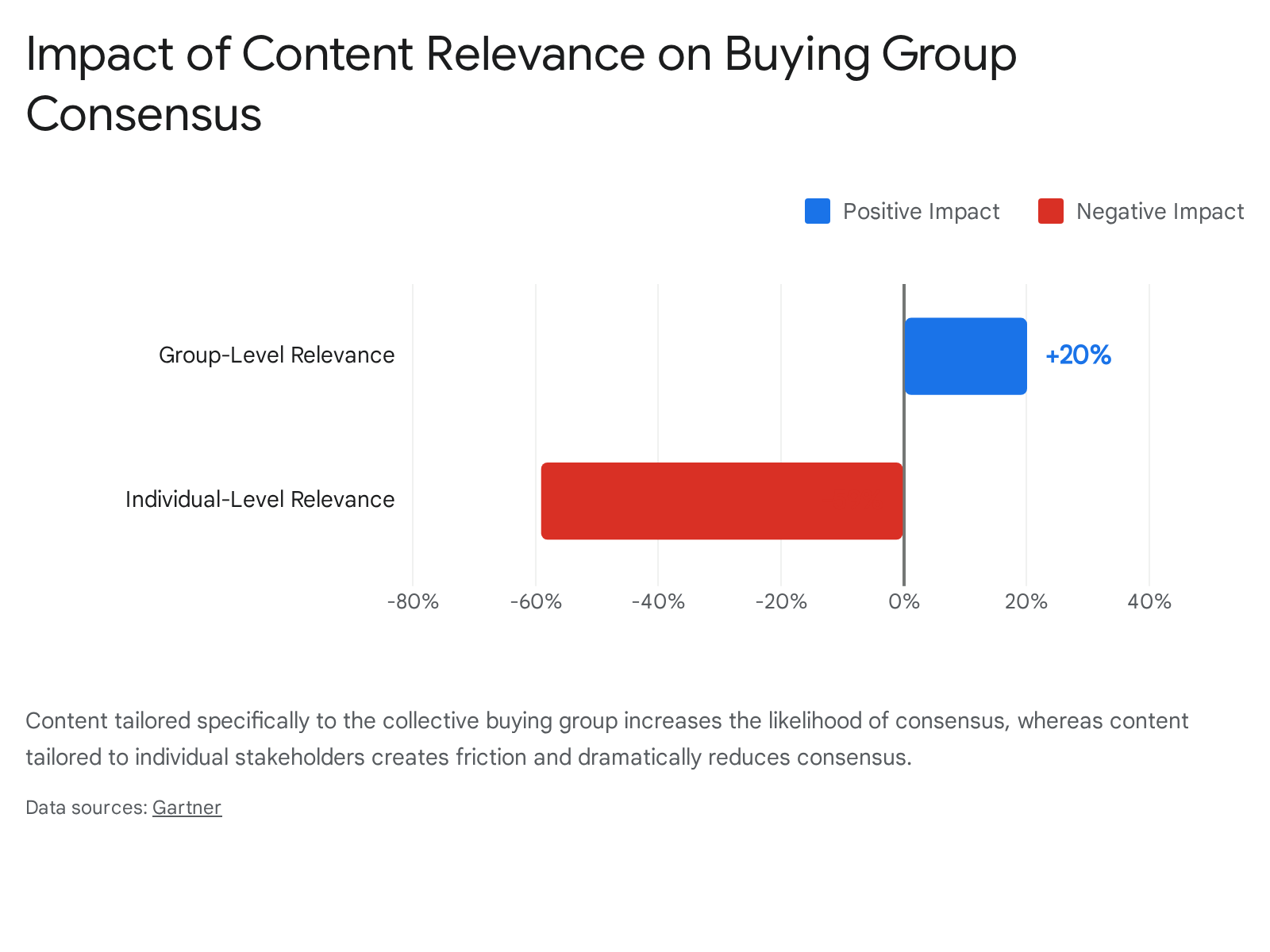
Crucially, the methodology used by vendors to tailor messaging profoundly affects the psychological cohesion of the buying group. While personalized marketing is widely touted as a best practice, tailoring content strictly to the individual professional level can actually be destructive in a committee environment.
Content that focuses heavily on individual-level relevance triggers confirmation bias, artificially inflating the perceived importance of narrow departmental requirements and entrenching divergent perspectives. This approach results in a 59% negative impact on group consensus, making stakeholders significantly less likely to compromise 10. Conversely, content explicitly tailored for buying group relevance - which actively aids stakeholders in understanding one another's distinct viewpoints and validates a shared, organizational-level decision-making framework - positively impacts consensus by 20% and drives higher overall deal quality 10.
The Non-Linear Buying Journey
The Six Buying Jobs and Looping Behavior
The traditional assumption of a linear sales funnel - where buyers move sequentially from awareness to consideration to purchase - fails to capture the psychological reality of modern procurement. Research frameworks identify six distinct "buying jobs" that committees must accomplish: problem identification, solution exploration, requirements building, supplier selection, validation, and consensus creation 1214.
Rather than progressing logically through these stages, buyers engage in complex "looping" behaviors 1213. Because 99% of organizational purchases are driven by broader internal operational changes rather than isolated technical needs, new variables constantly emerge during the evaluation process 12. Committees frequently revisit earlier stages, completely redefining their requirements after exploring initial solutions or failing to achieve internal validation, making the procurement timeline highly elastic and unpredictable 121413.
The Illusion of the Digital-Only Preference
Buyer behavior is increasingly mirroring consumer retail habits, with a pronounced shift toward autonomy. Current statistics reveal that between 61% and 75% of buyers express a preference for a completely rep-free, digital self-service experience 91114. However, a strictly rep-free process presents severe psychological pitfalls. Committees undertaking purely self-service digital purchases report significantly higher rates of post-purchase regret and implementation failure 111217.
While buyers favor autonomous digital tools for gathering general information, learning new concepts, and conducting initial market scans, their psychological needs shift abruptly during the validation phase 14. For tasks requiring contextual intelligence - such as determining whether a complex software architecture will seamlessly integrate with legacy proprietary systems - buyers still demand human intervention 14. They require sellers not as basic information conduits, but as expert sounding boards capable of mitigating perceived implementation risks 14.
The Rule of Thirds in Interaction Channels
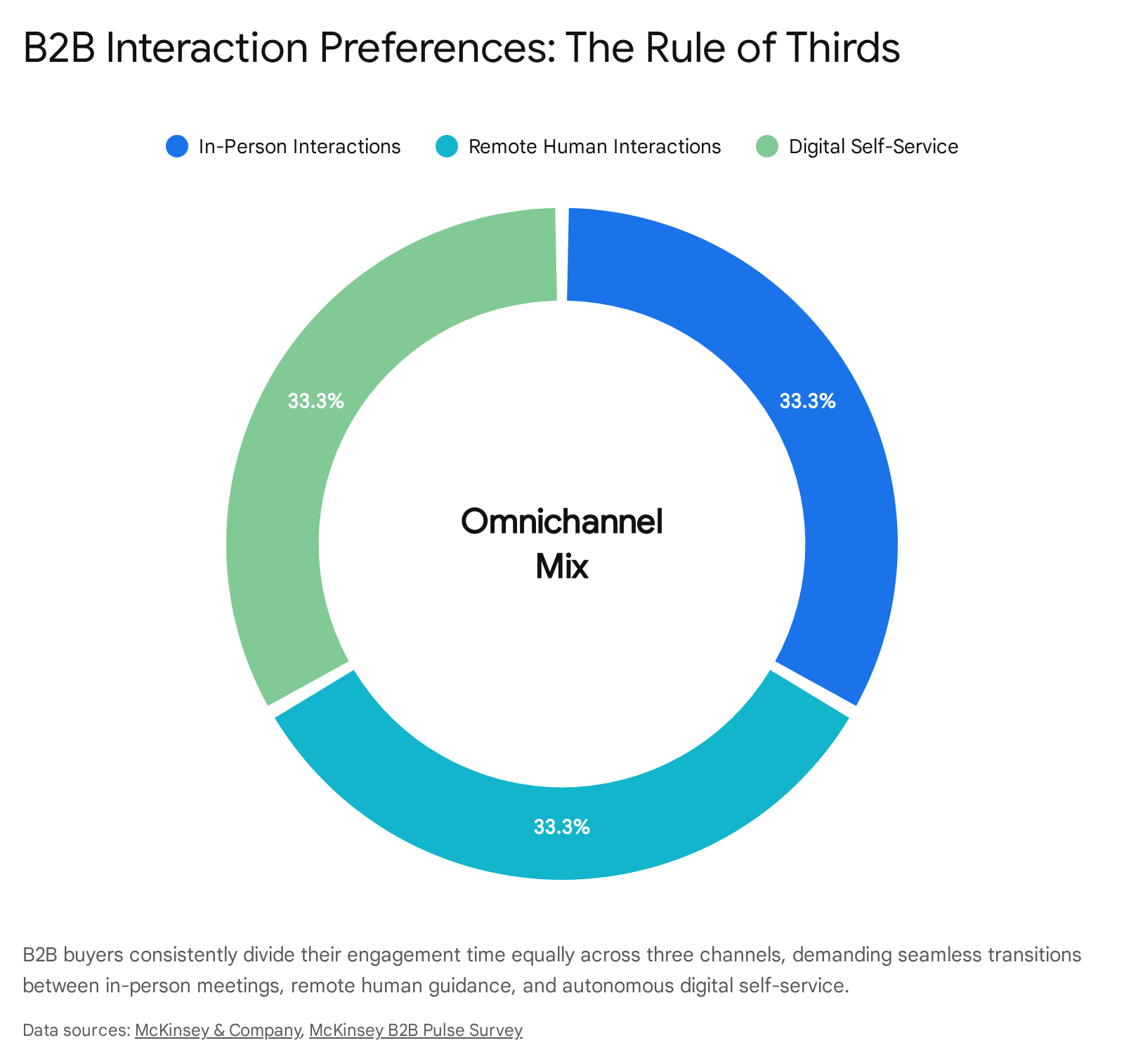
To navigate this tension between the desire for digital autonomy and the psychological necessity of human validation, successful organizations must deploy sophisticated omnichannel strategies. Extensive global survey data tracking nearly 30,000 respondents has identified a persistent "Rule of Thirds" governing modern procurement psychology.
Across varying geographies, industries, and company sizes, buyers distribute their interaction time almost perfectly equally among three channels: one-third dedicated to in-person interactions, one-third to remote human interactions (video conferencing and direct phone calls), and one-third to digital self-serve tools (e-commerce platforms, automated chatbots, and vendor portals) 18.
Buyers now utilize an average of ten distinct channels during their purchasing journey, representing a 100% increase from the five channels commonly used in 2016 15. Crucially, professional buyers possess zero tolerance for disjointed transitions between these environments. Over 54% of decision-makers indicate they will actively abandon a purchase or switch suppliers entirely if they encounter a poor-quality, fragmented omnichannel experience, demanding seamless continuity as they loop between autonomous research and human verification 15.
Early Shortlisting and Market Mindshare
This hybrid research behavior heavily dictates market outcomes long before a vendor is even aware a buyer is in the market. Buyers overwhelmingly rely on prior experience and pre-existing brand awareness to navigate the overwhelming volume of available choices 16. Currently, 81% of buyers choose their preferred vendors before initiating any formal sales contact, and 78% of buyers (rising to 86% in enterprise environments) populate their initial shortlists exclusively with products they had explicitly heard of before commencing their active research phase 916.
By day one of the formal evaluation, buyers have already placed approximately four out of five vendors on their shortlist, and 95% of the time, the vendor that ultimately wins the contract was already present on that initial list 9. The vendor ranked first prior to any sales contact wins the final deal roughly 80% of the time 917. This data indicates a severe "brand crisis" for unknown or highly niche vendors, as top-of-mind market leaders systematically edge out competitors simply by bypassing the cognitive burden of unknown risk during the initial selection phase 16.
Generative Artificial Intelligence and Algorithmic Trust
Generative AI as a Discovery Catalyst
The rapid integration of Artificial Intelligence (AI) has fundamentally altered the top of the sales funnel. According to extensive survey data, between 89% and 95% of enterprise buyers are now actively utilizing generative AI in at least one phase of their procurement process 818. Generative AI is actively displacing traditional search engines; a quarter of buyers now use generative models more frequently than conventional search tools for vendor discovery, and 66% of buyers use conversational AI chatbots as much as or more than traditional search 1920. Adoption is particularly pronounced in the technology sector, where 80% of buyers rely on generative AI for vendor research, compared to 28% in other industries 1920.
Buyers utilize AI to synthesize complex market data, compare feature matrices, summarize peer reviews, and draft internal evaluation documents at unprecedented speeds 19. Consequently, initial data suggested that global buying cycles were compressing - dropping from 11.3 months to 10.1 months - as AI enabled buyers to conduct deeper preliminary research in significantly less time 917.
The Accountability Paradox
Despite its operational efficiency, the reliance on artificial intelligence introduces severe psychological complications regarding institutional trust and accountability. While buyers are eager to use AI to build shortlists and digest content, they remain deeply skeptical of its ultimate veracity 21. Only 36% of buyers feel more confident in their decisions due to AI assistance, while 20% explicitly state they feel less confident because of encounters with algorithmic hallucinations and demonstrably inaccurate vendor information 21.
This dynamic creates a profound "accuracy versus accountability" paradox. In organizational settings, an AI analytical tool might be 95% accurate, but that 5% error rate represents an unacceptable career risk to the human buyer who must ultimately absorb the consequences of being wrong 5. Because procurement managers cannot successfully distribute blame to an algorithm when a multi-million dollar integration fails, "the AI said so" is not a defensible justification to a corporate audit committee 5. The highest-value use cases - complex, high-stakes decisions in finance, legal, and compliance - often see the lowest unverified adoption of AI recommendations precisely because the career risk of an algorithmic error is too severe 5.
The Enduring Premium on Human Credibility
Due to this accountability gap, the final stages of the purchase remain stubbornly reliant on traditional markers of human credibility and verifiable documentation. Buyers rank demonstrable industry expertise (52%) and overall brand trust above both price (49%) and strict product fit (46%) when making final selections 19.
As AI commoditizes basic feature information and generates infinite variations of marketing copy, the formal Request for Proposal (RFP) response and peer validation have become the ultimate proving grounds where vendor credibility is stress-tested 1920. To maintain credibility in an AI-saturated environment, vendors must implement rigorous human editorial oversight to ensure their automated outputs do not feature inaccurate specifications, which instantly erode trust with discerning, risk-averse buyers 22. As industry analysts note, while AI is drastically speeding up the mechanics of how businesses buy, it has not altered the psychological fundamentals of what buyers actually value 20.
Sales Methodologies and Psychological Intervention
Deconstructing the Challenger Sale Model
In response to the complex psychology of the modern buying committee and the natural tendency toward the status quo, behavioral research initially conducted by CEB (now Gartner) identified specific behavioral profiles among sales professionals 2324. Through self-assessments of over 130 attributes, researchers categorized sales behaviors into five distinct profiles: The Hard Worker, The Lone Wolf, The Relationship Builder, The Problem Solver, and The Challenger 232532333435.
Counterintuitively, the research revealed that the "Relationship Builder" profile is often the least effective in complex, enterprise-level environments 2425343536. While relationship builders focus heavily on nurturing trust, avoiding conflict, and satisfying immediate customer requests, their deeply accommodating nature makes them highly ineffective at overcoming the natural inertia of a risk-averse buying committee 24333626. They often connect with "talkers" within an organization who lack the internal political capital to actually drive consensus or finalize large-scale change 33.
Constructive Tension and Cognitive Reframing
Instead, the consistently highest-performing profile is the Challenger 2332343536. The psychological premise of the Challenger methodology relies on three behavioral pillars: teaching, tailoring, and taking control 2332342627. Rather than merely reacting to buyer-identified problems or conducting standard requirement-gathering exercises, Challengers utilize "constructive tension" 3226.
Challengers actively dispute the prospect's operating assumptions, introduce unconsidered operational risks, and fundamentally reframe the customer's perspective 23243226. This is achieved through a deliberate psychological sequencing: beginning with "rational drowning" - applying dense, irrefutable data and analytical logic to expose the hidden costs of the customer's current trajectory - followed immediately by "emotional impact," utilizing storytelling to connect how the systemic problem directly threatens the buyer's departmental goals and career standing 26. By safely pushing buyers out of their cognitive comfort zones, Challengers engineer a sense of immediate urgency that overrides status quo bias, elevating the vendor from a standard supplier to a trusted, authoritative advisor 232426.
Methodological Limitations and Risks
While highly effective, the Challenger methodology carries significant psychological risks if executed poorly. The inherently confrontational nature of challenging a senior executive's worldview can easily backfire if the salesperson lacks advanced emotional intelligence or industry credibility 2433. Customers may perceive the approach as arrogant, pushy, or condescending, leading to immediate defensive resistance 24. Furthermore, if the salesperson misidentifies the root cause of the customer's pain points and challenges them on the wrong strategic issues, the resulting friction permanently erodes trust and destroys the relationship 24.
Demographic and Cultural Market Segmentation
The psychology of corporate buying is not a monolith; it fractures significantly along the fault lines of organizational size, generational demographics, and regional business cultures.
Small and Medium Businesses Versus Enterprises
The psychological posture of a buyer shifts dramatically depending on the scale of their organization. Small and medium-sized businesses operate under entirely different constraints than multi-national enterprises, resulting in fundamentally distinct evaluation criteria and risk profiles 1328.
| Behavioral Dimension | Small and Medium Businesses (SMBs) | Enterprise Corporations |
|---|---|---|
| Buying Group Size | Compact and centralized (Typically 1 - 4 key decision-makers, often including the founder or owner) 1328. | Expansive and decentralized (6 - 13+ stakeholders across multiple rigid departments) 1328. |
| Sales Cycle Duration | Accelerated velocity (Typically concluding within 30 to 90 days) 1328. | Protracted timelines (Ranging from 6 to 18+ months) due to mandatory compliance, legal, and deep technical assessments 1328. |
| Primary Psychological Driver | Immediate urgency, rapid implementation speed, affordability, and clearly defined short-term value 28. | Extensive risk mitigation, long-term ROI, architectural scalability, and established institutional trust 28. |
| Decision-Making Style | Linear and highly predictable. Buyers progress from problem identification directly to solution selection 13. | "Looping" methodology. Buyers frequently revisit earlier stages of the decision process, continuously redefining requirements 1213. |
| Marketing Responsiveness | Highly responsive to short-term sales activation tactics, direct response, and clear feature comparisons 13. | Requires long-term emotional brand building, sophisticated account-based marketing, and consensus-oriented collateral 1328. |
The Generational Transition
A profound demographic transition is actively reshaping the psychology of corporate purchasing. Millennials and Generation Z professionals now account for 71% of all organizational buyers, a massive increase from just 64% in 2022 112930. By 2034, these younger cohorts are projected to account for 80% of the advanced economic workforce, bringing native digital expectations into the boardroom 30.
Younger buyers fundamentally reject traditional top-down, command-and-control decision-making models. They strongly prefer flatter organizational hierarchies and highly participatory, peer-driven processes 29. Decision-makers under the age of 40 naturally involve an average of 6.8 internal stakeholders in a standard purchase, nearly double the 3.5 stakeholders utilized by older executives 11. Despite involving more people, Millennials in leadership roles process information and reach conclusions 41% faster than their Baby Boomer counterparts 11.
Furthermore, younger cohorts are deeply reliant on external validation networks. Approximately 30% of younger buyers indicate that 10 or more people completely external to their organization actively influence their purchase decisions 31. Nearly three-quarters (72%) of modern buying teams now formally hire external consultants or industry analysts specifically to validate their technology choices 31. Consequently, they prioritize peer reviews, social media discourse, authentic influencer endorsements, and transparent case studies far above traditional vendor-supplied sales collateral 11303132.
Cross-Cultural Purchasing Psychology
Enterprise decision-making is heavily inflected by cultural norms, risk tolerance, and regional communicative practices. The assumptions underlying Western sales models frequently fail when exported without localization 4433.
| Geographic Region | Core Purchasing Psychology and Behavioral Characteristics |
|---|---|
| North America | Driven by a vision-oriented mindset focused on ambition, scale, and rapid transformation. Buyers respond favorably to narratives regarding competitive edge, high ROI, and rapid time-to-value. They expect fast scheduling, immediate pilots, and swift iterations. Notably, 74% heavily weigh the smoothness of the contracting and digital experience when considering renewals 93334. |
| Europe | Defined by a highly process-driven, risk-averse psychology. Buyers demand rigorous validation, detailed implementation paths, and robust security documentation before committing. Stability and reputation matter far more than theoretical transformation. Consequently, the European cycle is notably slower (averaging 9.8 months) and is characterized by the highest rate of stalled deals globally 173334. |
| Asia-Pacific (APAC) | Purchasing psychology is deeply intertwined with concepts of "face" (social standing) and the strict imperative of downside protection. Direct, aggressive sales tactics or artificial urgency often trigger deep hesitation 4447. Cognitive psychology studies show Asian buyers utilize "holistic" thinking, naturally concentrating on contextual relations, whereas Westerners utilize "analytic" attribute-focused thinking 35. Trust must be built incrementally through repeated exposure, third-party endorsements, and local partnerships 4447. Silence during negotiations frequently indicates discomfort rather than agreement 4447. |
| Latin America | Experiencing a massive surge in digitalization, with projections indicating 80% of sales transactions between suppliers and buyers will occur through digital platforms by the end of 2024. Fueled by banking reforms and AI adoption, there is a rapidly growing preference for direct, intermediary-free digital purchasing experiences that shift loyalty from individual sales agents directly to the corporate platform 36. |
| China | Represents a unique blend of ancient cultural values and hyper-modern digital adoption. Consumer and B2B habits are heavily influenced by online reviews; 75% of Chinese internet users actively post feedback, compared to less than 20% in the US 37. Brand perception is critically tied to social status and "cultural capital" 38. While highly receptive to Western goods associated with prestige, successful adoption requires brands to meticulously harmonize their offerings with traditional Chinese values and localized marketing narratives 3738. |
Balancing Brand Building and Sales Activation
Adapting the Binet and Field Framework
In broad consumer marketing, the widely accepted "Long and the Short of It" framework, developed by researchers Les Binet and Peter Field based on the IPA Databank, established the "60/40 rule" 3953. This rule recommends allocating 60% of marketing budgets to long-term, emotional brand building designed to increase mass awareness, and 40% to short-term, rational sales activation designed to capture immediate conversions 39535440.
Recent empirical analyses of datasets specific to business marketing confirm that these core psychological principles apply equally to the corporate sector, albeit with slightly altered optimization ratios 4056. Binet and Field's research demonstrates that in the corporate sector, the optimal investment split shifts to approximately 46% for broad brand building and 54% for targeted sales activation (lead generation) 40.
Despite the persistent industry assumption that professional buyers only respond to cold logic and specification sheets, Binet and Field's research proves that effective brand building is fundamentally an emotional exercise 4057. Emotional advertising engages "System 1" processing (the fast, intuitive part of the brain), successfully bypassing the critical filters of the rational mind to create lasting "mental availability" 395354. By anchoring these memory structures with emotional resonance or "fluent devices" (recurring characters or themes), vendors ensure that when an out-of-market buyer eventually recognizes a corporate need, the vendor's brand is intuitively and effortlessly recalled 395354. Analysis of over 40,000 campaigns demonstrates that 92.1% of advertisements achieving high ratings for long-term emotional brand building also achieved above-average short-term sales spikes, proving that emotion effectively supports both horizons 53.
Conversely, rational messaging is highly effective strictly for short-term sales activation. Once a buyer is actively in the market and has been emotionally primed by prior brand exposure, rational marcom (marketing communications) highlighting specific features, ROI, and promotional pricing efficiently harvests that existing demand, converting mental availability into active pipeline opportunities 395440. Binet and Field outline five key principles for B2B growth based on this psychology: setting Share of Voice (SOV) above Share of Market (SOM), balancing the budget between brand and activation, focusing on expanding the total customer base rather than pure loyalty, maximizing mental availability, and harnessing the power of emotion 4056.
Framework Critiques and Contextual Variables
While highly influential, the Binet and Field framework is not without academic and practical criticism. Detractors argue that the original research datasets are heavily biased toward massive, established, pre-digital enterprise corporations with vast capital reserves 41. Critics suggest the model fails to fully account for the realities of modern digital-first strategies, where rapid algorithmic experimentation, highly targeted performance marketing, and precise data-driven decisions dominate the operational reality of modern growth teams 41.
Furthermore, the optimal balance is highly contextual. Startups and small businesses operating with limited venture capital often cannot afford the luxury of delayed returns. They must temporarily skew their allocation heavily toward sales activation (frequently adopting a 30:70 brand-to-activation ratio) to validate product-market fit, secure initial pilot customers, and maintain essential operational cash flow 41. However, even in these constrained environments, entirely neglecting foundational brand-building activities starves the top of the funnel over time, preventing the establishment of the psychological trust and recognition required for long-term pricing power and category dominance 5441.