
How Much Screen Time Do Kids, Teens, and Adults Get
Global screen time averages approximately six hours and forty-five minutes daily, with adolescents dedicating over eight hours to recreational digital media. While overall usage remains at historic highs, medical experts are shifting their focus away from strict time limits toward evaluating the quality of content and its broader impact on mental health. Achieving digital well-being now centers on minimizing passive consumption, fostering intentional engagement, and preserving essential offline activities.
The Global State of Screen Time in 2025 and 2026
Screen exposure surged globally out of necessity during the COVID-19 pandemic as populations shifted to remote work, virtual classrooms, and digital socialization. While researchers anticipated a sharp drop in usage once schools and offices reopened and physical socialization resumed, global data indicates that elevated digital consumption was not a temporary spike, but rather a permanent behavioral shift 123.
The Return to Pandemic Peaks and the New Baseline
By the first quarter of 2026, global screen time had climbed back to pandemic-era peaks, averaging between 6 hours and 40 minutes and 6 hours and 54 minutes per person, per day 1456. Rather than being forced indoors by lockdowns or stay-at-home mandates, this sustained usage is voluntary, habitual, and deeply integrated into how modern society works, shops, and socializes 17.
The scale of this digital immersion is profound. Assuming an average of eight hours of sleep per night, the typical internet user now spends roughly 40% to 42% of their waking life looking at a digital display 18. At the current global rate, the average person will spend roughly 19 years of their life staring at screens, while younger, digitally native generations are projected to spend nearly 29 years of their lifespans looking at devices 1.
Researchers point to a stabilization at these historically high levels. After a slight dip in 2022 when pandemic restrictions broadly lifted, growth resumed in 2023 and accelerated through 2024 and 2025 158. This stabilization reveals a fundamental truth about modern society: screens are no longer an adjunct to daily life; they are the primary infrastructure through which life is conducted 8.
Mobile Dominance Versus Desktop Utilities
While laptop and desktop computers remain essential for professional productivity and specific gaming demographics, the smartphone has cemented itself as the primary conduit for the global digital experience. Across the world, mobile devices account for roughly 53% to 57% of total screen time, with global mobile screen time averaging around 4 hours and 37 minutes per day 8345.
Conversely, desktop and computer screens represent roughly 43% to 47% of total screen time, averaging just under 3 hours and 14 minutes per day 685. This split is largely dictated by employment status, with working-age adults contributing the most to desktop screen time, while teenagers and seniors skew heavily toward mobile and television screens, respectively 812.
Geographic and Cultural Disparities in Digital Engagement
Geographic infrastructure, cultural norms, and economic factors play massive roles in determining how much time regional populations spend online. Countries with younger overall populations and heavy mobile-first internet infrastructure tend to drastically outpace regions with older demographics and legacy broadband systems.
| Country | Average Daily Screen Time | Primary Drivers and Regional Context |
|---|---|---|
| South Africa | 9 hours, 24 minutes | Leads globally in daily internet usage, driven heavily by mobile adoption and extended online communication 4634. |
| Brazil | 9 hours, 13 minutes | High smartphone penetration (98%) and intense social media usage drive massive daily engagement 364. |
| Philippines | 8 hours, 52 minutes | Extensive mobile gaming, social network engagement, and high daily mobile screen time (over 5 hours) 464. |
| United States | 7 hours, 2 minutes | High engagement across streaming television, remote work, and algorithmic social feeds. Americans check phones roughly 144 times daily 46812. |
| Global Average | ~6 hours, 45 minutes | Represents the baseline mix of digital work, streaming, and social media connectivity 568. |
| United Kingdom | 5 hours, 36 minutes | More moderate overall usage, offset by a stronger cultural retention of traditional linear television and broadcaster content 44. |
| Japan | 3 hours, 56 minutes | The lowest among surveyed nations, driven by cultural digital restraint, older average demographics, and less social media dependency 4634. |
Generational Divides: How Age Dictates Digital Diet
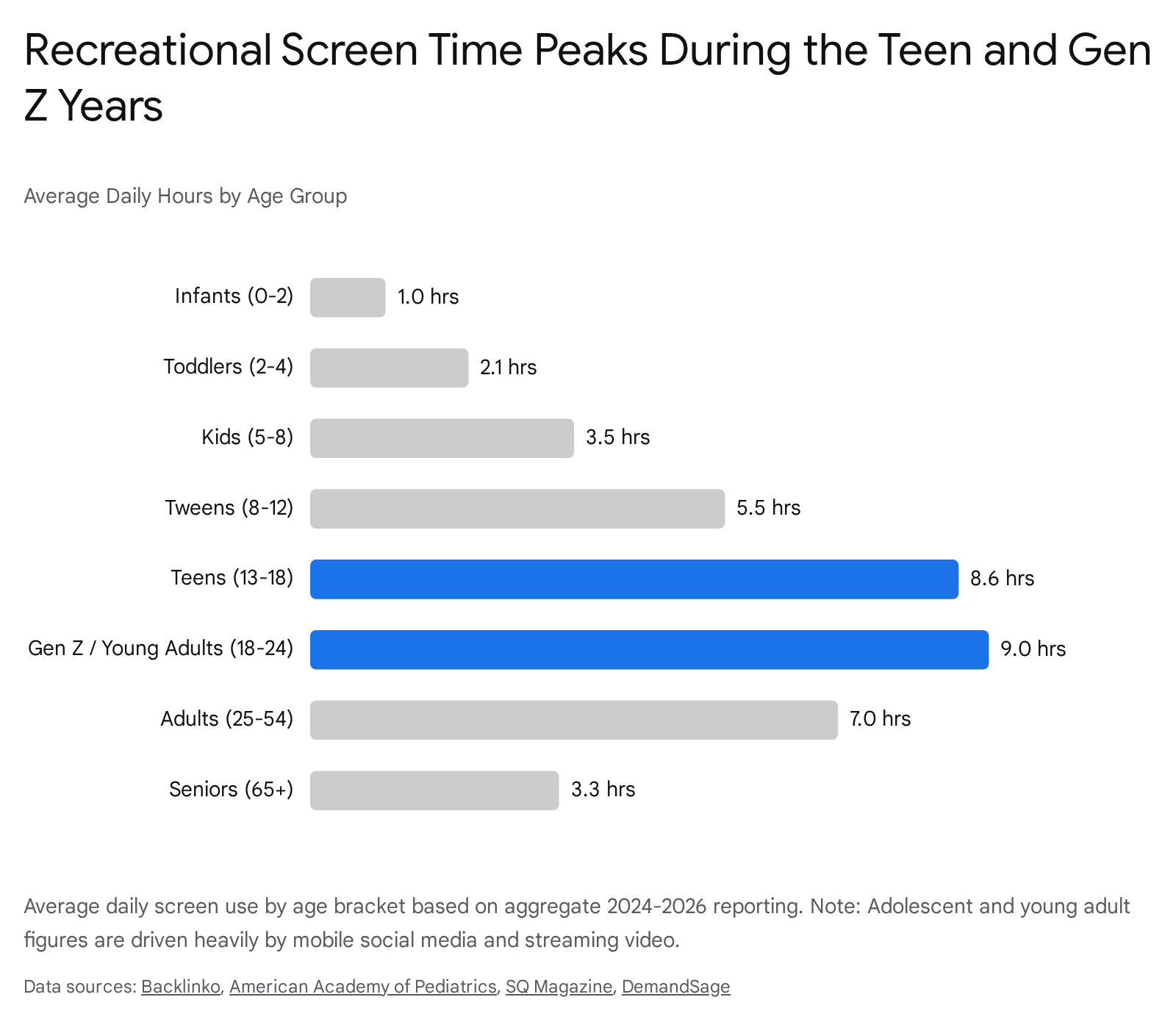
The differences in technology use across age groups are staggering. The data reveals a distinct, predictable curve: screen time starts low in infancy, accelerates rapidly through the tween years, peaks dramatically during the teenage and young adult stages, and tapers off as populations enter their senior years.
Infants and Toddlers (0 - 4 Years): The Early Integration of Screens
Despite guidelines from health organizations advising against early exposure, screens are introduced almost immediately in modern households. The 2025 Common Sense Census revealed that children are acquiring screens at unprecedentedly young ages. By age two, 40% of children own their own tablet, a number that jumps to 58% by age four 614.
Consequently, usage metrics are high from the outset. As of 2026, 98% of two-year-olds interact with screens on a daily basis, averaging roughly 129 minutes (over two hours) of use 15. This is more than double the World Health Organization's recommended maximum of 60 minutes for children aged two to four 1. For infants under two years old, the average hovers around one hour and three minutes per day 57.
The driving force behind this early adoption is often parental necessity. In surveys conducted across the United States, 49% of parents admit to relying on screen time every day to help manage parenting responsibilities 89. One in four parents utilize screens as a stand-in babysitter because they cannot afford childcare, and 28% provide screen time multiple times a week specifically to avoid toddler meltdowns or tantrums 9. Furthermore, one in five families report using mobile devices to manage their child's bedtime routines and mealtimes 6. Parents frequently balance this convenience with intense guilt; 60% of surveyed parents feel guilty about their child's screen time, fearing they are sacrificing family cohesion and critical development 9.
School-Aged Children and Tweens (5 - 12 Years): The Shift to Interactive Media
As children enter school, their screen habits diversify. Children aged five to eight consume roughly three and a half hours of screen time daily 5147. Nearly two-thirds of this time is dedicated to watching streaming television and online videos 10.
The transition into the "tween" years (ages 8 - 12) brings a sharp acceleration in usage. Tweens average about five and a half hours (5 hours, 33 minutes) of daily screen-based entertainment 5147. This is the developmental stage where interactive gaming and early social media exploration begin to take precedence over passive educational television. Approximately 64% of tweens play online video games daily, and 43% play mobile games 7. Despite age restrictions on most platforms, 38% of tweens report having used social media, with 18% using it every day on platforms like Snapchat, Instagram, and Discord 711.
Gender differences also emerge during this phase. Tween boys average approximately 6 hours and 11 minutes of daily media use, heavily driven by interactive gaming, while tween girls average roughly 4 hours and 55 minutes 7.
Teenagers (13 - 18 Years): The Social Media Ecosystem
The teenage demographic represents the most profound shift in digital behavior, characterized by massive consumption and intense social connectivity. Excluding time spent on screens for schoolwork or remote learning, American teenagers average 8 hours and 39 minutes of entertainment screen time per day 5814. Over 41% of teenagers spend more than 8 hours per day on screens, and over 50% report 4 or more hours of daily usage 81412.
For teenagers, the internet is not merely a place they "visit" - it is the primary infrastructure of their social lives. According to 2024 and 2025 data from the Pew Research Center, nearly half of all teens describe their online presence as "almost constant" 1314. YouTube remains the most universally dominant platform, visited daily by roughly three-quarters of teens, with 90% reporting they use the site 131516.
However, algorithmic short-form video has captured adolescent attention uniquely. TikTok usage accounts for nearly two hours (1 hour, 53 minutes) of a teen's day, with 16% of teens admitting they use the app almost constantly 11315. Instagram (used by roughly 60% of teens) and Snapchat (55%) also command significant daily attention, while legacy platforms like Facebook and X (formerly Twitter) have seen steep declines among this age group over the past decade 141516.
The psychological weight of this consumption is palpable to the teens themselves. Over 45% of teenagers now explicitly state they spend too much time on social media - a significant jump from 36% in 2022 - and 44% report actively trying to cut back on their smartphone use 17. While many credit social media with helping them stay connected to friends, roughly one in five teens report that social media actively hurts their mental health, sleep, and academic productivity 17.
Generation Z and Young Adults: The Nine-Hour Generation
Young adults and Generation Z (broadly encompassing individuals aged 18 to 28) spend the most time connected to screens of any living demographic, averaging between 8.1 and 9 hours per day depending on the tracking methodology 261412. For Gen Z, this represents more time spent looking at screens than time spent sleeping 1.
This high usage is fueled by a blend of digital-first employment, heavy social media use, and streaming entertainment. At a rate of 9 hours per day, the average Gen Z individual will spend 28.8 years of their life on screens 1. Their time is heavily fragmented across platforms, with massive daily allocations to TikTok (95 minutes), YouTube (54 minutes), Instagram, Snapchat, and Discord 1.
Older Adults and Seniors: A Traditional Media Approach
Usage drops off steadily as populations age, reflecting different generational relationships with technology. Adults aged 35 to 44 average roughly 6.5 to 7 hours of daily screen time, a figure heavily inflated by desktop computer use for employment and productivity 814. Adults aged 55 to 64 average around 5 hours and 15 minutes per day 614.
Seniors aged 65 and older log the lowest internet-connected screen time, averaging between 3 hours and 20 minutes to 4 hours per day 514. This demographic primarily utilizes screens for traditional broadcaster television, reading news, and keeping in touch with family via messaging apps or video calls, rather than engaging in heavy algorithmic social media scrolling 1418.
What Are People Actually Doing on Their Screens?
To fully understand the screen time epidemic, it is necessary to look past the hardware and examine the specific activities demanding user attention. The global digital economy is dominated by social media, streaming video, and an emerging focus on digital commerce.
Social Media and the Rise of Short-Form Video
Social media is the uncontested driver of global screen time. As of 2026, there are over 5.66 billion active social media user identities worldwide, representing roughly 68.7% of the total global population 19. The average person uses 6.7 different social media platforms and spends between 2 hours and 21 minutes and 2 hours and 31 minutes daily scrolling through feeds 16428.
The nature of this scrolling has changed dramatically with the rise of short-form video. Globally, short-form video is viewed every week by nearly 87% of all internet users 3. TikTok commands the highest daily consumption of any platform; adult users average 1 hour and 37 minutes per day on the app, driven by its highly optimized algorithmic video feed and lack of natural stopping points 1319. YouTube follows closely, commanding an average of 1 hour and 23 minutes of daily user attention 19. Legacy platforms still capture massive aggregate attention, with global users averaging 67 minutes daily on Facebook and 1 hour and 13 minutes on Instagram 19.
Streaming Entertainment and the Television Transformation
Television viewing has fundamentally transformed. Globally, internet users spend an average of 3 hours and 13 minutes watching television content daily, but the distribution method has shifted 5. Over-the-top (OTT) streaming services and online video now account for more than 50% of total TV watch time worldwide 19.
In the United States, streaming reached a historic milestone in late 2025, capturing an all-time record 47.5% share of total U.S. TV usage 6. On Christmas Day alone, U.S. audiences generated over 55 billion streaming minutes 6.
This shift is profoundly generational. While older adults continue to sustain traditional linear and broadcast television, younger audiences view the television set merely as another monitor for internet content 518. In the United Kingdom, for example, 20% of children aged 4 to 15 go straight to the YouTube app as soon as they turn on the living room TV, treating user-generated content identically to broadcaster programming 2021.
The Surge of Social Commerce
Screens are no longer just for communication and entertainment; they are the new storefronts. Shopping has quietly integrated into the social media experience, creating a global social commerce market projected to hit $1.10 trillion in 2025 and $2.6 trillion by 2026 731.
Approximately 31% of consumers worldwide now shop directly on social media platforms 31. The behavior is heavily concentrated among younger demographics, with 53% of 18- to 26-year-olds reporting they have made a purchase via social media, and roughly 40% of U.S. digital consumers stating they follow an influencer specifically for product recommendations 31. Over a quarter of users admit they actively visit social platforms specifically to find products to purchase, fundamentally altering the utility of screen time from leisure to consumerism 7.
Educational Versus Entertainment Screen Time
Not all screen time is recreational. The distinction between educational and entertainment screen time is a crucial metric for researchers, though the line is increasingly blurred, especially for young children.
The Blurring Lines in Early Childhood
For children aged zero to eight, nearly two-thirds of all screen time is spent watching shows, movies, or online videos 10. Among children who watch online videos, 65% consume what are categorized as "learning videos" - content covering numbers, shapes, or basic science 10. Within this educational subset, 59% watch animal-related content, 57% watch general educational programs like Sesame Street, and 55% watch nursery rhymes 10.
However, pediatricians warn that the format of the content matters as much as the subject. The consumption of short-form videos (like TikToks or YouTube Shorts) among young children has exploded. The average daily time spent on short-form video by kids aged zero to eight jumped from just 1 minute in 2020 to 14 minutes in 2024 - a 14x increase 10. Studies indicate that heavy exposure to these fast-paced, high-stimulation clips can fragment attention spans, making it harder for children to focus on slower-paced educational tasks 1022.
Co-Viewing and Active Supervision
The educational value of screen time is vastly improved when parents engage in "co-viewing" - watching and discussing the content alongside the child to help them contextualize what they are seeing 2223. However, parental supervision varies drastically by platform. According to the Common Sense Census, 62% of parents report occasionally watching YouTube alongside their young children, but only 17% co-view TikTok content 614.
Furthermore, educational screen time has evolved beyond passive video. Artificial intelligence is making rapid inroads into early childhood education, with nearly one-third of parents reporting that their child has used an AI tool or chatbot for school-related learning 6. Despite this, health organizations currently advise caution, recommending that parents avoid letting young children use AI toys or chatbots until more definitive evidence exists regarding their psychological impact 22.
| Content Delivery Type | Characteristics | Impact on Child Development |
|---|---|---|
| Traditional Educational Broadcasting | Slower-paced, predictable narrative structure (e.g., PBS Kids). | Supports cognitive development, language acquisition, and social-emotional learning when age-appropriate 22232425. |
| Interactive Educational Apps | Requires active user input, problem-solving, and decision-making. | Can support memory and thinking skills, though efficacy depends heavily on the app's design 1036. |
| Algorithmic Short-Form Video | Fast-paced, high-stimulation, infinite scroll (e.g., TikTok, YouTube Shorts). | Linked to attention fragmentation, distractibility, and lower performance on focus-based tasks 1022. |
| Background / Passive Viewing | Screens left on in the background during family time or play. | Reduces opportunities for social interaction, face-to-face language development, and active play 2225. |
The Shift in Expert Guidance: Moving Beyond the Clock
For nearly a decade, the gold standard of digital parenting was the "two-hour rule" - a blunt recommendation from health organizations that children should be limited to a maximum of 120 minutes of screen time per day. However, in an era where schools require digital textbooks, extended families communicate via FaceTime, and social lives are managed on digital platforms, counting minutes has become an obsolete and largely impossible metric 82627.
The Obsolescence of the Two-Hour Rule
In early 2026, the American Academy of Pediatrics (AAP) officially released a sweeping policy update titled "Digital Ecosystems, Children, and Adolescents," formally moving away from strict, hour-based limits for older children and adolescents 82426.
The new technical report acknowledges that treating an hour of creative video editing, a live video chat with a grandparent, or digital homework the same as an hour of passive, algorithmic doomscrolling is scientifically unsound 827. The AAP noted that historical recommendations placed an unreasonable burden of shame and pressure on parents to police minutes in a society where screens are ubiquitous 27.
The 2026 Framework: The 5 Cs
Instead of a ticking clock, pediatric experts now encourage parents and healthcare providers to evaluate digital media through a socioecological framework known as the "5 Cs":
- Child: Factoring in the child's unique developmental stage, identity, and personal sensitivities.
- Content: Ensuring the media is high-quality, age-appropriate, child-centered, and not heavily commercialized or reliant on "engagement-prolonging" designs.
- Calm: Monitoring whether children are using screens exclusively for emotional regulation or soothing, rather than developing internal coping mechanisms.
- Crowding Out: Ensuring that screen time does not displace vital offline activities like sleep, physical exercise, homework, and face-to-face play.
- Communication: Fostering open, ongoing dialogue about what children are seeing online and role-modeling healthy digital habits 2427.
Note: While flexibility is encouraged for older children, the AAP still maintains strict limits for early childhood. They recommend avoiding all recreational screen time for infants under 18 months (save for brief video calls) and limiting toddlers to one hour or less of highly curated, co-viewed educational content 232428.
Evaluating Active Versus Passive Consumption
This qualitative shift in research has led to the development of frameworks like the "Screen Time Quality Index," which suggests evaluating habits based on user agency and social dynamics 1.
Harmful patterns usually involve passive consumption. This includes scrolling through algorithm-driven infinite feeds, engaging with content that lacks natural stopping points, and participating in environments heavy on social comparison (like lifestyle envy on Instagram) 1. These behaviors are designed to capture attention compulsively, leading to what users describe as "time blindness" and post-use anxiety.
Neutral or beneficial patterns involve active, intent-driven use. This includes searching for specific information (like finding a recipe or watching a tutorial), engaging in digital creation, maintaining clear session boundaries, and participating in active communities (like multiplayer gaming while voice-chatting with real-life friends) 1.
The Scientific Debate: Screen Time and Mental Health
With nearly 41% of teenagers spending over eight hours a day on screens, public health officials have raised significant alarms. The U.S. Surgeon General has issued advisories noting that high recreational screen time correlates with rising rates of anxiety, depression, obesity, and developmental challenges 82930.
Data from the CDC's National Health Interview Survey-Teen (NHIS-Teen) supports this broad correlation. Teenagers logging more than four hours of daily screen time are significantly more likely to report symptoms of anxiety (27.1% vs 12.3% for lower users) and depression (25.9% vs 9.5%) 231. Furthermore, high screen use is consistently associated with lower rates of physical activity, infrequent strength training, and higher weight concerns 31.
Reevaluating "Problematic Use" Over Total Duration
While the correlational data is clear, the exact causal mechanisms are highly debated in the scientific community. A recent peer-reviewed meta-analysis published in Development and Psychopathology revealed that the total hours spent on a device are actually a relatively poor predictor of severe psychological distress 43.
Instead, the real danger lies in "problematic media use." Children and teens who exhibit addictive behavioral patterns - such as obsessing over getting back online, feeling intense emotional distress when denied access to their phones, or sacrificing their relationships to stay on social media - show drastically higher rates of depression, anxiety, and self-harm than teens who simply spend a high volume of hours online doing homework, streaming, or playing games 43. The study emphasized that researchers must focus on how screens impact daily lives rather than strictly how much time is spent on them 43.
Physical Repercussions and Sleep Disruption
The most universally agreed-upon harm of excessive screen time is its impact on sleep architecture. Late-night screen use, particularly within one hour of bedtime, exposes the eyes to artificial blue light, which suppresses the natural production of melatonin and delays sleep onset 2444.
Teens logging high daily screen time are significantly more likely to report an irregular sleep routine, insufficient sleep duration, and excessive daytime sleepiness 2531. Given that sleep is foundational to adolescent brain development and emotional regulation, researchers suspect that sleep disruption acts as a primary mechanism linking screen time to poorer mental health outcomes 31.
The Measurement Gap: Objective vs. Self-Reported Data
When interpreting the vast array of screen time statistics, a critical caveat is how the data is collected. Most massive national surveys (including the CDC and Pew Research data) rely on self-reporting - asking teenagers or adults to estimate their own daily usage.
Recent clinical studies comparing self-reported estimates against objective smartphone tracking data (like Apple's Screen Time or battery usage logs) have uncovered a massive measurement gap 324633. Users systematically underestimate their screen time. In one study of adults, participants underestimated their objective smartphone use by an average of 71 minutes per day 3233. This "time blindness" is especially prevalent among heavier, inactive users, indicating that the true scale of the screen time epidemic may be even more severe than subjective survey data suggests 3233.
Digital Well-Being: Strategies for a Hyperconnected World
As awareness of digital burnout and time blindness grows, over half of Americans express a desire to cut back on their phone usage, though nearly half also admit they feel addicted to their devices 248. In response, the concept of "digital well-being" has evolved from a trendy buzzword into an evidence-based psychological practice 495051.
The Emergence of the Digital Wellness Market
Ironically, the technology industry has become heavily involved in solving the problems it created. The global digital fitness and well-being market is projected to reach $83.4 billion by 2029 52. Digital wellness apps have seen massive spikes in downloads, with 67% of users now actively monitoring their screen time 12.
Tools like Apple's "Screen Time" and third-party apps like "Forest" and "OffTime" utilize gamification and hard limits to help users break compulsive checking habits 50. Furthermore, AI-powered mental health platforms (such as Woebot and Wysa) are being used to provide real-time, chat-based cognitive behavioral support to users experiencing digital anxiety or stress 5134.
Architectural Changes in the Home and Workplace
Rather than attempting extreme "digital detoxes" (which studies show are often unsustainable), psychologists recommend architectural changes to how we interact with devices on a daily basis:
- Establish Device-Free Zones: Keeping bedrooms and dining tables completely free of screens promotes family cohesion and protects sleep hygiene. Banning phones from the bedroom effectively eliminates late-night scrolling 22234451.
- Utilize Greyscale Mode: Turning a smartphone screen to black-and-white strips away the slot-machine-like visual appeal of notification badges and algorithmic feeds, significantly reducing the psychological urge to compulsively check the device 4449.
- Implement the 50/10 Rule: For digital productivity, working for 50 minutes followed by a 10-minute completely tech-free break has been shown to reduce cognitive fatigue, increase focus duration by 47%, and lower stress markers 49.
- Disable Non-Essential Notifications: Turning off alerts for everything except direct human communication (calls and direct messages) stops apps from artificially fragmenting user attention 484951.
Systemic Defaults and the Future of Digital Hygiene
The burden of managing screen time currently falls almost entirely on individual users and parents. However, pediatricians and policymakers are increasingly advocating for systemic changes. The AAP has called on the technology industry to implement "child-centered design," making safety and privacy the default settings for minors 24. This includes turning off autoplay by default, disabling targeted advertising, and providing algorithmic transparency 24.
Furthermore, there is a growing push for "universal erasure laws" allowing minors to easily remove unconsented content, as well as the implementation of evidence-based, phone-free school policies to ensure distraction-free learning environments 24.
Bottom line
Screen time has plateaued at historically high levels, with the average adult spending nearly seven hours online daily and teenagers pushing past eight and a half hours. However, the scientific and medical consensus is shifting: the total number of minutes spent staring at a screen matters far less than what is happening on that screen. By moving away from arbitrary time limits and focusing instead on active, purposeful usage that does not displace sleep or physical activity, individuals and families can foster a healthier, more balanced relationship with technology in an increasingly digitized world.