
How to Cut Back on Social Media Without Quitting
Reducing social media use is highly effective when approached as a long-term harm reduction strategy involving environmental friction, rather than a rigid test of absolute willpower. Research demonstrates that structural adjustments - like batching notifications, enabling grayscale mode, and addressing underlying emotional triggers - systematically devalue digital rewards without causing the psychological backlash of total deprivation.
The Modern Crisis of Digital Engagement
The integration of digital technology into the fabric of daily life is absolute. In recent years, global internet access has expanded to encompass roughly two-thirds of the human population, with the average adult spending more than six and a half hours online every single day 1234. While this connectivity offers unprecedented access to information, productivity tools, and social networking, it has concurrently fueled a secondary epidemic of problematic digital behavior.
Concerns regarding the psychological toll of excessive screen time are heavily supported by longitudinal and cross-sectional data. Extensive usage of smartphones and social media platforms has been robustly linked to increased rates of anxiety, depressive symptoms, sleep deficits, and diminished overall life satisfaction, particularly among adolescents and young adults 4576. For example, analyses from the CDC and the Pew Research Center highlight that teenagers exposed to more than four hours of screen time daily experience roughly double the rates of recent anxiety and depression symptoms compared to those with more moderate usage 2.
However, recognizing that a problem exists is drastically different from successfully treating it. For years, the default cultural and clinical advice for dealing with digital overload was to simply "unplug," take a "digital detox," or delete the apps entirely. Yet, as empirical evidence mounts, it has become increasingly clear that these abstinence-based models are largely ineffective for the vast majority of users 78. To understand how to sustainably reduce social media consumption, it is necessary to examine the neurobiology of habit formation, the psychological backlash of restriction, and the emerging science of environmental friction.
Deconstructing the "Dopamine Detox" Myth
If you browse productivity forums or wellness blogs, you will inevitably encounter the concept of the "dopamine detox" or "dopamine fast." The popular narrative suggests that modern life is overly saturated with high-dopamine stimuli - social media feeds, hyper-processed foods, and video games - which overstimulate and eventually exhaust the brain's reward centers 91011. According to this trend, completely abstaining from enjoyable digital activities for a set period allows the brain's dopamine receptors to "heal" or "reset," theoretically making mundane tasks like working or reading feel more rewarding again 91415.
While the behavioral practices associated with a dopamine fast (such as spending time outdoors or reading physical books) are objectively healthy, the neuroscientific premise used to justify them is fundamentally flawed 91014.
Wanting vs. Liking
To understand why social media is difficult to quit, one must correctly understand dopamine. Dopamine is not a consumable resource or a toxin that builds up and needs to be flushed out; it is a naturally occurring neurotransmitter vital for motivation, learning, and motor function 101114. It operates in two modes: tonic (a steady background level) and phasic (brief bursts in response to significant environmental events) 10.
Crucially, dopamine is primarily responsible for the anticipation of a reward rather than the actual sensation of pleasure 1415. In the field of neuroscience, this is understood through the framework of "wanting" versus "liking" 15. Dopamine drives the "wanting" (the seeking behavior), which compels a user to pick up their phone and swipe. The actual "liking" (the satisfaction) is mediated by different neural pathways.
This decoupling explains a ubiquitous modern phenomenon: users frequently find themselves scrolling through social media feeds for hours, long after they have ceased to actually enjoy or "like" the content 1512. The brain is caught in a dopamine-driven seeking loop, conditioned by the unpredictable, variable rewards of the feed - a psychological mechanism virtually identical to the one that keeps gamblers pulling the lever on a slot machine 15131814.
Because dopamine is naturally and continuously produced by the brain to drive survival and learning, it cannot be "detoxed" or reset by simply locking a smartphone in a drawer for a weekend 91014. Attempting to do so often results in immense cognitive strain without addressing the structural cues that trigger the habit 10.
Why Total Abstinence Fails: The Harm Reduction Model
When confronted with the negative impacts of social media, the instinctive response for many individuals and policymakers is to mandate or encourage total abstinence. However, complete disconnection is often unfeasible in a society where digital platforms mediate essential professional networking, educational resources, and personal relationships 715.
The Psychological Cost of Sudden Disconnection
Research into digital abstinence reveals complex, and sometimes counterintuitive, results. A recent comprehensive re-analysis of 19 distinct studies investigating social media reduction and abstinence interventions found a critical variable: the duration of the break 1617.
The data revealed that abstinence interventions lasting less than one week actually resulted in worse mental health outcomes (producing a negative effect size, d = -0.175) 1617. Taking a sudden, short-term break from social media often induces separation anxiety, fear of missing out (FOMO), and a sharp sense of social isolation 131824. Conversely, the meta-analysis demonstrated that interventions lasting one week or longer produced significant improvements in mental well-being (d = 0.156), with an optimal intervention length appearing to sit around three weeks 1617.
These findings align with broader literature on behavioral addiction. When users consciously attempt to break a digital habit through abrupt willpower, they are abruptly stripped of their primary emotional coping mechanism without having developed a healthier alternative. This void frequently leads to swift relapse, sometimes with exacerbated, compensatory usage 1824.
Adopting a Nutritional Approach to Technology
Given that permanent, total abstinence from digital technology is practically impossible for most adults, public health experts are increasingly advocating for a "harm reduction" approach 719.
Historically utilized in the context of substance use (e.g., needle exchange programs) and nutrition, harm reduction does not focus on eradicating a behavior entirely 7826. Instead, it aims to facilitate the behavior in a manner that buffers the individual from severe negative outcomes 7.
The nutritional analogy is particularly apt. Humans cannot abstain from eating, but they can restructure their diets and environments to minimize harm 2627. Nutritional harm reduction involves strategies like eating fiber before carbohydrates to reduce glycemic spikes, or choosing not to keep junk food in the house to introduce physical friction 27. Applied to digital wellbeing, a harm reduction framework shifts the focus away from moralizing screen time or demanding total willpower. Instead, it emphasizes altering the digital environment to reduce the potency of the platforms' addictive triggers, allowing for safer, more intentional use 1726.
| Feature | Abstinence-Only Model | Harm Reduction Model |
|---|---|---|
| Core Philosophy | Technology use is a binary of good vs. bad; elimination is the goal. | Technology is unavoidable; minimizing negative impacts is the goal. |
| Primary Tactic | Deleting apps, 30-day "digital detoxes," sheer willpower. | Environmental friction, structural limits, mindful integration. |
| Psychological Impact | High risk of guilt, separation anxiety, and eventual relapse. | Lower friction, sustainable habit formation, reduced reactivity. |
| Analogous Public Health approach | Traditional addiction models (e.g., complete sobriety). | Nutritional management (e.g., portion control, environment design). |
The Backfire Effect of App Blockers and Screen Time Limits
A standard first step in digital harm reduction is utilizing built-in screen time limiters or downloading third-party app blockers 620. While these tools seem logically sound, human psychology frequently undermines their effectiveness.
In behavioral psychology, the resistance to these hard limits is explained by Psychological Reactance Theory, originally formulated by Jack Brehm in 1966 2921. Reactance is an intense motivational state that occurs when an individual feels their autonomy or freedom is threatened or restricted. The immediate psychological response is a powerful urge to restore that lost freedom, often regardless of the logical benefits of the restriction 292131.
When an app blocker forcefully shuts down a social media feed, it transforms a mildly distracting app into a forbidden fruit 29. This "hard block" triggers digital reactance. Instead of calmly returning to productive work, the user's brain - driven by the subconscious, automatic processing of "System 1" thinking - diverts cognitive energy toward finding a workaround 2932. Users will frequently dig into macOS terminal commands, alter smartphone system settings, or simply pick up a secondary device to bypass the very restrictions they placed upon themselves 2931.
The Paradox of Self-Imposed Time Limits
Even softer interventions, such as setting a daily usage quota (e.g., "30 minutes of Instagram per day"), can trigger unintended behavioral backfires. Some experiments indicate that when adults set explicit time limits on platforms, their overall time spent on the app does not decrease; in some scenarios, it actually increases 2223.
This occurs because the time limit subtly reframes the relationship with the app. Instead of logging off when they are naturally satisfied or bored, users treat the allotted time as a budget to be spent. If they have only used 15 minutes of a 30-minute limit, they may linger on the platform simply because they are "allowed" to, overriding their natural satiety cues 2223.
The data reveals that strict blocks and temporary interventions generate immediate reductions in usage, but they do not foster the internal habituation required to sustain healthy behavior once the external restriction is removed 24.
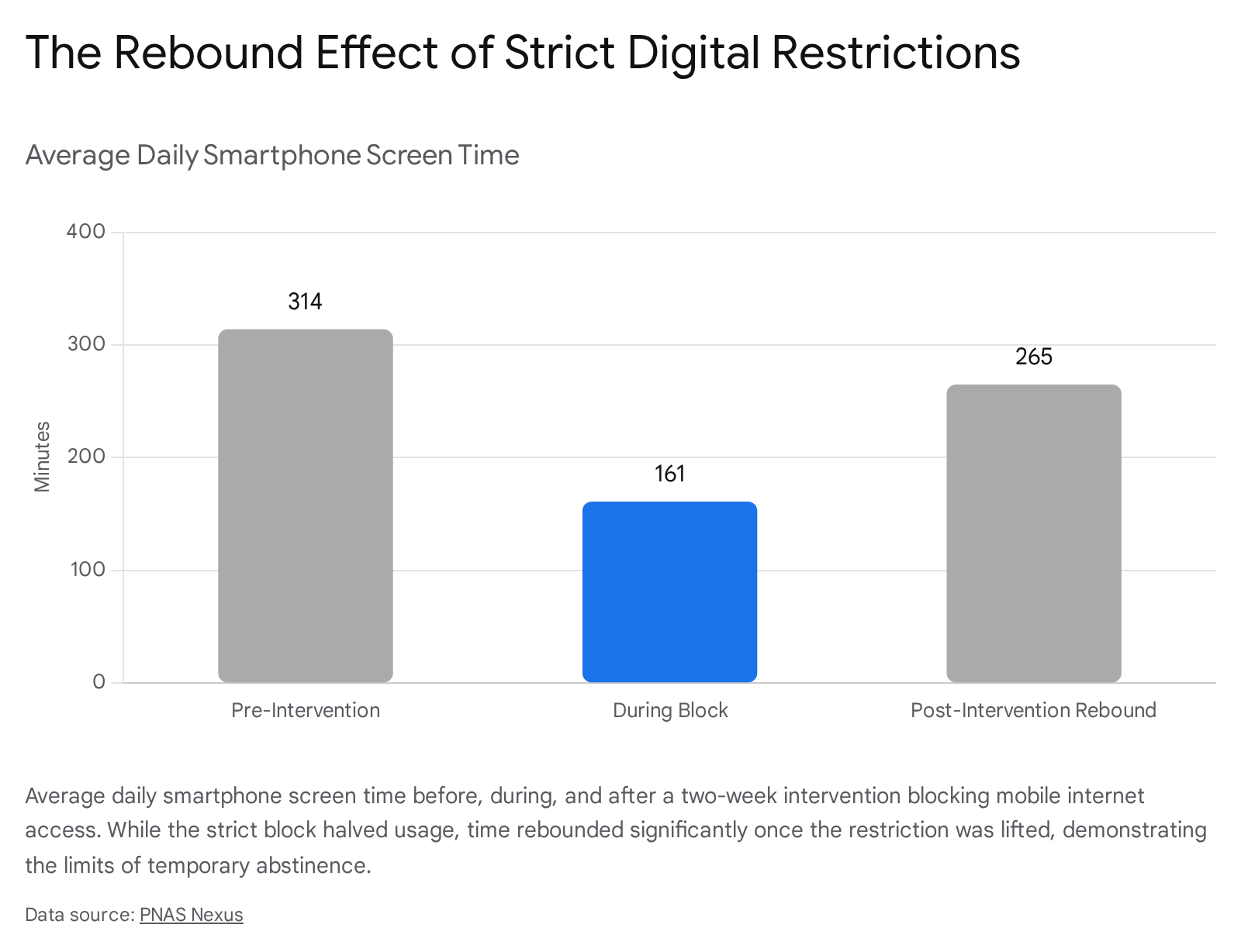
Therefore, the goal is not to strictly block access, but to subtly alter the environment so the subconscious compulsion is systematically devalued 29.
Designing Environmental Friction: What Actually Works
If reliance on willpower causes cognitive fatigue, and hard application blockers trigger psychological reactance, the most effective path forward is the strategic application of "environmental friction" 29232526.
Friction involves introducing minor, surmountable inconveniences between an impulse (the desire to check social media) and the execution of the habit (opening the app). By making the behavior slightly less convenient, the automatic, habitual loop is disrupted just long enough for the brain's executive functioning (the prefrontal cortex) to engage and consciously decide whether the action is truly desired 152326.
The Efficacy of Grayscale Mode
One of the most widely studied and recommended environmental friction techniques is switching a smartphone's display to grayscale 6272829. Modern user interfaces are masterpieces of behavioral engineering, meticulously designed to capture and hold visual attention using bright, highly saturated colors. Features like red notification badges are specifically chosen to trigger arousal and urgency in the human brain 2741.
By systematically stripping color from the interface and rendering the screen entirely in black and white, the neurological reward associated with using the device is immediately and substantially dampened 274142. Without vivid hues, the interface feels less stimulating, sucking the intrinsic "fun" out of mindless doom-scrolling 28.
Longitudinal trials evaluating the efficacy of grayscale interventions have yielded compelling results. In multiple studies, participants who switched their phones to grayscale for periods ranging from one to two weeks experienced significant reductions in objective daily screen time. A study on college students demonstrated an average screen time reduction of nearly 38 minutes per day, particularly curtailing time spent on social media and internet browsing 742. Another robust study tracked users over two weeks and found a highly significant daily reduction of 20 minutes 2729.
Beyond objective time metrics, subjective well-being also improved. Participants in grayscale interventions consistently reported lower levels of anxiety, reduced "online vigilance," and an improved, intentional sense of control over their devices 27294142.
Limitations of Grayscale
However, grayscale is not a universal cure. While it successfully reduces the duration of screen time (how long a user stays on the app once opened), some studies show it has zero effect on the frequency of phone unlocks 2729. The deeply rooted motor habit of reaching into a pocket and checking a screen remains intact; users simply close the phone faster once they realize the visual experience is unrewarding 272829.
Furthermore, the intervention's success rate varies heavily depending on the user's underlying neurobiology. Anecdotal and qualitative reports suggest that individuals with Attention-Deficit/Hyperactivity Disorder (ADHD) - who inherently struggle with executive dysfunction and impulse control - often find that grayscale does not provide enough friction to override their compulsions 4143. The lack of color may make the phone less satisfying, but it does not physically stop the action of scrolling 43. Additionally, grayscale introduces legitimate functional annoyances, rendering apps that rely on color coordination (like mapping or design tools) difficult to use, which occasionally prompts users to abandon the strategy entirely 28.
The Science of Notification Batching
Billions of smartphone notifications are delivered daily, directly capturing and monetizing human attention by exploiting our inherent psychological vulnerability to variable rewards 1318. The most common advice for mitigating this intrusion is to simply turn off all push notifications. However, research within human-computer interaction (HCI) has revealed that complete notification silence often backfires 3031.
A randomized controlled trial investigating the effects of disabling notifications found that a one-week restriction did not actually reduce objective smartphone checking frequency or overall screen time 31. More alarmingly, participants who received no notifications at all reported increased levels of anxiety and a heightened Fear of Missing Out (FOMO) compared to the control group 131831. When deprived of passive alerts, users adopt a compensating strategy: they manually and obsessively check their phones to ensure they aren't missing critical professional or social updates, effectively transferring the cognitive burden from the device back to the user 131832.
The optimal solution lies in a structural compromise: "notification batching." In a comprehensive field experiment conducted by Duke University researchers, participants were divided into groups with varying notification schedules 131832. The study utilized a custom application to hold notifications in a buffer, delivering them only at predictable, fixed intervals throughout the day 1318.
The results were striking. Participants whose notifications were batched and delivered exactly three times a day (at 9:00 AM, 3:00 PM, and 9:00 PM) experienced optimal psychological benefits. Compared to both the control group (real-time interruptions) and the total-deprivation group (zero notifications), the three-times-a-day group reported feeling significantly more attentive, highly productive, in a better mood, and experiencing less stress 131832. They also objectively unlocked their phones fewer times per day 32.
Crucially, the study also tested an hourly batching schedule (receiving all notifications once an hour, on the hour). This hourly group saw almost none of the benefits experienced by the three-times-a-day group 32. Frequent, fixed schedules still reinforce a pattern of behavior that serves the attention economy rather than the user's focus 32. By batching alerts into a few predictable daily intervals, users maintain the security of knowing they will receive their messages, completely alleviating FOMO, while reclaiming vast swaths of uninterrupted cognitive focus 131832.
Physical Distance and the "Brain Drain" Effect
Smartphone habits are context-dependent; the brain rapidly forms automatic cue-behavior associations based on physical environments 25. If a user consistently scrolls social media in bed or at their desk, the mere act of sitting in those locations triggers an automatic behavioral sequence 2526.
The most profound, yet simple, form of environmental friction is physical distance. Cognitive psychology research has identified a phenomenon known as the "brain drain" effect 15. In a landmark 2017 study by Ward et al., researchers demonstrated that the mere physical presence of a smartphone on a desk - even if the device was completely silenced and placed face down - significantly reduced a participant's available working memory capacity and fluid intelligence 15.
The mechanism behind this cognitive drain is straightforward. Even when a user is not consciously thinking about their phone, their brain is subconsciously expending precious cognitive resources to inhibit the automatic urge to check the device 15. The phone acts as a continuous, silent cognitive load.
When participants physically moved their phones to another room, their cognitive performance significantly improved 1525. Introducing physical distance adds the "friction of energy" 23. If checking social media requires standing up, walking into another room, and retrieving a device, the behavior is no longer an effortless, automatic System 1 reflex 292326. The physical barrier introduces a necessary pause, allowing deliberate System 2 thinking to engage and evaluate whether the action is actually desired 2926.
This strategy is exceptionally powerful for sleep hygiene. Charging a phone outside the bedroom overnight severs the cue for late-night and early-morning doom-scrolling, protecting vital sleep architecture from the disruption of screen-emitted blue light, which delays melatonin release and exacerbates impulsive behaviors the following day 2541.
The Algorithmic Escalation: Short-Form Video
While strategies like grayscale and notification batching are effective against traditional social media platforms, the landscape of digital consumption has fundamentally shifted in recent years. The dominant force in the attention economy is no longer the text-or-photo feed (like early Facebook or Twitter), but algorithmic short-form video (SFV), pioneered by TikTok and subsequently aggressively adopted via Instagram Reels and YouTube Shorts 1233484950.
This evolution represents a structural shift in how content is served. Legacy platforms operated on a "social graph," where a user explicitly curated their feed by following friends, brands, and public figures 4951. In contrast, short-form video platforms operate on an "interest graph" 4951. These highly sophisticated recommendation algorithms do not rely on who you follow; instead, they analyze millions of micro-interactions - watch time, scroll speed, re-watches, and cursor hovers - to infer intent and serve an endless stream of hyper-personalized content 12493435.
This model is uniquely frictionless. The primary interaction is no longer clicking or commenting, but passive, continuous swiping 1249. By removing the need for the user to make choices about what to watch next, the algorithm overrides traditional cognitive resistance 51. Functional magnetic resonance imaging (fMRI) studies indicate that exposure to this algorithmically curated, personalized video feed continuously activates the ventral tegmental area (VTA) and other core regions of the brain's reward pathway, leading to intense, sustained reinforcement motivation 1236.
Cognitive Decline and the "Dual Theory"
The neurological implications of sustained short-form video consumption are increasingly alarming. A massive 2025 systematic review and meta-analysis - encompassing 98,299 participants across 71 distinct studies - quantified the cognitive toll of SFV algorithms 5137.
The researchers found a moderate negative correlation between short-form video usage and overall cognitive performance (r = -0.34) 37. More specifically, the data showed significant degradation in two critical executive functions: Attention (r = -0.38) and Inhibitory Control (r = -0.41) 37. Inhibitory control is essentially the brain's "brakes" - the willpower muscle required to delay gratification, focus on a difficult task, and resist impulses 3637.
This cognitive degradation is explained by the Dual Theory of Habituation and Sensitization 37. 1. Habituation: As the brain is repeatedly exposed to fast-paced, highly stimulating, 15-second narratives, it becomes habituated to extreme levels of arousal. Consequently, real-world tasks - such as reading a complex document, listening to a lecture, or engaging in a slow-paced conversation - fail to meet the brain's new threshold for stimulation, rendering them unbearably boring 37. 2. Sensitization: Simultaneously, the brain's neural pathways become hypersensitized to the immediate, low-effort reward mechanism of the "swipe" 37.
This algorithmic rewiring also alters how the brain evaluates risk and consequence. A recent neurological study published in NeuroImage utilized brain imaging and computational models to analyze severe short-video addiction. The researchers discovered that heavy SFV users exhibited significantly lower "loss aversion" - the evolutionary tendency to weigh potential losses more heavily than potential gains 38.
Brain scans revealed that these addicted users had depressed activity in the precuneus, a region of the brain involved in deep reflection, option evaluation, and mental focus 3638. With a suppressed precuneus, users exhibited a "lower drift rate," meaning they accumulated evidence and processed information more slowly, making even simple decisions feel mentally draining 38. Consequently, their decision-making became increasingly impulsive and reward-driven, as they were neurologically less sensitive to negative consequences 38.
| Feature | Legacy Social Media (e.g., Early Facebook) | Algorithmic Short-Form Video (TikTok, Reels) |
|---|---|---|
| Core Architecture | Social Graph (Content explicitly chosen by following connections) | Interest Graph (Content predicted by AI watch-time analysis) |
| Primary Interaction | Clicking, commenting, manual scrolling | Continuous auto-play, frictionless vertical swiping |
| Cognitive Impact | Social comparison, traditional FOMO | Habituation to high stimuli, loss of inhibitory control |
| Friction Level | Moderate (Requires active curation of network) | Zero (Endless, self-optimizing feed) |
Sustaining Adherence and Preventing Relapse
Even when individuals successfully implement environmental friction - such as moving their phone, utilizing grayscale, and restricting apps - long-term adherence remains a formidable challenge. In the realm of digital health research, the rapid drop-off in user engagement with well-being interventions is so universally observed that it has been formally termed "Eysenbach's Law of Attrition" 339. Users typically display high motivation in the first few days of a digital detox, only to slowly regress to their baseline habits within a matter of weeks 183940.
To truly prevent relapse, it is necessary to understand that compulsive scrolling is rarely just a physical motor habit; it is a profound emotional coping mechanism 141824.
The Emotional Triggers of Relapse
Recent studies utilizing the Stimulus-Organism-Response (S-O-R) framework have investigated the specific psychological triggers that cause individuals to abandon their moderation strategies and relapse into excessive social media use 1824.
The research identifies that relapse is rarely caused by a mere lack of discipline. Instead, it is driven by intense emotional stimuli, specifically: instant gratification seeking, perceived irreplaceability of the platform, separation anxiety, and FOMO 1824. These stimuli generate powerful "approach urges" (the desire to connect) and "avoidance urges" (the desire to escape real-world stress, boredom, or unpleasant situations) 182441.
When users consciously attempt to break a digital habit using only behavioral restrictions - like enforcing a strict screen-time curfew - they leave the underlying emotional drivers entirely unaddressed 18. The moment they encounter a stressful situation at work or experience a bout of loneliness, the psychological demand for emotional regulation overpowers the behavioral block, resulting in a relapse 1841.
The Superiority of Therapeutic Interventions
Because digital addiction is intertwined with emotional regulation, interventions rooted in psychological therapy consistently outperform standard time-limiting apps. A comprehensive systematic review of social media interventions found that therapy-based approaches - specifically those utilizing Cognitive Behavioral Therapy (CBT) techniques - were vastly more effective at improving mental well-being than simple abstinence rules 51442.
In the reviewed studies, 83% of interventions utilizing CBT strategies (such as identifying emotional triggers, maintaining reflective diaries, and challenging cognitive distortions) showed significant improvements in mental well-being 5. In stark contrast, only 20% of interventions that simply limited social media use without therapeutic support showed similar positive effects 5.
Techniques like motivational interviewing are also proving highly effective 43. Rather than dictating rules, motivational interviewing helps users articulate their own intrinsic values and goals, creating internal motivation to change behavior rather than relying on external constraints 43. Ultimately, true behavioral change requires emotional literacy. It requires the user to recognize why they are reaching for their phone, and to intentionally substitute the digital pacifier with high-quality leisure - such as exercise, reading, or in-person socializing - which provides sustainable psychological rewards 11141518.
The Limits of Structural and Government Bans
The difficulty of relying purely on behavioral blocks at the individual level is perfectly mirrored in geopolitical attempts to regulate digital consumption. In recent years, several nations have attempted to combat youth internet addiction through unprecedented top-down structural interventions, providing a fascinating real-world laboratory on the limits of restriction.
China has been at the forefront of this approach. In 2019, the Chinese government introduced strict laws limiting online gaming for minors to just 90 minutes per day, which was further aggressively tightened in 2021 to a mere one hour on Friday, Saturday, and Sunday evenings 444546. This regulatory framework has since expanded, mandating that tech giants like Tencent and ByteDance implement strict "minor modes" across video-sharing sites and social media, strictly classifying harmful content, and enforcing usage curfews 4445464748. Similarly, Australia recently passed landmark legislation aiming to outright ban children under 16 from accessing social media platforms entirely 4547.
However, researchers tracking the efficacy of these systemic bans note a familiar pattern: aggressive circumvention 3145. Much like an individual user battling an app blocker, youths subject to national restrictions frequently utilize sophisticated workarounds. Because the underlying emotional and social motivations to consume media remain intensely strong, minors quickly learned to bypass facial recognition systems by using the real-name IDs of adult family members or utilizing secondary, unregulated devices 45.
The persistence of these workarounds underscores a vital lesson in digital wellness: structural bans - whether imposed by a personal app blocker or a national government - struggle with long-term effectiveness if they fail to engage meaningfully with the user's intrinsic motivations 314547. South Korea offers an alternative perspective. While the Korean government historically implemented strong gaming restrictions, their broader approach to "digital welfare" has increasingly emphasized digital literacy, extensive public awareness campaigns, and the integration of evidence-based Digital Therapeutics (DTx) into the national healthcare system to treat the root causes of addiction, rather than relying solely on technological blockades 49505152.
Bottom line
Reducing social media consumption is highly unlikely to succeed if approached through the lens of sheer willpower, restrictive app blockers, or complete abstinence. Instead, treating digital wellness as a matter of harm reduction - focusing on environmental design and psychological triggers - yields far more sustainable results. By strategically increasing environmental friction (such as switching the screen to grayscale, physically keeping the device in another room, and batching notifications to three times a day), users can effectively interrupt the automatic habit loops engineered by modern algorithms. However, while these structural changes are necessary, long-term adherence ultimately depends on developing emotional literacy to address the underlying anxiety, boredom, and avoidance urges that drive compulsive scrolling in the first place.