
Efficacy of digital detox interventions for wellbeing
The proliferation of digital technologies, social media platforms, and constant connectivity has fundamentally altered global human behavior, prompting widespread academic and clinical scrutiny regarding the psychological and physiological impacts of excessive screen time. In response to documented correlations between high digital consumption and declining mental health, the concept of a "digital detox" - a period of voluntary abstinence or significant restriction from digital devices - has emerged as both a popular lifestyle intervention and a subject of empirical study. As research has accumulated, the efficacy of digital detoxification has been subjected to rigorous evaluation. While short-term interventions demonstrate measurable improvements in specific well-being indicators such as sustained attention and sleep quality, longitudinal data reveal high relapse rates, persistent rebound effects, and significant theoretical limitations in the underlying metaphorical framework of detoxification.
This report provides a comprehensive analysis of the current research on digital detox and screen time interventions. It synthesizes theoretical frameworks of screen time morbidity, evaluates the psychological and physiological outcomes of disconnection, contrasts temporary detox interventions with the paradigm of digital minimalism, and examines the recent shift toward systemic policy interventions and national bans.
Mechanisms of Screen Time Impact
To evaluate the efficacy of digital detox interventions, it is necessary to examine the theoretical frameworks that explain how screen time influences well-being. Researchers have largely relied on behavioral, cognitive, and neurobiological models to understand the etiology of digital distress.
Displacement Theory Dynamics
The predominant explanatory framework in screen time research is the displacement hypothesis. Originating in media studies from the late 1980s to explain the effects of television viewing, the theory has been modernized to address smartphone and internet use 1. The displacement theory posits that screen time influences brain development and cognition indirectly; the primary detriment is not necessarily the screen exposure itself, but the deprivation of developmental, real-world activities that screen time displaces 2.
When individuals increase their digital consumption, they actively reduce the time allocated to other critical functions - most notably physical activity, sleep, and in-person social interactions 34. Data from the Adolescent Brain Cognitive Development (ABCD) Study, a prospective longitudinal investigation, reveal that higher total screen time is consistently associated with depressive, conduct, somatic, and attention-deficit/hyperactivity symptoms across racially diverse subsamples 5. When models adjust for sleep and physical activity, these associations weaken but remain statistically significant, indicating that displacement theory partially accounts for, but does not entirely explain, the detrimental mental health effects of excessive screen time 5.
The social displacement theory further suggests that excessive engagement in online activities, such as video gaming, diminishes opportunities for real-life social interactions. Over time, this creates a social deficit pathway, whereby depressive symptoms are exacerbated through a reduction in both the quantity and quality of offline social connections 6. Adolescents reporting high levels of digital consumption frequently report lower levels of perceived friend support, which serves as a conditional mediator between frequent digital device usage and depressive symptoms 6. Furthermore, evaluations of Chinese children and adolescents (ages 10 - 18) indicate that specific behaviors, such as short video watching, directly correlate with insufficient physical activity, demonstrating the behavioral substitution effect where adaptive physical habits are replaced by pathological technology use 47.
Screen and Sleep Displacement Pathways
One of the most biologically disruptive forms of displacement involves sleep architecture. The "screen-sleep-displacement theory" outlines how screen use near bedtime delays circadian rhythms and directly impedes sleep initiation 18. This disruption is attributed to two primary physiological mechanisms: the suppression of melatonin production caused by the blue light emitted from screens, and the psychological arousal triggered by interactive or stimulating content 2.
A 2025 structural equation modeling analysis of Swedish adolescents (N=4810) provided granular empirical support for this pathway. The study evaluated four distinct sleep facets as competing mediators for depression: sleep quality, sleep duration, chronotype, and social jetlag 1. The analysis revealed that screen time deteriorated sleep metrics within three months. For adolescent females, compromised sleep quality, duration, and chronotype mediated 57%, 38%, and 45% of the depressive effects associated with excessive screen time, respectively 1. Males exhibited a direct adverse effect on depression after twelve months related to screen time, suggesting that biological and social vulnerabilities to screen-induced sleep loss differ by gender 1. Further studies corroborate that individuals exceeding seven hours of daily screen time exhibit clinical levels of insomnia, anxiety, and severe bedtime procrastination 8.
Methodological Limitations in Evidence
Despite the prominence of displacement theory, experts in adolescent mental health and cyberpsychology recognize significant methodological limitations in the existing evidence base, constraining the ability to establish definitive causal relationships 9.
A primary limitation is the reliance on cross-sectional survey data and retrospective self-reporting. Many studies measure aggregate screen time without capturing broader time-use patterns or differentiating between active, meaningful digital engagement and passive, habitual scrolling 91010. Furthermore, research into the correlation between screen usage and disorders such as Attention-Deficit/Hyperactivity Disorder (ADHD) has uncovered complex bidirectional relationships. Mendelian randomization investigations utilizing polygenic risk scores have identified evidence for a "selection effect" - meaning individuals genetically predisposed to ADHD are naturally inclined to spend more time on highly stimulating digital screens, complicating the assumption that screen time is the sole etiological driver of the disorder 2. Higher levels of screen exposure represent both a potential cause and a manifestation of underlying behavioral and emotional symptoms 5.
Outcomes of Short-Term Detoxification
Interventions designed to mitigate the negative impacts of digital consumption range from short-term total abstinence to sustained, moderate restrictions. Empirical evaluations of these detox programs report a complex spectrum of outcomes, demonstrating distinct physiological and cognitive benefits alongside unintended psychological costs.
Cognitive and Psychological Restoration
Structured digital detox interventions consistently yield measurable improvements in specific cognitive domains. A prominent 2025 longitudinal study demonstrated that a two-week digital detox - in which participants utilized application-blocking software (Freedom app) to restrict smartphones to basic calling and texting functions - halved average daily screen time from five hours to approximately 2.5 hours 11. Post-intervention cognitive assessments involving sustained attention tasks revealed that participants maintained continuous focus for significantly longer durations. Researchers equated this improvement in continuous focus to reversing approximately ten years of age-related cognitive decline 11.
Beyond raw cognitive performance, digital detox interventions promote specific dimensions of well-being. Unlike hedonic well-being, which focuses purely on pleasure, eudaimonic well-being emphasizes purposeful living, personal growth, authenticity, and the realization of one's potential 12. By eliminating the constant cognitive drain of algorithmically driven feeds, individuals experience enhanced working memory, improved emotional regulation, and significant stress reduction 12. Reductions in non-essential smartphone and internet dependency frequently result in decreased technological anxiety and lowered levels of clinical depression, particularly among young adults and individuals with high baseline symptom severity 1314.
Sleep Hygiene Alterations
Because screen time heavily displaces sleep, detox interventions inherently function as sleep restoration protocols. In controlled trials where participants abstained from leisure screen use, self-reported sleep duration increased by an average of 20 minutes per night - a metric large enough to noticeably shift daily mood and executive functioning 11.
Additionally, randomized controlled trials among adolescents undergoing ten-week structured detox programs, which included psychoeducation and cognitive-behavioral techniques aimed at minimizing evening device exposure, showed significant improvements in sleep hygiene scores 15. In one trial, sleep hygiene scores rose from a baseline of 81.27 to 93.18 post-intervention, with outcomes stabilizing at a five-month follow-up, while control groups exhibited minimal changes 15.
Unintended Consequences and Relapse
Despite documented benefits, digital detox programs are not universally effective or entirely benign. A significant subset of literature details the adverse psychological outcomes associated with abrupt digital disconnection. Participants undergoing strict digital abstinence frequently report heightened sensations of alienation, social exclusion, and acute loneliness 16. The sudden removal of digital stimuli also induces profound boredom, particularly during brief intervals between daily tasks that were previously occupied by micro-interactions with smartphones 16.
Furthermore, the long-term efficacy of short-term detox programs is undermined by a distinct "rebound effect." Observational data and qualitative reports indicate a strong propensity for relapse once the intervention period concludes 1617. In many cases, participants exhibit a rebounding operation wherein consumption patterns rapidly revert to, or briefly exceed, pre-intervention baselines as users attempt to catch up on missed social communications and content 16.
The instability of these behavioral modifications points to the limitation of utilizing temporary interventions for systemic environmental conditions. In a study evaluating the MinimalistPhone application over 14 days, the experimental group saw significant reductions in habitual behavior (17.86% decrease versus a 1.22% decrease in the control group) and total screen time (a reduction of 805 minutes) 18. Negative affect also decreased.
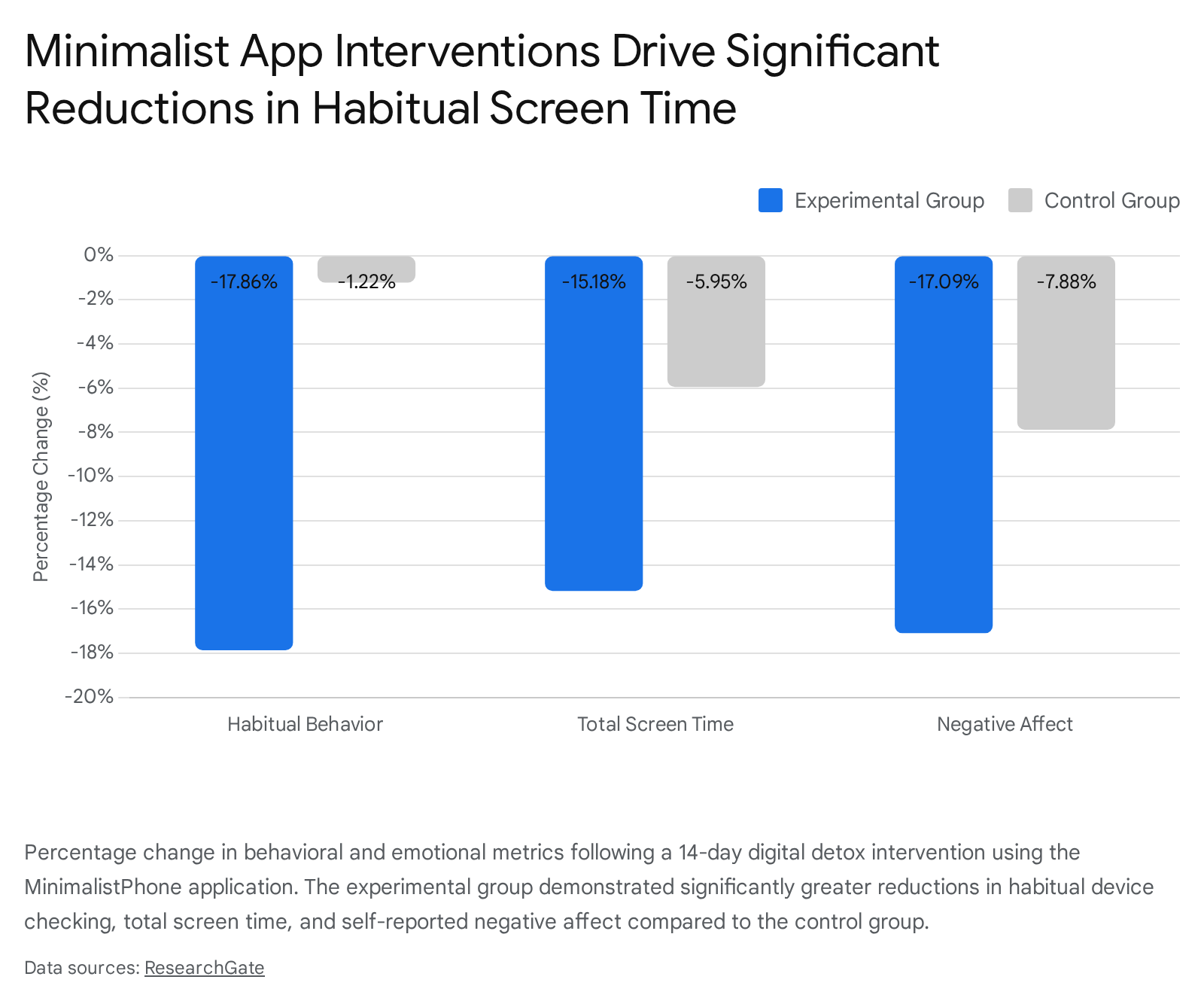
However, researchers noted that these behavioral effects manifest rapidly under the strict constraints of the software, and their stability without continuous application support remains largely unverified 18.
Critiques of the Addiction Metaphor
The academic discourse surrounding digital detox is increasingly critical of the linguistic metaphors used to describe technology use, specifically the framing of digital media as a "toxin" or an "addiction."
Rejection of Toxicity Terminology
In popular nomenclature, digital media is frequently likened to environmental toxins, drugs, or refined sugar 2019. Terms such as "digital detox" implicitly frame digital data as a poisonous substance to be purged from a contaminated biological system 2021. Scholars in sociology and Human-Computer Interaction (HCI) argue that this toxicological metaphor is fundamentally flawed. Unlike biological toxins, digital environments are complex socio-technical systems embedded with profound cultural, educational, and professional utility 22.
Treating technology purely as a neurobiological hijacker or a literal toxin fails to acknowledge that participation in digital networks is essentially a prerequisite for modern civic and social life 2324. Public health scholars and media theorists advocate for abandoning the addiction paradigm - which places the burden of behavioral correction entirely on the individual user's willpower - in favor of a framework centered on "digital influence literacy" 2025. This approach focuses on training users to recognize, analyze, and emotionally regulate the feelings generated by specific platform architectures, rather than attempting an impossible and alienating total withdrawal 20.
Interpassivity in Application Design
Building on these structural critiques, consumer research has explored the paradoxical effects of digital abstinence through the psychoanalytic lens of interpassivity - a concept describing situations where an external object or system performs an act of consumption, restriction, or belief on behalf of the human subject 2627.
When individuals utilize "app-blocking apps" or subscribe to timed detox programs, they outsource their self-discipline to the commercial market. Extensive netnographic studies and qualitative interviews with digital detoxers reveal that these apolitical, pragmatic forms of abstinence do not permanently disrupt the underlying psychological desire for digital consumption 2627. Instead, the detox period acts as a "desire-regenerating force" 27. The temporary restriction creates a cycle of re-autonomization and deceleration that eventually re-sensitizes the user, making the return to digital platforms feel more novel, potent, and rewarding 26. Consequently, rather than curing reliance, episodic detoxing effectively diversifies and expands the very networks of desire it aims to restrict, inadvertently serving the mechanisms of the attention economy 2627.
Digital Detox Versus Digital Minimalism
As the theoretical limitations and rebound effects of short-term digital detoxes have become apparent, scholarly and practical attention has shifted toward the framework of "digital minimalism," a concept pioneered by computer scientist Cal Newport 2829.
Conceptual Divergence
The primary distinction between the two paradigms lies in their time horizon, philosophical foundation, and ultimate objectives. A digital detox functions as a temporary relief mechanism - a pause utilized to recover from acute burnout, after which the individual frequently returns to their prior digital environment 30. In contrast, digital minimalism is a long-term lifestyle modification and an ongoing behavioral framework 2930.
Minimalism requires an initial period of rapid technological decluttering (often a 30-day reset), followed by the highly intentional, permanent reintroduction of only those digital tools that provide significant value and strictly align with the user's core personal or professional goals 2829.
| Framework Characteristic | Digital Detox Paradigm | Digital Minimalism Paradigm |
|---|---|---|
| Primary Objective | Short-term recovery, acute stress relief, and temporary break from digital overload 30. | Long-term lifestyle redesign, cognitive protection, and sustained intentional technology use 2830. |
| Duration of Intervention | Temporary and episodic (typically ranging from 24 hours to 30 days) 29. | Permanent, ongoing behavioral framework applied indefinitely 28. |
| Methodological Approach | Complete or severe restriction of all digital devices, internet access, or specific platforms 1630. | Value-based assessment of tools; creation of strict operating procedures for necessary technologies 2931. |
| Expected Post-Intervention Outcome | Acute alleviation of symptoms followed by a high risk of relapse and behavioral rebound 1629. | Sustainable autonomy, reduced habitual reliance, and long-term protection of cognitive resources 2829. |
Research indicates that digital minimalism is significantly more effective for long-term productivity and psychological well-being. A 2022 study evaluating the application of minimalist principles found that participants who adhered to the philosophy experienced a 28% reduction in perceived stress and a 23% improvement in sustained attention when compared directly to control groups utilizing conventional, reactive screen time management approaches 28. Furthermore, participants who practice general minimalism in physical consumption are statistically less susceptible to the Fear of Missing Out (FoMO), making them more adept at executing digital minimalism sustainably 32.
Hardware Restrictions and Minimalist Devices
The philosophy of digital minimalism has also catalyzed specific hardware innovations, evidenced by the rising adoption of "minimalist phones." These devices purposefully eliminate high-resolution touchscreens, third-party app stores, and algorithm-driven notification systems 33. Instead, they focus exclusively on core utilities such as calling, text messaging, and basic productivity tools (e.g., alarms and calculators) 33.
By physically altering the affordances of the device, users disrupt the automatic, habitual usage patterns trained by smartphones. Stripped-down interfaces serve as physical buffers against the attention economy, significantly reducing the psychological friction required to resist digital temptations 1833. This hardware-level intervention addresses the flaws of software-based app blockers, ensuring that the device cannot act as an interpassive agent of desire regeneration, but rather remains a strictly utilitarian tool.
Post-Pandemic Behavioral Shifts
The urgency surrounding digital well-being interventions has been compounded by lasting behavioral shifts initiated by the COVID-19 pandemic. The global necessity of transitioning to digital spaces resulted in entrenched habits that continue to influence public health outcomes.
Normalization of Constant Connectivity
Between 2020 and 2022, the transition to tele-work, virtual schooling, and digitized social interactions normalized continuous connectivity, fundamentally altering human time-use patterns 3435. Longitudinal datasets indicate that these elevated digital routines have largely failed to return to pre-pandemic baselines. For example, analyses of South Korean adolescents revealed that average daily screen time surged from 133.24 minutes in the pre-pandemic era to 303.66 minutes during the pandemic 3637. This permanent transition to a "tele-everything" environment has blurred work-life boundaries and exacerbated systemic digital stress 3538.
Trajectories of Clinical Anxiety
The entrenchment of these digital behaviors correlates with concerning trajectories in population mental health. A repeated cross-sectional analysis utilizing data from the Mental Health and Lifestyle Habits Dataset spanning 2020 to 2024 evaluated the psychological fallout of these shifts. The analysis demonstrated that self-reported anxiety scores linked to digital behavior were significantly higher in 2023 and 2024 compared to the reference year of 2020 38.
The data established that each additional hour of daily screen time was associated with a statistically significant increase in anxiety scores, underscoring the chronic psychological toll of sustained, inescapable digital immersion 38. This evidence reinforces the understanding that post-pandemic digital habits represent a systemic public health challenge requiring interventions that scale beyond individual self-regulation 38.
Systemic Policy Interventions
Recognizing the limitations of individual self-regulation, the inefficacy of temporary detoxes, and the persistent harms of digital environments, the response to excessive screen time has rapidly escalated from personal lifestyle trends to macro-level state interventions. Governments globally have begun treating digital platform design not as a private family matter, but as a crisis requiring statutory restriction 39.
Historical Precedents and Repeals
Legislative attempts to control screen time are not entirely without precedent, though early efforts provide cautionary evidence regarding enforcement. In 2011, South Korea implemented the "Shutdown Law" (also known as the Cinderella Law), which legally prohibited children under the age of 16 from accessing online video games between midnight and 6:00 AM 363940.
While the policy aimed to curb gaming addiction and protect adolescent sleep, it was ultimately abolished in 2021 3637. The law suffered from severe enforcement hurdles, as users easily circumvented restrictions utilizing Virtual Private Networks (VPNs) or by using their parents' identification credentials 39. The political establishment faced significant backlash over youth digital rights, leading to a retreat from blanket bans toward softer, graduated restrictions and voluntary guidelines in South Korea 3940.
Implementation of National Access Bans
Despite the historical difficulties encountered in South Korea, a contemporary wave of legislation has opted for aggressive, platform-wide restrictions. Modern lawmakers have shifted the legal and financial burden of age verification entirely onto the technology corporations, moving away from policing end-users 3941.
| Implementing Jurisdiction | Status and Effective Date | Policy Scope and Target Demographics | Enforcement Mechanisms and Penalties |
|---|---|---|---|
| Australia (Federal) | Passed 2024; Effective Dec 2025 | Blanket ban preventing users under 16 from holding accounts on major social media platforms (e.g., TikTok, Instagram). | Social media companies face fines up to $49.5 million AUD for non-compliance. Initial reports indicate 4.7 million underage accounts removed 394041. |
| Indonesia | Effective March 2026 | Ban targeting users under 16 across eight high-risk platforms (YouTube, TikTok, Facebook, Instagram, Threads, X, Bigo Live, Roblox). | Mandates platform-side deactivation. Future expansion planned to include e-commerce platforms to mitigate child scam victimization 424344. |
| South Australia | Proposed 2024; Superseded | State-level proposal to ban access for children under 14 and require parental consent for ages 14 - 15. | Superseded by the Australian Federal legislation to ensure a uniform national approach 414546. |
The Australian legislation represents a landmark shift, establishing a blueprint that intentionally offers no exceptions for children who already possess accounts or who have parental consent 39. Indonesia's rapid adoption of similar measures in March 2026 further targets gaming and streaming platforms like Roblox, where more than half of the 45 million Indonesian users are under 16 42. While these bans address acute public health concerns surrounding cyberbullying and digital reliance, human rights organizations note that total bans strip young populations of their rights to access information, raising complex questions regarding freedom of expression and the necessity of testing proportional, digital-literacy-based alternatives 4447.
Conclusion
The empirical evidence surrounding digital detox interventions reveals a complex interplay of short-term benefits and long-term limitations. Unplugging from digital devices undeniably offers acute physiological and cognitive relief, effectively mitigating sleep displacement and restoring sustained attention by providing a reprieve from the algorithms driving the attention economy. However, as an isolated behavioral intervention, the classic "digital detox" is frequently undermined by high relapse rates, theoretical flaws in the toxicity metaphor, and the overarching reality of a post-pandemic society reliant on constant connectivity.
The academic consensus suggests that while temporary detoxes are insufficient for lasting behavioral change, the principles of digital minimalism - emphasizing intentional, value-driven technology use and structural hardware modifications - offer a more sustainable pathway. Concurrently, the global escalation from individual self-help strategies to sweeping national bans indicates that the burden of mitigating digital harm is shifting decisively from the consumer to the state and the platform providers, fundamentally altering the future landscape of digital interaction.