
How to Choose the Right Therapist
Finding the right therapist requires balancing a provider's clinical credentials, their therapeutic approach, and the personal connection you share. Research consistently shows that a strong therapeutic alliance - built on mutual trust and shared goals - is the single greatest predictor of successful mental health treatment, significantly outweighing the specific therapeutic techniques used. By understanding the different licensing credentials and preparing targeted questions for an initial consultation, you can confidently evaluate whether a therapist is equipped to meet your specific clinical and cultural needs.
The Therapeutic Alliance: The True Engine of Healing
When embarking on the search for a mental health professional, it is remarkably easy to become overwhelmed by the vast array of acronyms, theoretical orientations, and treatment modalities available. Patients often assume they need to find the "perfect" therapeutic method to achieve healing, spending hours researching whether cognitive-behavioral techniques are fundamentally superior to psychodynamic exploration. However, decades of rigorous clinical research have consistently revealed a surprising truth: the specific brand of therapy matters far less than the relationship you build with the person delivering it 11.
In the realm of clinical psychology, this foundational relationship is known as the "therapeutic alliance." The concept is not merely about liking your therapist or finding them agreeable. The most enduring and widely accepted model of the therapeutic alliance, first proposed by Edward Bordin, breaks the concept down into three interdependent components. The first is an affective bond composed of trust, care, empathy, and mutual respect. The second is a mutual agreement on the goals of the treatment, representing the "what" of therapy. The third is a shared agreement on the tasks required to achieve those goals, representing the "how" of therapy 245. When these three elements align, the nervous system naturally calms, creating the essential conditions for psychological growth and allowing the patient to engage in the deeply vulnerable work required for change 2.
The Statistical Reality of Therapeutic Efficacy
The strength of the therapeutic alliance is not a subjective, intangible feeling; it is a measurable, statistically robust predictor of treatment success across virtually all forms of psychotherapy 53. A comprehensive meta-analysis encompassing 295 independent studies and over 30,000 patients spanning four decades found a moderate but highly reliable correlation between the alliance and positive psychotherapy outcomes, regardless of whether the therapy was conducted face-to-face or online 378.
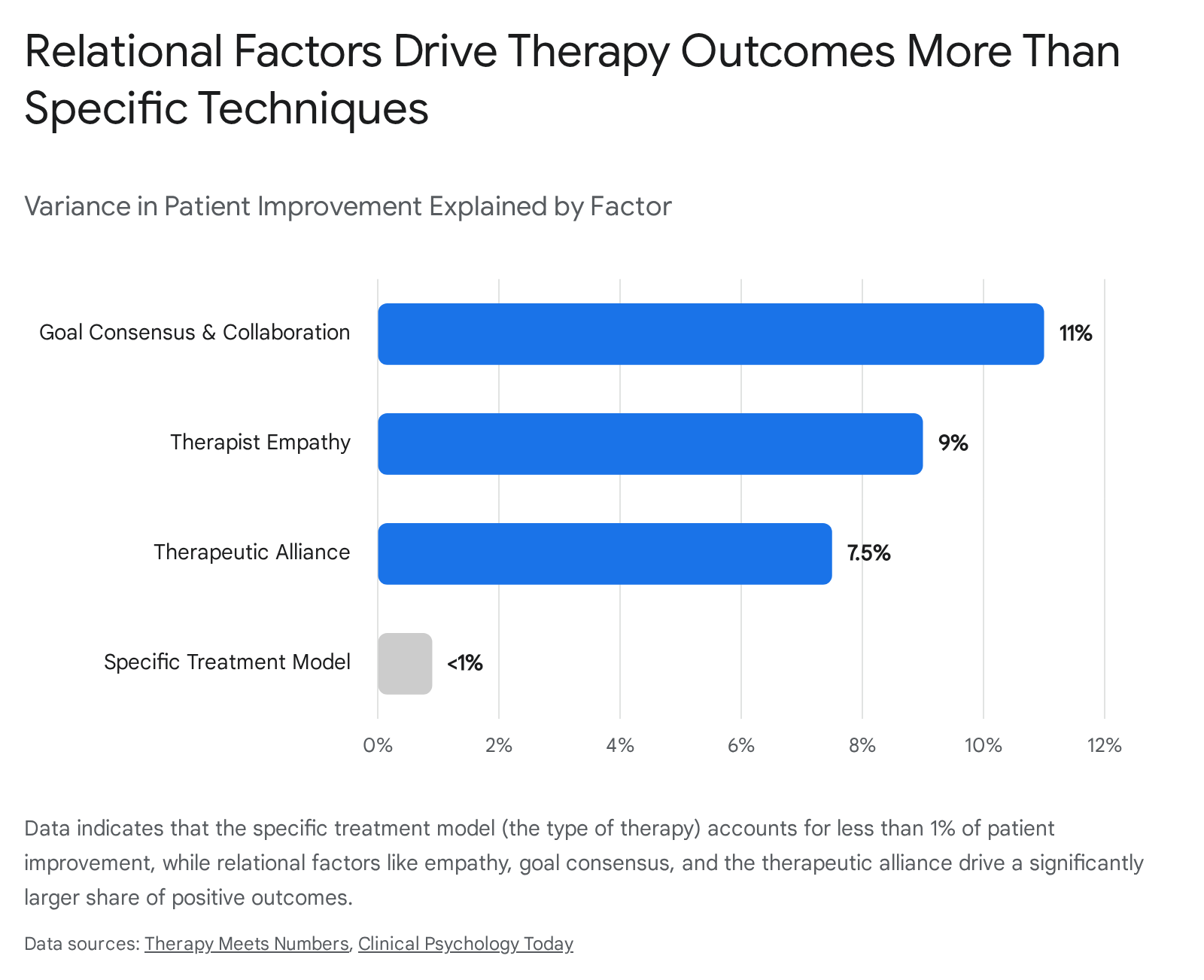
To put this into perspective within the broader context of clinical research, the therapeutic alliance accounts for approximately 7.5% to 8% of the variance in therapy outcomes 474. While this number may initially appear modest, its true significance emerges when compared to other factors. Research spearheaded by clinical psychologists like Bruce Wampold reveals that specific treatment models and specific clinical techniques - the actual differences between various named therapies - account for less than 1% of the variance in patient outcomes 47. Put simply, the relationship accounts for roughly seven times more of the healing impact than the specific theoretical modality utilized 4. Other relational and common factors, such as goal consensus and collaboration (which account for 11% of the variance) and therapist empathy (which accounts for 9%), further underscore that the human connection is the true engine of therapeutic change 47.
Navigating Instability and Ruptures
The process of building this alliance is dynamic. Some researchers theorize that a strong alliance operates by establishing a baseline of "epistemic trust," which allows the patient to feel secure enough to step away from the certainty of their deeply held, maladaptive self-beliefs 5. This creates a state of specific, beneficial instability in the patient's psyche - a necessary precursor to cognitive and behavioral change 5. Without this trust, clients may remain rigid, and the necessary "opening up" of new perspectives simply never occurs, leading to limited or failed outcomes 5.
Interestingly, research shows that patients tend to view the therapeutic alliance relatively consistently throughout the duration of their treatment. If a patient feels a positive connection early in the process, they are highly likely to rate the alliance positively at the termination of therapy 4. Therefore, it is critical for therapists to establish a strong, trusting bond within the first few sessions. However, it is vital to recognize that a healthy therapeutic alliance is not characterized by a complete absence of conflict. Misunderstandings and disagreements are inevitable. The true marker of a strong alliance is the therapist's ability to successfully navigate and repair these "ruptures" in the relationship 116. A clinician who invites metacommunication - a willingness to openly discuss the dynamic of the relationship itself - and proactively asks for feedback is actively building a resilient alliance that can withstand the rigors of deep psychological work 2.
Deciphering Therapist Credentials and Training
When browsing directories to find a provider who can build this vital alliance, you will immediately encounter a confusing alphabet soup of credentials following providers' names. These letters dictate a professional's scope of practice, the fundamental philosophy of their training, and frequently, their billing rates 13147. Broadly speaking, the mental health landscape is divided into three categories: medical doctors, doctoral-level psychologists, and master's-level clinicians.
Medical Doctors (Psychiatrists)
Psychiatrists hold an MD (Doctor of Medicine) or a DO (Doctor of Osteopathic Medicine) 138. Following four years of rigorous medical school, they complete a specialized three-to-four-year residency in psychiatry 8. Because their education is rooted in the medical model, their training focuses heavily on the biological and neurological aspects of mental illness, as well as psychopharmacology 78.
Due to this specialized medical background, psychiatrists are the primary mental health professionals licensed to prescribe and manage psychiatric medications 138. While some psychiatrists do provide traditional, 50-minute talk therapy sessions in addition to prescribing medication, the vast majority focus their practices primarily on medication management 139. These medication appointments are typically shorter, often lasting 15 to 30 minutes, and focus on symptom tracking and dosage adjustments rather than deep psychological exploration 18.
Doctoral-Level Psychologists (PhD and PsyD)
Psychologists hold terminal doctoral degrees in their field - either a PhD (Doctor of Philosophy) or a PsyD (Doctor of Psychology) - which typically require four to six years of graduate study, followed by one to two years of full-time supervised clinical work and exhaustive licensing examinations 138.
While both degrees lead to licensure as a clinical psychologist, their focal points differ. PhD programs heavily emphasize scientific research, statistical analysis, and academic methodology alongside clinical training 138. Graduates are trained as scientist-practitioners. PsyD programs, conversely, were developed specifically for individuals who wish to focus almost entirely on clinical practice and direct patient care, placing less emphasis on producing original academic research 1314.
Psychologists are uniquely qualified to administer comprehensive psychological testing and complex diagnostic assessments. If a patient requires formal cognitive testing, neuropsychological evaluation, or assessment for conditions like ADHD, autism spectrum disorders, or complex personality disorders, a psychologist is typically required 147. They are highly trained to handle severe psychopathology and administer evidence-based treatments 14. It is important to note that, with very few exceptions in specific states that require additional post-doctoral training, psychologists do not prescribe medication 78.
Master's-Level Clinicians
The vast majority of standard, weekly talk therapy in the United States is provided by master's-level clinicians 8. These professionals complete a two-to-three-year master's degree, followed by a rigorous, state-mandated period of supervised clinical experience before they can practice independently 819. While all are qualified to diagnose and treat mental health disorders, their foundational training perspectives differ significantly.
LCSW (Licensed Clinical Social Worker): Social workers view mental health through a systemic and ecological lens. Their graduate training in social work emphasizes how an individual is impacted by their external environment. An LCSW is trained to consider how family structures, community resources, workplace dynamics, economic status, and cultural oppression intersect to shape a client's psychological reality 13147. Social workers are highly prevalent in community clinics, hospitals, and private practice, bringing a holistic, advocacy-oriented approach to therapy 1420.
LMFT (Licensed Marriage and Family Therapist): LMFTs specialize in relational dynamics and systems theory. While they frequently treat individuals for anxiety or depression, their foundational training centers on how familial patterns, communication styles, and interpersonal relationships shape psychological well-being 131420. They are specifically trained to view problems not as residing solely within an individual, but as existing within the space between people, making them uniquely suited for couples counseling and family therapy 14.
LPC, LPCC, or LMHC (Licensed Professional Counselors): The exact title for these clinicians varies widely by state, but they all undergo specific graduate training in clinical mental health counseling 13720. Their education focuses heavily on developmental psychology, counseling techniques, and clinical assessment designed to treat a broad spectrum of mental health conditions 137. They tend to focus deeply on individual psychological issues, life transitions, and behavioral change 14.
The Rigor of Supervised Hours
The journey to independent licensure for master's-level clinicians is incredibly demanding and is measured not just in academic credits, but in thousands of supervised clinical hours 1921. After earning their degree, these professionals must work under the strict oversight of a veteran licensed clinician for several years.
The specific requirements vary dramatically across state lines, creating a complex regulatory landscape. For instance, a candidate seeking licensure as an LMFT or LPCC in California must complete 3,000 hours of supervised experience, whereas an LICSW in Massachusetts must complete 3,500 hours 192110. In Delaware, counselors must accrue 3,200 hours over a maximum of four years 23. Generally, across the United States, most states require between 1,500 and 4,000 supervised clinical hours, with a mandate that 50% to 60% of those hours involve direct, face-to-face client contact 192124. Clinicians must also undergo continuous continuing education (CE) throughout their careers, with states mandating ongoing training in ethics, cultural competency, and specific public health issues like opioid addiction or domestic violence 10.
Associate and Intern Therapists
While browsing directories, you will frequently see titles such as ASW (Associate Clinical Social Worker), AMFT (Associate Marriage and Family Therapist), or APCC (Associate Professional Clinical Counselor). These are professionals who have fully completed their graduate degrees and are currently in the process of accruing their state-mandated supervised clinical hours 921.
Associate therapists practice under the direct license and ongoing clinical oversight of an experienced supervisor, meaning patients benefit from the combined expertise of both the associate and their mentor 921. Because they are not yet independently licensed, associates generally offer significantly reduced session rates 918. For budget-conscious patients who do not require highly specialized care for severe pathology, working with a well-trained associate is often an excellent, high-value option.
The Financial Landscape: Understanding the Cost of Therapy
The cost of therapy is one of the most significant barriers to care, and navigating the financial realities of treatment requires a clear understanding of market rates, insurance structures, and geographical variations. Without a compatible insurance plan, therapy is entirely self-pay, and the costs can accumulate rapidly for weekly sessions 1825.
Across the United States, public data indicates that standard outpatient psychotherapy sessions generally range from $100 to $250 per visit 1825. However, this average obscures significant variations based on the provider's specific credentials, their level of specialization, and the local cost of living 911.
Cost Variations by Credential
The level of education and training a provider has completed directly influences their baseline rates. Psychiatrists, given their medical degrees and specialized capacity to prescribe medication, command the highest fees. A typical psychiatric evaluation or session ranges from $200 to $450, with national averages hovering around $325 1811.
Doctoral-level psychologists (PhD or PsyD) typically charge between $150 and $325 per standard 45-to-55-minute session, reflecting their advanced training in complex diagnostics and evidence-based interventions 1811. Master's-level clinicians, including LCSWs, LMFTs, and LPCs, form the middle tier of pricing, generally charging between $100 and $225 per hour 1811.
For those seeking more affordable options, associate or intern therapists - who are fully trained but currently accruing their licensure hours under supervision - typically charge between $50 and $100 per session 918. Additionally, community mental health clinics and university training centers often utilize a sliding scale based on household income, where fees can drop to between $20 and $80 per session, though these options frequently come with long waitlists 911.
Geographic Realities
Therapy costs are deeply intertwined with the local economy. Providers in major metropolitan areas with high commercial rents and steep costs of living routinely charge significantly more than the national average 925. In New York City, for example, the median session fee for a psychiatrist is roughly $400, while social workers average $200 per session 27.
Even within a single city, neighborhood variations are stark. In Los Angeles, therapists practicing in affluent areas like Beverly Hills or West Hollywood may charge $200 to $400 per session - 30% to 50% above the city average. Meanwhile, providers in East or South Los Angeles might charge $90 to $175 per session, falling well below the municipal average 911. Conversely, in smaller cities like Providence, Rhode Island, rates are much more compressed, with master's-level clinicians and psychologists averaging between $125 and $150 per session 27.
Insurance and Long-Term Affordability
When utilizing health insurance, the financial equation changes dramatically. If a therapist is "in-network" with a patient's insurance provider, the cost is typically reduced to a standard copay, often ranging from $20 to $60 per session 2511. However, many private practice therapists choose to remain "out-of-network" due to low reimbursement rates and heavy administrative burdens from insurance companies. If a patient sees an out-of-network provider, they must typically meet a high deductible first, after which the insurance may reimburse 50% to 70% of the session cost, requiring the patient to submit a "Superbill" for processing 251112.
Ultimately, the most important question regarding cost is not just the sticker price of a single session, but whether the rate is sustainable over the necessary duration of treatment. Research suggests that the most common reason therapy fails is not a poor clinical match, but premature termination because the weekly cost became financially unsustainable 9. For focused, symptom-reduction work, patients typically need 8 to 12 sessions to see meaningful benefit, while deeper relational or trauma work often requires six months or more 9. A competent therapist will engage in transparent discussions about long-term affordability during the initial consultation, exploring options like bi-weekly sessions or sliding-scale spots to ensure the patient can remain in treatment long enough for it to be effective 9.
Summary of Average Therapy Costs
| Provider Type / Setting | Average Cost Per Session | Key Financial Considerations |
|---|---|---|
| Psychiatrist (MD/DO) | $200 - $450 | Highest cost; primarily for medication management rather than weekly talk therapy. 91811 |
| Psychologist (PhD/PsyD) | $150 - $325 | Higher rates reflecting doctoral-level expertise in testing and complex diagnostics. 1811 |
| Licensed Master's Clinician (LCSW, LMFT, LPC) | $100 - $225 | The standard rate for weekly private practice talk therapy in most US markets. 91811 |
| Pre-Licensed Associate / Intern | $50 - $100 | High-value option providing quality care under the supervision of a veteran clinician. 918 |
| Community Clinic / University Center | $20 - $80 | Sliding scale based on income; highly affordable but often entails long waitlists. 911 |
| In-Network Insurance | $20 - $60 (Copay) | Highly affordable, but restricts the patient's choice of available providers. 2511 |
Mapping Evidence-Based Modalities to Specific Needs
While the therapeutic alliance provides the necessary psychological safety for healing, the specific clinical framework a therapist utilizes provides the operational roadmap. The American Psychological Association (APA) and the National Institute of Mental Health (NIMH) recognize a variety of "evidence-based" therapies 291331. An approach is considered evidence-based when it has been subjected to rigorous scientific scrutiny, typically through randomized controlled trials (RCTs), demonstrating consistent effectiveness in reducing symptoms compared to a placebo or waiting list 1331.
Most modern evidence-based psychotherapies operate by targeting and modifying at least one of three primary mechanisms: a patient's cognitions (their thoughts and interpretations of the world), their behaviors (their actions, avoidance strategies, and exposure to triggers), or their relational and emotional experiences 29. Therapists often specialize in a few specific modalities, applying them based on the unique pathology of the client.
Cognitive and Behavioral Approaches
Cognitive Behavioral Therapy (CBT): CBT is arguably the most extensively researched and widely practiced psychological intervention in the English-language literature 2932. It operates on a highly structured, time-limited basis, typically designed to span 12 to 20 sessions 2931. The foundational premise of CBT is that our thoughts, emotions, and behaviors are inextricably linked. It posits that psychological distress is often maintained by "cognitive distortions" - automatic, inaccurate, and negative ways of interpreting events 1314.
Unlike open-ended talk therapy that explores childhood memories, CBT is resolutely present-focused. Therapists actively train patients to identify these automatic negative thoughts, critically examine the evidence supporting or refuting them, and systematically replace them with more balanced, accurate appraisals 2913. CBT sessions are highly collaborative and often resemble a structured training program, complete with specific homework assignments designed to practice new skills between sessions 2934. Data shows that CBT is a highly effective, first-line treatment for major depressive disorder and anxiety disorders, frequently matching or exceeding the efficacy of second-generation antidepressants, with lower relapse rates upon discontinuation 3536.
Exposure and Response Prevention (ERP): A specialized, highly potent subset of cognitive-behavioral treatment, ERP is considered the gold-standard behavioral intervention for Obsessive-Compulsive Disorder (OCD) and severe phobias 34. ERP operates on the principle that avoiding anxiety-provoking stimuli only reinforces the brain's fear response over time. In ERP, the therapist guides the patient to systematically and safely confront their specific fears (exposure) while strictly refraining from engaging in their usual neutralizing compulsions or avoidance behaviors (response prevention) 1334. By repeatedly enduring the anxiety without escaping, the patient's nervous system gradually learns that the feared outcome will not occur, leading to a natural reduction in distress known as habituation.
Third-Wave Behavioral Therapies (DBT and ACT): In recent decades, clinical psychology has seen the rise of "third-wave" cognitive behavioral therapies, which shift away from aggressively challenging the content of negative thoughts, focusing instead on mindfulness, emotional acceptance, and values-based action 36.
- Dialectical Behavior Therapy (DBT): Developed by psychologist Dr. Marsha Linehan at the University of Washington, DBT was originally built specifically to treat individuals with borderline personality disorder and chronic suicidality 2931. It combines individual therapy with rigorous skills-training groups. The curriculum covers four core modules: mindfulness, distress tolerance, emotion regulation, and interpersonal effectiveness 29. The term "dialectical" represents the therapy's central, challenging tension: radically accepting the patient exactly as they are in the present moment, while simultaneously relentlessly pushing them to change their destructive behaviors 29.
- Acceptance and Commitment Therapy (ACT): ACT helps patients stop fighting their internal experiences. Instead of trying to eliminate anxiety or depressive thoughts, ACT uses mindfulness techniques to help patients observe these thoughts with detachment and accept difficult emotions 2935. Once the struggle against the internal experience ceases, the therapy focuses heavily on identifying the patient's core life values and committing to concrete behavioral actions that align with those values, even in the presence of psychological pain. ACT has demonstrated robust efficacy for chronic pain, generalized anxiety, and depression 293135.
Trauma-Focused and Depth-Oriented Approaches
Eye Movement Desensitization and Reprocessing (EMDR): Developed by Francine Shapiro, EMDR is a highly structured, evidence-based trauma treatment verified by the World Health Organization for the management of PTSD and complex trauma 293536. Unlike traditional talk therapy, EMDR does not require the patient to extensively discuss the details of their trauma. Instead, the patient briefly holds a distressing traumatic memory in mind while the therapist facilitates bilateral sensory stimulation, typically through guided side-to-side eye movements, auditory tones, or physical tapping 2935. The exact neurological mechanism remains a subject of ongoing debate, but the bilateral stimulation appears to help the brain successfully reprocess the fragmented, emotionally charged traumatic memories, integrating them into standard biographical memory so they no longer trigger intense, involuntary physiological reactions 35.
Psychodynamic Therapy: Contrasting sharply with the structured, homework-driven nature of CBT, psychodynamic therapy operates on the fundamental premise that our current psychological suffering is deeply shaped by unconscious conflicts, unresolved developmental themes, and relational patterns established early in life 293235. The primary mechanism of change in psychodynamic work is insight - helping the patient recognize deeply ingrained, unconscious emotional patterns that they previously could not see 2932.
Sessions are generally less structured and more open-ended, allowing the patient to freely associate and explore past relationships, particularly examining how those historical dynamics are recreated in the present, including within the therapeutic relationship itself (transference) 3236. While psychodynamic therapy has historically been viewed as a long-term, open-ended endeavor, recent clinical data shows that Time-Limited Psychodynamic Psychotherapy (typically 11 to 30 sessions) is highly effective. In fact, randomized controlled noninferiority trials have demonstrated that short-term psychodynamic therapy is a viable, effective initial treatment option for uncomplicated major depressive disorder, performing comparably to CBT 36.
Interpersonal Psychotherapy (IPT): IPT is a focused, time-limited therapeutic approach (usually spanning 12 to 16 sessions) that operates on the premise that psychological distress is intimately tied to our relationships with others 31. Rather than focusing on internal cognitive distortions or childhood trauma, IPT hones in on current interpersonal problem areas. It is particularly effective at addressing grief following a significant loss, navigating intense role transitions (such as becoming a parent or retiring), managing active conflicts with important figures in the patient's life, and addressing social deficits that make forming relationships difficult 31. Network meta-analyses have shown IPT to have an efficacy comparable to CBT for the treatment of depression 36.
Summary of Evidence-Based Modalities
| Therapy Modality | Core Focus & Mechanism of Change | Primary Conditions Treated | Typical Duration |
|---|---|---|---|
| Cognitive Behavioral Therapy (CBT) | Identifying and changing automatic negative thoughts and maladaptive behaviors. 2913 | Depression, Anxiety Disorders, Phobias. 3132 | 12 - 20 sessions 2931 |
| Dialectical Behavior Therapy (DBT) | Balancing radical acceptance with behavioral change; building emotion regulation and distress tolerance skills. 29 | Borderline Personality Disorder, Chronic Suicidality, Emotion Dysregulation. 2931 | 6+ months (Individual + Group) 31 |
| Acceptance & Commitment Therapy (ACT) | Using mindfulness to accept difficult emotions while taking action aligned with core values. 3536 | Chronic Pain, Anxiety, Depression. 2931 | 8 - 16 sessions 31 |
| Exposure & Response Prevention (ERP) | Systematically confronting feared stimuli while strictly refraining from avoidance or compulsions. 34 | Obsessive-Compulsive Disorder (OCD), Severe Phobias. 34 | Varies by severity |
| EMDR | Reprocessing traumatic memories using bilateral sensory stimulation (eye movements/tapping). 2935 | PTSD, Complex Trauma. 293135 | 6 - 15 sessions 3136 |
| Psychodynamic Therapy | Exploring unconscious conflicts and early life relationship patterns to generate deep insight. 2932 | Depression, Relational Issues, Complex Trauma. 3536 | 11 - 30 sessions (or open-ended) 36 |
| Interpersonal Psychotherapy (IPT) | Improving current relationship dynamics, navigating role transitions, and addressing active interpersonal conflicts. 31 | Depression, Grief, Life Transitions. 3136 | 12 - 16 sessions 31 |
It is important to note that many modern practitioners do not rigidly adhere to a single modality. Instead, they consider themselves "integrative" or "eclectic," fluidly drawing upon cognitive restructuring, mindfulness tools, and psychodynamic insight to custom-fit their approach to the specific, evolving needs of the patient sitting in front of them 1332.
The Delivery Method: Online vs. In-Person Therapy
The landscape of mental healthcare access was fundamentally altered by the global pandemic, precipitating a massive shift toward teletherapy. As of recent data, roughly 96% of licensed psychologists in the United States have offered some form of online therapy, and the U.S. digital mental health market has ballooned into a multi-billion dollar sector 3738. For a patient beginning their search, deciding whether to sit in a physical clinic or open a laptop involves weighing clinical efficacy, personal convenience, and crucial considerations regarding data privacy.
Clinical Efficacy: Is Virtual as Good as Reality?
For years, skeptics questioned whether the therapeutic alliance could truly form through a screen. However, robust, large-scale clinical research has largely settled the debate for standard outpatient care. A landmark 2024 study published in the prestigious journal Nature Mental Health, which analyzed data from over 27,500 patients, demonstrated conclusively that therapist-guided virtual therapy is clinically equivalent to in-person care for the treatment of common conditions like anxiety and depression 37.
In fact, some data indicates that 78% of online CBT patients no longer met the diagnostic criteria for anxiety after treatment, a success rate that directly matches in-person clinical rates 37. Furthermore, virtual appointments boast significantly higher attendance rates, as removing the friction of commuting, parking, and waiting rooms makes it much easier for patients to remain consistent with their treatment plans 3839.
However, in-person therapy remains demonstrably superior in specific, higher-risk contexts. Face-to-face interactions allow therapists to read subtle nonverbal cues, nervous body language, and fleeting micro-expressions that are easily obscured or entirely missed over a webcam 38. Additionally, for individuals dealing with severe mental illness, active psychosis, or acute crisis situations - such as active suicidality or severe eating disorders requiring physical monitoring - in-person therapy is strongly recommended, as physical proximity allows the clinician to better manage safety protocols and provide immediate intervention 3839.
The Tech-Platform Landscape: Talkspace vs. BetterHelp
The explosion of teletherapy gave rise to massive, subscription-based mental health platforms. These venture-backed companies have successfully democratized access, offering streamlined apps and varied communication methods, but they operate very differently than traditional private practices. Two of the dominant forces in this space are Talkspace and BetterHelp, each with distinct operational models.
Talkspace boasts a network of over 5,000 licensed clinicians 1516. A significant advantage of Talkspace is its integration with the traditional healthcare system; it accepts numerous major insurance plans, as well as Medicare Part B, which can lower a patient's out-of-pocket cost to a standard copay of $15 to $30 per session 16. Furthermore, Talkspace offers psychiatric services, allowing patients to manage their talk therapy and their medication prescriptions within the same ecosystem 151617.
BetterHelp, conversely, is a massive operation with a network exceeding 30,000 therapists 1516. While its integration with insurance networks is historically more limited, BetterHelp often proves more affordable for patients paying entirely out-of-pocket, particularly because the platform offers income-based financial aid that can significantly reduce monthly subscription costs 1516. A notable structural difference is the matching process: BetterHelp relies heavily on an algorithmic questionnaire to assign you to a therapist, whereas other platforms or private directories allow patients to browse profiles and independently select their provider 154318.
The Privacy Caveat: The FTC and Health Data
Patients utilizing tech-first therapy platforms must remain highly vigilant regarding their health data privacy. While traditional medical providers are bound by strict HIPAA regulations protecting clinical records, the data entered into app interfaces, marketing questionnaires, and website trackers has sometimes fallen into a regulatory gray area.
This tension reached a boiling point in 2023, when the Federal Trade Commission (FTC) took decisive action against BetterHelp, resulting in a landmark $7.8 million settlement regarding the mishandling of sensitive consumer data 451920. Following an investigation, the FTC formally alleged that between 2017 and 2020, BetterHelp had engaged in deceptive practices by sharing highly sensitive consumer health information with major third-party advertising platforms, including Facebook, Snapchat, Criteo, and Pinterest 4548.
Despite explicitly promising consumers on their website that their data would remain private and anonymous, BetterHelp allowed the IP addresses, email addresses, and specific answers to mental health intake questionnaires - revealing intimate details about patients' struggles with depression or anxiety - to be transmitted to these tech giants for the purpose of optimizing targeted marketing 451948. The FTC mandated that BetterHelp halt these practices, and an independent redress administrator, Ankura Consulting Group, was tasked with distributing the $7.8 million in refunds to approximately 800,000 affected consumers 19.
For patients who are highly concerned with data privacy, this case serves as a vital cautionary tale. If retaining complete control over digital health footprints is a priority, seeking out a traditional therapist in private practice who utilizes a closed, strictly HIPAA-compliant telehealth portal - rather than utilizing a venture-backed, tech-first subscription platform - is generally the safest route to ensure that intimate mental health data is not monetized 4520.
Cultural Humility: Finding Truly Affirming Care
For marginalized groups, including BIPOC (Black, Indigenous, and People of Color) and LGBTQ+ individuals, the process of finding a therapist extends far beyond verifying clinical degrees. It is fundamentally about finding a provider who comprehends how systemic oppression, ongoing discrimination, and intersecting identities directly impact mental health and psychological safety 212251.
The Paradigm Shift: From Competence to Humility
Historically, the psychological establishment focused on the concept of "cultural competence." This framework suggested that a therapist could attend a workshop, study a list of facts about a specific ethnic or social group, and emerge "competent" in treating them 2324. Today, leading psychological institutions recognize that this approach is flawed, as it often reduces complex, diverse communities to rigid stereotypes and fails to account for the unique, lived reality of the individual 2325.
The modern clinical standard has shifted toward cultural humility. This is not a static endpoint to be achieved, but a lifelong, ongoing commitment 5526. Cultural humility requires the therapist to deliberately abandon the stance of the "all-knowing expert" and instead view the patient as the supreme, unquestionable expert on their own life and cultural experience 5527.
A practitioner operating with cultural humility engages in continuous self-reflection, actively examining how their own unconscious biases, racial background, and socio-economic privilege influence their clinical judgments 512355. Crucially, it involves a conscious effort to dismantle the inherent power imbalances within the therapist-patient dynamic 2327. If a cultural misunderstanding occurs in session, a culturally humble therapist does not become defensive or rely on their professional authority; instead, they apologize, remain deeply curious, and invite the patient to guide the correction, ensuring the therapy room remains a safe space where the patient does not have to expend energy defending their reality 232758. The American Psychological Association (APA) explicitly updated its multicultural guidelines in 2017 to emphasize this exact ecological approach, stressing that psychologists must recognize how intersectionality and fluid identities shape their clients' lives 2528.
Utilizing Specialized Directories
While mainstream databases like Psychology Today offer robust filtering options, utilizing specialized directories can significantly streamline the process of finding a culturally humble, affirming provider who shares or deeply understands specific lived experiences:
- Inclusive Therapists: A highly regarded database that actively centers the needs of marginalized identities, prioritizing culturally responsive, LGBTQ+ affirming, and social justice-oriented mental health care 293031.
- Therapy for Black Girls: A vibrant community and dedicated directory specifically designed to connect Black women and girls with trusted, culturally attuned therapists 3063.
- National Queer and Trans Therapists of Color Network (NQTTCN): A vital resource focused specifically on connecting QTPOC (Queer and Trans People of Color) individuals with mental health practitioners who actively share and affirm their intersecting identities 316332.
- Asian Mental Health Collective & Latinx Therapy: Specialized directories providing tailored resources and therapist connections specifically catering to the nuances of the AAPI and Latinx communities, respectively 293063.
The Consultation: Essential Questions to Ask
Before committing to regular sessions, most private practice therapists offer a free 10-to-15 minute introductory phone or video call 656667. It is crucial to view this not as a formal therapy session, but as a mutual interview. The patient is hiring a healthcare provider, and evaluating their fit requires asking targeted, specific questions to gauge their operational style, clinical expertise, and capacity for cultural humility 6567.
Logistical and Clinical Exploration
To determine if the therapist's practical approach aligns with your needs and resources, ask direct questions regarding their framework: * What specific therapeutic modalities do you utilize, and what is your rationale for using them to treat my specific concern (e.g., severe anxiety, complex trauma)? 136768 * How do you typically structure your sessions, and how do we collaboratively measure progress or success over the course of treatment? 6668 * What is your exact fee structure, do you accept my specific insurance plan, and how do you handle cancellations or scheduling conflicts? 666768 * Do you have specialized, formal training in treating my specific issue, or is it simply a general clinical interest? 666768
Probing for Cultural Humility and Safety
For individuals seeking an LGBTQ+ affirming or culturally responsive therapist, the consultation call is the perfect opportunity to perform a critical "vibe check" 33. Pay close attention to how the therapist reacts to these questions; a practitioner grounded in cultural humility will welcome them warmly, while a defensive reaction is a clear warning sign 27. * What is your specific experience treating clients who share my racial, cultural, or LGBTQ+ identity? 212270 * How do you actively incorporate a racial equity or anti-racist lens into your clinical treatment planning? 21 * What is your professional stance on "conversion therapy"? (Note: If a therapist claims to be neutral on this topic, or claims not to know what it is, they fundamentally lack the basic ethical competency required to treat LGBTQ+ individuals safely) 2170. * How do you navigate intersectionality in your practice - understanding that my race, gender expression, and sexual orientation overlap and compound to impact my mental health? 212227
Evaluating the First Three Sessions
If the consultation goes well, the initial sessions of therapy will serve as the true testing ground for the relationship. These first few meetings are typically structured as "intake" sessions. During this time, the therapist focuses heavily on gathering your biographical history, reviewing confidentiality agreements and consent forms, and collaboratively setting treatment goals 7172.
It is important to manage expectations: you will not necessarily walk away from these early sessions feeling magically "cured" or unburdened. In fact, opening up about historical trauma or deep-seated relational issues with a new person might leave you feeling temporarily emotionally raw or fatigued 7134. However, by the conclusion of the third or fourth session, clear indicators should emerge regarding whether a healthy therapeutic alliance is truly taking root 34.
Recognizing the Green Flags
- A Sense of Emotional Safety: You feel genuinely validated and understood without feeling the need to exhaustively over-explain or justify your worldview. When you share vulnerabilities, they are met with deep empathy, not clinical detachment, judgment, or pathologization 134.
- Collaborative Agenda Setting: The therapist actively asks what feels most important to you to focus on that day, empowering you in the process rather than dictating the flow of the session entirely on their own agenda 2.
- Tolerable, Safe Challenges: Effective therapy inherently requires psychological growth, which necessitates facing discomfort. However, you should always feel that the therapist challenges your maladaptive perspectives gently and safely, consistently acting as your steadfast ally 34.
- Consistency and Professional Boundaries: The therapist respects your time by starting and ending sessions promptly, maintains clear professional boundaries regarding out-of-session contact, and remains consistently attentive - never distracted by their phone, email, or external issues while you are speaking 74.
Identifying the Red Flags
- You frequently leave sessions feeling a lingering sense of shame, judgment, or disgust regarding the topics discussed 34.
- You find yourself intentionally holding back, lying, or carefully censoring your thoughts because you simply do not feel safe enough to be fully honest with the provider 34.
- The therapist talks over you, interrupts frequently, fundamentally misinterprets key issues despite correction, or habitually centers their own personal stories and opinions rather than maintaining focus on your clinical needs 6534.
If the therapeutic fit feels wrong after a few earnest sessions, it is perfectly acceptable - and clinically recommended - to inform the therapist and seek a new provider. Therapy represents a profound investment of your time, financial resources, and emotional labor. Finding a supportive, highly competent professional who fosters a powerful therapeutic alliance is the mandatory first step toward achieving meaningful, lasting psychological change.
Bottom line
Choosing a therapist requires looking beyond a professional's theoretical orientation to find someone with whom you can build a genuine, deeply trusting therapeutic alliance. While specific clinical modalities like CBT or EMDR are highly effective for targeted conditions, decades of research confirm that the relational quality between you and your provider is the ultimate driver of healing. Take advantage of free consultations to rigorously evaluate a therapist's training credentials, their true commitment to cultural humility, and their data privacy practices before committing your time and resources to long-term care.