
How Algorithmic Bias Affects Hiring, Loans, and Policing
Algorithmic bias occurs when artificial intelligence systems produce systematic, unfair outcomes that privilege certain groups over others. Rather than eliminating human prejudice, these systems often learn from flawed historical data and biased assumptions, quietly amplifying discrimination at scale across critical areas like hiring, lending, and policing.
The Illusion of Mathematical Neutrality
One of the most powerful and enduring beliefs in the digital age is that algorithms are inherently neutral. Because they run on code, process numbers, and lack human emotions, society often assumes they represent a gold standard of objectivity 11. If decisions are made by a machine, the prevailing logic suggests, then bias disappears, responsibility is diffused, and human conflict is neatly resolved 1.
However, technology scholars, data ethicists, and legal professionals increasingly warn that algorithmic neutrality is a dangerous myth 23. No artificial intelligence (AI) system is built in a cultural or mathematical vacuum. Every algorithm is the byproduct of a long chain of human decisions regarding what data to include, what outcomes to optimize, and what errors are acceptable 12.
The Psychology of Automation Bias
The idea of a neutral algorithm serves as a psychological shortcut. Numbers feel cleaner than people, and code feels fairer than human judgment 1. This belief gives rise to "automation bias" - a psychological phenomenon where humans inaccurately project greater authority and infallibility onto automated systems than human expertise 4.
When the public or corporate stakeholders claim an algorithm is "neutral," they usually mean one of three things: it treats everyone exactly the same, it relies strictly on data rather than human opinions, or it operates without emotional prejudice 3. While a machine learning model indeed lacks feelings, these factors do not automatically create fairness. Treating everyone exactly the same can still produce highly unfair outcomes if the society generating the data is already profoundly unequal 3. Furthermore, an algorithm cannot operate without an objective function, and choosing what to optimize - whether that is computational speed, corporate profit, or risk reduction - is fundamentally a moral and value-based choice 13.
Harms of Allocation and Representation
The consequences of biased AI are generally categorized into two main frameworks: harms of allocation and harms of representation 1.
Harms of allocation occur when an automated system unfairly withholds resources or opportunities from marginalized groups 1. This manifests tangibly when individuals are wrongfully denied a job interview, rejected for a mortgage, or disqualified from receiving public healthcare benefits based on algorithmic profiling. Harms of representation involve skewed depictions that reinforce negative societal stereotypes, shaping how users perceive the world. An example of this occurs when an image search for a generic term like "CEO" returns almost exclusively pictures of white men, or when generative AI tools produce content that inaccurately and stereotypically depicts specific nationalities 15.
These harms are not simply the result of malicious software engineers writing bigoted code. They are systemic errors resulting from how data is collected, how variables are defined, and how success is measured in the machine learning pipeline 67.
The Anatomy of Algorithmic Bias
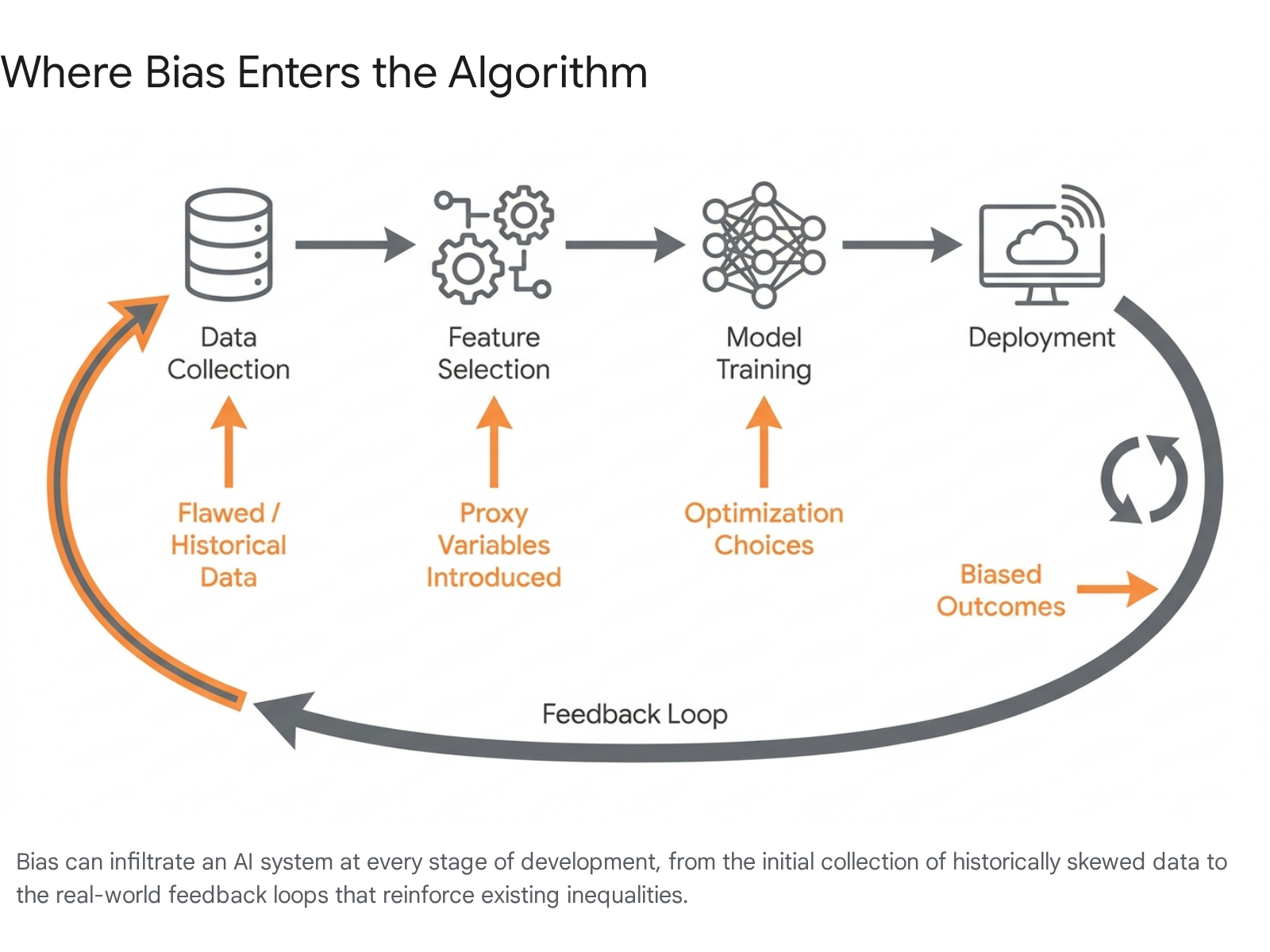
To understand how algorithms discriminate, it is necessary to examine the mechanics of machine learning. The algorithms powering modern AI do not learn rules explicitly written by humans; they learn by finding statistical patterns in massive datasets 18. If those datasets contain historical flaws, the algorithm will inherit and formalize them 17.
Flawed and Historical Training Data
Data is often treated as a raw, unfiltered reflection of physical reality. In practice, data is a record of historical inequalities, institutional behaviors, and cultural norms 12. If a predictive algorithm is trained on past decisions, it will faithfully replicate the biases embedded in those human decisions.
For instance, if a corporation uses its past ten years of hiring data to train an AI to identify "successful" candidates, the AI will look for patterns among the people who were historically hired and promoted. If human recruiters historically favored male applicants due to conscious or unconscious bias, the algorithm will mathematically deduce that being male is a primary predictor of success 9. It will then systematically screen out women, not because the code was programmed to be sexist, but because the algorithm was optimized to recreate the historical reality it was fed 911. This is known as historical bias, and it demonstrates how algorithms do not remove values, but rather enforce the values present in the data 311.
The Hidden Danger of Proxy Variables
Even if developers deliberately remove protected characteristics - such as race, gender, religion, or age - from a dataset, algorithms can still discriminate through "proxy variables." A proxy is a seemingly neutral data point that is highly correlated with a protected characteristic 91110.
A real-world analogy highlights how this mathematical substitution works. In South Africa, a legacy of racial segregation means that geographic neighborhoods are still deeply divided along racial lines. If a financial algorithm uses a person's zip code to predict their likelihood of defaulting on a loan, it is effectively using their race to make the decision 911. The zip code acts as a direct proxy variable for race. Similarly, a model might not explicitly know a job applicant's gender, but it might downgrade candidates who attended historically women's colleges or played sports predominantly associated with a specific gender 1112.
Target Variable Bias and Measurement Errors
Bias also emerges from how success is defined and measured. In statistical terms, this is often referred to as "target variable bias," which occurs when the unobserved target outcome of interest is replaced by an imperfect, observed proxy in the training data 15.
Measurement bias occurs when the proxy chosen is a poor substitute for the actual trait the system is attempting to assess 1115. For example, a policing algorithm might use "prior arrest records" as a proxy for "actual crime rates." However, arrest records do not merely measure where crime happens; they heavily measure where police are deployed to look for crime 13.
Once deployed, these biased measurement parameters create dangerous feedback loops 31013. If a predictive policing model flags a low-income neighborhood as high-risk based on historical arrest data, police commanders will send more officers to patrol that area. Because more officers are present, they will naturally record more minor infractions, generating new arrest data that feeds back into the system, "proving" the algorithm was mathematically correct all along 13. This cycle, where an algorithm continually learns from the very reality it distorted, leads to increasingly skewed and discriminatory results 1013.
Algorithmic Bias in the Hiring Process
The modern recruitment process has become deeply automated. Recent reports indicate that nearly 99 percent of Fortune 500 companies use AI-based or automated tools in their hiring pipelines, with increasing prevalence in lower-wage job sectors such as retail and food services 12. These systems are designed to parse overwhelming volumes of online applications and quickly filter candidates into "qualified" and "unqualified" tranches 14. Yet, they frequently introduce invisible barriers.
Resume Screening and Correlation Errors
AI is routinely used to reject or rank applicants based on keyword requirements and historical correlations 12. Because these tools search for patterns that correlate with existing top performers, they can latch onto bizarre, non-causal variables. In one well-documented case, an automated screening tool correlated the name "Jared" and the act of playing high school lacrosse with being a highly successful employee 12. These correlation errors act as proxies for race, gender, and socioeconomic status, quietly filtering out candidates who lack specific cultural markers 12.
A famous example involves a major technology company that attempted to build an AI tool to automate resume reviews. The machine learning model was trained to vet applicants by observing patterns in resumes submitted to the company over a ten-year period. Because the technology industry was overwhelmingly male during that decade, the algorithm quickly learned to penalize resumes that included the word "women's" (such as "women's chess club captain") and specifically downgraded graduates of two all-women's colleges 915. The project was eventually scrapped when developers realized the systemic bias could not easily be untangled from the underlying mathematical optimization 9.
Video Interviews and Biometric Bias
Employers increasingly use AI tools to conduct algorithmic evaluations of video interviews 14. These systems capture and analyze facial movements, micro-expressions, voice pitch, tone, and specific word choices to assess "amorphous" personality characteristics such as extroversion, enthusiasm, or general positivity 12.
These biometric tools are highly problematic from a fairness perspective. First, they often rely on culturally specific standards of "normal" professional behavior 12. An AI trained heavily on American corporate norms might score a neurodivergent candidate or a speaker with a non-standard dialect - such as African American Vernacular English (AAVE) - as a poor cultural fit 1216. Furthermore, algorithms assessing physical interactions, such as eye contact consistency or how fast someone clicks a mouse during an automated assessment, can easily screen out candidates with disabilities like autism, depression, or physical impairments 12.
The Regulatory Response to Hiring AI
The proliferation of automated hiring has triggered a wave of regulatory scrutiny. While federal law in the United States does not yet have a comprehensive AI-specific statute, the Equal Employment Opportunity Commission (EEOC) has made it clear that civil rights laws prohibit discrimination in hiring whether it occurs through human bias or automated software 1217. The EEOC has warned that employers will be held liable if their AI tools screen out applicants with disabilities or cause a disparate impact based on race or gender 1117.
State and local jurisdictions are stepping in to fill the legislative gap. New York City's Local Law 144 prohibits employers from using automated employment decision tools unless the software has undergone an independent bias audit within the past year 141819. Employers must also notify candidates that AI is being used and publish summaries of the bias audits publicly 1819. Similarly, the Illinois AI Video Interview Act requires employers to notify candidates and obtain consent before using AI to analyze video interviews, while California regulations demand proactive bias testing and meaningful human oversight for automated hiring systems 1819.
Importantly, courts are determining that the legal liability for biased AI does not rest solely with the software vendors. In ongoing litigation, such as cases involving major human resources platforms, employers who merely purchased and used the discriminatory AI tools have been named as defendants, establishing that "vendor risk is employer risk" 18.
Algorithmic Bias in Lending and Consumer Finance
Lending and consumer finance represent another massive frontier for AI decision-making. Algorithms now dictate credit ratings, loan terms, bank account fees, and mortgage approvals 17. Lenders expect these models to accurately predict an individual's likelihood of default, but the alternative data fed into these systems can mask profound inequities.
Digital Redlining and Alternative Data
Modern credit underwriting models increasingly rely on complex algorithms that ingest "alternative data" not typically found in a traditional credit file 20. Seemingly neutral behavioral data points - from a user's email domain to the specific time of day they shop online - can severely skew lending algorithms 21.
When algorithms systematically deny credit to specific demographics based on geographic or behavioral proxies, critics refer to the practice as "digital redlining" 22. Because algorithmic models are complex and proprietary, the discrimination is effectively buried in the mathematics. However, regulatory authorities are beginning to unearth and penalize these practices. In July 2025, the Massachusetts Attorney General reached a $2.5 million settlement with Earnest Operations, a student loan company, over allegations that its AI underwriting models resulted in disparate harms to Black, Hispanic, and non-citizen applicants regarding loan eligibility, terms, and pricing 23. The settlement required the company to implement a strict AI governance structure, including regular bias testing and risk assessments 23.
The "Black Box" Prohibition
When a human loan officer denies an application, the reasoning is usually transparent and tied to conventional metrics (e.g., a high debt-to-income ratio). But AI systems are often "black boxes," making it incredibly difficult for the institution itself to explain exactly why a machine learning model generated a specific denial 10.
The U.S. Consumer Financial Protection Bureau (CFPB) has explicitly stated that there are "no AI exemptions" to consumer protection laws 17. Under the Equal Credit Opportunity Act (ECOA), financial providers have a strict legal obligation to explain any adverse credit decision 1721. The CFPB's guidance insists that creditors must provide specific, accurate reasons for taking adverse action 20. A creditor cannot justify noncompliance by claiming their technology is too complicated, opaque, or novel to explain 20. If a lender uses non-intuitive behavioral data - such as lowering a credit limit because the algorithm flagged the specific type of establishment where a consumer shops - they must specifically disclose that purchasing history to the consumer as the reason for denial 20.
To summarize the shift in critical life decisions and how bias enters different sectors, the table below highlights how algorithmic processes differ from traditional human judgment.
| Sector | Traditional Human Decision-Making | Algorithmic Decision-Making | Primary Source of Algorithmic Bias |
|---|---|---|---|
| Hiring | Recruiters review resumes and conduct in-person interviews based on subjective rubrics. | AI parses resumes for keywords, administers neuro-games, and analyzes video micro-expressions. | Training models on historically male/white workforces; penalizing non-standard dialects or neurodivergence. |
| Lending | Loan officers review standardized credit history, income, and debt-to-income ratios. | Machine learning models analyze thousands of data points, including non-financial consumer behaviors. | Proxy variables like zip codes or digital purchase histories that highly correlate with race or poverty levels. |
| Policing | Officers use community intelligence, witness reports, and 911 dispatch calls to patrol areas. | Algorithms analyze historical arrest data and geographic mapping to predict "hot spots" for future crime. | Feedback loops where over-policed neighborhoods generate more arrest data, prompting even more algorithmic policing. |
Algorithmic Bias in Policing and Justice
Perhaps the highest-stakes application of algorithmic decision-making operates within law enforcement and criminal justice, where AI is utilized for predictive policing, bail risk assessments, and mass surveillance 2224.
Predictive Policing and the Feedback Loop
"Predictive policing" utilizes machine learning to forecast criminal activity, including the type of crime and geographical location, in order to guide where law enforcement officers should be deployed 13. The data fed into these algorithms consists almost entirely of historical crime reports, pedestrian stops, and arrests 13.
The primary structural flaw in predictive policing is that it conflates actual crime with police activity. Research into the New York Police Department's stop-and-frisk policies is deeply suggestive of this bias. Even in years where hundreds of thousands of stops were conducted, the overwhelming majority (nearly 90%) targeted Black and Latino individuals, despite the vast majority of these stops resulting in no arrest, weapon recovery, or summons 13.
If historical policing focused heavily on minority communities, feeding that historical data into an AI model creates a structural bias. The algorithm predicts that crime will happen in those specific neighborhoods, directing more police there, which results in more stops and subsequent arrests - creating a self-fulfilling feedback loop 13. Critics term this effect "digital redlining," warning that predictive policing algorithms inadvertently amplify systemic biases under the guise of objective mathematics, potentially violating the Fourteenth Amendment's Equal Protection Clause 22. Courts have also urged caution; in cases like State v. Loomis, defendants have challenged the use of opaque risk assessment algorithms during criminal sentencing, emphasizing the risk of reinforcing inequities due to a lack of transparency 22.
The Facial Recognition Failure
Facial recognition technology is widely used by law enforcement agencies, customs and border protection, and private security to scan surveillance footage and identify suspects 2526. However, it is notoriously inaccurate for certain demographic groups.
A landmark 2019 study by the National Institute of Standards and Technology (NIST) analyzed 189 facial recognition algorithms submitted by 99 developers, representing a majority of the industry at the time 2527. The researchers found that facial recognition technologies falsely identified Black and Asian faces 10 to 100 times more often than they did white faces 2527. The algorithms also misidentified women more frequently than men, making Black women the most vulnerable demographic to false algorithmic matches 2527. Algorithms utilizing U.S. law enforcement mugshot images also falsely identified Native Americans at disproportionately high rates 25.
The cardinal factor driving these disparate error rates is representation bias within the training data. Historically, the millions of face images used to train these algorithms were predominantly lighter-skinned males 2627. As a result, the algorithms struggle to accurately map the facial geometries of darker-skinned individuals.
This issue is not isolated to early versions of the technology; it persists globally today. In late 2025, controlled trials on the UK Police National Database's retrospective facial recognition system - conducted by the National Physical Laboratory on behalf of the Home Office - confirmed massive demographic disparities 282933. At low confidence thresholds, the false positive identification rate ballooned to 5.5 percent for Black faces and 4.0 percent for Asian faces, compared to just 0.04 percent for white faces 3330.
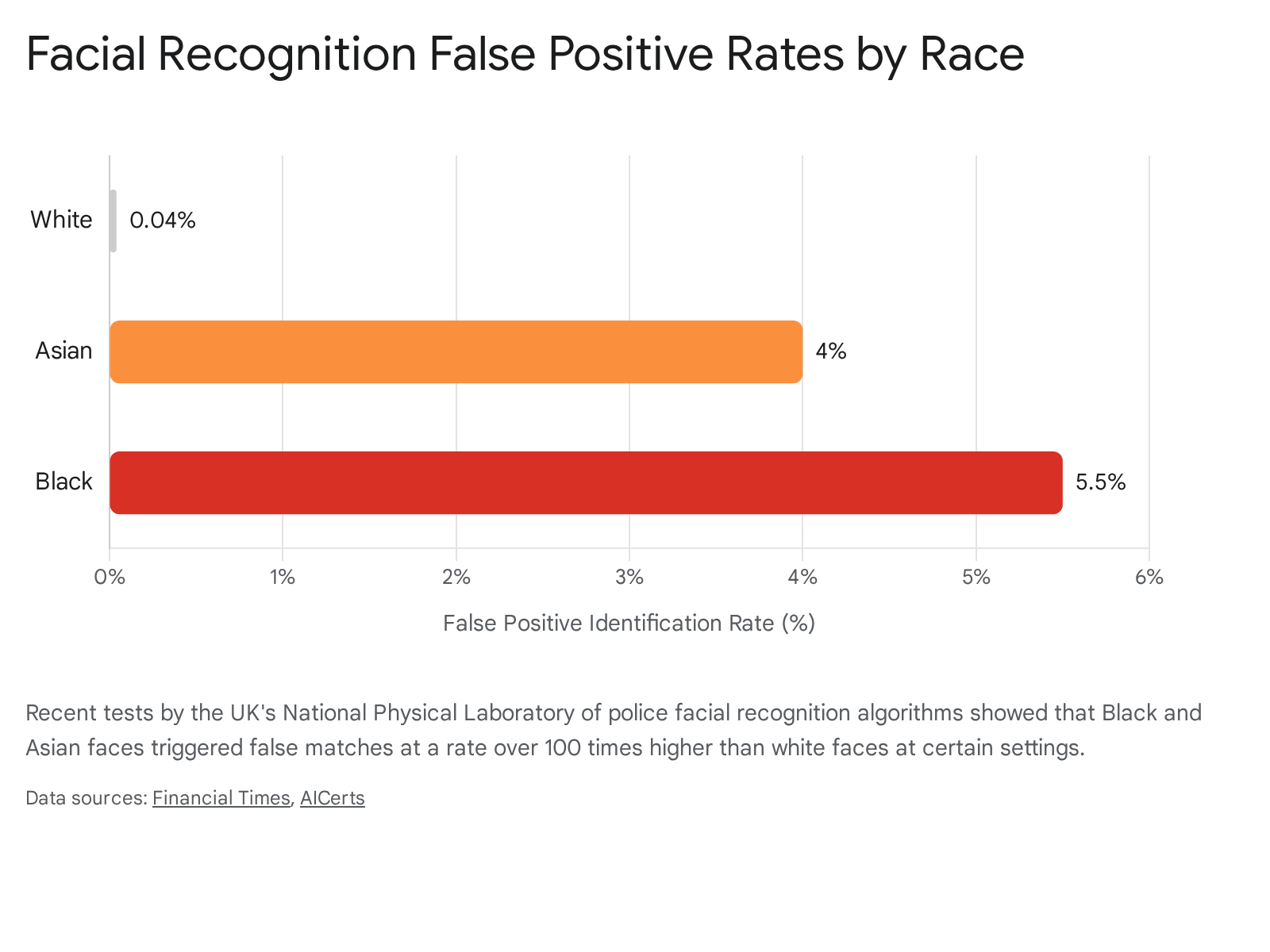
This represents a 100-fold statistical disparity.
Despite these alarming figures and internal warnings regarding the erosion of public trust, UK police forces successfully lobbied to lower the confidence threshold of the software. Their argument rested on the fact that raising the threshold to a setting where bias was mitigated significantly reduced the number of "investigative leads" the system generated 2831. This highlights the ongoing tension between operational efficiency and civil rights in algorithmic deployment.
Global Perspectives on Algorithmic Bias
While discussions of algorithmic bias often center on corporate deployments in the United States and regulatory responses in Europe, the expansion of AI has distinct and profound impacts on populations globally.
The Data Deficit in Africa
In many African nations, such as Nigeria, Kenya, and South Africa, the rapid rollout of AI across healthcare, finance, and policing is hindered by a severe lack of localized training data 363233. Datasets used to train global AI systems frequently underrepresent African populations, leading to high error rates in biometric verification and health diagnostics 532. For instance, AI healthcare models designed to diagnose skin diseases or monitor sexual and reproductive health are often trained on retrospective data from the United States or Europe, making them highly inaccurate for diverse African demographics 33.
Furthermore, Western algorithms carry socioeconomic assumptions that do not map accurately to local realities. AI security systems might mistakenly flag intermittent network connectivity - a common infrastructure reality in many African regions - as suspicious or fraudulent activity 5. Financial algorithms trained on standard credit card histories often misjudge the creditworthiness of users operating primarily in cash economies 5. Without locally audited datasets, culturally sensitive feature mapping, and robust domestic data protection frameworks, AI threatens to exacerbate the digital divide on the continent rather than bridge it 3634.
China's Algorithmic Governance
In contrast to the fragmented commercial adoption in the West, China has embraced algorithmic evaluation at a formalized state level through its Social Credit System (SCS). Originally conceived as a mechanism to assign trustworthiness scores to citizens, the system relies heavily on AI to aggregate data from court judgments, surveillance cameras, and financial records to reward or punish behavior 35.
Recent forensic analyses from 2025 and 2026 suggest that China's system has evolved significantly from its initial dystopian framing. The deeply feared "individual citizen score" has largely been deemphasized at the national level in favor of a massive corporate compliance and regulatory infrastructure 3642. However, where individual scoring still exists in localized municipal pilots, researchers note significant structural biases.
An analysis of a 2019 national model in an anonymized city of one million people ("Meritown") found that the algorithm systematically disadvantaged rural residents 37. While the system rewarded "good" behavior (like volunteering) and penalized "bad" behavior (like traffic violations), rural citizens faced 28 percent of the system's penalties while having access to only 6 percent of the reward opportunities compared to their urban counterparts 37. Government employees, conversely, were afforded vast opportunities to earn bonus points to secure promotions. The system illustrates how algorithmic governance can formally encode state priorities and demographic advantages into the digital infrastructure of daily life 3637.
Can We Fix the Problem? Regulation and Recourse
Addressing algorithmic bias is extraordinarily difficult because it requires solving both mathematical optimization problems and deeply entrenched societal problems simultaneously. Currently, there are significant regulatory pushes globally to hold developers and users of AI accountable.
The Challenge of Challenging AI Decisions
For everyday consumers and citizens, challenging an algorithmic decision remains an uphill battle. In legal arenas, applicants who try to appeal an AI-driven decision - such as a denied immigration visa or a rejected application for public benefits - face what Canadian courts are increasingly calling a "clear evidence" standard 44.
In cases such as Espinosa Cotacachi v. Canada, where applicants challenged visa refusals heavily influenced by Microsoft's Chinook software, courts ruled that applicants cannot simply speculate that an algorithm was biased or that human adjudicators improperly delegated their authority to a machine 44. They bear the heavy evidentiary burden of proving exactly how the AI functioned and influenced the specific finding 44. Without mandatory transparency into the underlying code and training data, meeting this standard of proof is nearly impossible for the average citizen.
The US Patchwork Approach
In the United States, there is currently no comprehensive, unified federal law specifically targeting AI development 1138. Instead, federal agencies like the Federal Trade Commission (FTC), Securities and Exchange Commission (SEC), and the Department of Justice are applying existing civil rights and consumer protection laws to AI tools 173846. Under initiatives like the FTC's "Operation AI Comply," regulators are actively targeting companies that use AI to deceive consumers or obscure biased data practices 46. State attorneys general are also deploying broad "unfair and deceptive acts or practices" (UDAP) statutes to investigate AI-related conduct, arguing that biased outcomes from AI models inherently violate general consumer protection authority 2138.
The European Union AI Act
Meanwhile, the European Union has taken a vastly more aggressive and structured stance with the EU AI Act, the world's first comprehensive horizontal legal framework for artificial intelligence 3948. The Act, which officially entered into force in August 2024, explicitly prohibits certain AI practices that carry "unacceptable risks" 3940. As of February 2025, practices such as social scoring by public authorities, mass real-time biometric surveillance in public spaces, and the use of emotion recognition technology in the workplace or educational institutions are completely banned across the EU 3940.
The EU AI Act classifies algorithms used in critical sectors like employment screening, credit scoring, education, and law enforcement as "high-risk" systems 394841. While a "Digital Omnibus" political agreement reached in mid-2026 delays the compliance deadlines for these high-risk systems to December 2027 (for stand-alone systems) and August 2028 (for AI embedded in regulated products), the legislation ultimately requires companies to ensure meaningful human oversight, maintain robust documentation, and actively mitigate biases 394842. Despite these protections, European consumer advocacy groups like BEUC argue that the Act still leaves critical gaps, particularly by failing to grant consumers the explicit right to challenge an algorithmic decision or seek collective redress in court when an AI causes widespread economic harm 4143.
The Mathematical Paradox of Fairness
Even as regulators increasingly demand "fair" algorithms, the AI industry faces a fundamental epistemic and mathematical challenge: fairness is frequently contradictory 1544.
In machine learning, it is often mathematically impossible to satisfy multiple competing definitions of fairness simultaneously. If a data scientist attempts to adjust an algorithm to ensure it has an equal overall accuracy rate across all racial groups, the mathematical constraints of the model may inevitably create a severe disparity in the false positive rate between those same groups 15. Because different demographics have different historical baselines and representation within the data, optimizing an algorithm to meet one statistical standard of justice almost always violates another. Therefore, "de-biasing" an AI is rarely a simple technical or engineering fix. It requires human beings to make a deliberate, moral choice about which trade-offs to accept, which constraints to prioritize, and whose errors matter most 1315.
Bottom line
Algorithmic bias proves that artificial intelligence is neither neutral nor mathematically objective; it is a mirror reflecting the historical inequalities, proxy variables, and value judgments embedded in its training data. In critical domains like hiring, consumer lending, and policing, flawed algorithms systematically filter out qualified candidates, deny credit based on behavioral proxies, and subject marginalized groups to higher rates of false identification. While sweeping regulations like the EU AI Act and state-level audit laws attempt to rein in these systems, eliminating bias entirely remains a profound mathematical and societal challenge, highlighting that true algorithmic fairness cannot be achieved by code alone.