
Green Consumer Behavior and the Attitude-Behavior Gap
Introduction to Sustainable Consumption Dynamics
The transformation of global consumption paradigms toward environmental sustainability has evolved into a strategic and ecological imperative over recent decades. Driven by increasing collective awareness of climate change, resource depletion, and ecological degradation, consumer preferences have ostensibly shifted toward sustainable, eco-friendly products and services. Surveys repeatedly demonstrate overwhelming public support for environmental protection; recent global polling indicates that up to 85% of consumers report experiencing the disruptive impacts of climate change firsthand, and 84% state they would prioritize environmental protection even at the cost of slowed economic growth 123. Despite this profound shift in environmental consciousness, a fundamental paradox plagues sustainable consumer behavior research: the dissonance between expressed pro-environmental attitudes and actual purchasing behavior.
This phenomenon, widely documented in behavioral economics and consumer psychology, is termed the attitude-behavior gap, the intention-behavior gap, or simply the green gap 45678. The green gap demonstrates that while consumers express high environmental awareness and robust intentions to purchase eco-friendly products, these psychological dispositions fail to translate consistently into actual market behavior 48. For example, empirical studies in the fast-moving consumer goods (FMCG) sector reveal that while 82% of consumers consider sustainability an important factor in their purchasing decisions, only 33% consistently purchase eco-friendly alternatives 910.
Closing the attitude-behavior gap is not merely an academic exercise in consumer psychology; it is a critical requirement for achieving global climate targets. Nearly 70% of multinational corporations' carbon footprints are influenced by consumer purchasing decisions, product usage, and disposal patterns 11. Understanding the gap requires a multidimensional analysis of individual cognitive biases, structural market barriers, and the varying efficacy of behavioral interventions designed to facilitate sustainable choices.
Theoretical Foundations of Sustainable Consumption
To conceptualize the discrepancy between sustainable attitudes and actual consumption, researchers rely on established social psychology frameworks, utilizing methodologies such as the Theory-Context-Characteristics-Methodology (TCCM) framework to systematically map consumer decisions 461112. These frameworks attempt to isolate the specific variables that interrupt the translation of abstract environmental values into physical purchases.
The Theory of Planned Behavior
The Theory of Planned Behavior (TPB) remains the dominant analytical model applied to sustainable consumption 5131414. The TPB posits that behavioral intentions are shaped by three core determinants: personal attitudes toward the behavior, subjective norms (perceived social pressures), and perceived behavioral control (the perceived ease or difficulty of performing the behavior) 5141415. Under ideal conditions, a strong intention serves as the proximal cause of behavior. Individuals who evaluate sustainable consumption positively, feel moral encouragement from their peers, and perceive themselves as financially and logistically capable are highly likely to form strong behavioral intentions 16.
However, the TPB frequently falls short in predicting actual retail behavior because it presumes a high degree of rational deliberation 1617. Empirical research shows that purchase intentions are often not translated into actual purchase actions due to situational modifiers 18. In response, scholars have extended the TPB to include additional variables such as environmental consciousness, moral norms, and anticipated feelings of regret 1415. Despite these additions, the model still struggles to account for the spontaneous, heuristic-driven nature of everyday shopping.
Value-Belief-Norm Theory and Bounded Rationality
An alternative framework frequently utilized is the Value-Belief-Norm (VBN) theory, which argues that stable personal values shape beliefs, which in turn influence environmental attitudes and behaviors 1119. The VBN model is particularly useful for understanding the intrinsic motivations of highly committed "green consumers." However, for the average consumer, decisions are often governed by bounded rationality 20.
Consumers rarely have the time, cognitive bandwidth, or comprehensive information required to optimize every purchase for sustainability 2022. In modern retail environments, shoppers operate under cognitive constraints, leading them to rely on established habits and heuristics rather than conscious value-based deliberation. This cognitive limitation forms the foundation of behavioral economic interventions, highlighting that rational models of consumption are insufficient for explaining the green gap 2021.
Retail Dynamics and Point-of-Sale Interferences
Beyond internal psychological models, the physical and digital retail environments introduce situational variables termed "interferences." A qualitative study on situated consumer behavior identified five primary categories of retail interferences that prevent consumers from acting on stated intentions: message overload, shopping on autopilot, perceived price barriers, competing value judgments, and a fundamental lack of immediate knowledge regarding product origins 7.
When consumers enter a store, the intention to buy a sustainable product is frequently hijacked by the sensory overload of the retail environment. Habitual buying - shopping on autopilot - represents a powerful interference, as consumers instinctively reach for familiar brands without subjecting them to environmental scrutiny 722. Overcoming these point-of-sale interferences requires disrupting deeply ingrained behavioral loops, a task that abstract environmental attitudes are rarely strong enough to achieve independently.
Table 1: Dominant Theoretical Frameworks in Green Consumer Research
| Theoretical Framework | Core Premise | Application to the Attitude-Behavior Gap | Key Limitations |
|---|---|---|---|
| Theory of Planned Behavior (TPB) | Behavior is driven by attitudes, subjective norms, and perceived control. | Identifies specific psychological roadblocks preventing intention formation. | Presumes high rationality; struggles to explain habit-driven or spontaneous purchases. |
| Value-Belief-Norm (VBN) Theory | Personal values dictate ecological beliefs and moral norms. | Explains the intrinsic motivation of highly dedicated ethical consumers. | Weak predictor of behavior in low-involvement, everyday transactions. |
| Bounded Rationality | Decision-making is limited by cognitive capacity, time, and available information. | Explains why consumers default to familiar, non-green products to reduce cognitive load. | Focuses on systemic cognitive limits rather than specific environmental attitudes. |
| Situated Interferences | Retail environments introduce immediate barriers that hijack intentions. | Highlights the gap between out-of-store intentions and in-store realities. | Highly context-dependent; varies drastically between retail sectors. |
Methodological Artifacts in Consumption Research
Before analyzing the economic and structural barriers that impede green consumption, it is necessary to examine whether the attitude-behavior gap is as vast as self-reported data suggests, or if it is partially an artifact of methodological measurement errors. The reliance on self-reported survey instruments in sustainable consumption research introduces significant risks of data distortion.
Social Desirability Bias
Social Desirability Bias (SDB) refers to the tendency of respondents to answer questions in a manner that will be viewed favorably by others, leading to the over-reporting of socially acceptable behaviors and the under-reporting of undesirable behaviors 232425. Because environmental protection is a highly moralized and socially lauded objective, consumers frequently feel implicit social pressure to express eco-friendly attitudes and claim higher rates of sustainable purchasing than they actually execute 2526.
This psychological need for a positive social image and ethical self-concept artificially inflates recorded environmental intentions, thereby exaggerating the measured gap when these intentions are compared to actual retail sales data 151826. Recent meta-analyses of environmental psychology research have sought to quantify the exact influence of SDB on self-reported green behavior. An analysis synthesizing data from 29 previously published papers investigated the correlations between validated SDB scales and self-reports of pro-environmental behaviors 25.
The findings reveal that the pooled correlations with social desirability are generally small but statistically significant, ranging from 0.06 to 0.11 (and 0.08 to 0.13 when correcting for measurement error attenuation) 25. Individuals who score high in social desirability are more likely to exaggerate their pro-environmental habits, viewing themselves as more ethical than their peers 2327. However, the relatively small effect sizes indicate that while SDB is a persistent confounder, it does not entirely explain away the attitude-behavior gap. The discrepancy between attitude and action remains a tangible reality driven by external frictions, even after adjusting for individual reporting biases 25.
Self-Reported Versus Observational Metrics
To mitigate these methodological limitations, contemporary researchers advocate for mixed-methods designs that combine self-reported psychological metrics with objective, observational behavioral data. A recent two-phase study involving Italian adults directly compared self-reported sustainable behaviors (using the Sustainable Behaviors Scale, SBS) with an observational behavioral measure (the Behavioral Sustainability Performance Parameter, BSPP) 131617.
The results demonstrated a critical divergence: while behavioral intentions strongly predicted self-reported behaviors, their link to actual, observed choices was markedly more modest 1316. This confirms that relying solely on survey data captures the consumer's idealized self-concept rather than their pragmatic retail behavior. To achieve higher ecological validity, research must pivot toward analyzing actual point-of-sale scanner data, implicit attitude testing, and direct field observations 1626.
Primary Barriers to Sustainable Purchasing
While psychological biases influence the measurement of the green gap, the primary drivers of behavioral failure in the marketplace are deeply rooted in economic constraints, convenience deficits, and a pervasive lack of institutional trust. When consumers enter a retail environment, abstract environmental values frequently succumb to immediate, self-oriented utilitarian goals 28.
Economic Friction and the Green Premium
The most formidable and consistently cited barrier to green consumption is the price premium associated with sustainable products 293031. Sustainable manufacturing processes, ethically sourced raw materials, and green certifications generally incur higher operational costs, which are subsequently passed on to the end consumer 10. In periods of macroeconomic stability, a segment of the population exhibits a willingness to absorb this cost; studies indicate some consumers claim they are willing to pay an average premium of 9.7% for goods that meet specific environmental criteria, such as a lower carbon footprint or recycled packaging 2.
However, stated willingness to pay rarely matches revealed preferences. In the context of recent global inflation, supply chain disruptions, and an escalating cost-of-living crisis, the "sustainability surcharge" has become increasingly untenable for the mainstream market 3532. Recent market research reveals that traditional consumer decision trees have inverted: rather than selecting a desired product and assessing its price, consumers in inflationary environments begin with a fixed, constrained budget and force categories to compete for limited capital 33. Consequently, affordability dictates the boundaries of moral consumption.
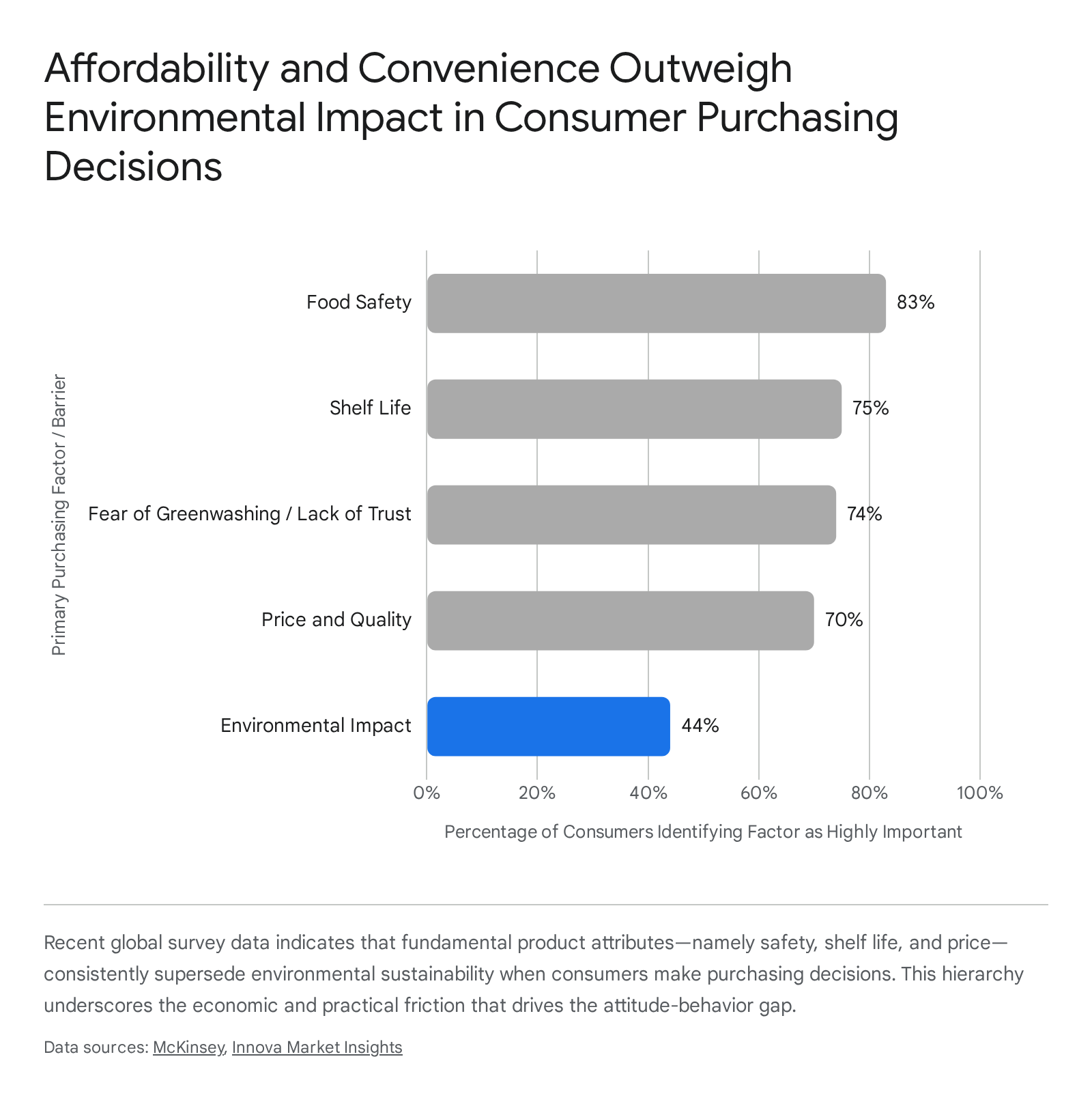
A 2025 study of Australian and New Zealand consumers utilizing MaxDiff trade-off analysis highlighted an acute rejection of the green premium. When forced to make real-world choices between competing product attributes, 65% of respondents stated that businesses should absorb the costs of sustainability through reduced profit margins rather than passing them to shoppers 35. Except for a niche segment of highly driven ethical consumers, sustainability consistently ranks fifth or lower when forced to compete directly against price and basic functional benefits 35. Furthermore, even those willing to pay a premium cap their tolerance at 4-5% on average - a figure that barely covers the cost of green certification, let alone meaningful operational changes 35.
This economic friction reveals a distinct class divide in sustainable consumption. While affluent cohorts can afford to align their purchasing habits with their environmental values, low-income demographics are frequently priced out of the green market 34. High prices render eco-friendly products exclusive, undermining the mass-market adoption necessary to achieve systemic environmental goals 3134.
Product Performance and Convenience Trade-offs
When price parity is achieved, convenience and product efficacy emerge as the secondary gatekeepers of the attitude-behavior gap. Consumers inherently seek to minimize cognitive load and physical effort during routine transactions 3536. Sustainable products often demand a disruption of established habits, requiring consumers to expend additional effort to locate products, learn new usage instructions, or accept compromises in performance 71837.
The specific manifestations of convenience barriers vary drastically by industry sector. In the Fast-Moving Consumer Goods (FMCG) and packaging sectors, consumer choices are heavily dictated by concerns over food safety and product longevity. McKinsey's 2025 packaging survey highlights that 83% of consumers prioritize food safety and 75% prioritize shelf life, largely because extending shelf life prevents household food waste and associated financial loss 38.
If sustainable packaging (e.g., compostable films or reduced-plastic containers) is perceived to compromise durability or freshness, consumers will instinctively revert to conventional plastics.
Conversely, in the durable goods and automotive sectors, convenience barriers manifest as infrastructural deficits. The adoption of Electric Vehicles (EVs), despite high theoretical consumer interest, is heavily impeded by "range anxiety" and the lack of accessible charging infrastructure. Nearly 47% of consumers cite battery charge limitations and travel distance as their primary deterrents to transitioning from internal combustion engines to EVs 39. Whether navigating grocery aisles or automotive markets, consumers demonstrate a low tolerance for friction; if a green choice requires significantly more effort, time, or compromise than the conventional alternative, the pro-environmental intention is rapidly abandoned 3740.
Information Asymmetry and Greenwashing Skepticism
The third pillar of the attitude-behavior gap is the widespread erosion of consumer trust, exacerbated by the proliferation of greenwashing. Greenwashing occurs when firms disseminate misleading, exaggerated, or unsubstantiated claims regarding the environmental benefits of their products or operational practices 522. As the green market has expanded, so too has opportunistic marketing, leading to a saturated environment of unregulated eco-labels and vague sustainability jargon 22.
From the perspective of signaling theory, green product attributes are often "credence qualities" - characteristics that the consumer cannot easily verify even after purchase and use 4. Consumers must rely entirely on the brand's signals to ascertain the product's ecological value. However, persistent exposure to greenwashing has induced profound consumer skepticism 918. Apprehensions regarding corporate deception actively diminish the translation of positive environmental attitudes into purchase intentions 5. Research indicates that up to 74% of consumers are highly critical of greenwashing tactics, and this skepticism acts as a severe moderating variable that dampens green purchase behavior 541.
When trust is compromised, the perceived risk of the purchase increases. Consumers fear they are paying a premium for a product that yields no actual environmental benefit, leading to cognitive dissonance and ultimate avoidance of the green category altogether 8. Conversely, when companies cultivate "green trust" through radical transparency, third-party verifiable certifications, and clear communication of supply chain impacts, they significantly reduce information asymmetry. Studies utilizing structural equation modeling confirm that green perceived value and green trust are critical mediating mechanisms that bridge the attitude-behavior gap, actively converting latent environmental concern into brand loyalty and actualized purchases 481142.
Demographic and Geographic Variations
The attitude-behavior gap is not a uniform phenomenon; it manifests with distinct variations across different socio-economic regions and generational cohorts. Analyzing these demographic splits provides essential granularity for designing targeted sustainability interventions.
Generational Disparities in Eco-Consciousness
Generational divides heavily influence how sustainable consumption is approached. Generation Z and Millennials consistently demonstrate the highest baseline levels of environmental concern, with 61% of Millennials viewing environmental preservation as a severe global priority 3043. These younger cohorts actively research brands' sustainability claims on social media and are more likely to seek out plant-based diets or engage with the circular economy (e.g., second-hand apparel markets) 44.
However, despite strong ethical identities linked to sustainability, Generation Z often exhibits a pronounced attitude-behavior gap, particularly in sectors like fashion. A 2025 study analyzing fashion consumption among Generation Z and Baby Boomers found that while younger consumers show a strong tendency toward ethical consumption, they frequently default to less sustainable "fast fashion" options due to strict affordability constraints and high responsiveness to rapid social media trends 18. For these consumers, the desire to maintain a relevant social image often conflicts with their ethical self-concept, resulting in compromised purchasing decisions 18.
On the other hand, older generations (such as Baby Boomers) may express lower baseline anxiety about climate change but often exhibit more consistent, practical sustainability behaviors driven by frugality, such as minimizing household energy and water consumption 30.
The Global North Versus Emerging Markets
A prevailing narrative in environmental economics historically suggested that sustainable consumption was a "luxury" priority, predominantly pursued by affluent consumers in the Global North who had satisfied basic Maslowian needs. However, comprehensive polling data from 2024 and 2025 subverts this assumption, revealing that demand for green action is paradoxically stronger in emerging economies than in wealthier Western nations 13.
In a global survey of over 10,000 individuals across 10 countries, support for prioritizing environmental protection over economic growth was highest in developing and emerging markets, led by Turkey (91%), Nigeria (89%), South Africa (88%), India (82%), and China (79%) 13. Conversely, wealthier nations exhibited significantly lower levels of urgency, with public support in Australia dropping to 46% 3. Furthermore, trust in the ability of political and corporate leaders to ensure a sustainable future is heavily polarized; while 83% of Chinese respondents exhibit high trust levels, skepticism dominates in the Global North (e.g., only 29% in Australia) 3.
This geographic disparity can be attributed to the proximity of environmental threats. Populations in emerging markets are frequently on the frontlines of ecological degradation, experiencing the immediate, tangible consequences of industrial pollution, extreme weather events, and water scarcity 11042. In these regions, environmental concern is not an abstract moral preference but an urgent public health and economic necessity.
Despite this heightened environmental consciousness, consumers in the Global South face an arguably wider attitude-behavior gap due to severe structural constraints. While the psychological intention to purchase green products is exceptionally high, emerging markets suffer from inadequate recycling infrastructure, limited availability of sustainable product variations, and absolute income constraints that make even minimal price premiums prohibitive 102022. In these contexts, consumers often operate under "bounded rationality," where limited information, economic scarcity, and lack of supportive government policy force them into unsustainable choices despite their strong pro-environmental values 2022.
Table 2: Comparative Environmental Attitudes by Geographic Region (2024-2025 Data)
| Region / Country | Priority for Environmental Protection | Trust in Leadership on Sustainability | Primary Consumption Barrier |
|---|---|---|---|
| Emerging Markets (e.g., Nigeria, India) | Extremely High (79% - 89%) | Mixed to High (e.g., China at 83%) | Absolute affordability and infrastructure limits. |
| Global North (e.g., Australia, US) | Moderate (e.g., Australia at 46%) | Very Low (e.g., Australia at 29%) | Convenience trade-offs and greenwashing skepticism. |
Behavioral Interventions and Choice Architecture
To bridge the attitude-behavior gap, policymakers and corporate strategists employ a spectrum of interventions. The least intrusive of these rely on behavioral economics to alter the choice architecture without restricting freedom or altering economic incentives.
The Mechanisms of Green Nudging
Rooted in behavioral science, a "nudge" is an intervention that alters the choice architecture - the environment in which people make decisions - to predictably influence behavior 354546. Green nudges aim to bypass cognitive inertia by making the sustainable choice the easiest, most salient, or most socially normative option 283747.
A comprehensive quantitative review of over a decade of research, encompassing more than 440 effect sizes and over 2.1 million participants, confirmed that choice architecture interventions successfully promote behavior change with an overall small-to-medium effect size (Cohen's $d = 0.43$) 48. However, the efficacy of nudges varies dramatically based on their structural design.
Default Options Versus Informational Nudges
The literature generally categorizes nudges into informational, normative, and structural interventions, each with varying degrees of success:
- Decision Information Nudges: Techniques such as eco-labels, carbon footprint scores, or real-time energy displays rely on the assumption that consumers lack data 3548. While useful for highly motivated individuals, information nudges generally yield the weakest behavioral shifts, as they require the consumer to actively process the data and overcome their own habitual inertia 4748. In some instances, informational nudges have even backfired, leading to moral licensing or rebound effects where consumers increased energy consumption after receiving feedback 47.
- Decision Assistance and Social Norms: Reminders and social comparisons (e.g., showing a household's energy use relative to neighbors) effectively harness peer pressure and intrinsic motivation 3547. Norm-nudges have proven particularly effective in environments where behavior is visible, such as reducing towel usage in hotels or shifting transport choices 2847. A field experiment in tourism demonstrated that raising the frequency of norm-nudges did not cause a backfiring effect, suggesting social pressure can be safely maintained to encourage sustainable actions 28.
- Decision Structure Nudges (Defaults): Modifying the default option is universally recognized as the most potent behavioral intervention 4849. Because consumers suffer from decision fatigue and status quo bias, pre-selecting the eco-friendly option yields the highest compliance rates 213549. Field experiments in cafeterias have shown that shifting a menu default to a reduced-meat option resulted in a 90.6% adoption rate, compared to just 38.5% when consumers had to actively choose the sustainable portion 49.
Digital Nudges and Habitual Disruption
As consumption moves online, "digital nudging" has emerged as a crucial tool to guide sustainable e-commerce. Digital environments allow for dynamic choice architecture, utilizing timely notifications, default digital receipt settings, and algorithmic product sorting to prioritize eco-friendly options 2236. However, digital nudges must contend with "temporal discounting," where consumers undervalue abstract, distant environmental benefits in favor of immediate gratification 36.
Furthermore, despite their cost-effectiveness and high public acceptance, green nudges suffer from critical temporal limitations. Evidence indicates that the behavioral impact of most nudges (particularly informational and social nudges) is subject to rapid decay; once the nudge is removed or the consumer habituates to the intervention, behavior frequently reverts to the baseline 455051. Nudges alone are insufficient for driving systemic, permanent market transformations, as they do not address the underlying economic frictions (like price premiums) that cause the attitude-behavior gap.
Structural Interventions in the Market
To correct fundamental market failures and internalize negative environmental externalities, governments must deploy structural interventions, primarily in the form of taxation and prohibitive bans. These mechanisms do not rely on the consumer's moral attitude; they force behavioral compliance through financial penalty or restricted choice 4652.
Carbon Pricing and Taxation Efficacy
Carbon taxes operate on the standard economic assumption that increasing the cost of carbon-intensive activities will rationally drive consumers and businesses toward low-carbon alternatives 4652. A recent machine-learning-assisted meta-analysis of 80 causal ex-post evaluations across 21 carbon pricing schemes globally demonstrated that introducing a carbon price yields immediate and substantial emission reductions 52. Across the evaluated schemes, carbon pricing achieved statistically significant emission reductions ranging from 5% to 21% 52. Furthermore, panel difference-in-difference experiments demonstrate that carbon taxes promote green trade and comparative advantages in low-carbon markets 53.
However, the real-world efficiency of carbon taxes is frequently compromised by political concessions and sectoral exemptions. Analyses of carbon tax "c-efficiency" (the ratio of actual revenue collected to the theoretical revenue if all emissions were taxed uniformly) reveal a global weighted average c-efficiency of just 0.26 54. This indicates that carbon taxes often capture only a fraction of their intended base 54. Furthermore, carbon taxes face severe public resistance, as they directly exacerbate cost-of-living pressures and disproportionately impact lower-income populations, triggering political backlash 4655.
Product Bans and Regulatory Mandates
When specific products pose severe ecological hazards, outright bans are often deployed. Single-use plastic bags represent a highly visible battleground for structural policy. A 2025 study published in Science, analyzing data from international coastal cleanups, found that jurisdictions implementing plastic bag bans saw a 25% to 47% reduction in plastic bags collected in the environment 5657.
However, policy design is paramount, as poorly structured interventions can trigger unintended consequences. A comprehensive cross-country analysis of 208 nations from 1960 to 2021 revealed complex dynamics: while outright bans successfully reduce population exposure to fine particulate matter ($PM_{2.5}$) and effectively limit plastic waste, taxes on plastic bags unexpectedly increased $PM_{2.5}$ exposure across several World Health Organization targets 58. Furthermore, "partial bans" that only outlaw lightweight plastics frequently result in consumers treating thicker, heavier "reusable" plastic bags as single-use items, inadvertently increasing the total tonnage of plastic waste generated 5664.
Synergistic Policy Approaches
Recognizing the distinct limitations of both purely psychological and purely economic interventions, frontier research in behavioral economics advocates for the synergistic application of green nudges and carbon taxes. Standard economic theory assumes that taxes and behavioral instruments are alternatives, but emerging evidence suggests they act as powerful complements 46.
Combining Behavioral Nudges and Structural Policies
A 2026 empirical study by the Toulouse School of Economics tested this interaction through an online shopping experiment utilizing both a carbon tax and a traffic-light-style carbon label (a nudge) 55. The findings were highly illustrative of consumer behavior dynamics: 1. Tax Alone: A carbon tax successfully reduced the overall carbon footprint per euro spent, but it did so purely through an income effect (forcing consumers to buy less overall due to constrained budgets) 55. 2. Nudge Alone: The traffic-light label successfully prompted consumers to substitute high-carbon products (red) for low-carbon products (green) within specific categories, but it did not significantly reduce the absolute carbon footprint of the total basket 55. 3. The Synergy: When the high carbon tax was combined with the informational nudge, it produced a massive substitution effect. The label provided the cognitive map necessary for consumers to navigate the tax environment effectively, allowing them to lower their tax burden by actively choosing greener alternatives 55.
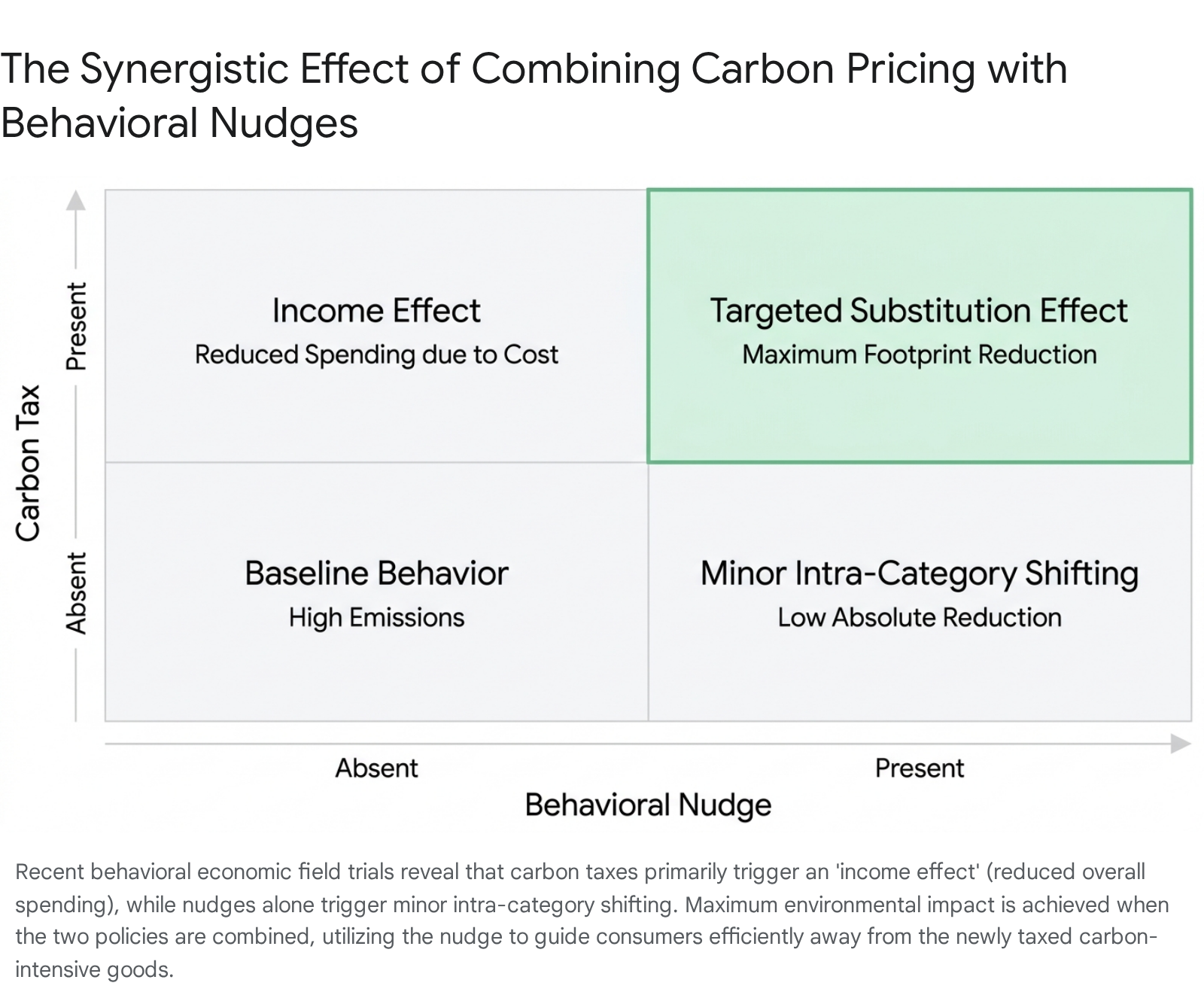
Furthermore, behavioral economists argue that green nudges significantly increase the public acceptability of carbon taxes. By framing the tax contextually and highlighting the normative goal of environmental protection, nudges help rebrand punitive economic measures as collective social endeavors, thereby mitigating political backlash 46.
Institutional and Corporate Purchasing Behavior
While the attitude-behavior gap is predominantly studied at the individual consumer level, it mirrors dynamics found in institutional and business-to-business (B2B) purchasing. Corporations frequently express high-level commitments to ESG (Environmental, Social, and Governance) goals, yet face operational barriers in executing them.
For instance, in the pharmaceutical and life sciences sector, clinical trials account for a significant portion of global greenhouse gas emissions (estimated at up to 100 million tonnes of $CO_2e$ annually) 59. While industry sponsors acknowledge the need for sustainability, the adoption of green protocols (such as decentralized trials to reduce patient travel, or local manufacturing of materials) is severely slowed by risk aversion 6061. Institutional purchasers fear that deviating from standard, carbon-intensive processes might jeopardize regulatory compliance or delay timelines 61.
To close this institutional gap, industry consortiums like the Pistoia Alliance and the Sustainable Healthcare Coalition are developing standardized carbon calculators and predictive models to measure emissions prior to trial enrollment 6062. Just as individual consumers require clear eco-labels to overcome information asymmetry, institutional purchasers require robust, standardized metrics to confidently choose sustainable operational models without perceiving unacceptable levels of risk 5962.
The green consumer attitude-behavior gap is a multifaceted phenomenon resulting from a complex interplay between cognitive biases, economic constraints, and structural market failures. While social desirability bias artificially inflates the perceived size of this gap in academic literature, the underlying failure of consumers to translate genuine environmental concern into consistent market behavior is an undeniable reality 82537. Bridging this gap will require moving beyond simple information campaigns, utilizing a sophisticated blend of default choice architecture to ease cognitive friction, alongside structural economic policies that eliminate the prohibitive green premium.