
Functional Social and Emotional Dimensions of Jobs to Be Done
The Jobs to Be Done framework represents a fundamental paradigm shift in innovation strategy, product development, and consumer psychology. Rather than analyzing markets through the traditional lens of demographic segments, psychographic profiles, or product feature sets, the framework asserts that consumers "hire" products or services to accomplish specific "jobs" in their lives 123. A job is defined as the progress an individual or organization seeks to make within a specific set of circumstances 456. This approach transcends surface-level market data to uncover the causal drivers of consumer behavior, recognizing that purchase decisions are rarely based on pure utilitarian function alone 1.
The architecture of a customer job is inherently multidimensional. While the overt catalyst for a purchase is often a practical requirement, the underlying decision-making process is heavily governed by internal psychological states, affective responses, and external societal pressures 18. Consequently, every job comprises three interacting dimensions: functional, emotional, and social 8910212. Understanding the interplay of these dimensions is critical for organizations seeking to achieve product-market fit, differentiate their offerings, and accurately predict consumer behavior across varying contexts, industries, and cultures.
Theoretical Foundations and Divergent Interpretations
To accurately analyze the dimensions of customer progress, it is necessary to trace the origins of the framework and understand its diverging academic and practical interpretations. The underlying logic traces back to Theodore Levitt's foundational observation that customers do not desire a quarter-inch drill; they desire a quarter-inch hole 93. The formalization of this concept into a distinct framework, however, is historically contested and primarily divided between methodologies advanced by Clayton Christensen, Tony Ulwick, Bob Moesta, and others 63.
The Jobs-As-Progress Model
Popularized by Clayton Christensen in publications such as The Innovator's Solution (2003) and Competing Against Luck (2016), the Jobs-As-Progress interpretation views jobs as the pursuit of a positive life change 3. This school of thought emphasizes the contextual circumstances that generate a consumer struggle and asserts that individuals inherently wish to avoid doing work. The unit of analysis is the push and pull forces of demand, focusing heavily on emotional motivations, anxieties, and the habits of the present that hold consumers back from adopting new solutions 1016.
In this model, the taxonomy of functional, emotional, and social dimensions is widely accepted, though some industry analysts note that the tripartite division originated from relatively brief assertions in early literature rather than extensive, isolated empirical testing . Nonetheless, the taxonomy has become the standard mechanism for analyzing the totality of the consumer experience.
The Jobs-As-Activities Model
Predating Christensen's popularization, Tony Ulwick introduced Outcome-Driven Innovation in the 1990s 345. This highly quantitative methodology treats the job as a literal process or activity that the customer is trying to execute. It systematically deconstructs functional jobs into discrete process steps and measures customer success through predefined "desired outcomes" based on speed, predictability, and output quality 20.
While these models differ fundamentally - one focusing on human psychology and behavioral progress, the other on systematic process optimization and continuous improvement - both acknowledge that functional tasks cannot be isolated from their emotional and social contexts 1. In practice, many modern enterprises blend these approaches, utilizing the qualitative empathy of the Jobs-As-Progress model to define the core job, and the quantitative rigor of the Jobs-As-Activities model to score and prioritize specific features 162021.
The Tripartite Dimensional Structure
In evaluating why consumers choose one solution over another, the framework categorizes motivations into a tripartite structure. These dimensions do not operate in isolation; they interact simultaneously and fluidly during the purchase evaluation phase 18. The relative weight a consumer assigns to each dimension dictates brand loyalty, price elasticity, and ultimately, the success or failure of the product 6.
Functional Job Components
The functional dimension represents the objective, practical task the customer is attempting to execute 91023. It is the most visible and easily articulated layer of consumer demand. Functional jobs are strictly solution-agnostic; they describe what needs to be done without dictating the technological or operational mechanism used to accomplish it 124. For example, the functional job of commuting is simply to transport an individual from a residence to a workplace, a job that can be hired out to a bicycle, a personal vehicle, or public transit 25.
In highly technical or enterprise environments, functional jobs are often detailed and multifaceted, comprising numerous sub-tasks. Success in functional jobs is evaluated through objective criteria, such as time saved, friction reduced, durability, system reliability, or cost efficiency 6. However, satisfying the functional job is frequently only a baseline requirement. It acts as a prerequisite that grants a product entry into the consumer's consideration set, after which emotional and social factors dictate the final choice 267.
Emotional Job Components
The emotional dimension addresses the internal psychological state of the consumer. It explores how the customer wishes to feel, or conversely, what negative affective states they wish to avoid, while executing the functional job 8910. Human decision-making is heavily influenced by cognitive biases, particularly loss aversion, where the psychological pain of a loss is perceived as roughly two and a half times more severe than the joy of an equivalent gain 5.
Emotional jobs relate intimately to personal fulfillment, anxiety reduction, and peace of mind 28. For a consumer purchasing an enterprise software system, the emotional job may be the desire to feel confident and in control of organizational data, or the need to avoid feeling overwhelmed by interface complexity 1025. In the realm of consumer goods, emotional jobs often revolve around hedonic pleasure, stress relief, or the internal gratification of acting in alignment with personal ethical values, such as purchasing sustainable products to feel environmentally responsible 299.
Social Job Components
The social dimension is concerned with external perception: how the customer wants to be viewed, judged, or accepted by peers, colleagues, or society at large 89102. Social jobs tap into the deeply ingrained human psychological machinery of status signaling, group affiliation, and conspicuous consumption 56.
When a consumer purchases a luxury vehicle, the functional job of transportation is heavily outweighed by the social job of signaling wealth, exclusivity, and professional success to onlookers 268. Social jobs are notoriously difficult for organizations to fulfill because they require establishing a shared cultural consensus around the brand's meaning 26. A product cannot successfully complete a social job unless the broader societal group recognizes and validates the status or affiliation the product is intended to signal.
Dimensional Interaction Across Market Sectors
The weighting and interaction of functional, emotional, and social dimensions vary drastically depending on the industry, the target market, and the specific circumstances surrounding the purchase 1225. Products with high functional requirements demand fundamentally different research, development, and marketing strategies than those relying primarily on emotional resonance.
The Four Quadrants of Product Jobs
Market research and consumption value theories indicate that industries generally fall into a four-quadrant matrix based on the functional complexity and the emotional resonance of the jobs their products are hired to perform 67. Differentiation strategies must align precisely with the primary jobs customers seek to fulfill in each sector.
| Quadrant | Functional Complexity | Emotional Resonance | Characteristic Industries | Differentiation Strategy |
|---|---|---|---|---|
| Quadrant 1 | Low | Low | Raw materials, base chemicals | Compete on supporting dimensions such as cost reduction, supply chain reliability, or logistical service delivery 7. |
| Quadrant 2 | Low | High | Cosmetics, luxury goods, packaged food | Products have limited objective functionality; consumers hire them for emotional/social jobs (e.g., feeling attractive). Differentiation relies almost entirely on emotional branding 7. |
| Quadrant 3 | High | High | Automotive, high-end apparel | High complexity in both spheres. Products must fulfill rigorous functional requirements (safety, performance) while satisfying critical social jobs (status signaling). Messaging must synthesize both 7. |
| Quadrant 4 | High | Low | Enterprise SaaS, medical devices, heavy electronics | Must satisfy dozens of functional outcomes. Overt emotional appeal is low; differentiation requires isolating which specific functional parameters (e.g., speed vs. accuracy) are most underserved 7. |
Evaluation Mechanics in B2B and Enterprise Markets
While business-to-business purchases (typically situated in Quadrant 4) appear strictly logical, spreadsheet-driven, and consensus-oriented on the surface, dimensional analysis reveals a massive underlying emotional driver known as the "Cover Your Ass" factor 525. B2B buyers spend only an estimated 17 percent of their buying time meeting with potential suppliers; the remainder is spent on internal research and consensus building 5.
In enterprise environments, the individual championing the purchase or signing the contract is making a career-defining decision. While the buyer will articulate strictly functional requirements on a vendor checklist, the ultimate purchase decision is heavily dictated by emotional and social risk aversion 25. If a chosen software platform fails to integrate or disrupts operations, the buyer faces severe social damage in the form of lost professional reputation, and emotional damage stemming from the fear of termination. Therefore, the actual job the enterprise buyer is hiring the software to do is often: "Make my company more efficient without making me look incompetent to my peers or putting my job at risk" 25.
The historical enterprise adage, "Nobody ever got fired for buying IBM," perfectly encapsulates this dynamic 25. To win in B2B markets, organizations must satisfy the functional requirements to pass procurement guidelines, but they ultimately close the sale by satisfying the emotional job of reducing the economic buyer's career risk and the social job of enhancing their internal organizational status 2531.
The Impact of Personal Value in B2B Purchasing
Empirical data reinforces the dominance of emotional and social dimensions even in highly functional business markets. Research surveying roughly 3,000 B2B buyers demonstrates that perceived personal value - defined as the combination of professional, social, emotional, and self-image benefits - has twice the impact of perceived business value across a range of outcomes 10.
Buyers who recognize a high degree of personal value in a B2B brand are more than three times as likely to state they would make a purchase compared to those who do not recognize personal value (71 percent versus 22.6 percent) 10. Furthermore, these buyers are approximately eight times more likely to pay a premium for the product or service (68.8 percent versus 8.5 percent) 10. This indicates that demonstrating business and functional value is merely a prerequisite for consideration, while emotional and social value directly drives conversion and pricing power 10.
Cross-Cultural Variations in Job Dimensions
The interaction of these dimensions is not globally uniform. Societal norms heavily dictate which jobs are prioritized, requiring multinational corporations to adapt their outcome expectations based on regional cultural paradigms 111213. Applying the same dimensional weighting across different geographies often leads to market failure.
Individualistic Market Orientations
Using Hofstede's cultural dimensions as an analytical lens, research demonstrates profound differences in how consumers in individualistic versus collectivistic societies hire products 11363714. In individualistic cultures, such as the United States and Western Europe, societal structures emphasize self-reliance, personal achievement, independence, and self-expression 113615.
Consequently, consumers in these markets are more likely to prioritize functional and personal emotional jobs. They seek products that offer individual fulfillment, personal efficiency, and opportunities to express their unique identity 123616. In the workplace, individualistic employees prioritize resources and software tools that grant them autonomy, personal control, and the ability to participate directly in decision-making 1115. When engaging with marketing, these consumers respond best to direct communication styles and messaging that highlights self-improvement 1241.
Collectivistic Market Orientations
Conversely, in collectivistic cultures, such as China, Brazil, India, and broader Latin American markets, societal norms prioritize group harmony, interdependence, family cohesiveness, and strict social hierarchies 911361641. In these markets, the social dimension of a job carries exponentially more weight, often subordinating personal functional utility to group interests 9.
Drawing on Bourdieu's Cultural Capital Theory, research shows that Chinese consumers frequently purchase Western luxury brands not purely for functional utility, but to fulfill the critical social job of signaling cultural capital, preserving "face," and demonstrating upward mobility within a rigid social hierarchy 91314. In B2B and workplace environments within Latin America, business technology is often adopted based on trust, personal relationships, and hierarchical respect rather than purely objective functional efficiency 4142. A product that disrupts group harmony, fails to facilitate interpersonal connection, or ignores social etiquette will likely be rejected by a collectivistic user base, regardless of its functional superiority 11361641.
| Cultural Orientation | Representative Markets | Primary Job Focus | Workplace Technology Adoption Drivers | Consumer Behavior Characteristics |
|---|---|---|---|---|
| Individualistic | United States, Western Europe | Functional & Personal Emotional | Autonomy, personal control, individual efficiency 1115. | Values personal achievement, direct communication, and self-expression 1236. |
| Collectivistic | China, India, Brazil, Latin America | Social & Group Emotional | Trust, relationship-building, respect for hierarchical structures 414243. | Values social harmony, status signaling, and brand loyalty driven by continuous engagement 131416. |
Case Analysis: Environmental Sustainability and Green Consumption
The divergence in dimensional priorities is highly visible in the context of sustainable or "green" consumption. While global awareness of climate change is rising, the jobs hired to address it vary. In the United States, consumers tend to focus on the detailed functional aspects of green products; they expect environmental concepts to be reflected in product features, design, and packaging to justify differentiation 299.
In contrast, Chinese consumers generally exhibit a stronger ecological affect, with surveys indicating higher baseline concern for global climate change than their American counterparts 9. Because of their collectivist orientation, Chinese consumers are more willing to subordinate individual financial interests for the preservation of the country's cohesiveness and environmental health 9. Marketers succeeding in China leverage this by connecting ecological issues directly to emotional and social jobs - framing green consumption as an act of group preservation and societal duty, rather than just an individual lifestyle choice 9.
Product Strategy and Innovation Case Studies
The efficacy of dimensional analysis is best demonstrated through historical product pivots that successfully re-aligned a company's offerings with the true, often hidden, demands of their customer base. A reported 63 percent of tech startups fail within their first five years, primarily due to poor product-market fit - a failure to understand the actual jobs customers are trying to accomplish 44.
Overcoming Non-Consumption Through Functional Pivots
The canonical example of the framework in action is the McDonald's milkshake study. Traditional market research attempted to increase milkshake sales by altering product attributes (flavor, thickness, chunkiness) based on demographic feedback, yielding no measurable sales growth 1746.
Observational research revealed that morning commuters were "hiring" milkshakes to perform a specific functional job: providing a distraction during a long, boring drive while staving off hunger until noon 546. The milkshake's true competitors were not other fast-food milkshakes, but bagels, bananas, and donuts - all of which were inferior because they were difficult to eat with one hand, left crumbs in the car, or were consumed too quickly to cure the boredom of the commute 546. By recognizing this functional job, along with the emotional job of alleviating commuting stress, McDonald's was able to optimize the product's viscosity to last exactly the length of an average commute, successfully capturing market share from non-traditional competitors 54647.
Similarly, the B2B communications platform Intercom realized rapid growth by abandoning traditional feature-based selling. Instead of segmenting users by company size or industry, they split their monolithic platform into distinct products based strictly on the jobs users were hiring them for: onboarding users, customer support, and driving sales conversations. This alignment with specific functional and emotional outcomes resulted in a fifteen-fold increase in annual recurring revenue over eighteen months 1017.
Success Driven by Social and Emotional Resonance
In instances where functional differentiation is difficult due to technological parity, products succeed by dominating emotional and social jobs. The music streaming service Spotify offers functional utility (playing audio files) that is virtually indistinguishable from major competitors 17. However, Spotify frames its product development around emotional jobs (e.g., boosting mood, maintaining focus) and powerful social jobs (e.g., impressing others with musical taste, connecting with cultural trends) 17. Features like algorithm-driven discovery and highly curated sharing mechanisms dominate the social dimension, creating high switching costs and deep brand loyalty that functional features alone could not achieve 17.
Another compelling example is Product People Club, a community founded to address a specific emotional struggle. The founder recognized that software developers possessed the functional skills to build products but were failing to launch them because they felt emotionally "stuck," overwhelmed, and isolated . By building a product focused entirely on the emotional motivation to progress and the social need for community support, the membership sold out immediately, despite lacking traditional "functional software" features . This demonstrates that when a severe emotional struggle is identified, the social and emotional dimensions alone can carry a product to commercial success.
Measuring and Operationalizing Job Dimensions
Understanding these dimensions is merely theoretical unless organizations can operationalize them into product development and marketing workflows. Organizations utilize specific metrics to map and measure the friction and satisfaction associated with each dimension.
Integration with Customer Effort Scores
A leading operational methodology is the synthesis of the framework with the Customer Effort Score (CES). While job mapping outlines the chronological steps a customer takes to complete a task, CES provides quantitative data on the friction experienced at each functional step 21. By measuring the percentage of customers who report difficulty (high effort) at a specific juncture, product teams can objectively prioritize feature development based on actual friction points rather than internal assumptions 21.
When combined with dimensional analysis, teams can see how high effort in a functional step negatively impacts the emotional job. For instance, if a marketing director struggles to export a campaign report (high functional effort), it directly threatens their emotional job of feeling confident presenting to executives and their social job of appearing strategic to leadership 21.
The Opportunity Algorithm and Market Segmentation
Tony Ulwick's Outcome-Driven Innovation relies on the "Opportunity Algorithm," which scores desired outcomes based on a formula comparing the Importance of an outcome against the customer's current Satisfaction with available solutions 16449. Features are prioritized where customer importance is exceptionally high, but current market satisfaction is low - revealing an "underserved need" 162050.
By quantifying functional, emotional, and social outcomes through this formula, organizations remove the guesswork from innovation 418. This quantitative approach also allows for advanced market segmentation. Rather than grouping consumers by age or income, companies segment the market by those who struggle with the same specific jobs in the same specific contexts, allowing for hyper-targeted product development and messaging 161920.
Technological Disruption: Artificial Intelligence and SaaS
The advent of generative and agentic artificial intelligence in 2024 through 2026 has introduced unprecedented complexities to consumer behavior analysis. AI fundamentally alters how functional jobs are executed, but its current limitations expose the enduring necessity of emotional and social job fulfillment 454.
Functional Automation via Agentic Systems
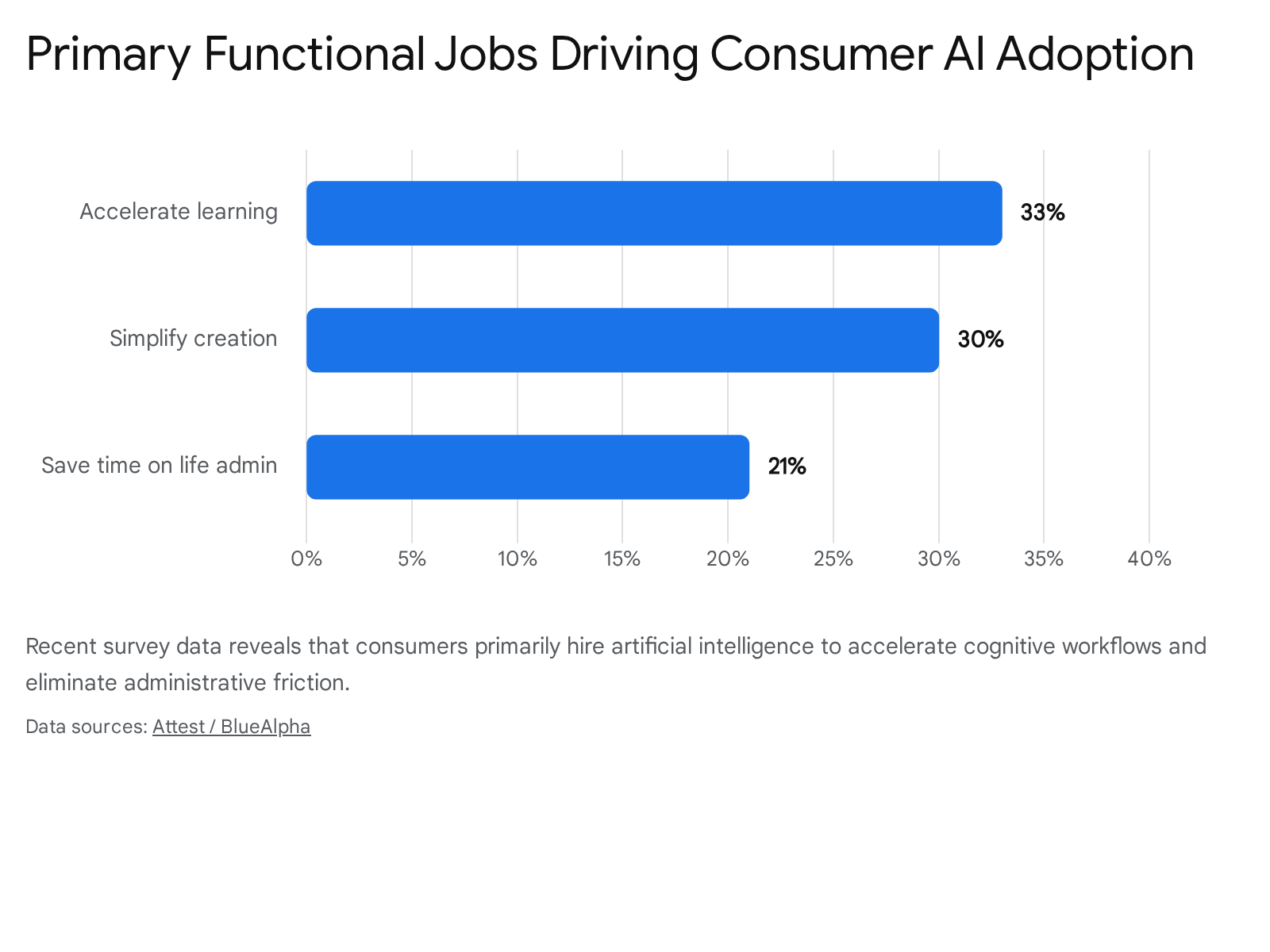
Recent empirical data tracks the primary jobs consumers are actively hiring AI to perform. As of mid-2025, consumer AI usage is heavily dominated by functional acceleration and cognitive offloading 56.
In the enterprise software sector, the focus has shifted entirely toward "agentic AI" - systems capable of autonomous reasoning, tool access, and multi-step execution 5721. Organizations are attempting to redesign end-to-end workflows to let agents execute massive functional jobs . However, research across telecommunications and biopharma indicates that treating agentic AI merely as an overlay on existing functional tools leads to marginal productivity gains. True value capture requires fundamentally redesigning the organizational operating model around the new way the job is accomplished, redefining roles for both human and machine agents 22.
Limitations in Empathetic and Social Intelligence
Despite the immense functional prowess of AI, current systems lack the empathetic intelligence required to fully execute social and emotional jobs 5423. Academic frameworks assessing AI integration argue that consumer-focused perspectives must emphasize "consumer-granted permissibility" - the degree to which humans will emotionally allow an AI to perform a job - rather than just technical feasibility 23.
An illustrative case study involves the financial services firm Klarna, which implemented an AI customer service agent to drive operational efficiency. While the AI successfully performed the functional job of answering queries quickly, it failed the social and emotional dimensions of the job. Customers engaging with financial customer service are often in a state of distress; they are hiring the system to "make me feel heard," "resolve my specific situation," and "give me confidence that someone is accountable" 4. The AI could not provide human accountability or empathy, demonstrating that when a technology disrupts a functional process for the sake of margin improvement, it risks failing the market entirely if it strips away the necessary emotional scaffolding 454.
Furthermore, academic studies in the Journal of Consumer Research (2025) warn of a dangerous trajectory for AI integration defined as "democratization-average trap-model collapse" 2425. As generative AI democratizes access to solutions, it inherently tends to optimize for average consumer behavior. In the final stage of this trajectory - model collapse - AI systems begin training extensively on their own outputs rather than on real, nuanced human-generated data 2425. As these models become increasingly self-referential, they lose touch with the complex, shifting emotional and social jobs that drive true consumer loyalty. If organizations rely entirely on AI-generated data to understand their markets, they risk designing products for machine-generated averages rather than the deep, underlying progress real humans are trying to make 2425.
Conclusion
The Jobs to Be Done framework demonstrates unequivocally that consumers are not merely purchasing bundles of features or reacting blindly to demographic targeting; they are engaging in a highly complex, multidimensional calculus to achieve progress in their lives. The functional dimension of a job serves as the baseline mechanism for task completion and market entry. However, it is the emotional and social dimensions that ultimately drive brand loyalty, justify premium pricing, overcome the friction of non-consumption, and dictate long-term market success.
As global markets become increasingly saturated and technological advancements like agentic AI commoditize functional execution, the competitive battlefield will shift almost entirely to the emotional and social realms. Organizations that successfully map all three dimensions, account for profound cross-cultural nuances in social signaling, and systematically prioritize underserved outcomes will transition from competing on transient product features to competing on profound human progress.