
Frugal innovation and low-cost product development models
1. Introduction
The paradigm of global innovation is undergoing a profound and necessary structural transformation. Historically, multinational corporations (MNCs) headquartered in advanced economies have operated under a "more for more" logic, relying on resource-intensive methodologies characterized by massive research and development budgets, highly complex value propositions, and continuous feature accretion designed to justify escalating price premiums 12. However, this traditional architecture is increasingly incompatible with the macroeconomic realities of the contemporary era. In a landscape defined by severe supply chain volatility, compounding planetary boundaries, and persistent inflationary pressures, economic growth in developed nations has plateaued to an average of roughly two percent annually, while emerging markets present immense, yet highly price-sensitive, growth opportunities 223. In response, the corporate and academic arenas have pivoted toward a philosophy of constraint-driven engineering, catalyzing the formalization of "frugal innovation." This strategic, systematic approach aims to generate significantly more business and social value while drastically reducing the consumption of scarce resources such as capital, energy, and time 14.
While initially relegated to the Global South as a survival mechanism born of extreme poverty and institutional voids, frugal innovation has matured into a disruptive global strategy. It is now heavily scrutinized and advocated for by top-tier institutions, with prominent analyses appearing in the Harvard Business Review, MIT Sloan Management Review, and the Journal of Product Innovation Management, alongside authoritative policy guidance from entities such as the World Bank and the United Nations 5767. Yet, the rapid popularization of the term has precipitated a dangerous epistemological conflation. Frugal innovation is frequently, and incorrectly, utilized as an umbrella term encompassing any low-cost, improvised, or makeshift solution emerging from developing economies 8912. To accurately harness its strategic potential, it is absolutely critical to distinguish formal frugal engineering from regional, informal problem-solving mentalities.
Furthermore, as the global economy navigates the compounding pressures of the current decade, recent developments from 2023 onward demonstrate that frugal innovation is intersecting deeply with the imperative of the circular economy, overarching sustainability goals, and the highly disruptive trajectories of "reverse innovation" 1310. This comprehensive research report systematically examines the structural mechanics of frugal innovation. It contrasts formal frugal frameworks with regional paradigms such as India's jugaad, China's shanzhai, and Brazil's jeitinho. It further deconstructs the targeted cost-reduction mechanisms utilized in these models, compares their product development lifecycles against traditional Western Stage-Gate frameworks, and evaluates the severe limitations, regulatory hurdles, and intellectual property challenges inherent in radically low-cost engineering paradigms 31611.
2. Epistemological Distinctions: Formal Frugal Engineering Versus Regional Heuristics
To implement robust innovation strategies, corporate strategists and policymakers must recognize that resource-constrained innovations do not emerge from a monolithic source. The literature identifies distinct phenomenological roots across different geographic and cultural contexts. Differentiating between an improvised behavioral mindset and a scalable, rigorous engineering process is the foundational step in avoiding the romanticization of poverty and successfully applying these concepts to advanced global manufacturing 718.
2.1 The Misconception of Jugaad and the Necessity of Formal Engineering
The conflation of jugaad and formal frugal innovation represents a significant conceptual barrier to the latter's adoption in structured corporate ecosystems. Jugaad is a Hindi colloquialism denoting an improvised, makeshift fix or a clever workaround born from ingenuity in the face of severe resource scarcity 122013. It is fundamentally a bottom-up, grassroots behavioral mindset. Practitioners of jugaad act as bricoleurs, utilizing disparate materials that are immediately at hand to patch a pressing problem temporarily, prioritizing immediate utility over long-term viability 13. While jugaad demonstrates extreme resilience, flexibility, and creative problem-solving, its outputs are typically ad hoc, highly localized, unscalable, and largely devoid of scientific rigor or formalized quality control 81423. Jugaad is inherently reactive; it resolves an immediate pain point but rarely results in a globally competitive, safe, or legally compliant product architecture 823.
Conversely, formal frugal innovation - often termed frugal engineering, a concept popularized by corporate leaders such as Carlos Ghosn of the Renault-Nissan Alliance and Jeffrey Immelt of General Electric - is a highly structured, proactive, and systematic process 4524. It involves stripping away unnecessary complexity while applying rigorous scientific and engineering principles to ensure durability, user safety, and massive scalability 524. Academic literature establishes that frugal innovation must adhere to three strict criteria to distinguish it from merely "cheap" goods or jugaad improvisation: it must achieve substantial cost reduction (typically a 33% or greater reduction in the total cost of ownership compared to existing market solutions), it must maintain a relentless focus on core functionalities, and it must deliver an optimized performance level tailored precisely to the specific operating environment 315. Therefore, while a frugal engineering team might adopt a jugaad-like "mindset" to challenge assumptions during the conceptual ideation phase, the actual execution relies on lean manufacturing, rigorous research and development, and scalable supply chain management 716. Where jugaad is a temporary hack, frugal innovation is a sustainable, systematically engineered disruption.
2.2 Shanzhai (China): From Counterfeit Imitation to Ecosystem Modularity
Moving beyond the Indian context, China provides a highly distinct regional innovation framework known as shanzhai, which translates literally to "mountain stronghold" but colloquially refers to operations outside regulatory reach 1718. Originally, shanzhai was a pejorative neologism for "fake" or "counterfeit," referring to the illicit copying of Western electronics, particularly mobile phones, in manufacturing hubs like Shenzhen 171819. However, regional academic and business analyses from 2024 and 2025 demonstrate that shanzhai has evolved far beyond simple piracy; it now represents a unique, hyper-agile, decentralized innovation ecosystem that is fundamentally reshaping global supply chains 1920.
The contemporary shanzhai model is characterized by a "bottom-up" network of highly specialized, small-to-medium enterprises that share open-source hardware templates and rapidly iterate on product designs 20. This ecosystem operates on the principle of extreme modularity. By standardizing core components - such as utilizing common, low-cost chipsets - countless independent manufacturers can rapidly assemble, modify, and launch products tailored to hyper-specific micro-demands that massive multinationals ignore 17. This intense, localized sparring, coupled with peer learning and a cultural acceptance of "grabism" (rapidly adopting and improving upon others' ideas), fostered a supply chain ecosystem of unparalleled speed and depth 20.
Chinese companies that internalized these rapid iteration cycles transitioned from mere imitators to authentic, formidable innovators - a phenomenon deeply embedded in the "Made in China 2025" strategic initiative, which seeks to elevate indigenous technological capabilities 192021. Today, the shanzhai legacy underpins the success of globally dominant Chinese firms in advanced sectors such as electric vehicles. Companies like BYD and Nio leverage the ability to amalgamate localized ecosystem capabilities, allowing for the rapid deployment of highly competitive, cost-effective technologies 1921. Shanzhai thus highlights how decentralized modularity, shared architectural templates, and ferocious local competition can serve as a potent mechanism for formal frugal innovation at a global scale.
2.3 Jeitinho (Brazil): Navigating Bureaucracy Through Institutional Flexibility
In Latin America, specifically Brazil, the cultural phenomenon of jeitinho offers another critical, geographically diverse lens through which to view resource-constrained operations. Jeitinho brasileiro translates roughly as "the little way" or "finding a way" - a behavioral strategy utilized to navigate highly bureaucratic, rigid, and often dysfunctional institutional systems 2223. From an institutional theory perspective, Brazil's business environment presents profound challenges, including complex tax codes, severe infrastructure deficits, protectionist policies, and high power distance within organizational hierarchies 222425. In this restrictive environment, jeitinho acts as an informal social lubricant. It relies heavily on personal networks, emotional intelligence, and situational flexibility to bypass red tape, circumvent obstacles, and achieve business objectives 222326.
While jeitinho fosters remarkable adaptability and allows supply chains to function in unpredictable, turbulent environments, recent empirical investigations reveal a stark duality inherent in the practice 26. On one hand, it drives spontaneous creativity, rapid problem-solving, and grassroots resilience, akin to the agility needed to initiate frugal innovation 2326. On the other hand, it can lead to severe operational inconsistencies, a lack of process standardization across supply chains, and ethical ambiguities that border on corruption or nepotism 222326. The lack of standardized cross-cultural frameworks often leads to fragmented strategic management, hampering the seamless integration of supply chain activities 22. For Western multinationals attempting to implement frugal innovation within Brazil, understanding jeitinho is vital. Formal strategic management frameworks often fail if they do not account for these deeply ingrained cultural norms, which prioritize emotional bonds and personal networks over rigid, rational corporate mandates 2225. Successful frugal strategies in Brazil - such as those employed by the cosmetics firm Natura, which utilizes Amazonian plant extracts to cut costs while supporting local economic networks - must delicately balance the adaptive flexibility of jeitinho with the standardized governance and ethical compliance required for scalable manufacturing 225.
3. The Architectural Mechanics of Extreme Affordability
True frugal innovation is not achieved by indiscriminately slashing budgets, utilizing substandard materials, or exploiting labor. Rather, it requires a fundamental re-architecting of both the value proposition and the underlying cost structure. Companies achieve extreme affordability through a combination of deliberate, sophisticated engineering choices and radical supply chain reconfigurations 223.
3.1 Stripping Non-Essential Features for Optimized Performance
The most visible mechanism of frugal innovation is the ruthless elimination of non-essential, "nice-to-have" features that inflate costs without contributing directly to the product's primary utility 2312. Traditional Western innovation operates on a logic of accumulation, where sequential product generations are loaded with incremental, often underutilized technological features to justify higher margins 12. Frugal innovation reverses this paradigm by strictly focusing on core functionalities 3. By defining the exact minimum viable performance required by the end-user, engineers can eliminate extraneous sensors, luxury materials, and complex user interfaces 12.
This subtraction not only reduces direct component costs but also drastically lowers the cognitive load for the user, decreases maintenance requirements, and minimizes points of mechanical or software failure 2312. A quintessential example is the GE MAC 400 portable ECG machine, developed initially for rural India. By stripping away heavy printing mechanisms and complex keyboards, and instead using a simple interface paired with standard commercial batteries, GE reduced the cost of an ECG machine from $20,000 to roughly $800, bringing the cost of an individual patient scan down to mere pennies 37. Similarly, Godrej & Boyce developed the ChotuKool, a small, portable refrigerator designed for rural Indian populations without reliable electricity. By eliminating the traditional, heavy compressor and substituting a solid-state thermoelectric cooling system that runs on a battery, they created a highly affordable, core-function product that disrupted the market 3738.
3.2 Bottom-Up Design and Systems Modularity
Frugal products are frequently architected using "bottom-up" design methodologies. Unlike top-down approaches where a master blueprint dictates the creation of highly customized, proprietary components, bottom-up design relies on aggregating existing, standardized sub-systems to build a complex whole 2740. This is tightly coupled with the concept of modularity.
Modularity in frugal innovation allows for maximum flexibility and profound cost efficiency. By designing products as a set of interoperable, standardized modules, manufacturers can leverage immense economies of scale on individual parts across varied product lines 2842. Furthermore, modularity facilitates localized repair, maintenance, and upgrading. In resource-constrained environments where access to specialized technicians is limited, a modular product allows users to swap out a single broken component rather than discarding and replacing the entire unit 202944. This approach extends the product lifecycle, aligns perfectly with circular economy principles, and drastically reduces the total cost of ownership for the end consumer 4244.
3.3 Utilizing Local Supply Chain Ecosystems
Frugal innovation demands a departure from highly centralized, complex globalized supply chains, which are vulnerable to macroeconomic shocks and incur heavy logistics and tariff costs. Instead, successful frugal innovators utilize local supply chain ecosystems to source raw materials, talent, and manufacturing capabilities 23031.
By co-locating research and development with manufacturing near the target market, firms avoid import tariffs, reduce transportation overhead, and benefit from labor arbitrage 547. More importantly, it allows firms to substitute expensive, imported proprietary materials with locally abundant, cost-effective alternatives 23249. For instance, the Jaipur Foot, a revolutionary prosthetic developed in India, utilizes locally sourced rubber and irrigation piping, reducing the manufacturing cost to a mere $150, compared to Western prosthetics costing thousands of dollars 215. Engaging the local ecosystem also fosters inclusive industrialization, capacity building, and secures community buy-in, transforming marginalized populations from passive consumers into active co-producers 293334.
3.4 Minimizing Traditional R&D Overhead
In traditional Western business models, R&D represents a massive capital expenditure, often involving isolated laboratories, extensive blue-sky research, and the pursuit of entirely novel, proprietary technological development 112. Frugal innovation minimizes this overhead by practicing "recombinative innovation" - the art of repurposing existing, mature technologies in novel ways rather than inventing entirely from scratch 2416.
Frugal R&D heavily leverages open-source platforms, standard off-the-shelf components, and rapid, low-fidelity prototyping to test hypotheses 2035. Furthermore, rather than relying solely on expensive in-house engineering teams, frugal organizations frequently tap into global knowledge networks, academic partnerships, and user-driven innovation ecosystems to crowdsource solutions and diffuse costs 335354. The development of the NASA ventilator during the COVID-19 pandemic is a testament to this: by leveraging existing components and focusing strictly on essential life-saving functions, a highly complex medical device was prototyped and licensed globally in just 37 days 2.
3.5 Comparative Cost Structure Breakdown
The architectural differences between traditional Western innovation models and frugal innovation manifest starkly in their respective cost structures. While the absolute total budget of a frugal product is a fraction of its Western counterpart, examining the proportional allocation of capital reveals the strategic priorities of the frugal methodology.
The following comparative analysis outlines a representative percentage breakdown of cost structures, synthesizing insights from innovation management literature, supply chain case studies, and manufacturing ecosystem analyses 1261247:
| Cost Category | Traditional Western Development Model (%) | Frugal Innovation Development Model (%) | Strategic Rationale in the Frugal Context |
|---|---|---|---|
| Research & Development (R&D) | 15% - 25% | 5% - 10% | Relies on recombinative innovation, existing off-the-shelf technologies, and open-source modularity rather than proprietary, capital-intensive blue-sky research 12435. |
| Materials & Components | 20% - 30% | 40% - 50% | Though overall nominal costs are slashed, physical materials form a proportionally larger percentage of the budget because administrative and R&D overheads are heavily minimized. Emphasizes locally sourced, abundant, or upcycled materials 23249. |
| Manufacturing & Operations | 25% - 35% | 35% - 45% | Lean manufacturing principles, decentralized assembly, and integration of local labor ecosystems dominate the operational budget footprint, ensuring high efficiency 21630. |
| Marketing & Distribution | 20% - 25% | 5% - 10% | Rejects massive, high-gloss ad campaigns. Relies on word-of-mouth, community NGO partnerships, and unconventional, localized distribution networks (e.g., rural micro-entrepreneurs) 154749. |
| Administrative Overheads | 10% - 15% | 5% | Employs flat organizational structures, decentralized decision-making, and the ruthless elimination of bureaucratic corporate hierarchies 2455. |
Note: Percentages reflect the proportional allocation of the total development and operational budget for a given product lifecycle, not absolute dollar values.
4. Transforming the Product Development Cycle: Frugal/Agile Versus Western Stage-Gate
The traditional architecture of New Product Development (NPD) in the West has been governed by the Stage-Gate® process, a methodology formalized by Robert Cooper in the 1980s that has since become the industry standard for risk management 163657. The Stage-Gate model is highly linear and sequential, typically moving through five distinct phases: Ideation/Discovery, Scoping, Building a Business Case, Development, Testing and Validation, and finally, Launch 16365859. At the end of each phase, a formal "gate" requires the project team to present detailed financial metrics, market studies, and rigid product specifications to senior management, who then make a go/kill/hold decision regarding resource allocation 1636.
While Stage-Gate is excellent for corporate governance, preventing sunk costs, and mitigating risk in stable, resource-abundant markets, it is profoundly ill-suited for the realities of frugal innovation. The traditional model is heavily bureaucratic, slow (often taking years to reach the market), and treats innovation as a straight line, demanding that the "how" and "what" of a product be defined perfectly before actual physical development begins 5557. This rigidity inherently stifles the adaptability required to navigate volatile, resource-constrained environments where consumer needs shift rapidly 5760.
In stark contrast, the frugal product development cycle operates on a hybrid of Spiral, Agile, and Lean methodologies 5560.
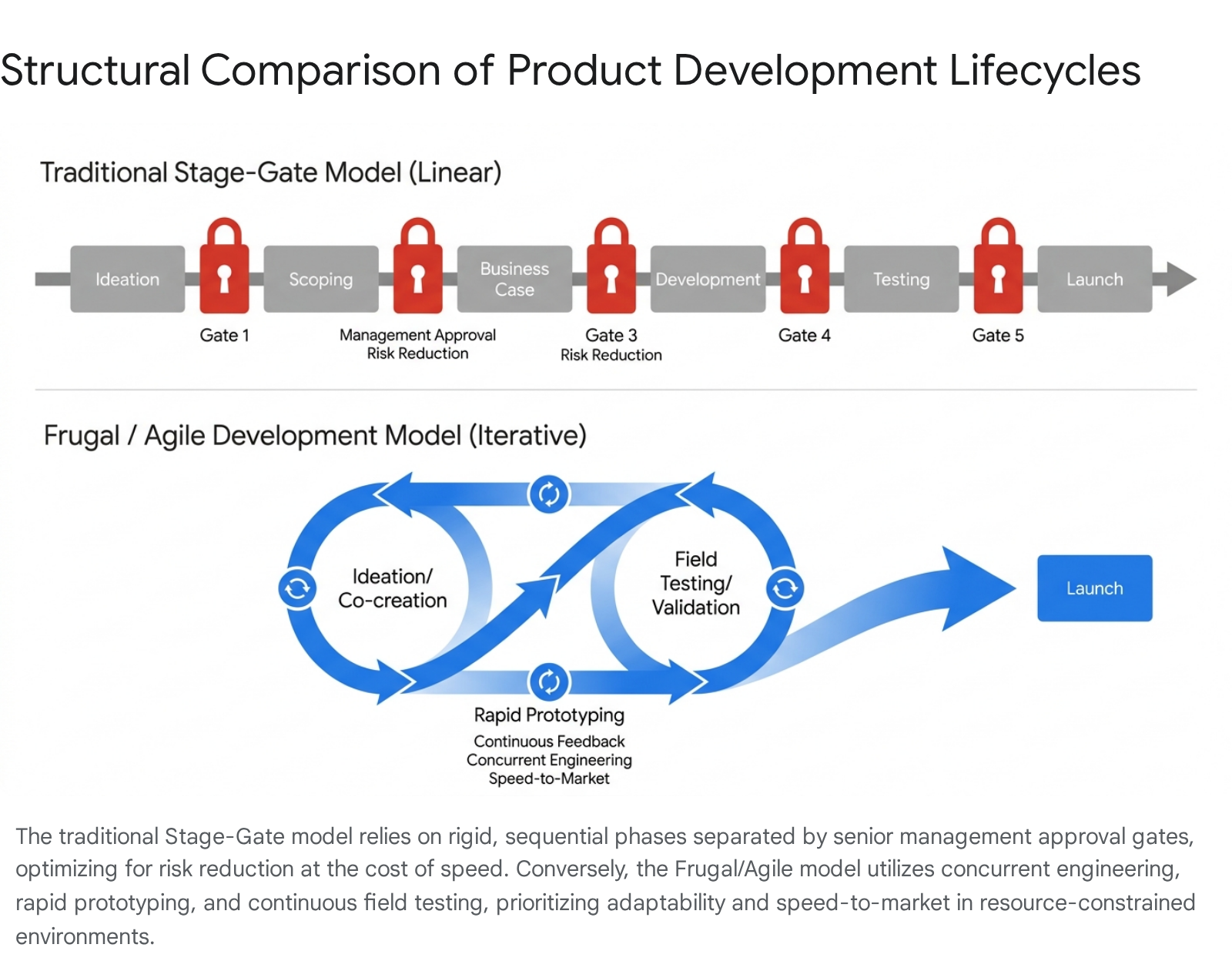
Frugal development rejects the strict linear progression in favor of rapid, overlapping iterative loops. Instead of waiting for a fully funded, formal "Development" stage, frugal innovators build low-fidelity prototypes almost immediately during the ideation phase, testing them directly with end-users in the field 2055. This concurrent engineering allows teams to pivot instantly based on real-world constraints - such as unexpected power grid fluctuations, material shortages, or low user literacy - rather than returning to a corporate board for a formal, time-consuming gate review 6061. By defining only the high-level "why" and "what" early on, and leaving the "how" flexible to be solved through experimentation, the frugal cycle collapses the time-to-market dramatically. In certain manufacturing sectors, transitioning from Stage-Gate to iterative frugal methods has reduced product development cycles from six years to roughly 18 to 24 months 5561.
5. Convergence with Global Imperatives: Developments from 2023 Onward
As global macroeconomic conditions have tightened in the post-pandemic era, frugal innovation has definitively transcended its origins as a mere survival tactic for the developing world. Current research published between 2023 and 2026 demonstrates that frugality is converging tightly with two massive corporate imperatives: the transition to the circular economy and the strategic disruption of developed markets through reverse innovation 13103162.
5.1 The Intersection with Circular Economy and Sustainability Goals
The philosophical and operational alignment between frugal innovation and the Circular Economy (CE) is profound. Both paradigms seek to decouple economic growth from resource depletion 1310. While the CE provides the overarching macroeconomic framework for "closing the material loop" - focusing on reduce, reuse, recycle, and remanufacture - frugal innovation provides the micro-level engineering tools and business models to execute it affordably and at scale 10.
Recent reports from the World Bank and the UN Environment Programme underscore the urgency of this convergence, noting that the global economy currently consumes roughly 100 billion metric tons of resources annually, with global extraction projected to surge by a staggering 150% by 2060 3738. Such consumption models are ecologically untenable. Frugal innovators act as critical change agents in the CE transition by designing for durability, reparability, and extreme resource efficiency from the outset 1842. In sectors like sustainable fashion and footwear, companies are utilizing frugal logic to upcycle agricultural and textile waste into new consumer goods, thereby localizing supply chains, mitigating climate change impacts, and fostering social sustainability 4231.
Moreover, this convergence directly advances several United Nations Sustainable Development Goals (SDGs), notably SDG 9 (Industry, Innovation, and Infrastructure) and SDG 12 (Responsible Consumption and Production) 3439. A key facilitator of this is the "Digital-Frugal Convergence" - the application of low-cost digital technologies such as IoT sensors and AI to manage constrained resources 3440. For example, the use of affordable smart metering in off-grid solar micro-grids (such as those pioneered by M-KOPA in Africa or Boond in India) allows low-income populations to access clean energy through pay-as-you-go mobile money platforms 3829. In this context, frugal innovation is no longer viewed simply as a cost-reduction strategy; it is a fundamental mechanism for environmental resilience and inclusive development 40.
5.2 Reverse Innovation: Disrupting Affluent Western Markets
Perhaps the most disruptive trend analyzed in recent literature is the massive acceleration of "Reverse Innovation" - the phenomenon wherein products originally developed through frugal engineering for emerging, low-income economies successfully migrate to, and fundamentally disrupt, high-income Western markets 541.
Historically, multinational corporations practiced "glocalization," developing high-end, feature-rich products in the West and eventually exporting stripped-down, inferior, or older-generation versions to developing nations 4168. Reverse innovation completely inverts this vector. Faced with stagnant economic growth, soaring inflation, and an increasingly price-sensitive, eco-conscious consumer base in Europe and North America, MNCs are finding that their traditional product lines are bloated and out of touch 23. To survive, they are importing their frugal successes back to their home markets 341.
Prominent success stories evaluated in 2024 and 2025 highlight the magnitude of this shift. General Electric's aforementioned MAC 400 portable ECG and their PC-based portable ultrasound machines, originally designed for rural clinics in India and China, found massive, unexpected success in the United States 37416869. In US emergency rooms, accident sites, and ambulance fleets, the extreme portability and low cost of these frugal devices were highly valued, turning a niche emerging-market product into a multi-hundred-million-dollar global business segment 4168. Similarly, MIT researchers developed the Leveraged Freedom Chair, an off-road wheelchair built from bicycle parts for rough terrain in the developing world; its highly efficient mechanical design was subsequently reverse-innovated into the GRIT Freedom Chair, a premium recreational product for hiking trails in the US and Europe 68.
In the automotive sector, Renault's Dacia Logan, engineered as an ultra-low-cost vehicle for Eastern Europe and emerging markets, became one of the top-selling retail cars across affluent Western European nations, driven by consumers seeking high utility without the financial burden of over-engineered luxury . Furthermore, the role of Global Capability Centres (GCCs) based in India is evolving. No longer just cost-arbitrage back offices, GCCs for companies like Walmart, SAP, and JPMorgan Chase are now actively developing frugal, AI-based demand forecasting and sustainability analytics that are exported globally to streamline retail and trading operations in the US and Europe 70. Reverse innovation proves conclusively that frugal products are not inherently inferior; rather, their core value proposition of high utility, durability, and simplicity resonates universally in an era of global austerity 2462.
6. The Frugal Scalability Paradox: Limitations, Trade-Offs, and Debates
Despite its transformative potential across emerging and developed markets, frugal innovation is not a flawless panacea. The aggressive pursuit of extreme cost reduction and structural simplification introduces severe systemic risks. Recent literature (2024 - 2026) highlights the "Frugal Scalability Paradox" - the inherent strategic tension between hyper-contextualizing a product for a specific local market's constraints and standardizing it sufficiently to achieve global scalability, mass manufacturing, and profitability 1171. Navigating this paradox requires addressing several critical, highly debated limitations.
6.1 Safety Standards and Quality Control Trade-Offs
The most pronounced critique of frugal innovation centers on the inevitable trade-offs between relentless cost reduction and product safety 1124. Stripping a product to its absolute essentials, reducing testing phases, and utilizing non-traditional, locally scavenged materials can severely compromise the structural integrity, reliability, and lifespan of the final good 1153.
The cautionary tale of the Tata Nano - frequently hailed in early literature as a triumph of frugal automotive engineering - illustrates this catastrophic risk. Designed as a $1,500 "people's car" for the Indian masses, the Nano suffered from severe negative brand perception. Consumers rejected the stigma of buying the "world's cheapest car," but more detrimentally, the vehicle's reputation was heavily exacerbated by reports of safety failures, poor crash test ratings, and instances of the vehicles catching fire 272. The drive to minimize costs led to engineering compromises that ultimately destroyed consumer trust, leading to low sales and the product's eventual discontinuation 2. Stringent quality control is inherently expensive 53. Frugal innovators face the immense challenge of reconciling the low-cost nature of their products with the absolute necessity of rigorous performance testing, ensuring that affordability does not equate to sub-standard, fragile, or dangerous outputs 2453.
6.2 Intellectual Property Concerns in Open Ecosystems
Frugal innovation, particularly in regional models like China's shanzhai, relies heavily on ecosystem collaboration, open-source hardware, rapid imitation, and reverse engineering 1720. However, this highly generative, collaborative ethos clashes violently with Western paradigms of Intellectual Property (IP) protection 23.
In many emerging markets, weak institutional enforcement of IP rights allows frugal innovators to rapidly iterate upon existing technologies without paying exorbitant licensing fees, which is a primary driver in keeping costs down 1128. Yet, when these companies attempt to scale globally or engage in reverse innovation into developed markets, they immediately encounter dense "patent thickets" and face aggressive litigation from Western incumbents seeking to protect their market share 2318. Conversely, the inability to legally protect their own frugal innovations via patents prevents many grassroots startups from securing traditional venture capital funding, creating a massive barrier to achieving economies of scale 1171. The academic and policy debate over whether IP serves as a necessary catalyst for investment or a monopolistic barrier to inclusive, sustainable innovation remains highly polarized and unresolved 1823.
6.3 Regulatory Hurdles and Compliance Costs
Finally, frugal innovations face massive regulatory friction that severely limits their global diffusion. Advanced economies enforce rigid, homogenous safety, environmental, and efficacy standards (e.g., FDA approvals in the US, CE markings in Europe, and ICH standards for pharmaceuticals) 1823. These regulatory frameworks are structurally designed around high-tech, resource-intensive, Stage-Gate development models; they do not easily accommodate products born of constraint.
For a frugal medical device constructed from repurposed consumer electronics or open-source software to enter the US or European market, the cost of regulatory compliance and clinical trials often vastly exceeds the cost of engineering the product itself 1823. This creates a structural barrier that stifles the flow of reverse innovation and prevents marginalized populations in developed countries from accessing affordable solutions. To overcome this systemic hurdle, policymakers and researchers are increasingly debating the implementation of "Regulatory Sandboxes" - controlled, monitored environments where frugal solutions can be validated without facing immediate, crushing bureaucratic burdens 1171. Such frameworks aim to ensure that essential safety standards are met without financially suffocating the very innovations designed to democratize access to technology.
7. Conclusion
Frugal innovation has matured rapidly from a localized survival tactic into a highly sophisticated, strategic imperative for the 21st century. By sharply distinguishing formal, structured frugal engineering from informal, unscalable workarounds like jugaad, and by understanding the ecosystem dynamics of shanzhai and the institutional flexibility of jeitinho, global enterprises can effectively harness the power of constraint to drive growth 72026. Through targeted, disciplined mechanisms - such as relentlessly stripping non-essential features, leveraging bottom-up modularity, embedding in local supply chains, and adopting iterative, agile development lifecycles in place of rigid Stage-Gate models - companies can achieve extreme affordability without sacrificing core quality 2360.
Crucially, the intersection of frugal engineering with the circular economy positions this methodology at the vanguard of global sustainability efforts, providing the practical tools necessary to decouple economic progress from resource depletion 1031. As reverse innovation continues to demonstrate the immense viability and desirability of frugal products in advanced Western economies facing inflation and stagnation, the artificial boundary between "developing" and "developed" market strategies is permanently dissolving 6241. However, unlocking the full potential of frugal innovation requires a nuanced, highly strategic navigation of the Frugal Scalability Paradox 71. Innovators and policymakers must collaboratively address the critical trade-offs in quality control, modernize intellectual property frameworks to support open-source collaboration, and construct adaptive regulatory pathways 1123. Only by balancing radical cost efficiency with uncompromising safety, ethical governance, and systemic resilience can frugal innovation fulfill its promise of delivering sustainable, inclusive growth on a truly global scale.