
Does Somatic Shaking Actually Release Trauma
Clinical evidence shows that somatic shaking therapies, such as Tension and Trauma Releasing Exercises (TRE) and Somatic Experiencing (SE), are highly effective at reducing PTSD symptoms and chronic stress by physically discharging trapped survival energy. However, the popular biological narratives explaining these therapies - including the idea that wild animals shake to avoid trauma and the foundational claims of Polyvagal Theory - are currently being heavily critiqued and dismantled by evolutionary biologists and neuroscientists. Ultimately, while the foundational theories are fiercely debated, the physical practices themselves appear to offer genuine, measurable relief for many trauma survivors who do not respond to traditional talk therapy.
The Viral Trend vs. Clinical Practice
In recent years, "somatic shaking" has surged in popularity across social media platforms like TikTok, where users demonstrate themselves rapidly shaking their limbs and torsos to reset their nervous systems 123. Promoted as a quick hack to lower cortisol, flush out daily stress, and even treat unresolved trauma, the viral version of this practice is a simplified offshoot of decades of clinical trauma research 134.
While spontaneous shaking can provide cathartic stress relief for the average person, clinical somatic therapy is a much more structured discipline. The modern landscape of trauma shaking is primarily built on two foundational approaches: Tension and Trauma Releasing Exercises (TRE) and Somatic Experiencing (SE) 112. Both operate on the premise that trauma is not merely a psychological memory, but a physiological event trapped in the nervous system and the body's connective tissues, specifically the fascia and the psoas muscle 134.
To understand the landscape of somatic shaking, it is helpful to distinguish between the three main ways it is practiced today:
| Modality | Origin / Creator | Core Mechanism | Best Suited For |
|---|---|---|---|
| Informal Shaking | Viral wellness trend / Intuitive movement | Conscious, spontaneous movement (bouncing, shaking limbs) to burn off excess adrenaline and cortisol 239. | Daily stress relief, closing minor stress cycles, and mild anxiety management 4. |
| TRE® (Tension & Trauma Releasing Exercises) | Dr. David Berceli (1998) | A series of 7 physical exercises that fatigue the lower body to trigger involuntary "neurogenic tremors" originating in the psoas muscle 1410. | Deep muscle tension, disaster relief, generalized anxiety, and individuals who prefer a self-guided, non-verbal approach 111. |
| Somatic Experiencing (SE) | Dr. Peter Levine | A therapist-guided process of "titration" and "pendulation," tracking subtle bodily sensations. Shaking may occur naturally as survival energy is discharged 121314. | Complex PTSD, developmental trauma, and severe nervous system dysregulation requiring a safe, co-regulated environment 1516. |
While these modalities differ in execution, they share a common biological metaphor that has guided trauma therapy for decades: the belief that humans have forgotten how to act like wild animals.
The "Gazelle" Metaphor: Do Animals Shake Off Trauma?
The theoretical bedrock of somatic shaking - particularly in Peter Levine's Somatic Experiencing - is derived from observations of wildlife in the African savannah. The standard narrative suggests that when a gazelle is chased by a cheetah, its body is flooded with massive amounts of adrenaline and cortisol to fuel the "fight or flight" response 31417. If the gazelle is caught, it may enter a "freeze" state (tonic immobility) as a final protective mechanism, which produces an analgesic effect to reduce suffering 12185.
If the gazelle manages to escape, it does not hold onto that physiological terror. Instead, it will intuitively collapse, shake, and tremble violently for several minutes 1420. According to somatic theory, this shaking discharges the built-up survival energy, successfully "completing the stress cycle." The gazelle then stands up, takes a deep breath, and returns to grazing, completely free of PTSD 31421.
The somatic argument is that humans possess this exact same biological mechanism, but societal norms condition us to suppress it. When humans experience a car crash, an assault, or a chronically abusive environment, we are taught to "keep it together" and maintain composure 1422. Because we do not physically discharge the survival energy, it remains trapped in our tissues. This trapped energy keeps the nervous system looping in a state of high alert, resulting in hyper-vigilance, dissociation, and the chronic symptoms of PTSD 1314.
The Ethological Reality: Animals Do Get PTSD
The gazelle metaphor is intuitive, comforting, and highly effective as a therapeutic visualization. However, modern evolutionary biologists and ethologists are increasingly challenging it as a scientific fact.
Recent research demonstrates that wild animals do, in fact, suffer from long-lasting trauma 236. A landmark 2019 study by researchers at the University of Western Ontario examined the ecology of fear in wild animals 2526. They found that animals surviving predator encounters do not simply "shake it off" and return to normal 6. Instead, the fear leaves quantifiable, long-lasting traces in their neural circuitry 26.
In studies on wild rodents (such as gerbils and mice) and birds (such as black-capped chickadees), animals that survived severe predator stress exhibited long-lasting behavioral dysfunctions that closely mirror human PTSD 62526. These animals showed chronically elevated stress hormones, spent significantly more time hiding rather than foraging, and experienced severe drops in reproductive success that persisted long after the predator was gone 2325. Furthermore, researchers observed a decrease in new neuron formation in the parts of the brain that control fear - a neurological change identical to that seen in traumatized humans 25.
While animals do use shaking to reset their autonomic nervous systems, and sometimes simply for thermoregulation or drying off, this reflex is not a magical shield against trauma 2728. The biological reality is that severe stress damages the nervous systems of all mammals. Despite this flawed metaphor, the clinical therapies born from it have proven remarkably effective in human trials.
The Polyvagal Theory Debate
While the clinical results of somatic therapies are strong, the underlying neuroscience used to explain them is currently undergoing a massive paradigm shift. Much of modern somatic therapy is tethered to Stephen Porges' Polyvagal Theory (PVT), developed in the 1990s, which suggests that the autonomic nervous system operates on an evolutionary hierarchy 293031.
PVT claims that mammals evolved a unique "ventral vagal" pathway responsible for social engagement, connection, and calm, while relying on a primitive, reptilian "dorsal vagal" pathway that triggers freezing, dissociation, and shutdown during severe trauma 293031. In somatic therapy, the goal is often described as moving a patient out of a "dorsal vagal shutdown" and back into "ventral vagal safety" 31.
The 2025-2026 Scientific Critique
However, in late 2025 and 2026, a comprehensive evaluation co-authored by 39 leading experts in evolutionary biology, physiology, and vertebrate behavior declared Polyvagal Theory to be scientifically "untenable" 297. Led by Professor Paul Grossman, an emeritus research director of psychosomatic medicine, the experts debunked several foundational premises of the theory:
- Respiratory Sinus Arrhythmia (RSA) is an unreliable measure: PVT relies heavily on RSA (heart rate variability tied to breathing) as a direct measure of central vagal tone from the brainstem. The expert consensus firmly states that RSA is influenced by multiple peripheral mechanisms (like breathing frequency and blood pressure) and is not a reliable direct measure of the central nervous system state 297.
- Anatomical Misattributions (NA vs. DMV): PVT claims the "dorsal vagus" (Dorsal Motor Nucleus, or DMV) is responsible for emotional freezing and massive heart rate drops (bradycardia) during trauma 297. Neurophysiologists clarified that the DMV primarily controls the gastrointestinal tract and has almost no influence on mammalian heart rate control 297. The Ventral Vagus (Nucleus Ambiguus), which PVT associates solely with safety and social engagement, is actually the structure that mediates defensive freezing and heart rate reactions in mammals 7.
- Evolutionary Inaccuracies: PVT claims that myelinated vagal fibers - which allow for rapid heart rate adjustments and social engagement - are an emergent adaptation unique to mammals 7. The experts proved this false, noting that fish, amphibians, reptiles, and birds all possess these myelinated cardiac vagal efferent axons 7.
- Mischaracterization of Non-Mammalian Social Behavior: PVT asserts that reptiles and other non-mammals lack integrated prosocial behavior because they lack these unique vagal fibers. Ethologists point out that many non-mammalian vertebrates exhibit complex social behaviors, including communal parental care, long-term pair-bonding, and reciprocal helping 7.
- Reliance on Dismissed Hypotheses: The evaluation highlights that PVT relies on Ernst Haeckel's long-dismissed biogenetic hypothesis ("ontogeny recapitulates phylogeny") and frequently cites physiological articles that do not actually support its premises 7.
Does this mean somatic shaking is a placebo? No. The clinical success of somatic therapies is well-documented 3334. What the 2026 Polyvagal critique reveals is that therapists have been using an inaccurate biological map (Polyvagal Theory and the Gazelle metaphor) to navigate a very real territory (the autonomic nervous system's response to trauma). The physical release of tension works, even if the evolutionary story used to explain it is largely a fiction 7.
Clinical Efficacy of Tension and Trauma Releasing Exercises
Moving beyond the animal metaphors and debated vagal theories, rigorous clinical trials conducted over the last few years have provided concrete evidence that somatic shaking and trauma release exercises have a measurable, positive impact on human health.
Tension and Trauma Releasing Exercises (TRE) rely on inducing involuntary neurogenic tremors to release deep muscular tension. Developed by Dr. David Berceli, the process involves seven simple exercises that fatigue the leg and pelvic muscles, specifically targeting the psoas muscle 1410. Because it is a bottom-up approach that does not require patients to verbally recall or process their traumatic memories, it has become highly popular among populations hesitant to engage in traditional talk therapy 1115.
Success with East African Refugees
A 2024 peer-reviewed study by Parker et al. tested the efficacy of TRE on a community sample of 33 female East African refugees resettled in the United States - a population with high exposure to war, displacement, and violence, who often face language or cultural barriers to traditional psychotherapy 3536.
After an eight-week TRE intervention, where participants practiced the exercises weekly in a group and at home, the results were highly significant: * Symptom Reduction: The treatment group experienced a 33% drop in the overall severity of their trauma symptoms, compared to a statistically insignificant 12% drop in the delayed-treatment control group 36. * Symptom Elimination: Treatment participants reported the total elimination of 11 out of 40 trauma symptoms measured by the Harvard Trauma Questionnaire (HTQ). These included sleep disturbances, emotional dysregulation, nightmares, and dissociation 3536. * Quality of Life: Participants reported vast qualitative improvements, noting gains in their ability to connect with others, manage their affect, and maintain a sense of competence and self-worth 3536.
Physical Rehabilitation and Multiple Sclerosis
TRE has also shown efficacy beyond psychological trauma, venturing into physical rehabilitation. In a 2021/2025 exploratory pilot study on individuals with Multiple Sclerosis (MS), researchers investigated whether releasing deep muscle tension could alleviate the heavy symptom burden of the disease 8.
After completing a nine-week TRE program, the MS patients saw dramatic reductions in their daily symptom burden. The total average fatigue level, measured via the Modified Fatigue Impact Scale (MFIS), decreased significantly by nearly 50%.
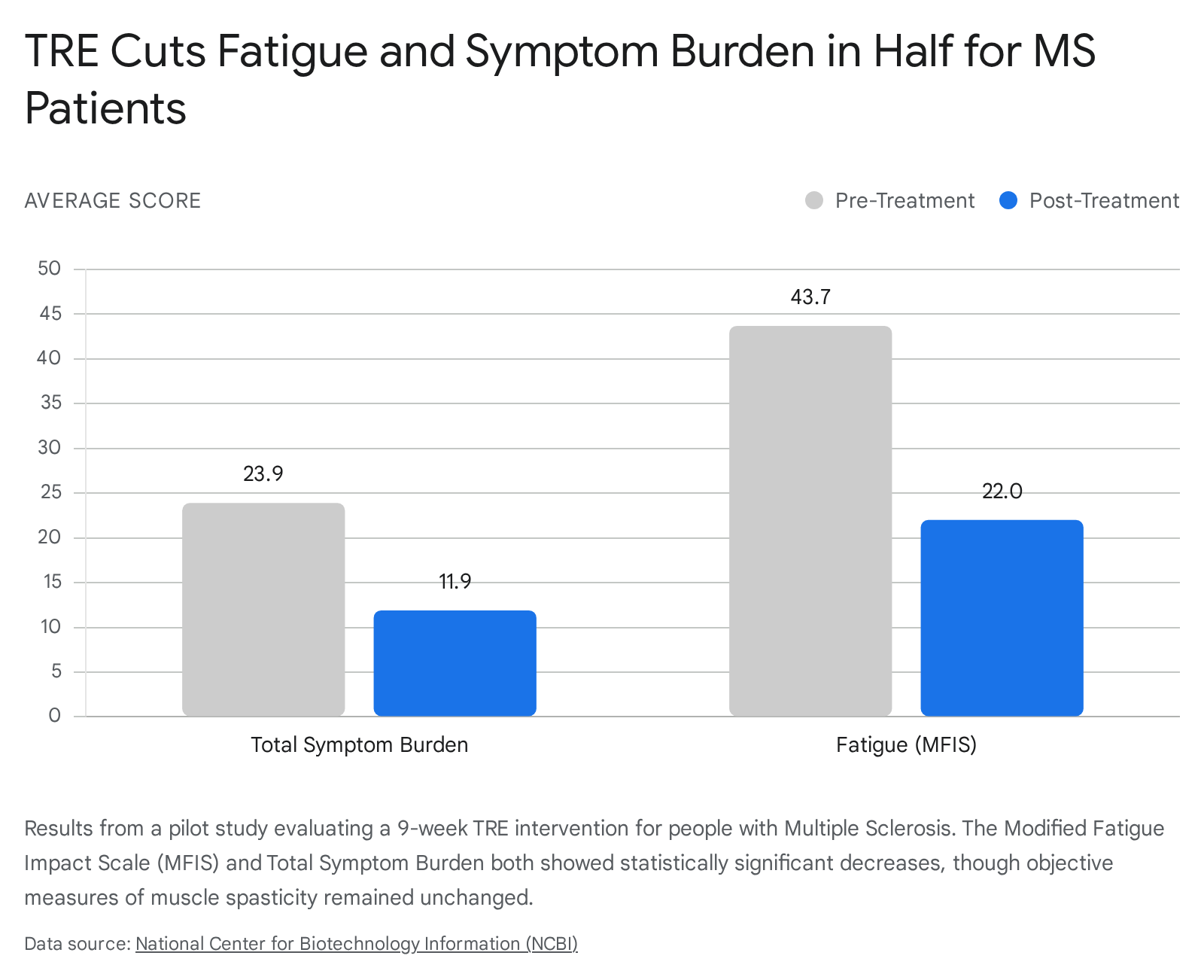
Patients also reported improved sleep quality and reduced day-to-day stress 8. Interestingly, while subjective feelings of stiffness improved, objective measurements of muscle spasticity using a Portable Spasticity Assessment Device (PSAD) remained unchanged, suggesting the therapy may alter the nervous system's perception of the symptoms rather than the mechanical spasticity itself 8.
Disaster Relief in High-Conflict Zones
Because of its scalability and the fact that it can be taught to large groups simultaneously without requiring psychological disclosure, TRE has been heavily utilized in active conflict zones and natural disaster sites 3839. Observational data from 2024 and 2025 highlight its deployment in Ukraine and Gaza, where traditional long-term psychotherapy is logistically impossible 404142.
In Gaza, where the World Health Organization reported nearly 42,000 life-changing injuries and a devastated rehabilitation workforce, body-based trauma interventions are critical for immediate nervous system down-regulation 41. Providers in Ukraine report that TRE effectively interrupts the central nervous system's chronic protective strategies, helping civilians and first responders reduce the charge of stress hormones, manage panic attacks, and regain sleep in the midst of ongoing crises 4243.
Clinical Efficacy of Somatic Experiencing
Somatic Experiencing (SE), developed by Dr. Peter Levine, relies less on vigorous, exercise-induced shaking and more on the subtle tracking and release of trapped physical sensations. While TRE is often self-administered, SE requires a trained practitioner to guide the patient through their physical sensations.
Historically, SE lacked the rigorous randomized controlled trials (RCTs) of cognitive behavioral therapies like Prolonged Exposure (PE) or Cognitive Processing Therapy (CPT). For decades, these top-down, cognitive approaches were considered the "gold standard," operating on the premise that patients must confront the memory to extinguish the fear 34. However, recent trials have shifted this narrative.
A landmark RCT by Brom et al. evaluated SE for 63 individuals with full criteria PTSD 44. The results showed a 44.1% remission rate, meaning nearly half of the participants no longer met the clinical criteria for PTSD after 15 weeks of treatment 3344. The study recorded large effect sizes (Cohen's d = 0.94 to 1.26) for the reduction of post-traumatic symptom severity, and similar large reductions in comorbid depression 44.
Recent systematic reviews from 2024 and 2025 note that somatic therapies are particularly vital for the massive subset of trauma survivors who fail traditional therapy. Research indicates that 30% to 50% of patients do not achieve remission even after completing gold-standard cognitive protocols, and dropout rates in real-world settings often reach 50% for exposure therapy 34. By addressing the autonomic nervous system directly, SE allows patients to process trauma without the agonizing requirement of narrating their worst memories aloud, offering a lifeline for treatment-resistant PTSD 34.
The Neuroscience of Somatic Release
If the evolutionary theories are flawed, how exactly does somatic shaking work? The answer lies in the emerging fields of psychoneuroimmunology and neurobiology 49.
Trauma heavily alters the brain's physical structure. In individuals with PTSD, the amygdala (the brain's threat-detection center) becomes hyperactivated, the prefrontal cortex (responsible for rational thought) goes effectively offline, and the hippocampus is structurally altered 9. Because trauma is a neurobiological wound, cognitive talk therapy often hits a wall; the patient logically knows they are safe, but their body still reacts as if the threat is present 946.
Somatic therapy retrains the nervous system through neuroception - the subconscious process of assessing safety and danger 3146. By working directly with breath, posture, and interoception (the awareness of inner bodily sensations), therapists bypass the cognitive loops and restore communication between the survival brain and the rational brain 46.
Furthermore, techniques like TRE specifically target the psoas muscle and the body's fascia 427. The fascia, a web of connective tissue surrounding muscles and organs, can become chronically tight and restricted due to trauma 4. Activating neurogenic tremors physically forces these tissues to relax, interrupting the physiological loop of chronic tension. Functional MRI studies are increasingly showing measurable brain changes after somatic interventions, moving traumatic memories from implicit sensation ("I feel terrified and my body is shaking") to explicit story ("This happened, and I survived") 3346.
Safety Guidelines: When Not to Shake
Despite the viral TikTok videos encouraging people to wildly shake away their stress, clinical experts warn that somatic release must be handled with immense care.
When a person begins to tremor or track traumatic sensations, the nervous system can easily become overwhelmed - a state known as flooding 47. If a trauma survivor pushes their body to release too much stored energy at once, it can trigger intense flashbacks, panic attacks, or severe dissociation. Attempting to force a cathartic release without proper regulation can effectively re-traumatize the individual 216.
To prevent this, clinical somatic therapy relies on two vital concepts: * Titration: Approaching the trauma in very small, manageable increments. Rather than trying to discharge all the survival energy at once, the patient touches the edge of the physical discomfort, feels the sensation, and then backs away before it becomes overwhelming 131447. * Pendulation: Shifting awareness back and forth between a place of safety or grounding in the body, and the place of traumatic tension. This rhythmic swinging teaches the nervous system that it is capable of experiencing stress and successfully returning to a calm baseline 13.
For individuals with complex PTSD, developmental trauma, or severe physical injuries, self-guided somatic shaking is strongly discouraged. These individuals require the presence of a trained practitioner who can act as a safe "container," co-regulating the patient's nervous system and pacing the physical release appropriately 11516.
Bottom line
Somatic shaking and trauma release exercises offer a powerful, evidence-based alternative for individuals seeking to heal from chronic stress and PTSD, particularly those who have found little relief in traditional talk therapy. While the romanticized biological theories behind the practice - such as wild animals remaining immune to trauma and the evolutionary claims of Polyvagal Theory - are currently being dismantled by scientific consensus, the clinical outcomes remain robust. Tremoring and somatic tracking successfully help the body discharge trapped physical tension, but they must be approached gently and with proper professional guidance to avoid overwhelming a fragile nervous system.