
Does Meditation Actually Change the Brain
Scientific evidence confirms that meditation rapidly alters brain activity and strengthens functional neural networks related to focus, emotional regulation, and memory. However, recent large-scale research has challenged older claims that brief mindfulness programs physically grow or reshape the brain's structural gray matter, suggesting that the most significant everyday benefits stem from how the brain operates and communicates rather than how it physically looks.
For thousands of years, the idea that sitting quietly and engaging in contemplative practices could transform the mind was verified only through the subjective, internal experiences of practitioners. Today, contemplative neuroscience is a booming academic field. Researchers at the world's top institutions are utilizing functional magnetic resonance imaging (fMRI), deep-brain intracranial electrodes, and advanced blood plasma analysis to map exactly what happens inside the heads of meditating monks and stressed-out novices alike 123.
The emerging data reveals a fascinating, yet highly nuanced, picture. Meditation is not a magic pill, nor is it a single, uniform activity. Instead, it functions more like a targeted mental workout. Just as different physical exercises build different muscle groups, distinct meditation techniques train distinct neural pathways 45.
However, as the science has matured, the field has also faced a reckoning. Over the past few years, more rigorous, large-scale studies have overturned some of the most sensationalized media claims about meditation physically bulking up brain tissue in a matter of weeks. To understand what meditation actually does, we must look past the media hype and examine the latest clinical data on neuroplasticity, brainwave states, and the brain's surprisingly literal self-cleaning mechanisms.
The Neuroplasticity Debate: Structure vs. Function
If you have read anything about mindfulness in the last decade, you have likely encountered the claim that an eight-week meditation course will physically increase the thickness of your brain's gray matter and shrink your amygdala, the brain's primary threat detection center.
This compelling narrative was born from early neuroimaging studies in the 2000s and early 2010s, which observed structural differences when comparing the brains of long-term expert meditators to those of non-meditators 678. The popular media quickly translated "neuroplasticity" - the brain's lifelong ability to form new neural connections - into the idea that a casual daily meditation habit could physically remodel the architecture of your brain in just two months 910.
The 2022 Replication Crisis
The scientific reality of structural brain changes is far more complex and heavily debated. In 2022, a landmark study published in the journal Science Advances by researchers at the University of Wisconsin-Madison (including prominent neuroscientist Richard Davidson) upended the established narrative regarding short-term structural growth 71011.
The research team set out to directly replicate the famous older findings that the standard 8-week Mindfulness-Based Stress Reduction (MBSR) program alters brain structure. Utilizing the largest and most rigorously controlled dataset to date, the researchers examined 218 meditation-naïve participants. To eliminate placebo effects and generalized wellness benefits, they utilized three arms: an active MBSR group, a waitlist control group, and a highly validated active control group matched for time and attention 1112.
The results were definitive: the researchers found absolutely no evidence that eight weeks of mindfulness produced structural or neuroplastic changes in gray matter volume, gray matter density, or cortical thickness 711. This failure to replicate extended to the whole-brain level as well as specifically targeted regions of interest like the amygdala and prefrontal cortex 11.
Shifting Focus to Functional Connectivity
Does this lack of structural growth mean short-term meditation is useless? Not at all. The researchers were quick to note that while the physical hardware of the brain did not measurably grow or shrink in eight weeks, the software - how the brain functions, communicates, and regulates emotion - demonstrated substantial improvements 1012.
When leading neuroscientists talk about the benefits of neuroplasticity for the average practitioner today, they emphasize functional connectivity. While physically building noticeable gray matter density likely takes years of consistent, intensive practice - much like developing the physique of an elite athlete - functional benefits manifest rapidly 1214. For the average person meditating for 15 to 20 minutes a day, the benefits arise because the brain's networks simply learn to communicate more efficiently and flexibly 210.
How Meditation Alters Brain Networks
If the brain isn't physically growing new lobes during your morning meditation, what is actually causing the profound reductions in anxiety, depression, and stress that practitioners consistently report? The answer lies in how meditation modulates large-scale brain networks.
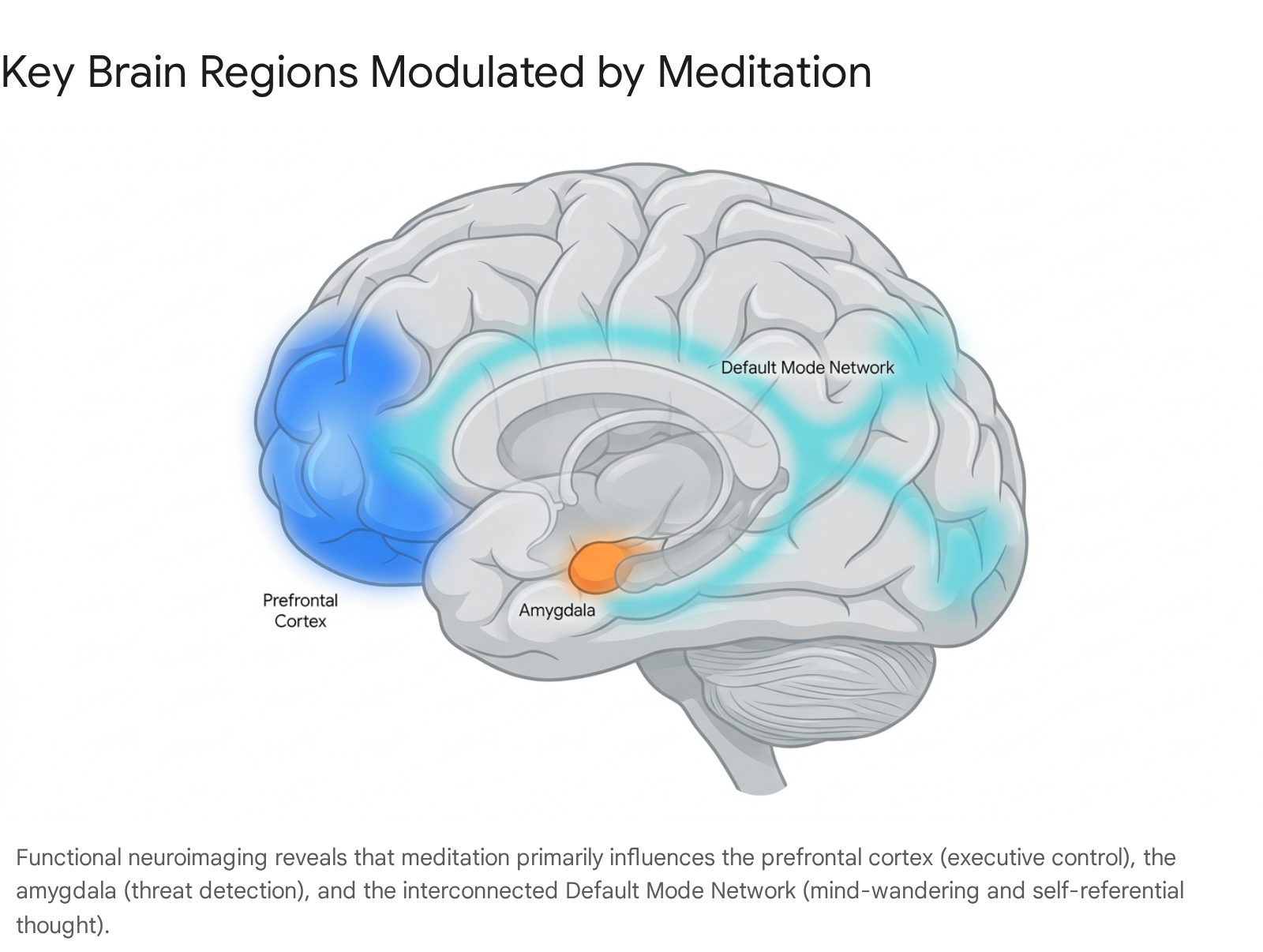
Quieting the Default Mode Network
Cognitive neuroscientists have identified a resting-state system in the brain called the Default Mode Network (DMN), primarily involving the posterior cingulate cortex and the medial prefrontal cortex 1513. The DMN is essentially the brain's "autopilot." It becomes highly active when our minds are wandering, when we are ruminating on past regrets, or when we are projecting anxieties into the future 1514.
Overactivity and hyper-connectivity within the DMN are strongly correlated with clinical anxiety, rumination, and depressive episodes, as the brain gets trapped in repetitive, self-referential thought loops 1513.
During meditation, fMRI scans show that activity within the DMN drops significantly 181915. As practitioners deliberately focus their attention on an anchor - such as the physical sensation of breathing - the brain shifts metabolic power away from the DMN. Instead, it activates the Central Executive Network (CEN), a system responsible for focused attention, working memory, and cognitive control 1321.
Over time, regular meditators develop enhanced microstructural integrity in their white matter tracts - the brain's insulated communication cables 514. This improved connectivity allows the Salience Network (the brain's switchboard) to more rapidly detect when the mind has wandered into unproductive DMN rumination, allowing the practitioner to consciously switch back to the present moment via the CEN 513.
Rapid Access to Deep Limbic Centers
It was previously assumed that it took years of rigorous monastic practice to exert any voluntary control over deep, subcortical brain regions. However, a groundbreaking 2025 study from the Icahn School of Medicine at Mount Sinai proved that meditation immediately affects the deepest limbic emotion centers of the brain 116.
Because it is incredibly difficult to measure deep brain activity accurately with standard scalp EEG sensors, researchers recruited a unique group of neurosurgical patients. These were drug-resistant epilepsy patients who already had responsive neurostimulation electrodes surgically implanted deep inside their amygdala (the emotion processing center) and hippocampus (the memory center) 116.
The researchers asked these complete meditation novices to listen to a brief, 10-minute guided audio meditation. The results were immediate and striking. Within minutes, the intracranial sensors recorded profound shifts in neural oscillations, specifically increases in gamma waves and decreases in beta bursts directly inside the amygdala and hippocampus 123. This demonstrated that the neurological state shift begins almost the moment a person anchors their attention, proving that one does not need decades of practice to initiate deep-brain emotional regulation 1617.
The Brain's Literal Self-Cleaning Mechanism
One of the most fascinating recent developments in contemplative neuroscience is the discovery that meditation may literally help wash the brain of toxic metabolic waste.
A December 2025 study published in the Proceedings of the National Academy of Sciences (PNAS) utilized novel neuroimaging methods to track the flow of cerebrospinal fluid (CSF) in the brains of healthy adults 18. CSF is a clear fluid that circulates through the central nervous system, acting as a shock absorber and a vital waste removal system (the glymphatic system). It flushes out problematic metabolic byproducts, including the amyloid-beta peptides that contribute to neurodegenerative conditions like Alzheimer's, Huntington's, and Parkinson's diseases 1819.
Typically, this neurofluid waste-clearance system only operates at peak efficiency when we are in a state of deep, non-rapid eye movement (NREM) sleep 18. However, researchers at Vanderbilt University found that just 25 minutes of focused attention meditation shifted the participants' CSF flow into a highly efficient rhythm that remarkably mirrored the patterns seen during sleep 231820.
Data indicates a notable decrease in absolute CSF flow motion through the cerebral aqueduct, dropping from 4.60 mL/min during states of mind-wandering down to 4.17 mL/min during focused attention meditation. Crucially, this overall reduction was driven by a specific decrease in backward, "regurgitant" fluid motion 192021. Because hyperdynamic and regurgitant CSF flow is commonly associated with aging and neurodegeneration, the smoothing of these fluid dynamics suggests that mindfulness serves as a rare, non-pharmacological waking mechanism capable of stimulating the brain's internal cleaning system to support long-term cognitive health 192021.
Not All Meditation Does the Same Thing
A pervasive public myth is that "meditation" is a single, uniform activity where the goal is to sit cross-legged and completely blank the mind of all thoughts 23. In reality, the word "meditation" is a broad umbrella term, much like the word "sports." Playing chess and swimming are both sports, but they train entirely different cardiovascular and cognitive systems.
Neuroscience categorizes meditation into several specific styles, each yielding highly distinct neural signatures. The Max Planck Institute conducted an exhaustive nine-month study where participants spent three months sequentially training in three different styles of meditation. Subsequent brain scans confirmed that the different techniques altered entirely different neural networks, proving that the specific type of mental practice dictates the neurobiological outcome 222324.
Comparing Major Meditation Styles and Neural Targets
| Meditation Style | Core Practice Mechanism | Primary Brain Regions Modulated | Functional Real-World Benefit |
|---|---|---|---|
| Focused Attention (e.g., Breath Awareness, Shamatha) | Anchoring attention to a single target. Actively returning focus when the mind inevitably wanders. | Prefrontal Cortex, Anterior Cingulate Cortex (ACC), Parietal Lobe 6182223. | Improved sustained attention, executive impulse control, and working memory. |
| Open Monitoring (e.g., Vipassana, Mindfulness) | Observing thoughts, feelings, and bodily sensations as they arise without judging, suppressing, or holding onto them. | Insula, Somatosensory Cortex, Default Mode Network 61822. | Enhanced interoceptive self-awareness, reduced emotional reactivity, and optimal cognitive flexibility 25. |
| Loving-Kindness (e.g., Metta, Compassion) | Actively generating feelings of compassion and warmth, first toward oneself, then extending outward to others. | Amygdala, Temporoparietal Junction (TPJ), Anterior Insula 6182226. | Increased empathy, elevated oxytocin, and decreased self-criticism and social anxiety 222634. |
When a practitioner engages in Focused Attention meditation, they are essentially performing "bicep curls" for their prefrontal cortex, actively strengthening their top-down executive control over distractions 421.
Conversely, Loving-Kindness is an active emotional generation practice that bypasses executive focus. It weakens the default mode network's tendency toward self-judgment and rewires the brain toward prosocial behavior, cooperation, and empathy 2634. Meanwhile, Open Monitoring practices have been shown to help practitioners achieve a state of "brain criticality" - an optimal balance of neural chaos and order that allows the brain to remain highly attentive and adaptable to new information 25.
Intensive Retreats: A Catalyst for Systemic Change
While a daily 10- to 20-minute habit provides steady cognitive maintenance, intensive, multi-day meditation retreats appear to trigger profound, systemic biological shocks to the human body that extend far beyond the brain.
A fascinating 2026 study published in Communications Biology (a Nature portfolio journal) tracked 20 healthy adults attending a 7-day immersive mind-body retreat at the University of California San Diego 21927. Participants were removed from their daily stressors and engaged in approximately 33 hours of guided meditation, group healing rituals, and cognitive reframing lectures 215.
The pre- and post-retreat diagnostics revealed transformations that were staggering in their scope. Functional MRI scans showed that the brain had shifted into a highly integrated, fluid state - resembling the neural connectivity usually only seen during clinical psychedelic experiences, but achieved entirely without drugs 1927. The retreat lowered activity in regions linked to internal mental chatter and decreased whole-brain modularity, allowing different networks to communicate much more efficiently 228.
Blood Plasma and Cellular Neuroplasticity
The most surprising findings from the UCSD study did not come from brain scans, but from the participants' blood. The intensive retreat triggered a massive surge in endogenous opioids (the body's natural painkillers) and caused a complex, adaptive priming of the immune system 2729.
Most remarkably, researchers extracted post-retreat blood plasma from the participants and applied it to lab-grown human brain cells (neurons) in a petri dish. The post-retreat plasma directly caused the isolated lab neurons to grow longer dendritic branches and form new neural connections 22829. This provides stark evidence that intensive meditation triggers the release of circulating systemic factors - such as Brain-Derived Neurotrophic Factor (BDNF) - that physically prime the entire central nervous system for neuroplastic growth and cellular repair 1928.
Finding the Optimal Dosage: How Much is Enough?
For anyone looking to start a practice, the question of "dosage" is intensely debated. The gold-standard clinical program (MBSR) recommends 45 minutes of daily practice for eight weeks 3031. However, modern reality dictates that very few working adults can sustain that level of daily commitment.
The Rise of App-Based Micro-Dosing
With the explosion of commercial digital platforms like Calm and Headspace, the average meditation session has dropped from 45 minutes to roughly 10 minutes 32. Skeptics initially argued that these shortened, app-guided sessions were too brief to be biologically effective.
However, recent meta-analyses and longitudinal trials suggest that in the realm of brain changes, consistency matters far more than duration 1423. Data analyzed by researchers at Carnegie Mellon University indicates that just 10 to 21 minutes of app-based meditation, performed three times a week, is sufficient to produce measurable, statistically significant reductions in blood pressure, cortisol levels, and repetitive negative thinking 3233.
Traditional vs. Digital Meditation
| Feature | Smartphone App-Based Meditation | Traditional / In-Person Practice |
|---|---|---|
| Typical Session Length | 5 - 15 minutes 3132. | 30 - 60+ minutes 3233. |
| Primary Advantages | High accessibility, on-demand availability, lowered barrier to entry for beginners 3233. | Interpersonal support, customized teacher guidance, highly restorative physical environments 323435. |
| Mechanisms of Action | Downregulates amygdala reactivity, reduces worry, mediates anxiety symptoms 1534. | Fosters deep states of absorption (Jhana), enhances overall life satisfaction, builds social accountability 3536. |
| Main Drawbacks | Massive attrition rate; research shows ~95% of users quit within 30 days of downloading 32. | High barrier to entry regarding time commitment, financial cost, and geographic availability 32. |
If traditional sitting meditation creates physical agitation or anxiety in a beginner, neuroscientists suggest that "movement-based" practices like yoga, tai chi, or walking meditation serve as excellent, scientifically valid alternatives. These modalities offer the exact same cognitive training benefits by using physical movement as the focal anchor for attention rather than the breath 1237.
Hidden Risks: The "Dark Side" of Meditation
Because mindfulness is heavily marketed as a universally benign wellness tool - often equated to taking a warm bath or getting a massage - the medical community has historically underreported its potential adverse effects.
Meditation is not simply relaxation; it is active concentration training and, frequently, a form of emotional exposure therapy 1238. A comprehensive study led by psychologist Nicholas Van Dam at the University of Melbourne found that nearly 60% of meditators reported experiencing at least one adverse side effect during their practice 38.
Approximately 30% of practitioners found these experiences to be actively distressing. Reported side effects include panic attacks, the sudden resurfacing of traumatic memories, and feelings of dissociation or depersonalization (feeling unnervingly disconnected from one's own body or reality) 38.
Researchers emphasize that while meditation is overwhelmingly beneficial for the vast majority of the population, it requires proper informed consent. Individuals with active trauma, severe PTSD, or acute psychological distress should approach intensive meditation with caution. In these cases, mindfulness should ideally be explored under the guidance of a trauma-informed clinician rather than alone with a smartphone app 3839.
The WEIRD Bias in Contemplative Neuroscience
As we map the future of contemplative science, researchers are confronting a massive demographic blind spot that threatens the generalizability of current findings. Up to 80% of all behavioral science and meditation research has been conducted on populations from Western, Educated, Industrialized, Rich, and Democratic (WEIRD) societies 4041.
Meditation has its deepest roots in ancient Eastern philosophies, yet the bulk of the neuroimaging data we rely on comes from white, middle-class university students in North America and Western Europe 404243. This highly homogeneous sampling calls into question whether certain brain changes or emotional responses to meditation are universal human biological traits, or if they are heavily influenced by top-down Western cultural expectations and modern industrial lifestyles 4143.
To combat this WEIRD bias, international collaborations like the ENIGMA-Meditation consortium are actively aggregating brain imaging data from across the globe. By linking laboratories in Mexico, India, Norway, South Africa, and beyond, researchers aim to ensure that the neuroscience of mindfulness accurately reflects the neurodiversity of the entire global population, rather than just a narrow western demographic 4244.
Therapeutic Potential Across Specific Populations
As researchers move beyond healthy college students, the application of meditation for specific clinical and vulnerable populations is showing remarkable neurobiological promise.
Aging and Cognitive Decline
As the human brain ages, it naturally loses gray matter volume and cortical thickness, leading to cognitive decline. However, longitudinal neuroimaging studies suggest that long-term meditators experience a decelerated rate of age-related brain tissue loss 8. The intense mental activity of meditation may stimulate synaptogenesis (the branching of new dendrites), effectively conserving gray matter and protecting against the neurotoxic effects of chronic stress hormones like cortisol on the hippocampus 48.
Schizophrenia and Psychosis
Historically, meditation was considered contraindicated for individuals with schizophrenia due to fears of exacerbating hallucinations. However, recent mixed-methods clinical trials suggest that mindfulness-based interventions can serve as a powerful adjunctive therapy 53. By strengthening prefrontal cortical activity and improving amygdala-prefrontal connectivity, meditation helps counteract the limbic hyperactivation common in schizophrenia. Patients report that while hallucinations may not disappear, mindfulness significantly reduces the distress associated with them, improving emotional resilience and cognitive control 53.
Incarcerated Populations
Prison environments induce chronic, severe stress that radically alters the neuropsychological profile of inmates, leading to high rates of PTSD, aggression, and mood disorders 54. Emerging studies in correctional facilities demonstrate that interventions like Heartfulness meditation can significantly reduce the default mode network activity associated with trauma rumination. Clinical data shows measurable improvements in emotional control, state depression, and overall anger management among awaiting-trial and long-term inmates, offering a low-cost, non-pharmacological tool for neurological rehabilitation in highly stressful environments 54.
The Frontier: Meditation Meets Neurofeedback
The future of meditation research is increasingly technological. While subjective self-reporting has limitations, scientists are now combining ancient contemplative practices with real-time neurofeedback (mbNF) using EEG and fMRI technologies 5556.
In these clinical setups, practitioners meditate while receiving live visual or auditory feedback about their brain states. For example, a practitioner might hear a tone that lowers in pitch specifically when they successfully downregulate their Default Mode Network or achieve specific theta-band brainwave states 5556. This technology effectively removes the guesswork for beginners, allowing them to instantly verify if they are accessing the correct neural pathways. While large-scale, sham-controlled randomized trials are still needed to confirm long-term mental health outcomes, early data suggests that technologically assisted mindfulness could dramatically accelerate a practitioner's ability to achieve advanced states of emotional regulation 1356.
Bottom line
Meditation definitively alters the brain, but the scientific consensus has shifted away from the idea that short-term practice physically restructures brain tissue. Instead, meditation acts as a rapid functional workout, re-wiring neural networks to improve how the brain communicates, clears metabolic waste, and regulates intense emotion - with measurable state shifts happening in a matter of minutes. While digital apps and short daily doses are highly effective for managing modern stress, practitioners should remain aware that meditation is a powerful cognitive tool that requires consistency and, in some cases, clinical guidance to navigate safely.