
Do NMN and NR NAD Boosters Actually Work for Aging
Nicotinamide mononucleotide (NMN) and nicotinamide riboside (NR) safely and reliably increase blood NAD+ levels in humans, successfully engaging their primary biochemical target. However, comprehensive meta-analyses published through 2026 indicate that the dramatic anti-aging, metabolic, and physical performance benefits observed in rodent studies have largely failed to translate into significant functional improvements in humans. While both supplements show promise for targeted metabolic support and remain highly popular, current clinical evidence does not support their marketing as universal, age-reversing therapies.
The Promise of NAD+ and the Aging Cell
For over a decade, the rationale for taking nicotinamide adenine dinucleotide (NAD+) precursors has been built on a foundational premise in longevity science: systemic NAD+ levels naturally and universally decline as humans age, leading to a cascade of cellular dysfunction.
NAD+ is a vital coenzyme found in every living cell. It serves two primary, indispensable functions. First, it acts as a critical metabolic fuel, facilitating the transfer of electrons in the mitochondria to convert the food we eat into adenosine triphosphate (ATP), the body's energy currency. Second, it acts as a substrate for essential cellular defense enzymes, including sirtuins (the so-called "longevity genes" that regulate cellular health) and poly (ADP-ribose) polymerases (PARPs), which repair damaged DNA 123.
Because these protective enzymes physically consume NAD+ during their operation, the body must constantly replenish its supply. The prevailing theory in anti-aging medicine has been that as we age, the activity of NAD+-consuming enzymes - particularly an inflammatory enzyme called CD38 - skyrockets, draining the body's NAD+ reserves faster than they can be synthesized 4. By age 50, it was widely reported that humans possessed roughly half the NAD+ they had in their twenties 125.
Because the NAD+ molecule itself is too large to easily cross cell membranes, direct supplementation is highly inefficient. Instead, researchers and longevity enthusiasts turned to smaller precursor molecules - specifically nicotinamide mononucleotide (NMN) and nicotinamide riboside (NR) - which the body can absorb and biochemically convert into NAD+ internally 678. In animal models, supplementing with these precursors yielded spectacular results, reversing signs of vascular aging, increasing treadmill endurance, and improving insulin sensitivity 6110.
The 2026 Paradigm Shift: Does NAD+ Actually Decline?
The foundational narrative of universal, age-related NAD+ decline was significantly complicated by a landmark 2026 study published in the journal Nature Metabolism.
An international research team led by Trętowicz et al. utilized state-of-the-art, rigorously validated ultra-high-performance liquid chromatography coupled with high-resolution mass spectrometry to measure NAD+ across seven independent human cohorts. They examined the blood of 237 healthy donors ranging in age from 18 to 70 1112214.
The findings defied the established dogma: whole-blood NAD+ levels remained remarkably stable across all age groups 1214. Furthermore, blood NAD+ levels were surprisingly robust against lifestyle interventions; elite endurance athletes and highly trained individuals showed no significant differences in resting blood NAD+ compared to sedentary individuals 1215. The study also revealed unexpected metabolic nuances, noting that blood NAD+ levels were generally higher in obese individuals compared to normal-weight subjects, and generally lower in females compared to males within the 18 - 30 age bracket 14.
However, this data does not mean the NAD+ aging hypothesis is a myth; rather, it highlights the severe limitations of using blood as a universal proxy for biological aging.
Blood is a complex matrix dominated by red blood cells and circulating immune cells. While whole-blood NAD+ does not appear to drop with age, tissue-specific evidence paints a different picture. In energy-hungry compartments like skeletal muscle and brain tissue, localized NAD+ levels do suffer measurable, age-related declines 111415. Ultimately, the Nature Metabolism study demonstrated that while a simple blood test cannot serve as a stand-alone biomarker for chronological aging, supporting cellular metabolism in localized tissues with NAD+ precursors remains a biologically plausible pursuit 1115. Furthermore, the researchers confirmed that NAD+ levels are indeed significantly depressed in specific age-related disease states, including Parkinson's disease, Alzheimer's disease, and several forms of cancer 14.
NMN vs NR: The Head-to-Head Clinical Evidence
A fierce marketing debate has long positioned NMN and NR against one another. The most common argument favoring NMN relies on a simplified reading of the biosynthetic pathway: NMN is "one step closer" to NAD+ than NR. According to this logic, when you take NR, the body must first use energy to convert it into NMN, and only then convert it to NAD+ 1617.
For years, this debate remained largely theoretical, relying on animal models and indirect comparisons. However, groundbreaking human clinical trials published in 2025 and 2026 finally provided direct, head-to-head data, revealing that the "one step closer" argument is biologically irrelevant when these supplements are ingested orally 18.
The Microbiome Equalizer
The most definitive answer to the NMN versus NR debate emerged from a 2025 randomized, placebo-controlled trial published by Cuenoud et al. in Nature Metabolism. The researchers administered 1,000 mg of NMN, 1,000 mg of NR, and 500 mg of standard nicotinamide (NAM) to 65 healthy adults over 14 days 1819.
The findings completely rewrote the understanding of how NAD+ boosters are metabolized in humans: * Equivalent NAD+ Elevation: At matched doses, both NMN and NR sustainably doubled baseline circulating whole-blood NAD+ levels over 14 days. There was no statistically significant difference in long-term efficacy between the two precursors 181920. * The Preiss-Handler Pathway: When ingested orally, neither NMN nor NR enters the systemic circulation intact in meaningful quantities. Instead, gut bacteria rapidly metabolize both precursors into a different molecule entirely: nicotinic acid (NA). The body then absorbs this microbe-generated NA and converts it into NAD+ through a specific biochemical route called the Preiss-Handler pathway 1921. * Gut Health Byproducts: By interacting with the microbiome, both NMN and NR modulate gut bacteria to increase the production of short-chain fatty acids (SCFAs). SCFAs are vital microbial metabolites known to promote gut barrier integrity and possess broad anti-inflammatory and anti-diabetic properties 1819.
This research proves that because both molecules are intercepted and broken down by the same gut bacteria into the exact same intermediate compound, the theoretical structural advantage of NMN is entirely neutralized in the human digestive tract 181921.
Short-Term Spikes vs. Long-Term Baselines
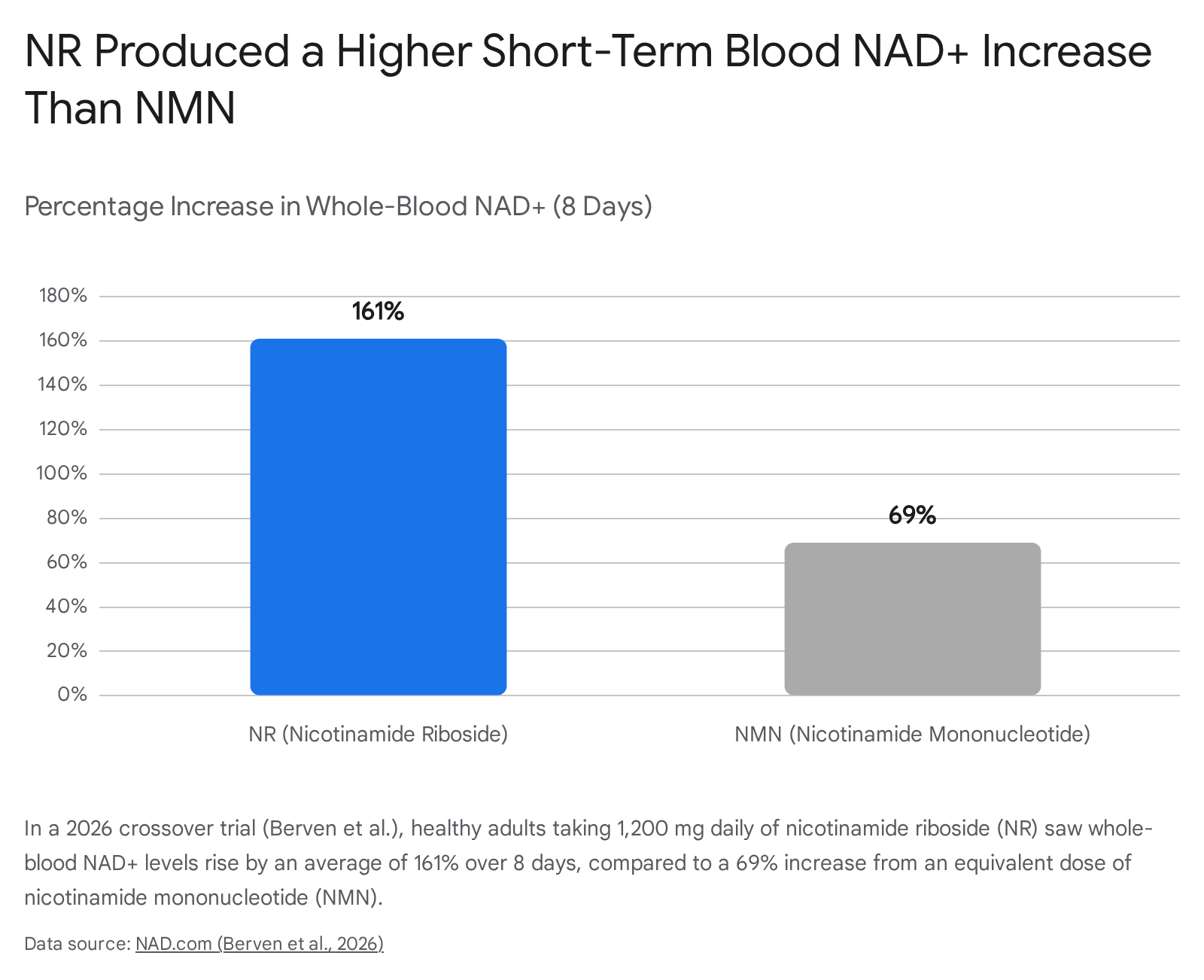
While 14-day steady-state elevations are equivalent, the acute pharmacokinetics differ slightly. A separate 2026 crossover trial by Berven et al., published in iScience, examined the short-term effects of high-dose supplementation (1,200 mg/day) over just 8 days in healthy adults and Parkinson's patients 222324.
In this tighter, 8-day window, NR actually produced a faster and more aggressive initial spike in blood NAD+ levels compared to NMN 24.
Interestingly, the Berven trial also utilized MRI technology to measure NAD+ levels deep within the brain. During the initial 8-day period, neither NR nor NMN successfully raised brain NAD+ levels. It was only when the researchers extended the NR treatment to 4 continuous weeks that brain NAD+ levels finally increased, reaching roughly 40% above baseline in healthy subjects 2324. This suggests that while blood levels respond quickly, neurological tissue requires prolonged, consistent supplementation to absorb the molecule.
Why Cheap Nicotinamide (NAM) Falls Short
If the ultimate goal is simply to raise cellular NAD+, some consumers understandably question whether standard, inexpensive vitamin B3 (nicotinamide/NAM) is a sufficient substitute for premium NMN or NR supplements.
The 2025 Cuenoud Nature Metabolism trial explicitly tested this and found that NAM behaves very differently in the body. While a 500 mg dose of NAM produced a massive, acute spike in NAD+ within four hours of ingestion, it failed entirely to sustain elevated baseline levels over the 14-day trial period 1920.
Furthermore, processing high, constant doses of NAM places a heavy metabolic burden on the body's methylation pathways. To excrete excess NAM, the body must attach methyl groups to it. The Cuenoud trial found that 14 days of NAM supplementation resulted in a strong, eightfold increase in homocysteine - an amino acid biomarker closely associated with an increased risk of cardiovascular disease and endothelial damage 2025. Because NMN and NR follow different enzymatic degradation pathways, neither compound raised homocysteine levels, cementing their superior safety and efficacy profiles for long-term daily use 2025.
Translating Molecules to Movement: The Functional Evidence
The most significant challenge facing longevity science today is the stark disconnect between successful biochemical target engagement and tangible human functional outcomes. The data unequivocally proves that oral NMN and NR raise systemic NAD+ 35. The critical question is whether those elevated molecules translate into slower aging, faster recovery, or better metabolic health.
The Rodent-to-Human Gap
Much of the intense media hype surrounding NAD+ boosters traces back to spectacular preclinical studies. In mice, restoring NAD+ with NMN or NR rejuvenates intestinal stem cells, resolves diet-induced insulin resistance, dramatically increases treadmill endurance, prevents cognitive decline, and clears out damaged cellular components through a process called autophagy 48110.
However, translating geroscience from short-lived rodents to long-lived humans is notoriously difficult. Mice possess different metabolic rates, different fasting responses, and distinct cellular aging trajectories. When interventions that look transformative in a mouse are applied to humans, the clinical results are routinely smaller, highly heterogeneous, or entirely absent 361026.
Physical Performance and Muscle Strength
In 2024 and 2026, researchers published several comprehensive systematic reviews and meta-analyses aiming to aggregate all available human clinical trial data on NAD+ precursors.
The conclusions were sobering for anti-aging enthusiasts. A 2026 PRISMA-guided systematic review of 113 eligible studies (including 33 human intervention trials) concluded that while oral NR and NMN are highly effective at biochemical target engagement, their clinical effectiveness for broad anti-aging or wellness outcomes remains inconclusive, with effects that are often null 10.
Specifically concerning physical performance, a 2025 meta-analysis published in the Journal of Cachexia, Sarcopenia and Muscle pooled data from randomized controlled trials of adults over the age of 60. The analysis found no significant improvements in skeletal muscle index, handgrip strength, gait speed, or chair-stand tests 22. A separate 2024 meta-analysis reviewing 10 NMN studies (involving 437 patients) confirmed that any observed gains in physical strength or aerobic capacity represented a "non-significant trend" rather than a clear, objective clinical effect 31.
There are, however, isolated pockets of positive data. A 2024 study in GeroScience reported that 12 weeks of NMN supplementation helped older adults maintain walking speed and subjectively improved their sleep quality compared to a placebo 27. Similarly, individual trials in amateur runners have shown slight, dose-dependent increases in aerobic capacity (oxygen utilization) 351. But broadly speaking, the current evidence does not support the idea that NAD+ boosters act as a potent exercise mimetic or muscle-building supplement in humans.
Metabolic Health and Insulin
The metabolic data is similarly mixed. Early hope was driven by a 2021 trial showing that 10 weeks of NMN improved insulin sensitivity in the skeletal muscle of overweight, pre-diabetic women 326.
However, subsequent, larger meta-analyses have dampened these expectations. A 2024 systematic review of NMN trials found that short-term supplementation failed to significantly improve major markers of glucose control (like HbA1c or fasting glucose) or lipid profiles (like total cholesterol or triglycerides) across broader populations 32228. A sophisticated indirect comparison meta-analysis published in 2026 attempted to compare the metabolic effects of NMN against NR. The researchers found that across 14 distinct metabolic outcomes, neither precursor achieved a statistically significant improvement over placebo, grading the certainty of the evidence as "Very Low" due to small sample sizes and structural limitations in the trials 293031.
| Biological Domain | Rodent Study Observations | Human Clinical Trial Reality (2024-2026 Data) |
|---|---|---|
| NAD+ Blood Levels | Dramatic, sustained increases across diverse tissues. | Consistent, reliable increases (1.5x to 2.5x baseline) across multiple trials 3720. |
| Metabolic Health | Resolves insulin resistance, prevents obesity on high-fat diets 81. | Heterogeneous. Small insulin sensitivity gains in specific pre-diabetic cohorts; meta-analyses show no broad changes to HbA1c, glucose, or total cholesterol 32830. |
| Physical Performance | Massive increases in treadmill endurance and skeletal muscle function 61. | Negligible. Non-significant trends in aerobic capacity; meta-analyses show no objective improvements in grip strength or gait speed in the elderly 3422. |
| Brain/Cognitive | Strong neuroprotection and prevention of cognitive decline 7. | Brain NAD+ levels take 4 weeks to rise in humans 23. Clinical data on actual cognitive improvement or dementia prevention remains inconclusive 510. |
The consensus among longevity researchers in 2026 is that NMN and NR are biologically active and hold genuine promise for supporting metabolic health, cellular energy management, and targeted physiological functions. However, there is no convincing clinical evidence that they dramatically extend human lifespan, reverse biological age, or serve as a standalone cure for metabolic dysfunction 4527.
The Safety Profile: Debunking the Nerve Damage Myth
One of the most encouraging aspects of NAD+ booster research is the robust safety profile of these molecules. Across dozens of published human clinical trials testing doses of up to 1,250 mg/day for up to 12 weeks, zero serious adverse events have been attributed to either NMN or NR supplementation 4132. Minor side effects, when reported, are generally limited to occasional mild gastrointestinal discomfort, transient skin irritation, or harmless, temporary blood pressure fluctuations 532.
Despite this strong clinical safety record, a theoretical health scare periodically circulates in online longevity communities: the idea that taking NMN might cause nerve damage.
This fear originates from the discovery of a protein called SARM1 (sterile alpha and TIR motif-containing 1). SARM1 is a powerful metabolic sensor and NADase enzyme located in the axons of nerve cells. When SARM1 is activated, it triggers a rapid, catastrophic destruction of the axon - a process central to various neurodegenerative diseases, traumatic brain injuries, and peripheral neuropathies 34.
In 2015, researchers discovered that the physical accumulation of NMN inside a nerve cell is the exact trigger that activates SARM1 353637. This finding sparked a logical, albeit premature, fear: if NMN activates the nerve-destroying SARM1 enzyme, wouldn't taking an NMN supplement be toxic to the brain?
Subsequent structural biology and biochemical research published through 2024 has definitively debunked this fear, proving that NMN supplementation is entirely safe for healthy human nerves 335.
The NMN/NAD+ Ratio Rule
The critical detail lies in how the SARM1 enzyme is structured. SARM1 possesses an auto-inhibitory N-terminal armadillo repeat (ARM) domain that acts like a lock. Both NMN and NAD+ compete to bind to this exact same pocket on the enzyme 34.
Therefore, SARM1 is not triggered by the absolute amount of NMN in the cell, but rather by the ratio of NMN to NAD+. * When NAD+ levels are high, NAD+ easily outcompetes NMN, binds to the ARM domain, and firmly locks SARM1 in an inactive, safe state 338. * It is only when NAD+ levels plummet and NMN levels simultaneously spike (a massive shift in the ratio) that NMN binds to the pocket and activates the destructive cascade 33537.
The NMNAT2 Protective Factor
In healthy human neurons, an essential survival enzyme called NMNAT2 works constantly to convert raw NMN into finished NAD+ using ATP 33538. Because NMNAT2 is highly efficient, NMN is immediately processed and never accumulates in isolation. This constant processing ensures that NAD+ levels remain high, keeping the SARM1 enzyme safely locked 33539.
Pathological SARM1 activation only occurs when a nerve is physically severed, poisoned by chemotherapy, or diseased. During these catastrophic events, the protective NMNAT2 enzyme is destroyed. Without NMNAT2 to process it, NMN violently backs up, NAD+ production halts, the ratio flips, and SARM1 triggers axonal death to clear away the irreparably damaged nerve 3738.
Because oral NMN and NR supplements reliably raise systemic NAD+ levels in the body, they actually protect against SARM1 activation in healthy individuals by reinforcing the abundance of the inhibitory NAD+ molecule 35. Preclinical trials consistently show that administering NAD+ precursors actually prevents the development of chemotherapy-induced and diabetic peripheral neuropathies by keeping SARM1 deactivated 35.
The Wild West of Supplement Quality
While the molecules themselves are safe and biochemically active, the consumer retail market for NAD+ boosters is notoriously unreliable. Because dietary supplements do not undergo the rigorous pre-market FDA approval process required for pharmaceutical drugs, bad actors frequently flood e-commerce platforms with counterfeit, diluted, or entirely fake products 4142.
The scale of this problem was exposed in a highly influential 2021 market analysis conducted by the independent laboratory ChromaDex. Researchers utilized High-Performance Liquid Chromatography (HPLC) to test the exact chemical composition of 22 of the highest-selling NMN brands available on Amazon. The results revealed systemic, industry-wide fraud: * 64% of the tested products contained less than 1% of the NMN claimed on the label 414243. * 14% contained absolutely zero detectable NMN, acting as complete placebos 4143. * Only 14% of the brands actually met or exceeded their advertised label claims 4143.
The situation was exacerbated by the physical properties of the molecule. Pure β-NMN is a white powder encased in standard capsules, making it visually indistinguishable from cheap fillers or plain niacin 41. Furthermore, early iterations of NMN were highly unstable and degraded rapidly when exposed to heat or moisture during shipping 18.
How to Verify Purity in 2026
As of 2026, consumer awareness has forced a positive shift in the market. Industry data indicates that 64% to 70% of global NMN sales are now captured by premium brands offering high-purity formulations 4445.
| Quality Indicator | The Gold Standard | Red Flags to Avoid |
|---|---|---|
| Purity Level | >98% (ideally >99%) authentic β-NMN 116. | "Proprietary blends" that hide the exact milligram dosage 16. |
| Testing Method | High-Performance Liquid Chromatography (HPLC); sometimes supplemented with NMR spectroscopy 11641. | Relying solely on raw ingredient testing before manufacturing 16. |
| Laboratory Standards | Independent, third-party testing by an ISO/IEC 17025-accredited laboratory 16. | In-house laboratory testing without external verification 16. |
| Transparency | A publicly available Certificate of Analysis (CoA) matched to the specific batch/lot number on the bottle 1641. | Brands that refuse to provide a CoA upon consumer request 41. |
| Contaminant Checks | Explicitly tests negative for heavy metals (lead, arsenic) and microbial pathogens (E. coli) 41. | CoAs that only show potency but ignore safety and stability markers 41. |
Medical professionals and industry experts universally advise that consumers should never purchase an NMN or NR supplement based solely on user reviews or package design. If a brand cannot provide a recent, third-party Certificate of Analysis verifying the exact milligram content of the finished batch, the product should be avoided entirely 1641.
A Fractured Global Regulatory Landscape (2026)
The legal status of NMN is exceptionally volatile, driven by a persistent tension between the rapidly expanding dietary supplement industry and the protective regulations surrounding pharmaceutical drug development. As of 2026, different global regulatory bodies treat the exact same molecule with wildly divergent legal frameworks, creating a complex web for manufacturers and consumers 4647.
United States: The FDA's U-Turn
In the United States, dietary supplements are governed by the Dietary Supplement Health and Education Act of 1994 (DSHEA). A critical provision of DSHEA - the "drug preclusion clause" - states that if an ingredient is formally authorized for investigation as a new pharmaceutical drug before it is lawfully marketed as a dietary supplement, it cannot be sold as a supplement. This rule exists to protect the intellectual property and massive financial investments of pharmaceutical companies developing novel therapies 424648.
In November 2022, the FDA shocked the longevity industry by officially banning the sale of NMN as a dietary supplement. The agency invoked the drug preclusion clause, citing that a pharmaceutical company had initiated clinical trials on a proprietary form of NMN (designated MIB-626) before the broader supplement industry had submitted proper safety notifications 464749.
The industry fought back aggressively. The Natural Products Association (NPA) and the Council for Responsible Nutrition (CRN) filed extensive citizen petitions, arguing that NMN had a safe history of use and that the FDA's timeline was flawed. When those stalled, the NPA escalated to a formal federal lawsuit 474950.
Under immense legal and congressional pressure, the FDA finally reversed its stance. In late September 2025, and formalized via official response letters in December 2025 to major suppliers like SyncoZymes and Kingdomway, the FDA reinstated NMN's New Dietary Ingredient (NDI) status. As of 2026, NMN is officially recognized as lawful and can be legally marketed and purchased as a dietary supplement across the United States 47505152.
United Kingdom and the European Union: The Novel Food Hurdle
In Europe, the regulatory barrier is entirely different. Both the UK and the EU enforce strict "Novel Food" regulations. By legal definition, any food or ingredient that was not widely consumed by humans within the region prior to May 15, 1997, is considered "novel" and must undergo a rigorous, multi-year safety and toxicology assessment before it can be legally sold 5354. * United Kingdom: Following Brexit, the UK Food Standards Agency (FSA) handles its own authorizations. As of mid-2026, NMN is officially listed in the UK Novel Foods Catalogue as "under assessment." While it lacks broad formal authorization, the FSA generally exercises enforcement discretion, allowing compliant businesses that submitted early safety dossiers to continue selling NMN while the review is pending 5355. * European Union: The environment is far more hostile in the EU. In November 2022, the European Commission explicitly classified NMN as an unauthorized novel food 46. While the European Food Safety Authority (EFSA) is actively evaluating at least six safety dossiers from major manufacturers, no NMN product has been officially approved 5156. Consequently, national food-safety authorities across member states actively enforce a ban. The Rapid Alert System for Food and Feed (RASFF) frequently flags, blocks, and destroys unauthorized NMN supplements attempting to enter the EU market 5557.
Asia: Japan's Boom vs. China's Ban
The regulatory divide is equally stark in Asia, highlighting differing philosophies on preventive health and ingredient safety. * Japan: Japan is the undisputed global pioneer in NMN accessibility and clinical research. In 2020, the Japanese Ministry of Health, Labor and Welfare (MHLW) fully approved NMN, moving it to the non-drug list and classifying it as a permitted food ingredient 46. Operating under rigorous domestic Good Manufacturing Practice (GMP) standards, Japanese companies produce exceptionally high-purity NMN. The molecule is deeply integrated into the country's wellness culture, legally available in pharmacies, department stores, and anti-aging clinics nationwide 4658. * China: A profound paradox defines the Chinese market. Chinese biotech facilities manufacture the vast majority of the world's raw NMN supply. Yet, the Chinese National Medical Products Administration (NMPA) and the National Health Commission strictly prohibit the domestic sale of NMN as a food additive, dietary supplement, or pharmaceutical 4647. In mid-2025, Chinese customs authorities intensified the crackdown, closing cross-border e-commerce (CBEC) loopholes that previously allowed foreign brands to sell into China. Today, Chinese citizens can only obtain NMN via direct international mail for limited personal use, while domestic manufacturers are forced to export their entire supply to the US and Japan 47.
| Region | Regulatory Status (as of 2026) | Practical Impact on Consumers & Markets |
|---|---|---|
| United States | Fully Permitted (Dietary Supplement) | Widely available following the FDA's late-2025 legal reversal on the drug preclusion clause 4752. |
| Japan | Fully Permitted (Food Ingredient) | Widely available. Japan serves as the global hub for premium clinical research and high-purity manufacturing 4658. |
| United Kingdom | Under Assessment (Novel Food) | Legal to purchase through compliant vendors while the FSA conducts its ongoing safety review 53. |
| European Union | Unauthorized (Novel Food) | Prohibited from legal sale. Shipments are subject to seizure and destruction by customs authorities 5657. |
| China | Prohibited (Domestic Sale) | World's largest manufacturer of raw NMN, but domestic citizens can only import it for personal use via direct mail 47. |
Bottom line
NMN and NR are highly effective biochemical tools that safely and reliably elevate systemic NAD+ levels in human blood, proving that they achieve their primary metabolic goal. However, current clinical evidence tempers the extreme anti-aging hype; while these supplements support overall metabolic resilience, gut microbiome health, and cellular energy pathways, human trials have not yet demonstrated the dramatic physical rejuvenation or strength gains seen in animal models. Both compounds exhibit excellent safety profiles - dispelling previous fears regarding SARM1 nerve toxicity - but due to a fractured global regulatory landscape, consumers must relentlessly prioritize third-party tested brands to avoid the widespread presence of counterfeit, low-purity products on the retail market.