
The Distinction Between Self-Promotion and Bragging
The negotiation of self-presentation requires individuals to balance the necessity of communicating competence with the social risks of appearing arrogant. Impression management, a foundational concept in social psychology, posits that individuals consistently attempt to control the perceptions others form of them across various social and professional contexts 121. In competitive environments - ranging from professional workplaces to digital networking platforms - this translates into an ongoing effort to maximize perceived value without violating social norms of modesty. The demarcation between confident self-promotion and bragging is not anchored in the objective magnitude of an achievement, but rather in a complex matrix of psychological attributions, linguistic framing, demographic expectations, and algorithmic mediation.
This research report examines the precise thresholds that separate acceptable self-advocacy from penalized boasting. By synthesizing research across social psychology, computational linguistics, organizational behavior, and algorithmic management, the analysis defines the mechanisms through which audiences evaluate self-promotional speech and the variables that shift these boundaries.
Psychological Dimensions of Pride
The motivation to share personal accomplishments stems fundamentally from the psychological experience of pride, a self-conscious emotion elicited by the evaluation of one's own achievements against social or internal standards 23. However, pride is not a monolithic construct. Behavioral science identifies a dual-facet model of pride, which serves as the psychological engine driving differing styles of self-presentation.
The distinction between confident self-promotion and bragging aligns closely with the bifurcation of pride into "authentic" and "hubristic" dimensions 23645. These two facets generate entirely different modes of social rank attainment and elicit distinct reactions from audiences. Authentic pride is derived from specific, controllable, and unstable causes, such as effort and hard work 23. It is centered on the evaluation of doing. Consequently, self-promotion driven by authentic pride tends to focus on the process, the effort expended, and the specific behavioral metrics of an achievement. Individuals who exhibit authentic pride demonstrate higher implicit and explicit self-esteem, greater conscientiousness, and a propensity toward prosocial behavior 345. In group settings, authentic pride facilitates the attainment of "prestige" - a form of social rank based on earned respect and the sharing of expertise 34.
Conversely, hubristic pride is attributed to global, stable, and uncontrollable causes, such as inherent genius or natural superiority 23. It involves an evaluation of being. Self-promotion fueled by hubristic pride often manifests as boasting, characterized by comparative superiority claims and a lack of contextual grounding. Hubristic pride is positively correlated with narcissism, aggression, disagreeableness, and low implicit self-esteem 365. It is evolutionarily tied to the attainment of "dominance" - social rank achieved through intimidation, coercion, or the aggressive assertion of superiority 34.
| Psychological Dimension | Source of Evaluation | Attribution Type | Social Rank Mechanism | Associated Personality Traits |
|---|---|---|---|---|
| Authentic Pride | Specific accomplishments ("Doing") | Internal, unstable, controllable (Effort) | Prestige (Earned respect, expertise sharing) | High self-esteem, conscientiousness, prosociality |
| Hubristic Pride | Global self-evaluations ("Being") | Internal, stable, uncontrollable (Ability) | Dominance (Superiority, intimidation, coercion) | Narcissism, aggression, low implicit self-esteem |
Audiences intuitively detect the underlying attributions of pride in self-promotional speech. When an individual communicates an achievement through the lens of effort (authentic), audiences are more likely to perceive the behavior as confident and justified. When the achievement is presented as evidence of inherent, global superiority (hubristic), audiences categorize the behavior as bragging and apply social penalties 64.
The Empathy Gap in Social Interactions
A primary reason individuals cross the line from self-promotion into bragging is a profound failure in emotional perspective-taking. Research on "self-exuberance" indicates that individuals fundamentally miscalibrate how their self-promotional efforts will be received because they erroneously project their own emotional states onto their interaction partners 67.
When individuals achieve something positive, they experience happiness and pride. In an attempt to maximize the favorable impressions others hold of them, they engage in self-promotion, assuming that the audience will share in their positive emotional state 6. However, this constitutes an empathy gap. Self-promoters consistently overestimate the degree to which recipients will feel proud of or happy for them, and they severely underestimate the extent to which recipients will experience negative emotions, such as annoyance, envy, or resentment 67.
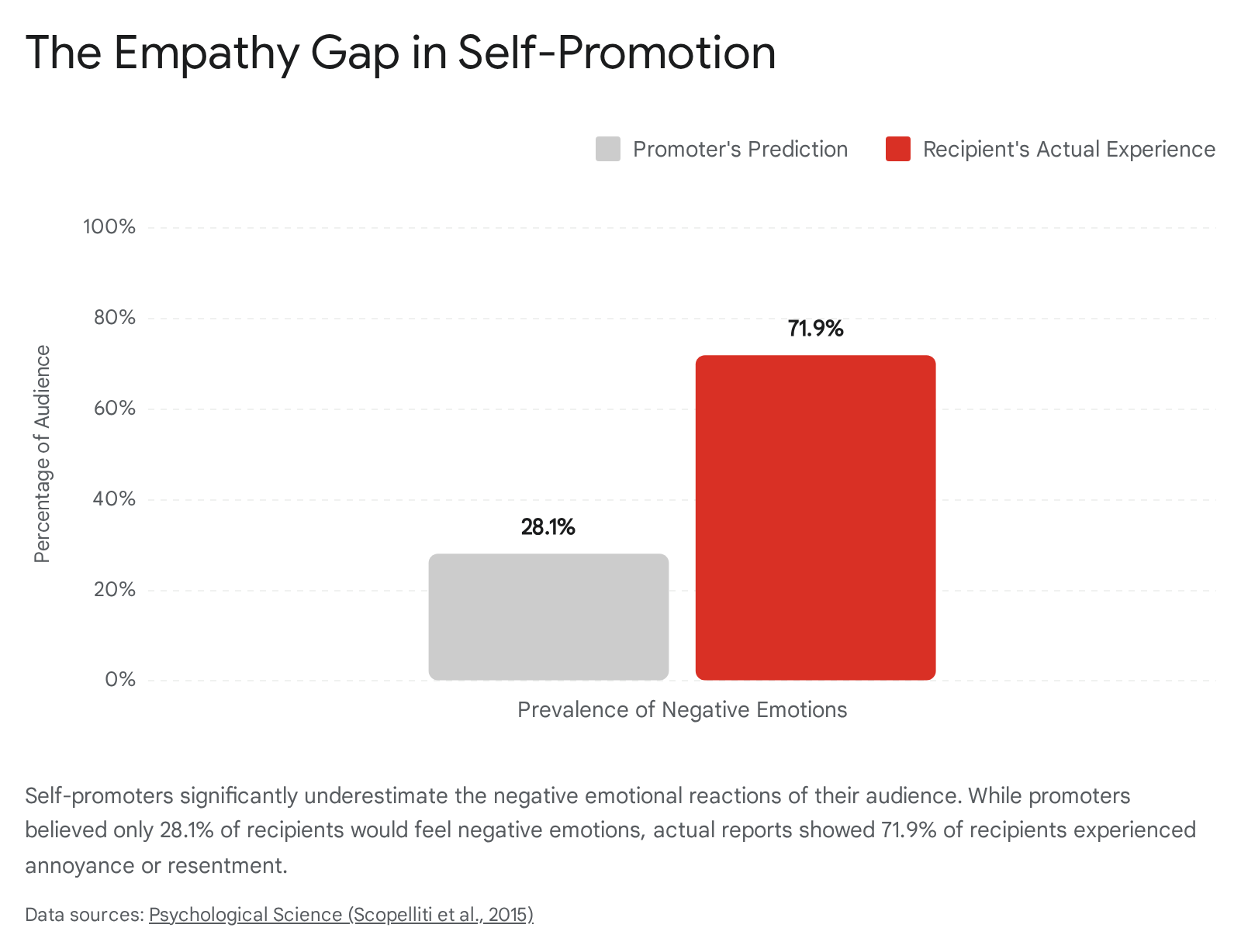
This miscalibration leads to excessive self-promotion. In attempting to elicit a favorable response, individuals increase the frequency and intensity of their claims, which backfires and causes the audience to view them as less likable, less competent, and ultimately as braggarts 678. The threshold of bragging is crossed precisely at the point where the speaker's assumption of shared joy diverges from the audience's actual experience of social threat or annoyance.
Linguistic Classifications of Self-Promotion
To circumvent the social penalties associated with bragging, individuals deploy various linguistic strategies designed to mask their self-promotional intent. However, computational linguistics and discourse analysis reveal that many of these strategies are functionally counterproductive and structurally identifiable.
Structural Models of Humblebragging
Humblebragging - defined as bragging masked by a complaint or an expression of humility - has proliferated as an indirect self-presentation tactic, particularly in digital environments 191011. The strategy is born from a desire to satisfy two conflicting needs simultaneously, as mapped onto Maslow's Hierarchy of Needs: the need for belonging (achieved through humility or vulnerability) and the need for self-esteem and status (achieved through boasting) 9.
Research taxonomizes humblebragging into distinct linguistic dimensions, primarily distinguishing between complaint-based humblebrags and humility-based humblebrags 101216. A detailed breakdown identifies six specific dimensions of humblebragging: self-praise plus a disclaimer, praise originating from a third party, self-praise combined with a shift of focus, self-praise accompanied by self-denigration, self-praise coupled with a reference to hard work, and self-praise framed strictly as a complaint 16.
Despite the actor's belief that combining a boast with a complaint captures the benefits of both strategies, empirical research demonstrates that humblebragging is uniquely ineffective 1101112. The primary driver of this failure is a severe reduction in perceived sincerity. Audiences are adept at identifying conversational implicature and the underlying illocutionary intent of a statement, as described by Searle's Illocutionary Act Theory 17131920. When an audience detects that the surface-level complaint is merely a vehicle for an implicit boast, the speaker incurs a "sincerity penalty." Consequently, humblebragging results in lower likability and lower perceived competence than straightforward bragging, and it is viewed far less favorably than genuine complaining 11011.
| Presentation Strategy | Surface-Level Frame | Primary Illocutionary Intent | Audience Perception | Overall Effectiveness |
|---|---|---|---|---|
| Straightforward Bragging | Positive claim regarding accomplishments | Self-enhancement | Arrogant but sincere | Low |
| Straightforward Complaining | Negative claim regarding circumstances | Elicit sympathy / Vent | Vulnerable, sincere | Moderate |
| Complaint-Based Humblebragging | Negative claim / Expression of burden | Self-enhancement | Insincere, manipulative | Very Low |
| Humility-Based Humblebragging | Self-deprecation / Feigned shock | Self-enhancement | Insincere, falsely modest | Very Low |
The acceptability of self-promotion is also highly contingent upon the discursive context in which it occurs. A critical variable is whether the self-praise is solicited or unsolicited. Speakers are perceived significantly less negatively - and often as highly competent and likable - when their self-promotion is delivered in direct response to a question 14. By answering a prompt, the speaker adheres to the conversational maxim of relevance and preserves the modesty norm, as the burden of introducing the achievement is shifted to the interlocutor 14.
In unprompted scenarios, self-promoters who proactively raise the issue of their own success face harsher judgments 14. To navigate this, social media users have developed metalinguistic cues, such as the hashtags #brag or #humblebrag. Discourse analysis suggests that these tags serve as explicit acknowledgments of the face-threatening nature of the speech act 1213. By meta-tagging the post, the speaker engages in a preemptive face-mitigation strategy, attempting to negotiate a socially acceptable space for positive self-presentation by demonstrating self-awareness of the norm violation 13.
Natural Language Processing and Bragging Detection
Advances in computational sociolinguistics have further operationalized these markers. Natural Language Processing (NLP) models trained to differentiate bragging from irony and sarcasm reveal that bragging features distinct semantic clusters centered around achievements, traits, affiliations, and possessions 2922. Models demonstrate that predicting a humblebrag requires the algorithmic recognition of a specific linguistic incongruity: a positive semantic payload wrapped within a negative syntactic structure 9.
Large-scale computational studies of social media behavior indicate that bragging is a common occurrence, with users historically bragging in roughly 1 out of 9 original tweets in studied datasets, although the overall prevalence has shown a steady decrease over the last decade within fixed user populations 215. These linguistic models are critical for broader applications, such as distinguishing genuine consumer complaints from self-promotional noise in automated sentiment analysis 9.
Socioeconomic Status and Class Bias
Socioeconomic status (SES) fundamentally shapes the norms of workplace behavior and the reception of self-promotional cues, often operating as an underappreciated and invisible force of bias 2416. Individuals from working-class backgrounds tend to possess interdependent, relational models of self, prioritizing team cohesion, community, and prosocial behavior 241617. In contrast, individuals from middle- and upper-class backgrounds are socialized toward independent models of self, which emphasize uniqueness, autonomy, and individual self-promotion 17.
In organizational settings, this divergence creates a systemic penalty for lower-SES individuals. Because the prevailing corporate definition of leadership is deeply intertwined with independent, assertive self-promotion, working-class employees who downplay individual achievements in favor of team-oriented narratives are often perceived as lacking the autonomy required for advancement 17. Working-class demographic groups are up to 34% less likely to accede to leadership roles and earn roughly 17% less than counterparts from middle or upper-class backgrounds, despite possessing equivalent college degrees 17. Conversely, individuals with upper-class backgrounds are frequently perceived as more competent simply because they exhibit higher baseline levels of confident self-promotion, which projects an aura of capability regardless of actual skill equivalence 24.
Furthermore, audiences exhibit a "goal-value bias" based on the speaker's perceived class. Evaluators systematically assume that wealthier, higher-status individuals possess a higher intrinsic motivation for goal pursuit, attributing a greater degree of drive and competence to their self-promotional claims 18. This bias actively discounts the self-advocacy of lower-status individuals, assuming they are less invested in professional or personal milestones because they are ostensibly overwhelmed by daily struggles 18. This perception persists even though empirical measurements demonstrate no actual difference across status levels regarding the internal valuation of career, health, or financial goals 18. Additionally, algorithmic and digital literacy studies indicate that lower-SES youth exhibit reduced critical capacity regarding digital advertising personalization, suggesting that class environments shape not just the output of self-promotion, but the critical processing of incoming persuasive media 19.
Age and Generational Differences
Age operates as a primary filter for the reception of self-promotion, heavily influenced by the Stereotype Content Model (SCM). The SCM posits that social groups are judged along two universal dimensions: warmth (communality) and competence (instrumentality) 2021222324.
The prevailing stereotype of older adults is ambivalent: they are generally perceived as high in warmth but low in competence 212224. When older individuals engage in confident, agentic self-promotion - behavior typically associated with high competence and low warmth - they disrupt prescriptive age stereotypes. While younger adults are granted wider latitude to assert competence without necessarily sacrificing likability, older adults who aggressively self-promote risk triggering hostile ageism if they are perceived as violating the paternalistic expectation of passive warmth 202122. Conversely, older adults who align with the stereotype by utilizing relational, pro-social framing (high warmth) are met with greater acceptance 2224.
Digital demographic analyses confirm that the threshold for bragging acceptability is heavily skewed toward youth. Young adults are the most likely cohort to engage in online self-promotion 215. In computational studies of Twitter datasets, younger, highly educated users were identified as the demographic most likely to boast 215. Furthermore, adolescents exhibit a strong correlation between a high focus on social media self-presentation and lower overall wellbeing, an effect that is particularly pronounced among adolescent girls compared to boys 25.
Speech Perception and Credibility
Listener reception is also impacted by auditory cues related to age. Experimental data regarding speech rate and credibility indicate that when listeners perceive a speaker as deviating from expected adult target norms, their assessment of the speaker's authority and credibility shifts 35262728. For instance, listeners reliably estimate speaker age based on speech rate, perceiving slower speech as indicative of older age 27.
In contexts where speakers exhibit non-standard linguistic traits - such as child-like speech or heavy dialectal variations - listeners alter their perceptual leniency 2628. Adult listeners are more likely to accept certain phonetic variations as correct when produced by adult speakers, but are highly critical of the exact same variations when produced by children, highlighting how baseline assumptions of competence are tethered to the perceived chronological age and maturity of the speaker 28.
Gender Dynamics in Impression Management
Gender introduces one of the most rigorously documented variations in the reception of self-promotion. Women face a severe double bind rooted in the same warmth-competence paradigm of the SCM. Because societal norms prescribe communal, modest, and nurturing behavior for women, direct self-promotion violates traditional gender expectations 2029.
When women engage in the exact same confident self-promotion as their male counterparts, they are significantly more likely to be penalized for lacking warmth and are perceived as bragging or being excessively aggressive 29. For example, in academic medicine and competitive corporate environments, women report that a primary barrier to advancement is the fear that highlighting their achievements will render them unlikable, triggering a backlash effect 29. To mitigate this risk, women often default to self-deprecation or the sharing of credit, which protects their likability but inadvertently damages their perceived competence and promotion velocity 29.
Furthermore, computational analyses of digital bragging reveal distinct gendered patterns in content. Men are more likely to boast about leisure activities, material possessions, and external achievements, whereas women are more likely to focus their self-promotional content on affiliations or interpersonal traits, navigating the constraints of digital performativity through mitigated self-reference 215. Furthermore, susceptibility to persuasion principles in advertising shows variations by gender, indicating that the cognitive processing of self-promotional messaging is fundamentally influenced by the demographic identity of both the speaker and the recipient 30.
Self-Advocacy in Disability Contexts
The parameters of self-promotion shift dramatically when analyzed through the lens of disability studies. For populations with intellectual and developmental disabilities (IDD), self-presentation is frequently framed as "self-advocacy" rather than self-promotion. While professional self-promotion centers on highlighting exceptionalism and career milestones, self-advocacy for transition-age adults with IDD focuses on fundamental agency, such as asserting basic needs, navigating relational conflicts, and establishing autonomy from caregivers 314232.
Research involving young adults with IDD indicates that they conceptualize self-advocacy not merely as speaking up, but as the active practice of caring for oneself in systems that frequently marginalize their voices 3142. In these contexts, the threshold for acceptable self-advocacy is heavily policed by systemic barriers, including limited interagency communication, societal skepticism regarding their competence, and paternalistic educational environments 3233. Consequently, the assertion of competence by disabled individuals is often mischaracterized by neurotypical audiences as non-compliance or unnecessary friction, rather than legitimate self-presentation 4232.
Algorithmic Mediation of Self-Presentation
The transition from face-to-face interactions to professionally oriented social network sites (P-SNS) has redefined the boundaries of self-promotion. In digital spaces, the "audience" includes not only human peers but also algorithmic intermediaries that determine content visibility based on engineered parameters 454647.
Professional Networking Algorithms
On platforms like LinkedIn, algorithmic architecture actively dictates the stylistic norms of self-promotion. As of 2024 and 2025, network algorithms have fundamentally shifted away from rewarding viral, clickbait-style bragging toward prioritizing "expertise-driven engagement" 4849.
This shift is operationalized through a multi-stage content distribution process. In the critical "Golden Window" (the first hours after posting), the algorithm evaluates the content using strict proxies for value and sincerity 48. A key metric is "consumption rate" or dwell time, assessing whether users are actually reading the content rather than mindlessly engaging 4850. Furthermore, the algorithm heavily weights meaningful interactions, such as comments exceeding 15 words, over superficial metrics like shares or basic reactions 4849.
| Algorithmic Stage | Timeframe | Evaluated Metrics | Impact on Visibility |
|---|---|---|---|
| Quality Check | First 60 minutes | Spam detection, hashtag limits, external link penalties | Determines initial categorization (spam vs. high quality) |
| Golden Window | First 2 hours | Dwell time, interaction depth, relevance to 1st-degree connections | Determines broader network distribution |
| Expertise Valuation | Ongoing | Topic consistency, comment length (>15 words), conversational depth | Establishes subject matter authority and sustained reach |
This structural engineering shifts the definition of acceptable self-promotion. A user who broadcasts an uncontextualized boast (e.g., "I am honored to announce my promotion") may achieve low dwell time and minimal substantive commentary, resulting in the algorithm suppressing the post 48. Conversely, a user who frames an achievement through the lens of shared expertise (e.g., detailing the specific methodologies that led to a successful project launch) invites lengthy discourse. The algorithm recognizes this as "subject matter authority" and amplifies the reach 4851. In this context, the line between confident self-promotion and bragging is enforced mathematically: self-promotion must yield educational utility for the network to achieve algorithmic velocity.
Algorithmic Management in the Gig Economy
The integration of algorithmic management into daily professional life generates a psychological duality regarding self-promotion 4534. On one hand, leveraging the self-presentation affordances of digital platforms fulfills a deep psychological need for subjective vitality, career advancement, and boundary expansion 454653. The consistent curation of a digital trace - posting strategic content and engaging audiences - serves as a socially endorsed capital essential for modern job crafting and establishing credibility 4653.
On the other hand, the pressure to conform to algorithmic demands results in "algorithmic self-presentation," wherein users alter their authentic behavior strictly to appease machine logic 4754. For gig workers, digital nomads, and independent contractors subject to direct algorithmic management on platforms like Upwork, the demand for continuous digital self-optimization and visibility often leads to feelings of objectification and obsessive work passion, disconnecting the individual from the human elements of their labor 45343536. The algorithmic logic systematically privileges semantic proximity and topological diversity in skill clustering, forcing workers to curate their digital presence based on machine-readable taxonomies rather than human nuance 36.
Political Performativity and Network Polarization
In the realm of political communication, algorithmic self-presentation pushes actors toward specific styles of performativity that redefine traditional self-promotion. On short-form video platforms, political actors adjust to algorithmic rules to gain visibility, transforming ideological communication into algorithmic performance 475437.
Research comparing political campaigns reveals two dominant patterns of algorithmic self-presentation. In some contexts, politicians adapt to entertainment logic by performing authenticity, warmth, and humor to foster digital closeness 54. In other contexts, politicians rely on emotional confrontation and ideological polarization, catering to algorithmic preferences for provocative content 54.
This dynamic fosters "oil spill polarization," where extreme, identity-driven posturing spills over into seemingly apolitical spaces. Analysis of millions of Twitter bios reveals that users' non-political lifestyle references statistically align with their political partisanship 38. In these highly polarized, homophilous networks, the threshold for acceptable self-promotion is radically altered; aggressive bragging or ideological posturing that would be penalized in a professional setting is actively rewarded as a signal of ingroup solidarity 5438.
Network Homophily and Third-Party Promotion
Given the inherent risks and algorithmic complexities of digital self-promotion, research highlights an emerging alternative: promotion by others. Network analysis indicates that individuals highly value connections exhibiting high "perceived promoter potential" (PPP) - friends or colleagues who are likely to organically share the individual's successes with the broader network 3940.
Promotion by others sidesteps the empathy gaps and modesty violations associated with bragging. When an achievement is heralded by a third party, the audience attributes the claim to genuine merit rather than narcissistic intent 3940. In highly homophilous networks, where users cluster based on shared cultural and professional markers, third-party promotion functions as a powerful validating signal. It reinforces ingroup solidarity and elevates the primary actor's prestige without exposing them to the backlash typically reserved for braggarts 3940.
Conclusion
The line between confident self-promotion and bragging is neither static nor purely objective; it is a dynamic threshold negotiated across multiple domains. Psychologically, it hinges on the attribution of pride - whether an audience perceives the speaker as celebrating specific, effort-based achievements (authentic pride) or asserting a generalized, innate superiority (hubristic pride). Linguistically, attempts to obscure self-promotional intent through humblebragging universally fail, incurring severe sincerity penalties that make direct boasting preferable in human interactions.
Contextually, the threshold is highly fluid. What is considered standard confident self-promotion for a young, upper-class male is frequently categorized as inappropriate bragging when enacted by an older adult, a working-class individual, or a female professional, due to deeply ingrained stereotype content regarding warmth, competence, and relational autonomy. Finally, in the contemporary digital ecosystem, this line is increasingly drawn by algorithmic architectures. Platforms are evolving to suppress overt, low-value bragging while actively amplifying self-promotion that is framed as actionable, expertise-driven insight. Navigating this landscape requires a sophisticated awareness of demographic biases, high emotional intelligence, and a strategic alignment with the communal and algorithmic expectations of the target audience.