
Consumer overvaluation of self-assembled products
Introduction to the Economics of Effort
The traditional neoclassical economic model posits a rational consumer who seeks to maximize utility while minimizing costs, including the expenditure of physical and mental effort. Within this framework, labor is viewed strictly as a cost to be optimized or eliminated. However, the field of behavioral economics has consistently demonstrated that human behavior systematically deviates from this utility-maximizing baseline 1. One of the most profound illustrations of this deviation is the phenomenon in which the expenditure of labor actively generates subjective value, a cognitive bias formally codified as the "IKEA Effect" 23.
Named after the Swedish furniture retailer renowned for its flat-pack, self-assembly products, the IKEA effect describes a psychological paradigm wherein consumers place a disproportionately high financial and emotional value on products they have partially created, customized, or assembled themselves 23. The formal identification of this effect was established in a seminal 2012 study published in the Journal of Consumer Psychology by Michael I. Norton, Daniel Mochon, and Dan Ariely 4. Through a series of rigorous empirical tests, their foundational experiments revealed that "labor leads to love." Individuals who successfully assembled utilitarian products, such as basic storage boxes, or hedonic products, such as origami figures, expressed a willingness to pay (WTP) up to 63% more for their own creations compared to identical, pre-assembled items 24. In one of the original experiments involving origami, amateur creators subjectively valued their often-flawed, misshapen creations on par with the work of professional origami experts, bidding approximately $0.19 to $0.21, and operated under the cognitive blind spot that others would share this inflated valuation 245.
While product designers and marketers had historically utilized this principle - evidenced by the 1950s introduction of cake mixes that required housewives to add a fresh egg to foster a sense of domestic baking, or the immense success of the Build-A-Bear Workshop franchise - Norton and his colleagues provided the empirical rigor necessary to establish it as a distinct cognitive bias 24. Today, the implications of the IKEA effect extend far beyond particleboard furniture and craft projects. As the global economy transitions from goods-dominant to service-dominant, and ultimately to an experience-dominant logic, understanding the psychological premium placed on do-it-yourself (DIY) effort is paramount 6.
This report provides an exhaustive analysis of the IKEA effect, exploring its underlying psychological mechanisms, establishing its divergence from related cognitive biases such as the sunk cost fallacy, examining its cross-cultural universality in both Western and non-Western consumer behaviors, and tracing its evolving application in modern digital environments, video games, and human-artificial intelligence (AI) interactions.
Foundational Principles and Psychological Mechanisms
To successfully harness or mitigate the IKEA effect within market environments, one must first deconstruct the underlying psychological architecture that converts physical or cognitive friction into hedonic value.
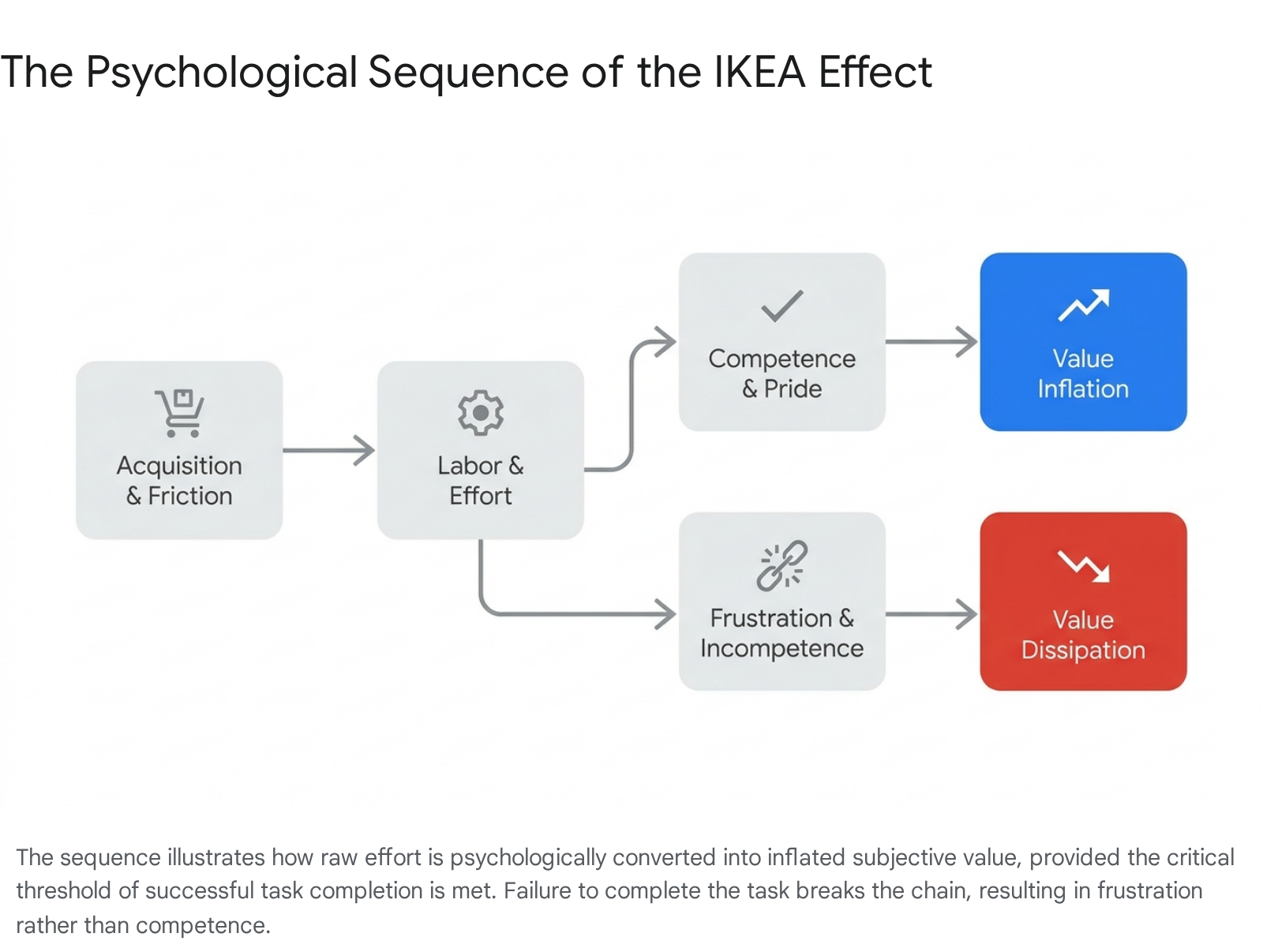
The phenomenon does not operate in a vacuum; rather, it is the culmination of several overlapping cognitive mechanisms, primarily driven by the human need for competence, the drive for effort justification, the pursuit of meaning, and the desire for self-signaling 577.
Effectance and the Need for Competence
The primary psychological driver of the IKEA effect is the innate human desire for "effectance," which translates to a profound need for competence and mastery 23. According to foundational theories of self-efficacy proposed by Albert Bandura (1977), humans possess a fundamental psychological requirement to feel capable of successfully producing desired outcomes and exerting control over their surrounding environment 247. When a consumer unboxes a flat-pack piece of furniture or an unassembled set of digital components, they are presented with an immediate challenge. The subsequent act of assembling the product acts as a tangible manifestation of their individual capability 29.
The successful completion of the task provides immediate psychological feedback, operationalized as feelings of pride, joy, and competence 9108. Research confirms that these feelings of competence directly mediate the increased valuation of the product; the item ceases to be a mere commodity and transforms into a physical monument to the consumer's self-efficacy 89. This dynamic is so powerful that when an individual's sense of competence is externally threatened - for instance, in an experiment where participants were deliberately given unsolvable math problems to shake their confidence - their propensity to seek out DIY tasks increased 58. Assembling a product offers a reliable, structured mechanism to restore their shaken sense of self-worth 58. Conversely, when consumers receive external affirmation that boosts their self-esteem, the psychological necessity of the IKEA effect diminishes, and they derive less supplementary value from self-made products 89.
Self-Signaling Theory and Identity Formation
While early behavioral models relied heavily on cognitive dissonance and effort justification to explain the IKEA effect, contemporary consumer psychology increasingly utilizes self-signaling theory as a robust alternative explanatory framework 1014. Formulated by Bodner and Prelec (2003), self-signaling theory posits an expanded economic model of utility maximization that includes "diagnostic utility" 1014. In this model, individuals do not possess perfect, intrinsic knowledge of their own identities. Instead, they actively observe their own actions to infer their underlying traits, values, and ethical alignments 1011.
Applied to the IKEA effect, consumers actively use their participation in creation to signal to themselves that they possess desirable qualities - such as being industrious, tech-savvy, environmentally conscious, or deeply invested in their family's domestic life 81014. For instance, a Gen-Z consumer purchasing a highly customizable smartwatch may spend hours tweaking the operating system, watch faces, and aesthetic interfaces. Under self-signaling theory, this effort is not merely a functional customization task; it is an identity marker 14. By investing the effort, the consumer signals to themselves that they are a technological innovator and part of a digital vanguard 14. The customized product becomes a mirror reflecting an idealized self-concept. The effort invested acts as empirical proof to the self, generating a psychological lock-in that makes the product infinitely more valuable than an identical, off-the-shelf alternative 1411.
Neurological Substrates of Experiential Value
Recent advancements in neuroergonomics have begun to map the IKEA effect onto specific neural correlates, moving the phenomenon from pure behavioral observation to biological science. A 2023 study utilizing functional near-infrared spectroscopy (fNIRS) explored the cerebral hemodynamic responses of 30 participants during willingness-to-pay evaluations of DIY versus pre-assembled products 12.
The neuroimaging revealed significantly higher cortical activation in the left middle frontal gyrus (L-MFG) and the left inferior frontal gyrus (L-IFG) when participants evaluated products they had built themselves 12. These specific brain regions are heavily implicated in executive function, working memory, and the cognitive processing related to memory retrieval and emotional attachment 12. The heightened L-MFG activation provides empirical biological confirmation that the experience of assembly fundamentally alters the cognitive processing of value. The product's financial worth becomes inextricably anchored in the episodic memory of the effort expended 12. Furthermore, researchers exploring the psychology of effort have established that effort itself, beyond being a mere physiological or temporal cost, is a fundamental source of personal meaning 13. Exerting effort transforms mundane tasks into meaningful pursuits, fundamentally altering how individuals perceive and derive satisfaction from their interactions with consumer goods 13.
Boundary Conditions: Debunking the "Effort Equals Value" Misconception
A pervasive and dangerous misconception within product design, user experience (UX) architecture, and marketing is the assumption that any introduction of effort or friction will automatically yield an increase in consumer valuation. This misinterpretation dangerously conflates the "effort heuristic" - a separate cognitive bias where people generally assume that items requiring more effort to produce are of higher objective quality or monetary value - with the highly specific mechanisms of the IKEA effect 514.
The IKEA effect contains a strict, non-negotiable boundary condition: the labor must result in successful completion 3415. In their foundational experiments, Norton, Mochon, and Ariely demonstrated that when participants were instructed to build origami structures or simple storage boxes, but were either interrupted before finishing or asked to immediately disassemble their creations, the WTP premium completely evaporated 49. Participants who built and then destroyed their Lego creations valued them no higher than those who never built them at all 45.
When a task is uncompleted, the effort does not yield effectance or pride; instead, it yields frustration, regret, and a stark reminder of incompetence, which are psychologically aversive states 49. Therefore, for the IKEA effect to successfully trigger value inflation, product architects must navigate a delicate psychological tightrope. The task must be sufficiently arduous to require meaningful labor, but structured and simple enough to guarantee successful completion by an amateur without inducing cognitive overload 35. If a task surpasses the consumer's capabilities, or if an interface is too confusing to navigate, the resultant cognitive friction leads to abandonment, actively destroying the product's subjective and objective value 520.
Comparative Behavioral Economics: Triggers and Limits
To achieve a nuanced understanding of consumer behavior, it is imperative to distinguish the IKEA effect from adjacent cognitive biases. Marketing strategies and organizational management frequently conflate the Endowment Effect, Effort Justification, Sunk Cost Fallacy, and the IKEA effect. While they frequently operate in tandem to compound consumer loyalty and behavioral inertia, their core mechanisms, psychological triggers, and systemic limitations are highly distinct 3521.
Explicit Divergence: The IKEA Effect vs. The Sunk Cost Fallacy
The most critical distinction for business strategy lies between the IKEA effect and the Sunk Cost Fallacy. The Sunk Cost Fallacy, often termed the irrational escalation of commitment, occurs when an individual or organization continues to invest resources (time, money, or effort) into a failing endeavor simply because they have already incurred unrecoverable past costs 16231718. Rooted deeply in prospect theory and loss aversion, the sunk cost fallacy is viewed by researchers as an evolutionary trait originally developed to protect prior investments and foster teamwork in survival situations, driven by the fear of admitting failure and actualizing a loss 1619. It is characterized by an individual taking a suboptimal or irrational action solely to avoid psychological discomfort or the admission of waste 2728.
In stark contrast, the IKEA effect is not driven by loss aversion; it is driven by value generation 3420. The IKEA effect posits that the successful investment of effort actively generates new hedonic utility and elevates the subjective valuation of the end product above its objective market value 34.
To empirically separate these two phenomena, researchers conducted experiments where subjects earned a lottery ticket via a real-effort task 17. When given the opportunity to switch to a mathematically dominant (superior) lottery, 23% of participants stuck with their dominated (inferior) lottery, demonstrating a sunk cost effect driven by their prior effort, independent of mere ownership 17. Under the sunk cost fallacy, a consumer might refuse to abandon a broken, outdated software system because they spent millions implementing it years ago, acting out of a desire to prevent a realized loss 1628. Under the IKEA effect, a consumer subjectively believes their highly customized software dashboard is objectively superior to a competitor's simply because they built it themselves 3031. The former is a defensive mechanism against loss; the latter is an offensive generation of psychological premium.
Explicit Divergence: The Endowment Effect and Effort Justification
The Endowment Effect describes the human tendency to place a greater value on a good that one owns compared to an identical good one does not own 32. Famously demonstrated by Richard Thaler and Daniel Kahneman, participants endowed with a simple coffee mug demanded significantly more money to sell it than buyers were willing to pay to acquire it 1732. The crucial difference is that the endowment effect requires zero effort; mere possession or a transient sense of psychological ownership triggers the bias 51928. The IKEA effect specifically requires the active application of labor to produce the valuation premium 5.
Similarly, Effort Justification - a subset of cognitive dissonance theory - describes situations where individuals elevate the value of outcomes they suffered or struggled to achieve, rationalizing that the suffering must have been worthwhile (e.g., harsh fraternity hazing or grueling psychotherapy) 235. While the IKEA effect relies on effort, it focuses on the tangible creation of an object or system and the resulting competence, rather than merely rationalizing psychological pain or suffering 331.
Comparative Analysis Table
The following table explicitly contrasts the four primary effort- and ownership-based biases, detailing their specific mechanisms, triggers, and boundary conditions to aid in precise strategic application 352117182832.
| Cognitive Bias | Core Psychological Mechanism | Specific Triggering Condition | Boundary Limits and Dissipation | Distinctive Feature |
|---|---|---|---|---|
| IKEA Effect | Competence signaling and effectance realization. | Active, physical or cognitive labor applied to a task resulting in successful completion. | Dissipates entirely if the task is too difficult, left incomplete, or if the creation is disassembled. | Transforms neutral labor into subjective financial and emotional value. |
| Endowment Effect | Psychological ownership and loss aversion. | Mere possession or establishment of psychological ownership, even without effort. | Weakens if ownership is highly transient or if the object is purely viewed as exchange currency. | Does not require any labor; simply holding or owning the object triggers the premium. |
| Effort Justification | Cognitive dissonance resolution. | Enduring a difficult, painful, or taxing process to achieve a specific goal or outcome. | Dissipates if the reward is explicitly monetary or if the effort lacks a specific terminal goal. | Focuses on rationalizing the suffering of the process rather than the tangible quality of an end product. |
| Sunk Cost Fallacy | Loss aversion and status quo bias. | Accumulation of unrecoverable past investments (time, capital, effort) in an ongoing endeavor. | Can be overcome by strict future-focused cost-benefit analysis or predefined exit thresholds. | Causes irrational persistence in a failing course of action, rather than generating genuine affection for an object. |
Note: Another related phenomenon is the "Trophy Winner Effect," wherein successful effort invested in winning a competition increases the valuation of the prize, highlighting how competitive effort mirrors creative effort in generating subjective utility 2021.
The Digital and Virtual Frontier: 2023+ Research
Historically, research into the IKEA effect was strictly confined to physical consumer goods, such as particleboard furniture, origami, and Lego sets 2434. However, as the global economy rapidly digitizes, contemporary research from 2023 onward indicates that the psychological premium placed on self-creation is equally, if not more, prevalent in digital and virtual environments 303522.
Software Customization and the NIH Syndrome
In modern software engineering, the IKEA effect frequently manifests as the "Not Invented Here" (NIH) syndrome. This is a systemic cognitive bias wherein engineering teams reject superior, off-the-shelf technology frameworks in favor of building inferior, proprietary systems from the ground up 30. Driven by the need for effectance and the psychological overvaluation of internal effort, major technology companies routinely expend massive resources reinventing foundational build systems, deployment pipelines, and communication protocols 30. While this creates a high degree of emotional investment and attachment among the developers - making them highly resistant to transitioning away from their creations - it often leads to architectural bloat, organizational inefficiency, and dangerous "tunnel vision" that ignores better external solutions 163037.
Conversely, savvy digital product designers actively weaponize the IKEA effect to increase user retention. Digital products are no longer static; they are continuous processes of assembly 35. Modern Software-as-a-Service (SaaS) platforms intentionally introduce "interactive onboarding" flows 30. By forcing users to manually configure dashboards, build unique templates, and curate data streams, these platforms shift the user's role from a passive recipient of software to an active co-creator of their own "digital brain" 3435. Deep user research reveals that absolute frictionless onboarding can actually destroy long-term retention; users with zero "skin in the game" abandon platforms significantly faster 34. Introducing minor, manageable friction via mandatory customization leverages the IKEA effect to manufacture long-term product loyalty, fundamentally reversing traditional value creation logic: the user delivers value (data, labor) to the system, which the system captures as attachment 3435.
Video Games, Modding, and Gamification
The gaming industry heavily relies on the confluence of the Endowment Effect and the IKEA effect to secure deep player engagement 720. Modern video games rarely deliver purely linear narratives; instead, they provide expansive sandboxes, deep character customization engines, and community modding tools 730. When a player spends hours customizing an avatar's facial features or building an in-game settlement, they are investing creative labor. This effort dramatically amplifies the perceived worth of the digital assets, transforming neutral code into personally meaningful artifacts 735.
This principle extends successfully into corporate gamification. For example, the Erajaya Group utilized gamification through a "Cari Kata" (word search) game in 2024 to celebrate corporate milestones 7. By requiring players to expend effort embarking on a journey to discover words embodying specific brand fragrances and personality traits, the campaign fostered a profound sense of ownership and connection, generating over 7,000 highly qualified leads and strengthening bonds with loyal customers through active psychological participation 7.
Artificial Intelligence and Generative Interactions
As human-AI collaboration becomes ubiquitous, researchers are heavily scrutinizing whether the IKEA effect applies when an algorithm performs the majority of the heavy lifting. A landmark 2024 study by Mehler et al., alongside subsequent 2025 analyses, tested the boundaries of the IKEA effect across different modalities of Generative AI among 174 participants 23.
The researchers discovered a fascinating divergence based on the nature of the digital product. When participants utilized generative visual AI models (such as Stable Diffusion) to co-create images through iterative prompt engineering, the IKEA effect was strongly detected. Users exhibited a significantly higher willingness to pay and a marked preference for the final visual product when they had collaborated to produce it 23. Furthermore, this collaborative effort increased their overarching intention to adopt and utilize modern AI technologies moving forward, viewing the AI as a valuable co-pilot 23.
However, when participants collaborated with Large Language Models (LLMs) like ChatGPT to generate textual content, such as drafting a company mission statement, the IKEA effect initially failed to materialize reliably in several trial structures 23. Behavioral economists hypothesize this divergence is rooted in cognitive load; evaluating, proofreading, and interpreting heavily generated text requires a significantly higher and more exhausting cognitive burden than parsing visual imagery 23. This fatigue can override the feelings of competence and pride. However, rigorous 2025 studies demonstrated that if the experiment is meticulously designed to ensure the participant maintains a high sense of control and achieves clear, successful completion, the IKEA effect can be detected in text generation, leading users to value the specific AI tool more highly 23. Future digital platforms must therefore calibrate the type of interaction they demand from users, prioritizing co-creation modalities that maximize effectance without inducing cognitive exhaustion.
Cross-Cultural Dynamics and Non-Western Consumer Behavior
A critical inquiry within behavioral economics is whether cognitive biases discovered in Western, Educated, Industrialized, Rich, and Democratic (WEIRD) societies hold true globally 2425. The psychological premium placed on DIY effort offers a unique lens through which to examine cross-cultural consumer behavior, particularly across the socio-cultural spectrum of individualism versus collectivism.
The Universality of the Labor-Love Link
To determine if the IKEA effect is a localized cultural construct or a universal human bias, developmental psychologists conducted rigorous cross-cultural research evaluating the phenomenon in young children. A major study compared 128 children, aged 5-to-6 years old, evenly split between the United Kingdom (representing Western, individualistic, middle-class norms) and India (representing non-Western, collectivistic, middle-class norms) 242627.
The children were tasked with assembling "monster" toys either independently or collaboratively in pairs. The results were highly illuminating: children from both the UK and India demonstrated a robust, statistically significant IKEA effect ($\eta_p^2 = .19$), valuing their own creations vastly more than identical copies provided by the researchers 242627. Crucially, this inflated valuation held true regardless of whether the children built the toy alone or in a collaborative pair, and no significant interactions were found between cultural background and the magnitude of the effect 2426. This empirical evidence strongly suggests that the connection between physical labor, psychological ownership, and value inflation is a deeply rooted, universal cognitive mechanism present across diverse socioeconomic and geographic landscapes, relatively immune to cultural variability at a foundational evolutionary level 242526.
Cultural Localization in Brand Communication
While the underlying cognitive bias is fundamentally universal, cross-cultural research indicates that the mechanisms of communication and appeal surrounding the IKEA effect must be highly localized to resonate with specific societal values 28.
Hofstede's cultural dimensions - specifically the dichotomy between individualism and collectivism - dictate how different cultures conceptualize power, status, emotional expression, and the self 2844293031. In individualistic Western cultures (e.g., the United States, Northern Europe), the self is viewed as autonomous, independent, and defined by unique personality traits 293031. Consequently, consumers in these regions value the IKEA effect primarily as an expression of personal uniqueness, mastery, and the ability to stand out 443148. They are motivated to engage in DIY behavior to fulfill a desire for personal competence, independent achievement, and self-differentiation 4832.
In contrast, collectivist cultures (prevalent in Asia and Africa) define the self interdependently, emphasizing group cohesion, shared responsibilities, and social harmony 4429303148. In these markets, the appeal of co-creation does not stem from individual autonomy, but from relational bonding and collective contribution 4430. A comparative analysis of IKEA's brand communication strategies revealed that in its native Sweden, marketing converges on individualism, personal autonomy, and functional minimalism 28. Conversely, IKEA's brand communication in China explicitly pivots to emphasize emotional bonding, traditional family values, and omni-directional service, framing the assembly process as a shared family activity that fosters group harmony rather than an individual conquest 28.
This cultural divergence also extends to sustainable consumption and ethical fashion. Studies applying the Theory of Planned Behavior (TPB) to consumers in Spain and China revealed that while individualistic consumers rely heavily on their internal perceived behavioral control to make sustainable choices (as a marker of unique identity), collectivist consumers in China were more heavily influenced by subjective norms and societal pressures 48. Thus, to successfully export business models reliant on the IKEA effect into emerging economies, multinational corporations must adapt their messaging, shifting the psychological reward from personal efficacy to collective fulfillment and cultural resonance 2833.
Real-World Applications and Boundary Extents
The realization that "labor leads to love" has triggered a paradigm shift across various sectors of the modern economy. Businesses have recognized that instead of engineering all friction out of the consumer experience to achieve absolute efficiency, strategically reintroducing effort can drastically increase profit margins, brand loyalty, and perceived value 353734.
The Modern Service Economy: Meal-Kit Delivery Services
The exponential growth of the meal-kit delivery industry (e.g., HelloFresh, Blue Apron) serves as a textbook execution of the IKEA effect in the modern service economy 352. These services charge a premium price for what is essentially unassembled, pre-portioned groceries. Rationally, consumers should demand a discount for having to supply the labor of chopping, cooking, and plating the meal 3. However, by allowing the consumer to act as the chef, these services trigger intense feelings of competence and effort justification 352. The consumer successfully completes the cooking task, resulting in a meal that they subjectively perceive as more delicious, healthier, and of higher value than a pre-made restaurant delivery. This cognitive bias entirely justifies the price premium in their own minds and fosters habitual purchasing 3.
Personalized Retail and B2B Co-Creation
The retail sector actively leverages mass customization toolkits to transform consumers into "prosumers" - individuals who simultaneously produce and consume value 935. Brands such as Nike (with its customizable sneaker platforms) or various luxury automotive configurators do not merely sell products; they sell the psychological satisfaction of digital and physical creation 3410. Providing consumers with agency over color palettes, materials, and design features engenders profound psychological ownership 1054. Research explicitly notes that the positive emotional reactions (joy) elicited when users view their self-designed products are incredibly strong predictors of purchase behavior, far surpassing the emotional response to standard off-the-shelf options 10. Incorporating UX elements like progress bars and visual previews during this customization phase heavily amplifies anticipation and effort investment 10.
Furthermore, the IKEA effect is permeating Business-to-Business (B2B) strategy. Rather than selling finalized, closed-loop solutions to corporate clients, leading organizations now partner with clients to co-create solutions 55. For instance, logistics giants like DHL collaborate with clients to configure warehouse robotics applications or tailor supply-chain software specifically to their operational nuances 55. By making the client an active participant in the architectural design of the service, B2B vendors ensure higher adoption rates, greater tolerance for initial implementation flaws, and formidable barriers to exit, as the client is intimately attached to the solution they helped build.
The Limits of the IKEA Effect: High-Stakes Finance and Meaning Pursuit
Despite its pervasive influence, the IKEA effect has distinct boundaries beyond incomplete tasks. In high-stakes environments where objective outcomes strictly dictate utility, the effect falters. A 2023 study by Brunner et al. investigated the "MyPortfolio" phenomenon, testing whether the IKEA effect extended to financial investment decisions 2335. The researchers found no evidence of the IKEA effect in this context; investors did not significantly overvalue financial portfolios they assembled themselves compared to pre-assembled algorithmic portfolios 2335. In realms governed by strict quantitative returns, the psychological premium of effort cannot override objective financial metrics.
Interestingly, when consumers actively pursue "meaning" in the marketplace, their behavior surrounding effort and cost can invert. Research in the Journal of Consumer Research found that when people are prompted to make purchases with the explicit goal of finding meaning in life, they tend to "cheap out," preferring less expensive options 36. They rationalize that saving money allows them to allocate resources to other meaningful pursuits 36. However, if their attention is forcefully focused onto the specific benefits of a premium, handcrafted, or DIY product, their WTP increases, highlighting the delicate interplay between the pursuit of meaning, the expenditure of effort, and monetary valuation 36.
Conclusion
The IKEA effect represents a profound subversion of traditional neoclassical economic logic. It dictates that value is not solely derived from the objective utility of a product, nor is labor strictly a cost to be minimized and eradicated. Instead, the careful curation of effort, friction, and successful task completion acts as a powerful engine for subjective value creation.
As detailed throughout this comprehensive analysis, this cognitive bias relies fundamentally on the human need for competence, effectance, and self-signaling. Importantly, it diverges completely from the loss-aversion mechanics of the Sunk Cost Fallacy, functioning instead as a mechanism for positive value generation. Whether analyzing young children in India collaboratively assembling toys, software developers in Silicon Valley fiercely guarding proprietary code, or modern consumers collaborating with generative AI to produce digital art, the psychological premium placed on self-creation remains a remarkably consistent and universal facet of human behavior.
Moving forward, the organizations that will dominate the experience-driven economy will not be those that deliver perfectly finalized products with absolute, frictionless efficiency. Rather, the market leaders of the next decade will be those that provide the ultimate "blank canvas," expertly calibrating effort and weaponizing the IKEA effect to sell consumers the highly addictive psychological satisfaction of their own competence.