
Can Prediction Markets Forecast FDA and Fed Decisions
Direct Answer and Core Findings Prediction markets function as highly efficient, decentralized information aggregators that consistently outperform traditional expert forecasting in both speed and accuracy. By converting real-world events into tradable financial contracts, these platforms leverage the economic incentives of crowds to produce real-time, calibrated probabilities. However, beneath the veneer of forecasting superiority lies a complex ecosystem fraught with structural risks. The analysis indicates that while prediction markets are not purely random gambling - as contract prices reliably reflect genuine probabilistic signals and aggregate dispersed knowledge - the financial outcomes for participants heavily mirror those of speculative casinos. Exhaustive data from 2025 and 2026 reveals that over 84% of retail participants lose money, with wealth heavily transferring to a microscopic fraction of sophisticated algorithmic traders and institutional "whales." Furthermore, these markets remain highly vulnerable to low-liquidity manipulation, sophisticated insider trading surfaces regarding corporate and medical data, and conflicted arbitration models. Consequently, global regulators have fractured in their response: nations such as India, Singapore, and France have enacted strict bans under gambling statutes, while the United States Commodity Futures Trading Commission (CFTC) fights to classify them as legitimate hedging derivatives, pending the legislative outcomes of the 2026 CLARITY Act.
The Everyday Hook: Why the General Reader Should Care Imagine knowing the precise probability of a looming economic recession, the outbreak of an international conflict, or the approval of a life-saving drug with the same ease and precision as checking the daily weather forecast. For decades, the public has relied on a small priesthood of pundits, pollsters, and political analysts to map the future, often suffering the consequences of their collective blind spots and biases. Today, prediction markets have democratized and financialized the future. The probabilities generated by platforms processing tens of billions of dollars are no longer niche curiosities; they are actively integrated into institutional data feeds, financial terminals, and corporate risk models. The outcomes of these markets indirectly influence the interest rates on mortgages, the strategic decisions of global supply chains, and the legislative priorities of governments. Understanding how this "truth machine" operates - and how it can be exploited - is essential for anyone navigating the modern information economy.
What exactly are prediction markets, and how do they aggregate human knowledge?
To comprehend meta-forecasting and prediction markets, one must look beyond the interfaces of modern digital exchanges and consider a simple, non-academic analogy: the county fair ox-weighing contest.
In 1906, the statistician Sir Francis Galton attended a livestock fair where 800 villagers were asked to guess the weight of an ox. The crowd included a few butchers and farmers (the experts) and hundreds of everyday citizens (the non-experts). Individually, the guesses were wildly inaccurate, plagued by subjective biases, poor judgment, and wishful thinking. However, when Galton calculated the median of all 800 guesses, the crowd's collective estimate was 1,197 pounds. The actual weight of the ox was 1,198 pounds. The crowd, in aggregate, possessed a collective intelligence that vastly outperformed even the most knowledgeable individual expert 11.
A prediction market digitizes and financializes this exact phenomenon. Instead of guessing the weight of an ox, participants buy and sell contracts based on the future outcome of real-world events. It functions exactly like a traditional stock market, but rather than trading shares of a corporation based on its future cash flows, participants trade shares of a binary outcome based on its likelihood of occurrence 13.
If a market asks, "Will the Federal Reserve cut interest rates in September?" it issues two mutually exclusive shares: "Yes" and "No." These shares are priced between $0.00 and $1.00. If the "Yes" share is currently trading at $0.65, it means that the collective wisdom of the market - backed by real capital - believes there is a 65% probability that the rate cut will occur 325. The price is the probability. If an individual possesses unique data suggesting the true probability is 80%, they are economically incentivized to buy the underpriced $0.65 shares. As they buy, demand pushes the price upward until it reaches $0.80, perfectly incorporating their private knowledge into the public price 16.
Through continuous price discovery, prediction markets aggregate decentralized, fragmented information scattered across thousands of minds. The idiosyncratic noise, biases, and errors of individual traders naturally cancel each other out, leaving behind a highly refined, calibrated signal of probability. When financial rewards are tied to being correct, participants are heavily penalized for trading on emotion, and only those with genuine informational edges survive to dictate the market price 123.
Are prediction markets just a new form of digital gambling?
It is vital to actively correct a pervasive public misconception: prediction markets are not purely random gambling 284. To equate them with a roulette wheel or a slot machine is to fundamentally misunderstand their architectural purpose, economic utility, and structural mechanisms.
In a traditional casino, the odds are mathematically fixed by the house, the outcomes are dictated by pure physical or algorithmic randomness, and the activity generates zero external economic value 45. In contrast, prediction markets are decentralized pricing mechanisms that yield a valuable positive externality: public information. The prices generated by these markets provide actionable data to observers who never place a single trade. A business owner can consult a prediction market to assess the likelihood of a port strike and adjust their supply chain inventory accordingly. This hedging and informational function is precisely why the United States Commodity Futures Trading Commission (CFTC) classifies these instruments as commodity derivatives, acknowledging that they serve an essential economic purpose in risk management 111213.
However, acknowledging their systemic economic utility does not negate the severe financial realities faced by retail participants. While the system produces accurate forecasts, the individual financial experience often mirrors the destructive cycles of sports betting 5615. A 2026 empirical analysis of over 2.5 million user wallets revealed a stark reality: 84.1% of retail traders on major prediction platforms realized net losses 161718. To place this in context, the median return on investment for retail participants on prediction markets was -8%, a figure that underperforms even traditional legal sportsbooks, which sit at a median ROI of -5% over comparable periods 1517.
The market structure inherently favors highly capitalized, technologically sophisticated actors. Analysis of decentralized ledger data from platforms like Polymarket demonstrates that less than 0.04% of wallet addresses captured over 70% of all realized profits, totaling approximately $3.7 billion 1619. These profits were largely extracted through algorithmic arbitrage, superior data-scraping capabilities, and high-frequency trading strategies that front-run the slower retail public. Furthermore, addiction specialists have noted that the psychological engagement loop of prediction markets - characterized by continuous, micro-duration contracts - triggers the exact same dopamine responses as conventional sports wagering, leading to documented cases of severe relapse among individuals seeking treatment for gambling disorders 520. Therefore, while the collective outputs of prediction markets are sophisticated forecasting tools, the retail participation layer functions as a highly efficient wealth-transfer mechanism from the many to the few 1821.
How do prediction markets compare to traditional expert forecasting?
The debate over whether a decentralized crowd or a panel of credentialed experts provides superior forecasts has been heavily researched across academia and financial institutions. Longitudinal data and meta-analyses heavily favor the market mechanism for the vast majority of scenarios.
In a comprehensive review of 24 empirical studies comparing prediction markets to alternative forecasting methods, meta-analytic estimates indicated that prediction markets are, on average, 79% more accurate than alternative methods, including expert panels and aggregate polling 22. Across five U.S. Presidential elections, prediction markets aligned with actual outcomes 74% of the time when compared against 964 traditional polls, proving superior in both long-term outlooks and eve-of-event precision 3.
The advantage of the market lies in the principle of "skin in the game." Experts participating in traditional surveys face minimal penalties for incorrect predictions. They may consciously or unconsciously prioritize defending their established theories, signaling to their peers, or maintaining a media-friendly contrarian stance. In contrast, prediction market participants who allow bias or wishful thinking to cloud their judgment suffer immediate financial loss, while those who correct market mispricings are financially rewarded 13724.
| Feature / Attribute | Prediction Markets | Traditional Expert Forecasting |
|---|---|---|
| Information Aggregation | Decentralized; continuously aggregates dispersed, real-time knowledge from thousands of diverse participants. | Centralized; relies on the limited, siloed cognitive capacity of a small panel or a single institutional analyst. |
| Incentive Structure | Real financial stakes ("skin in the game") systematically penalize bias, wishful thinking, and emotional forecasting. | Reputational stakes; often subject to institutional bias, groupthink, or the desire for sustained media attention. |
| Update Speed | Instantaneous; prices update dynamically within seconds as new information breaks globally. | Delayed; requires the drafting, peer-review, and publication of updated reports or revised polling data. |
| Output Format | A precise, calibrated probability (e.g., 67%) continuously updated in real-time based on order book depth. | Often qualitative ("highly likely", "doubtful") or static point-in-time percentage estimates that rapidly age. |
| Primary Vulnerabilities | Susceptible to low-liquidity manipulation, wash trading, and insider trading by well-capitalized whales. | Susceptible to echo chambers, availability heuristics, and reliance on stale historical models. |
Traditional financial forecasting highlights this disparity. Throughout 2024, Wall Street's consensus year-end price targets for the S&P 500 missed the actual market performance significantly, with the most optimistic targets falling 13% short and the most pessimistic missing by nearly 40% 25. The cognitive overload experienced by analysts attempting to synthesize millions of data points often results in paralyzed forecasting, whereas the market instantly processes this same data into a unified price 2526. Furthermore, prediction markets like Kalshi demonstrate remarkable long-term calibration, maintaining Brier scores (a statistical measure of probabilistic accuracy) of 0.05 to 0.06 even 200 days before an event's resolution 27.
However, there are specific, highly nuanced domains where experts retain a structural advantage. In complex, "slow-motion" variables with extremely low base rates of change - such as forecasting the 25-year trajectory of global nuclear proliferation - trained subject-matter experts outperform decentralized crowds by a measurable margin, exhibiting Brier scores roughly 60% better than generalist prediction pools 8. In highly specialized scientific fields, purely financial markets can be outmaneuvered by epistemic meta-forecasting platforms, which utilize Bayesian statistics, ensemble modeling, and non-financial reputational rewards to incentivize participants for long-term accuracy rather than short-term zero-sum trading 29.
Visualizing Uncertainty: How does pre-decision market volatility behave?
The true power of meta-forecasting lies in its ability to quantify uncertainty in real-time. Traditional analysts provide static price targets or periodic reports; prediction markets provide a living, breathing chart of human expectation, continuously digesting macroeconomic shocks.
A prime illustration of this dynamic occurred surrounding the United States Federal Reserve's monetary policy decisions in September 2024. For months, financial markets operated under a rigid consensus regarding interest rates, guided by standard banking forecasts. However, as shifting labor market data and cooler inflation metrics were quietly released into the ecosystem, the prediction markets captured a violent, instantaneous reassessment of macroeconomic reality that outpaced every major financial institution's reporting desk.
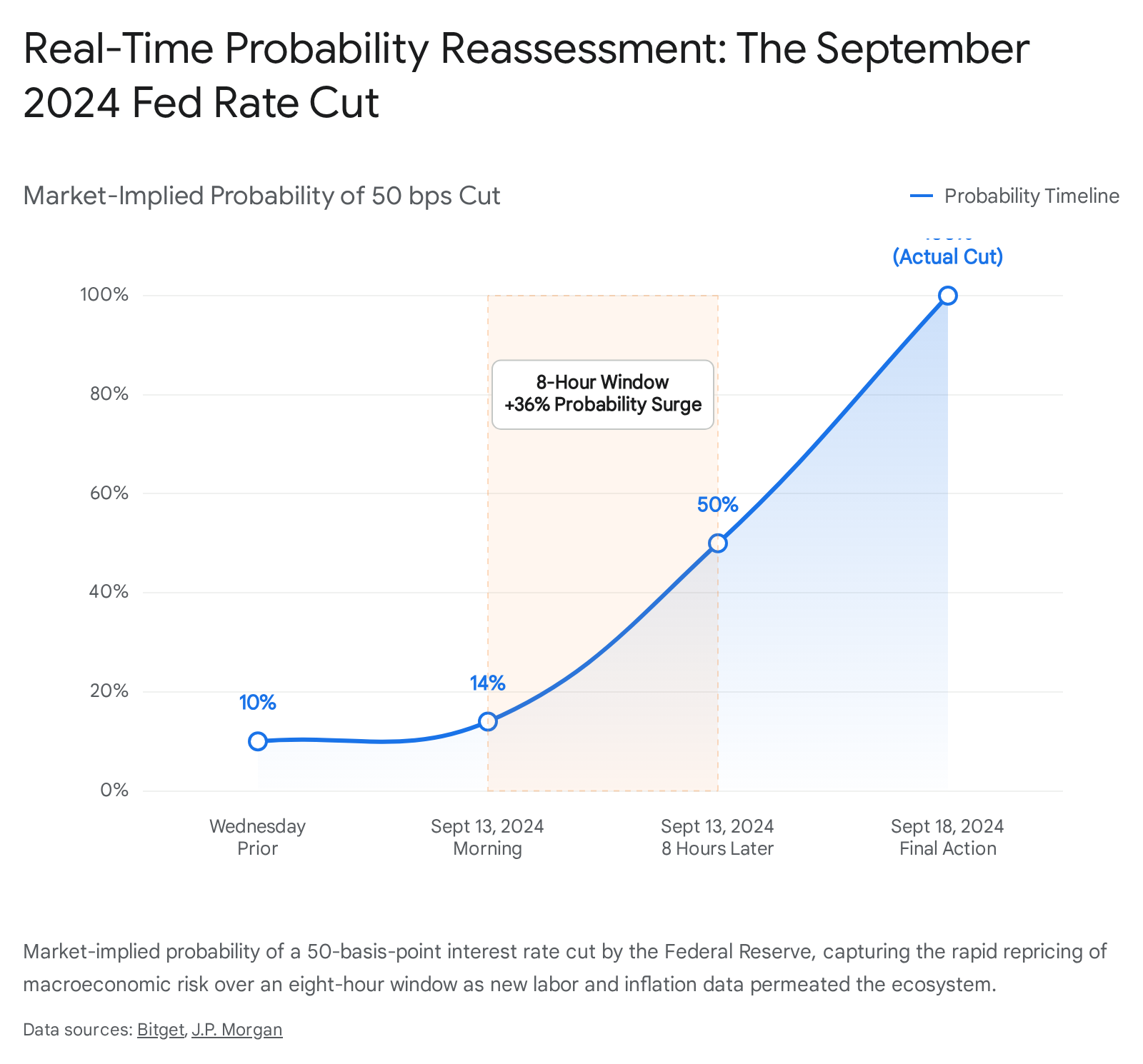
As illustrated, the probability of a substantial 50-basis-point rate cut sat at a mere 14% on the morning of September 13. Within an eight-hour window following the release of nuanced economic signals, prediction markets violently repriced the probability to nearly 50% 309. This rapid, decentralized consensus allowed businesses, bond traders, and corporate treasurers to hedge exposure immediately, days before traditional Wall Street analysts updated their formal guidance and before the Federal Open Market Committee officially announced the 50-basis-point reduction on September 18 303210. The prediction market did not just guess the outcome; it provided a continuous, millisecond-by-millisecond metric of global anxiety and expectation.
Where do prediction markets fail, and when have they been wrong?
For all their mathematical elegance and speed, prediction markets are ultimately human constructs, inheriting the vulnerabilities of the financial plumbing upon which they are built. Relying blindly on these platforms without understanding their structural limitations leads to catastrophic miscalculations. Recent data from reputable financial journals explicitly highlights the growing pains of this asset class.
The Threat of Low-Liquidity Manipulation and Wash Trading
The "Wisdom of Crowds" fundamentally requires a deep, diverse crowd. In markets with low trading volume, the price can be easily distorted by a single wealthy actor. This vulnerability was profoundly evident during the 2024 U.S. Presidential Election cycle on Polymarket. In mid-October 2024, the odds of a Donald Trump victory inexplicably surged to 60%, drastically diverging from traditional polling models and competing prediction platforms, which showed a much tighter race 3411.
Investigative analyses by the Wall Street Journal revealed that this divergence was largely driven by a single French trader - subsequently dubbed the "Trump Whale" or "Théo" - who deployed over $30 million across four anonymous accounts 3411. While subsequent independent investigations by Polymarket concluded that Théo was taking a massive directional bet based on his own analysis rather than intentionally manipulating the market for political optics, the structural weakness of the platform was laid bare. A single highly capitalized entity could dictate the "public probability" of a global event 3411. Although Théo ultimately proved correct, capturing an $85 million payout upon the election's resolution, the incident highlighted how thin liquidity allows capital to overpower collective intelligence 1911.
Compounding the liquidity issue is the prevalence of artificial volume. A comprehensive 2025 study by researchers at Columbia University analyzing two years of blockchain data concluded that approximately 25% of trading volume on decentralized prediction markets consisted of "wash trading" - users simultaneously buying and selling contracts to themselves to create the illusion of liquidity and activity 19. This fabricates the appearance of a wise crowd where none exists.
The Rise of Insider Trading Surfaces
Prediction markets create powerful new financial incentives to monetize confidential information that previously held no direct market value. Before the advent of event contracts, an employee at Google knowing the internal metrics of the "Year in Search" marketing campaign had no financial avenue to exploit that knowledge. In early 2026, authorities began investigating instances where Google employees allegedly utilized this exact internal data to extract guaranteed, risk-free profits from prediction platforms prior to the public release of the data 36.
This insider risk extends deeply into sensitive geopolitical and biomedical spheres. In early 2026, researchers and financial journalists noted suspicious, perfectly timed, multi-million dollar wagers placed just hours prior to unannounced military strikes in the Middle East, as well as highly classified operations involving the extraction of political figures in Venezuela 4612. This strongly suggests that classified military and diplomatic intelligence is being actively monetized by individuals with clearance 4.
The pharmaceutical industry presents perhaps the most lucrative and dangerous insider trading surface. The U.S. Food and Drug Administration (FDA) approval process is closely tracked by prediction markets, turning clinical trial coordinators and regulatory reviewers into potential market manipulators 13. Consider the complex regulatory environment of 2026. Pharmaceutical giant AstraZeneca sought approval for camizestrant, a next-generation breast cancer therapy viewed as a potential $5 billion blockbuster drug. Following a negative 6-to-3 vote by the FDA's Oncologic Drugs Advisory Committee (ODAC), the FDA quietly delayed the final approval decision to request further circulating tumor DNA data 14151617.
Concurrently, Eli Lilly navigated the approval of Foundayo, an oral weight-loss pill that ultimately secured FDA approval in April 2026, triggering massive market cap shifts due to its projected billions in revenue 43441846. If clinical trial coordinators, lab technicians, or corporate insiders place anonymous bets on the exact dates of these FDA delays or approvals prior to corporate press releases, they extract risk-free capital from the market 3613. As the FDA moves toward "real-time" clinical trial monitoring via cloud integration, the sheer volume of these micro-decisions creates an unprecedented surveillance challenge, turning every regulatory action into a potential insider trading event 413.
Arbitration and Structural Conflicts of Interest
When a controversial bet is placed and the real-world outcome is ambiguous, who decides the winner? Decentralized platforms like Polymarket utilize third-party token-voting systems, such as UMA, for dispute resolution. A 2026 investigation by the Wall Street Journal revealed alarming conflicts of interest within this arbitration layer. Analysis showed that over 60% of the active UMA voters adjudicating disputes could be directly linked back to Polymarket trading accounts. In nearly 300 specific cases, the adjudicating voters held a direct financial interest in the outcome of the market they were actively judging 47. This lack of neutral, independent arbitration threatens the foundational integrity of the asset class, allowing the house - or the platform's heaviest users - to tilt the scales of reality.
Why are global regulators cracking down on these platforms?
As the total notional volume of prediction markets eclipsed $44 billion in 2025, scaling to a staggering $13 billion in monthly volume by early 2026, global governments recognized the profound societal and economic implications of unrestricted event trading 17202748. The regulatory response has been swift, severe, and highly fractured, dividing the global economy into distinct regulatory camps.
The International Prohibition
Internationally, the prevailing legal theory views prediction markets functionally rather than architecturally. Regulators maintain that regardless of whether a platform uses blockchain technology, decentralized oracles, or cryptocurrency to settle trades, the core action - staking money on an uncertain future event with a binary payout - constitutes unlicensed gambling 4950.
In early 2026, the regulatory hammer fell heavily across Asia and Europe: * Singapore: The Gambling Regulatory Authority officially blocked Polymarket, citing Section 20 of the Gambling Control Act of 2022. The government ruled that the economic reality of the platform was wagering, not forecasting, subjecting users to potential fines of SG$10,000 and six months of imprisonment. The ruling explicitly noted that decentralization does not shield a platform from domestic gambling laws 4951. * India: Operating under Section 69A of the Information Technology Act and the Promotion and Regulation of Online Gaming Act (PROGA), the Ministry of Electronics and Information Technology explicitly banned real-money prediction markets, classifying them alongside prohibited "online money games." Crucially, India ordered VPN providers to enforce the block at the network level, stripping "safe harbor" protections from any internet service provider that failed to comply with the geofencing 505119. * Europe: Regulatory bodies in France (the National Gaming Authority), Switzerland, Belgium, and Portugal issued sweeping nationwide bans, forcing platforms to institute strict geoblocking compliance to avoid severe financial penalties and criminal liability 1151.
The United States: A Jurisdictional Civil War
While the international community leans toward prohibition, the United States is currently embroiled in a jurisdictional civil war over the soul of prediction markets. On one side are state attorneys general and gaming commissions (such as those in Rhode Island, Arizona, and Massachusetts), who argue these platforms are operating illegal sportsbooks and online casinos in direct violation of state gambling laws 116.
On the opposing side is the federal Commodity Futures Trading Commission (CFTC). Following significant litigation in 2024 where federal courts upheld the right of operators like Kalshi to offer election contracts, CFTC Chairman Michael Selig shifted the agency's stance in 2026 to aggressively defend prediction markets 11122054. Writing in the Wall Street Journal and testifying before Congress, Selig asserted that these platforms serve legitimate economic functions, allowing businesses to hedge event-driven risks and providing the public with vital informational data. The CFTC has formally intervened against state lawsuits, asserting exclusive federal jurisdiction over commodity derivatives and demanding that states cease their "power grab" against federal authority 11121321.
The Legislative Horizon: The CLARITY Act
This regulatory friction is driving unprecedented legislative action in Washington. In May 2026, the Senate Banking Committee advanced the CLARITY Act (Digital Asset Market Clarity Act) in a historic 15-9 bipartisan vote 5657. Aimed at a highly contested July 4, 2026 signature target by President Donald Trump, the legislation seeks to permanently codify the division of oversight between the SEC and the CFTC, definitively establishing a statutory framework for event contracts, stablecoins, and digital asset market structures 5657585960. If passed, the CLARITY Act will effectively end the jurisdictional civil war, formalizing prediction markets as an embedded, federally protected pillar of the American financial system.
What are the practical takeaways for everyday readers?
Navigating the landscape of meta-forecasting requires a highly defensive and analytical posture. For the general reader, the data yields several strict, calibrated probabilities regarding engagement with these platforms.
- Forecasting Reliance (95% Confidence): Everyday readers, business owners, and investors should actively monitor high-liquidity prediction markets as a primary source of news and probability. As demonstrated by the Federal Reserve rate cuts and election cycles, these markets provide a faster, more accurate read on unfolding geopolitical and economic events than traditional cable news, polling, or institutional punditry.
- Retail Trading Success (15% Confidence): The probability of a casual retail trader generating long-term, consistent profit by actively trading on these platforms is exceedingly low. With over 84% of participants realizing net losses, everyday users should treat direct financial participation strictly as an entertainment expense or a highly specific portfolio hedge, rather than a reliable secondary income stream. The structural advantages of whales and algorithms are simply too vast for casual users to overcome.
- Institutional Takeover (90% Confidence): By 2027, assuming the passage of the CLARITY Act, the prediction market ecosystem will likely be entirely dominated by institutional capital, high-frequency algorithms, and Agentic AI. The manual arbitrage opportunities that currently exist will compress, and the platforms will transition from retail speculation hubs to foundational institutional risk-management infrastructure.
Bottom line
Prediction markets represent one of the most significant advancements in information aggregation since the advent of the polling industry. By harnessing the collective financial incentives of the global crowd, they generate hyper-accurate, real-time probabilities that traditional experts simply cannot match, offering unparalleled utility for hedging economic and geopolitical risk. However, this architectural brilliance is inextricably paired with brutal financial mechanics; they are sophisticated truth machines built atop a foundation that quietly extracts wealth from the vast majority of its retail users. As global regulators ban the platforms and US legislators race to build frameworks around this explosive $40-billion industry, the ultimate utility of prediction markets will depend on whether they can mature from the "Wild West" of digital speculation into heavily audited, deeply liquid, and neutral arbiters of reality.