
Analysis of the 70-20-10 Learning and Development Model
Introduction: The Paradigm Shift in Organizational Learning
Within the complex disciplines of Organizational Psychology and Learning and Development (L&D), few theoretical frameworks have achieved the pervasive, global adoption of the 70-20-10 model. As corporations allocate vast financial resources toward talent management - with global corporate training expenditures reaching an estimated $383 billion in 2023 - the pressure to demonstrate tangible returns on learning investments has never been higher 1. Historically, the vast majority of these budgets were funneled exclusively into formal, classroom-based instruction. The 70-20-10 framework disrupted this paradigm by positing a radically different ratio for optimal professional capability development. The framework asserts that 70 percent of adult learning is derived from experiential, on-the-job challenges and problem-solving; 20 percent is acquired through social interactions, mentoring, and peer collaboration; and a mere 10 percent is obtained via formal, structured educational interventions 23126.
For decades, this ostensibly simple heuristic has profoundly influenced the architectural design of corporate training infrastructures, talent management strategies, and the deployment of digital learning platforms worldwide. Organizations embraced the model to justify a strategic pivot away from traditional event-based training, recognizing the so-called "spending/outcome paradox" identified by researchers, which suggested that while formal learning historically consumed 80 percent of an organization's training budget, it provided only a 20 percent return on learning in terms of actual performance outcomes 3.
However, as the global labor market transitions into a highly digitized era defined by asynchronous remote work, generative artificial intelligence, and decentralized hybrid team structures, the foundational mechanics of the 70-20-10 model are facing unprecedented operational strain 4510. Furthermore, rigorous methodological examination by academic institutions and major professional bodies - such as the Chartered Institute of Personnel and Development (CIPD) and the Association for Talent Development (ATD) - has illuminated a stark and problematic divergence between the model's original empirical origins and its subsequent commercial popularization as an immutable, mathematically validated corporate dogma 67138.
This comprehensive research report exhaustively traces the 70-20-10 framework back to its 1980s genesis, dissects the peer-reviewed critiques surrounding its empirical validity, and explores its modern evolution. By analyzing recent technological developments, including continuous learning ecosystems, asynchronous digital simulations, and the integration of artificial intelligence, alongside a rigorous cross-cultural evaluation of non-Western corporate environments, the ensuing analysis seeks to delineate the boundaries of the framework's contemporary utility and evaluate the emergence of competing theoretical models.
Foundational Origins: The Center for Creative Leadership (1980s)
The ubiquitous 70-20-10 framework did not emerge from a controlled, peer-reviewed psychological experiment designed to systematically quantify human cognition, nor was it the result of a longitudinal study measuring longitudinal knowledge retention across diverse demographics. Rather, it originated as a retrospective, descriptive observation formulated in the 1980s by researchers Morgan McCall, Michael M. Lombardo, and Robert A. Eichinger during their tenure at the Center for Creative Leadership (CCL), a nonprofit educational institution based in Greensboro, North Carolina 12159.
The seminal research underlying the model was first published in the 1988 book, The Lessons of Experience: How Successful Executives Develop on the Job, and later codified into the recognizable ratio in the 1996 publication, The Career Architect Development Planner 69101112. The researchers embarked on a mission to understand the specific developmental trajectories of highly successful corporate leaders. To achieve this, they conducted a series of interviews and qualitative surveys with a sample of approximately 191 to 200 high-performing, successful executives drawn exclusively from six large, traditional U.S.-based multinational corporations 610111314.
The executives were asked to reflect retrospectively on their careers and identify the specific experiences, events, and interactions that contributed most significantly to their managerial success and capability development 214. Upon aggregating and analyzing this self-reported data, the researchers identified a recurring pattern regarding the sources of executive learning. The executives attributed the vast majority of their professional development - roughly 70 percent - to "tough jobs," which encompassed challenging assignments, navigating complex bureaucratic hurdles, and engaging in hands-on problem-solving directly within the workflow 291315. A smaller, yet highly critical portion of their learning - roughly 20 percent - was attributed to developmental relationships and interactions with other people, primarily consisting of observing, modeling, and receiving feedback from direct supervisors, senior bosses, or formal mentors 291315. Finally, the smallest fraction of their perceived developmental value - the remaining 10 percent - was derived from formal coursework, reading materials, and structured away-from-work training environments 291315.
It is imperative to recognize the explicit, self-imposed boundaries of the CCL researchers' original claims. McCall, Lombardo, and Eichinger presented these specific ratios as broad, anecdotal approximations of executive development, not as a universal, biologically hardwired theory of adult cognitive learning 61216. The original proposition was purely descriptive; it was an effort to document what had historically occurred in the career pathways of a very specific demographic of late-20th-century American executives. The authors never intended for their findings to serve as a prescriptive, standardized blueprint dictating the exact allocation of corporate training hours or financial resources across all levels, departments, and industries of a global workforce 6716.
Corporate Popularization and the Myth of the Mathematical Formula
Despite its localized and highly specific origins, the concept rapidly permeated the broader corporate sector. The model's popularization accelerated significantly in the early 2000s, championed by influential L&D practitioners such as Charles Jennings, the former head of learning for Thomson Reuters, who introduced the model to his organization in 2002 and later established the "70:20:10 Forum" to evangelize its broader application 2.
The framework's appeal was undeniable. It offered a seemingly elegant, simple, and intuitive solution to the perennial challenge of workforce development, aligning perfectly with the growing realization that classroom training alone was insufficient for driving lasting behavioral change. However, during this period of aggressive commercialization, the model's descriptive origins were largely obscured, and the framework was transmuted into a rigid, prescriptive organizational rule 21317.
Organizations began utilizing the exact 70-20-10 ratio to justify massive, sweeping shifts in their overarching L&D strategies. In many cases, this popularization took on a concerning operational manifestation: corporations weaponized the ratio as an empirical rationale to drastically reduce financial investments in formal training departments 1101117. The prevailing executive logic dictated that if formal training mathematically accounted for only ten percent of an employee's development, then funding for instructional design and classroom facilitation could be proportionally slashed 1017. This budgetary optimization was predicated on the fundamentally flawed assumption that merely placing an employee in an unstructured "on-the-job" environment would naturally, automatically, and cost-effectively yield the remaining 90 percent of capability development 1101117.
An Exhaustive Review of the Empirical Critique
The transformation of the 70-20-10 framework from a retrospective executive survey into an unchallenged, quasi-scientific corporate law has drawn severe and sustained criticism from contemporary organizational psychologists, research methodologists, and peer-reviewed academic journals. The most robust deconstructions of the model have frequently appeared in publications such as the Human Resource Development Quarterly (HRDQ), where scholars have systematically dismantled the framework's claims to empirical validity 610111718.
Methodological Flaws, Tautology, and the Generalization Gap
The primary academic critique leveled against the model is its profound lack of a rigorous, generalizable empirical foundation 671214. Clardy (2018) and Johnson et al. (2018) emphasize that the original CCL data collection methodology relied entirely on self-assessments and post-hoc rationalizations, which are inherently unreliable metrics for establishing scientific fact 61011. Relying on memory introduces severe recall bias; highly successful individuals are psychologically predisposed to attribute their career ascendance to their own active experiences, struggles, and inherent resilience ("tough jobs") rather than crediting the passive, foundational educational interventions or formal training they received earlier in their careers.
Furthermore, the original sample presents a textbook case of survivorship bias 6. By surveying exclusively successful executives who had already successfully navigated the corporate hierarchy of the 1980s, the researchers systematically excluded the data of individuals who failed, stagnated, or were terminated. Consequently, it remains epistemologically impossible to determine whether the 70-20-10 experiential path is actually the optimal mechanism for achieving success, or if it was simply the default path taken by the survivors in an era before modern structured training ecosystems existed.
Extrapolating the anecdotal learning habits of 1980s corporate executives to modern, highly technical roles represents a severe generalization gap 61419. Navigating board meetings in 1981 requires a vastly different cognitive and developmental pathway than operating as a software engineer, a specialized data scientist, or a commercial pilot in 2026 619. These modern roles require immense foundational formal knowledge before experiential learning can even safely commence; one cannot allow a pilot to acquire 70 percent of their foundational flight knowledge through unstructured trial-and-error on the job 19.
Critics also highlight a fundamental tautology embedded within the original survey design. In the corporate landscape of the 1980s, formal leadership and management training that required robust certification was relatively scarce compared to contemporary standards 10. Therefore, asking executives to identify where they learned their skills naturally resulted in an overwhelming preference for "on the job" experience, simply because formal, high-quality training interventions were not widely available, attended, or prioritized at that time 10. The conclusion was essentially a self-fulfilling prophecy shaped by the environmental constraints of the era.
The Transfer Problem and the Failure of Unstructured Experience
A critical, operational danger of the 70-20-10 model, as implemented in modern human resources, is the "overconfident assumption" that unstructured experiential learning automatically leads to capability development 61116. Extensive research on the "transfer problem" demonstrates that individuals do not inherently or automatically synthesize random, high-stress workplace challenges into actionable, repeatable, and optimal skills 1118.
Without deliberate instructional design, the experiential "70" component frequently devolves into rote, repetitive task execution rather than genuine cognitive learning 819. Clardy (2018) points out that it is a severe misconception to view "on-the-job learning" and "experiential learning" as perfectly synonymous terms; genuine experiential learning requires structured guidance, dedicated time for reflection, and, crucially, the psychological safety to fail without catastrophic career repercussions - elements that are frequently entirely absent in high-pressure, results-oriented operational environments 61120.
Similarly, the social "20" component is often poorly executed. Organizations tend to narrowly interpret this bucket merely as the establishment of formal, assigned mentorship or coaching programs, entirely neglecting the informal, daily behavioral observation, spontaneous role-modeling, and subtle cultural immersion that truly constitute effective social learning 611. Furthermore, there is a pervasive misconception that managerial behavior will automatically change following the formal "10" training event, without the organization needing to actively provide post-training support or scaffolded opportunities to practice the new skills in the workplace 11.
The Position of Major Professional L&D Bodies
In light of these rigorous critiques, major professional bodies have officially acknowledged the empirical limitations of the framework while simultaneously attempting to salvage its underlying philosophical utility. The Association for Talent Development (ATD) has explicitly published statements clarifying that the 70-20-10 concept is a theoretical model based on retrospective musings, warning its membership that "it is neither a scientific fact nor a recipe for how best to develop people" 7.
Similarly, the Chartered Institute of Personnel and Development (CIPD) and the ATD advocate for utilizing the model strictly as a philosophical heuristic or reference model - a conceptual reminder that learning must extend beyond the physical classroom paradigm and be deliberately integrated into the daily flow of work 27138921. Academic scholars explicitly warn against the "siren song" of the 70-20-10 rule, noting that the exactness of the specific ratio creates a false sense of scientific precision that dangerously tempts executives to slash formal training budgets 17. Ultimately, treating formal training as an isolated, minor 10 percent event ignores its actual, disproportionately powerful function: it acts as the essential cognitive catalyst and foundational launchpad that makes all subsequent experiential and social learning decipherable, contextualized, and effective 61529.
Evolution in the Digital, Remote, and Hybrid Workplace (2023 - 2026)
The rapid transition to remote, hybrid, and digital-first work models - initially accelerated by global health events and subsequently cemented as a permanent structural fixture by 2024 and 2025 - has profoundly destabilized the physical mechanisms that historically powered the 70-20-10 model 4223132. Prior to 2020, both experiential and social learning relied heavily, if implicitly, on physical geographic proximity. A junior employee absorbed the "20" by literally sitting next to an experienced specialist and observing their daily workflows, or through spontaneous, serendipitous mentoring interactions occurring during an office coffee break 622.
In a distributed, remote, or highly asynchronous workforce, these organic, spontaneous interactions have dropped to unprecedented lows, often exacerbating feelings of professional isolation 2231. Consequently, the traditional assumption that the 70 and 20 will "just happen" organically is no longer viable. L&D professionals have been forced to architect, orchestrate, and digitize these components deliberately, shifting the entire paradigm toward asynchronous learning frameworks and AI-augmented ecosystems.
Digitizing the "70": The Rise of Asynchronous Experiential Learning
The traditional execution of the "70" component inherently assumed that the physical work environment naturally provided observable, hands-on challenges. In a digital, hybrid setting, experiential learning must be carefully simulated, tracked, and delivered via digital workflows. A major structural development in this area is the rapid rise of asynchronous experiential learning 232435. Rather than waiting for a challenging assignment or a crisis to organically present itself to an employee, modern organizations and educational institutions are actively engineering the experience by leveraging digital labs, highly immersive virtual reality (VR) environments, and high-fidelity algorithmic simulations 5232537.
For example, contemporary clinical simulation platforms and digital field education modules now permit learners - such as Master of Social Work students or medical professionals - to practice emergent, high-stakes skills in low-risk, asynchronous scenarios. These platforms utilize standardized, AI-driven clients and actors to authentically replicate complex practice experiences 52324. Similarly, initiatives like Southern New Hampshire University's HEaRT program utilize specialized learning management systems to deliver innovative, asynchronous experiential learning opportunities to remote learners, such as refugees in camps across Africa and the Middle East, bypassing geographic barriers entirely 24. This digital shift allows remote workers to engage in necessary trial-and-error learning and repetitive behavioral practice without exposing the broader organization to the catastrophic business risks associated with real-world failure, thereby optimizing the experiential aspect of the model for a distributed workforce 525.
Transforming the "20": Digital Social Collaboration and Generative AI
Social learning in a hybrid context has undergone a massive transformation, shifting from a reliance on synchronous, physical proximity to asynchronous, digital connectivity 42639. According to CIPD's Learning at Work research, the strategic necessity of this component has only grown; there has been a significant upward shift in the strategic use of peer collaboration, rising from roughly 30 percent in 2021 to 36 percent by the end of 2023 and into 2024 2741.
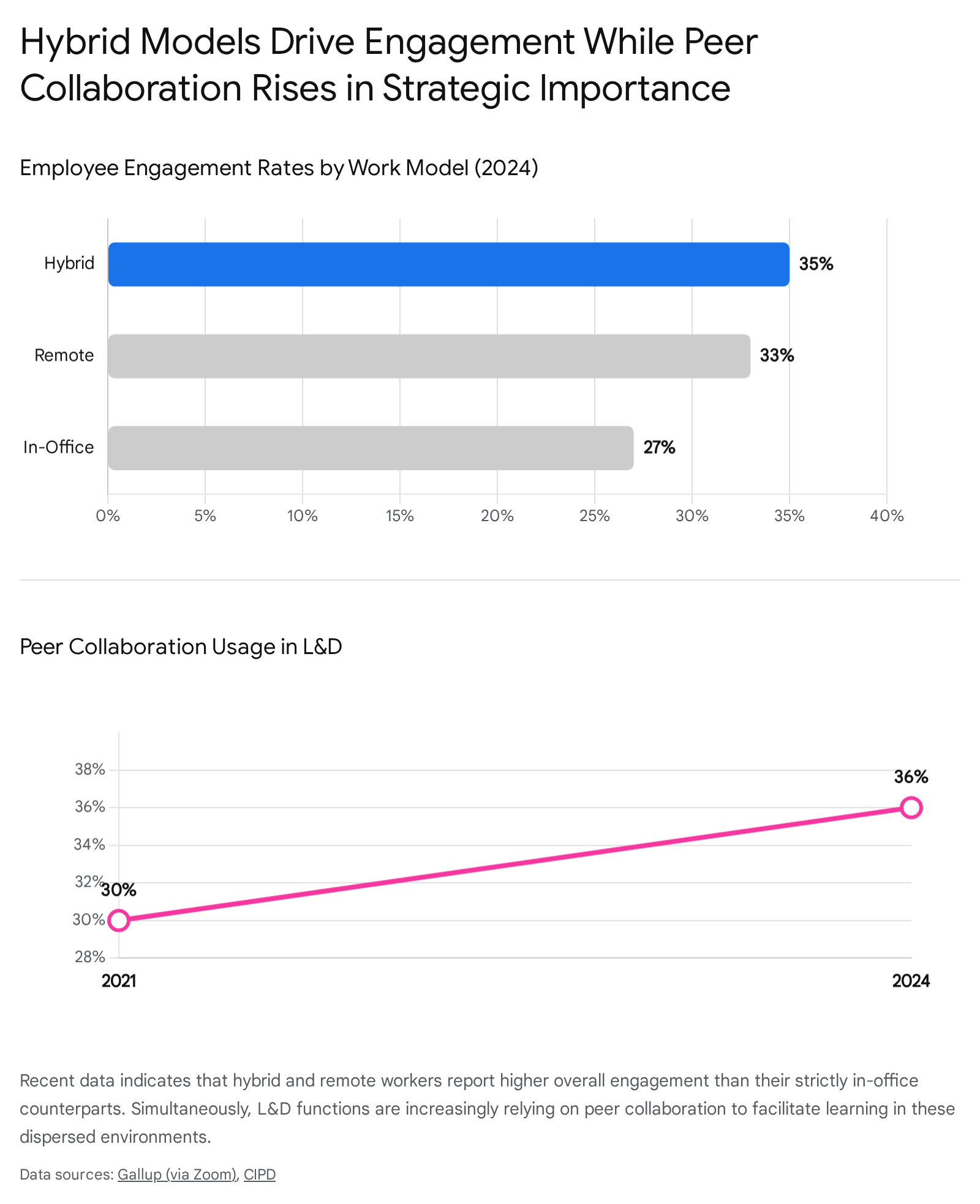
To facilitate this, organizations are aggressively deploying specialized collaborative learning platforms, asynchronous discussion forums, and highly structured enterprise social networks in an attempt to artificially recreate the lost "water cooler" dynamic 341442.
More radically, however, the explosive advent of generative artificial intelligence is fundamentally altering the very definition of the "20." By 2025 and 2026, generative AI is no longer merely utilized as a backend tool for administrative content creation (traditionally part of the "10"); it is actively functioning and interacting with employees directly within the social and experiential domains 254344. Advanced AI-powered chatbots now act as virtual tutors and on-demand, always-available coaches 4525. They provide immediate, personalized, real-time feedback, answer highly specific workflow queries, and actively prompt reflective practice - functions that were historically fulfilled exclusively by human managers or senior peers 4525. This development hybridizes the model into a new paradigm where an employee's "social" learning may consist heavily of human-machine interaction, utilizing large language models intentionally designed to facilitate cognitive scaffolding and provide a safe space for inquiry 102545.
Elevating the "10": Microlearning in the Flow of Work
Simultaneously, the formal 10 percent has transitioned sharply away from the traditional, multi-day, instructor-led classroom events toward continuous, on-demand microlearning 42244. To accommodate the realities of remote and asynchronous schedules, workers now integrate short, highly focused 5-to-10-minute multimedia modules directly into their daily routines, often accessing content via mobile devices during transit or between digital meetings 446. This approach is heavily reliant on sophisticated Learning Management Systems (LMS) and algorithmic personalization, which dynamically serve relevant content based on the employee's current project demands 4223947. This methodology effectively blurs the rigid historical lines between "formal education" and "real-time performance support," ensuring that necessary foundational knowledge is delivered exactly at the precise point of need, rather than months in advance during an onboarding seminar 4223947.
The 70-20-10 Framework: Traditional vs. Modern Paradigm
To succinctly illustrate the stark operational shift in the framework, the following table contrasts the original 1980s assumptions of the model against its modern execution within a digital-first, AI-augmented organizational ecosystem.
| Component | Traditional 1980s Definition & Delivery (CCL Origins) | Modern 2023+ Interpretation & Digital Delivery |
|---|---|---|
| The 70% (Experiential) |
Definition: Learning occurs via "tough jobs," physical trial-and-error, and navigating hierarchical corporate bureaucracy. Delivery: Unstructured stretch assignments, geographical job rotations, long-term expatriate postings, and learning organically from unstructured workplace failures 2913. |
Definition: Data-driven, dynamic skills-based learning integrated seamlessly into the digital workflow, focusing on continuous behavioral adaptation. Delivery: Asynchronous experiential learning modules, virtual reality (VR) risk-free simulations, immersive AI roleplay environments, and short-term project-based gig assignments curated within internal talent marketplaces 5102325. |
| The 20% (Social) |
Definition: Top-down learning heavily reliant on observing the boss, formal physical mentorship programs, and serendipitous office interactions. Delivery: Scheduled face-to-face coaching sessions, physical desk-side shadowing, and spontaneous water-cooler knowledge sharing 291122. |
Definition: Networked, asynchronous collaborative learning, decentralized peer-to-peer knowledge sharing, and sophisticated human-machine coaching. Delivery: Enterprise social networks, dedicated peer learning forums, crowdsourced corporate wikis, and Generative AI agents acting as interactive, always-on coaches and mentors 4142543. |
| The 10% (Formal) |
Definition: Instructor-led, event-based knowledge transfer that is physically and temporally isolated from the actual work environment. Delivery: Multi-day classroom workshops, physical corporate seminars, and printed coursework, manuals, or textbooks 24922. |
Definition: Hyper-personalized, on-demand foundational knowledge that serves primarily as a rapid catalyst for immediate workflow application. Delivery: AI-curated microlearning modules, mobile-first video tutorials, seamlessly integrated LMS learning pathways, and synchronized interactive digital webinars 43947. |
Cross-Cultural Analysis: Geopolitical Variations and the Universalist Fallacy
A profound, yet frequently overlooked, limitation of the original 70-20-10 research is its intense ethnocentricity. The model was formulated exclusively within the highly specific context of 1980s American corporate culture. This culture is heavily characterized by specific sociological dimensions, most notably low power distance, high individualism, and a culturally ingrained high tolerance for risk and entrepreneurial failure 102849. When exported globally by multinational corporations and consulting firms as a universal, one-size-fits-all best practice, the framework frequently encounters severe structural friction due to fundamental variations in societal values and behavioral norms.
Applying the lens of Geert Hofstede's Cultural Dimensions Theory - specifically evaluating the Power Distance Index (PDI), Individualism versus Collectivism (IDV), and the Uncertainty Avoidance Index (UAI) - reveals definitively that the underlying behavioral mechanisms required for the traditional 70-20-10 model to function do not universally translate across non-Western corporate environments 284929.
The Stigma of Failure in High Power Distance and Uncertainty Avoidance Cultures
The absolute cornerstone of the 70 percent - experiential learning - relies implicitly on the existence of a high degree of psychological safety. The employee must feel empowered to experiment, fail, iterate, and learn without fear of severe career repercussions or social ostracization. In Western, low-PDI cultures, the concept of "failing forward" is often explicitly celebrated as a necessary developmental milestone.
However, in cultures characterized by high Power Distance and high Uncertainty Avoidance - such as many deeply rooted corporate environments in China, Japan, the broader Middle East, and parts of Eastern Europe - the operational dynamic changes drastically 4929305231. In these sociological contexts, authority is deeply respected, strict hierarchical instructions are expected to be explicit, and visible failure carries a heavy social and professional stigma, often translating to a severe loss of "face" or honor 4929. Asking a junior employee in a high PDI culture to autonomously navigate a vague "stretch assignment" via independent trial-and-error can induce severe cognitive anxiety. Furthermore, rather than being viewed as an empowering developmental opportunity, such an assignment is often interpreted by the subordinate as an abdication of leadership responsibility by the manager 492931.
Research indicates that in regions possessing strong Confucian dynamism, there is a distinct cultural preference for highly structured, predictable, instructor-led learning, adhering to a traditional dynamic where the recognized master formally imparts explicit knowledge to the student 303132. Consequently, self-directed experiential learning requires careful, culturally sensitive, and deliberate scaffolding. Multinational organizations operating in these regions must adapt the execution of the "70" by providing highly structured pilot programs, explicitly clear operational protocols, and highly visible, continuous sponsor authority to actively mitigate the culturally ingrained fear of unstructured failure 492933.
Collectivism and the "Ubuntu" Approach to Social Learning
Conversely, the 20 percent (social learning) aspect of the model often finds significantly stronger, more organic resonance in collectivist cultures than it does in the hyper-individualistic environments of the West. In highly individualistic societies, employees tend to prioritize personal achievement, individual bonuses, and proprietary knowledge hoarding; consequently, they may view open peer-learning or mentoring a colleague as a competitive vulnerability that threatens their own advancement 49. In collectivist cultures, however, group harmony, team-based achievement, and shared responsibility are paramount virtues 2849.
This dynamic is acutely observable in the African corporate and educational context. The indigenous African philosophy of Ubuntu - often translated as "I am because we are" - deeply emphasizes social interconnectedness, humaneness, and unwavering communal responsibility 13573459. In African organizational and innovative educational models, such as the widely praised African Leadership University (ALU), learning is inherently peer-driven and heavily communal by design 5735. Within the ALU's specific adaptation of the 70-20-10 model, the social learning component transcends the Western concept of formal, rigid 1-on-1 mentoring; instead, it manifests dynamically as multi-disciplinary community problem-solving and the establishment of deep, reciprocal peer networks 575935. Students routinely work in multi-country teams to tackle challenges in their home communities, learning to deeply value local, shared knowledge 57.
The success of such models - evidenced by ALU graduates achieving a 75 percent placement rate within six months and demonstrating a high propensity for entrepreneurial job creation - demonstrates a crucial cross-cultural reality 57. While a Western organization may need to aggressively engineer and mandate the "20" through digital platforms and KPIs to overcome individualistic isolation, a collectivist organization can leverage its existing cultural DNA to naturally amplify social learning, provided the learning objectives are aligned with communal growth and group goals rather than zero-sum individual competition 4957.
Broadening the Horizon: Competing Frameworks and Continuous Learning Ecosystems
Recognizing the extensive empirical weaknesses, the operational rigidity, and the inherent cultural biases of the traditional 70-20-10 ratio, modern organizational psychologists and leading global corporations have actively begun transitioning toward more nuanced, holistic, and structurally sound models 6126162. Rather than engaging in pedantic debates over specific numerical allocations, these updated frameworks focus heavily on the underlying cognitive mechanisms of learning and the deep structural integration of L&D directly into the business workflow.
The 3E Model (Experience, Exposure, Education)
To completely circumvent the "formula trap" of enforcing strict percentages, many institutions have adopted the simplified 3E Model: Experience (replacing the rigid 70), Exposure (replacing the rigid 20), and Education (replacing the rigid 10) 19633637386768.
The primary, overriding advantage of the 3E model is its philosophical and operational flexibility. It outright abandons the mathematically invalid assertion that exactly 10 percent of learning comes from formal education across all contexts. It explicitly acknowledges that for highly technical, specialized roles, or for novice employees entering a complex industry, "Education" may legitimately need to represent a significantly larger portion of their initial developmental time and organizational investment 141963. The 3E model acts as a qualitative lens rather than a quantitative budget allocation tool. It encourages L&D professionals to ensure that any comprehensive developmental program utilizes a healthy, context-appropriate blend of all three elements without forcing instructional designers to adhere to arbitrary, unsupported quotas 19633668.
The UNIQ Framework (London Business School)
A critical, deeply psychological limitation of the 70-20-10 model is its exclusive, surface-level focus on where the learning event happens (e.g., on the job vs. in a classroom), while almost entirely ignoring how the individual learner internally and cognitively processes the experience. Research conducted by Julian Birkinshaw at the London Business School, utilizing an extensive survey of over 800 multinational executives, proposed the UNIQ framework to explicitly address this psychological void 12.
The UNIQ model posits that genuine "learning magic" and capability development occur only at the intersection of three core cognitive and physical activities: * Understanding (UN): The acquisition of formal, theoretical knowledge and the cognitive process of sense-making. * Identity (I): The deeply introspective process of self-discovery, understanding one's own values, and analyzing how one relates to and influences others. * Quest (Q): The physical action-taking, the execution of challenging assignments, and experiential experimentation 12.
Birkinshaw's empirical research found that while executives do indeed spend the vast majority of their physical time in the "Quest" phase (which aligns somewhat with the experiential 70 percent), they place profound, disproportionate importance on the "Identity" work 12. The traditional 70-20-10 model fundamentally ignores identity construction and deliberate self-reflection. The UNIQ framework forcefully argues that raw action without structured, psychological self-reflection does not yield lasting leadership development; therefore, organizations must intentionally design pathways and allocate time that forces executives to reflect on their identity in direct relation to their daily operational actions 12.
The Shift to Continuous Learning Ecosystems
Ultimately, the most progressive and disruptive developments in L&D circa 2024 through 2026 involve abandoning discrete, compartmentalized learning models entirely in favor of establishing holistic Continuous Learning Ecosystems 51046476162.
Traditional models - even the 70-20-10 - still largely treated the workforce as a static organizational chart, deploying training reactively to fill perceived, point-in-time gaps 1061. A modern continuous learning ecosystem fundamentally shifts this view, treating the entire workforce as a highly fluid portfolio of adaptable capabilities 1061. Facilitated by AI-driven internal talent marketplaces and advanced predictive analytics, learning is no longer siloed artificially into "formal" or "informal" buckets, or tracked merely by course completion rates 5104762.
Instead, an employee's workflow, output, and interactions are continuously analyzed. If an emerging skill gap is detected, the ecosystem automatically intervenes holistically: it curates a micro-learning module to provide the foundational theory (Education), utilizes an algorithm to connect the employee via a digital platform with a relevant internal expert for a quick consultation (Exposure), and immediately matches them to a short-term, cross-functional gig project to practice the newly acquired skill in a real-world setting (Experience) 51047. In this highly dynamic, technology-driven paradigm, the historical debate over whether experiential learning accounts for exactly 70 percent or 40 percent of professional development becomes entirely obsolete 1246. Learning is measured not by arbitrary ratio adherence or compliance metrics, but by real-time skill acquisition, verified behavioral changes, and corresponding, measurable impact on core business objectives 1104647.
Conclusion
The 70-20-10 learning framework remains one of the most polarizing, influential, and widely debated constructs in the history of organizational psychology. Traced back to its 1980s origins at the Center for Creative Leadership, the model began as a highly valuable, albeit localized, descriptive observation regarding the retrospective career trajectories of successful American corporate executives. Its subsequent, aggressive distortion by the corporate sector into a prescriptive, universally applicable mathematical formula used to justify budget reductions has been rightly and rigorously criticized by contemporary academic researchers. The evidence demonstrates that the model, as widely popularized, is atheoretical, culturally biased, methodologically flawed by survivorship and recall bias, and dangerously reliant on the assumption that unstructured experience automatically yields professional capability.
However, as a broad, philosophical heuristic, the model's core underlying tenet - that deep human capability development requires a blended synthesis of formal foundational instruction, supportive social interaction, and rigorous practical application - remains fundamentally sound. As modern organizations navigate the unprecedented complexities of remote work environments, the integration of generative AI, and the nuances of cross-cultural globalization, strict adherence to the rigid 70-20-10 percentages must be permanently discarded. Instead, contemporary L&D strategy must focus relentlessly on building continuous, technologically augmented learning ecosystems that culturally contextualize experiential learning, actively engineer social collaboration across the digital divide, and integrate continuous skills development directly into the flow of work.