
Comparison of ADDIE, Agile, and SAM for Rapid Training Development
The contemporary landscape of corporate learning and development (L&D) requires organizations to rapidly adapt to shifting business priorities, emerging technological capabilities, and a fundamental transition toward skills-first workforce strategies 1. Historically, standard corporate training relied heavily on highly structured, sequentially driven instructional design methodologies to produce formal learning materials 23. However, as the lifespan of specific technical skills diminishes and the organizational demand for continuous, in-the-flow-of-work learning accelerates, the mechanisms by which training is developed have come under intense scrutiny and operational pressure 45. Instructional design models serve as the foundational blueprints for creating these educational experiences, dictating the speed, flexibility, and ultimate effectiveness of the final learning product 66.
In fast-moving organizational environments, instructional design teams are frequently caught between the academic need for comprehensive needs analysis and the operational demand for rapid deployment 8. This tension has fueled a decades-long evolution of instructional design frameworks. The historical industry standard, ADDIE (Analysis, Design, Development, Implementation, Evaluation), established a systematic approach that maximizes alignment and formal documentation but often struggles with speed and adaptability 23. In response, alternative methodologies such as the Successive Approximation Model (SAM) and Agile-derived frameworks like the Lot Like Agile Management Approach (LLAMA) emerged to prioritize iterative prototyping, continuous stakeholder feedback, and flexible development cycles 678.
The comparative efficacy of these models is not strictly binary; rather, it depends heavily on project constraints, content stability, target audience dynamics, and organizational culture 89. Furthermore, the rapid integration of generative artificial intelligence into instructional design workflows throughout 2024 and 2025 has begun to fundamentally alter the speed limitations of traditional models, forcing a reevaluation of how these frameworks operate in contemporary practice 101311.
The Evolution of Corporate Learning Methodologies
Understanding the application of instructional design models requires an examination of the macroeconomic and workforce trends driving the L&D sector. The learning function has transitioned from a peripheral human resources activity into a strategic, data-driven business partnership 1.
Shifting Paradigms in Workplace Training
Throughout recent years, the corporate focus has shifted decisively from training employees for specific job titles to emphasizing durable, transferable skills that are applicable across departments - a paradigm known as the skills-first strategy 112. This shift requires mapping workforce capabilities, spotting critical skill gaps, and rapidly deploying training to align development with strategic initiatives 12. Consequently, the traditional model of standardized, multi-day courses and annual training sessions has lost traction.
Data from the 2025 State of the Industry report by the Association for Talent Development (ATD) indicates that the average number of formal learning hours used per employee declined significantly from 17.4 in 2023 to 13.7 in 2024 513. This nearly 60 percent decline since 2020 underscores a movement away from protracted formal instruction and toward informal learning, microlearning, and contextualized, point-of-need support 514. Microlearning interventions - often lasting five to ten minutes - have matured into data-driven, mobile-first sequences leveraging cognitive load theory and spaced repetition to improve retention 1214. For instructional designers, this compression of learning time significantly elevates the pressure on each minute of training, necessitating design models that can rapidly produce targeted, high-impact content 5.
The Imperative for Rapid Development
As the velocity of business change increases, the half-life of acquired skills continues to shrink. Organizations face constant disruptions from artificial intelligence, shifting supply chains, and evolving market dynamics 415. In this environment, an instructional design process that requires six months to analyze, design, and deploy a training program is often obsolete by the time it reaches the learner. L&D leaders are pressured to demonstrate business impact and return on investment (ROI) quickly, tying learning initiatives to concrete outcomes such as increased deal sizes, reduced error rates, and enhanced employee retention 1. This necessity for speed-to-market has driven the industry's exploration of agile, iterative frameworks that can deliver functional training solutions in fractions of the traditional time 916.
The ADDIE Framework in Modern Practice
The ADDIE model remains the most widely recognized, documented, and utilized instructional systems design framework in the corporate and government training sectors 6817. Developed originally in 1975 by the Centre for Education Technology at Florida State University for the United States military, the methodology was designed to provide a highly systematic, repeatable set of tasks for creating robust training programs 2818.
Historical Foundations and Systematic Structure
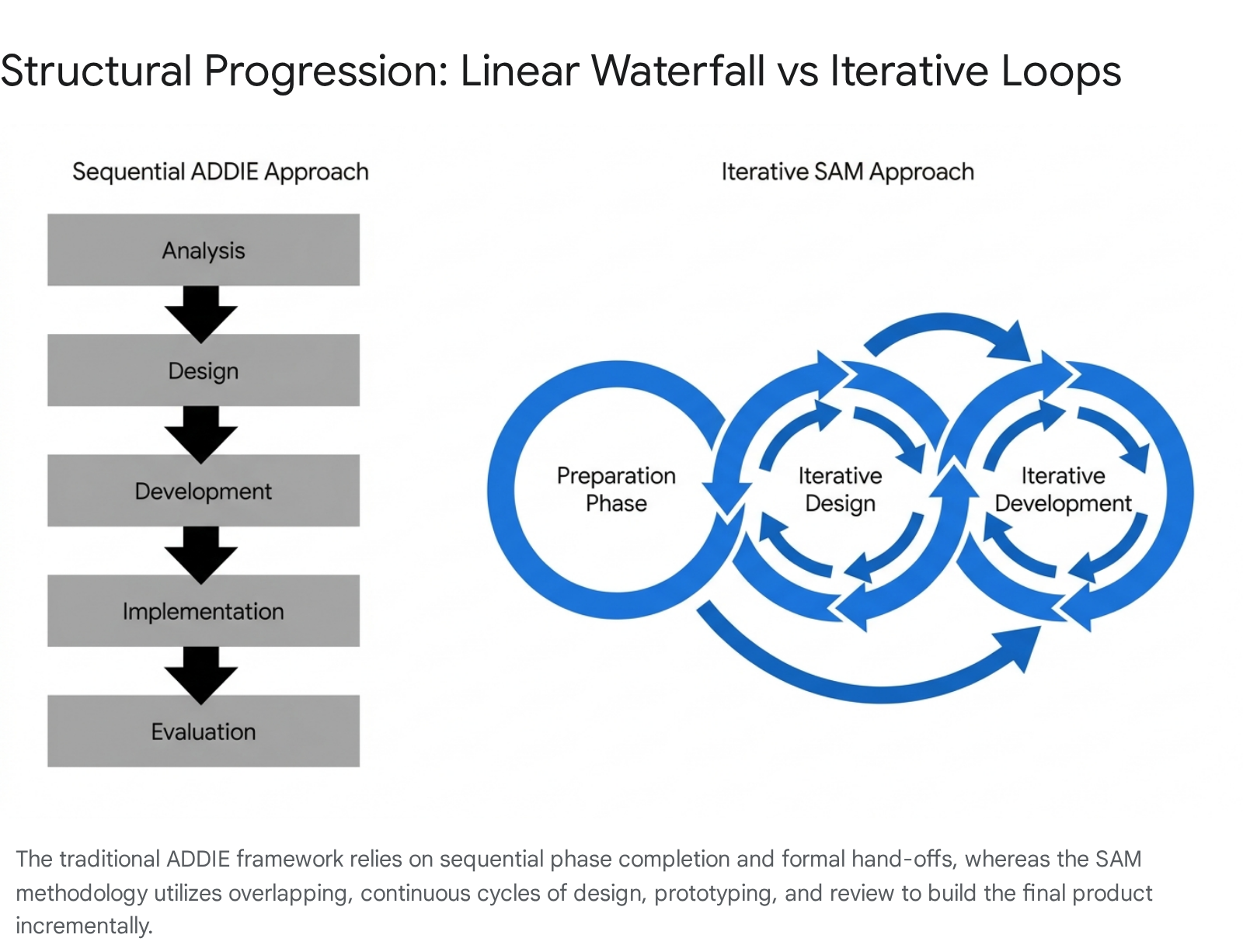
Because of its origins in military and institutional training, the ADDIE model inherently favors comprehensive upfront planning, rigorous standardization, and meticulous documentation 36. It is frequently characterized as a "waterfall" methodology, meaning that each of its five phases relies entirely on the finalized outputs of the preceding phase 2619. In a strict application of the model, a subsequent phase cannot be initiated until the current phase is completed, formally reviewed, and approved by stakeholders 220. This structured approach ensures that the resulting instructional materials are carefully planned, highly aligned with organizational objectives, and responsive to documented learner needs 21.
Phase Operations and Cognitive Framework Integration
The operations within the ADDIE model are exhaustive. The phases operate as a linear continuum designed to mitigate risk through thorough preparation 22.
The Analysis phase serves as the foundation of the project. Instructional designers conduct extensive research to identify the specific learning problem, analyze the target audience's demographics and existing knowledge, establish high-level instructional goals, and determine the technical, financial, and environmental constraints of the project 2022. This diagnostic stage frequently involves gap analyses, stakeholder interviews, and data collection to ensure the training is objectively necessary and appropriately targeted 323.
Following Analysis, the Design phase translates the gathered data into a structural blueprint. This phase codifies specific learning objectives, assessment instruments, exercises, and instructional strategies 2024. It is during this phase that instructional designers integrate foundational cognitive learning theories 8. For example, designers may utilize Bloom's Taxonomy to classify learning goals into hierarchical cognitive levels (e.g., remembering, understanding, applying, analyzing, evaluating, creating) to ensure the training requires appropriate higher-order thinking 825. Additionally, designers might apply Gagné's Nine Events of Instruction to structure the psychological flow of the lesson, or incorporate Merrill's First Principles of Instruction to guarantee the learning is problem-centered and integrated into real-world work 82225. The output of the Design phase typically includes detailed storyboards, visual mock-ups, and comprehensive design specification documents 2022.
The Development phase involves the physical creation and assembly of the learning materials outlined in the design documents 2022. Instructional designers, developers, and media specialists utilize authoring tools, graphic design software, and video production equipment to build e-learning modules, facilitator manuals, presentation decks, and participant workbooks 2021. This phase includes internal quality assurance testing and debugging 2627.
Implementation encompasses the deployment of the finalized training to the target audience 220. This involves loading digital courses into a Learning Management System (LMS), preparing the physical or virtual learning environments, and conducting "train-the-trainer" sessions to equip facilitators with the necessary skills to deliver the material effectively 1620.
Finally, the Evaluation phase measures the effectiveness of the instruction against the initial objectives 2. The model differentiates between formative evaluation (which theoretically occurs during each phase to ensure internal quality) and summative evaluation (which occurs post-implementation) 2022. Summative evaluation frequently utilizes frameworks like the Kirkpatrick Model to assess learner reaction, knowledge acquisition, behavioral change on the job, and ultimate business impact 31.
Documentation Requirements and Structural Rigidity
The primary strength of the ADDIE model is its structured approach and its reliance on comprehensive documentation 2028. By requiring stakeholders to formally sign off on detailed design documents before any active asset development begins, ADDIE theoretically prevents scope creep and ensures high alignment between business sponsors and the development team 38. This makes the model highly suitable for large-scale projects where the content is stable, the regulatory requirements are strict (such as compliance or safety training), and the cost of post-deployment errors is unacceptably high 38.
However, this reliance on exhaustive upfront analysis and text-heavy documentation is also ADDIE's most frequently cited vulnerability in fast-moving organizations 37. Creating detailed specifications that must be approved before building a functional prototype can result in prolonged, rigid development cycles 819. Stakeholders outside of the L&D function often struggle to visualize a final, interactive digital product based solely on written storyboards or static design documents, leading to inevitable misinterpretations 19. When these misalignments are only discovered during the Development or Implementation phases - when stakeholders finally see the functional product - backtracking to the Design phase becomes exceedingly costly and time-consuming, a phenomenon industry practitioners often refer to as a "death spiral" 618.
Iterative Adaptations of the ADDIE Framework
Recognizing the limitations of a strict waterfall progression, many contemporary instructional design teams have evolved the framework into an "Iterative ADDIE" approach. This adaptation acknowledges that the five phases do not need to be mutually exclusive silos 329. In practice, iterative ADDIE allows for overlapping phases; for instance, initial media development efforts might reveal technical constraints that trigger an immediate loop back to refine the design strategy 3.
By building tighter feedback cycles into each sequential stage, designers can attempt to mitigate the rigid "start-to-finish" delays inherent in the classic model while preserving its analytical rigor 30. Despite these modernizations, the core philosophy of ADDIE remains anchored in thorough preparation and linear logic. If the organizational learning requirements are expected to shift drastically during the development timeline, even an iterative interpretation of ADDIE may struggle to remain responsive 2830.
The Successive Approximation Model
Introduced to the broader industry in 2012 by Dr. Michael Allen, the Successive Approximation Model (SAM) was engineered to directly address the modern demand for rapid, flexible, and highly interactive e-learning development 2831. Grounded in the psychological principle of successive approximation, SAM posits that continuous testing, implementing, and refining is a vastly superior strategy to attempting perfection on the first conceptual pass 2732.
Core Philosophy and the Psychology of Iteration
The central premise of SAM is that human stakeholders are significantly better equipped to evaluate a tangible, functional product than an abstract, text-based idea 833. Rather than relying on textual design documents to secure stakeholder approval, SAM prioritizes the rapid creation of functional prototypes extremely early in the project lifecycle 82531.
This methodology operates under the assumption that the initial design will inevitably be flawed and that project requirements will naturally evolve as stakeholders interact with the material 2034. By accepting change as an inherent constant rather than a disruptive failure of planning, SAM prevents the unending revisions that plague linear development cycles 1840. Through continuous, tight cycles of designing, prototyping, and reviewing, the learning solution is brought successively closer to the ideal outcome in manageable increments 26.
Delineation Between SAM1 and SAM2 Frameworks
To accommodate learning projects of varying scope, timeline, and complexity, the SAM framework is bifurcated into two distinct operational models: SAM1 and SAM2 1935.
SAM1 (Basic SAM): Designed for smaller projects, straightforward training interventions, or individual instructional designers, SAM1 operates as a highly compressed, rapid cycle 826. It intentionally bypasses a formal, distinct preparation phase 8. Instead, designers engage in a tight, continuous loop of three steps: Evaluate, Design, and Develop 826. Existing materials and initial ideas are quickly assessed, integrated into a new design concept, and immediately developed into a working prototype. This prototype is then tested to gather feedback, which feeds directly into the next evaluative loop 826. The product is considered complete once this cycle of iterations yields a satisfactory result, allowing for incredibly rapid production 835.
SAM2 (Extended SAM): For complex, enterprise-level initiatives involving multiple stakeholders, significant technical constraints, and broader curricula, SAM2 provides a more robust scaffolding. SAM2 consists of eight distinct steps distributed across three major phases 1926. The table below outlines the architecture of the SAM2 methodology.
| Phase | Step | Operational Function |
|---|---|---|
| Preparation | 1. Background Information Gathering | Rapid collection of audience data, organizational constraints, and high-level goals. Avoids the exhaustive, time-consuming analysis seen in ADDIE 26. |
| Preparation | 2. The Savvy Start | A collaborative brainstorming session with all key stakeholders to establish consensus, define success metrics, and generate initial rough prototypes 2634. |
| Iterative Design | 3. Project Planning | Formal scheduling of tasks, resource allocation, and timeline generation, occurring only after initial prototyping has provided clarity 26. |
| Iterative Design | 4. Additional Design | Refining the initial rough prototypes into a more cohesive instructional strategy based on feedback from the Savvy Start 826. |
| Iterative Design | 5. Design Proof | The creation of a tangible, highly detailed representation of the instructional concept (e.g., advanced wireframes or interactive mock-ups) for final stakeholder approval 2640. |
| Iterative Dev. | 6. Alpha Release | The first working version of the complete program. It contains full functionality but may utilize rudimentary content or placeholders 840. |
| Iterative Dev. | 7. Beta Release | A modified version of the Alpha release incorporating comprehensive feedback. Finalizes course structure, activities, and multimedia assets 840. |
| Iterative Dev. | 8. Gold Release | The fully polished, refined, and optimized version of the training ready for mass deployment on the delivery platform 840. |
The Mechanics of the Savvy Start
The defining mechanism of the SAM2 framework is the "Savvy Start." Acting as the critical bridge between the Preparation and Iterative Design phases, the Savvy Start is an intensive, collaborative brainstorming session that typically spans one to two full days 2631.
Unlike traditional project kickoff meetings that rely solely on reviewing documentation, the Savvy Start mandates the presence of a diverse, cross-functional team. Required participants include project sponsors, subject matter experts (SMEs), recent or prospective learners, instructional designers, and technical developers 263435. The explicit goal of this session is not to finalize a written plan, but to actively generate a minimum of three rough, functional prototypes of the final project 31. These prototypes purposefully favor breadth and possibility over perfection and polish 31.
By forcing diverse stakeholders to interact with rough concepts immediately, the Savvy Start flushes out hidden assumptions, divergent expectations, and technical constraints early in the timeline - when changes are highly inexpensive to implement 8. The prototypes created during this session are then systematically reviewed, with the most successful elements selected to form the basis of the subsequent Iterative Design cycles 31.
Agile Methodologies and the LLAMA Adaptation
While SAM functions as an Agile-inspired model explicitly created for the nuances of instructional design, many fast-moving organizations have attempted to import pure Agile project management methodologies directly from software engineering into their L&D departments 2836. Grounded in the Agile Manifesto of 2001, this approach prioritizes individuals and interactions over rigid processes, working products over comprehensive documentation, customer collaboration over contract negotiation, and responding to change over blindly following a plan 733.
Translating Software Agile to Instructional Design
Applying pure software Agile methodologies to instructional design presents distinct operational and philosophical challenges. Software development is primarily driven by user feature requirements and functional utility, whereas instructional design is fundamentally guided by cognitive learning objectives, behavioral change, and performance outcomes 363738. Furthermore, software developers are typically dedicated full-time to a single project team or product, while instructional designers frequently manage three to four overlapping projects simultaneously across different departments 363739.
Instructional design teams also face unique external dependencies, such as waiting for specialized content validation from external SMEs, which creates necessary downtime that must be accounted for in project planning 37. Because of these structural disparities, rigid adherence to software-centric Agile frameworks (like Scrum) can lead to profound frustration and inefficiencies within L&D environments 37.
The Lot Like Agile Management Approach Framework
To resolve the friction between software Agile principles and instructional design realities, specific adaptations have emerged, most notably the Lot Like Agile Management Approach (LLAMA), developed by Megan Torrance 7. LLAMA successfully merges the structured, educational rigor of traditional models like ADDIE with the iterative, collaborative cadence of Agile project management 7.
The LLAMA framework makes critical adjustments to Agile ceremonies to fit the context of training development. For instance, rather than capturing software "user stories" (which tend to result in purely information-driven courses), LLAMA utilizes "learner stories" based on Cathy Moore's action mapping methodology 36. This ensures that the design is tethered directly to actionable, on-the-job behaviors rather than passive knowledge transfer 36. Additionally, LLAMA acknowledges the multi-project reality of instructional designers by advising leaders against scheduling simultaneous release dates across different projects to prevent severe resource bottlenecks 36.
Sprints, Backlogs, and Continuous Collaboration
In practice, Agile and LLAMA approaches require breaking the macro instructional design project down into small, highly manageable chunks 3640. Cross-functional teams operate in fixed time periods known as "sprints" (often one to three weeks in duration) to complete specific increments of the learning product 718.
Unlike the rapid prototyping of the SAM model - where the output is explicitly understood to be a rough draft destined for revision - pure Agile sprints aim to produce a complete, functional, and usable component of the final product by the end of the timebox 618. This modular approach significantly mitigates business risk; if organizational priorities shift abruptly, the business still possesses the fully completed, deployable modules from the previous sprints, rather than a monolithic, half-finished project trapped in a development phase 1840. The success of this methodology relies heavily on continuous daily collaboration, transparent task backlogs, and cross-functional team autonomy 3640.
Comparative Analysis of Design Variables
Selecting the optimal methodology requires a nuanced evaluation of project constraints, organizational culture, resource availability, and the nature of the content being developed. The following table synthesizes the operational differences between the three primary approaches across critical project variables.
| Variable | The ADDIE Framework | The SAM Approach (SAM2) | Agile / LLAMA Methodologies |
|---|---|---|---|
| Workflow Architecture | Linear, sequential phases with formal hand-offs 30. | Cyclical loops of design, prototyping, and development 30. | Incremental development executed in fixed timeboxes (sprints) 1836. |
| Speed to Deployment | Slower; requires extensive analysis before development begins 38. | Faster; relies on rapid prototyping to begin development immediately 816. | Fast; delivers modular, usable components incrementally 718. |
| Flexibility to Change | Rigid; highly resistant to shifting requirements late in the process 730. | Highly flexible; changes are expected and managed through successive loops 3041. | Highly flexible; requirements are reprioritized in the backlog between sprints 2836. |
| Documentation Demands | Heavy; relies on detailed design documents and storyboards for approval 38. | Light; utilizes rough prototypes to communicate concepts over written specs 3334. | Minimal; prioritizes functional deliverables over comprehensive design plans 33. |
| Stakeholder Involvement | Concentrated heavily at the beginning (Analysis) and end (Evaluation) 30. | Continuous; frequent interactions to test prototypes starting at the Savvy Start 3441. | Continuous; business sponsors and SMEs collaborate closely throughout sprints 3036. |
| Ideal Use Case | Large-scale, stable content (e.g., compliance) requiring deep metrics 23. | Dynamic projects requiring highly interactive, user-tested e-learning 1620. | Rapidly evolving environments where speed-to-market is the primary driver 2028. |
Speed to Deployment and Prototype Fidelity
In fast-moving organizations, the time-to-market for training initiatives is frequently the deciding metric for programmatic success 816. The traditional ADDIE model generally exhibits the slowest initial deployment speeds due to its sequential dependencies. Extensive upfront analysis and detailed instructional storyboarding can delay the actual development of digital training materials by weeks or months 38.
Conversely, SAM and Agile approaches excel in environments where content is volatile, deadlines are aggressive, or the organization requires immediate performance interventions. By prioritizing rapid prototyping, SAM drastically reduces the time between project initiation and the review of the first functional concept 831. Agile approaches achieve speed through incremental delivery, allowing organizations to roll out high-priority training modules to the workforce while subsequent, lower-priority modules are still being built 1830. Both iterative models allow instructional designers to pivot rapidly if business objectives change mid-project, an adaptation that would cause significant disruption and sunk costs in a pure ADDIE workflow 2028.
Stakeholder Involvement and Feedback Cadence
The cadence of stakeholder engagement represents a critical operational divergence in these methodologies. In ADDIE, subject matter experts and business sponsors are heavily involved during the initial Analysis phase to provide raw information, and again during the Evaluation phase to review the final product 30. During the Design and Development phases, instructional designers typically work in relative isolation, translating the analysis into the final asset 30.
Agile and SAM require sustained, active participation from stakeholders throughout the entire lifecycle. In SAM, the Savvy Start requires multi-day commitments from cross-functional teams, and stakeholders must continuously review Alpha and Beta releases 3441. While this continuous feedback loop severely minimizes the risk of delivering an irrelevant product, it also demands a significantly higher time commitment from individuals outside the L&D department 28. Organizations that cannot secure consistent access to SMEs or business leaders may find SAM and Agile implementations stalling due to a lack of timely feedback, making ADDIE a more practical choice despite its rigidity 3037.
The Impact of Artificial Intelligence on Development Speed
The technological landscape of 2024 and 2025 introduced a major paradigm shift in instructional design execution: the widespread adoption and integration of Generative Artificial Intelligence (GenAI). This technological injection is fundamentally altering the constraints that previously defined the ADDIE versus Agile debate, equalizing speed discrepancies and shifting the designer's role from content creator to strategic orchestrator 404243.
AI Adoption Metrics Among Instructional Designers
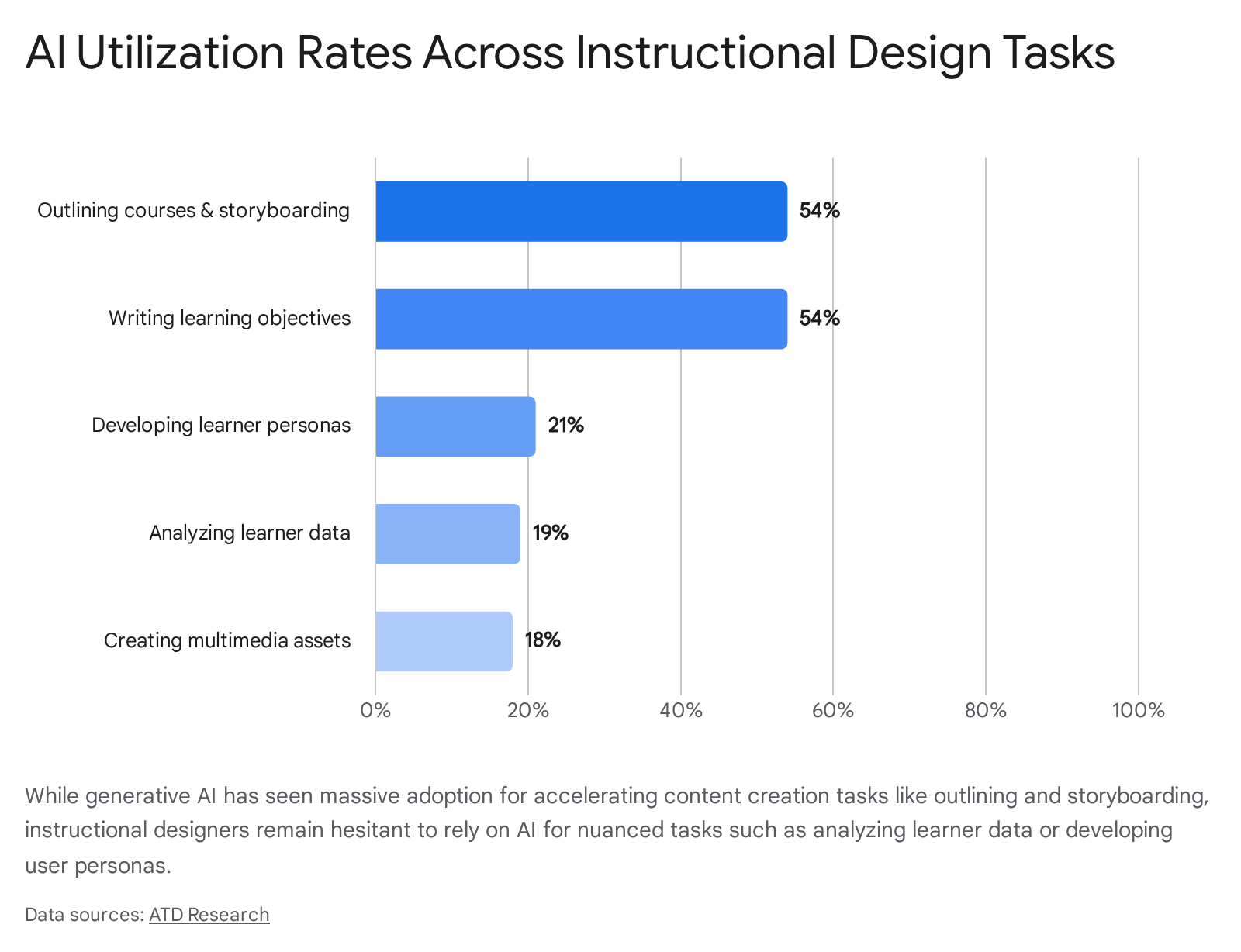
Industry reports published by the Association for Talent Development (ATD) in late 2025 revealed staggering adoption rates. The research, surveying 232 talent development professionals, found that 80 percent of instructional designers were actively utilizing AI tools in their daily workflows 1144. Of those utilizing AI, 96 percent relied specifically on generative AI models (such as ChatGPT, Microsoft Copilot, and DALL-E) rather than traditional predictive AI 4546.
The perceived benefits of this adoption are substantial. According to the ATD data, 37 percent of professionals reported that AI tools greatly reduced the amount of time required to design a course, while 70 percent noted explicit improvements in the overall quality of their course design 4546. Conversely, the 20 percent of instructional designers who abstained from AI adoption cited a lack of trust in AI-generated content, copyright issues, and concerns over intellectual property rights as their primary barriers 444546.
Accelerating the Analysis and Design Bottlenecks
Historically, the ADDIE model was heavily penalized for its sluggish, resource-intensive Analysis phase. However, AI-driven analytics, natural language processing, and predictive models have drastically compressed the time required to gather and interpret organizational data 1043. Generative AI can rapidly process massive, unstructured datasets from Learning Management Systems, aggregate skills assessments, and parse sentiment from employee feedback surveys to instantly identify performance gaps and draft comprehensive needs analysis reports 2143.
In the Design phase, AI tools have proven highly effective at brainstorming, drafting learning objectives, creating storyboards, and outlining comprehensive curricula 4546. Tasks that previously took instructional designers weeks to synthesize manually can now be generated as high-quality initial drafts in minutes 47. By leveraging prompt engineering - widely identified as a critical competency for L&D professionals moving into 2026 - designers can produce targeted, context-aware design documents at speeds that rival the rapid prototyping phases of Agile and SAM 13.
AI-Enhanced Prototyping in SAM and Agile
The infusion of artificial intelligence effectively equalizes the speed discrepancies between linear and iterative methodologies 1048. When a comprehensive design document can be generated, reviewed, and iterated upon via AI prompting in a matter of hours, the linear rigidity of the ADDIE model becomes significantly less burdensome 43. Some industry theorists have even proposed updated nomenclatures, such as the "ADGIE" model (Analysis - Design - Generation - Individualization - Evaluation), to reflect the new AI-driven reality 42.
Furthermore, AI exponentially enhances iterative models like SAM by accelerating the development of the functional prototypes required for the Savvy Start and subsequent Alpha releases 1043. Generative AI can produce basic multimedia assets, draft video scripts, generate voice-overs, and construct adaptive assessment questions instantaneously 2343. This allows stakeholders to interact with much higher-fidelity prototypes earlier in the cycle, providing more accurate feedback and accelerating the path to the final Gold release 2343. Ultimately, AI acts as a workflow accelerator across all instructional design frameworks, automating administrative functions and allowing practitioners to focus on human-centric strategy and pedagogical alignment 4247.
Global Corporate Learning Practices and Cultural Nuances
The selection and application of instructional design models do not occur in a vacuum; they are heavily influenced by regional business cultures, investment trends, and specific workforce priorities. Understanding these macroeconomic trends is essential for multinational organizations attempting to standardize rapid training development across borders 4950.
North American Technology Integration
In North America, corporate L&D is characterized by exceptionally high investment and aggressive technology integration 51. In 2023, the U.S. corporate training market alone was valued at over $160 billion 51. Organizations in this region prioritize the rapid deployment of digital skills, leadership development, and diversity, equity, and inclusion (DEI) initiatives 51. Because of the heavy emphasis on sophisticated technological platforms (e.g., e-learning, virtual reality, and AI-driven personalization), methodologies like SAM and Agile are highly favored 3551. The North American market's reliance on tech-centric delivery mechanisms aligns neatly with Agile's software-development origins, encouraging rapid prototyping and continuous digital iterations 736.
European Standardization and Holistic Approaches
Conversely, the European corporate learning market traditionally favors highly structured, holistic, and standardized approaches to workforce development 51. Heavily influenced by supportive government policies, highly unionized workforces, and broad initiatives like the European Qualifications Framework (EQF), European organizations often view ongoing education as a shared societal responsibility essential for career longevity 51. This culture of rigorous standardization and robust vocational apprenticeships (such as Germany's dual education system) aligns much more naturally with the systematic, highly documented nature of the ADDIE model, which ensures regulatory compliance, uniformity, and comprehensive evaluation 851.
Asia-Pacific Upskilling Strategies
In the Asia-Pacific region, rapid economic globalization has triggered a massive surge in demand for digital upskilling, particularly among a notably young workforce entering the expanding IT and advanced manufacturing sectors 51. The pressing demand for speed-to-competency in countries like India and China necessitates instructional design models that can deploy technical training quickly to bridge immediate, critical skill gaps 51. This dynamic environment heavily favors rapid content development methods and agile interpretations of ADDIE to maintain competitiveness in fast-moving global markets 351.
Global organizations managing these divergent regional priorities must strike a delicate balance between "globalization" (enterprise-wide standardization) and "regionalization" (incorporating culturally relevant anecdotes, practices, and learning preferences) 5052. Effective cross-cultural instructional design frequently requires utilizing flexible frameworks that allow core curricula to be developed centrally, while permitting regional L&D teams to iteratively adapt the content to local contexts without violating the structural integrity of the program 5052.
Strategic Hybridization and Future Outlook
The debate between ADDIE, SAM, and Agile is frequently presented in industry literature as a zero-sum choice; however, empirical evidence from the field indicates that strict, dogmatic adherence to any single model is rare among experienced instructional design teams 9. The most effective fast-moving organizations operate with pragmatic flexibility, aggressively adapting and blending their methodologies to fit specific project constraints, stakeholder needs, and organizational cultures 9.
A standard hybrid approach frequently leverages the rigorous Analysis and Evaluation phases of ADDIE to secure strategic alignment and measure business impact, while substituting ADDIE's slow Design and Development phases with the rapid prototyping loops of SAM or the time-boxed sprints of Agile 23. For example, a global financial institution rolling out highly regulated compliance training may utilize strict ADDIE documentation to satisfy legal auditing requirements, but apply Agile sprint methodologies to manage the actual software development and rollout of the digital modules 3042.
Ultimately, instructional design models are conceptual meta-frameworks, not immutable laws 42. They provide a shared professional vocabulary and an operational structure, but the success of the learning intervention depends entirely on the critical thinking, domain expertise, and strategic acumen of the practitioners wielding them 2542. As organizations continue their transition toward agile, skills-based architectures and fully embrace AI-augmented workflows, the ability to fluidly navigate and synthesize the rigorous structure of ADDIE, the rapid prototyping of SAM, and the modular delivery of Agile will remain the defining characteristic of a resilient and effective learning and development function 3825.