
7 Ways to Boost Cardiorespiratory Fitness on a Busy Schedule
Cardiorespiratory fitness is one of the strongest predictors of human longevity, capable of significantly reducing your risk of cardiovascular disease, dementia, and all-cause mortality. You do not need to adopt an elite endurance athlete's regimen to reap these benefits; science increasingly shows that brief bursts of intense activity, walking under load, and consolidated weekend workouts can substantially elevate your aerobic capacity. By strategically incorporating these scalable methods, you can dramatically improve your cardiovascular health without overhauling your entire life.
The True Value of Cardiorespiratory Fitness and Aerobic Capacity
When most people evaluate their physical health, they typically step on a scale. However, recent large-scale research suggests we are measuring the wrong metric. Cardiorespiratory fitness (CRF) - typically measured by your VO2 max, which is the maximum amount of oxygen your body can utilize during intense exercise - consistently outperforms body weight and body mass index (BMI) as a predictor of how long and how well you will live 12.
A systematic review and meta-analysis of nearly 400,000 individuals published in the British Journal of Sports Medicine found that people with high cardiorespiratory fitness showed no statistically significant increase in mortality risk regardless of their BMI. Conversely, unfit individuals had a two to three times higher mortality risk regardless of their weight 1. Fitness simply trumps weight as a mortality predictor 12.
The mathematical relationship between improving your CRF and extending your life is staggering. Every 1-MET (metabolic equivalent) increase in your cardiorespiratory fitness - which is roughly equivalent to a 3.5 ml/kg/min increase in your VO2 max - is associated with an 11% to 17% reduction in all-cause mortality and cardiovascular events depending on the specific cohort analyzed 13. A 46-year longitudinal study found that each 1-unit increase in VO2 max was associated with 45 additional days of life 1. Let that sit for a moment: 45 days of life for a single unit of aerobic improvement. Furthermore, highly fit individuals show a 36% to 88% reduction in the risk of developing dementia compared to their unfit counterparts across multiple large cohort studies 1.
The clinical reality is that you do not need to spend ten hours a week training for a triathlon to trigger these physiological adaptations. Global health guidelines advise 150 to 300 minutes of moderate-intensity physical activity, or 75 to 150 minutes of vigorous-intensity physical activity per week 451. These figures are echoed globally, from the European Society of Cardiology to China's physical activity guidelines, which emphasize regular combinations of aerobic and muscle-strengthening work 45. In Japan, the "Health Japan 21" campaign recommends at least 60 minutes of daily activity alongside step targets tailored by age 2.
The Non-Linear Relationship Between Activity and Fitness
It is important to understand that physical activity volume and cardiorespiratory fitness do not act independently; they interact in a non-linear way 8. A large-scale cohort and Mendelian randomisation study utilizing the UK Biobank accelerometer dataset followed over 17,000 participants for nearly eight years. The researchers discovered that the protective effect of moderate-to-vigorous physical activity (MVPA) is not identical across all levels of baseline fitness 8.
Individuals with higher baseline cardiorespiratory fitness naturally had a lower baseline cardiovascular risk. Those with lower fitness, however, required significantly more physical activity to achieve major risk reductions 8. For an unfit person, achieving a 20% risk reduction in cardiovascular disease required approximately 340 to 370 minutes per week of MVPA, while a 30% risk reduction required upward of 560 to 610 minutes 8. Because achieving 10 hours of moderate activity weekly is impossible for many working professionals, finding ways to elevate the intensity to increase baseline CRF becomes paramount.
If your schedule makes baseline targets feel impossible, emerging exercise science has identified highly efficient alternatives. Here are seven evidence-based ways to improve your cardiorespiratory fitness without an elite athlete's schedule.
1. Harness Vigorous Intermittent Lifestyle Physical Activity (VILPA)
For years, the fitness industry insisted that cardiovascular exercise had to be performed in continuous, uninterrupted blocks of 30 to 60 minutes to be effective. We now know this is biologically false. Vigorous Intermittent Lifestyle Physical Activity, or VILPA, refers to brief, spontaneous bursts of intense physical activity embedded directly into your daily routine - no gym required 3411.
This could mean carrying heavy groceries from your car to your kitchen, sprinting up a flight of stairs, or walking briskly at maximum effort to catch a departing train. The intensity is what matters; you must elevate your heart rate significantly, even if only for seconds 11.
The 3.4-Minute Sweet Spot
A landmark 2024 study published in the British Journal of Sports Medicine tracked over 22,000 non-exercisers using wearable devices over a 7.9-year follow-up period. The researchers discovered profound sex-specific benefits in the dose-response relationship of VILPA 513. Women who averaged just 3.4 minutes of VILPA per day - accumulated in bouts lasting roughly one minute each - were 45% less likely to experience a major adverse cardiovascular event (MACE), 51% less likely to have a myocardial infarction (heart attack), and 67% less likely to develop heart failure compared to women who did no VILPA 51314.
The minimum effective dose to see substantial benefits was remarkably low: just 1.2 to 1.6 minutes of VILPA per day provided a 30% lower risk of total major cardiovascular events 4514. Interestingly, men reaped slightly fewer benefits from these tiny bursts, with a median daily duration of 5.6 minutes correlating to a 16% reduction in MACE 14. Researchers hypothesize this difference may be due to the fact that women typically exhibit higher relative physiological effort during equivalent absolute tasks compared to men 13.

How Quickly Can You Reach the Vigorous Threshold?
A practical question arises: how long must you sprint up the stairs for it to actually "count" as vigorous? Laboratory research investigating exactly how long it takes for a daily chore to become physiologically vigorous provides a clear answer.
When observing adults performing standardized activities of daily living - such as fast walking, stair climbing, or carrying external loads equal to 10% of their body weight - researchers found that it takes an average of just 77 seconds for oxygen uptake to reach the vigorous threshold (%VO2 max), 83 seconds to reach the vigorous heart rate threshold (%HRmax), and a mere 45 seconds to reach the threshold for rating of perceived exertion 15. By simply rushing through physical chores a few times a day for just over a minute at a time, you send a potent survival signal to your cardiovascular system that forces structural adaptation.
2. Schedule Daily "Exercise Snacks"
While VILPA relies on the spontaneity of daily life, "exercise snacks" apply the same time-efficient physiology in a more deliberate, planned manner. Exercise snacking involves intentionally structured, short-duration bouts of physical activity - such as 20 to 30 seconds of high-intensity stair climbing, sprint cycling, or bodyweight squats - spread out over the course of the day 3116.
These bouts differ from simple "movement breaks." While movement breaks interrupt sedentary behavior with light walking or stretching, an exercise snack pushes your heart rate above 75% of its maximum for a brief period, leveraging acute metabolic spikes and blood-flow-induced shear stress on your vascular endothelium to drive adaptations 617.
The Impact on Cardiorespiratory Fitness
A 2024 systematic review and meta-analysis evaluating the effects of exercise snacks on inactive adults found that engaging in these brief bursts of activity just a few times a day resulted in significant improvements in VO2 max, peak power output, and muscular endurance 31718. Depending on the specific meta-analysis parameters, exercise snacks demonstrated a standard mean difference (SMD) in maximal oxygen uptake ranging from 0.63 up to 1.43 when compared to non-exercising control groups 618. Some trials observed VO2 max improvements ranging from 5% to 17% 19.
Beyond aerobic capacity, these snacks significantly improved metabolic markers, leading to meaningful reductions in total cholesterol, LDL cholesterol, and systolic blood pressure 618. Interestingly, while these micro-workouts improved the engine (the cardiovascular system), they did not typically produce significant changes in body weight or body fat 618.
The total weekly time commitment for these gains is shockingly low. Interventions required as little as 4.5 to 65 minutes of total exercise per week 319. Exercise snacks bypass the two most common barriers to fitness: a perceived lack of time and a lack of motivation to complete a grueling 45-minute continuous gym session 1718. Setting a daily alarm to do 60 seconds of rapid air squats before lunch and another 60 seconds before dinner is enough to prompt cardiovascular adaptations.
3. Prioritize High-Intensity Interval Training (HIIT)
If you only have 20 to 30 minutes a day to work out, the intensity of your exercise becomes the most critical lever you can pull to improve your fitness. The scientific community has long debated the comparative benefits of Moderate-Intensity Continuous Training (MICT) versus High-Intensity Interval Training (HIIT).
Currently, there is a massive trend promoting "Zone 2" training - exercising steadily at roughly 60% to 70% of your maximum heart rate where you can comfortably hold a conversation 20. Zone 2 is physiologically foundational; it keeps your heart rate low enough to allow for a longer diastolic phase (the period when the heart fills with blood). This extended filling time stretches the ventricle, allowing a larger volume of blood to accumulate before contraction. According to the Frank-Starling law of the heart, the greater the stretch (preload), the stronger the force of contraction, which eventually builds a larger, more efficient "athlete's heart" 21.
However, the modern Zone 2 narrative was originally built upon observational data of elite endurance athletes who train at incredibly high volumes - often exceeding 15 to 20 hours a week 2223. For a busy professional working out three days a week for 30 minutes, a pure Zone 2 regimen will likely yield disappointing structural changes.
The Case for Intensity Over Volume
A comprehensive 2025 review in the journal Sports Medicine concluded that current evidence does not support Zone 2 as the optimal intensity for the general public looking to improve mitochondrial or fatty acid oxidative capacity 2223. Instead, the researchers found that signaling for mitochondrial biogenesis - the creation of new cellular energy factories within the muscle - is heavily intensity-dependent 23. The harder you work, the stronger the biological signal. When training volumes are necessarily low, prioritizing higher exercise intensities (like Zone 4 or 5) is critical to maximize cardiorespiratory health 2223.
Multiple meta-analyses comparing MICT against HIIT confirm this approach. Across diverse populations - from healthy adults to older individuals with vascular dysfunction - HIIT produces superior gains in VO2 max 242526. One meta-analysis found that HIIT increased VO2 peak by an average of 1.80 ml/kg/min more than MICT protocols 24. Another 10-week randomized controlled trial observed a 17.9% improvement in VO2 peak for the HIIT group compared to just a 7.9% improvement for the MICT group 25.
What makes this compelling for a busy schedule is that HIIT frequently achieves these superior aerobic adaptations while requiring roughly 40% less total training time than MICT 25. The structural and peripheral adaptations are profound: 12 weeks of vigorous interval cycling has been shown to increase maximal cardiac output by 15%, maximal stroke volume by 14%, muscle capillary density by 22%, and citrate synthase activity (a marker of mitochondrial aerobic enzymatic activity) by 144% 27.
Modality Comparison: HIIT vs. MICT
The choice between steady-state and intervals depends heavily on your goals and available time.
| Feature | High-Intensity Interval Training (HIIT) | Moderate-Intensity Continuous Training (MICT) |
|---|---|---|
| Intensity Level | 80 - 100% of Max Heart Rate | 50 - 75% of Max Heart Rate |
| Time Requirement | Low (Typically 15 - 25 minutes) | High (Typically 30 - 60+ minutes) |
| VO2 Max Improvement | Superior (Produces rapid, significant gains) | Moderate (Requires higher cumulative volume) |
| Blood Pressure Reduction | Moderate | Superior (Slightly better for reducing systolic BP) |
| Mitochondrial Adaptation | High signaling for biogenesis | Relies on long-duration exposure |
While MICT appears slightly better for reducing resting systolic blood pressure, HIIT is the undisputed champion of time-efficiency for oxygen uptake and peak performance 26.
4. Trade Traditional Running for Rucking
Running is a highly effective way to build aerobic capacity, but it exacts a heavy toll on the joints. With every foot strike, a runner sends impact forces equivalent to two to three times their body weight up their legs; when sprinting or jogging with poor mechanics, the force multiplier on the knees can be as high as eight or nine times body weight 2829. This repeated impact damages meniscus tissue and leads to high rates of musculoskeletal disorders 2830.
If you want the cardiovascular benefits of running without the orthopedic risk, consider "rucking."
Originating from military training, rucking simply means walking with a weighted backpack or rucksack 28. Adding a physical load forces your cardiovascular system to work significantly harder at slower speeds. This pushes your heart rate into moderate or vigorous zones without requiring you to break into a high-impact jog 317.
Walking produces an impact force of only 1.1 to 1.4 times your body weight 29. Because rucking is essentially heavily-loaded walking, it keeps one foot on the ground at all times, preserving the low-impact nature of the movement while achieving high metabolic demand 28. Furthermore, the axial loading - the downward force of the weight compressing the spine and skeleton - is highly effective for maintaining and building bone mineral density 733.
In a 10-week study of load carriage training, participants saw their VO2 max increase by up to 5% 33. While 5% might sound modest compared to HIIT regimens, rucking's true power lies in improving your aerobic threshold - the intensity at which blood lactate begins to accumulate substantially 33. By elevating this threshold, you build a massive engine of aerobic stamina, allowing you to sustain steady-state work for much longer periods without fatigue 33.
Safety parameters: If you are new to rucking, do not start with a 50-pound pack. Experts recommend starting with 10 to 20 pounds (or roughly 10% to 15% of your body weight) and gradually adding 5 pounds per week as your connective tissues adapt 31. If you have a history of lower back issues, spinal fusions, or disc injuries, you must focus on maintaining a strict neutral spine and should seek medical clearance, as adding weight to a compromised spine during twisting or flexion can exacerbate pain 34.
5. Leverage Incline Walking for Low-Impact Gains
If carrying a weighted pack does not appeal to you, utilizing the treadmill incline button or finding local hills is the next best tool for accelerating fitness in a short window.
Walking on a flat surface is highly sustainable and accessible, but it burns relatively few calories and may not push your heart rate high enough to significantly move the needle on your VO2 max if you already possess a baseline level of fitness 29. However, altering the gradient changes the physiological math entirely. Research indicates that walking at a 5% gradient can increase your caloric burn by 30% to 40% compared to flat walking at the exact same pace 2935.
Incline walking alters your biomechanics. Pushing uphill requires more energy and recruits significantly more of your posterior chain - specifically the glutes, hamstrings, and calves 35. This muscular recruitment takes the pressure off the knee joint, making it a fantastic option for those recovering from knee surgeries, those dealing with osteoarthritis, or individuals with higher body weights looking to protect their cartilage 35. A 2021 study demonstrated that walking on a treadmill at a 10% and 16% grade effectively targets full-body musculature and elevates heart rate to levels comparable to jogging, but walking entirely eliminates the flight phase (and thus the jarring landing) of running 35.
For cardiovascular adaptation, incline walking provides a steady, predictable way to lock your heart rate into a specific training zone - such as the coveted Zone 2 or Zone 3 - without the cardiovascular drift and impact fatigue associated with sustained running.
6. Combine Resistance Training with Aerobic Work
A common misconception among gym-goers is that lifting weights rapidly with short rest periods "counts as cardio." While heavy lifting will absolutely spike your heart rate and leave you breathless, a high heart rate alone does not mean you are achieving aerobic adaptations 36.
During aerobic exercise (running, cycling, swimming), your heart pumps large volumes of blood through dilated, low-resistance blood vessels 36. This high-volume, low-pressure environment forces the heart to adapt via eccentric remodeling - the heart chambers physically expand so they can hold and pump more blood per beat, lowering your resting heart rate and improving cardiovascular efficiency 36.
Conversely, during heavy resistance training, your contracting skeletal muscles clamp down on your blood vessels. This forces your heart to generate immense force against high resistance in brief bursts 36. The heart muscle walls adapt to this high-pressure load by thickening - a process called concentric remodeling 36.
A 2019 study published in Circulation showed that middle-aged adults who lifted weights regularly but did little to no aerobic exercise had stiffer arteries and a higher pulse wave velocity (a marker of vascular aging) compared to those who combined lifting with aerobic training 36.
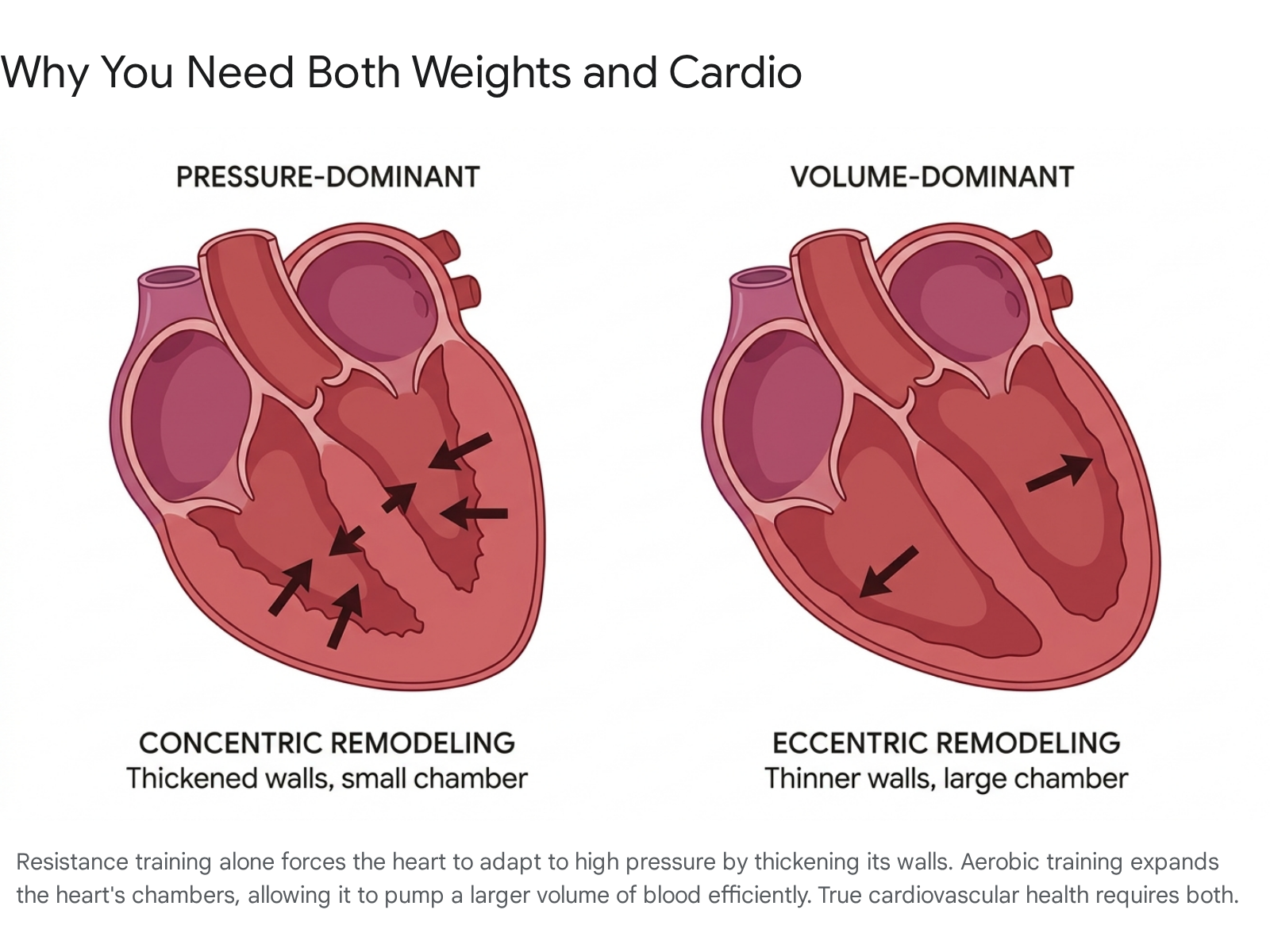
You need both modalities to build a powerful and durable cardiovascular system. Integrating 150 minutes of moderate cardio with two to three days of resistance training produces superior outcomes for body composition, visceral fat reduction, and metabolic health than relying on either modality alone 3738. Resistance training preserves lean muscle mass, which prevents the metabolic slowdown often seen during pure-cardio weight loss 37. Furthermore, increasing functional strength improves running economy, joint resilience, and muscular endurance, allowing your cardiovascular system to operate more efficiently during long efforts 39.
Even if you take a break from lifting to focus on cardio, your muscles retain "muscle memory" via retained myonuclei. When you eventually return to strength training, your muscles are primed to rebuild size and strength much faster than when you first started 40.
7. Exploit the 7,000-Step Inflection Point
If your schedule completely prevents you from adhering to a structured exercise routine, accumulating daily steps is an incredibly powerful fallback mechanism for preserving cardiovascular health. However, the famous "10,000 steps a day" target is not a biological imperative; it was actually born from a 1960s Japanese marketing campaign for a pedometer 41.
When researchers plot daily step counts against long-term health outcomes, they find a clear principle of diminishing returns. A massive 2025 systematic review published in The Lancet Public Health, analyzing 57 studies and over 35 cohorts, found that the relationship between steps and health is non-linear 41.
The most substantial, steepest drops in mortality risk occur early on in the progression from sedentary to moderately active. Researchers identified a critical "inflection point" between 5,000 and 7,000 steps per day 4142. When comparing individuals walking 7,000 steps to those walking only 2,000 steps, those hitting 7,000 experienced profound physiological benefits: - 47% lower risk of all-cause mortality. - 47% lower risk of cardiovascular mortality. - 38% lower risk of dementia. - 25% lower risk of cardiovascular disease incidence. - 14% lower risk of type 2 diabetes 42.
While walking 10,000 or 12,000 steps will yield additional benefits, the curve flattens out considerably after 7,000 4142. Similarly, when looking at active time rather than step counts, researchers have noted an inflection point around 234 minutes per week of moderate physical activity, after which the rate of mortality risk reduction slows down 8.
From a time-management perspective, hitting roughly 7,000 steps provides the ultimate return on investment. Once you cross that threshold, you are likely better off spending your remaining free time lifting weights or executing a 5-minute VILPA sprint protocol rather than pacing your living room aimlessly just to satisfy an arbitrary 10,000-step wearable goal.
The "Weekend Warrior" Alternative
What if your job forces you to be completely sedentary Monday through Friday? Can you cram all your weekly physical activity into Saturday and Sunday without losing the cardiovascular benefits?
The physiological data suggests yes. A fascinating 2025 clinical randomized trial investigated whether the consolidated "Weekend Warrior" approach was inferior to traditional, high-frequency training for improving VO2 max. The researchers took sedentary-to-recreationally-active adults and split them into two groups: one exercising four days a week, and the other condensing the exact same total volume and intensity into just two days a week on a cycle ergometer 44.
After eight weeks, both groups saw their VO2 max improve identically. The weekend warrior group improved from an average of 43.5 to 47.8 mL/kg/min, while the high-frequency group improved from 42.3 to 47.3 mL/kg/min 44. Furthermore, there were no significant differences between the groups regarding improvements in muscle oxidative capacity, hemoglobin mass, or cycling time-to-task-failure 44. The data indicates that over the short term, how you distribute your weekly exercise volume matters far less than simply getting the necessary volume completed 44. If the weekend is the only uninterrupted time you have, use it heavily and without guilt.
Does the Time of Day Matter?
If you do manage to squeeze in a workout during the week, is there an optimal time of day? A systematic review and meta-analysis of 31 original research studies investigated diurnal variations in cardiorespiratory responses 45.
The analysis revealed that while your actual oxygen uptake (VO2) remains relatively indifferent regardless of when you train, exercising in the late afternoon or evening (PM) yields slightly higher submaximal and maximal heart rates compared to morning (AM) sessions 45. More importantly, endurance performance - measured by time-to-exhaustion or total work accomplished - was statistically significantly higher in the PM than in the AM 45. This suggests that if you are pushing for a personal best or trying to maximize your total work volume within a short window, an after-work session might allow you to push slightly harder than a pre-dawn workout.
Bottom line
You do not need to quit your job and live at the gym to build a resilient, elite cardiovascular system. The latest evidence proves that micro-doses of vigorous activity - whether through spontaneous VILPA or planned exercise snacks - combined with time-efficient HIIT and joint-friendly modalities like rucking and incline walking, can drastically improve your VO2 max. While high total training volumes remain ideal, consistently hitting the 7,000-step sweet spot, protecting muscle mass with resistance training, and squeezing your workouts into the weekend are highly effective, scientifically validated strategies for extending your healthspan on an overbooked schedule.