
How Can You Identify the 5 Signs an AI Product Demo is Overselling Its Capabilities?
When observing an artificial intelligence demonstration, the suspension of disbelief is a buyer's greatest vulnerability. The most widely publicized AI controversies of the past several years reveal a remarkably consistent pattern of embellishment across the industry. Recognizing the following five primary signs is the foundational step in auditing an AI product's true operational readiness.
Sign 1: The "Zero-Latency" Mirage
One of the most immediate indicators of an embellished demonstration is the complete absence of processing latency. In real-world applications, large language models and multimodal AI systems require measurable computational time - often referred to as "Time to First Token" (TTFT) - to ingest prompts, process parameters, and generate coherent responses. Even highly optimized models like OpenAI's GPT-4o, which was specifically engineered for speed and audio-visual multimodality, average a latency of 0.32 to 0.90 seconds for standard queries 123. When utilizing advanced systems designed for logical problem-solving, such as OpenAI's "o1" chain-of-thought models, the system frequently requires ten to thirty seconds of invisible computational reasoning time before producing a complex answer 3.
When a demonstration shows an AI system seamlessly conversing, interrupting, or responding to complex visual stimuli with zero delay, it is almost certainly a post-production fabrication. A defining example of this occurred in December 2023, when Google released its highly anticipated "Hands-on with Gemini" demonstration video to tech journalism outlets 41. The video showcased the Gemini multimodal AI smoothly narrating a live feed of a user drawing a duck and playing rock-paper-scissors in real-time 41.
The hidden reality, quickly uncovered by publications like TechCrunch and Bloomberg, was entirely different 4. Google was forced to admit that the demonstration was not conducted in real-time, and that the video had been carefully edited to remove the latency that naturally occurs during AI processing 41. Furthermore, the model was not reacting to a fluid video feed; instead, researchers had fed the system a sequence of highly specific, curated still images accompanied by detailed text prompts 16. When Google eventually attempted live, unedited demonstrations of Gemini at its August 2024 "Made by Google" hardware event, the mobile app repeatedly crashed and failed to retrieve basic calendar information, forcing the presenter to switch devices in front of an awkward live audience 23.
Sign 2: The Malicious Use of "Wizard of Oz" Prototyping
In user experience research, the "Wizard of Oz" technique is a legitimate, cost-effective prototyping method where developers simulate system responses by having a human manually act as the AI behind the scenes 4511. For example, a healthcare startup might have a human clinician manually type responses into a chat interface to test whether patients actually engage with a digital therapeutic agent before writing a single line of machine learning code 6137. However, in the context of commercial product demonstrations and venture capital fundraising, this technique frequently morphs into outright deception, wherein a company claims its product is fully autonomous but secretly relies on massive offshore human labor to fulfill the AI's tasks.
A glaring example emerged from the United Kingdom with the spectacular collapse of Builder.ai. The startup achieved a staggering $1.5 billion valuation by pitching "Natasha," an AI assistant that allegedly allowed users to build custom software applications effortlessly 1516. The marketing narrative promised that Natasha functioned as an autonomous product manager that wrote code and assembled applications with minimal human intervention, making software development "as easy as ordering a pizza" 1617. In truth, the AI was a mere facade. A creditor audit revealed that the heavy lifting was performed manually by an estimated 700 human software engineers based in India 1518. The "Agentic-AI" was little more than a traditional outsourcing model wearing a digital mask, which ultimately led to bankruptcy, financial discrepancies involving alleged round-tripping fraud with VerSe Innovation, and federal investigations 151617.
A similar dynamic plagued Amazon's highly publicized "Just Walk Out" retail technology in the United States. Marketed as a triumph of computer vision and machine learning, the system promised a cashierless shopping experience where AI tracked purchases through advanced sensors and deep learning 198. By 2024, investigative reporting revealed that the system relied heavily on a team of roughly 1,000 reviewers in India who manually annotated and verified video feeds 1921. At one point, an estimated 700 out of every 1,000 checkouts required human intervention 1719. Amazon ultimately abandoned the technology in its larger Fresh grocery stores, pivoting to smart shopping carts due to the unsustainable operational costs of this hidden human workforce 89.
Sign 3: The Pre-Recorded, "Happy Path" Sandbox
A reliable hallmark of an oversold AI system is the vendor's refusal to demonstrate the technology live. Demonstrators will often rely on carefully scripted demonstrations - known in software development as the "happy path" - where the inputs are tightly controlled, ambiguity is removed, and edge cases are actively avoided to ensure a flawless execution 23.
In March 2023, the Chinese technology giant Baidu launched its highly anticipated "Ernie Bot," positioned as Asia's definitive answer to OpenAI's ChatGPT 1011. Rather than allowing journalists or the public to interact with the model in real-time, the CEO presented a scripted, pre-recorded video of the AI solving math problems and generating promotional material via PowerPoint slides 1026. The complete lack of spontaneity immediately signaled to investors that the model was not ready for real-world deployment, instantly wiping $3 billion off Baidu's market valuation 1026.
When the model was eventually released to the public, its limitations became painfully obvious. Operating under strict state censorship, the Ernie Bot routinely terminated conversations, redirected users, or produced hardcoded, state-approved responses when probed on sensitive topics like the status of Taiwan or the 1989 Tiananmen Square protests, demonstrating that the underlying model was tightly restricted by manual guardrails rather than dynamically intelligent 1112. The illusion of autonomy was further shattered when Baidu had to publicly deny allegations that the Ernie Bot was linked to Chinese military research, following reports that the People's Liberation Army had used the chatbot to generate simulated military response plans 11.
Sign 4: Cherry-Picked Successes Disguising Contextual Failures
Even when live software is utilized in a demonstration, vendors frequently cherry-pick specific tasks that the AI handles perfectly, deliberately ignoring the broader contextual reasoning required for the tool to be useful in a production environment 28.
The controversy surrounding Devin, a product billed by its creators at Cognition Labs as the "world's first AI software engineer," serves as a prime example of this tactic 2930. Promotional videos showed Devin autonomously taking jobs from the freelancing platform Upwork, writing code, and seemingly completing complex software engineering tasks entirely on its own 2829. However, independent developers who closely analyzed the demonstration footage discovered severe discrepancies 31.
The AI was shown fixing bugs in a GitHub repository, but the files it was editing did not actually exist in the original repository, implying the AI was merely fixing nonsensical bugs that it had generated itself in an isolated environment 3132. Furthermore, the original Upwork client had specifically asked for basic setup instructions to run code on an Amazon EC2 server; Devin completely ignored these specific instructions, failed to read the critical README file, and instead spent hours writing redundant, low-level file-read loops from scratch 2832. While human engineers demonstrated that the requested task could be completed in roughly 36 minutes, the AI took over six hours to produce an overly complex, functionally incorrect result 29. While the demo proved the model could write raw syntax, it completely failed to demonstrate the contextual understanding and adaptability required of an actual engineer 2932.
Sign 5: Heavy Buzzwords and "AI Slop"
Finally, the sheer language used in the demonstration or marketing collateral is highly indicative of the product's underlying maturity. The tech industry has seen a massive proliferation of "AI-washing," where companies rebrand simple heuristic scripts, basic robotic process automation tools, or legacy algorithms as "Agentic AI" or "Cognitive Workflows" to artificially inflate valuations 1733.
Evaluators should listen carefully for "AI slop" - a term used to describe low-information-density filler that relies on industry buzzwords rather than concrete technical mechanisms 1335. If a vendor explains a feature by stating it "deploys a multi-touch sequence designed to optimize conversion velocity using neural synergy," rather than explaining the specific data parameters and models being utilized, it is highly likely the AI capabilities are superficial 35. High-performing AI teams speak in terms of precise limitations, error rates, token context windows, data drift, and parameter adjustments 2336. The reliance on anthropomorphic language - treating an autocomplete engine as a digital coworker that "understands" requirements - is a critical red flag that the vendor is overselling the technology's cognitive abilities 37.
Why Are Tech Giants and Startups Resorting to Fake AI Demos?
The proliferation of fabricated or oversold AI demonstrations cannot be attributed solely to malicious intent; it is a systemic symptom of market economics and intense venture capital pressure. The current macroeconomic environment surrounding artificial intelligence mirrors the speculative fervor of the late 1990s dot-com bubble, but on an exponentially larger scale 1415.
Economists point to sky-high price-to-earnings (P/E) ratios among tech giants, noting that expectations have entirely detached from realistic technological timelines 14. With the top ten percent of companies by market value - many of which are heavily invested in AI infrastructure - accounting for roughly 75 percent of total market capitalization, the concentration of wealth is unprecedented 40. Technology executives are acutely aware that simply appending "AI-powered" to a pitch deck can secure massive funding rounds, while failing to demonstrate cutting-edge generative AI capabilities invites swift and brutal punishment from Wall Street 1737.
This volatile dynamic fosters an environment where marketing aggressively outpaces engineering. Startups facing exorbitant cloud computing costs, shrinking datasets for model training, and tightening operational runways are highly incentivized to engage in "AI-washing" 173341. Building genuine, autonomous AI systems that are reliable enough for enterprise deployment requires vast proprietary datasets, top-tier engineering talent, and immense computational power 16. In stark contrast, hiring a team of human offshore workers to manually process data behind a sleek graphical user interface is infinitely cheaper and faster to deploy in the short term to secure the next round of funding 1517.
The facade holds only until the company attempts to scale its operations. When a platform like Builder.ai is forced to undergo forensic financial due diligence, or when a system like Amazon's Just Walk Out faces the microscopic margins of the physical grocery sector, the sheer cost of the hidden human labor destroys the underlying business model 1519. Until those audits occur, however, the asymmetric information between the vendor and the buyer allows the "Wizard of Oz" illusion to remain highly profitable.
What Are the Real-World Consequences of Deploying Oversold AI?
When the illusion of a flawless demonstration shatters in a production environment, the fallout extends far beyond wasted software licenses. The premature deployment of AI technologies frequently results in severe reputational damage, consumer backlash, copyright litigation, and unpredictable regulatory entanglements.
The consumer hardware sector has provided the most visceral examples of this reality. In early 2024, the highly anticipated launches of dedicated AI hardware devices, such as the Rabbit R1 and the Humane AI Pin, were met with universal critical panning from major publications like Wired and The Wall Street Journal 174445. Both devices promised a post-smartphone future where a pocket-sized AI agent could book flights, identify objects, and navigate the web seamlessly via intuitive voice commands 1744. Upon release, reviewers found the devices to be functionally disastrous. The AI consistently hallucinated answers, the real-time translation features suffered from crippling multi-minute delays, battery life was abysmal, and the devices suffered from severe thermal heat issues 444546. The rush to capitalize on AI hype forced these companies to ship incomplete beta hardware, torching brand equity and proving that a simple API call to a large language model cannot reliably replace the robust, low-latency ecosystem of a smartphone 4546.
Furthermore, the aggressive pursuit of demonstration-worthy AI has exposed companies to massive copyright liabilities. Generative AI companies require staggering amounts of data to train their models, often resorting to scraping the internet without authorization. Stability AI, the London-based startup behind the popular Stable Diffusion image generator, faced severe legal and financial crises due to this practice 1819. The company was sued by Getty Images for allegedly stealing 12 million copyrighted photos to train its models, while simultaneously facing a class-action lawsuit from independent visual artists (Andersen v. Stability AI) for facilitating the copying of copyrighted material 2021. Amidst these legal battles, the company suffered from an estimated $8 million monthly cash burn, the exodus of its core researchers, and controversies surrounding its CEO's exaggerated credentials, highlighting the chaotic foundation upon which many AI darlings are built 19.
The unchecked hype surrounding artificial intelligence has also actively distorted international regulatory frameworks. In the European Union, the drafting of the landmark Artificial Intelligence Act was heavily influenced by aggressive lobbying from domestic startups, most notably France's Mistral AI and Germany's Aleph Alpha 1622. Leveraging the rhetoric of "technological sovereignty," these companies successfully pressured lawmakers to water down strict compliance and safety requirements for foundational models, arguing that heavy regulation would kill European innovation and prevent them from competing with American tech giants 1622.
However, the narrative of building purely sovereign, independent AI was highly exaggerated. Shortly after successfully lobbying for lighter regulations by doing the "dirty work" for Big Tech, Mistral AI - which had raised over $113 million before shipping a single product - announced a massive strategic partnership with Microsoft, meaning their models would be trained and distributed on American servers 2252. Similarly, critics noted that Aleph Alpha's AI models lagged significantly behind competitors despite the company's founder enjoying outsized political influence and direct access to the German government 2253. This dynamic illustrates how the aggressive marketing of AI capabilities is utilized not just to win consumers, but to capture policy-making processes and shape legislation to favor corporate interests under the guise of geopolitical necessity 2223.
How Can Non-Technical Buyers Effectively Stress-Test AI Claims?
The antidote to deceptive AI demonstrations is the implementation of rigorous, adversarial testing environments.
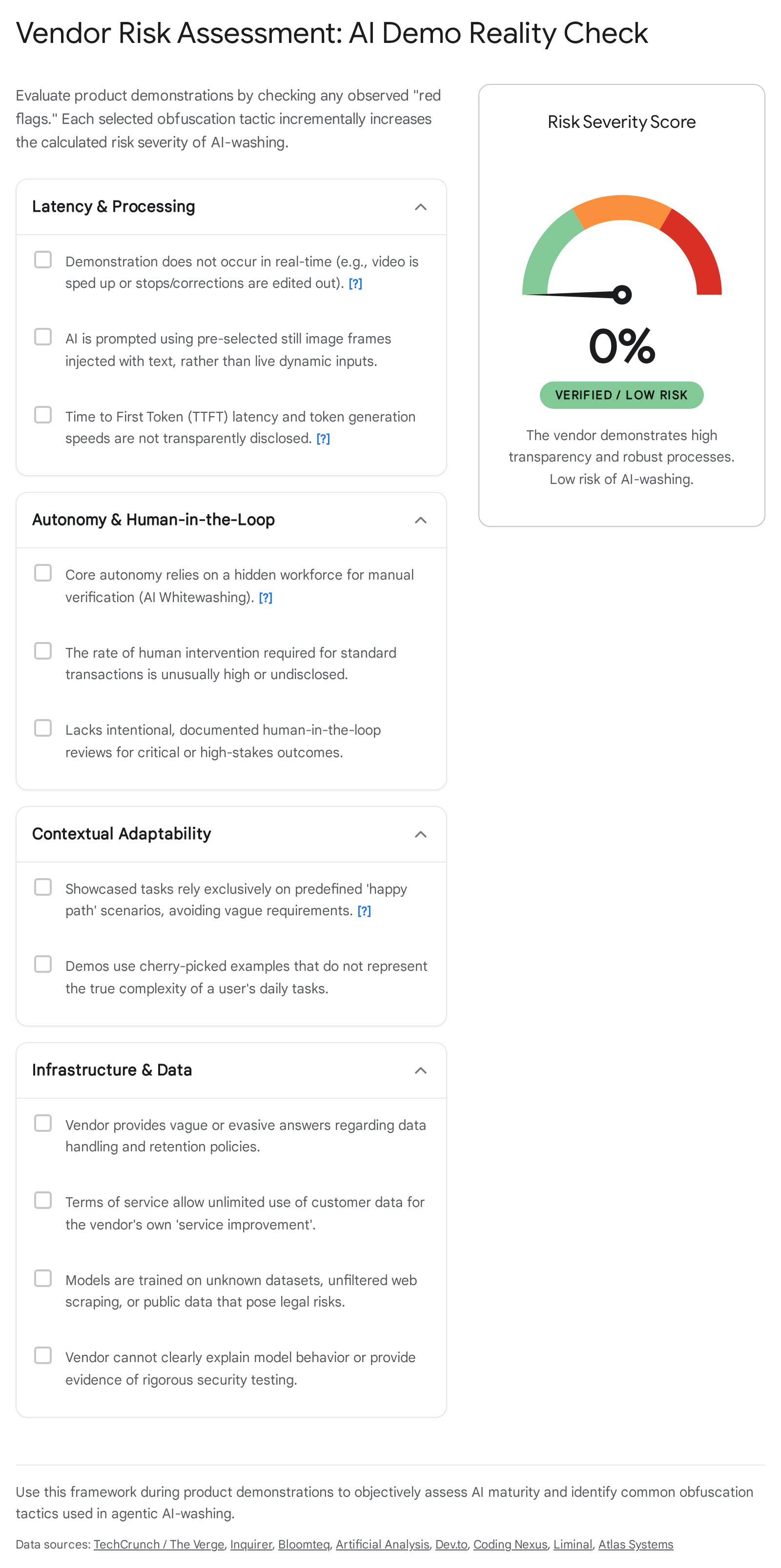
Non-technical buyers, small business owners, and enterprise procurement teams must shift their evaluation strategies from passive observation to active disruption. To truly assess an AI tool, buyers must treat the software not as an infallible oracle, but as a fragile system that must be pushed to its breaking point.
Break the "Happy Path" with Adversarial Constraints
Because tutorials and vendor demonstrations are designed to optimize for success, they actively avoid ambiguity and messy edge cases 23. Evaluators must introduce chaos into the testing process to see how the system recovers. Instead of asking an AI to perform a standard summary, users should issue ill-defined prompts, such as, "Summarize this data set for a highly skeptical executive audience, highlighting only the downside risks without assuming the outcome" 23.
Furthermore, evaluators should place strict constraints on the tool during the pilot phase - limiting the length of the context window, restricting the number of prompts allowed, or utilizing role-prompting to simulate real-world user personas 2355. The goal is to observe the system's failure modes. Does the AI admit it lacks context, or does it confidently hallucinate nonsense? An AI that confidently hallucinates in a sandbox will be catastrophic in a production environment 3637.
Analyze Visual Outputs for Structural and Physical Failures
When assessing generative AI meant to produce or analyze visual data, buyers should look for telltale signs of algorithmic generation, as artificial intelligence fundamentally does not understand the physical rules of geometry or temporal consistency 5657. Digital forensics experts emphasize looking for failing vanishing points (where parallel lines do not logically converge), mismatched lighting sources, disjointed shadows, and the uncanny smoothness of textures 5758.
For textual generation, evaluators should apply the "60-Second Slop Test": if a reader cannot underline three to five concrete, verifiable facts, specific metrics, or real-world examples in the first 200 words, the output is likely low-density, hallucinated filler 35. Replacing generic buzzwords with specific constraints forces the AI to demonstrate actual utility rather than mimicking professional vernacular 35.
Audit the Data and Security Architecture
Before procuring an AI tool, buyers must demand transparency regarding the underlying infrastructure. A vendor unable to produce comprehensive model cards or system cards - documents that clearly explain a model's training data sources, known biases, safety testing results, and intended limitations - should be immediately disqualified 59. If an AI system relies heavily on unregulated web scraping, it exposes the buyer to massive copyright infringement liabilities and data privacy risks 5960.
Furthermore, robust platforms must explicitly feature "Human-in-the-Loop" fallback protocols, acknowledging that AI should augment, rather than entirely replace, critical business decisions 596162. Access controls must be scrutinized to ensure that junior employees cannot accidentally rack up massive cloud computing bills by inappropriately querying expensive reasoning models for trivial tasks 60.
Execute Low-Risk, Time-Boxed Pilots
For small-to-medium businesses, the most effective defense against oversold technology is the "fail fast, fail small" methodology 2425. Rather than ripping out core legacy systems to install an untested enterprise AI suite, businesses should deploy six-to-twelve-week pilot programs targeting a single, low-risk workflow, such as automated email categorization, routine data entry, or baseline customer support routing 6165. By defining a clear, thirty-day measurable outcome and gathering baseline metrics prior to the pilot, organizations can accurately assess whether the tool actually drives productivity without committing to a devastating sunk cost 6165.
| Evaluation Vector | What the Demo Shows (The Illusion) | The Hidden Reality (The Truth) |
|---|---|---|
| Response Latency | Instantaneous, fluid, and highly conversational interactions that seamlessly mimic the pace of human dialogue without any pauses. | Videos are edited to remove processing delays. Real-world reasoning models (like o1) require 10-30 seconds of compute time to generate complex responses. |
| Autonomy & Operations | The software acts as an independent agent, flawlessly managing complex logistical networks or writing perfect software code without human oversight. | Systems often mask massive armies of offshore human workers ("Wizard of Oz" prototyping) or require constant human-in-the-loop intervention for accuracy. |
| Contextual Understanding | The AI flawlessly understands nuanced, highly specific client requests, reads supporting documentation, and executes multi-step logic flawlessly. | The model operates in a highly constrained "happy path." It frequently ignores explicit constraints, hallucinates data, and relies on repetitive, low-level execution patterns. |
| Data Ingestion | The platform effortlessly reads messy, unstructured enterprise data and synthesizes perfect, actionable business strategies on the fly. | Real-world AI requires pristine, highly structured data to function. Without rigorous data cleaning, the models suffer from "garbage in, garbage out" and produce "AI slop." |
| Cost & Efficiency | The tool runs effortlessly in the background, slashing operational costs and allowing for the immediate replacement of human capital. | Unpredictable token costs, expensive API calls, and the necessity of hiring IT managers to clean up errors often result in a net-neutral or negative short-term ROI. |
Bottom line
The current wave of artificial intelligence development undoubtedly possesses the potential to fundamentally restructure digital labor and enterprise efficiency. However, the ecosystem is currently saturated with vendors utilizing "movie magic" to camouflage basic automation, extreme latency, and hidden human labor. By discarding the assumption of autonomy and subjecting AI demonstrations to rigorous, hostile stress tests that break the "happy path," decision-makers can pierce the marketing veil. Ultimately, a business must treat any AI product not as an infallible oracle, but as a fragile, probabilistic tool that requires clean data, human oversight, and relentless verification to generate genuine, sustainable return on investment.