
Why Good Ideas Come in the Shower
Routine, low-demand activities like taking a warm shower place the human brain in a relaxed state of mild distraction, flooding the nervous system with dopamine. This specific cognitive environment temporarily dials down our rigid, goal-oriented focus, allowing the brain's resting networks to retrieve distant memories and forge the novel associations we experience as sudden creative epiphanies.
The Science of the "Shower Epiphany"
Almost everyone has experienced the phenomenon: after hours of staring at a computer screen trying to solve a complex professional or creative problem, you give up in frustration. Later, while standing under the warm water of a shower, scrubbing your hair, the perfect solution seemingly appears out of nowhere. This is not a random coincidence, but a highly specific neurological event that cognitive scientists have studied for decades.
Historically, this phenomenon has been categorized under the psychological concept of "incubation." First formalized in the 1920s by social psychologist Graham Wallas, the incubation stage of creativity occurs when a person steps away from a problem and is no longer consciously thinking about it 1. While it was once thought that the brain simply rested during this time, modern neuroimaging reveals that the subconscious mind is actually working furiously, searching through vast archives of memory to connect disparate concepts 13.
However, not all breaks are created equal. The specific environment of the shower provides a perfect neurochemical and psychological cocktail - combining sensory isolation, mild physiological relaxation, and a "low-demand" physical task - that optimizes the brain for divergent thinking 2. The warmth of the water triggers the release of dopamine, a neurotransmitter that not only enhances mood but lowers our inhibitory controls, signaling to the brain that it is safe to explore unconventional, chaotic cognitive pathways 25. To understand exactly why the shower acts as such an effective incubator, we must look at the competing networks operating inside the human brain.
The Brain's Dueling Networks
For a creative breakthrough to occur, the brain must perform a delicate balancing act between free-flowing imagination and critical evaluation. This process is governed by two massive, often opposing, neural systems: the Default Mode Network (DMN) and the Executive Control Network (ECN).
The Default Mode Network and Spontaneous Thought
The Default Mode Network is a widely distributed web of brain regions that activates when our minds are at rest or wandering, rather than focused on the outside world 534. It is closely associated with daydreaming, episodic memory recall, and projecting oneself into the future 56. When you are engaged in an automatic task - like washing your body - your brain does not require heavy cognitive resources, which frees the DMN to operate in the background and generate spontaneous, unfocused thoughts 5510.
The Executive Control Network
In contrast, the Executive Control Network is engaged when we deliberately focus our attention to achieve a specific goal, such as writing a report or analyzing a spreadsheet 78. The ECN handles top-down cognitive control, response inhibition, and working memory 8.
Under normal circumstances, the DMN and ECN act in opposition; when one turns on, the other typically turns off 48. If you are intensely focused on a task, your mind is restricted from wandering. However, creative thinking requires both networks to cooperate. The DMN generates new, seemingly unrelated ideas, while the ECN filters, evaluates, and organizes those chaotic ideas into a coherent, useful solution 513.
The Rostral Bridge
Recent advancements in neuroscience have pinpointed exactly how these networks collaborate. A 2024/2026 study examining patients with frontotemporal dementia - a disease that degrades the prefrontal cortex - identified the rostral prefrontal cortex as the literal "bridge" between the DMN and ECN 79. The researchers, operating out of the Paris Brain Institute, discovered that this region ensures a gradual functional transition between the "dreamy" spontaneous network and the "logical" control network 79. The greater the functional distance and connectivity between these two networks, the higher a person's creative ability in voluntary idea generation tasks 7910.
Causal Evidence from Brain Electrodes
Furthermore, groundbreaking studies utilizing intracranial electrodes implanted in the brains of epilepsy patients have provided rare, direct causal evidence of how these networks spawn ideas. Led by Dr. Ben Shofty and published in the journal Brain in 2024 and 2025, researchers measured high-resolution neural recordings in real-time as patients completed divergent thinking tasks 61112.
They found that the DMN is the very first region to activate during a creative task, lighting up within milliseconds to retrieve and sift through memories before synchronizing with the ECN to evaluate the thought 111213. The DMN activity was characterized by a distinct surge in gamma band power (30 - 70 Hz) and lower theta band power 413. Strikingly, when researchers used mild electrical stimulation to temporarily disrupt the DMN, the patients' ability to generate creative, out-of-the-box ideas was immediately stunted, proving the network's causal role in the creative process 61112.
The Goldilocks Zone of Distraction
If stepping away from a problem is the key to activating the DMN, why don't we get our best ideas while simply sitting in a chair and staring at a blank wall? The answer lies in the cognitive demand of the distraction.
Research indicates that a period of pure rest is actually less effective for creative incubation than engaging in a mildly engaging, habitual task 14. In a seminal 2012 study by Baird et al., participants were given an "Unusual Uses Task" and then assigned to one of four break conditions: a demanding task (requiring heavy working memory), an undemanding task (a simple reaction test), a period of pure rest, or no break at all 1415. The participants who engaged in the undemanding task performed substantially better on previously encountered creative problems compared to all other groups 1415.
This finding aligns with a massive 2009 meta-analysis by Sio and Ormerod, which reviewed 117 studies on the incubation effect. They consistently found that incubation periods are far more beneficial when individuals are occupied by an undemanding interpolated task rather than a highly demanding task or pure rest 1617.
Comparing Cognitive States for Creative Incubation
| Incubation Condition | Characteristics | Effect on Brain Networks | Impact on Creative Epiphanies |
|---|---|---|---|
| High-Demand Task | Requires heavy executive control and working memory (e.g., complex math, reading dense text). | Suppresses the Default Mode Network. Mind-wandering is minimal 1418. | Low. The brain remains fixed in an analytical mode, preventing distant associations from forming 14. |
| Rest / No Task | Sitting quietly with no external stimuli or physical engagement. | Allows some mind-wandering, but often leads to rumination or circular thoughts about the unresolved problem 1415. | Moderate. Fails to provide enough distraction to completely break cognitive fixation 1415. |
| Low-Demand Task | Habitual, automatic, mildly engaging activities (e.g., showering, walking, folding laundry). | Highly stimulates the DMN. Promotes "freely moving mind wandering" (FMMW) while occupying just enough conscious attention 219. | High. The optimal state. Distracts the conscious mind, allowing the subconscious to connect distant concepts 514. |
| N1 Sleep (Hypnagogia) | The brief twilight state between wakefulness and deeper sleep. | Maximum loosening of executive constraints; spontaneous visual and semantic associations 2021. | Very High. Provides extreme cognitive flexibility, though difficult to consistently harness without drifting into deep sleep 2021. |
The shower represents the ultimate "low-demand" environment. It occupies just enough of our executive function - monitoring water temperature, applying soap - to prevent us from consciously ruminating on our work 25. This leaves the vast majority of our cognitive resources free to engage in what researchers term "freely moving mind wandering" (FMMW) 19. FMMW is highly correlated with divergent thinking, allowing the mind to organically leap between unrelated concepts 19.
Additionally, the shower acts as a sensory isolation chamber. By stripping away digital notifications, screens, and environmental noise, the brain is temporarily shielded from incoming data, lowering the cognitive load and providing a fertile, distraction-free space for internal idea generation 2.
Connecting the Dots: Spreading Activation Theory
When the shower has successfully relaxed your executive control, stimulated your DMN, and flooded your system with dopamine, how exactly does a specific "good idea" physically materialize? Cognitive scientists explain this through "spreading activation theory" 282223.
Human memory is structured like a vast semantic network of interconnected nodes 2223. Concepts that are highly related - such as "fire engine" and "red" - are connected by strong, short conceptual links 23. When you think of a fire engine, activation energy quickly spreads to "red," making it easy to recall. However, breakthrough creativity relies on distant associations - connecting "fire engine" to a seemingly unrelated concept drawn from a widely different domain of knowledge 2432.
During focused, high-stress work, our executive control forces activation energy down the strongest, most obvious pathways to find quick, logical answers, which leads to incremental rather than radical ideas 2332. When we step into the shower and enter an incubation period, that rigid control dissipates. The activation energy from our unresolved problems is left to wander passively through the semantic network 33. Because the brain's filters are lowered, this energy can travel down weak, obscure, and distant pathways, eventually linking two previously unconnected nodes 233425. Once that distant connection is made, it breaches our conscious awareness, resulting in the sudden "aha!" moment.
The Twilight Sleep Sweet Spot
While the shower is a famous incubator, neuroscientists have recently identified another common daily state that mimics - and sometimes exceeds - these exact conditions: the brief twilight phase between wakefulness and deep sleep.
Known clinically as N1 sleep, or hypnagogia, this transitional state features a rapid loosening of mental constraints while the individual still retains a loose grip on conscious awareness 2026. Famous historical figures, including inventor Thomas Edison and artist Salvador Dalí, notoriously exploited this state. They would hold a steel ball or a heavy key over a metal plate while drifting off in a chair; the moment they slipped past N1 into deeper sleep, their muscles would relax, the object would drop, and the noise would wake them up, allowing them to record the bizarre, highly creative associations their brains had just generated 21.
Recent empirical studies have validated this eccentric habit. In a 2021 study by the Paris Brain Institute, participants were given a mathematical puzzle that contained a hidden, elegant rule that allowed for instant completion 2021. Participants who failed to see the rule were given a 20-minute break. Those who were allowed to briefly drift into N1 sleep (using the Edison object-drop technique) were exponentially more successful at discovering the hidden rule upon waking than those who stayed awake or those who fell into deeper (N2) sleep 2021.
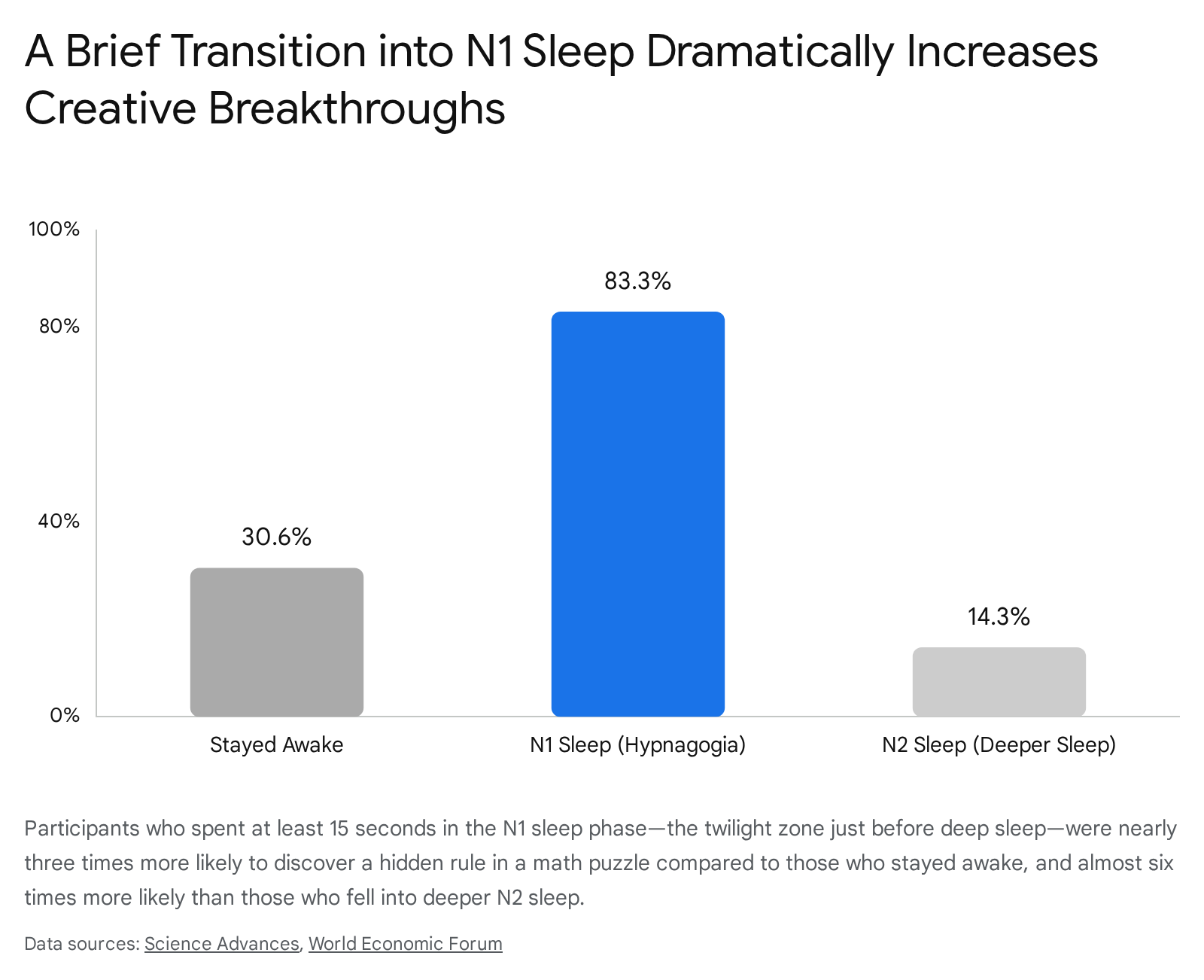
Further supporting this, a 2023 study by MIT and Harvard Medical School demonstrated that "targeted dream incubation" - prompting individuals to think about a specific topic as they entered N1 sleep - resulted in stories that were 43% more creative than those who napped without a prompt, and 78% more creative than those who stayed awake 26. Like the shower, the N1 sleep state provides an optimal balance of relaxed executive control and active, spreading semantic networks 3326.
Interestingly, there is a complex relationship between creativity and overall sleep quality. While brief periods of N1 sleep induce insight, prolonged sleep disturbances are sometimes viewed as the price of high creativity. A 2017 study from the University of Haifa comparing art and social science students found a dichotomy: highly visual creatives often reported poor sleep quality and daytime dysfunction (a phenomenon sometimes dubbed "creative insomnia"), whereas highly verbal creatives tended to sleep longer hours but on delayed schedules 2728. However, across larger populations, chronic poor sleep is generally detrimental; a study of college students during the pandemic showed that while sleep quality correlates negatively with raw creative output under stress, it is vital for restoring the executive function needed to evaluate those ideas 29.
Cultural and Psychological Contexts
Because creativity is often viewed through a cultural lens, cognitive scientists have questioned whether these mechanisms - and our attitudes toward mind-wandering - are universal.
Cross-Cultural Conceptions of Creativity
Cross-cultural studies consistently indicate that Eastern and Western populations define and prioritize different facets of creativity. Western, individualistic cultures frequently emphasize radical novelty, independence, and self-expression 4030. Conversely, East Asian cultures often place greater value on the "usefulness" dimension of creativity, emphasizing social contribution, refinement, and incremental improvement that respects existing norms 4042.
These cultural values dictate how the act of mind-wandering itself is judged. A comparative study between British and Chinese participants found no significant difference in the actual frequency or physiological causes of mind-wandering between the two groups 31. However, British participants tended to view mind-wandering as a neutral or even positive experience, whereas Chinese participants were more likely to emphasize its negative outcomes, potentially reflecting cultural norms that prioritize effortful, continuous attention as a moral duty 31.
Interestingly, bridging these cultures can be a massive catalyst for innovation. Research indicates that living abroad and developing a "global cultural identity" actively enhances cognitive flexibility. The friction of navigating different cultural norms forces the brain to reconcile distant concepts, leading to higher scores on divergent thinking tests than those who never leave their home culture 3232.
The Hidden Bias Against Creativity
Despite society's claimed desire for "out-of-the-box" thinking, human psychology often harbors a hidden bias against true creativity, particularly in times of uncertainty. A notable study from the University of Pennsylvania found that when people are primed to feel uncertain, they subconsciously associate words like "creative" and "original" with negative concepts like "poison" or "hell," rather than positive concepts 33. Because creative ideas are inherently risky and untested, the executive brain often rejects them in favor of safe, familiar solutions 33.
This is another reason why the shower is so critical. By removing the pressure to produce and dialing down the anxiety associated with formal brainstorming, the brain circumvents its own bias against novelty. As Stanford researchers found when monitoring brain activity during creative tasks, the cerebellum and executive regions can actually choke under pressure; as lead author Manish Saggar noted, "The more you think about it, the more you mess it up" 34.
The Universal Dynamics of Innovation
Despite variations in cultural attitudes toward daydreaming, the underlying neurological machinery of incubation appears entirely universal. In an unprecedented 2025 multi-center study, researchers analyzed resting-state fMRI and creative task performance across 2,433 participants from 10 independent samples spanning Austria, Canada, China, Japan, and the United States 435.
The researchers found that across all ethnicities and geographic locations, creative ability could not be predicted by general intelligence, but it could be reliably predicted by a single metric: the individual's capacity to dynamically switch between the Default Mode Network and the Executive Control Network 41335. Creativity is not just about letting the mind wander; it requires an "inverted-U relationship" of balanced brain network dynamics - enough freedom to generate a wild idea, and enough control to recognize its value 435.
Bottom line
The phenomenon of having brilliant ideas in the shower is a verifiable neurobiological event driven by the brain's need for incubation. By providing a warm, low-demand environment, the shower relaxes the rigid Executive Control Network, releases dopamine, and allows the Default Mode Network to wander through vast semantic memory banks to forge distant, novel connections. While cultural perceptions of daydreaming and sleep patterns may vary, the necessity of stepping away from a problem to allow the subconscious mind to work is a universal requirement for human innovation.