
How the Brain Switches Between Creating and Judging Ideas
Human creativity is not a singular, localized trait, but rather a highly dynamic biological process that relies on the brain continuously toggling between two competing modes: divergent thinking for generating novel ideas and convergent thinking for evaluating them. Recent breakthroughs in network neuroscience reveal that true innovation requires the brain's "salience network" to effectively manage the switch between the daydreaming default mode network and the analytical executive control network. Attempting to force the brain to create and judge simultaneously results in profound cognitive friction, which severely hinders both ideation and execution.
The Evolution of Creative Problem-Solving Theory
For much of the early twentieth century, the scientific and educational communities viewed human intelligence through a rigid, singular lens. Intelligence was widely considered a fixed trait, measurable exclusively through standardized testing that prioritized logic, memory recall, and the ability to find one correct answer to a highly structured question. The concept of creativity was largely relegated to the domain of the arts, viewed as a mysterious, unquantifiable gift rather than a cognitive mechanism that could be studied or improved.
The 1950 APA Address That Changed Intelligence Research
This reductive view of human cognition began to fracture in 1950 when American psychologist Joy Paul Guilford delivered his landmark presidential address to the American Psychological Association. Guilford argued forcefully that traditional intelligence tests were fundamentally flawed because they only measured a very narrow slice of human cognitive ability 12. He proposed that standard IQ tests entirely neglected the mental processes that drive innovation, original thought, and complex problem-solving 1.
Guilford's address is widely recognized as the founding document of modern creativity research 1. To replace the monolithic view of intelligence, Guilford developed the Structure of Intellect (SOI) model, a multidimensional classification system proposing that human cognition consists of up to 180 distinct intellectual abilities 1. The most enduring and revolutionary contribution of this model was Guilford's formal distinction between two complementary cognitive approaches: divergent thinking and convergent thinking 233.
Defining the Twin Pillars of Thought
Guilford theorized that navigating complex problems requires an individual to move fluidly between expanding possibilities and narrowing them down.
Divergent thinking is the exploratory, generative phase of problem-solving. It is a non-linear, free-associative, and uninhibited process designed to generate multiple possible solutions to an open-ended situation 233. When an individual brainstorms unusual uses for a brick, imagines the future trajectory of an industry, or sketches preliminary architectural designs, they are actively engaging in divergent thought 34. The fundamental goal of divergent thinking is not accuracy or feasibility, but rather volume and variety. Guilford identified four key properties that characterize strong divergent thinking ability: fluency (the sheer quantity of ideas produced), flexibility (the variety of different approaches or categories used), originality (the statistical rarity or uniqueness of the ideas), and elaboration (the depth of detail applied to the concepts) 13.
Convergent thinking represents the necessary counterpart to this creative expansion. It is the evaluative, analytical phase of problem-solving. Convergent thinking is structured, deliberate, and deeply logical 236. Once a divergent process has yielded a vast array of potential ideas, convergent thinking is the mechanism used to apply constraints, test logical consistency, and eliminate weak or unfeasible concepts 78. The ultimate objective of convergent thinking is to deduce the single best, most accurate solution to a specific problem 13.
To fully grasp how these two modes operate in daily cognition, it is helpful to look at their defining characteristics side-by-side:
| Cognitive Feature | Divergent Thinking | Convergent Thinking |
|---|---|---|
| Primary Objective | Generate multiple possible solutions or ideas. | Deduce the single optimal or correct solution. |
| Cognitive Approach | Non-linear, free-associative, exploratory. | Linear, logical, analytical, highly structured. |
| Key Performance Metrics | Fluency, flexibility, originality, elaboration. | Speed, accuracy, precision, deductive logic. |
| Typical Tasks | Brainstorming, mind-mapping, free-writing. | Multiple-choice tests, troubleshooting, data analysis. |
| Mental State Required | Suspension of judgment; uninhibited exploration. | Critical evaluation; strict adherence to boundaries. |
Both modes are entirely necessary for human progress and practical innovation. As cognitive scientists note, divergent and convergent thinking occupy opposite sides of the same coin: where divergent thinking is about discovering, convergent thinking is about defining 3. Divergent thinking without convergent thinking leads to endless daydreaming without execution or practical application. Conversely, convergent thinking without divergent thinking leads to rigid, repetitive execution without the capacity to adapt or innovate 3.
Measuring the Unmeasurable: The Torrance Tests
Following Guilford's theoretical breakthrough, the psychological community faced a new challenge: how to empirically measure these distinct modes of thought. Building directly on Guilford's foundation, Ellis Paul Torrance developed the Torrance Tests of Creative Thinking 12. These tests moved away from the multiple-choice formats of standard IQ assessments and instead presented subjects with open-ended challenges designed to measure divergent potential.
Common assessments included the Alternative Uses Test, where participants were asked to generate novel uses for common household objects, the Consequences Test, which required subjects to imagine the outcomes of unlikely hypothetical events, and the Plot Titles Test, where individuals created clever titles for short stories 1. While subsequent research noted that divergent thinking tests show only a modest correlation with real-world creative achievement - due to cultural and educational influences on test performance - these measurement tools fundamentally transformed how educational programs evaluated and fostered creative potential in students 12.
Dismantling the Left-Brain Versus Right-Brain Myth
Before examining the modern neuroscientific consensus on how the brain dynamically manages these two modes of thought, it is necessary to confront and discard one of the most pervasive, damaging myths in popular psychology: the concept of the "left-brained" versus "right-brained" thinker.
The Origins of a Persistent Neuromyth
The belief that human personality and cognitive style are dictated by a dominant hemisphere of the brain gained massive traction in the 1960s 95. The myth originated from misinterpretations of pioneering, Nobel Prize-winning research by neuroscientist Roger W. Sperry, who studied patients with severed corpus callosums (the bundle of nerves connecting the two hemispheres) to treat severe epilepsy 96.
Sperry's legitimate findings that certain functions exhibit lateralization - such as language processing frequently occurring on the left side and spatial awareness on the right - were rapidly distorted by popular culture 97. The oversimplified narrative suggested that the left hemisphere was the exclusive home of logic, structure, mathematics, and convergent thinking. Conversely, the right hemisphere was branded as the seat of intuition, art, emotion, and divergent creativity 98.
Consequently, society began to label people as either "left-brained" (analytical and quantitative) or "right-brained" (creative and qualitative) 89. Following this theory, corporate managers seeking innovative ideas were advised to hire "right-brained" team members, while those needing data analysis were told to seek out "left-brained" employees 5.
The Utah Brain Scan Study: Debunking Hemispheric Dominance
Modern neuroimaging technology has thoroughly dismantled this strict dichotomy. In 2013, a landmark study conducted by neuroscientists at the University of Utah provided definitive proof that the left-brain/right-brain personality divide is a biological fiction 79.
Led by Dr. Jeff Anderson, the research team utilized resting-state functional connectivity magnetic resonance imaging (rs-fcMRI) to scan the brains of 1,011 individuals aged between seven and 29 years 7. The researchers divided the neuroanatomy of each participant into over 7,000 distinct regions to determine whether one side of the brain was fundamentally more active, stronger, or more highly connected than the other 79.
The results were unequivocal: the researchers found absolutely no evidence of whole-brain "sidedness" 79. While specific micro-functions may lean left or right (for instance, 97% of right-handed individuals have their primary speech center in the left hemisphere), human beings do not possess a stronger left-sided or right-sided global network that dictates their personality or creative capacity 79. As Jared Nielsen, a researcher on the project, noted, the brain simply does not exhibit patterns where an entire hemispheric network is dominant 7. If a medical professional were to conduct a CT scan, an MRI, or an autopsy on a mathematician and an artist side-by-side, it is highly unlikely that any clear pattern in brain structure would differentiate the logical thinker from the creative one 8.
Societal and Educational Repercussions
Despite rigorous scientific debunking, the left-brain/right-brain myth persists, largely because of its seductive simplicity 97. Believing that one is "creative but not analytical" or "logical but unintuitive" provides an easy excuse for avoiding challenging tasks, fostering a fixed mindset that limits personal growth 78. As pioneering psychologist Carol Dweck has argued in her research on growth mindsets, individuals can improve their cognitive capacities in whatever areas they choose to invest time and focus; cognitive preferences are not hard-wired physiological limitations 8.
Furthermore, the persistent belief in a rigid hemispheric divide has deeply influenced educational frameworks worldwide, leading to the systemic devaluation of creativity 9. By artificially separating Science, Technology, Engineering, and Mathematics (STEM) disciplines from the arts, educational systems have promoted a societal mindset that segregates "hard skills" from "soft skills" 9. In an era where artificial intelligence is increasingly capable of executing strictly convergent, computational tasks, creativity across all disciplines - not just the arts - will become the defining cognitive skill 9. Creativity is not confined to the right hemisphere; it is a whole-brain process that relies on complex interconnections across multiple neurological networks 9.
The Tri-Network Architecture of Creativity
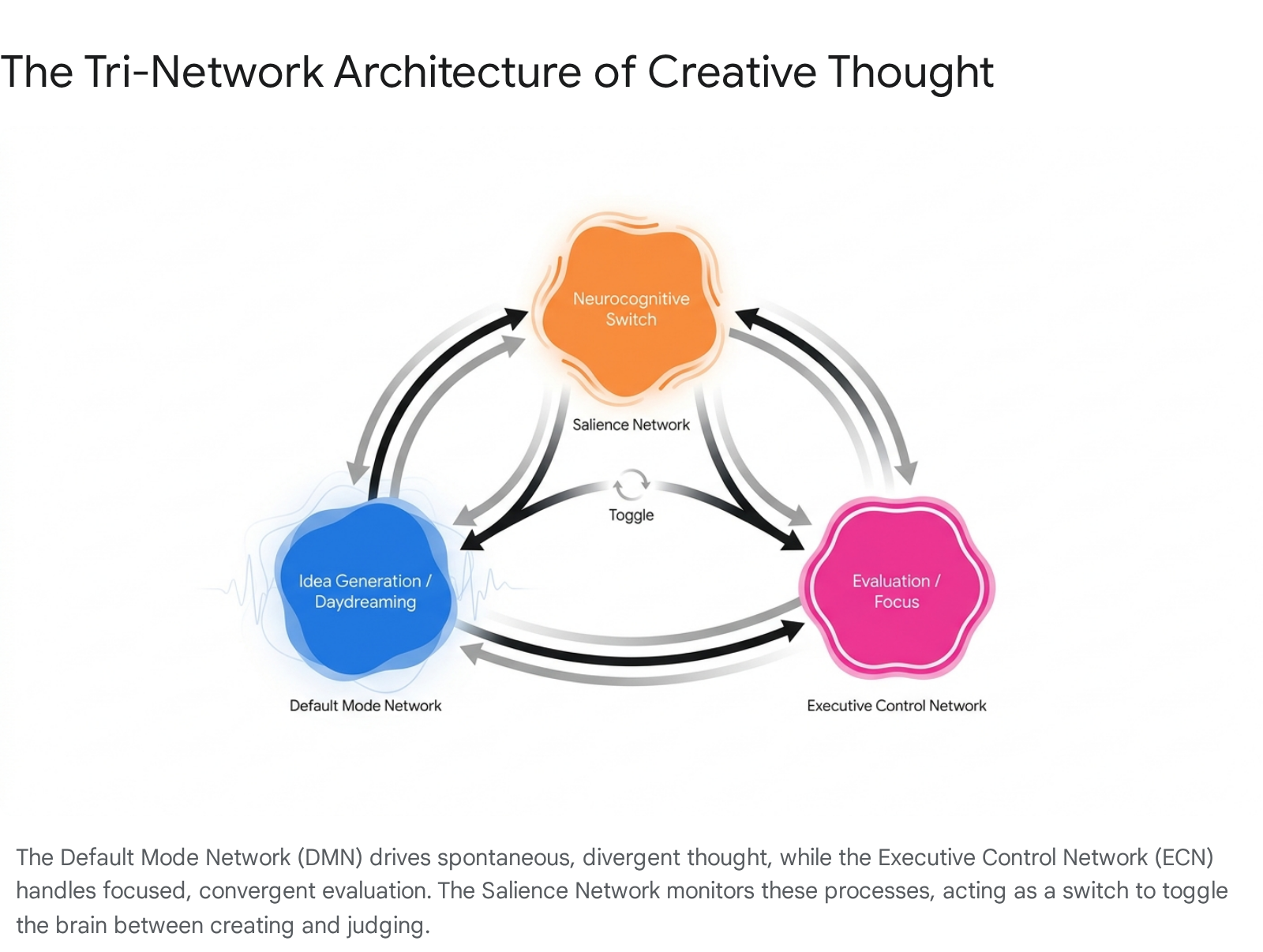
If creativity is not localized to the right side of the brain, where exactly does it come from? Over the past decade, advancements in functional magnetic resonance imaging (fMRI) have moved the scientific focus away from specific, isolated brain regions and toward the study of large-scale, distributed functional networks 10. Neuroscientists have discovered that the dynamic interplay between divergent and convergent thinking is governed by the continuous interaction of three massive brain networks.
The Default Mode Network (DMN): The Engine of Imagination
The Default Mode Network (DMN) is a widespread set of brain regions, heavily featuring midline structures, the medial prefrontal cortex, and the posterior cingulate cortex 101117. The DMN was discovered when researchers noticed that these specific areas become highly active during the absence of external task demands - when the brain is seemingly at "rest" 510.
However, the DMN is anything but dormant. It is the network responsible for self-referential thought, recalling past episodic memories, imagining future scenarios, and unstructured mind-wandering 1819. In the context of creative problem-solving, the DMN serves as the foundational engine of divergent thinking 18. When an individual is engaged in spontaneous, unfocused thought, the DMN pulls from vast reserves of memory and experience to generate novel ideas and forge connections between seemingly disparate concepts 41118.
The Executive Control Network (ECN): The Architect of Logic
Operating in stark contrast to the DMN is the Executive Control Network (ECN). The ECN comprises lateral prefrontal and parietal regions, including the dorsolateral prefrontal cortex 101117. This network engages specifically during cognitive tasks that require externally directed attention, complex decision-making, working memory, and response inhibition 10.
When an individual needs to rein in their imagination, filter out irrelevant environmental distractions, and critically assess whether a proposed idea aligns with logical constraints, the ECN takes absolute command 1819. The ECN is the primary biological driver of convergent thinking, goal-directed processing, and the meticulous execution of plans 1117.
The Salience Network (SN): The Neurocognitive Switch
Historically, neuroscientists viewed the DMN and the ECN as fundamentally anti-correlated. Under normal circumstances, activation of one network corresponds with the suppression of the other 10. When an individual is highly focused on entering data into a spreadsheet (high ECN activity), it is nearly impossible to simultaneously daydream about a new product design (high DMN activity) 5.
Yet, complex creativity inherently requires both. It requires the DMN to surface an original idea, and the ECN to evaluate, refine, and execute it 1118. To manage this paradox, the brain relies on a crucial third system known as the Salience Network (SN). Anchored deeply within the right anterior insula, the Salience Network acts as an intelligent neurocognitive switch 1112.
The SN continuously monitors incoming sensory data, internal emotional states, and streams of thought 11. When an exploratory idea bubbles up from the DMN that merits further development, the Salience Network initiates a switch. It recruits the lateral regions of the ECN to focus attention on the new idea, while simultaneously suppressing the spontaneous noise of the DMN to prevent distraction 1112. This tri-network circuitry - the seamless toggling between generation, switching, and evaluation - is the biological foundation of human creativity 11.
Dynamic Network Switching: The 2025 Global Neuroscience Breakthrough
The conceptual understanding of the tri-network model was significantly validated and expanded in January 2025 by a massive, multi-center neuroscience study published in Communications Biology 2113. Seeking to test the hypothesis that individual creativity relies on the functional connectivity and toggling between the DMN and ECN, an international team of researchers aggregated data from 10 independent neuroimaging samples across Austria, Canada, China, Japan, and the United States 2114.
Comprising 2,433 participants, this undertaking represented the largest and most ethnically diverse brain imaging study of human creativity ever conducted 2115.
Time-Resolved Network Analysis and the Inverted-U Relationship
Using advanced time-resolved network analysis, the researchers examined resting-state fMRI data to track how frequently participants' brains shifted between states of network segregation (where the DMN and ECN operate independently) and network integration (where they communicate) 2115.
The findings were profound: researchers discovered that an individual's level of creativity - specifically their divergent thinking ability as measured by human-rated originality scores on cognitive tasks - could be reliably predicted by the sheer frequency of dynamic switches between the DMN and ECN 2114. Crucially, this high switching frequency predicted creative ability, but it did not extend to predicting general intelligence scores, confirming that creativity relies on a highly specific neurocognitive mechanism distinct from raw IQ 211314.
Furthermore, the researchers identified a mathematically precise "inverted-U" relationship between creative performance and the degree of balance in DMN-ECN switching 2113. This inverted-U curve suggests that optimal creative performance requires a delicate equilibrium. If the brain switches networks too infrequently, it becomes stuck in either endless, unproductive daydreaming or rigid, overly constrained logic 2115. Conversely, if the brain switches too erratically, cognition becomes disjointed and chaotic. To ensure the robustness of this finding, the researchers conducted an independent task-based fMRI validation study with 31 additional participants 2113. This validation confirmed that DMN-ECN switching actively increases during the generation of creative ideas compared to control conditions, perfectly replicating the inverted-U dynamic 2114.
The Semantic Control Network and Word Associations
While the global switching between the DMN and ECN dictates broad creative states, neuroscientists have also observed similar dynamic toggling at the micro-level within specific cognitive domains, such as language processing.
A 2025 study from the University of York mapped the intrinsic functional architecture of the Semantic Control Network (SCN), located primarily in the left inferior frontal gyrus (LIFG) and the posterior temporal cortex 161718. The researchers wanted to understand how semantic memory interacts with control processes to generate both divergent and convergent creativity 16.
When participants engaged in divergent verbal creativity tasks - such as the Unusual Uses Task - the researchers observed that success relied heavily on the efficient retrieval of "weak associations" 1628. To achieve this, the LIFG decoupled from the brain's default and frontoparietal networks, instead coupling with language-related auditory-motor regions to pull distant, unusual concepts from the anterior temporal lobe's multimodal semantic store 162829.
However, when participants tackled convergent creativity tasks - such as the Remote Associates Task, which requires finding a single word that conceptually links three unrelated words - the neural strategy shifted entirely. Better performance on convergent tasks was linked not to broad retrieval, but to strict "semantic selection" 1617. This required greater coupling between the semantic store and the semantic control network to rigorously filter out irrelevant meanings and hone in on the precise, context-appropriate link 1628. This demonstrates that even within the specialized domain of language, the brain actively alters its functional architecture depending on whether it needs to expand the creative search space or bypass irrelevant data to converge on a single target 416.
Neurophysiological Markers: Upper Alpha Band Modulations
Recognizing that divergent and convergent thinking are parts of a continuous cycle rather than an absolute dichotomy, cognitive researchers are increasingly looking for ways to track this continuum in real-time. A 2024 paper in the Creativity Research Journal proposed that specific electroencephalography (EEG) signals can serve as neurophysiological markers for this shifting cognitive state 30.
The researchers argued that modulations in the upper alpha band (10 - 12 Hz) of brainwaves can reliably disentangle divergent-convergent cycles within creativity tasks 30. By tracking upper alpha band activity, scientists can observe the data-driven markers of task demands and immediate problem space accessibility, further confirming that creative problem-solving is an iterative continuum rather than a simple toggle switch 30.
The Science of Cognitive Friction
The brain's architecture clearly dictates that generating ideas and judging ideas require fundamentally different neural configurations. While the Salience Network is adept at switching between the DMN and ECN, forcing the brain to engage both networks simultaneously - or forcing it to toggle between them at an unnaturally rapid pace - creates severe "cognitive friction."
Cognitive friction occurs when cognitive effort encounters misaligned structures, conflicting task demands, or ambiguous conditions for action 31. In complex environments, this internal resistance accumulates gradually, leading to hesitation, confusion, mental fatigue, and a sharp decline in decision quality 31. Because the divergent DMN and the convergent ECN naturally act in opposition, attempting to deploy them simultaneously is akin to driving a vehicle while pressing the accelerator and the brake pedals at the exact same time 10.
Why Doing Both Simultaneously Fails
When cognitive flow is disrupted by friction, the core functional stages of the cognitive framework - perception, interpretation, evaluation, and action - lose coherence 31. Information may be perceived but not properly evaluated, or actions may proceed without clear ownership 31. Consequently, errors repeat, biases persist, and institutional memory weakens 31.
A prime example of this friction occurs when individuals attempt to execute highly creative tasks under intense, immediate analytical scrutiny.
The Neuroscience of Writing and Editing
Consider the famous literary adage advising writers to "write drunk, edit sober." While the endorsement of intoxication is hyperbole, the underlying cognitive principle is scientifically sound: the mental state required to generate text is utterly hostile to the mental state required to analyze it.
Neuroimaging studies examining the creative writing process provide clear evidence for this required segregation. When a writer plans and generates text, they rely on a fronto-parieto-temporal network that includes the bilateral inferior frontal gyrus (IFG) 19. This network activity facilitates verbal fluency, cognitive flexibility, and divergent thinking 19.
However, the act of reviewing, editing, and correcting grammar requires intense, top-down attentional control, which is primarily driven by the dorsolateral prefrontal cortex (dlPFC) within the executive control network 19. In 2013, a novel fMRI study by Shah et al. tracked brain activity during active handwriting 19. Subsequent analyses of creative generation tasks show that for true divergent creativity to occur, the analytical dlPFC must actually deactivate 19.
If a writer attempts to compose a first draft while simultaneously scrutinizing their spelling and sentence structure, their ECN remains highly active. Because the executive control network interacts with the default network specifically to inhibit salient conceptual knowledge and prepotent responses, the ECN's editing function will actively suppress the DMN's ability to retrieve the unusual, vivid associations required for compelling writing 1220. To operate effectively, the brain demands that generation and evaluation be temporally segregated 19.
The Impact of Artificial Intelligence on Cognitive Engagement
The introduction of generative Artificial Intelligence (AI) into daily problem-solving has introduced a new vector for cognitive interference. Because large language models (LLMs) effortlessly output highly structured, convergent-looking text, human users frequently bypass the divergent struggle of idea generation altogether.
A recent study conducted by researchers at the MIT Media Lab, led by Nataliya Kosmyna, investigated how over-reliance on AI tools impacts neural connectivity during writing tasks 34. The researchers divided over 50 college students into three groups to write essays: one group used only their own brains, a second used Google search, and a third utilized OpenAI's ChatGPT 34.
By measuring neural connectivity, the researchers observed that the group relying solely on their own cognitive faculties exhibited dense "chatter" across brain networks, as they actively retrieved memories, formulated concepts, and structured arguments 34. In contrast, the group using ChatGPT showed significantly reduced brain engagement and connectivity 34. Furthermore, the essays produced by the AI group suffered from impaired ownership - the students felt disconnected from the text they submitted - and the language produced was highly homogenous, reflecting an "average everything everywhere" baseline rather than original divergent thought 34. This suggests that bypassing the internal friction of generating ideas by offloading the task to AI fundamentally alters, and potentially degrades, the brain's natural creative engagement 34.
The Illusion of Group Brainstorming
The neurobiological conflict between divergent and convergent thinking perfectly explains the widespread failure of traditional corporate brainstorming. Over seventy years ago, advertising executive Alex Osborn popularized brainstorming as a group ideation technique 35. Osborn's core rule was that criticism must be suspended while participants shout out wild ideas in a free-for-all setting 3521.
While the theory of uninhibited group ideation sounds appealing, decades of rigorous cognitive research prove that traditional brainstorming consistently fails to maximize productivity or idea quality 3521. A meta-analysis of 23 controlled experiments comparing brainstorming groups to individuals working alone found that groups consistently generated fewer ideas 35. A subsequent 1991 meta-analysis of 38 experiments confirmed this counterintuitive phenomenon, revealing that individuals working separately outperform brainstorming groups by a staggering 83% 35.
Cognitive science points to several distinct psychological and neurological phenomena that ruin group brainstorming, all of which stem from forcing the brain into conflicting states.
Production Blocking and Attention Shifts
The primary factor undermining face-to-face brainstorming is "production blocking" 35. When individuals sit in a room and must take turns sharing ideas out loud, their natural, divergent flow of thought is abruptly interrupted 35.
Instead of allowing the DMN to freely associate, participants are forced to shift their attention to listening to their colleagues 35. This requires engaging the ECN to process incoming auditory information. While waiting for an opening in the conversation, momentum is lost, and nascent ideas generated during the downtime are frequently forgotten before they can be expressed 35. Researchers estimate that up to half of the time spent in a traditional brainstorming session is wasted on this non-productive cognitive traffic jam 35.
Evaluation Apprehension and Social Loafing
Beyond structural production blocking, brainstorming is heavily hindered by the social dynamics of evaluation apprehension and social loafing 35.
Evaluation apprehension occurs when individuals censor their own ideas due to the fear of judgment from peers or superiors 35. Even if a facilitator strictly demands a "no criticism" environment, human beings naturally self-edit for social acceptability 35. This fear forces the ECN to remain on high alert, constantly monitoring and censoring the DMN's outputs before they can be vocalized 35.
Social loafing further dilutes output. As group size increases, individual effort naturally declines due to a diffusion of responsibility 35. Participants subconsciously assume others will carry the creative burden, leading to decreased engagement. Combined, these phenomena ensure that traditional, unstructured group brainstorming sessions devolve into superficial discussions rather than high-yield creative gatherings 3521.
The Case of "Productive Failure" in Learning
The importance of structuring cognitive tasks correctly is also evident in educational models like "Productive Failure" (PF). PF is a learning design where students intentionally attempt to solve complex problems before receiving explicit instruction 37. The theory posits that the initial divergent struggle to generate solutions - even if they fail - better prepares the brain to understand the convergent, correct concept when it is later taught 37.
However, productive failure does not always succeed. An analysis of 95 experimental comparisons across 57 studies revealed that PF often fails to outperform traditional instruction when the specific design criteria of the activity are compromised 37. If the preparatory problem-solving activity lacks fidelity, or if the social surround does not adequately support the transition from the divergent exploration phase to the convergent instruction phase, the cognitive friction overwhelms the student, resulting in null or negative effects on conceptual knowledge transfer 37.
Achieving the Creative "Flow" State
When the brain successfully calibrates the relationship between the DMN and the ECN, mitigating cognitive friction entirely, a person can enter what psychologists term "flow" 1122. Initially identified by the pioneering psychologist Mihaly Csikszentmihalyi, flow is defined as a state of effortless, enjoyable productivity where an individual is so completely immersed in an activity that all external distractions fade away 1122.
Historically, flow was treated as an elusive, almost spiritual state. However, recent neuroimaging has provided a mechanical explanation for how the brain achieves it.
Expertise and the Release of Control
A 2024 neuroimaging study conducted by the Creativity Research Lab at Drexel University isolated the brain activity associated with flow during a highly dynamic creative task: jazz improvisation 22. Led by Dr. John Kounios and Dr. David Rosen, the team recorded high-density EEGs of guitarists as they improvised to determine how the brain reaches the "zone" 22.
The findings revealed that the creative flow state relies on an "expertise-plus-release" mechanism 22. First, an individual must build up extensive experience and expertise in a specific domain. This rigorous practice constructs a highly specialized, efficient network of brain areas capable of generating the desired types of ideas 22.
Once this specialized network is established, the second critical step is the release of cognitive control 22. The musician must "let go." The brain's executive control network significantly relaxes its conscious, convergent supervision, allowing the specialized divergent circuit to operate on "autopilot" with virtually no interference 22. Individuals who lack baseline expertise, or those who are unable to release the analytical grip of their ECN, struggle to achieve deep creative flow 22.
Jazz Musicians and Deep Creative States
The concept of releasing ECN control during improvisation has been documented in earlier neuroscience literature. A foundational 2008 fMRI study led by Charles Limb placed jazz musicians inside brain scanners to observe neural activity while they played scales, performed memorized sheet music, and engaged in free improvisation 19.
The scans showed that during spontaneous improvisation, the brain actively inhibited the dorsolateral prefrontal cortex - the region heavily linked with executive decision-making and self-censorship - while simultaneously activating the medial prefrontal cortex, a region linked with language and creative expression 19. This confirmed that deep creativity requires the conscious brain to quite literally get out of its own way 19.
Emotional Regulation and Reduced Self-Monitoring
A comprehensive 2026 review published in Frontiers in Behavioral Neuroscience synthesized data from nine distinct neuroimaging studies investigating flow states across diverse tasks, from video gaming to musical improvisation 111723. The review confirmed that flow is a unique neurocognitive phenomenon marked by dynamic network reconfiguration 11.
During flow, the brain exhibits a precise downregulation of core DMN regions associated with self-referential thought and the "inner critic," allowing for diminished self-consciousness 1117. Simultaneously, lateral prefrontal and parietal areas underpinning attentional control show increased activity to keep the individual anchored to the task 1117.
Crucially, this integrated network state fosters immense emotional stability. The studies noted a marked reduction in amygdala activity (the brain's emotional threat center) and increased coupling with reward networks 1117. This neurobiological shift explains why flow states provide the ultimate balance: high, effortless focus coupled with extremely low anxiety 1117.
Practical Strategies to Separate Thinking Modes
Understanding that divergent and convergent thinking are governed by distinct, competing neural networks provides a massive operational advantage for structuring everyday workflows. To maximize creative output, minimize cognitive friction, and avoid the pitfalls of unstructured brainstorming, individuals and organizations must intentionally and ruthlessly separate these two modes of thinking.
The Double Diamond Methodology
The design thinking methodology inherently respects the brain's biological need to separate these modes through an industry-standard framework known as the "Double Diamond" 34024.
The Double Diamond process dictates that problem-solving must occur in successive cycles of expanding (divergent) and contracting (convergent) focus 4024.
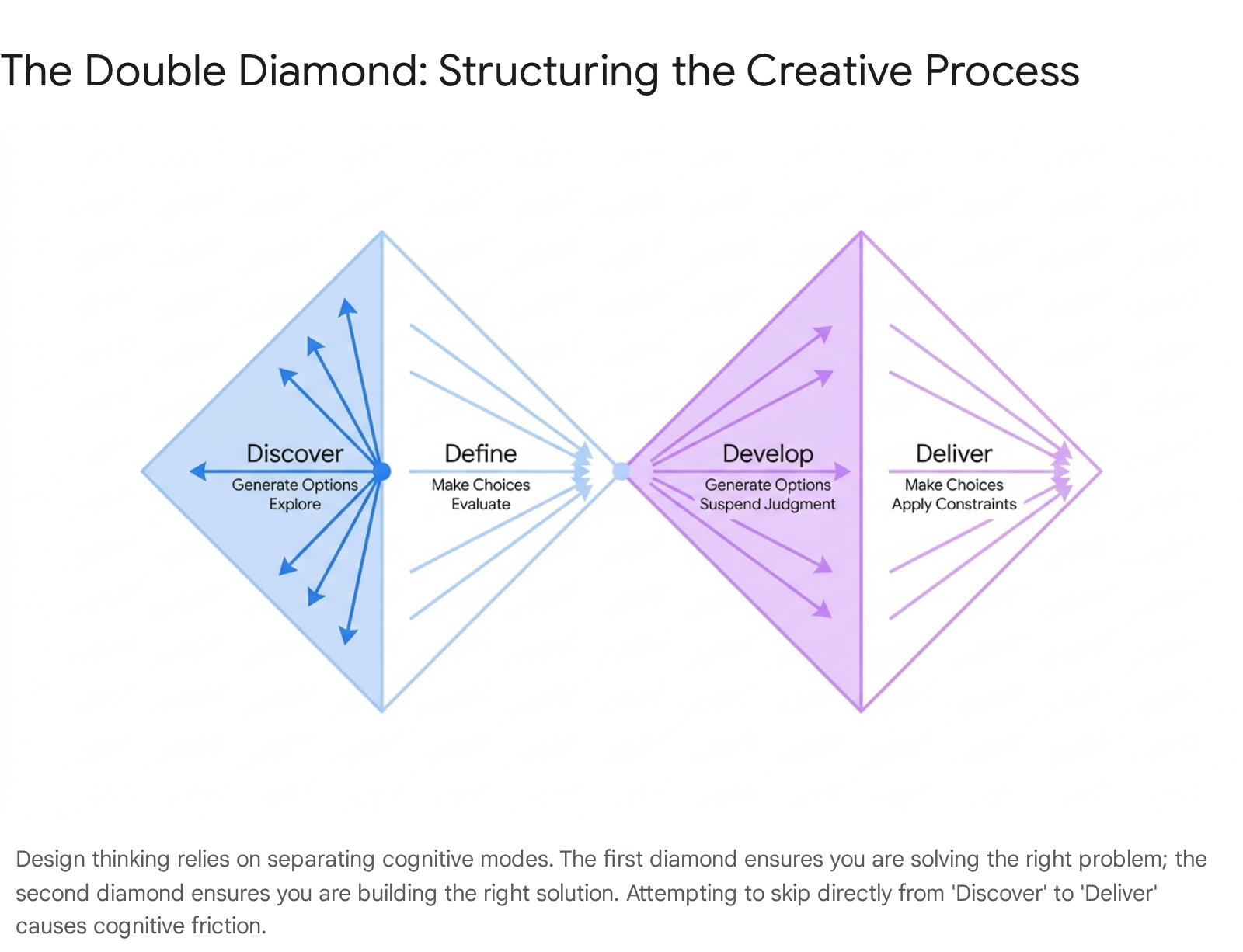
This ensures that teams fully explore opportunity spaces before locking into analytical decision-making 24. The framework is divided into four distinct phases:
- Discover (Divergent): Exploring the problem space widely and without bias. Teams look at situations in fresh ways, gather user insights, and question assumptions without attempting to solve anything 40.
- Define (Convergent): Processing and synthesizing the gathered data. Teams analyze the possibilities to make sense of them, applying constraints to narrow down the focus into a single, clearly articulated problem statement or creative brief 340.
- Develop (Divergent): Generating a massive quantity of diverse, potential solutions to the newly defined problem. This is the space for uninhibited ideation, sketching, prototyping, and wild speculation 40.
- Deliver (Convergent): Testing the prototypes against real-world constraints. Teams evaluate feasibility, impact, and cost, refining the ideas until only the most practical, innovative solution remains to be launched 840.
Implementing Reverging and Clustering
Even with structured frameworks like the Double Diamond, jumping immediately from a chaotic, free-flowing divergent ideation session directly into a strict, analytical convergent phase can be mentally jarring for participants 25. Performing these phases consecutively is cognitively challenging because it relies on shifting neural mechanisms rapidly 25.
To ease this transition, creative facilitators often employ an intermediary phase called "reverging" or "clustering" 25. Before actively evaluating the quality of any ideas, the team simply groups related concepts together visually - for instance, using affinity mapping to cluster similar sticky notes on a whiteboard 825. This activity acts as a crucial cognitive bridge. It allows the brain to organize the chaotic output of the DMN into structured themes, preparing the environment before the ECN fully engages to ruthlessly evaluate them 825.
Practicing Dedicated Convergent Tasks
While popular culture often emphasizes improving "creativity" through divergent exercises like brainstorming and free-association, convergent thinking requires equal dedication and practice to remain sharp. Teams can actively build their analytical muscles by deploying specific convergent exercises that demand logic and deduction 43.
Effective convergent exercises include troubleshooting technical failures, which requires methodically diagnosing an issue by eliminating potential causes to find a single root origin 43. Algorithm design and flowcharting serve as excellent convergent practice by forcing participants to break complex challenges down into highly constrained, logical sequences 43. Furthermore, conducting strict post-project retrospectives - where teams analyze a completed project's timeline and data to deduce the single most critical factor that drove its success or failure - reinforces the evaluative precision necessary for strong convergent thought 43.
Bottom line
The human brain does not possess a singular "creativity center," nor is innovation arbitrarily restricted to the right hemisphere. Instead, navigating complex problems requires the brain to dynamically toggle between the Default Mode Network - which generates spontaneous, divergent ideas - and the Executive Control Network - which applies analytical, convergent judgment. Attempting to execute both modes simultaneously generates intense cognitive friction, derailing brainstorming sessions, stalling individual productivity, and preventing the deeply immersive state of creative flow. By intentionally separating the generation of ideas from their critical evaluation, individuals can align their workflows with their brain's natural architecture, achieving sharper focus, reduced anxiety, and ultimately, far superior innovative outcomes.