
What Is Self-Determination Theory and How Does It Work
Self-determination theory is a globally recognized psychological framework explaining that human beings are naturally driven to grow when three basic needs are met: autonomy, competence, and relatedness. Rather than relying on external rewards or punishments, this approach demonstrates that fostering internal motivation leads to better performance, sustained habit changes, and deeper overall well-being.
The Origins of Self-Determination Theory
For much of the twentieth century, the field of psychology was heavily influenced by behaviorism. Pioneered by figures like B.F. Skinner, behaviorist theories operated on a relatively mechanical premise: human behavior is primarily driven by external reinforcement. If you want to encourage a behavior, you reward it; if you want to stop a behavior, you punish it 1. Within this framework, humans were often viewed as passive entities waiting to be motivated by external stimuli.
In the 1970s and 1980s, psychologists Edward L. Deci and Richard M. Ryan initiated what they described as a "Copernican turn" in the field of human motivation 1. Operating out of the University of Rochester, they proposed a more humanistic approach. They argued that humans possess an inherent, active propensity toward psychological growth, curiosity, and learning 12. Motivation, they proposed, is not a scarce resource that must be injected into a person from the outside; it is a natural baseline state that thrives unless the environment actively suppresses it 33.
Deci and Ryan formally introduced self-determination theory (SDT) in their seminal 1985 book, Intrinsic Motivation and Self-Determination in Human Behavior 25. Rather than rushing to establish a grand unified theory, the researchers took a meticulous "brick by brick" approach over four decades 14. They empirically tested individual components of motivation across diverse contexts - such as schools, workplaces, and clinics - gradually building a comprehensive macro-theory supported by thousands of peer-reviewed studies 13. Today, self-determination theory is one of the most widely researched frameworks in psychology, generating actionable insights for everything from video game design to medical adherence and parenting 154.
What Are the Three Core Psychological Needs?
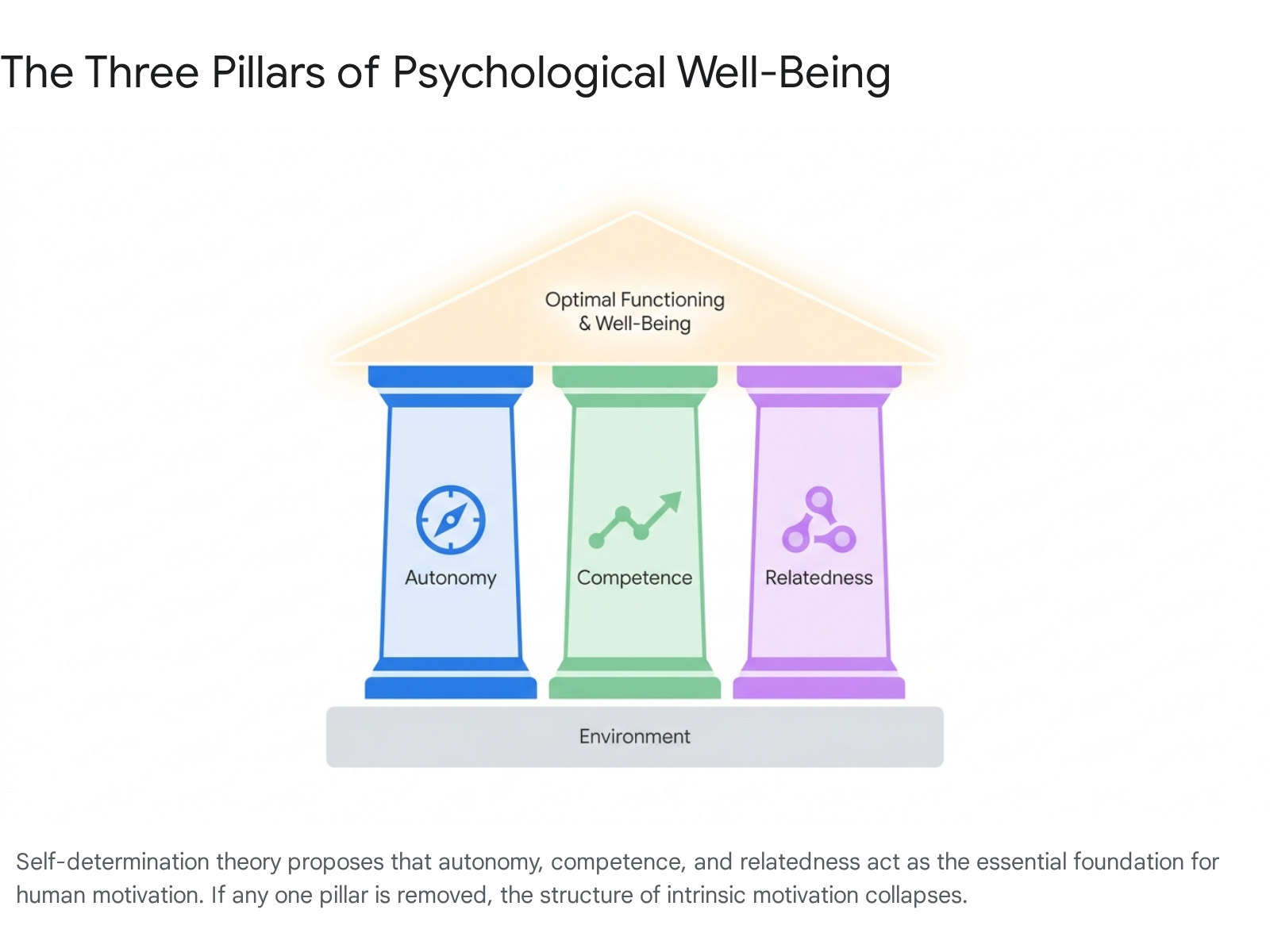
At the heart of self-determination theory is the concept of basic psychological needs. Just as biological organisms require water, sunlight, and nutrients to thrive, SDT posits that human beings require the continuous satisfaction of three universal psychological nutrients to experience optimal motivation and well-being 37. When these needs are met, people flourish; when they are chronically thwarted, people experience disengagement, burnout, anxiety, and psychological distress 38.
Autonomy: The Need for Volition
Autonomy refers to the human desire to be the author of one's own actions 355. It is the experience of volition, authenticity, and psychological freedom. When you act autonomously, your behavior aligns with your genuine interests, values, and integrated self-concept rather than stemming from external pressure or obligation 56.
A common misconception is that autonomy means total independence, hyper-individualism, or doing whatever you want without rules 611. In reality, self-determination theory draws a sharp distinction between autonomy and independence. A person can willingly follow a strict set of rules - such as a soldier following orders, a doctor adhering to clinical protocols, or an employee executing a mandated project - and still feel entirely autonomous if they deeply understand and agree with the value of those rules 7. Autonomy is destroyed not by structure, but by coercion, micromanagement, and environments that rely on guilt or external pressure 813.
Competence: The Need for Mastery
Competence is the basic desire to feel effective in interacting with your environment and to experience a sense of mastery over tasks 358. It is the psychological nutrient that drives curiosity, the pursuit of new challenges, and the desire to build skills.
People experience competence when they are met with "optimal challenges" - tasks that stretch their current abilities but are not impossibly difficult 57. If a task is too easy, it breeds boredom and apathy; if it is too hard, it breeds anxiety and feelings of inadequacy 7. Constructive feedback, clear structures, and the psychological safety to learn from mistakes all nourish the need for competence 55. When people feel they are growing in capability, their motivation becomes highly resilient.
Relatedness: The Need for Authentic Connection
Relatedness is the universal desire to feel connected, to care for others, and to be cared for in return 35. It is a sense of belonging and meaning within a social group or community.
In many institutional designs - particularly in corporate workplaces and traditional educational settings - relatedness is the most frequently ignored need 3. Organizations often invest heavily in autonomy (such as offering flexible working hours) and competence (through elaborate training and promotion pathways) while systematically overlooking the reality that humans must feel they matter to the people around them 3. Relatedness is not merely about popularity, having friends, or transactional networking; it is about authentic, psychologically safe inclusion and knowing that your contributions hold value for others 38.
How Does the Motivation Continuum Work?
Before self-determination theory gained prominence, motivation was widely treated as a unitary concept: you either had a high amount of motivation, or you lacked it 79. Deci and Ryan's breakthrough was demonstrating that the qualitative type of motivation matters far more than the total quantitative amount 79. A student who studies because she finds biology fascinating will ultimately out-perform, out-create, and outlast a student who studies because her parents threatened to take away her phone, even if both initially dedicate the same number of hours to the task 7.
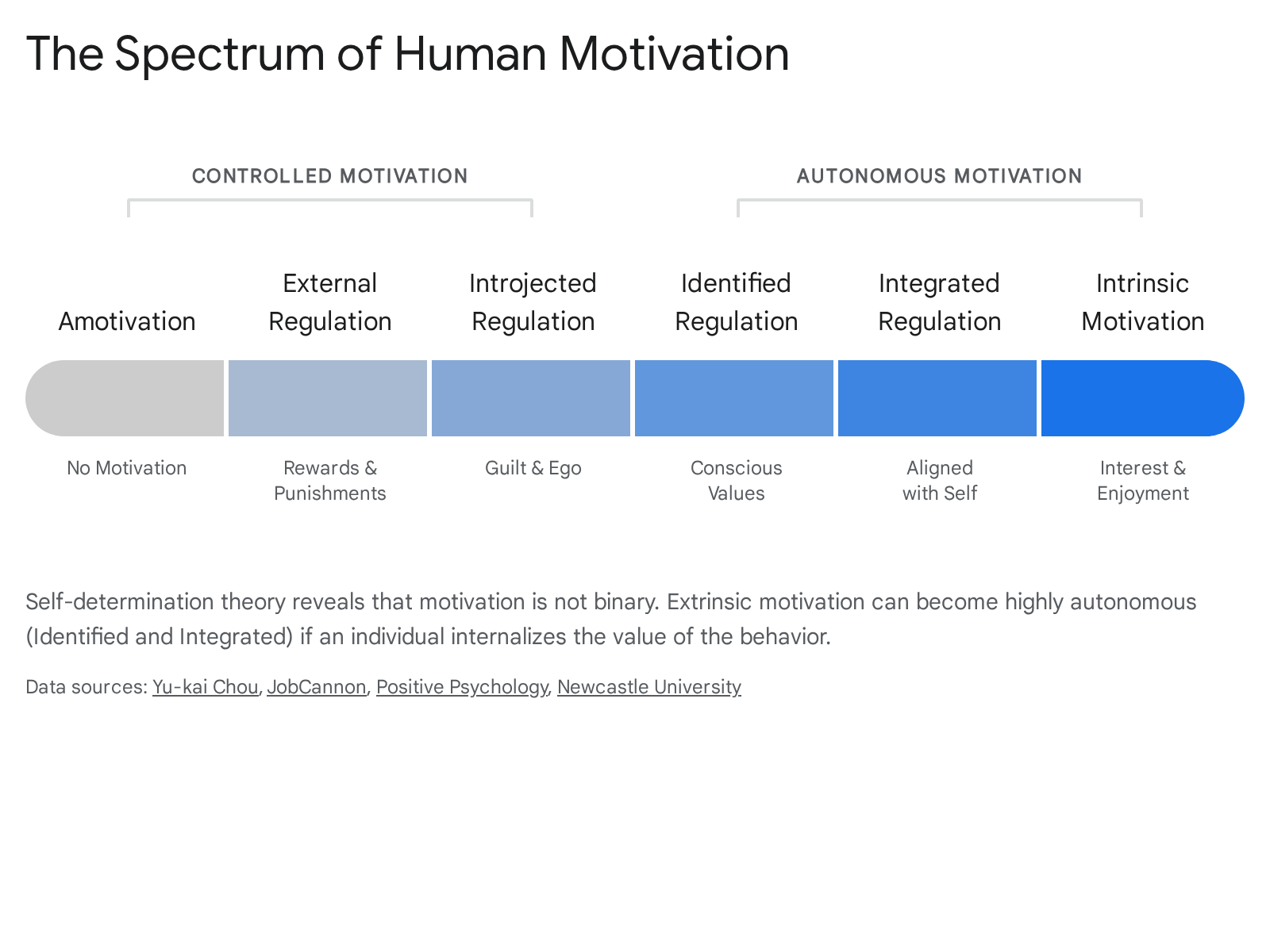
Through one of its core sub-theories, SDT establishes that motivation exists on a continuum ranging from completely non-self-determined (amotivation) to completely self-determined (intrinsic motivation) 237. Between these two poles lies extrinsic motivation, which the theory brilliantly subdivides based on how deeply an individual has internalized the external drive 69.
| Motivation Category | Regulatory Style | Description | Practical Example (Studying for a major exam) |
|---|---|---|---|
| Amotivation | Non-regulation | Complete lack of intent to act. The individual feels incompetent, disconnected, or believes the action will yield no desired outcome. | "I'm not studying. I'm going to fail anyway, and this subject is completely useless." 10 |
| Extrinsic | External Regulation | Action driven purely by external rewards, compliance, or the threat of punishment. The least autonomous form. | "I am studying only so my parents don't punish me or take away my car privileges." 79 |
| Extrinsic | Introjected Regulation | Action driven by internal pressure, guilt, ego protection, or the desire to maintain contingent self-esteem. | "I am studying because I will feel deeply ashamed and guilty if I get a bad grade." 79 |
| Extrinsic | Identified Regulation | Action driven by a conscious valuing of a goal. The task is not inherently fun, but it is seen as personally important. | "I don't enjoy studying biology, but I need this grade to get into nursing school, which I value." 79 |
| Extrinsic | Integrated Regulation | Action fully aligned with the individual's core identity and values. The most autonomous form of extrinsic motivation. | "I study hard because being a dedicated, knowledgeable student is a core part of who I am." 79 |
| Intrinsic | Intrinsic Regulation | Action driven by pure inherent interest, curiosity, and the joy of the activity itself. No external reward is needed. | "I am studying biology because the mechanics of human cells are genuinely fascinating to me." 79 |
The Internalization Process
A key concept within this continuum is internalization. Internalization refers to the active, psychological process by which an individual transforms an extrinsic motive into personally endorsed values 211. When internalization is successful, behaviors that were initially externally regulated become self-endorsed.
For instance, paying taxes or doing household chores are rarely intrinsically motivating. However, through integrated regulation, an individual might internalize these actions because they value contributing to their community or maintaining a healthy living environment 611. The more internalized the motivation, the more the person will experience autonomy, leading to better well-being and more sustained effort 12.
The Overjustification Effect and Cognitive Evaluation
One of the most famous and highly debated early findings of SDT research was the "overjustification effect" (also known as the undermining effect). Self-determination theory research showed that introducing external rewards for an activity someone already intrinsically enjoys can actually destroy their internal motivation 719.
If a child loves reading for fun, and a school starts paying them for every book they finish, the child's psychological framing shifts. The locus of causality moves from internal to external. Once the payment stops, the child is likely to stop reading entirely 719. Extensive meta-analyses have confirmed that expected, tangible rewards - such as money or prizes contingent on completing a task - significantly undermine intrinsic motivation 713. However, if rewards are framed as informational (such as unexpected positive feedback recognizing a person's mastery) rather than controlling (such as "do this specifically to get that"), they can enhance rather than diminish the internal drive 76.
The Six Mini-Theories Shaping the Framework
Because self-determination theory evolved through continuous empirical testing over several decades, it is technically a macro-theory composed of six interconnected mini-theories. Together, they explain the mechanics of human behavior across different contexts 127.
Cognitive Evaluation Theory (CET) explains how external events affect intrinsic motivation. It established that controlling rewards diminish autonomy, while informational feedback supports competence 23. Organismic Integration Theory (OIT) explores the spectrum of extrinsic motivation and explains the process of internalization - how people take on external social values and assimilate them into their own identities 26.
Basic Psychological Needs Theory (BPNT) posits the core triumvirate of autonomy, competence, and relatedness as universally necessary for psychological wellness and optimal functioning across all domains of life 24. Causality Orientations Theory (COT) examines individual personality differences, explaining why some people inherently orient toward autonomy, while others are chronically attuned to external controls, rewards, and societal expectations 212.
Goal Contents Theory (GCT) differentiates between the types of goals individuals set for themselves. Pursuing intrinsic goals, such as personal growth, community contribution, and deep relationships, yields high well-being. Conversely, pursuing extrinsic goals, such as wealth, fame, and status, often correlates with anxiety and lower life satisfaction, even when those extrinsic goals are successfully achieved 27. Finally, Relationships Motivation Theory (RMT) focuses on close personal connections. It states that high-quality relationships are those where both parties experience mutual autonomy and relatedness. A relationship that provides connection but strips an individual of autonomy - such as a highly controlling romantic partner - will ultimately fail to support psychological health 27.
Does Self-Determination Theory Work Across Cultures?
One of the most persistent academic debates surrounding self-determination theory is its claim to universality. Critics have historically argued that the need for autonomy is a Western, individualistic construct. They suggested that in Eastern, collectivist cultures - which often prioritize social harmony, duty, and familial interdependence - autonomy might not be necessary for well-being, or could even be detrimental to group cohesion 1415.
However, massive global datasets analyzed between 2023 and 2025 have provided robust support for SDT's cross-cultural validity. The theory operates on a principle of "universality without uniformity," meaning that while all humans share the exact same psychological needs, the cultural avenues used to satisfy those needs can look vastly different depending on local customs 16.
In a landmark 2024 study led by researchers King, Haw, and Wang, data from 535,512 students across 70 countries was analyzed 1718. The sample spanned individualistic societies in Western Europe and North America, Confucian cultures, and regions with authoritarian political regimes. The researchers found a remarkably consistent universal pattern: students who perceived their teachers as providing need-supportive environments experienced significantly higher subjective, eudaimonic, and cognitive well-being 17. While the exact magnitude of the effect varied slightly by region, the positive correlation held true globally 1718.
Similarly, an exhaustive 2024 meta-analysis by Slemp et al., evaluating over 443,000 participants from 881 independent samples, concluded that interpersonal supports for autonomy, competence, and relatedness were strongly related to well-being and performance across the board 192021. The researchers did note minor cultural moderations - for instance, the link between autonomy support and autonomous motivation was slightly weaker in highly collectivist cultures, while relatedness support showed unique strengths in those same regions - but the foundational premise that human beings require all three needs was strongly affirmed across global populations 2021.
Real-World Applications: How Is SDT Used?
Because self-determination theory identifies the specific environmental conditions that nurture or crush motivation, its principles have been widely adapted by organizational leaders, educators, healthcare professionals, and parents 1529.
Transforming Education and Classrooms
In educational settings, traditional teaching heavily relies on controlling behaviors: strict deadlines, the threat of failing grades, and prescriptive language 2223. According to SDT, these teacher-directed environments cultivate extrinsic motivation, leading to shallow learning, higher stress, and increased dropout rates.
Autonomy-supportive teaching, by contrast, involves taking the students' perspective and utilizing "invitational" language. Instead of issuing commands, need-supportive teachers explain the deeper rationale behind tasks, acknowledge when a subject is frustrating, and offer meaningful choices 2324.
| Motivation Strategy | Controlling Teaching Style | Autonomy-Supportive Teaching Style |
|---|---|---|
| Language Used | Prescriptive ("You must," "You should do this now") 23 | Invitational ("You might consider," "Let's explore") 23 |
| Task Framing | Focused on compliance and avoiding bad grades 23 | Focused on connecting the task to students' authentic interests 23 |
| Handling Resistance | Asserts power to overcome bad attitudes 23 | Acknowledges negative feelings and validates frustration 23 |
| Pacing | Impatient for immediate, correct answers 23 | Displays patience, allowing students to learn at their own pace 2324 |
Meta-analyses show that when classrooms shift from controlling to autonomy-supportive, students exhibit higher creativity, better conceptual understanding, and vastly improved well-being 72225.
Workplace Dynamics and the Gamification Trap
Corporate environments have increasingly turned to "gamification" - the application of points, badges, and leaderboards - to boost employee engagement. However, without an understanding of SDT, these systems routinely backfire 2635.
Points and badges are fundamentally extrinsic rewards. If an employee feels manipulated by a leaderboard or views a badge as a controlling mechanism to monitor their productivity, gamification undermines autonomy and triggers disengagement 2636. Educational platforms that relied heavily on superficial gamification have frequently seen engagement drop below baseline levels after just a few weeks because the external rewards crowded out natural curiosity 35.
Gamification only works for long-term motivation when it acts as informational feedback that satisfies psychological needs. For example, a progress bar can satisfy the need for competence by visualizing mastery, and team-based challenges can satisfy relatedness, provided the user freely chooses to participate 2637. True workplace engagement requires jobs that offer employees meaningful choice in how they execute tasks (autonomy), clear pathways for skill development (competence), and a collaborative, psychologically safe team environment (relatedness) 5827.
Healthcare, Habit Formation, and New Year's Resolutions
Self-determination theory is highly predictive of sustained health behaviors, such as smoking cessation, weight loss, and medication adherence 528. This is particularly evident in the notorious failure rates of New Year's resolutions.
Industry data from 2024 and 2025 indicates that roughly 88% of resolutions fail within the first few weeks 2829. SDT explains that these failures largely occur because goals are rooted in "introjected regulation" - driven by guilt, social pressure, or aesthetic ideals 2830. A 2025 study showed that when individuals reframed their health goals away from extrinsic motivators (such as losing weight to look good for an event) and toward intrinsic or highly integrated motivators (such as exercising to have the vitality to play with their children), they demonstrated a 30% increase in behavioral persistence 28. Habit change requires designing environments that satisfy competence by starting with easily achievable micro-goals and relatedness by recruiting social support, rather than relying purely on willpower 314332.
Raising Independent Kids: SDT in Parenting
Parents naturally struggle with the balance between protecting their children and fostering independence. Self-determination theory suggests that parents can raise highly self-determined children by supporting their autonomy within safe, structured boundaries 4546.
This means relinquishing absolute control and avoiding harsh punishments or excessive rewards to force compliance. Instead, autonomy-supportive parents offer empathy and choices. If a child refuses to go to bed, rather than resorting to yelling, a parent utilizing SDT acknowledges the child's frustration to validate their perspective, explains the clear rationale for sleep, and offers a controlled choice, such as asking which book they want to read before lights out 1146. This helps the child internalize the value of the routine rather than just submitting fearfully to authority.
What Are the Limitations and Criticisms of SDT?
Despite its massive evidence base, self-determination theory is not without limitations and methodological hurdles.
A primary criticism is that the theory places heavy emphasis on internal psychological states, which can sometimes overshadow severe external constraints. For individuals living in extreme poverty, experiencing systemic discrimination, or lacking basic physical safety, the ability to prioritize intrinsic motivation is severely curtailed. Studies examining low socioeconomic districts, such as recent research in Sri Lanka, suggest the theory needs better integration with sociological frameworks that account for harsh economic realities 847.
Furthermore, while autonomy is crucial, researchers note that giving individuals too many choices - especially in low-interest tasks - can lead to decision fatigue and reduced performance. The principle is not always "more autonomy is better"; it is that autonomy must be meaningful and manageable 11. Methodologically, the operationalization of SDT relies heavily on self-reported questionnaires, which are vulnerable to social desirability bias, and some constructs have been criticized for weak psychometric validity in certain applied contexts 11. Finally, some scholars note that SDT is relatively under-integrated with broader psychological frameworks, such as the Big Five personality traits, limiting cross-disciplinary insights 11.
Bottom line
Self-determination theory revolutionized psychology by proving that high-quality human motivation is not powered by external carrots and sticks, but by the innate human need for autonomy, competence, and relatedness. Whether you are managing a corporate team, designing a curriculum, or trying to stick to a new habit, success depends on creating environments where people feel in control of their choices, capable of mastery, and deeply connected to others. While researchers continue to refine how different cultural and socioeconomic backgrounds alter the expression of these needs, the foundational science remains clear: when our core psychological needs are supported, we don't just perform better - we flourish.