
Non-financial drivers of employee loyalty in startups
Startup Human Capital and Attrition
The rapid acceleration of the global technology ecosystem has fundamentally altered the paradigm of human capital management. High-growth startups, characterized by extreme uncertainty, resource constraints, and aggressive scaling targets, face a unique structural challenge: retaining the critical talent necessary to execute their vision while navigating volatile funding environments. Historically, organizational psychology has relied heavily on traditional compensation models to explain employee loyalty and attrition. However, recent empirical data demonstrates that the startup ecosystem operates on a distinct psychological contract.
While compensation remains a baseline necessity, its efficacy as a primary retention tool is mathematically and psychologically limited. The hyper-competitive nature of venture capital-backed talent markets means that established technology giants will consistently outbid early-stage startups in liquid compensation. Furthermore, behavioral economics reveals that financial rewards are subject to rapid psychological adaptation, failing to sustain long-term engagement 12. Consequently, successful employee retention in startups relies on a complex matrix of intrinsic motivators, psychological safety, evolving organizational design, and careful management of the unique stressors inherent to high-velocity environments.
Theories of Workplace Motivation
To understand retention beyond financial compensation, it is necessary to examine the fundamental theories of human motivation as they apply to the modern workforce. Traditional management paradigms have often misaligned organizational reward structures with actual human psychological needs.
Self-Determination Theory and Intrinsic Needs
The dominant framework for understanding sustained employee engagement is Self-Determination Theory (SDT), formally introduced by clinical psychologists Richard M. Ryan and Edward L. Deci in 1985 3. SDT challenges the traditional view that external rewards are the primary drivers of behavior. Instead, it posits that human beings require the fulfillment of three basic psychological needs to achieve optimal motivation and well-being: autonomy, competence, and relatedness 34.
Autonomy refers to the need to control the course of one's life and work; competence is the need to be effective and master new skills; relatedness is the need to feel connected and valued by others 34. When applied to the workplace, environments that support these three needs foster intrinsic motivation - the drive to engage in a behavior for the inherent pleasure and satisfaction it brings 4. Research consistently shows that intrinsically motivated employees are more likely to engage in meaningful work, exhibit stronger loyalty to their organization, and demonstrate extra-role performance (efforts that go beyond formal job descriptions) 345. Startups inherently possess the architecture to fulfill these needs. The early stages of a startup naturally offer unparalleled autonomy and require rapid competence development, providing a distinct advantage over legacy corporations.
Expectancy Theory and Motivation-Hygiene Frameworks
Complementing SDT is Frederick Herzberg's Motivation-Hygiene framework, which categorizes workplace factors into two distinct domains. "Hygiene factors," which include base salary, job security, and basic working conditions, do not create positive motivation; rather, their absence creates severe dissatisfaction 6. Once hygiene factors reach an acceptable baseline, they cease to drive further performance or loyalty. True retention is driven by "motivators" - intangible, intrinsic factors such as recognition, responsibility, and the nature of the work itself 67.
Furthermore, Victor Vroom's Expectancy Theory and Douglas McGregor's Theory Y reinforce this dynamic. Theory Y assumes that the average worker desires self-control and responsibility, directly contradicting the traditional Theory X view that workers must be coerced and externally incentivized 78. In the startup context, operating on Theory Y principles aligns perfectly with the agile, decentralized decision-making required for rapid growth.
Generational Shifts in Reward Preferences
The necessity of intrinsic motivation has been heavily amplified by demographic shifts in the workforce. Research analyzing millennial and Gen Z professionals indicates a profound departure from traditional retention models. Younger employees view extrinsic motivators - such as salaries, benefits, and standard promotions - as minimum baseline requirements rather than true rewards 3.
These cohorts prefer intrinsic rewards such as job satisfaction, purpose, pride, and autonomy. Organizations relying strictly on extrinsic motivators are failing to meet the psychological needs that younger employees are actively seeking 3. In environments where financial rewards are limited or constrained by cash runway, such as public sector organizations and early-stage startups, the fulfillment of these intrinsic needs becomes the primary mechanism for reducing turnover and boosting performance 39. Studies highlight that younger workers exhibit higher retention rates and lower burnout when their sense of autonomy and cultural representation is supported 3.
The Limitations of Financial Compensation
A prevailing myth in the technology sector is that retention is simply a function of outbidding competitors on base salary and bonuses. While competitive pay is required to fulfill Herzberg's hygiene requirements, longitudinal research in organizational psychology systematically demonstrates the limitations of extrinsic rewards.
Hedonic Adaptation and Wage Increases
Extrinsic motivation relies on external contingencies to drive behavior. While necessary to secure basic physiological safety, financial rewards are highly susceptible to the psychological phenomenon known as the "hedonic treadmill" or hedonic adaptation 110. Originally described by Philip Brickman and Donald Campbell in 1971, the hedonic treadmill dictates that as circumstances improve, human expectations and desires rise at a commensurate rate, rendering the sense of achievement or satisfaction temporary 10.
When an employee receives a salary increase, there is a measurable "honeymoon effect" - an immediate spike in job satisfaction. However, studies tracking within-individual job satisfaction indicate that this positive effect exhibits a distinct dynamic pattern of decay. Research analyzing wage changes over time reveals that the psychological boost from a pay raise experiences partial adaptation, often fading significantly within two to four years after the increase 2.
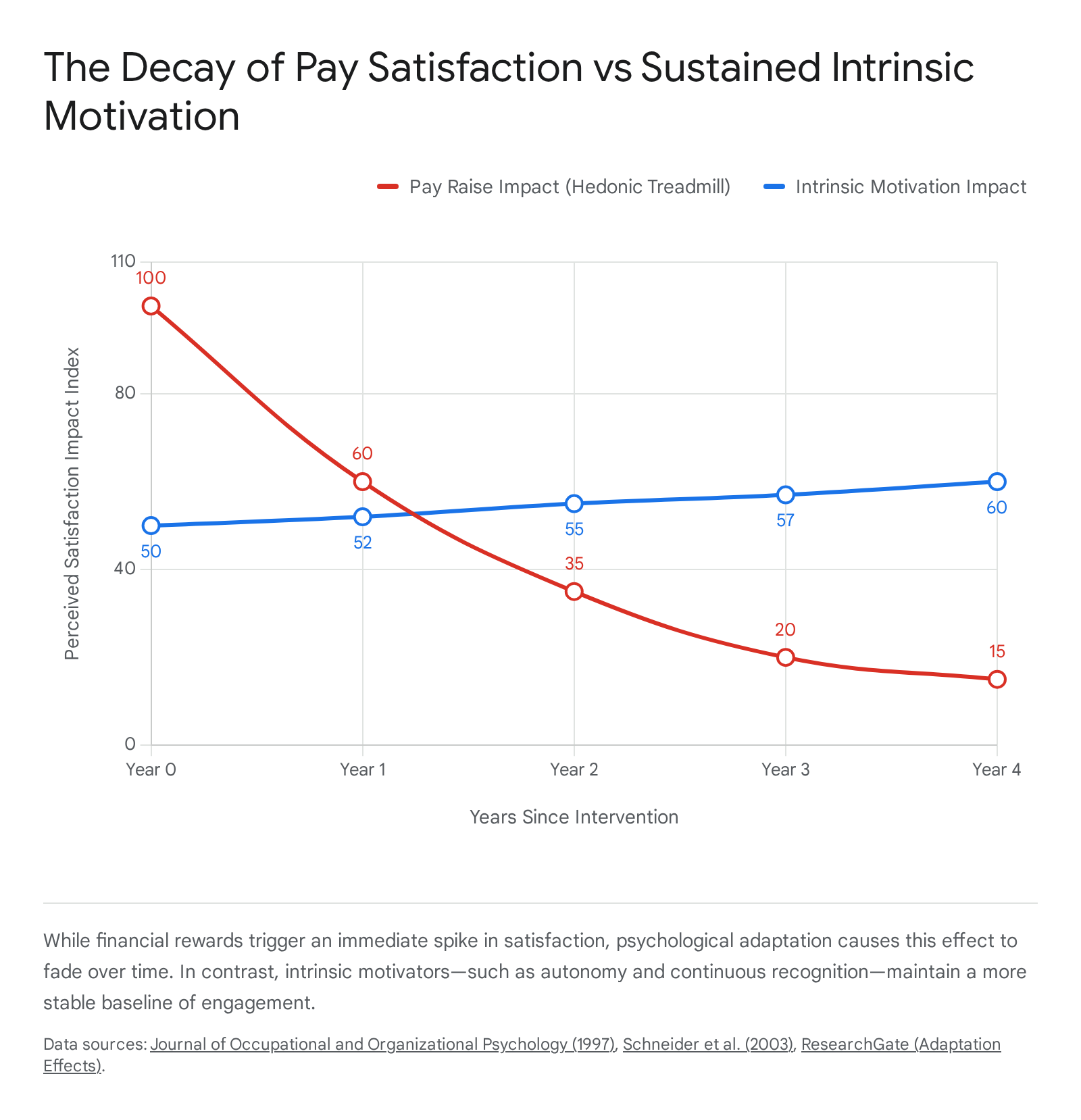
The individual simply adapts to the new income level, returning to their baseline level of happiness and engagement.
Furthermore, psychophysics investigations into pay thresholds demonstrate that a merit raise must exceed a stable threshold just to register a meaningful affective reaction. Studies indicate that a raise must be approximately 5.6% to 7% of prior base pay to make an employee feel "pleased" or to impact behavioral intentions to work harder 11. Increases below this threshold are met with indifference. Consequently, relying solely on cash to retain employees requires an unsustainable cycle of continuous, escalating financial injections. If an organization cannot perpetually exceed the 7% threshold, the motivational return on investment of compensation drops to zero.
The Mathematical Reality of Equity Dilution
In lieu of massive base salaries, startups heavily leverage equity - typically stock options - as a primary financial retention tool. The theoretical appeal is strong: employees share in the ultimate upside of the venture's success. However, the mechanics of venture capital financing introduce the complex reality of equity dilution, which fundamentally alters the motivational power of equity as a company matures.
An employee's equity stake is the number of shares they hold divided by the total shares outstanding. When a startup raises successive rounds of capital, the total number of shares outstanding increases dramatically. Unless the employee receives continuous "refresh" grants, their percentage ownership mathematically shrinks 12. Data spanning hundreds of venture financings - including many unicorns (startups valued over $1 billion) - shows that equity dilution is steepest during the Series A through Series C rounds. By the time a private firm reaches unicorn status, typically around Series C or D, an early employee's initial equity stake is routinely diluted by at least 20% to account for new investor shares and the expansion of the option pool 12.
While the overall valuation of the company may be much higher, making the smaller slice of the "pie" objectively more valuable, the psychological impact of seeing one's ownership percentage dwindle can be demoralizing if not managed transparently. Thus, while equity is a critical component of the total rewards package, its efficacy as a standalone retention driver diminishes as dilution accelerates, forcing the organization to rely on broader cultural and developmental factors to maintain loyalty.
Retention Drivers Across Startup Funding Stages
The motivations that drive an employee to join a seed-stage startup are fundamentally different from those that retain an employee at a Series C organization. Startups are not static entities; their structural, financial, and cultural realities transform radically with each venture capital injection. Understanding retention requires analyzing the evolving psychological contract between the firm and the workforce across these sequential funding stages.
| Funding Stage | Typical Capital Range | Primary Organizational Focus | Key Employee Retention Drivers | Equity & Risk Profile |
|---|---|---|---|---|
| Pre-Seed / Seed | $50K - $5M | Idea validation, MVP, initial product-market fit. | Extreme autonomy, mission alignment, broad generalist role scope. | Highest risk of failure; maximum potential equity percentage. |
| Series A / B | $10M - $50M+ | Scalability, repeatable revenue, specialized scaling. | Structured career progression, psychological safety, transition to specialization. | Moderate risk; equity valuation increases but roles narrow. |
| Series C+ | $50M+ | Market dominance, acquisitions, IPO preparation. | Market-rate compensation, comprehensive benefits, work-life balance. | Lowest risk; significant equity dilution, highly liquid potential. |
Pre-Seed and Seed Stage Mechanics
At the Pre-Seed and Seed stages, startups are highly speculative ventures. Organizations typically consist of 2 to 10 employees 13. The core objective during this phase is idea validation, developing a Minimum Viable Product (MVP), and identifying initial product-market fit 1414. Seed rounds have grown larger, averaging $3.2 million with median valuations around $16 million in 2025, but the fundamental risk remains immense, with failure rates hovering near 90% 16.
For employees joining at this stage, the primary retention drivers are heavily weighted toward intrinsic motivation and risk tolerance. Research indicates that early startup employees exhibit a significantly lower concern for job security compared to their peers in established firms, displaying a unique tolerance for ambiguity and a desire for independence 15. They are drawn to the intellectual challenge of building from zero and a deep alignment with the founder's vision. Because cash compensation is typically below market rate, it is the broad scope of work - the necessity of "wearing many hats" - that satisfies the human psychological need for competence and autonomy 13. Retention at this stage is achieved by maintaining high transparency, fostering a tightly knit relatedness among the founding team, and preserving the employee's ability to directly influence the product's trajectory.
Series A and Series B Transitions
The transition into Series A and Series B funding marks a critical inflection point. In recent years, the performance expectations for securing a Series A have skyrocketed. A striking 82% of companies completing their Series A in 2018 were generating revenue, up from just 15% in 2010 18. Funding amounts jump significantly, with Series A rounds averaging $10 million to $20 million, and Series B reaching into the tens of millions to fuel aggressive market expansion and sales team growth 141620.
For employees, this phase introduces the "middle-stage squeeze." The organization begins to institutionalize. Hierarchies form, specialized roles replace generalist functions, and key performance indicators shift from exploratory product milestones to rigorous, repeatable revenue generation 1821. Retention drivers must pivot accordingly. The extreme, unstructured autonomy of the Seed stage inevitably diminishes, which can alienate early joiners who preferred a generalist environment. To retain top talent during this scaling phase, startups must proactively replace structural autonomy with structured career progression. Employees expect professional development, clearer managerial support, and compensation adjustments that align closer to market benchmarks as the firm's existential risk decreases.
Series C and Late-Stage Maturation
By Series C, a startup is expected to be a dominant market player focused on scaling internationally, acquiring competitors, or preparing for an Initial Public Offering (IPO) or major exit 14141621. Valuations soar, and funding rounds frequently exceed $50 million, drawing interest from hedge funds and private equity firms 1417. Only about 1% of startups successfully progress from seed funding to Series C and beyond 23.
At this late stage, the risk profile of the company resembles a traditional corporate entity. From an employee's perspective, joining or staying at a Series C startup offers considerable stability and the prestige of association with a proven market leader 24. However, as noted previously, this is also the stage where significant equity dilution is fully realized 12. Retention strategies at this stage must normalize. Startups can no longer rely on the sheer thrill of survival or the promise of massive, undiluted equity. They must compete on total rewards packages, formal recognition programs, comprehensive health and wellness benefits, structured corporate cultures, and reliable work-life integration 1819.
Mission-Driven Cultures and Burnout
Startups frequently brand themselves as mission-driven entities poised to "change the world." While a compelling mission is a powerful initial attractor of talent, providing a strong sense of purpose, research reveals a darker reality regarding organizational models built exclusively on visionary zeal. When mismanaged, a high-conviction mission can become the primary driver of employee burnout.
The Control Paradox
Data regarding mental health in the startup ecosystem highlights a stark divergence between leadership and staff. According to The Untold Toll report, startup employees experience substantially higher emotional strain than founders. Specifically, 52% of employees reported struggling with anxiety since joining their current startup, compared to 37% of founders; similarly, 50% of employees reported symptoms of burnout, compared to 36% of founders 20.
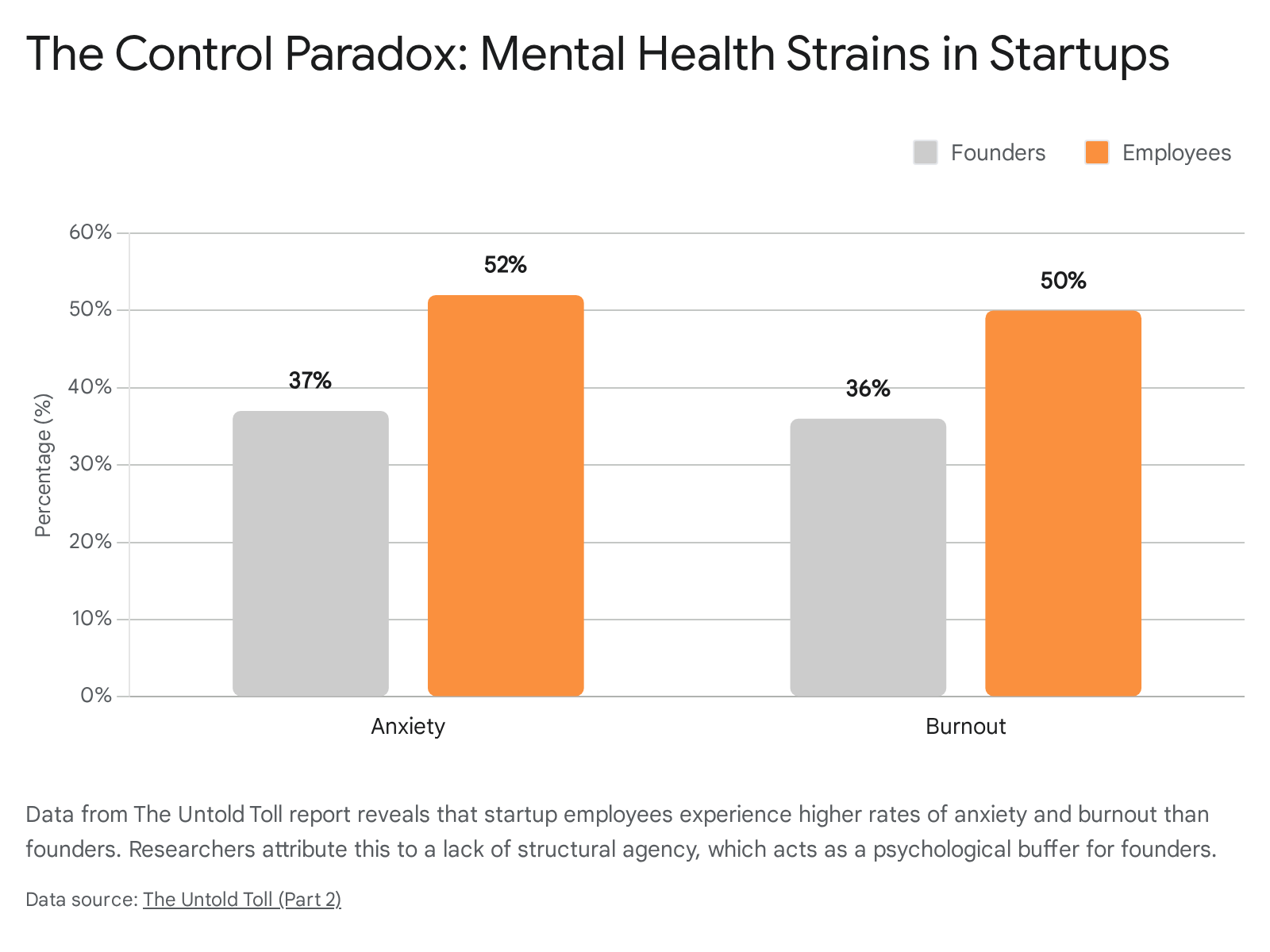
This discrepancy is explained by the "Control Paradox." While founders bear ultimate financial risk and immense pressure, they possess structural agency. They steer the organization, make the definitive choices, and have their identities inextricably fused with the venture's potential triumph. This agency serves as a powerful psychological buffer against anxiety 20. Employees, conversely, often function as passengers navigating market turbulence created by the founders' decisions 20. They share the extreme workload and the existential dread of startup failure but lack the executive control to alter the course. When startups fail to distribute decision-making power, they maximize employee stress while minimizing their psychological coping mechanisms, inevitably leading to burnout and turnover.
Performance Addiction and Weaponized Motivation
In resource-scarce environments, organizational values are frequently manipulated to extract excess labor. This phenomenon is termed "weaponized intrinsic motivation." Startups may use core values like "customer obsession," "accessibility," or "mission-first" to guilt, coerce, and enforce non-stop availability, ultimately crushing the psychological safety required for sustainable performance 2122.
This environment preys on high-achieving individuals susceptible to "performance addiction" - a condition where an individual's self-worth becomes fundamentally tied to their output, driven by a fear of stillness or failure rather than genuine creative desire 23. Unscrupulous leadership can exploit this, responding to long hours, constant connectivity, and low pay with the justification that this is simply "startup life" in service to a future unicorn payout 24. When passion is weaponized to mandate blurred work-life boundaries, the intrinsic motivation that initially attracted the employee degrades into emotional exhaustion and resentment. Burnout in these contexts is often caused by working tirelessly without seeing the effort result in recognized success, or having achievements constantly undermined by chaotic management 25.
Social Entrepreneurship and Emotional Strain
The burnout phenomenon is particularly acute in social entrepreneurship. Social enterprises are hybrid organizations that balance market demands with a moral responsibility for social outcomes 26. While these founders and employees draw immense meaning from mission-driven work, they also carry an additional emotional burden. Workers in human service and community-based startup roles experience high levels of emotional exhaustion and grief 26. The necessity of balancing profit generation with social purpose often leads to role overload and conflict, where the mission acts simultaneously as a buffer against burnout and an exacerbating stressor 2627. For these employees, resilience supports such as mental health provision and distributed leadership are not perks, but essential mechanisms for organizational survival 26.
The Cultic Startup Phenomenon
At the extreme end of weaponized mission lies the conceptualization of the "cultic startup." Organizational scholars have identified that deeply committed, mission-driven organizations can cross a threshold into severe dysfunction through four key dimensions: unmediated charismatic authority, insulated power structures, mission as doctrine, and totalizing entrainment 28.
In these environments, corrective mechanisms such as lateral communication, external reference, and dissent are completely disabled. The culture demands absolute ideological loyalty, isolating employees who question systemic inefficiencies or toxic norms. Language itself becomes weaponized to shut down serious discussion; questioning leadership is framed as a lack of commitment to the mission 2228. Startups operating with cultic dynamics experience a self-reinforcing matching mechanism: they attract and retain individuals with psychological vulnerabilities who cannot resist the demands, while rapidly shedding healthy, high-performing talent who recognize the toxicity and opt to exit 28.
Organizational Toxicity as an Attrition Catalyst
While compensation and workload are frequently cited in standard exit interviews, sophisticated linguistic analyses of employee sentiment reveal that corporate culture is the ultimate, undeniable determinant of retention. An expansive study conducted by MIT Sloan, analyzing over 1.3 million employee Glassdoor reviews across large organizations, found that a toxic corporate culture is 10.4 times more predictive of employee attrition than compensation 293038.
The Toxic Five Attributes
The MIT Sloan research isolated five specific behavioral dimensions that poison organizational environments, collectively termed the "Toxic Five." Startups that fail to aggressively police these attributes suffer from clustered regrettable attrition, falling engagement survey response rates, and ultimately, severe financial costs tied to recruitment and lost productivity 293039.
| Toxic Attribute | Behavioral Manifestation | Organizational Impact |
|---|---|---|
| Disrespectful | Belittling communication, lack of consideration, ignoring professional boundaries. | Has the single largest negative impact on overall culture ratings; destroys foundational trust 303141. |
| Non-inclusive | Systemic inequity (gender, race, age, LGBTQ, disability), cronyism, "clubby" inner circles. | Silences diverse perspectives; drives out minority talent and stifles creative innovation 304132. |
| Unethical | Dishonesty, regulatory evasion, misleading stakeholders ("shady" or "cheating" operations). | Induces values incongruence; causes moral injury, cynicism, and severe employee burnout 303233. |
| Cutthroat | Backstabbing, ruthless internal competition, active sabotage of colleagues. | Paralysis of collaboration; information hoarding; complete destruction of team cohesion 303141. |
| Abusive | Sustained hostility, bullying, shouting, condescension from management. | Eradicates psychological safety; triggers immediate "flight" responses and high turnover 303141. |
Identification and Remediation of Toxicity
Toxic culture is not merely a feature of difficulty; difficulty is a characteristic of challenging work, whereas toxicity is a structural defect 29. Identifying toxicity requires monitoring specific behavioral signals. Warning signs include regrettable attrition concentrated under specific managers or within specific teams, falling response rates to engagement surveys (indicating employees no longer feel safe responding), and public criticism without private repair 29.
Fixing a toxic culture requires top-down accountability. Leadership consistently emerges as the single best predictor of toxic culture 3033. To detoxify an environment, founders must quantify the benefits of cultural health to keep it on the executive agenda, publicly report progress on cultural metrics, model the exact behaviors expected from employees, and ruthlessly track honest data without filtering out uncomfortable truths as they move up the leadership chain 33.
Regional Variations in Retention Strategies
Startup ecosystems do not operate in a cultural vacuum. The structural realities of capital markets, combined with deep-seated regional values and macroeconomic environments, heavily dictate what mechanisms are most effective for retaining top talent. A monolithic, globally applied retention strategy will invariably fail when transitioning across the United States, Europe, and the Asia-Pacific (APAC) regions.
| Region | Ecosystem Characteristics | Key Employee Retention Priorities | Cultural Attitude Toward Time & Risk |
|---|---|---|---|
| United States | Deep venture capital, high valuations, competitive compensation packages. | High base salary, significant ESOP pools, rapid career acceleration. | High risk tolerance; highly fluid labor mobility; acceptance of intense hours. |
| Europe | Risk-averse capital, stringent labor laws, strong social safety nets. | Work-life integration, job enjoyment, sustainable culture, flexibility. | Linear time orientation; high value on personal time; preference for security. |
| Asia-Pacific | Rapid economic expansion, centralized leadership structures. | Job security, hierarchical advancement, relational loyalty, training. | Fluid time orientation; intense work ethic; focus on harmony and "face". |
The United States Ecosystem
The US startup ecosystem is defined by immense venture capital depth, aggressive scaling, and a high tolerance for risk. The median seed deal for US generative AI startups, for example, reached $3.5 million in 2023, double the $1.7 million median for European counterparts 34. This financial depth allows US startups to offer substantially higher baseline compensation packages and larger, more favorable Employee Stock Ownership Plan (ESOP) policies 34.
Consequently, the US labor market is highly fluid. Employees are accustomed to high turnover (costing US employers roughly $1.2 trillion annually) and treat startups as vehicles for rapid wealth accumulation and career acceleration 35. In this environment, retention is closely tied to the financial viability of the company, the speed of technological innovation, and the perceived likelihood of a lucrative liquidity event. However, the intense pressure to scale rapidly also makes the US workforce highly susceptible to the burnout vectors and toxic cultural attributes discussed previously 38.
The European Ecosystem
European startup culture contrasts sharply with the US model, heavily influenced by stricter labor laws, stronger social safety nets, and a cultural aversion to unchecked risk 36. While Europe boasts significant innovation, its ecosystem is often characterized by a more cautious approach to entrepreneurship. Many Europeans prefer to channel their innovative energy into existing companies as employees ("intrapreneurship") rather than founding or joining highly speculative pre-seed startups 36.
For retention, European professionals prioritize day-to-day job enjoyment and work-life balance over raw financial upside. Research from Eurostat indicates that 30% of EU employees rate flexible work as their absolute top retention priority, outweighing compensation 35. Similarly, ADP research shows European respondents place high value on day-to-day enjoyment of the job (43%) and job security (35%) 37. European businesses generally view time linearly but protect personal time fiercely. Therefore, European startups must emphasize sustainable work practices, rigid adherence to respectful boundaries, and robust long-term organizational identity. Startups attempting to import Silicon Valley "hustle culture" into European markets face immediate, systemic rejection by top-tier talent.
The Asia-Pacific Ecosystem
The APAC region presents a distinct blend of hyper-growth ambition and traditional hierarchical values. Work culture in many Asian markets is intense, with high expectations of commitment and long hours 38. However, unlike the individualistic, risk-seeking nature of the US workforce, APAC employees heavily prioritize job security. Half of the workers in the APAC region list job security as a high priority, second only to pay in importance 37.
Furthermore, Asian business environments prioritize relationships, harmony, and centralized decision-making. Leadership is often respected hierarchically, and communication is highly nuanced, focusing on avoiding confrontation 38. Loyalty in this region is often directed toward the leader or the collective group rather than the abstract concept of the company. Retention strategies here must focus on demonstrating the long-term stability of the venture, fostering deep mentor-mentee relationships within the hierarchy, and respecting non-verbal cues regarding team harmony. While financial rewards are critical, public recognition that builds "face" (mianzi in China, kao in Japan) and solidifies the employee's standing within the group serves as a highly effective, culturally congruent anchor 3839.
Non-Financial Interventions for Long-Term Loyalty
To transcend the limitations of compensation and navigate the psychological complexities of the modern workforce, startups must operationalize retention as a core strategic function. Based on the aggregate research spanning behavioral economics, organizational psychology, and startup dynamics, the following interventions represent the most effective non-financial mechanisms for sustaining loyalty.
Timely Recognition and Feedback Decay
While intrinsic motivation is internal, it requires external validation to persist. Employee recognition is a vital mechanism that bridges the intrinsic and extrinsic realms. A robust recognition program meets the psychological need for appreciation, reinforcing desired behaviors without necessarily relying on capital expenditure 1840. Research by the NeuroLeadership Institute shows that effective recognition activates the exact same neural pathways (dopamine release) as financial rewards, making it a highly cost-effective motivator 41.
However, the structural delivery of recognition matters profoundly. Behavioral science highlights the critical importance of timeliness through the concept of the feedback "half-life." According to research from the University of Pennsylvania, the psychological impact of recognition declines rapidly, losing approximately 50% of its effectiveness within 24 hours of the precipitating action 41. Delayed feedback weakens the neural reinforcement that associates the employee's action with the positive outcome, diminishing intrinsic motivation and making the eventual recognition feel insincere or performative 41. Conversely, employees receiving immediate recognition are reported to be 4.6 times more likely to feel valued compared to those acknowledged after delays 41. For startups, implementing peer-to-peer and immediate managerial recognition systems is a high-ROI strategy; companies utilizing effective real-time recognition programs see up to a 31% reduction in voluntary turnover 41.
Psychological Safety and Collaborative Leadership
As previously established, the "Control Paradox" is a primary driver of startup burnout. To mitigate this, startups must intentionally design systems that grant employees agency and voice. Google's seminal "Project Aristotle" conclusively proved that psychological safety - the shared belief that a team is safe for interpersonal risk-taking, where one will not be punished for speaking up with ideas, questions, or mistakes - is the foundational element of the most successful teams 42.
In a startup, fostering psychological safety requires moving away from the dictatorial, "CBS" (Cuz Boss Says) approach toward collaborative leadership 22. Collaborative leadership is not about seeking consensus on every minor decision, which can paralyze a fast-moving organization 42. Rather, it is about creating explicit team agreements, defining shared values based on observable behaviors, and giving employees a genuine, structural voice in the operational realities of their roles 42. By distributing leadership and allowing employees to "co-steward" the mission, founders address the root cause of burnout 2043. Providing employees with a sense of agency transforms passive passengers into active, loyal stakeholders who feel safe enough to innovate.
Continuous Learning and the Half-Life of Skills
The technological landscape is advancing at an unprecedented rate, resulting in a rapid decay of technical relevance. Research from the World Economic Forum indicates that the average half-life of modern professional skills is now roughly five years, meaning a skill loses half its value in that timeframe 40. In rapidly evolving tech fields, this half-life shrinks to merely two and a half years 4445. Similarly, studies on the durability of knowledge in specialized professional fields predict continual, steep decreases in the half-life of expertise, causing significant obsolescence concerns for workers 4647.
When a startup fails to invest in the continuous education of its workforce, employees experience career stagnation. They accurately recognize that their market value is depreciating. Consequently, offering robust internal training, micro-sabbaticals for self-directed learning, and professional development budgets is a primary retention driver. Data shows that 56% of workers rate career growth as more important than compensation, and employees provided with dedicated career development opportunities exhibit 34% higher retention rates 3944. A culture of continuous learning acts as a dual-force mechanism: it ensures the organization remains technologically competitive, and it signals to employees that the firm is deeply invested in their long-term employability. This reinvestment by the company into the individual creates a powerful reciprocal loyalty 44.