
What Is Product-Market Fit and How to Know You Have It
Product-market fit is the critical milestone where a company successfully identifies a specific target audience and delivers a solution that those customers desperately need, resulting in organic, sustainable growth. Founders know they have achieved this state not through initial vanity metrics like paid downloads, but when retention curves flatten, word-of-mouth compounding accelerates, and the market begins actively pulling the product out of the startup.
The Core Concept: Putting the Market Before the Product
The term "product-market fit" is universally cited as the most critical determinant of startup survival, yet the mechanics of achieving it are frequently misunderstood. Venture capitalist and entrepreneur Marc Andreessen popularized the concept, defining it simply as being in a good market with a product that can satisfy that market 113. However, the phrasing itself can be misleading. Growth strategists often argue that "market-product fit" is a more accurate sequence of operations, as the market and its problems must fundamentally precede the solution 4.
Startups routinely fail because they engineer a highly sophisticated solution and subsequently search for a problem to apply it to. If the market does not exist, or if the audience is not desperate for a solution, even the most flawlessly executed technology will inevitably fail 45. Data indicates that a staggering 42% of startups fail simply because they build a product that nobody wants, making the lack of market need the single most common cause of startup death 238.
The Value Hypothesis vs. The Growth Hypothesis
Andy Rachleff, the Stanford professor and venture capitalist credited with formalizing the product-market fit framework, categorizes a startup's journey into two distinct, sequential phases: proving the value hypothesis and proving the growth hypothesis 910.
The value hypothesis requires a founder to answer three foundational questions: What exactly is being built? Who is the specific audience that cares about it? And what is the business model that will compel them to pay for it? 1045. Rachleff maintains that a company must exhaustively prove this value hypothesis before spending any resources testing the growth hypothesis, which involves discovering how to cost-effectively acquire customers at scale. Attempting to scale a business before the value hypothesis is proven is the definition of premature scaling, a fatal error that consumes capital without generating sustainable traction 94.
A counterintuitive reality of the value hypothesis is that initial assumptions are almost always wrong. When a product fails to resonate, the natural instinct of product teams is to iterate on the technology by adding more features. However, adding features rarely converts an apathetic consumer into a desperate one 4. Instead of changing the product, successful founders iterate on the audience. The objective is to identify a specific market segment that is already desperate for the core capability the product provides 94.
The Phenomenon of Market Pull
When a startup aligns a desperate audience with a functional solution, a phenomenon known as "market pull" occurs. During the pre-fit stage, every sale requires immense effort, usage requires constant prompting, and growth relies entirely on the founders' sheer force of will to push the product into the market 1314.
Founders and investors frequently rely on physical analogies to describe the transition. Before achieving product-market fit, building a startup feels like pushing a massive boulder up a steep hill. Once fit is achieved, the physics of the business reverse. The boulder rolls downhill, and the company is frantically chasing it just to keep up with the momentum 141516. Demand abruptly outstrips supply, servers struggle under the load, and the market actively pulls the product out of the startup 51417.
To understand how a company's operational reality shifts once this milestone is reached, consider the structural changes in how the business functions.
| Operating Characteristic | Before Product-Market Fit (Pushing the Boulder) | After Product-Market Fit (Chasing the Boulder) |
|---|---|---|
| Primary Growth Engine | Dependent on heavy paid acquisition, discounts, and founder-led sales. | Driven exponentially by organic word-of-mouth and customer referrals. |
| Sales Cycle and Friction | Long, high-friction processes requiring deep persuasion and education. | Short, low-friction cycles; buyers already understand their pain and the solution. |
| User Retention | High initial churn; usage gradually bleeds out to zero over time. | High long-term retention; core users make the product a recurring habit. |
| Product Development | Reactive; constantly building custom features in an attempt to close individual deals. | Proactive; scaling core infrastructure to handle demand and expanding features for power users. |
| Customer Sentiment | Apathetic or mildly interested; highly price-sensitive and willing to switch to competitors. | Emotionally dependent; users would be highly disappointed if the product vanished. |
The Mirage of False Product-Market Fit
A fatal vulnerability in the startup ecosystem is the tendency to confuse early, unscalable traction with genuine product-market fit. This illusion, often termed "proxy-market fit," tricks founding teams into believing they have achieved market validation when they have actually just engineered temporary growth 619. Acting on this false signal leads to premature scaling, which research indicates is present in roughly 70% to 74% of all high-growth internet startup failures 31920.
The Paid Marketing Trap
One of the most common ways companies generate a false positive is through massive performance marketing expenditures. Startups can artificially manufacture usage spikes through aggressive ad campaigns, heavy promotional discounts, or high-profile public relations launches. However, this type of growth stops the exact moment the advertising budget runs dry 321. If a startup boasts hundreds of thousands of downloads but features a retention curve that drops to near zero after a month, the company does not possess product-market fit; it merely possesses a competent media buying strategy 320.
High-profile corporate failures provide stark examples of this phenomenon. The short-form video platform Quibi launched with a Super Bowl advertisement and $1.75 billion in funding, driving 3.5 million downloads in its first month. However, because the product did not solve a genuine behavioral need for consumers, massive churn immediately followed. Only 500,000 users converted to paying subscribers, and the company shut down within six months 7.
Similarly, the hardware startup Juicero raised $120 million for a Wi-Fi-enabled juicing machine. The company generated immense investor enthusiasm and early press coverage, but ultimately failed to solve a real problem for the consumer. When journalists demonstrated that the proprietary juice packets could be squeezed by hand just as effectively as by the expensive machine, the illusion of value vanished, and the company folded shortly after 7. In both cases, founders engineered external enthusiasm and bought downloads, tragically mistaking both metrics for authentic market demand. The photo-sharing app Color followed a similar trajectory, raising over $40 million from top-tier venture capitalists based on hype and early downloads, only to shut down within a year due to a complete lack of deep user engagement 23.
Founder-Led Sales and Whale Customers
In the business-to-business (B2B) sector, false fit often disguises itself as early revenue. A charismatic founder might leverage their personal professional network to secure a handful of pilot contracts. While these initial sales are encouraging, they do not guarantee scalability. If those early customers do not expand their usage over time, or if a newly hired sales team cannot replicate the founder's success when selling to strangers, the product lacks true market pull 2024.
Another common manifestation of proxy-market fit is a severe dependency on a single large customer. A company might rely on one "whale" enterprise client that accounts for the vast majority of its revenue. If the startup's product only perfectly fits the highly bespoke, idiosyncratic needs of that one specific organization, the startup has effectively become a specialized consulting firm for that client rather than a scalable product company 2023. True product-market fit requires a repeatable use case that applies broadly across a defined market segment.
Early adopters also skew initial data. The first users of a product are often technology enthusiasts who are highly forgiving of bugs and eager to try novel solutions 208. While their feedback is valuable, their willingness to tolerate a subpar user experience does not represent the broader, more demanding mainstream market. A product that satisfies early adopters may completely fail to resonate when exposed to general consumers who demand immediate, frictionless value.
Quantifying the Unquantifiable: Measuring Fit
While the physical sensation of a boulder rolling downhill describes how product-market fit feels to a founding team, subjective feelings are easily clouded by optimism bias. To verify that a product truly satisfies a market, companies must rely on hard, behavioral data and rigorous analytical frameworks.
The Sean Ellis Test and Emotional Dependency
One of the most reliable leading indicators of product-market fit is a metric known as the Sean Ellis test. Developed by the growth executive who helped scale companies like Dropbox, this framework involves sending a simple survey to active users asking a single, highly revealing question: "How would you feel if you could no longer use this product?" 3269.
The survey typically offers three primary responses: very disappointed, somewhat disappointed, and not disappointed. After analyzing data across hundreds of startups, Ellis discovered a clear threshold: if 40% or more of surveyed users reply that they would be "very disappointed," the product has achieved a critical mass of emotional dependency and demonstrates strong product-market fit 3726. Companies that score below 40% generally struggle to sustain growth, as they are pouring marketing dollars into a leaky bucket where users easily switch to alternatives.
The power of this metric lies in its ability to diagnose weaknesses and guide product strategy. For example, when the premium email client Superhuman first ran the Sean Ellis test, they scored only 22%, indicating a lack of fit 3. Instead of abandoning the product, the team segmented their survey data. They isolated the specific demographics of the 22% who loved the product and ignored the feedback of users who did not care. By dedicating their product roadmap entirely to serving that core niche and resolving the specific friction points preventing the "somewhat disappointed" users from fully committing, Superhuman systematically drove their score up to 58% within a year 3.
The Geometry of User Retention
While surveys measure stated intent and emotional reliance, user retention measures actual, sustained behavior. Retention curves are universally considered the most honest and un-gameable signal of product-market fit because they track whether users repeatedly return after the initial novelty of a product fades 31029. Growth metrics like daily active users or total signups can be artificially inflated, but if a product fails to form a lasting habit, the retention data will expose the flaw 36.
When data analysts plot the percentage of a user cohort that remains active over time, they look for specific geometric patterns. A product's long-term viability can generally be diagnosed by identifying which of three archetypal shapes its retention curve resembles 103011.
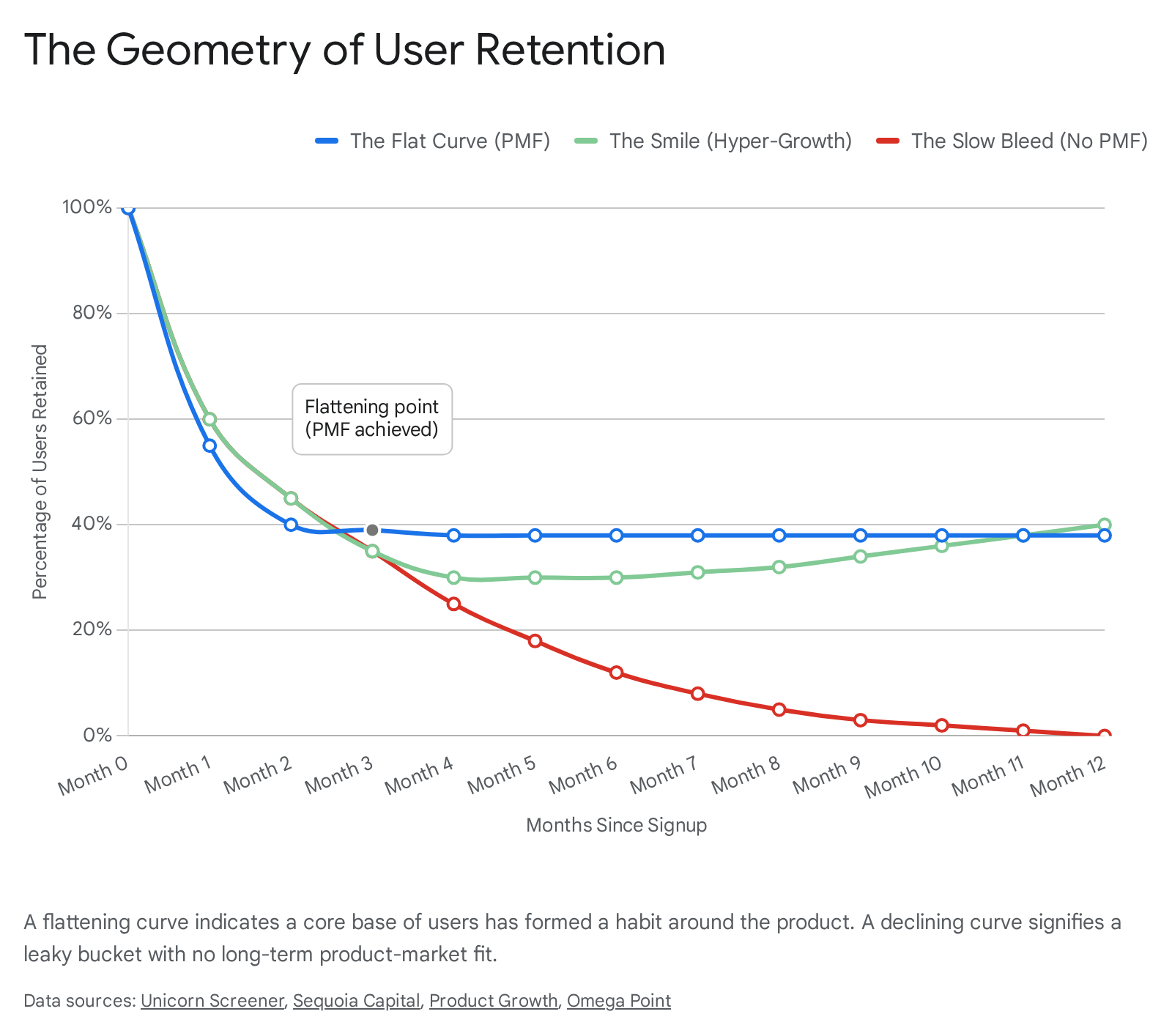
The first pattern is the slow bleed. In this scenario, the curve slopes continuously downward, eventually hitting zero. Even if a company acquires millions of new users through brilliant marketing, a curve that fails to flatten means the product has a short lifespan of utility or completely lacks internal habit loops 3011. This represents a fundamental failure to achieve product-market fit.
The second pattern is the flattening curve, which represents the ultimate goal for most businesses. The curve will always drop sharply in the first few days or weeks as curious users try the product and leave, but it eventually levels off and runs parallel to the horizontal axis 3032. If a curve flattens at 25% by month three, it indicates that a quarter of the acquired users have adopted the product permanently 3011. The higher the altitude at which the curve flattens, the healthier the business 1012.
The third and rarest pattern is the smiling curve. In this scenario, the retention drops, flattens, and then actually rises over time. This hyper-growth indicator suggests that churned users are resurrecting or that network effects are so powerful that the product becomes increasingly indispensable the longer a customer is exposed to it 1011.
Understanding Cohort Analysis
To accurately read retention, companies cannot simply look at their entire user base as a single monolith; they must utilize cohort analysis. A cohort is a group of users who share a common starting point, such as the month they signed up or the specific marketing channel that acquired them 343536.
By tracking distinct cohorts over time, product managers can isolate variables and determine if recent changes to the software actually improved the user experience. For example, if the January cohort shows a retention rate that flattens at 20% after three months, but the March cohort flattens at 35% after three months, the company has concrete evidence that their recent product updates successfully increased stickiness and moved the business closer to true product-market fit 3437. Conversely, if newer cohorts display steadily worsening retention compared to older ones, it signals that the company is exhausting its core audience and acquiring lower-quality users who do not genuinely need the product 1134.
Essential Benchmarks for B2B and B2C Startups
Determining what constitutes a "good" retention rate or a successful product-market fit metric requires deep contextual understanding. Benchmarks vary wildly depending on the industry, the specific business model, and the natural frequency of the problem being solved. Comparing the daily active usage of a consumer social media application to the annual renewal rate of enterprise accounting software yields meaningless conclusions 12.
B2B SaaS: Net Revenue Retention and Capital Efficiency
For Software-as-a-Service (SaaS) companies targeting other businesses (B2B), the standard for product-market fit is incredibly high. Because businesses sign contracts to solve structural operational problems, they are highly motivated to retain software that works. Consequently, successful B2B SaaS companies aim for annual gross revenue retention (GRR) above 85% to 90%, and target monthly user churn of less than 2% 31213.
However, in the modern B2B ecosystem, gross retention is often secondary to Net Revenue Retention (NRR). NRR calculates the percentage of recurring revenue retained from existing customers over a given period, explicitly factoring in expansion revenue from upsells, cross-sells, and seat expansions, while subtracting revenue lost to churn and downgrades 31440.
An NRR consistently above 100% indicates that the existing customer base is expanding its financial commitment faster than it is churning. At a median NRR of around 101% to 106%, a SaaS company possesses a compounding growth engine; it could theoretically stop acquiring new logos entirely and still grow its top-line revenue 1314. Top-tier enterprise software companies frequently push NRR beyond 115% to 120%, making account expansion their primary avenue for growth 31314.
B2C Mobile Apps and Consumer Stickiness
Conversely, consumer applications (B2C) naturally experience significantly higher churn rates. Individual consumers face virtually zero switching costs, have limited attention spans, and are bombarded with fiercely competitive alternatives in app stores. For a consumer mobile application, a retention curve that successfully flattens at 15% to 20% active users after a few months is often considered to demonstrate exceptional product-market fit 1112.
For consumer apps, tracking the specific time to first value is vital. If an app promises a quick solution but requires a ten-minute onboarding process, users will abandon the software before ever reaching the core utility 3041. Pre-product-market fit consumer companies must ruthlessly optimize their onboarding funnels to ensure users experience the "aha moment" immediately, as this dramatically increases the probability of long-term retention 1241.
| Key Performance Metric | B2B SaaS Benchmark | Consumer App (B2C) Benchmark |
|---|---|---|
| Healthy Month 1 Retention | 85% - 90%+ | 20% - 40% |
| Annual Customer Retention | 85% - 95%+ | Highly variable (often <15%) |
| Monthly User Churn Rate | < 1% to 2% | 5% - 10%+ |
| Net Revenue Retention (NRR) | > 100% (Ideally 110-120%+) | Rarely applicable (flat consumer pricing) |
Note: The figures provided represent median to top-quartile performance metrics across the technology industry based on 2024-2025 aggregate survey data 31342.
Complex Models: Navigating B2B2C Product-Market Fit
Certain businesses operate on a B2B2C model, where a company sells software to an enterprise, which then distributes that software to its own end consumers. Achieving fit in this environment is exceptionally complex because the product must satisfy two entirely distinct masters simultaneously 15.
First, the company must achieve consumer-product fit, ensuring that the end users actively adopt the tool and generate high engagement rates (typically aiming for 30-40% weekly active users among the registered base) 15. Simultaneously, the company must secure buyer-pricing fit. The enterprise paying for the software must see a clear return on investment, whether through newly generated revenue or drastically reduced operational costs. If the consumers love the product but the enterprise sees no financial benefit, the contract will churn. If the enterprise mandates the software but the consumers refuse to adopt it, the initiative fails. True B2B2C product-market fit only occurs when both the behavioral change in the consumer and the economic outcome for the buyer align perfectly 15.
Unit Economics and Organic Word-of-Mouth
Across all business models, the cleanest, most un-gameable signal of product-market fit is the presence of organic word-of-mouth acquisition. If 15% to 40% of a startup's new users arrive via organic referrals without any prompting or financial incentivization, the market is effectively taking over the company's marketing duties 319.
This organic pull directly transforms the company's underlying unit economics. As word-of-mouth increases, the blended Customer Acquisition Cost (CAC) drops significantly, while the Lifetime Value (LTV) of retained users continues to rise. The ultimate financial indicator that a business has achieved sustainable product-market fit at scale is an LTV:CAC ratio of 3:1 or higher. This ratio confirms that the company earns at least three times what it spends to acquire a given customer, proving that the business model is highly capital efficient and ready for aggressive scaling 234416. Furthermore, a healthy CAC Payback period - the time it takes for a customer's gross margin to cover the cost of acquiring them - should ideally fall under 12 months for a scaling startup 1320.
The Product-Market Fit Treadmill and Collapse
A pervasive and dangerous misconception among founders is that product-market fit is a permanent destination - a finish line crossed once and enjoyed indefinitely. In reality, product-market fit is a highly dynamic and fragile state. Consumer expectations constantly evolve, competitor capabilities improve, and macroeconomic conditions fluctuate. Growth strategists refer to this ongoing challenge as the "Product-Market Fit Treadmill" - once a company achieves fit, it must continually innovate simply to maintain its position 17.
Technology Shifts and Accelerated Expectations
When a paradigm-shifting technology enters the broader market, the speed of the PMF treadmill suddenly accelerates, drastically steepening the threshold required to satisfy customers. In previous technological eras, such as the transition to mobile smartphones, expectations shifted relatively gradually as hardware and networks matured over several years 17.
However, the rapid commercialization of generative Artificial Intelligence (AI) has caused what industry experts describe as "Product Market Fit Collapse" for numerous established software companies 17. Because AI tools allow users to bypass complex software interfaces and solve problems instantly using natural language, customer expectations have spiked exponentially rather than linearly. Software platforms that possessed incredibly strong product-market fit just two years ago suddenly face massive, unexplained churn because a faster, frictionless AI alternative now exists 17. This rapid collapse forces incumbent companies to completely re-evaluate their core value propositions or face obsolescence.
The BlackBerry Case Study: A Lesson in Lost Fit
Perhaps the most famous historical case study of a dominant company losing its product-market fit is BlackBerry (formerly Research In Motion). In the early 2000s, BlackBerry achieved absolute product-market fit among enterprise executives, politicians, and financial professionals who demanded highly secure push email and the tactical efficiency of a physical QWERTY keyboard 474818. At the zenith of its power in 2011, the company commanded over 43% of the U.S. smartphone market and boasted over 80 million global users 47.
However, the definition of what constituted a "must-have" mobile device fundamentally shifted when Apple introduced the iPhone in 2007, followed closely by the rise of the Android operating system. The mainstream consumer market decided that the core problem a smartphone needed to solve was no longer just secure corporate email, but rather seamless internet browsing, media consumption, and access to a vibrant, third-party application ecosystem 471850.
BlackBerry drastically misunderstood this tectonic shift in market demand. Convinced that their legacy strengths in enterprise security and physical keyboards were unassailable, leadership mocked the touchscreen interface and reacted far too slowly to the emerging app economy 474819. Furthermore, when BlackBerry finally attempted to modernize its operating system using a QNX-based architecture, developers refused to adopt it, preferring the massive distribution potential of iOS and Android 4819.
By pushing their legacy product onto consumers rather than listening to shifting market desperation, BlackBerry fell off the PMF treadmill. Their failure to adapt to touchscreens and app ecosystems was a failure of market comprehension, not hardware manufacturing. By 2016, BlackBerry's global smartphone market share had collapsed to less than 1%, forcing the company to abandon hardware manufacturing entirely and execute a massive pivot to survive as an enterprise cybersecurity and automotive software provider 47481819.
Other social and technological giants have suffered similar fates. MySpace dominated the early social networking landscape and was celebrated as a top-tier website in 2006, but it rapidly lost its product-market fit as Facebook introduced a cleaner, more compelling user experience that captured the global market's attention 4852.
Achieving Fit in Emerging Markets
While the fundamental principles of user retention, unit economics, and organic word-of-mouth apply universally, finding product-market fit in emerging markets - such as Sub-Saharan Africa, Southeast Asia, and Latin America - requires startups to navigate utterly unique logistical, financial, and cultural landscapes. Startups operating in these regions cannot simply copy and paste Silicon Valley playbooks; they are frequently forced to build foundational infrastructure alongside their digital software to achieve true market fit 53.
Building Trust and Mitigating Logistical Friction
In developed western markets, an e-commerce platform assumes the existence of reliable national postal services, highly accurate digital mapping, and widespread consumer credit card adoption. In emerging markets, a digital product cannot achieve fit if the underlying physical infrastructure required to deliver the value is broken.
When the e-commerce company Jumia launched in Nigeria in 2012, leadership quickly realized that launching a standard western-style website was vastly insufficient to generate market pull. Nigerian consumers generally lacked trust in online payment gateways and harbored deep concerns regarding package theft and delivery reliability 154. To achieve true product-market fit, Jumia had to customize its entire operational model to directly address these local anxieties. They integrated local mobile money solutions, heavily promoted a "cash-on-delivery" option to circumvent the trust barrier, and went as far as creating their own vast logistical infrastructure and delivery fleet from scratch 15455. Jumia's product-market fit was rooted not just in the software of a digital storefront, but in their ability to mitigate the severe operational friction of the physical environment they operated within.
Similarly, the Kenyan startup M-Pesa achieved massive product-market fit by recognizing the severe lack of banking infrastructure in Sub-Saharan Africa. By allowing users to send, receive, and store money securely via simple SMS text messages on basic feature phones, M-Pesa perfectly solved the immediate needs of a vast, underbanked demographic, seamlessly integrating into the daily lives of millions 1.
The Super-App Strategy and Rapid Experimentation
In Southeast Asia, companies like Gojek and Grab achieved unprecedented product-market fit by creating comprehensive "super-apps" that catered to highly specific, localized behaviors. Gojek began its operations in Indonesia in 2010 not as an app, but as a simple call center designed to connect customers with motorcycle taxis (known locally as "ojeks"), which were widely recognized as the only reliable way to navigate Jakarta's notoriously congested traffic 56.
However, Gojek's trajectory toward decacorn status was driven by rapid, data-driven experimentation. To test new value hypotheses, the company launched a minimum viable product (MVP) feature called Go-Shop, an open-ended on-demand delivery service that allowed users to request the delivery of virtually anything. Analyzing the behavioral data, Gojek's leadership realized that 80% of users were utilizing the feature specifically to order food 56. Responding directly to this undeniable market pull, they formally launched GoFood, a dedicated food delivery platform that rapidly captured over 75% of the Indonesian market share 56.
Gojek's executive team knew they had definitively cemented product-market fit when they realized that even after strategically increasing prices, customers continued to rely heavily on the service. This demonstrated extreme price inelasticity and high emotional dependence on the platform 56. To survive and thrive in these highly dynamic environments, founders must maintain a delicate balance: they must relentlessly solve immediate, localized pain points while building adaptable technological platforms that can scale rapidly as the region's digital literacy and middle-class purchasing power expand 53.
Bottom line
Product-market fit is the critical inflection point where a startup transitions from desperately pushing an unproven solution to frantically managing runaway market demand. Founders can empirically verify this state not through easily manipulated marketing metrics, but by observing flattening user retention curves, exponential organic word-of-mouth, and an emotional dependency among their core users. However, fit is never permanent; shifting consumer expectations, aggressive competitors, and technological paradigm shifts demand that a company continually iterate on its value hypothesis to avoid obsolescence.