
Market Positioning and Differentiation for Startups
Theoretical Foundations of Market Positioning
Market positioning represents the foundational architecture of any commercial venture's go-to-market strategy. Defined formally within academic marketing literature, brand positioning is the deliberate, strategic act of designing a company's offering and corporate image so that it occupies a distinct and valued place in the target consumer's mind relative to competing alternatives 12345. Effective positioning dictates the overarching trajectory of a firm's marketing strategy, heavily influencing product development, pricing models, distribution channels, and external communications 56. If executed with precision, positioning establishes a durable competitive advantage and facilitates customer search, evaluation, and patronage 7. Conversely, a failure to secure a distinct market position frequently results in capital exhaustion, market ambiguity, and eventual venture collapse 789.
Historical Frameworks: Ries, Trout, and Moore
The intellectual bedrock of positioning theory was established by Al Ries and Jack Trout in their seminal 1981 publication, which popularized the concept that the ultimate battleground for market share resides entirely within the consumer's cognitive processing 25101110. Ries and Trout operated on the premise that in an increasingly over-communicated commercial society, brands must aggressively differentiate themselves to survive, carving out highly specific mental real estate 5111011. This orthodox view asserts that positioning is less about the physical product itself and more about shaping consumer perceptions and associations relative to established competitors 10.
A subsequent foundational pillar, specifically tailored to the technology sector, emerged in 1991 with Geoffrey Moore's framework regarding the technology adoption lifecycle 1011101213. Moore's thesis posited that technology startups face a critical vulnerability - the "chasm" - separating early adopters (visionaries) from the early majority (pragmatists) 1112. To survive, Moore argued that startups must secure a highly defined "beachhead" in a mainstream market by dominating a small, tightly networked customer base before attempting to expand outward 12.
While these frameworks have heavily influenced decades of venture capital methodologies, modern empirical marketing research has challenged their contemporary efficacy. Analysts observe that modern business-to-business (B2B) software purchasing behavior no longer strictly adheres to the linear technology adoption lifecycle described by Moore 12. Digital categories evolve dynamically, and buyers frequently skip across the traditional early-adopter-to-laggard segmentation model, necessitating a re-evaluation of how startups sequence their go-to-market strategies in saturated environments 12.
Empirical Critiques of Orthodox Differentiation
The most substantial theoretical challenge to orthodox positioning - and the primacy of differentiation itself - has emerged from the Ehrenberg-Bass Institute, specifically through the longitudinal research of Byron Sharp and Jenni Romaniuk 111214151617. Across multiple decades of empirical study, Sharp and Romaniuk have systematically dismantled the received wisdom that brands grow by creating highly differentiated positionings aimed at narrow, hyper-segmented audiences 12141517.
The core of their critique rests on several empirically observed, law-like patterns in buyer behavior: * The Illusion of Differentiation: Sharp and Romaniuk provide robust empirical evidence indicating that perceived differentiation plays a remarkably limited role in brand competition 1115. Competing brands within a given category are typically evaluated by consumers as similarly differentiated, with only small, predictable asymmetries favoring larger brands 1115. Image positions are largely independent of brand buying patterns, and price elasticities tend to vary based on the context of the price change rather than inherent, brand-specific differentiation 15. * The Double Jeopardy Law: Brands with smaller market shares inevitably suffer from both fewer buyers and lower purchase frequency among those buyers 1417. The data suggests that attempting to grow by nurturing a small, fiercely loyal niche - as often recommended by orthodox differentiation strategies - is statistically flawed and structurally self-defeating 1417. * Mental and Physical Availability: Rather than agonizing over unique positioning statements or philosophical brand purposes, Sharp argues that long-term growth is driven by maximizing total market penetration 14. This is achieved by building "Mental Availability" (leveraging distinctive brand assets like logos, colors, and slogans that reliably trigger brand recall in specific buying situations or category entry points) and "Physical Availability" (ensuring the product is maximally easy to locate and purchase) 17.
In this empirically grounded view, startups should treat brand positioning and corporate identity as distinct elements. The objective is not necessarily to convince consumers that a product is philosophically unparalleled, but to ensure the brand is highly distinctive, easily recognizable, and consistently associated with core purchasing triggers 111417.
Contextual Isolation Methodologies
Bridging the gap between high-level empirical theory and operational startup reality, contemporary practitioners have developed specialized, sequential frameworks. The most widely adopted model in the modern B2B Software-as-a-Service (SaaS) sector is April Dunford's contextual positioning methodology 101318211923.
Traditional positioning exercises often begin internally with the product, attempting to construct a compelling narrative around specific technical features. Dunford's framework reverses this sequence entirely, treating positioning as an exercise in context-setting rather than creative messaging 1019. The methodology isolates positioning into five sequential component pieces: 1. Competitive Alternatives: Identifying what the target customer would realistically do if the startup's product did not exist. Crucially, this often includes manual workarounds, spreadsheets, or utilizing disparate legacy tools, rather than just direct startup competitors 1924. 2. Unique Attributes: Isolating the specific, objective features and capabilities the startup possesses that the identified competitive alternatives demonstrably lack 19. 3. Value Propositions: Translating those unique technical attributes into objective, measurable business value delivered to the customer (e.g., revenue generation, cost reduction, risk mitigation) 19. 4. Target Market Characteristics: Defining the specific customer segments that care most deeply about that uniquely delivered value, ensuring the product is marketed to audiences with a high willingness to pay 19. 5. Market Category: Selecting the overarching market category that provides the most advantageous context for the product to be evaluated by the buyer 1019.
By utilizing this precise sequence, startups avoid the common pitfall of competing in a market category where incumbent giants define the prevailing buying criteria. For example, rather than an early-stage startup attempting to position itself generically as a "Customer Relationship Management" (CRM) platform against heavily resourced incumbents like Salesforce or Oracle, a structured positioning process isolates the startup's unique relational modeling attributes to redefine its category and capture a highly specific, underserved target audience 19.
| Positioning Theorist / Framework | Core Philosophical Premise | Primary Mechanism for Venture Growth | Empirical Critique / Strategic Limitation |
|---|---|---|---|
| Ries & Trout | The consumer's mind is a literal battlefield. | Aggressive differentiation to occupy an uncontested mental category. | Empirical data indicates heavy differentiation is exceptionally rare; brands grow through broad penetration, not isolated mental ownership 121415. |
| Geoffrey Moore | Technology adoption follows a predictable lifecycle curve. | Secure a highly pragmatic beachhead of early adopters, then cross the chasm. | Modern enterprise software buying does not strictly adhere to this linear adoption curve; buyer segments frequently overlap and skip stages 12. |
| Sharp & Romaniuk | Growth adheres to statistical, law-like empirical patterns. | Maximize Mental and Physical Availability; prioritize distinctiveness over absolute differentiation. | This highly quantitative approach can be difficult to operationalize for pre-product startups lacking historical baseline data 111416. |
| April Dunford | Positioning is fundamentally an exercise in context-setting. | Reverse-engineer positioning starting from competitive alternatives to define a highly specific value metric. | Execution can succumb to survivorship bias if founders mistakenly interpret early, non-scalable acquisition as true product-market fit 21192526. |
Geographic and Ecosystem Influences on Positioning
Positioning literature is overwhelmingly dominated by Western - specifically Northern Californian - case studies. However, the macro-environment heavily dictates which strategic positioning narratives are viable. The assumption that the venture capital frameworks developed in Silicon Valley are universally applicable has led to significant capital misallocation in emerging and global markets.
The Silicon Valley Disruption Paradigm
The Silicon Valley model of startup positioning has historically been framed around the concept of "creative destruction" and the zero-sum displacement of incumbent corporations 20212230. Under this paradigm, positioning is inherently combative; startups are portrayed as agile, technologically superior disruptors challenging slow, monolithic market leaders 2021.
This model is characterized by a "pure-play financial" approach 22. Driven by the influx of immense venture capital - epitomized by mega-funds like SoftBank's Vision Fund, which launched with approximately $100 billion under management in 2017 - the ecosystem structurally incentivized aggressive market-share acquisition, user-base scaling significantly ahead of revenue generation, and the establishment of monopolistic or duopolistic category dominance 22. In this hyper-capitalized environment, startups frequently position themselves based on overarching, visionary technological narratives (such as "disrupting an industry"), relying on highly leveraged venture capital to subsidize extreme customer acquisition costs until an insurmountable network effect is achieved 2230.
Collaborative Innovation Models in East and Southeast Asia
In sharp contrast to the combative Silicon Valley narrative, empirical observations of East Asian ecosystems - specifically Japan, South Korea, and increasingly China and Taiwan - reveal a model conceptualized by analysts as "Startup Capitalism" 202122. In these environments, startups are strategically positioned not as disruptors seeking to dismantle incumbents, but as complementary partners integrated into broader industrial strategies 22.
Governments and institutional investors in these regions actively position startups as external engines of "innovative DNA" designed to be injected into national champions, such as Japan's Keiretsu or South Korea's Chaebol conglomerate structures (e.g., Sony, Toyota, Samsung, Hyundai) 22. Corporate Venture Capital (CVC) arms play a dominant role, providing startups with immediate access to established supply chains, deep manufacturing capacity, and global distribution networks that would be virtually impossible to replicate independently 2022. Consequently, an East Asian startup's positioning strategy is frequently tailored to highlight interoperability, supply-chain enhancement, and the technological augmentation of existing industrial leaders, rather than aggressive, consumer-facing disruption 2022.
This collaborative "David and Goliath" model is increasingly being adopted by policymakers in Southeast Asia (including Singapore, Indonesia, and Vietnam) 202131. While these startup scenes are on rapid growth trajectories and producing unicorns, the ecosystems face significant structural barriers to independent scaling, such as severe regulatory friction, limited access to late-stage funding, and fragmented cross-border markets 20. Therefore, startups in Southeast Asia often achieve superior outcomes by positioning themselves as enterprise partners to regional conglomerates 2021. However, researchers note that this close intertwining of government, big business, and startup ecosystems carries inherent macroeconomic risks, including regulatory capture, resource misallocation based on political ties rather than merit, and the stifling of truly radical, paradigm-shifting competition 20.
Localization Requirements in Emerging Markets
The direct importation of Western positioning statements into emerging markets like India and Sub-Saharan Africa routinely results in commercial failure 3023333435. In these regions, positioning must be inextricably linked to immediate, localized pain points and realistic unit economics.
For example, an Indian B2B SaaS startup attempting to position itself around generic "HR automation" and utilizing pricing tiers derived from US benchmarks will likely encounter extreme friction and high churn 3435. Case studies demonstrate that successful positioning in the Indian SME market requires translating generic software features into highly specific, localized business outcomes - such as strict GST (Goods and Services Tax) compliance or localized attendance tracking - paired with pricing structures heavily optimized for local willingness-to-pay and distinct business margins 3435. Furthermore, market dynamics in India often favor a "Do It For Me" (DIFM) positioning approach over the self-serve "Do It Yourself" (DIY) models popular in Western SaaS 35.
Similarly, the African financial technology (FinTech) sector has undergone a profound structural pivot regarding its strategic positioning. Initial venture-backed efforts attempted to replicate Western consumer-facing neobanks and standalone financial applications 23. However, the market quickly demonstrated that in environments with high institutional friction, low consumer trust, and vast informal economies, standalone financial products face massive, unsustainable distribution hurdles 23. Consequently, African tech positioning has pivoted aggressively toward "Embedded Finance" 23. Startups now position themselves as infrastructure providers, integrating working capital directly into logistics dispatch applications (e.g., Kobo360, Lori) or embedding savings tools directly into agricultural supply chains and retail kiosks 23. The positioning narrative has fundamentally shifted from treating "finance as a sector" to treating "finance as a feature of commerce" 23.
The Evolution of Positioning Across Funding Stages
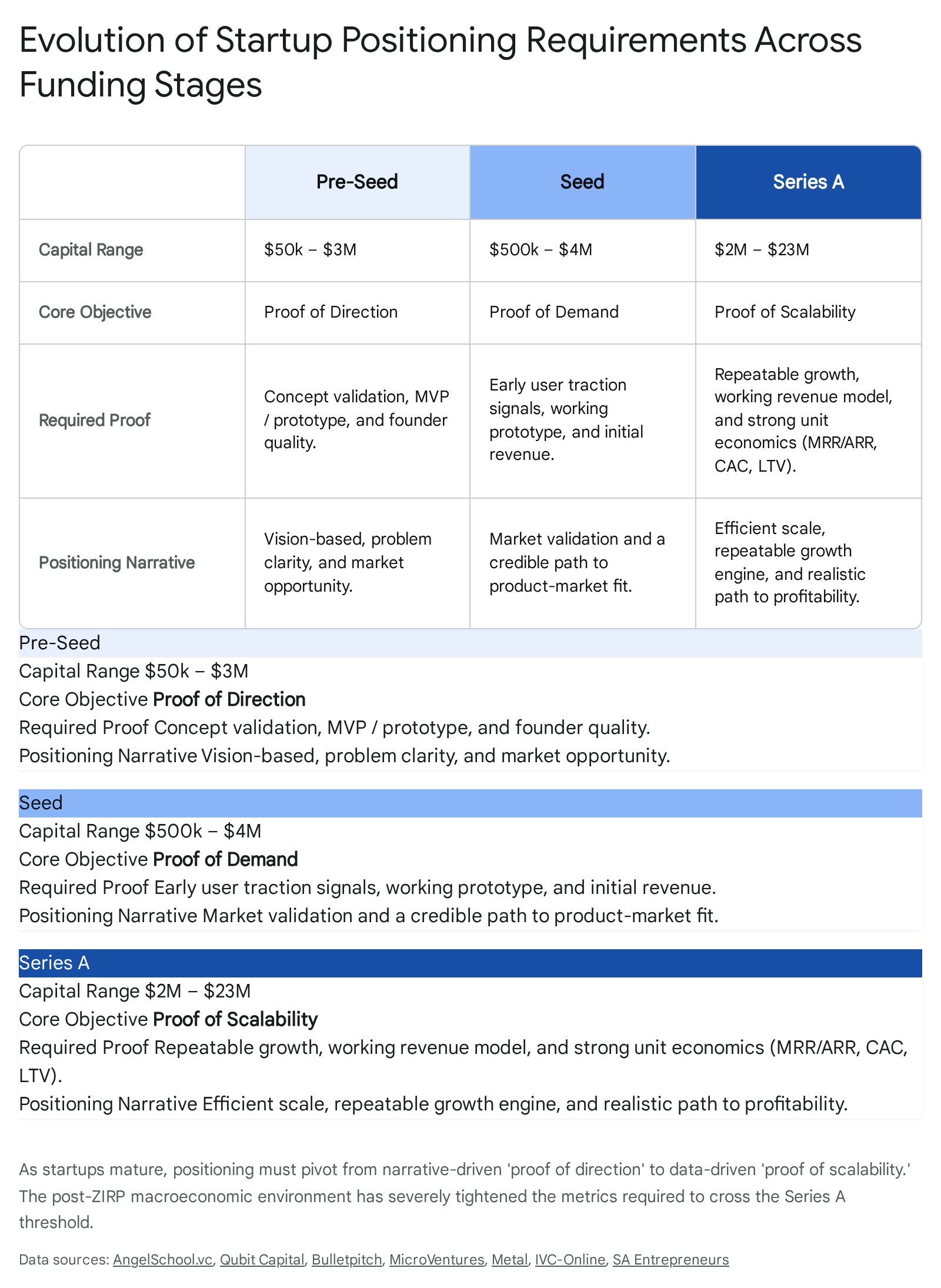
A startup's positioning is not a static artifact; it is a dynamic strategic posture that must pivot fundamentally as the venture progresses through capital lifecycle stages. The metrics by which investors evaluate a company - and therefore the narrative the company must project to the market and capital allocators - change dramatically from pre-seed formation to late-stage scaling 3624252627.
Pre-Seed and Seed Validation Dynamics
At the pre-seed stage, hard data points regarding customer acquisition costs, long-term retention, and lifetime value are generally non-existent 362627. Positioning at this stage is fundamentally about proving the validity of the problem and the credibility of the founding team 2526. The core narrative focuses on "founder-market fit," early customer discovery insights, and demonstrating that a minimum viable product (MVP) can secure early pilot adoption from design partners 362527. Pre-seed investors, who typically inject between $500,000 and $3 million, are funding founder belief and directional proof rather than audited financial scaling 242527.
As the venture transitions to the Seed stage, the positioning requirements tighten considerably. Seed rounds, which currently average between $1 million and $4 million and establish valuations between $8 million and $25 million, require startups to position themselves based on repeatable early traction 362527. The narrative must demonstrate that early adopters are using the product repeatedly, that retention signals are positive, and that a functional feedback loop exists to iterate rapidly toward true product-market fit 362425.
The Series A Threshold and Post-ZIRP Constraints
The leap from Seed to Series A represents the most severe mortality phase in the venture lifecycle, with historical data indicating that fewer than 10% of seed-funded startups successfully raise a Series A round 24. At this stage, positioning undergoes a massive structural pivot: the narrative shifts entirely from "proof of demand" to "proof of scalability" 2425.
To cross the Series A threshold, startups must abandon theoretical total addressable market (TAM) narratives and instead position themselves around rigorous, highly defensible unit economics. The positioning must be backed by quantifiable, audited metrics: Monthly Recurring Revenue (MRR), Customer Acquisition Cost (CAC), Lifetime Value (LTV), and net revenue retention (NRR) 3624. The company must prove it has built a repeatable go-to-market engine where capital inserted yields a predictable, highly profitable revenue output 2425.
This transition has been vastly complicated by the macroeconomic environment of 2024 - 2026. Following the end of the Zero Interest-Rate Policy (ZIRP) era, global venture capital markets experienced a profound and lasting correction 33282930313233. During the liquidity bubble peaking in 2021, startups could successfully position themselves entirely on raw user growth, regardless of margin sustainability or cash burn. In the post-ZIRP reality, the industry has aggressively prioritized efficiency over growth-at-all-costs, leading to massive headcount reductions - with over 127,000 tech layoffs tracked in 2025 alone - and a demand for immediate paths to absolute profitability 282933.
Furthermore, capital concentration has fundamentally altered the competitive landscape. Recent data indicates that the top decile of deals captures upwards of 50% to 70% of all private capital, heavily concentrated in foundational artificial intelligence models and national defense technologies (such as the autonomous systems developed by Anduril) 303234. This leaves the vast majority of the ecosystem operating on heavily constrained financial scales 32. For general B2B SaaS startups, the bar for Series A positioning has never been higher; they must position themselves as "compound startups" capable of defending margins through deep, proprietary domain expertise, rather than relying on thin software layers that are increasingly commoditized by generative AI agents 34.
Maturation from Founder-Led to Institutional Execution
As a venture scales from Seed to Series A and beyond, the operational mechanics of how positioning is delivered to the market must mature alongside the financial metrics. Early-stage positioning is inherently founder-led; founders leverage deep domain intuition, personal networks, charisma, and unscalable tactics to secure initial customers and pilot programs 2135363752.
However, as the organization scales and hires dedicated, institutional sales teams, relying purely on founder intuition becomes a critical bottleneck. Startups frequently encounter severe failure rates during this transition because they attempt to scale sales headcounts before establishing a repeatable, documented go-to-market pitch and a crystalline Ideal Customer Profile (ICP) 21. If the sales system is broken or the positioning is ambiguous, hiring more representatives only accelerates capital burn 21.
The operational reality of scaling requires the formalization of the Product Marketing Management (PMM) function. The PMM is tasked with translating the founder's initial, often highly technical vision into data-driven, systematic positioning 3538. This transition involves shifting from qualitative intuition to rigorous market analysis - leveraging objective data sources such as customer support tickets, win/loss analytics, usability studies, and cohort retention data to refine the positioning strategy continuously 3539. The PMM establishes the "battle strategy," ensuring that the overarching positioning is not watered down when translated into specific messaging for discrete channels and audiences 10.
Empirical Analysis of Positioning Failures
While popular business literature and venture capital blogs often focus disproportionately on the successes of unicorn startups, empirical studies utilizing cross-case analyses and post-mortem failure autopsies reveal consistent, structural mechanisms by which inadequate positioning destroys ventures. The failure rate of early-stage software and high-tech startups remains extraordinarily high, with macroeconomic estimates indicating that up to 90% of ventures ultimately fail, and the vast majority (up to 65%) do not survive past their tenth year of operation 4041.
Premature Scaling and the Product-Market Fit Illusion
A recurring pathology in startup failure is the premature scaling of sales and marketing operations before true product-market fit (PMF) and stable positioning have been achieved 424344. Research highlights that financial mismanagement and capital exhaustion are rarely root causes of failure in isolation; they are almost universally lagging symptoms of core business missteps, specifically the fundamental inability to align product features with genuine market demand 4243.
Adapting the aviation sector's SHELL framework (Software, Hardware, Environment, Liveware) to entrepreneurship, researchers have identified that tech startups heavily over-index their capital and operational focus on "Software/Hardware" (the physical or digital product itself) while critically failing to develop the corresponding business model and market positioning (the strategic environment) 4142. The absence of an accurate product-market fit results in ventures becoming "stuck in the middle," burning vast amounts of venture capital on marketing efforts that acquire users who ultimately churn because the product does not solve a high-priority, systemic problem 2142.
As demonstrated by empirical observations of SaaS scaling, customer acquisition cost (CAC) can initially appear highly favorable due to early-adopter enthusiasm, organic traction, and founder networks. However, this CAC will aggressively escalate as the company attempts to acquire the early majority if the underlying positioning appeals to a segment with low long-term retention 21. Scaling what converts rather than what retains is a fatal positioning error 21.
Feature, Benefit, and Surrogate Positioning Efficacy
Empirical studies investigating how consumers cognitively process different forms of positioning have yielded critical insights for technology marketing. Brand positioning strategies are generally categorized into three distinct typologies: Feature-based, Benefit-based, and Surrogate-based 8945.
Extensive empirical testing across multiple sectors reveals consistent performance hierarchies among these typologies: * Feature Positioning: This strategy highlights the objective, physical, or technical attributes of the product (e.g., processing speed, specific software integrations). Despite being the default strategy for engineering-led startups, consumers consistently evaluate feature positioning as the least effective strategy for establishing distinctiveness, favorability, and credibility 83045. * Benefit Positioning: This strategy highlights the functional or emotional outcomes derived from using the product. Empirical data demonstrates that benefit positioning performs significantly better than feature positioning, particularly when the benefits communicated are direct rather than indirect 8. * Surrogate Positioning: This strategy focuses on intangible associations, such as the identity of the target user, the specific usage occasion, or the brand's overarching prestige, rather than the product itself 8945. In highly saturated markets where technical features are rapidly commoditized and easily imitated, surrogate positioning has demonstrated the strongest positive response in consumer evaluations, driving higher brand equity and sustainable competitive advantage 945.
Startups that persistently market based on technical feature lists face severe cognitive disadvantages against competitors that successfully adopt Benefit or Surrogate positioning 3045.
| Positioning Typology | Strategic Focus | Empirical Effectiveness | Common Startup Application |
|---|---|---|---|
| Feature-Based | Objective technical attributes and specifications. | Lowest effectiveness; fails to establish strong brand distinctiveness or emotional resonance 845. | Default for engineering-led startups; highly vulnerable to rapid commoditization 30. |
| Benefit-Based | Functional or emotional outcomes of product usage. | High effectiveness, specifically when benefits are directly linked to tangible consumer value 8. | Utilized as startups mature and shift focus from product building to customer problem-solving. |
| Surrogate-Based | Intangible associations, user identity, and brand prestige. | Highest effectiveness in saturated markets; generates the strongest positive consumer response and loyalty 945. | Employed by mature startups seeking to establish long-term brand equity beyond transient software features. |
Environmental Turbulence and Marketing Agility
Positioning is not insulated from macroeconomic or technological shocks. Studies assessing the dynamic capabilities of startups in emerging economies highlight the absolute necessity of "Entrepreneurial Strategic Posture" (ESP) and institutional marketing agility 4647484950.
In environments characterized by high technological turbulence or severe institutional voids, initial positioning advantages degrade rapidly. Rivals imitate product features, regulatory frameworks shift, or overarching macroeconomic conditions render initial pricing models obsolete 484950. Organizations that treat positioning as a static, one-time document rather than a continuous, cross-functional process of experimentation and re-orientation are mathematically more likely to fail 4449.
Marketing agility - defined as the institutional capacity to rapidly detect environmental shifts, actively solicit and analyze customer feedback, and pivot the positioning narrative through data-driven iterations - serves as a critical moderator. This agility actively amplifies the success rate of new product innovations and sustains long-term customer loyalty in highly turbulent sectors 4647.
Operationalizing the Positioning Strategy
To move positioning from a theoretical exercise to an operational reality that drives revenue, startups must translate their strategic choices into tangible organizational artifacts and navigate deep-seated cognitive biases.
Constructing Positioning Statements and Messaging Houses
The earliest artifact of startup positioning is typically the founder's investor pitch deck. However, utilizing investor-facing materials as the foundation for customer acquisition is a pervasive and damaging error 3866. Investors evaluate total addressable market, team pedigree, and exit potential; customers evaluate immediate utility and pain alleviation.
As a startup matures toward a scalable go-to-market motion, the positioning must be codified into specialized internal frameworks 3539665152. The standard structural outputs utilized by high-performing product marketing teams include: * The Positioning Statement: A concise, internally facing declaration that explicitly identifies the target market segment, the market category, the unique value proposition, and the primary competitive differentiation 355152. It serves as the strategic anchor for all subsequent marketing activities. * The Messaging House: A subsequent, highly structured framework built upon the foundation of the positioning statement. It establishes an "umbrella statement" (the core, unifying narrative) supported by specific value pillars, tangible proof points, utility descriptions, and unified calls-to-action 3966.
When properly constructed and rigorously enforced, the messaging house guarantees that every external touchpoint - from web copy and press releases to sales enablement scripts and product launch campaigns - maintains narrative uniformity, projecting a cohesive, differentiated brand identity to the market 3966.
Mitigating Survivorship and Sampling Biases
A critical limitation in operationalizing positioning strategies is the pervasive influence of survivorship bias and sampling bias. The vast majority of popular startup literature and prescriptive frameworks are reverse-engineered from the trajectories of hyper-successful outlier companies, often ignoring the countless ventures that executed identical strategies but failed due to timing, macroeconomic shifts, or resource constraints 25264053.
Furthermore, early positioning is heavily susceptible to "sampling bias" based on the composition of the initial beta testing cohort. For example, research into software startups launched on platforms like Product Hunt reveals significant demographic skews among early adopters 54. If the early user base does not accurately represent the broader, mainstream market (e.g., heavily skewing male, highly technical, or overly focused on niche use cases), the feedback loops driving the startup's product iterations and positioning adjustments become fundamentally distorted 54.
This demographic distortion can lead to a documented "product-growth gap." In this scenario, products positioned to serve underrepresented demographics systematically experience suppressed acquisition metrics and higher exit rates due to faulty early-market signals that misguide venture capital decision-making and product development efforts 54. Founders and product marketing managers must rigorously audit their early traction data. Optimizing a positioning strategy based solely on the loudest early adopters, without critically evaluating whether those users represent a scalable, high-retention ideal customer profile, is a frequent precursor to systemic go-to-market failure 215455.
Conclusion
Positioning a startup effectively requires navigating a complex interplay of academic theoretical frameworks, highly localized economic realities, and dynamic funding constraints. While orthodox models emphasizing absolute differentiation and rigid adoption lifecycles provided the historical foundation for technology marketing, modern empirical research heavily favors strategies optimized for mental and physical availability, iterative agility, and highly specific context-setting.
Furthermore, the macroeconomic environment strictly dictates execution. The era of the pure-play financial, disruption-oriented Silicon Valley model is contracting in the face of heightened capital costs. In its place, the post-ZIRP environment demands positioning anchored in rigorous unit economics, immediate paths to profitability, and tangible value propositions. Whether through the collaborative corporate models of East Asia, the infrastructure-focused pivoting in emerging markets, or the demand for highly defensible "compound startups" in Western B2B SaaS, effective positioning has evolved from a superficial branding exercise into a core, existential mechanism of enterprise survival. Ultimately, the startups that succeed are those capable of transitioning from founder-led intuition to systematic, data-driven frameworks, continuously refining their strategic posture in response to market turbulence, sampling biases, and empirical feedback.