
The psychology of affective forecasting
The human cognitive architecture functions as a sophisticated anticipation engine, uniquely adapted for mental time travel. This capacity for prospection enables individuals to simulate potential future scenarios and estimate the emotional responses those scenarios will elicit. This phenomenon, formalized in psychological and economic literature as affective forecasting, forms the fundamental architecture of human decision-making. From mundane daily choices, such as selecting a meal or scheduling a meeting, to monumental life alterations, such as initiating a marriage, accepting a career opportunity, or selecting medical treatments, human behavior is largely guided by predictive models regarding future emotional states 123. In classical economic utility theory, these forecasts are synonymous with "predicted utility," an estimation of the satisfaction an outcome will yield, which is later contrasted with "experienced utility," the actual satisfaction derived 4.
Despite the evolutionary necessity of prospection, decades of interdisciplinary research indicate that humans are remarkably fallible when predicting their own psychological futures. Investigations spanning cognitive psychology, neuroscience, and behavioral economics systematically demonstrate that while individuals generally possess a high degree of accuracy regarding the valence of future emotions (anticipating correctly whether an event will feel positive or negative) and the specific qualitative categories of emotions they will experience (such as anger, joy, or disgust), they systematically misjudge the magnitude of these affective states 1567. This ubiquitous cognitive error, whereby the enduring emotional impact of an event is substantially overestimated, is defined as the impact bias 278.
The persistence of the impact bias across diverse populations, sociodemographic cohorts, and situational scenarios presents a critical puzzle for behavioral sciences. Errors in affective forecasting are not merely theoretical curiosities; they drive suboptimal consumer choices, influence resource allocation in public health, and dictate long-term interpersonal relationships. By systematically examining the cognitive heuristics, neurobiological substrates, methodological controversies, and sociocultural variables that shape affective forecasting, a comprehensive framework emerges explaining why humans are fundamentally inaccurate predictors of their own emotional futures.
Cognitive Mechanisms Underlying Predictive Errors
The discrepancy between expected and actual emotional states does not arise from random predictive noise. Instead, it is the downstream consequence of systematic cognitive processing mechanisms. Research has identified two primary heuristic drivers that reliably produce the impact bias: focalism and immune neglect 7910.
Focalism and the Contextual Isolation Effect
Focalism, frequently conceptualized alongside the focusing illusion, occurs when individuals direct a disproportionate allocation of attention toward the central details of a predicted future event while simultaneously neglecting the peripheral, contextual factors that will inevitably co-occur and dilute the event's emotional resonance 7911. When an individual imagines a highly salient future occurrence - such as winning a financial windfall, securing academic tenure, or experiencing a romantic rejection - the cognitive simulation isolates the event in a contextual vacuum.
For instance, classic studies examining college students' affective forecasts regarding housing lotteries demonstrate severe focalism. Students universally predicted that assignment to a highly desirable dormitory would result in significantly elevated long-term happiness, while assignment to an undesirable dormitory would induce sustained unhappiness. However, longitudinal follow-ups revealed that actual happiness levels a year later were statistically indistinguishable between the two groups 2. The forecasters failed to account for the myriad of daily occurrences - academic achievements, social interactions, transient illnesses, and minor annoyances - that ultimately consumed their attention and dictated their overarching affective state 1011.
By failing to integrate non-schematic, incidental information into their mental representations of the future, individuals over-weight the focal event's capacity to govern their subjective well-being 1011. To empirically test this hypothesis, researchers have designed "defocusing" exercises intended to artificially expand a participant's temporal and contextual awareness. In these prospective diary tasks, participants are required to explicitly list the mundane, hourly activities they will be engaged in on the day a target event is scheduled to occur. Engaging in this cognitive broadening prior to making an affective forecast significantly moderates predictions, bringing expected emotional states into closer alignment with actual experienced states 911.
The efficacy of defocusing interventions is clearly observable in high-stakes political contexts. In a longitudinal investigation of the 2004 United States Presidential election, researchers tracked the predicted and actual emotional responses of partisans facing electoral victory or defeat.
| Electoral Subgroup | Baseline Happiness | Predicted Affective Change | Actual Affective Change | Forecasting Discrepancy |
|---|---|---|---|---|
| Winning Candidate Supporters (Standard) | 6.35 | +0.85 | +0.60 | +0.25 (Minor Overestimation) |
| Losing Candidate Supporters (Standard) | 5.65 | -1.73 | -0.78 | -0.95 (Significant Impact Bias) |
| Losing Candidate Supporters (Diary Defocusing) | N/A | -0.89 | -0.63 | -0.26 (Moderated Impact Bias) |
Data summarizes the predicted versus actual changes in happiness (measured on a 1-9 scale) surrounding the 2004 U.S. election. The data illustrates standard impact bias among losing supporters, which was significantly mitigated when participants completed a defocusing diary task prior to forecasting 12.
Immune Neglect and Emotional Homeostasis
While focalism applies symmetrically to the anticipation of both positive and negative events, a second mechanism, termed immune neglect, predominantly exacerbates the impact bias for adverse occurrences. The human psychological architecture possesses a robust suite of unconscious cognitive defense mechanisms - collectively termed the psychological immune system - that actively regulate and ameliorate the experience of negative affect 131415.
When confronted with failure, trauma, or interpersonal rejection, individuals instinctively engage in rationalization, cognitive dissonance reduction, motivated reasoning, and sense-making 12. These homeostatic processes reconstruct the narrative of the threatening event, rendering it more psychologically palatable and hastening emotional recovery 12. However, because the psychological immune system operates implicitly and largely outside of conscious awareness, individuals systematically fail to account for its efficacy when projecting themselves into future distress 1316.
This specific failure to anticipate one's own resilience leads to a pronounced durability bias - the tendency to drastically overestimate the chronological persistence of a negative emotional state 131718. In studies investigating romantic breakups, academic rejections, and critical negative feedback, forecasters consistently predict protracted periods of devastation. In reality, the psychological immune system rapidly metabolizes the negative experience. Experimental data from studies tracking romantic breakups demonstrate that while predicted distress remains highly elevated for months, actual distress decays at a rapid, linear rate 19.
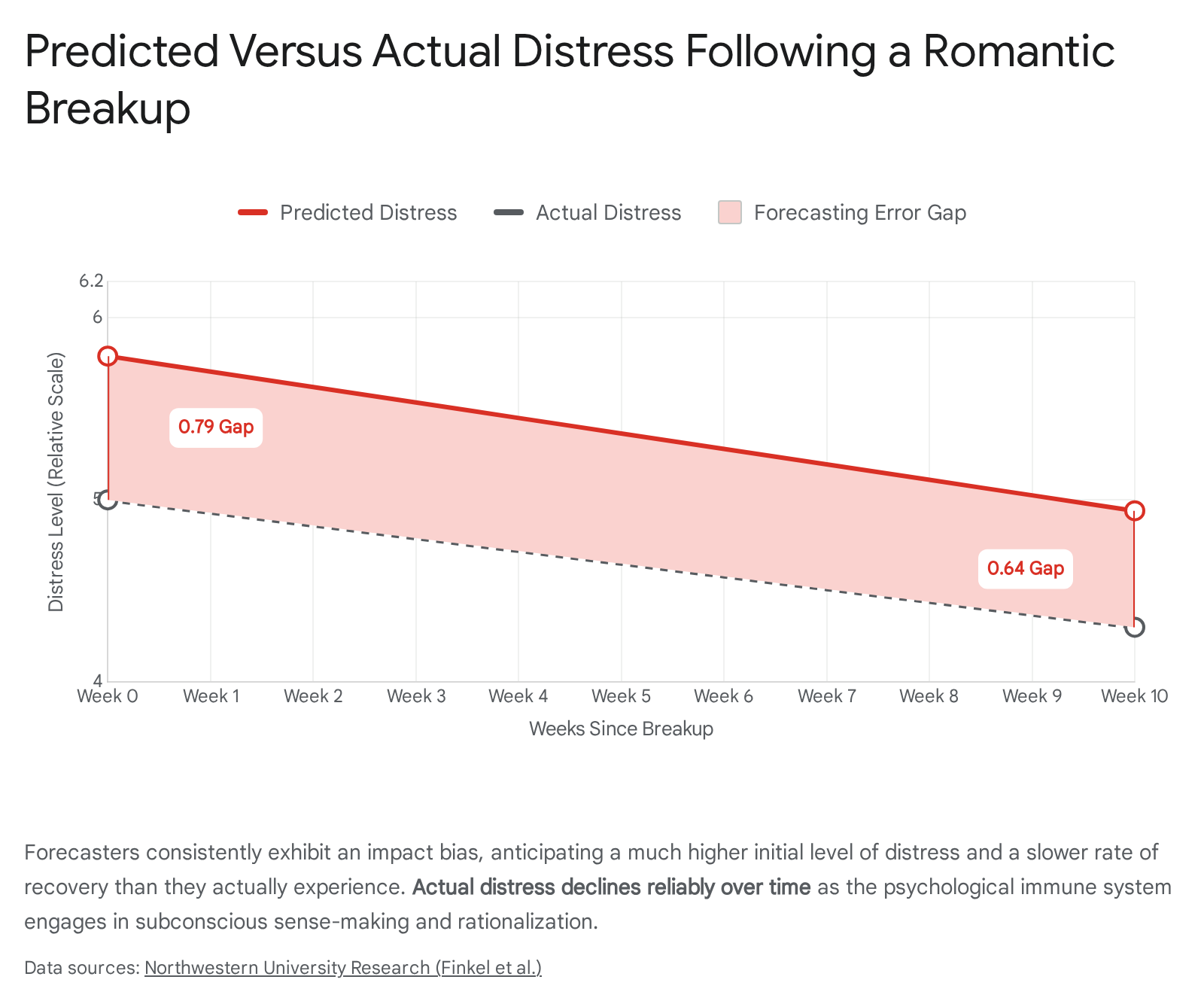
Similarly, when examining specific coping mechanisms, such as active emotional processing during events like Valentine's Day for unpartnered individuals, actual emotional reactions correlate strongly with the deployment of coping strategies, yet participants' predictions show almost no correlation with their own coping abilities 20.
Empathic Forecasting and Psychological Distance
The limitations governing self-prediction extend symmetrically, and sometimes more severely, to the prediction of others' emotional states - a concept formally termed empathic forecasting 721. Utilizing Construal Level Theory, researchers map how psychological distance dictates predictive accuracy. When an individual forecasts their own future, they have access to both a high-level construal (the abstract, theoretical impact of the event) and, eventually, a low-level construal (the granular, experiential reality of the event as it occurs).
When forecasting for others, the observer is restricted solely to the high-level construal because the social distance prevents actual experiential feedback 721. Consequently, observing another person's misfortune or success relies entirely on "decision from description" rather than "decision from experience." This mechanism ensures that focalism and immune neglect remain unchecked when evaluating peers. Experimental paradigms utilizing sequential gambling tasks indicate that while individuals exhibit impact bias when predicting their own risk-aversion shifts following a financial loss, this bias is significantly amplified when forecasting the behavioral shifts of a socially distant peer 721. Without the actual experience to trigger diminishing sensitivity and reference-point adaptation, the empathic forecast remains rigidly tethered to the isolated focal event 21.
Methodological Controversies and Measurement Validity
While the impact bias is widely cited as a robust psychological axiom, recent empirical scrutiny has sparked intense methodological debates regarding the genuine magnitude of these forecasting errors. The methods utilized to elicit and quantify expectations heavily influence the observed prevalence of predictive failure.
The Procedural Artifact Hypothesis
A prominent critique of classical affective forecasting paradigms asserts that the magnitude of the intensity bias is artificially inflated by procedural artifacts in study design. Researchers advancing this critique note a subtle but critical misalignment between how prediction questions are posed and how subsequent experiential data is collected 222324.
In standard methodologies, participants are often asked to forecast how an event will make them feel "in general." However, cognitive processing constraints often cause participants to misinterpret this as an inquiry into how they will feel specifically about the focal event. Later, when researchers measure the actual affective state, they assess general mood without explicitly reminding the participant of the target event. Meta-analytical reviews incorporating this distinction reveal that when experimental designs align the specificity of the prediction with the specificity of the experience - asking participants to predict and report their feelings specifically concerning the focal event - the magnitude of the intensity bias shrinks considerably 222324.
Proponents of the original impact bias framework maintain that this procedural critique does not invalidate the underlying psychological phenomenon. They argue that the human failure to recognize that a focal event will eventually fade into the background of general affect is the exact empirical definition of focalism 23. Therefore, the impact bias remains a critical barrier to accurate decision-making; individuals routinely make long-term choices based on the assumption that specific events will permanently alter their general baseline utility.
Ecological Validity and Naturalistic Sampling
Historically, affective forecasting has been measured using hypothetical laboratory scenarios or singular, highly salient events, such as national elections, sporting championships, or major financial windfalls. Critics argue that these extreme paradigms may lack ecological validity, failing to capture the dynamic, fluctuating nature of emotion and anticipation in everyday, naturalistic contexts 242526.
To address these limitations, contemporary researchers increasingly rely on the Experience Sampling Method (ESM) and Ecological Momentary Assessment (EMA). These methodologies involve intensive, repeated sampling of individuals' predictions and actual emotions in their natural environments via mobile technology, thereby minimizing recall bias 1524. ESM studies reveal complex nuances in prediction. For instance, rather than uniform overestimation, individuals in naturalistic settings frequently exhibit a strong projection bias, anchoring their forecasts of future states heavily on their current momentary affective state 1527. Furthermore, investigations differentiating between dimensional and discrete measurement approaches indicate that while people reliably overestimate emotional intensity for high-arousal, discrete events (e.g., sheer panic before a public speech), they occasionally underestimate future intensity for low-arousal or emotionally complex daily tasks 8.
Statistical Baselines and the Kalman Filter
To evaluate whether human forecasting errors are uniquely flawed or simply a byproduct of computational complexity, behavioral scientists have compared human affective forecasts against advanced statistical models. When affective forecasting is framed as an adaptive learning process, it can be formally modeled using mathematical mechanisms like the Kalman filter, which updates predictions based on a continuous stream of prior error data 27.
When human predictions regarding affect over a 2-to-3-hour window are compared to forecasts generated by a Kalman filter processing the same experiential data, humans demonstrate significantly larger absolute errors. The computational sub-optimality of human forecasting arises from a disproportionate reliance on projection - humans fail to appropriately weight historical baselines, instead projecting their immediate affective state onto the future 27. Interestingly, these deviations from statistical optimality are highly pronounced in hour-long forecasts but diminish significantly in minute-long, immediate forecasts, suggesting that the cognitive architecture struggles specifically with temporal integration over extended periods 27.
Neuroanatomical Substrates of Prospection
The cognitive shortcomings observed in behavioral research are deeply rooted in the neuroanatomical constraints of the central nervous system. The neural networks responsible for encoding and retrieving the past are inextricably linked to those utilized for simulating the future, creating inherent vulnerabilities in predictive accuracy and affective regulation.
Hippocampal and Ventromedial Prefrontal Circuits
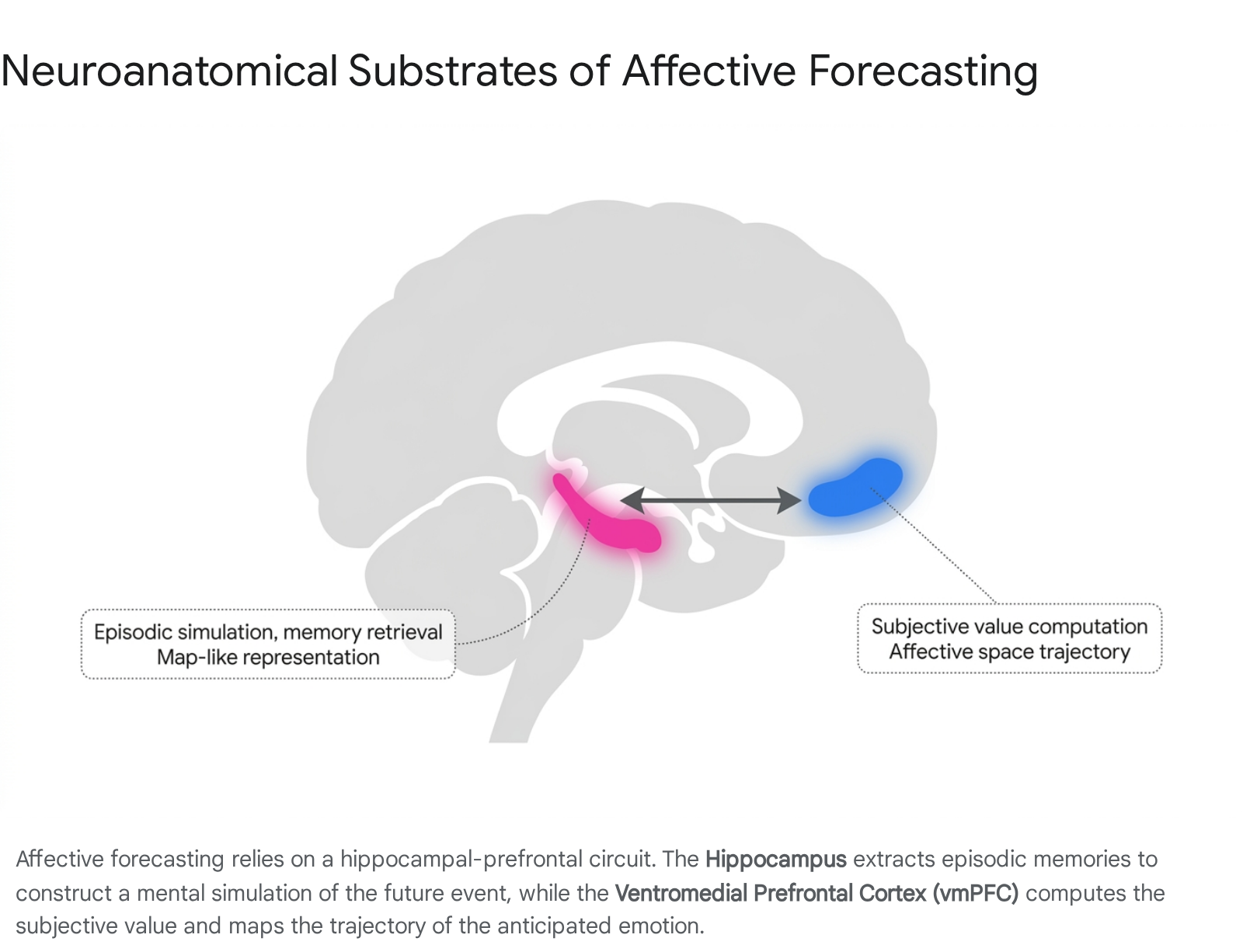
High-resolution neuroimaging studies have established a functional double dissociation in the specific roles of the hippocampus and the ventromedial prefrontal cortex (vmPFC) during affective forecasting. To predict future emotions, the brain cannot access a literal future; it must assemble fragmented episodic memories into a novel, cohesive simulation 2829.
The hippocampus operates as the structural and spatial organizer of this simulation. Current neurobiological models suggest the hippocampus represents knowledge in a map-like fashion, binding highly processed sensory inputs and defining the discrete, categorical nature of the anticipated emotion (e.g., determining that a specific scenario is structurally associated with "fear" rather than "disgust") 2930. Because the brain relies strictly on memory reconstruction to construct the future, any distortion in memory recall directly corrupts the affective forecast. If an individual remembers the acute peak intensity of a past failure but fails to recall the subsequent rapid recovery, the hippocampus will feed an artificially intense baseline into the forward simulation 28.
In contrast, the vmPFC is tasked with computing the subjective value of the simulation and mapping its trajectory through a dimensional affective space. The vmPFC integrates the episodic details generated by the hippocampal formation and assigns an abstract, dimensional value of valence (positive/negative) and arousal (high/low) to the anticipated event 293031. The interaction within this hippocampal-prefrontal circuit indicates that forecasting is not a mathematical calculation of probabilities, but a reconstructive, highly subjective integration of past emotional valences 3033.
Emotion Regulation and Attentional Deployment Networks
Beyond the core hippocampal-prefrontal circuit, affective forecasting is heavily modulated by the brain's executive control and emotion regulation networks, specifically involving the Default Mode Network (DMN), the amygdala, and the insula 293332.
When individuals forecast outcomes that are emotionally bivalent or highly complex - such as evaluating a medical treatment that offers substantial pain relief but guarantees severe, permanent side effects - their predictions are shaped by attentional deployment 33. Functional magnetic resonance imaging (fMRI) reveals that when attention is actively directed toward the negative, threatening aspects of a forecast, the insula and frontal pole demonstrate heightened activation. Conversely, maintaining focus on the positive, rewarding aspects of the same bivalent scenario recruits the superior frontal gyrus 33.
Because humans often lack conscious, top-down control over sub-personal attentional biases, the brain frequently locks onto the most salient threat or reward. The amygdala determines the relevance of incoming stimuli and provides direct biasing signals to fronto-parietal attention regions 32. This physiological reality exacerbates the behavioral phenomenon of focalism; the brain literally dedicates more neural real estate and processing power to the singular, high-arousal element of a future scenario, starving the contextual, moderating variables of necessary computational resources.
Affective Forecasting in the Context of Health and Disability
While forecasting errors regarding sports outcomes or consumer purchases represent relatively benign cognitive flaws, the consequences of affective misprediction are exceptionally profound in the realm of medical decision-making and health policy. Patients, healthy proxy decision-makers, and physicians routinely make life-altering choices regarding aggressive treatments, palliative care, and institutional resource allocation based on their predictions of future quality of life.
Hedonic Adaptation and the Disability Paradox
The foundational understanding of emotional forecasting in health contexts traces back to a landmark 1978 empirical study that systematically compared the happiness levels of major lottery winners, paralyzed accident victims, and a geographically matched control group 353337. Operating against deeply ingrained societal intuitions, the researchers discovered that lottery winners were not statistically significantly happier than the control group, and the paralyzed accident victims reported general happiness levels only modestly lower than the controls.
| Participant Cohort | Reported General Happiness (0-5 Scale) | Contrast Effect Manifestation |
|---|---|---|
| Major Lottery Winners | 4.00 | Ordinary daily pleasures yielded significantly less satisfaction. |
| Control Group | 3.82 | Baseline functioning. |
| Accident Victims (Paraplegia/Quadriplegia) | 2.96 | Idealization of the past, but robust adaptation to current reality. |
Data adapted from the foundational 1978 Brickman investigation demonstrating that catastrophic physical trauma and extreme financial windfalls exert vastly smaller permanent effects on subjective well-being than intuitively forecast 353334.
This study illuminated the powerful forces of hedonic adaptation. Over time, lottery winners experienced a habituation effect, where the initial euphoria normalized, and a contrast effect, where the massive spike in stimulation rendered mundane daily pleasures less enjoyable 3337. Conversely, the paralyzed individuals demonstrated the resilience of the psychological immune system, habituating to their physical limitations and recalibrating their internal benchmarks for satisfaction 37.
This dynamic has since been codified in the medical literature as the "disability paradox." The paradox describes the massive, irreconcilable discrepancy between the high quality of life self-reported by individuals living with chronic illnesses or severe, permanent disabilities, and the dismal, unlivable quality of life predicted by healthy individuals asked to imagine those exact same conditions 353637.
Healthy individuals evaluating disability succumb to severe, unmitigated focalism. When forecasting life as a paraplegic, an observer focuses almost exclusively on the loss of mobility and the acute trauma of the transitionary phase. They fail to imagine the eventual return to routine human experiences - consuming meals with family, consuming media, or engaging in fulfilling social relationships 738. Furthermore, healthy individuals demonstrate profound immune neglect, radically underestimating the human capacity to recalibrate internal psychometric standards, abandon inaccessible life goals, and construct entirely new sources of meaning and competence 373940.
Early Adaptation Trajectories and Healthcare Policy
It is crucial to note that forecasting errors regarding disability are not solely committed by healthy outsiders; newly diagnosed patients also commit profound errors regarding their own trajectories. Longitudinal investigations following patients recently diagnosed with life-altering physical impairments reveal that early in the adaptation process, these individuals reliably underestimate their own capacity to adapt over time. Consequently, their initial predictions regarding their future well-being are biased excessively low 3941.
The clinical implications of the disability paradox are severe. Because affective forecasting generates erroneous judgments regarding future quality of life, it directly informs - and frequently corrupts - the calculus of medical decision-making 535. In health economics, resource allocation often relies on Quality-Adjusted Life Years (QALYs), a metric where health state values are frequently assigned by members of the general public imagining what a specific state would feel like, rather than by patients actually inhabiting the state 40. This systemic forecasting error can result in public policy that chronically undervalues the lives of disabled populations.
Similarly, in acute clinical settings where healthcare resources are scarce (e.g., pandemic triage protocols, organ transplantation waiting lists), implicit biases regarding whose life is "worth living" may result in disabled individuals being systematically deprioritized by able-bodied physicians 35. At the individual patient level, inaccurate forecasts often lead proxy decision-makers to refuse necessary, life-extending treatments for incapacitated patients out of a misguided, focalism-driven belief that the resulting lifestyle changes will result in permanent, unbearable psychological suffering 5.
The Impact of Psychopathology on Forecasting
The mechanisms of affective forecasting are not universally uniform across all human minds; predictive architecture is heavily modulated by individual neurological and psychological differences. Conditions characterized by systemic emotion dysregulation fundamentally warp the predictive mechanisms of the brain, transforming forecasting from a flawed but functional system into a driver of pathology.
Major Depressive Disorder and Dysphoria
Theoretical frameworks regarding depression have long posited that a pervasive, negative view of the future constitutes a core, maintaining aspect of the disorder, historically referenced as the cognitive triad 24. Empirical investigations utilizing Ecological Momentary Assessment to track affective forecasting confirm that dysphoric individuals and patients with Major Depressive Disorder (MDD) exhibit profound and specific deficits in prospection.
While healthy populations display a well-documented optimistic prediction bias - routinely expecting future events to be slightly more positive than they actually manifest - depressed individuals exhibit a blunted positive prediction bias 24. They anticipate significantly less pleasure from upcoming events, a cognitive error that directly contributes to the severe anhedonia and amotivation characterizing the illness 24. Furthermore, temporal network analyses reveal that in depressed populations, the cognitive network linking anticipatory, experienced, and consummatory emotions is significantly denser. Dysphoric individuals place disproportionate, pathological weight on past negative experiences when estimating future emotions, effectively locking themselves into a reconstructive memory loop that guarantees negative expectations and preemptively neutralizes potential joy 24.
Trait Anxiety and Neural Decoupling
Similarly, individuals exhibiting high trait anxiety (HTA) and Generalized Anxiety Disorder (GAD) demonstrate distinct neuro-behavioral profiles regarding affective prediction. Behaviorally, HTA individuals systematically anticipate lower levels of arousal for future positive events, viewing potential rewards as muted, while maintaining heightened negative expectations for adverse outcomes 46.
Resting-state functional connectivity analyses reveal that these forecasting biases in anxiety are linked to specific aberrations in the brain's baseline architecture. HTA individuals display altered connectivity between the vmPFC and regions involved in sensory processing and fear regulation, such as the insula, the lingual gyrus, and the amygdala 46. In healthy individuals, the vmPFC regulates and dampens hyperactive amygdala responses during prospection. In highly anxious populations, Bayesian modeling suggests decreased functional connectivity within these vmPFC-insula-amygdala circuits 46. Because anxiety inherently involves an intolerance of uncertainty, the decoupled brain compensates by generating highly distressing, worst-case affective forecasts as a maladaptive, hyper-vigilant protective mechanism.
Sociocultural Modulators of Prediction
Psychological science has increasingly recognized that cognitive heuristics, including those governing prospection, are not always universal human constants; they are frequently shaped by socio-cultural ecologies. Affective forecasting exhibits distinct, measurable variations across different cultural paradigms, largely driven by differences in overarching cognitive styles and regional norms regarding emotional expression.
Analytic Versus Holistic Cognitive Styles
The magnitude of the impact bias is significantly influenced by whether a given culture promotes analytic or holistic cognitive processing. Western cultures (e.g., Euro-Canadians, populations in the United States) generally utilize analytic thinking, which is characterized by a reductionist approach that places an intense focus on focal objects and de-emphasizes surrounding situational context. Conversely, East Asian cultures heavily rely on holistic thinking paradigms, fundamentally viewing events as embedded within a complex, interconnected web of social and environmental relationships 4243.
Empirical studies directly comparing Euro-Canadian and East Asian populations demonstrate that East Asians are markedly less susceptible to the impact bias when predicting their emotional reactions to future events 42. Because holistic thinkers naturally consider the broader context of their lives - implicitly recognizing without prompting that a single positive or negative event will be diluted by other routine daily occurrences - they exhibit far less focalism 2842. Notably, when researchers applied a targeted "defocusing" manipulation to Euro-Canadian participants, forcing them to temporarily adopt a holistic framework regarding their future context, their forecasting accuracy improved dramatically, matching the baseline accuracy of the East Asian participants 2842.
Expressive Interdependence and Arousal Norms
Further variations in forecasting accuracy and baseline assumptions are observed in cultures characterized by differing models of selfhood and emotional expression. For instance, Latin American cultures have been shown to emphasize a unique psychosocial model termed "expressive interdependence" 4445. Unlike the restraint-focused interdependence typical of Confucian East Asian cultures, Latin American cultures display elevated levels of emotional expressivity and a strong orientation toward positive, socially engaging emotions 45.
While direct research mapping these specific expressive traits onto explicit forecasting error rates is still an emerging field, the underlying cross-cultural literature suggests that cultural baselines of emotional arousal dictate predictive baselines. Utilizing machine learning models to analyze sentiment on social media platforms across linguistic boundaries, researchers have identified distinct arousal profiles. Cultures that normalize and promote high-arousal positive emotions (such as amusement and extreme excitement, frequently observed in Hispanic populations) versus those that prioritize low-arousal positive emotions (such as calmness and serenity, observed in Arab populations) systematically differ in the categorical thresholds they use to build affective forecasts 46. Consequently, an accurate forecast in one cultural context may be classified as a severe impact bias in another, highlighting the necessity of culturally calibrated measurement tools in psychological research.
Conclusion
The science of affective forecasting reveals a profound and functional paradox within human cognition: the precise neuropsychological mechanisms that allow individuals to survive trauma, adapt to new physical realities, and maintain emotional homeostasis are the exact mechanisms that prevent them from accurately predicting their future emotional states. By systematically ignoring the efficacy of the psychological immune system and focusing far too narrowly on isolated, highly salient events, humans construct mental simulations of the future that are vastly more dramatic, devastating, and euphoric than objective reality dictates.
Recent methodological advancements, particularly the shift from hypothetical, extreme laboratory scenarios to Ecological Momentary Assessment and the application of statistical models like the Kalman filter, have added crucial nuance to the understanding of these biases. These approaches demonstrate that while the classic intensity bias may be partially influenced by procedural measurement artifacts, the behavioral consequences of emotional misprediction remain highly impactful in naturalistic settings. Furthermore, the integration of resting-state and functional neuroscientific data confirms that forecasting is a highly reconstructive, memory-dependent process, strictly constrained by the biological limits and functional connectivity of the hippocampus, the ventromedial prefrontal cortex, and fronto-parietal attention networks.
As research in this domain accelerates, the mitigation of affective forecasting errors presents a vital frontier, particularly in clinical psychology and medical policy. Interventions designed to artificially expand temporal focus, promote holistic cognitive processing, and explicitly remind individuals of their own historical psychological resilience hold the potential to dramatically improve complex decision-making. By understanding the architectural boundaries of emotional prospection, individuals, physicians, and policymakers can learn to proactively calibrate their expectations, rendering their choices less reactive to the cognitive illusions of the future, and more accurately aligned with the enduring, highly adaptable realities of the human condition.