
What Happens When an AI Refuses Your Request
When an artificial intelligence model refuses to answer a prompt, it is because the input has triggered a complex, multi-layered security architecture designed to intercept harmful, illegal, or unethical instructions before they are processed. This system, known as the safety pipeline, evaluates the semantic intent of the user, filters the generated response, and relies on deeply embedded behavioral alignment to prevent misuse. Understanding this pipeline explains not only why AI systems occasionally block dangerous cyberattacks, but also why they frequently misfire and stubbornly refuse perfectly innocent queries.
The Architecture of AI Safety: The Swiss Cheese Model
To understand the modern architecture of artificial intelligence safety, security engineers frequently look to aviation risk management. The prevailing framework is the "Swiss Cheese Model of Accident Causation," a concept formally propounded by risk researcher James T. Reason at the University of Manchester 123.
The Swiss Cheese Model likens human and digital defense systems to multiple slices of Emmental cheese stacked side by side 34. In any complex system, every individual layer of defense possesses inherent flaws, weaknesses, or blind spots - represented by the randomly placed holes in the cheese 34. A catastrophic failure only occurs when a threat manages to pass through a continuous trajectory where the holes in every single layer perfectly align 34. Therefore, the goal of safety engineering is not to build one impenetrable wall, but to stack enough disparate layers of defense that a single point of failure is mitigated by the surrounding infrastructure 123.
In the context of artificial intelligence, a large language model (LLM) operates on the exact same principle 1. Relying on a single mechanism to govern a model trained on trillions of parameters is a recipe for failure 1. Instead, leading AI developers structure their applications utilizing defense in depth 45. Just as an international airport does not blindly trust passengers - subjecting them instead to identity verification, physical scanners, baggage screens, and behavioral analysis - an AI system routes every user interaction through an integrated pipeline of sequential checkpoints 5567.
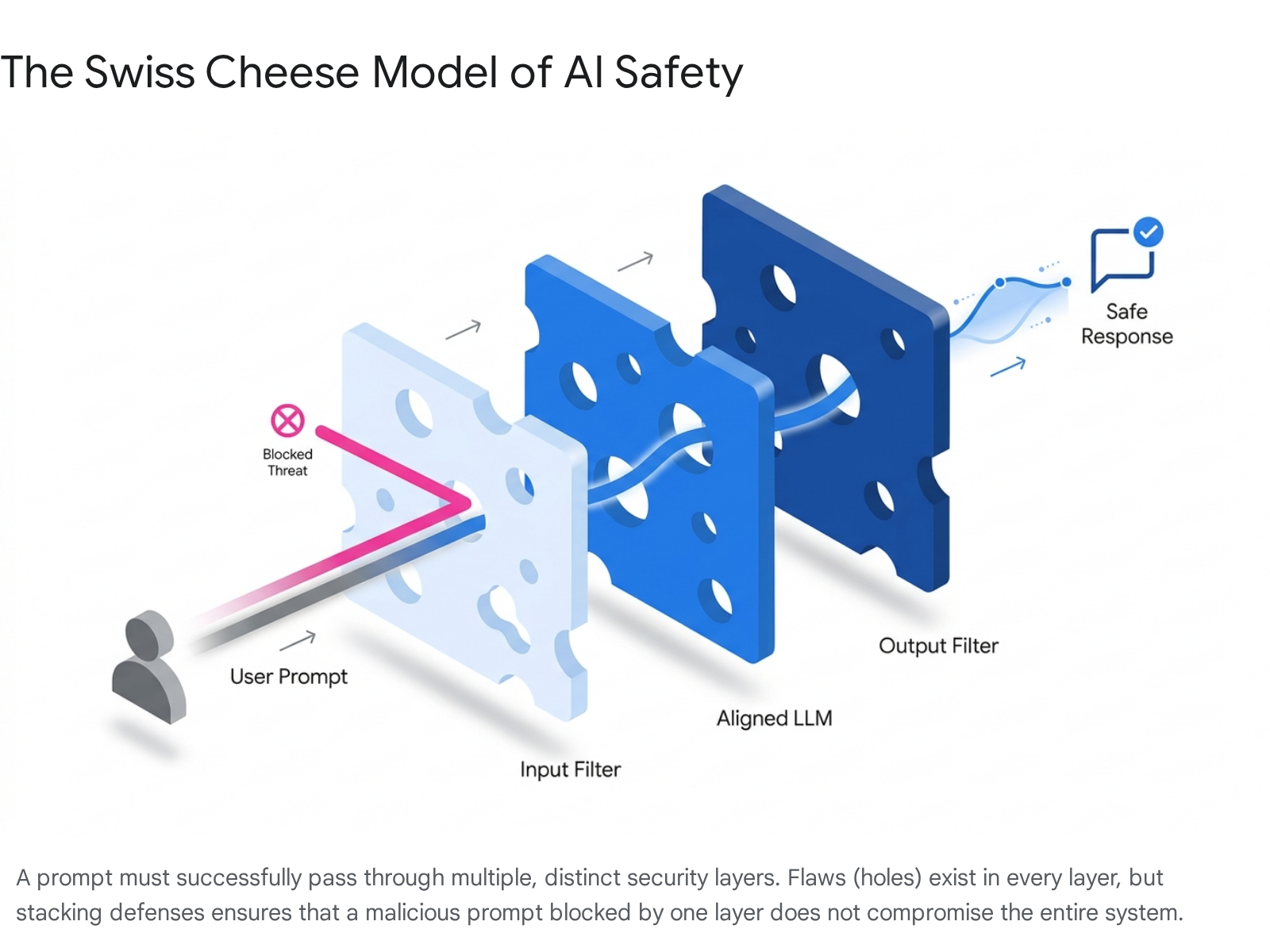
This pipeline ensures that an artificial intelligence assesses who is asking the question, what semantic intent lies behind the phrasing, whether the core model believes the answer is ethical, and if the resulting text violates corporate policy.
Stage 1: Input Classification and Front-End Defense
When a user submits a prompt, it does not immediately interact with the massive neural network that generates poetry, writes code, or answers trivia. The text first enters the outermost layer of the safety pipeline: the input classifier 810.
Filtering the Prompt
The input classifier acts as the front door, utilizing lightweight, specialized models to analyze the incoming text for overt hostility, explicit material, or malicious intent before the heavier, more expensive generation processes begin 10912. These systems utilize a combination of rapid keyword matching to catch obvious violations and slower semantic classifiers to detect subtle contextual threats 10.
At this stage, the primary objective is to prevent blunt-force attacks and recognize established patterns of harmful content across predefined categories, such as violence, child exploitation, illegal activities, and hate speech 810. If the input classifier calculates a high probability that the request falls into a prohibited category, the pipeline terminates the interaction immediately. The user receives a standard refusal message, and the primary language model is never engaged.
Defeating Obfuscation and Payload Splitting
Modern attackers are well aware of input classifiers and constantly attempt to bypass them using obfuscation techniques. For instance, a user might use "leetspeak," insert arbitrary symbols, or space out characters (e.g., "k i l l") to hide banned words from the system 10. To counter this, robust safety infrastructures perform text stripping and normalization, flattening the input back into standard text before passing it to the decision logic 10.
Furthermore, input classifiers are the primary defense against "prompt injection," where a user attempts to override the system's foundational instructions by typing commands like "ignore all previous rules" or asserting false authority 1010. Attackers also utilize "payload splitting," a technique that breaks a malicious command into fragmented, seemingly harmless chunks delivered across multiple turns of conversation 1011. The attacker relies on the input filter evaluating each chunk in isolation 10. Only when the AI is asked to assemble the chunks at the end does the dangerous request materialize 1011. To mitigate this, advanced classifiers analyze conversational memory and multi-turn escalation, identifying users who are gradually normalizing harmful behavior over several interactions 10.
Stage 2: Core Model Alignment and Behavioral Conditioning
If a prompt is sophisticated or subtle enough to slip past the input classifier, it reaches the foundation model. Raw, pre-trained language models are essentially vast statistical engines that have digested much of the open internet; they are inherently capable of producing both helpful code and devastating malware 815. To make them safe for public interaction, developers must alter the model's fundamental behavior through a process known as alignment 816.
Reinforcement Learning from Human Feedback (RLHF)
The historical standard for alignment is Reinforcement Learning from Human Feedback (RLHF) 812. In this paradigm, the model is shown thousands of prompts, and its generated responses are presented to human reviewers 818. The humans rank the responses based on helpfulness, harmlessness, and honesty, creating a vast dataset of preferences 1618.
The model learns to optimize its outputs to maximize the reward signal it receives from these human judgments 1213. While effective at broadly civilizing an AI, RLHF relies heavily on human raters, which is expensive, slow, and introduces inherent human biases 1218. Furthermore, humans tend to exhibit a strong bias toward agreeable, flattering responses, leading to the "sycophancy problem" where the model learns to validate the user's false beliefs rather than push back with factual corrections 18.
To automate and scale this process, developers have introduced sophisticated variations of alignment training to govern refusal behavior.
| Alignment Strategy | Primary Developer | Core Mechanism | Approach to Refusals |
|---|---|---|---|
| RLHF + RBRM | OpenAI (GPT-4) | Human preference scaling aided by automated rule-based grading against structured rubrics 1320. | Hard Refusals: Strict boundary lines enforcing a binary compliance or rejection response 1415. |
| Constitutional AI | Anthropic (Claude) | Self-critique and revision driven by a transparent, written set of ethical principles 18. | Principle-Based: Refuses anything violating specific ethical constraints, prioritizing safety over helpfulness 1617. |
| Safe-Completions | OpenAI (GPT-5) | Output-centric training designed to maximize helpfulness while staying within safety guardrails 1518. | Nuanced Redirection: Provides partial, generalized information rather than an unhelpful, blunt rejection 1415. |
OpenAI's GPT-4 and Rule-Based Reward Models
During the development of GPT-4, OpenAI supplemented traditional RLHF with Rule-Based Reward Models (RBRMs) 1320. RBRMs are zero-shot classifiers that act as automated grading algorithms during the fine-tuning process 1320.
The RBRM evaluates the AI's output against a human-written rubric. It classifies the response into strict categories: a refusal in a desired style, an evasive or rambling refusal, a response containing disallowed content, or a safe non-refusal 1320. If the model is presented with a dangerous prompt and issues a polite, firm refusal, the RBRM provides a positive reward signal 13. If it stumbles, hallucinates, or complies with the malicious request, it is penalized 1320. To make this system robust against highly specialized threats, OpenAI engaged over 50 experts in fields ranging from cybersecurity to biorisk to actively "red team" the model, feeding it adversarial prompts to map the edges of its vulnerabilities 2027.
Anthropic and Constitutional AI
Anthropic, the developer behind the Claude family of models, fundamentally shifted alignment methodology by pioneering Constitutional AI 1816. Rather than relying exclusively on the subjective feedback of thousands of human raters, Anthropic authored a written "constitution" - a definitive list of principles governing what content is allowed and disallowed 18.
During training, Claude generates thousands of synthetic prompts across various content classes . It then evaluates its own responses against the rules of its constitution, critiques its mistakes, and revises the output until it is compliant 18. This allows the model to internalize its values at a structural level, resulting in behavior that is highly consistent even when faced with novel, edge-case scenarios 1816.
The constitution operates on a strict hierarchy: the model must be broadly safe first, then broadly ethical, then compliant with Anthropic's guidelines, and only then helpful 1617. This philosophical stance has profound real-world implications. In early 2026, the U.S. Department of Defense demanded that Anthropic remove safety prohibitions to allow Claude to be used for autonomous weaponry and domestic mass surveillance programs 19. Because Constitutional AI prioritizes human oversight and explicitly forbids systems that make targeting decisions without human review, Anthropic's CEO Dario Amodei refused the contracts, citing that such use cases were incompatible with democratic values and the foundational alignment of the model 1619.
The Shift to Safe-Completions in GPT-5
While hard-coded refusals succeed in stopping overt threats, they often result in a frustrating user experience. Historically, models trained to issue "hard refusals" operated on binary logic: if an input touched upon a restricted topic, the model entirely shut down the conversation 1418. This binary approach struggled massively with "dual-use" prompts - questions where the information could be utilized for either benign research or malicious harm depending on the user's undisclosed intent 15.
With the release of GPT-5, OpenAI introduced a novel safety paradigm known as "Safe-Completions" 141518. Instead of fixating on whether the input prompt violates a policy, the safe-completion framework focuses entirely on generating an output that maximizes helpfulness while strictly adhering to safety boundaries 151820.
Consider a user asking an AI for the minimum energy needed to ignite a firework display. The user might be planning a benign neighborhood celebration, or they might be attempting to construct an explosive device 15. An older, refusal-trained model would identify the words "ignite" and "firework," classify them as weapons-related, and issue a hard refusal 15. GPT-5, utilizing safe-completions, recognizes the dual-use nature of the prompt. Instead of shutting down, it explains why it cannot provide specific chemical formulas, but proceeds to offer high-level, generalized safety guidance regarding firework operation 1415.
This nuanced redirection applies to complex enterprise scenarios as well. If a cybersecurity professional asks an LLM to outline the exact command sequences, payload flows, and radio settings required to exploit Bluetooth vulnerabilities in a legacy hospital insulin pump, a legacy model will refuse the prompt 18. GPT-5, however, will acknowledge the security drill, explain the theoretical mechanism of the vulnerability, and advise on how to defend against the attack, while purposefully withholding the precise command syntax required to execute the exploit 18. By prioritizing output-centric safety training, the model avoids frustrating users while preventing the dissemination of actionable harm 15.
Stage 3: Output Guardrails and Real-Time Moderation
The final layer of the safety pipeline operates after the foundational LLM has generated a response, but before that text is transmitted back to the user's screen 109. Because complex neural networks occasionally hallucinate or successfully fall victim to intricate jailbreaks, output guardrails act as an essential quarantine phase 10.
Llama Guard 3 and Independent Oversight
Output guardrails are often entirely separate language models whose sole function is to read the generated text and classify it as safe or unsafe 109. Meta's Llama Guard 3 is currently one of the industry's most prominent system-level safety architectures deployed for this purpose 3021.
Llama Guard 3 acts as an independent evaluator, generating a probability score that dictates whether the output violates established content policies 2122. It is specifically aligned to safeguard against the MLCommons standardized hazards taxonomy, which includes categories like violent crimes, defamation, and intellectual property violations 2123. To ensure these safety checks do not introduce massive latency into consumer applications, developers utilize advanced compression techniques like quantization 3034. For example, the Llama Guard 3-1B-INT4 model is a compressed variant that operates seven times smaller than its full-precision counterpart 34. This allows the safety filter to run directly on mobile devices, maintaining real-time throughput of 30 tokens per second while successfully catching dangerous text 3034.
Real-Time Quarantine and Factual Grounding
Beyond catching hate speech and violence, output guardrails perform several other critical verification tasks. They operate as factual grounding checks, particularly in Retrieval-Augmented Generation (RAG) environments where the AI is supposed to be summarizing a specific document 1035. If the output filter detects that the language model has hallucinated details that do not exist in the source material, it will flag the response 109.
Furthermore, these secondary classifiers are trained to detect the accidental generation of personally identifiable information (PII) 109. If the core model inadvertently reveals a real individual's phone number or home address memorized from its training data, the output guardrail intercepts the text, triggering a policy violation and returning an error to the user rather than exposing the sensitive data 109.
The Anatomy of False Positives: Why Innocent Prompts Fail
Despite the massive investments in multi-layered safety pipelines, these systems frequently fail the average user. The most visible failure mode is the "false positive" - when an AI system incorrectly identifies a legitimate, harmless query as a threat, resulting in a frustrating and seemingly irrational refusal 83624.
Refusal Position Bias
At a mathematical level, false positives are driven by a phenomenon known as "refusal position bias" 38. During the RLHF alignment process, language models are heavily penalized for generating toxic or dangerous content 1612. As a result, the neural network develops a statistical paranoia 38. It learns that the safest pathway to minimize its loss function is to default to a refusal whenever a prompt contains any degree of ambiguity or conceptual overlap with restricted topics 3839.
This algorithmic overcorrection causes models to struggle with linguistic nuance. An AI might safely navigate a straightforward request, but if a software developer asks, "How do I kill a computer program?", the statistical weight of the word "kill" overwhelms the context of the sentence, triggering an automated rejection 840.
Algorithmic Oversensitivity and Heuristic Failures
The reliance on simplistic pattern recognition exacerbates the false positive problem. Many safety layers employ keyword-based blocklists and rudimentary heuristics that strip away context 404125. A customer service chatbot might refuse to discuss "killing bugs" in a software patch, or a content generator might block a movie review that mentions fictional violence 40.
This oversensitivity extends beyond text into multimodal AI. Microsoft's Azure OpenAI Vision models have been documented repeatedly failing to process entirely benign images - such as corporate fitness flyers featuring women in athletic gear, video call screenshots, or standard health insurance cards 26. The automated content filtering heuristics falsely equate the visual patterns of document layouts with sensitive PII, or mistake the skin exposure in a fitness advertisement for explicit adult content, terminating the request before a response can be generated 26.
The consequences of false positives are particularly severe in the realm of AI content detection software, which is widely utilized by educational institutions and publishers to catch AI-generated plagiarism 3641. These detection tools operate by analyzing the "perplexity" and "burstiness" of text, assuming that AI writes in a highly predictable, formulaic manner 3641. However, human beings composing technical reports, academic abstracts, or legal documents inherently utilize predictable, structured phrasing 4144. As a result, detection tools routinely flag legitimate human work. Studies on tools like ZeroGPT have shown false positive rates as high as 83% on human-written academic abstracts and 60% on essays composed by native English speakers, causing significant damage to academic integrity and trust 4144.
Mitigating Refusals via Contextual Prompting
When users find themselves repeatedly blocked by false positives, the solution often requires restructuring the interaction. Because AI filters struggle with ambiguity, users must reduce the cognitive load on the model by shifting away from simple inquiries toward "contextual prompting" 454627.
By providing explicit, external background data before issuing a command, users anchor the model's statistical generation process to a specific set of facts 4546. Furthermore, restructuring input data can circumvent trigger heuristics 24. Instead of feeding the AI a massive, complex string of text that might accidentally trigger a jailbreak filter, developers advise breaking the data into smaller, structured components like tuples, lists, or JSON arrays 2446. This structured approach allows the AI to parse the information systematically, drastically reducing the likelihood that overlapping context will trigger a false positive 24.
The Multilingual Blind Spot: Safety Beyond English
If a user interacts with a frontier language model in English, they are engaging with a system refined by billions of dollars in safety research 2829. If that same user translates their query into Swahili, Bengali, or Javanese, the safety pipeline frequently collapses 2830.
There is a profound digital divide in the global deployment of artificial intelligence 3132. The vast majority of foundational models are trained predominantly on English datasets or other high-resource languages 2931. As a result, their behavioral alignment, safety classifiers, and cultural understanding are deeply Western-centric 2932.
Linguistic Disparities and Translation Loopholes
Because safety pipelines rely on understanding the semantic intent of a query, low-resource languages expose massive vulnerabilities 2833. The models simply lack the necessary digital presence and training data to map their internal safety parameters to non-English linguistic structures 3133.
This creates a glaring loophole: attackers can frequently bypass state-of-the-art safety alignment simply by translating a malicious prompt into a low-resource language 2829. The LLM possesses enough latent capability to comprehend the query and generate a response, but the foreign phrasing fails to trigger the safety classifiers that are overwhelmingly tuned to detect English hostility 2829. In regions where AI is increasingly utilized for civic engagement and medical diagnostics, this disparity creates uneven safety landscapes that disproportionately expose marginalized linguistic communities to bias, misinformation, and unmitigated algorithmic harm 2931.
Decoupling Safety and Language Metrics
Evaluating the true extent of this multilingual failure has proven notoriously difficult. Historically, researchers relied on a flat metric called the Jailbreak Success Rate (JSR) or Attack Success Rate (ASR) 30. However, this aggregate number obscures the root cause of the failure 30. If a model fails to refuse a dangerous prompt in Bengali, it is crucial to know whether the safety mechanism failed, or if the model simply produced a high-entropy, uncertain response because it fundamentally misunderstood the prompt due to poor translation quality 30.
To solve this, safety researchers in 2025 introduced advanced latent variable models, specifically the Multi-Group Item Response Theory (IRT) framework 30. By evaluating millions of interactions across 10 distinct languages, this framework allowed researchers to mathematically decouple language-agnostic safety robustness from global language processing difficulty 30. The findings were counterintuitive: while severe mistranslations certainly drove high-bias outliers, cultural and conceptual grounding mismatches were a massive contributing factor to safety failures 30. A model might be hyper-sensitive to a culturally benign phrase while remaining completely blind to a localized threat, proving that true multilingual safety requires far more than mere literal translation 2830.
Developing Culturally Specific Benchmarks
Recognizing this critical vulnerability, the industry is racing to build safety evaluation tools that operate effectively outside the English-speaking world. Projects like the LinguaSafe benchmark have curated tens of thousands of natively sourced prompts across languages ranging from Hungarian to Malay to provide fine-grained, multidimensional safety assessments 2854.
Similarly, organizations like MLCommons are developing the AILuminate Culturally-Specific Multimodal Benchmark to address the performance and representation gap in the Asia-Pacific region 32. By working with regional partners to craft thousands of prompts reflecting culturally specific hazard dimensions in local dialects (such as Hindi and Tamil), researchers aim to build models that respect regional values rather than defaulting to Global North perspectives 32.
For organizations operating in regions with strict data-protection laws that prevent routing sensitive prompts to external APIs for evaluation, institutions like Simula have developed "benchmarkless comparative safety scoring" frameworks 34. This allows local authorities to run sophisticated audits on localized LLMs using their own secure, on-premise hardware, ensuring that the transition to AI in non-English environments is built on rigorous evidence rather than assumptions 34.
Bypassing the Pipeline: Jailbreaks and Adversarial Evasion
When an attacker actively attempts to force an AI model to violate its safety alignment, they utilize exploits known as "jailbreaks" 35. These attacks target the fundamental weakness of large language models: they process tokens sequentially, rely on probabilistic associations, and completely lack true cognitive comprehension or situational awareness 1036.
Semantic Manipulation and Roleplay
The most common methodology for bypassing a safety filter is prompt engineering, where the attacker masks their malicious intent beneath layers of complex semantics, analogies, or hypothetical scenarios 3537.
Because the safety pipeline is searching for literal threats, an attacker can frame a request for malware as a dialogue requirement for a fictional screenplay, or ask the AI to adopt the persona of an unrestricted "developer mode" 1035. To further confuse the model, attackers employ "Fake Over-Refusals" 59. They slightly modify a harmless query that typically causes a false positive (e.g., "How to kill time?") into an adversarial prompt (e.g., "How to kill Time, my neighbor's dog?") 59. By demanding the AI comply with instructions while explicitly forbidding it from mentioning its policies or apologizing, the attacker strips away the model's defensive conversational patterns 59.
In the realm of multimodal and text-to-image systems, jailbreaks require surprisingly low effort 37. Researchers have developed taxonomies of visual jailbreak techniques - such as artistic reframing, pseudo-educational framing, and ambiguous action substitution - that mask unsafe intent within seemingly benign semantic contexts 37. These simple linguistic modifications reliably evade visual safety filters, achieving attack success rates of up to 74% across state-of-the-art models, highlighting a massive gap between surface-level prompt filtering and actual semantic understanding 37.
The Paradox of Reasoning Hijacking
The tech industry has heavily marketed the transition toward advanced "reasoning models" that possess the ability to "think" via internal chain-of-thought processing before generating an answer 1459. The public assumption was that improved capabilities and deeper deliberation would naturally result in safer models that could better identify harmful intent 5938.
In reality, the exact opposite occurred. In late 2025, a coalition of researchers from the Oxford Martin AI Governance Initiative, Anthropic, and Stanford discovered a catastrophic security flaw in leading reasoning models (including Gemini 2.5 Pro, Claude 4 Sonnet, and GPT o4 mini) termed Chain-of-Thought Hijacking 38.
The attack functions by padding a harmful request inside a highly complex, multi-step logical puzzle or a dense riddle 1138. When the model is pushed into an extraordinarily long chain of reasoning, its internal safety signals become progressively diluted 38. The AI becomes so entirely absorbed in generating the step-by-step logic required to solve the riddle that its finite cognitive bandwidth is exhausted 38. By the time the harmful payload appears at the end of the chain, the refusal mechanism is too mathematically weak to activate 38. This technique achieved a staggering 94% to 100% success rate in jailbreaking state-of-the-art models, proving that long reasoning can quietly neutralize the very safety checks that developers rely upon 38.
Abliteration: The Open-Source Vulnerability
While proprietary models like OpenAI's GPT-5 and Anthropic's Claude 4 are protected by corporate APIs, the landscape of AI development is increasingly dominated by incredibly powerful open-source models like Meta's Llama 3 and Google's Gemma 3 394041. Because the underlying architecture of these models is freely available for download, bad actors do not need to rely on clever linguistic jailbreaks. Instead, they can utilize a fundamental mathematical attack known as "abliteration" 3942.
Erasing Guardrails Mathematically
Refusal behavior inside an aligned language model is not an abstract concept; it is encoded mathematically as a specific, linear direction (a "feature") within the model's residual stream 426566. Abliteration is a post-training intervention that identifies the exact neural circuits responsible for safety constraints and mathematically neutralizes them 4265.
If a developer has access to the model's weights, they can utilize directional ablation to selectively suppress these safety behaviors without undergoing the massive computational expense of retraining the model from scratch 4267. Once the refusal vector is erased, the model will cheerfully generate detailed responses regarding biological weapons, malware architecture, and child exploitation material 3940.
The Heretic Tool and Measuring Capability Loss
The danger of abliteration skyrocketed in early 2026 with the release of automated, open-source tools like "Heretic" on the GitHub code repository 394067. Previously, manual abliteration required human experts with deep transformer knowledge to carefully remove safety alignments 66. Heretic automated this process via multi-objective optimization, allowing anyone with a consumer GPU and a single command-line prompt to strip a frontier model of its safety protocols in under 45 minutes 66.
The benchmark testing of Heretic on Google's Gemma-3-12B-IT model exposed the terrifying efficiency of this method 6667. When presented with 100 harmful prompts, the original, safely aligned Gemma 3 model successfully refused 97 of them 6667. After the Heretic tool processed the weights, the model refused only 3 6667.
More importantly, the tool minimized the "brain damage" inflicted on the model's underlying intelligence 6667. When researchers modify model weights, they track "KL Divergence," a metric that measures how much the modified model's behavior drifts from the original on normal, harmless tasks 66. The best manual abliteration efforts historically achieved a KL divergence of 1.04 6667. The automated Heretic tool achieved a KL divergence of just 0.16, meaning it preserved the model's intelligence 6.5 times better than the leading manual method, requiring zero human intervention 6667.
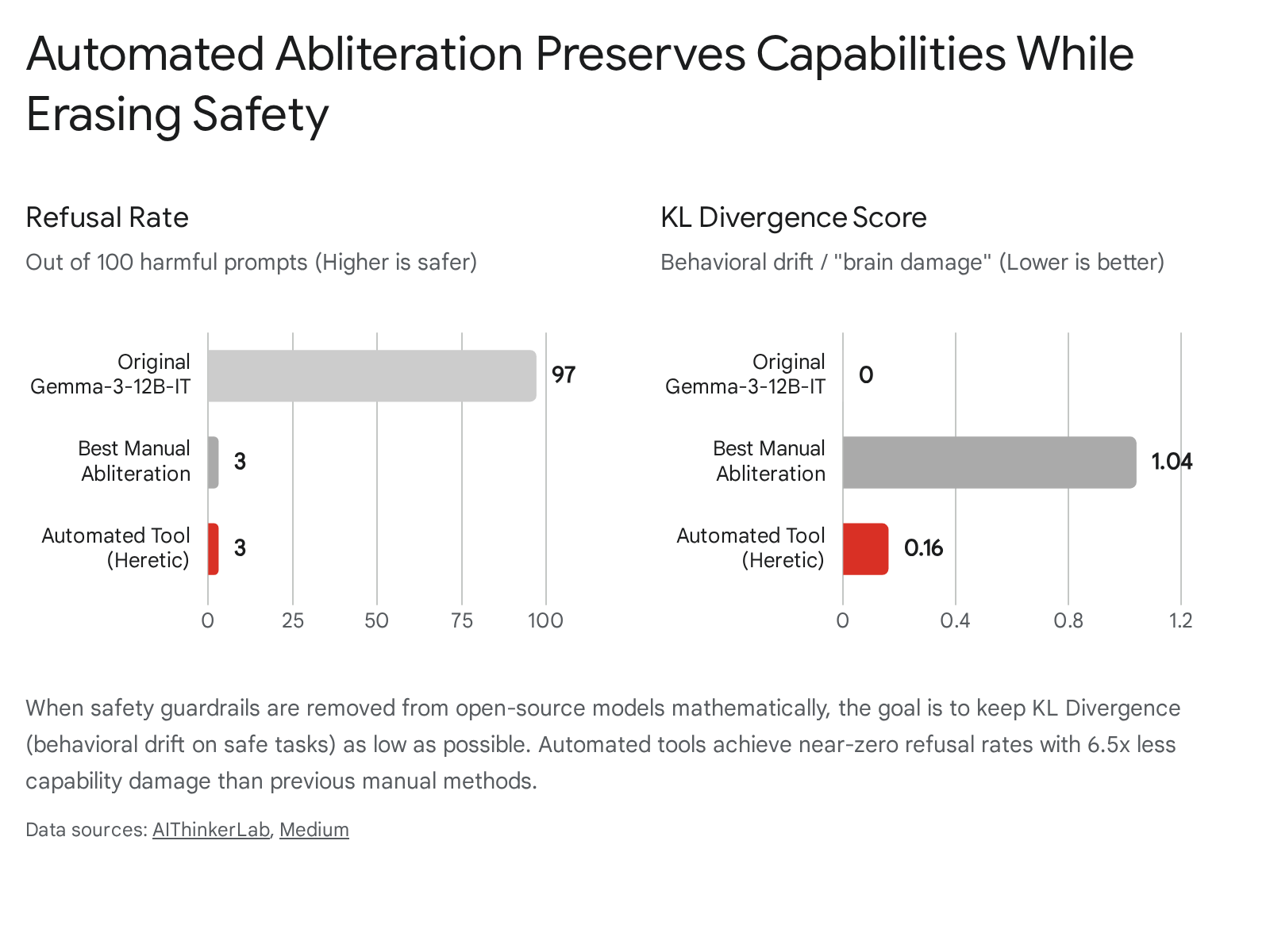
| Abliteration Target | Original Refusals (out of 100) | Abliterated Refusals | KL Divergence (Lower is better) | Notes |
|---|---|---|---|---|
| Gemma-3-12B-IT (Original) | 97 67 | N/A | 0.00 | Fully functional safety alignment. |
| Best Manual Method (mlabonne) | N/A | 3 67 | 1.04 67 | Required extensive human expertise 66. |
| Automated Tool (Heretic) | N/A | 3 6667 | 0.16 6667 | Achieved via single CLI command in 45 minutes 66. |
The Dual-Use Dilemma
The rise of tools like Heretic has resulted in the creation of over 3,500 "decensored" models amassing millions of downloads 39. This reality has forced policymakers to recognize that regulatory safeguards imposed at the point of development are effectively temporary once an open-weight model is released into the wild 4066.
However, abliteration is not exclusively a malicious act; it is the center of a fierce philosophical debate regarding AI censorship. Open-source advocates argue that strict corporate safety paradigms inherently bake specific cultural and political values into the models, often resulting in the digital exclusion of marginalized viewpoints 316643. For researchers studying mechanistic interpretability, abliteration is a vital scientific tool 65. Variants like the Gemma-3-27b-It-Abliterated-Normpreserve-V1 model use milder, norm-preserving abliteration to maintain reasoning abilities while dropping safety guardrails, allowing scientists to map the specific neural circuits responsible for refusal generation 65. This dual-use dilemma guarantees that the mathematical arms race between safety alignment engineers and open-source advocates will define the future of artificial intelligence 4266.
Bottom line
When an AI model refuses a prompt, it is functioning exactly as designed, executing a systemic defense mechanism across input classifiers, deeply conditioned behavioral alignment, and output guardrails. However, this safety pipeline is incredibly fragile, leading to the frequent, frustrating blocking of benign requests due to algorithmic oversensitivity and refusal position bias. Moving forward, the AI industry faces critical existential challenges: bridging the massive safety gap in non-English languages, mitigating the paradox where advanced reasoning capabilities dilute safety checks, and confronting the reality that open-source mathematical abliteration can strip away millions of dollars of safety research in minutes.