Toastmasters Distinguished Club Program goal setting and club health
Introduction to Non-Profit Performance Measurement
Performance measurement systems within non-profit and volunteer organizations operate at a complex intersection of individual intrinsic motivation and organizational strategic objectives. Unlike corporate environments where performance is driven by financial incentives, non-profit organizations must motivate a volunteer workforce using mission-aligned goals, community recognition, and personal development opportunities 12. As demands for accountability from stakeholders increase, non-profits frequently deploy metric-driven evaluation frameworks to quantify their social impact and organizational efficiency 345.
Toastmasters International, a global educational organization focused on public speaking and leadership development, provides a highly structured example of non-profit performance measurement. Founded in 1924, the organization has expanded to encompass members across 149 countries, operating tens of thousands of local clubs 67. To evaluate and drive the health of these decentralized local chapters, Toastmasters utilizes a framework known as the Distinguished Club Program (DCP) 89.
The DCP functions simultaneously as an organizational performance dashboard, a strategic planning tool, and a behavioral incentive mechanism. By establishing distinct targets related to educational curriculum completion, membership growth, officer training, and administrative compliance, the program translates macro-level organizational objectives into quantifiable micro-level actions 1011. This report provides an exhaustive analysis of the Distinguished Club Program, examining its structural mechanics, its theoretical underpinnings in Locke's Goal-Setting Theory, its cascading effects on member engagement, and the specific cross-cultural contexts in which it operates. Furthermore, the analysis assesses the unintended consequences of metric-driven evaluation in volunteer environments, including the phenomena of goal displacement and strategic gaming of performance indicators.
Structural Framework of the Distinguished Club Program
The Distinguished Club Program evaluates a local club's performance over the Toastmasters operational year, which runs continuously from July 1 to June 30 1012. The framework provides a standardized operational metric, allowing the organization to assess whether a given club is delivering a high-quality, supportive environment that enables its members to achieve their educational objectives 1013.
Core Educational Goals
The DCP comprises ten specific, measurable goals categorized into four distinct operational areas: Education, Membership, Training, and Administration 1014.
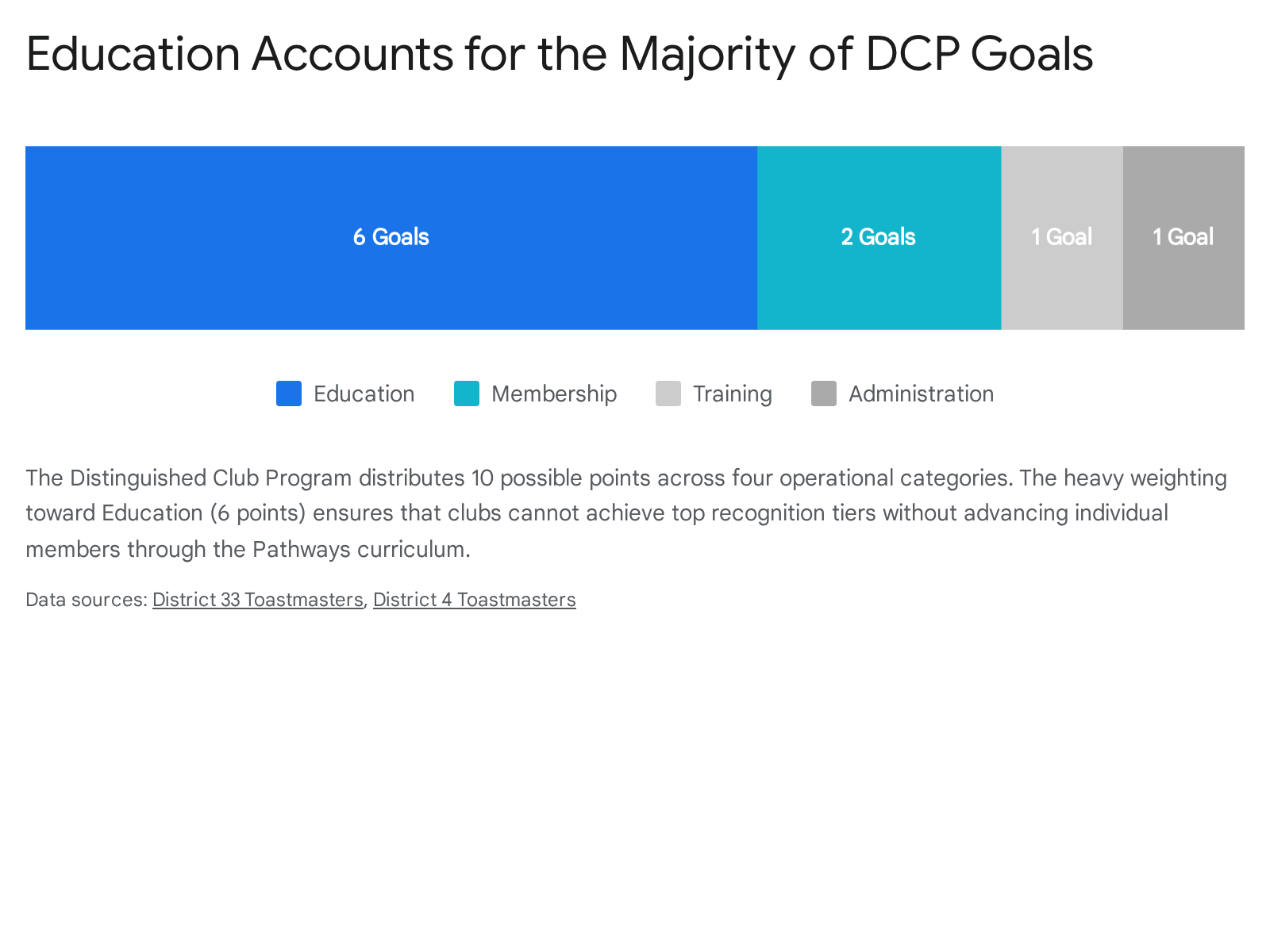
The program deliberately places the heaviest quantitative weight on the core educational mission of the organization.
Six of the ten available goals track the completion of the Pathways learning experience, which serves as Toastmasters' primary educational curriculum 81415. Clubs accumulate points when their members complete sequential levels within their self-selected learning paths. Specifically, a club achieves these goals when four members complete Level 1; two members complete Level 2; an additional two members complete Level 2; two members complete Level 3; one member completes Level 4, Level 5, or earns the capstone Distinguished Toastmaster (DTM) award; and one additional member completes Level 4, Level 5, or the DTM 1011.
Because 60% of the maximum attainable points are tethered to educational advancement, a club cannot achieve top recognition tiers through recruitment or administrative efficiency alone 1315. The structure forces club executive committees to actively monitor individual member progress, schedule speaking opportunities, and ensure members are formally registering their completions within the organization's digital portal 1416.
Membership and Administrative Goals
The Membership category consists of two goals, rewarding clubs for adding four new, dual, or reinstating members, and an additional four such members, yielding a target of eight new additions per year 1017. Organizational data demonstrates that standard clubs experience an average natural attrition rate of approximately 30% annually due to relocation, schedule changes, and goal completion 914. The membership goals are mathematically engineered to offset this anticipated loss, demanding continuous recruitment to maintain a viable audience size for public speaking practice 1417.
The Training category contains a single goal, requiring a minimum of four of the club's seven elected officers to attend official District-sponsored training during both the summer and winter training periods 1014. This ensures localized leadership is continuously updated on organizational policies, conflict resolution strategies, and club management techniques 1218.
The Administration category also contains one goal, earned by submitting the annual club officer list and at least one set of membership dues renewal reports prior to strict organizational deadlines 1014. Administrative compliance ensures that guest inquiries generated by the organization's global search portal are routed to active local leaders, and that members maintain uninterrupted access to the digital educational materials 14.
Qualifying Requirements and Recent Policy Modifications
Achieving the required number of goals is a necessary but insufficient condition for DCP recognition. Clubs must also meet explicit qualifying prerequisites regarding absolute membership size and strategic planning 1617. Historically, a club was required to end the program year with a minimum of 20 active members, or record a net growth of three to five members depending on the specific recognition tier sought 121719.
For the 2025-2026 program year, Toastmasters International executed significant structural modifications to these prerequisites to increase accessibility for struggling clubs while providing higher ceilings for elite chapters 1120. A primary new prerequisite requires clubs to complete and submit a formal Club Success Plan to World Headquarters by September 30 of the active program year 111220. This forces clubs to engage in proactive operational forecasting rather than reactive metric aggregation at the end of the term.
Furthermore, the membership requirements were recalibrated across the recognition tiers. The "Smedley Distinguished" tier was introduced to provide a new operational ceiling for historically high-performing clubs, requiring all 10 goals to be met and a closing membership of 25 1220. Because these specific policy changes are currently in their initial implementation phase, specific global compliance figures and demographic distributions regarding the 2025-2026 requirements are presently unavailable.
Recognition Tiers
Based on the total sum of goals achieved and the fulfillment of the qualifying requirements, clubs are assigned a final recognition tier at the conclusion of the operational year 1217. The baseline metric indicating a healthy, functional club is the "Distinguished" designation. The program escalates through "Select Distinguished" and "President's Distinguished," culminating in the newly established "Smedley Distinguished" level 1220.
| Recognition Level | Minimum Goals Required | Membership Requirement (As of June 30) | Planning Requirement |
|---|---|---|---|
| Distinguished | 5 | 20 total members OR net growth of 3 | Club Success Plan by Sept 30 |
| Select Distinguished | 7 | 20 total members OR net growth of 5 | Club Success Plan by Sept 30 |
| President's Distinguished | 9 | 20 total members | Club Success Plan by Sept 30 |
| Smedley Distinguished | 10 | 25 total members | Club Success Plan by Sept 30 |
Table 1: Distinguished Club Program Requirements for the 2025-2026 Program Year 1220. For newly chartered clubs, the Club Success Plan is due 90 days after the official charter date.
Theoretical Foundations: Goal-Setting in Volunteer Environments
The psychological and operational efficacy of the Distinguished Club Program relies heavily on the principles of Goal-Setting Theory, primarily developed and refined by Edwin Locke and Gary Latham. This robust framework posits that human behavior and task performance are directly regulated by conscious goals, intentions, and the structures surrounding them 212223.
Mechanisms of Locke's Goal-Setting Theory
According to Locke and Latham's extensive research, goals influence organizational performance through four distinct psychological mechanisms: directive function, energizing function, persistence, and strategy development 212223. The DCP systematically activates all four mechanisms within the context of localized club management.
The directive function occurs when goals focus the attention of individuals away from irrelevant tasks and toward mission-critical activities 2122. The ten DCP goals explicitly inform club officers that time should be spent on educational award completion and guest conversion rather than peripheral administrative concerns. The energizing function operates on the principle that specific, difficult goals lead to substantially higher effort than vague exhortations to "do one's best" 212324. The DCP provides precise, numerical targets - such as securing exactly four Level 1 completions - which mobilizes volunteer effort more effectively than a generalized mission to "encourage public speaking" 1023.
Goals also mandate persistence. Deadlines, such as the June 30 end-of-year cutoff and the September 30 Club Success Plan deadline, establish rigid temporal boundaries that force sustained effort and prevent organizational procrastination 2021. Finally, challenging goals motivate individuals to discover, develop, and utilize task-relevant knowledge and operational strategies 2123. When a club leadership team identifies a deficit in membership goals, the specific gap forces them to conceptualize targeted marketing campaigns, open house events, and mentorship pipelines that they otherwise might not have prioritized 252627.
Moderators of Goal Success
Goal-setting theory dictates that the relationship between a goal and actual performance is moderated by several variables, most notably self-efficacy, feedback loops, and task complexity 212324. Self-efficacy - the individual's belief in their capacity to execute behaviors necessary to produce specific performance attainments - is heavily emphasized in Toastmasters 2324. As members progress through basic speeches, their self-efficacy rises, making them more likely to commit to the difficult, advanced goals required for higher DCP points 23.
Feedback is another critical moderator. Goals are substantially more effective when individuals receive continuous data tracking their progress 2124. Toastmasters facilitates this through a centralized, publicly accessible digital dashboard that updates daily, allowing club officers to monitor their exact DCP standing 828. This real-time performance tracking leverages the high-performance cycle, wherein high goals lead to high performance, which subsequently generates rewards (such as official ribbons and public recognition), culminating in elevated satisfaction and renewed commitment for the following operational year 1723.
The Dynamics of Volunteer Motivation
Applying goal-setting theory to non-profit organizations introduces distinct behavioral complexities 22229. Unlike corporate employees bound by financial compensation and formal performance reviews, volunteers rely on intrinsic motivation, driven by a desire for self-improvement, socialization, and community service 13031.
Rigid external goals can occasionally clash with Self-Determination Theory (SDT), which argues that human motivation requires the fulfillment of autonomy, competence, and relatedness 2229. Assigning strict performance quotas to volunteers can reduce their perceived autonomy, inadvertently diminishing intrinsic motivation 22. If a club president pressures a member to complete a speech strictly to secure a DCP point rather than for the member's personal development, the individual may experience burnout and exit the organization 3232.
To mitigate this, successful goal-setting in volunteer environments must be participative 23. Research demonstrates that when organizational goals align with individual motives, retention and output improve dramatically 2334. The most robust Toastmasters clubs utilize the DCP as an aligned framework; they map the club's macro-goals to the individual member's micro-desire to overcome public speaking anxiety, thereby satisfying both organizational and personal objectives simultaneously 1330.
Micro-to-Macro Alignment in Organizational Health
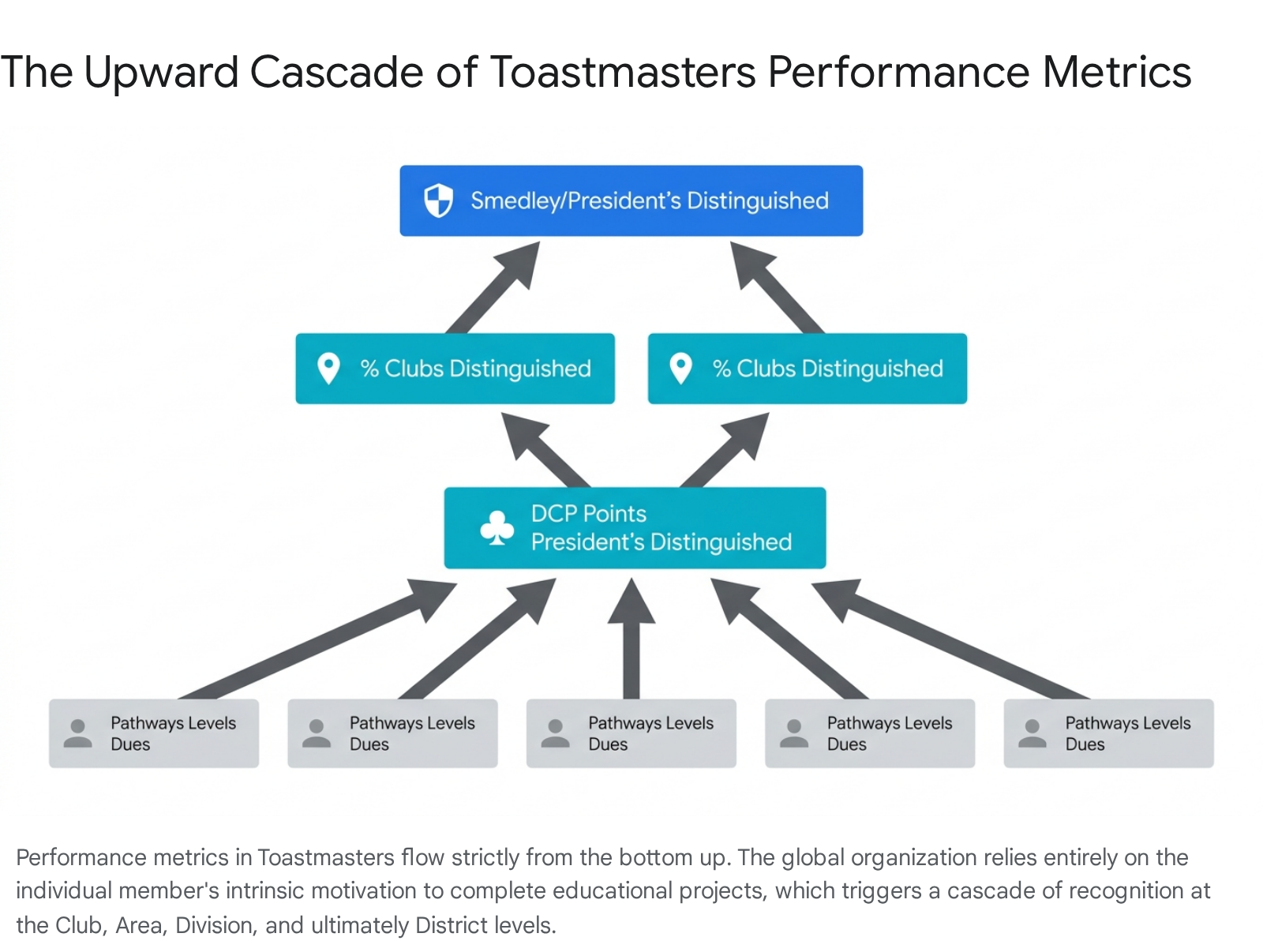
A defining characteristic of the Distinguished Club Program is its capacity to align the micro-level actions of individual members with the macro-level strategic imperatives of the global organization. The metric system is designed as an upward cascade, ensuring that the highest levels of the organization only record success when grassroots members are actively engaging with the curriculum 32.
The Pathways Educational Experience
At the micro level, individual members engage with Pathways, an e-learning educational system introduced to replace a nearly century-old booklet-based curriculum 3334. Pathways requires members to progress through increasingly complex communication and leadership projects, categorized into five levels across various specialized tracks, such as Dynamic Leadership or Presentation Mastery 333435.
Because the majority of DCP points are generated by members completing these levels, a club cannot achieve "Distinguished" status simply through administrative maintenance or dues collection 101314. The transition to Pathways highlighted the challenges of technology acceptance in voluntary associations 33. Initial reactions were mixed; older demographics and tenured members accustomed to the legacy manuals exhibited resistance to the digital interface, leading to localized instances of attrition 33.
However, studies applying the Technology Acceptance Model (TAM3) to Toastmasters indicate that members are more likely to adopt the new system if club leaders provide strong subjective norms and dedicated support 33. Clubs that successfully integrated Pathways into their DCP strategy - often by designating a "Pathways Ambassador" to provide technical onboarding - discovered that the structured, milestone-driven nature of the new program mapped perfectly onto goal-setting mechanics, accelerating educational velocity 33.
Aggregation to Club, Area, and District Levels
The DCP serves as the foundational unit for Toastmasters' broader District Recognition Program 36. The organization is geographically divided into Areas, Divisions, and Districts, with each tier managed by elected volunteer leaders 193637. The performance evaluations of these higher-tier leaders are entirely derivative of the DCP performance of the local clubs within their jurisdiction 3238.
For a District to achieve the prestigious "President's Distinguished District" status, it must meet stringent criteria directly tethered to the DCP. Specifically, at least 50% of its base clubs must achieve Distinguished status (earning 5+ DCP goals), while simultaneously recording a 5% net increase in membership payments and a 3% net increase in the total number of chartered clubs 19. This fractal goal structure - where an individual delivering a five-minute speech triggers a club DCP point, which aggregates into an Area metric, which ultimately determines the District's global standing - creates a synchronized organizational focus 3237.
Integration of District Success Plans
To facilitate this upward flow of metrics, District leadership teams utilize District Success Plans, which act as macro-level equivalents to the Club Success Plans 193639. Program Quality Directors and Club Growth Directors utilize the DCP data to identify struggling areas and deploy resources accordingly 36.
Region Advisors act as senior consultants to these District leaders, emphasizing that supporting quality club programming and promoting the Distinguished Club Program are the primary mechanisms for fulfilling the overarching organizational mission 36. Through this alignment, the DCP prevents organizational silos; a District Director cannot succeed in isolation, relying wholly on the continuous educational output of the grassroots membership 323640.
Drivers of Member Engagement and Retention
Goal-setting structures operate effectively only if the individuals within the system remain engaged and committed to the process. In voluntary associations, member retention serves as the ultimate lagging indicator of organizational health 304142. If a club focuses excessively on recruitment without providing a high-quality educational experience, it will suffer high churn rates and routinely fail to meet the absolute membership requirements of the DCP 1441.
The Role of Mentorship and Climate
Academic research and internal organizational data indicate that formal mentorship is a critical determinant of retention, particularly for ensuring new members stay beyond their first year 942. A robust mentoring program satisfies fundamental psychological needs by providing guidance on navigating the curriculum and integrating into the club's social fabric 79.
When clubs formalize mentorship, they directly impact their capacity to achieve DCP Education goals. Mentors guide protégés through speech preparation, ensuring they do not stall out before completing initial milestones 3334. Furthermore, a supportive club climate - characterized by structured evaluations, clear meeting roles, and positive reinforcement - transforms the intimidating psychological barrier of public speaking into an engaging experiential learning loop 13162843. The distinction between a club that merely chases metrics and one that achieves sustainable excellence lies in this environment; healthy clubs naturally generate DCP points as a byproduct of cultivating a space where members genuinely desire to participate 134445.
Demographic and Regional Growth Trends
Toastmasters has experienced significant shifts in its global demographics, illustrating how structured goal-setting and experiential learning appeal across varying regional contexts 74246. While traditional strongholds in North America have experienced plateauing or declining growth rates, expansion in the Global South, particularly Africa and Asia, has been profound 3846.
Between 2014 and 2024, the number of clubs in West Africa surged by 310%, expanding from 76 to 312 clubs 46. Similarly, Southern Africa saw a 60% jump in the same decade, and East Africa (now District 114) tripled its club count over a two-year period 646. This exponential growth demonstrates that the core mechanisms of the DCP - clear educational milestones, structured leadership tracks, and standardized evaluations - resonate powerfully in emerging markets where professionals are actively seeking competitive skill development 46. The organization's strategic targeting of the estimated 350 million English speakers in India and China further underscores the global applicability of this structured educational model 42.
Cross-Cultural Perspectives on Volunteerism
The motivations driving volunteer engagement are highly susceptible to cultural contexts 4748495051. Cross-cultural academic studies on volunteerism suggest that in highly individualistic societies, participants are often motivated by career enhancement, skill acquisition, and resume building 484952. Conversely, in collectivistic societies, social integration, altruism, and community obligation play larger motivational roles 48505152.
Toastmasters effectively bridges this divide by acting as a cultural equalizer. The consistent, highly regulated meeting structure provides a psychologically safe space where traditional social hierarchies and cultural barriers are temporarily suspended 753. Inside a club meeting, a junior employee and a senior executive evaluate each other as peers, bound by the strict timing and evaluation rubrics of the curriculum 7.
The organization's structure also facilitates profound cross-cultural dialogue and conflict resolution 5455. For example, storytelling and public speaking workshops utilizing Toastmasters' methodologies have been deployed in the West Bank to bring Israeli and Palestinian participants together, using the structured vulnerability of personal narrative to foster mutual respect and empathy 56. Ultimately, the DCP provides a universal language of success that transcends regional differences, allowing a club in Nairobi or Manila to measure its health against the exact same benchmarks as a club in London or San Francisco 284446.
Unintended Consequences of Metric-Driven Assessment
While the Distinguished Club Program provides vital operational structure, extensive academic literature on performance measurement warns that metric-driven systems invariably generate unintended consequences within organizations 345758. Relying strictly on quantitative indicators can sometimes distort the very processes they are intended to monitor 5859.
Campbell's Law and Goal Displacement
The application of strict performance evaluation systems (PES) is highly susceptible to "Campbell's Law," which states that the more a quantitative social indicator is used for decision-making and resource allocation, the more it will be subject to corruption pressures, ultimately undermining its value 59. In the non-profit sector, funder-mandated metrics frequently lead to goal displacement, where administrators prioritize hitting numerical targets over executing the actual mission 33460.
In the context of Toastmasters, intense pressure from District leadership to secure "President's Distinguished" status can cause local club officers to fixate on the DCP dashboard at the expense of member experience 323234. The drive for metrics can alter peer relationships, shifting the club environment from collaborative support to transactional pressure 58. When the metric becomes the goal, rather than an indicator of a healthy learning environment, the organization suffers from mission drift 5960.
Strategies of "Gaming the Metrics"
Goal displacement frequently manifests in behaviors academically categorized as "gaming the metrics," where participants manipulate system rules to inflate performance data without delivering genuine value 61626364.
Critics of the DCP highlight structural vulnerabilities that invite such gaming. A primary issue involves the temporal boundaries of the membership qualifying requirement. Because end-of-year honors are predicated on membership tallies between April 1 and June 30, members recruited in the fall who do not renew in the spring mathematically offer no utility toward the club's final DCP recognition 32. This dynamic can disincentivize Vice Presidents of Membership from aggressively pursuing retention outside of the critical spring window, or lead to artificial inflation of rosters right before the deadline 32.
Similarly, the pressure to secure final Education points near the June 30 deadline can result in "pencil-whipping" or compromised evaluations. If a club requires one final Level 3 completion to reach Distinguished status, officers may pressure a member to deliver multiple speeches rapidly, sacrificing the quality of preparation, deep feedback, and genuine experiential learning 283265. Goal-setting theory acknowledges this vulnerability, demonstrating that high-stakes goals tethered to strict deadlines can inadvertently motivate unethical pro-organizational behavior, such as expediting or falsifying completions to secure collective prestige 586465.
Balancing Quantitative and Qualitative Measures
The fundamental limitation of the Distinguished Club Program is that it explicitly measures the outputs of a club - awards filed and members added - but cannot perfectly capture the qualitative experience that produces those outputs 81059. A club could theoretically achieve ten DCP goals by relying on two highly motivated veteran members to complete multiple advanced paths while the majority of the membership remains stagnant and intimidated 1341. This phenomenon satisfies the quantitative dashboard but masks a deeply flawed qualitative environment 284166.
To counteract this, Toastmasters International explicitly instructs leaders that the DCP is merely "one measure" of quality, not a checklist to be completed for its own sake 810. The most resilient organizations utilize mixed methods of evaluation, bridging the quantitative data of the DCP with qualitative feedback mechanisms 596768. Toastmasters promotes the "Moments of Truth" self-evaluation module, which forces clubs to qualitatively assess the warmth of their guest experience, the inclusiveness of their culture, and the depth of their peer evaluations 36. When qualitative peer support actively aligns with the quantitative tracking of the DCP, clubs mitigate the risks of metric gaming and ensure sustainable, long-term volunteer engagement 677169.
Conclusion
The Distinguished Club Program serves as a highly effective operational framework that successfully adapts classical goal-setting theory to a global, volunteer-driven non-profit environment. By disaggregating the broad organizational objective of "improving communication and leadership skills" into ten discrete, measurable targets, the DCP directs member attention, stimulates persistent effort, and mathematically aligns local club health with the macro-organizational goals of Toastmasters International. The program's recent structural updates, including the mandated early-stage Club Success Plans and the introduction of the Smedley Distinguished tier, reflect an ongoing institutional effort to refine these behavioral incentives and improve strategic planning.
However, the efficacy of the DCP remains entirely dependent on local implementation. When utilized as a supportive scaffold to guide members toward their intrinsic personal goals, the program drives robust engagement, high retention, and diverse cross-cultural integration. Conversely, when the metrics are elevated above the organizational mission, the system becomes vulnerable to goal displacement and strategic gaming, which degrades the qualitative member experience. Ultimately, the long-term health of a Toastmasters club requires leaders to view the Distinguished Club Program not as the final destination, but as the statistical byproduct of a genuinely supportive, educational, and engaging community.