
Organic Marketing Costs for SEO, Instagram, and Reddit in 2026
The Fallacy of the "Free" Channel: Expanding the Definition of Marketing Costs
A pervasive fallacy within digital strategy is the categorisation of organic marketing as a "free" or low-cost alternative to paid acquisition. This misconception stems from a fundamental misunderstanding of resource allocation, rooted in the simplistic view that avoiding a per-click toll paid to ad networks equates to zero expenditure. In reality, organic channels demand immense, sustained capital investments in highly specialised human labour, extensive software infrastructure, and intensive strategic oversight. To accurately compare the true operational costs of Search Engine Optimisation (SEO), Instagram organic marketing, and Reddit community engagement, the definition of "costs" must be radically expanded beyond direct financial outlays.
Quantifying Hidden Labour, Strategy, and Management Overhead
Organic marketing requires highly skilled, continuous labour that incurs significant hidden costs. A single high-quality Instagram Reel, for instance, requires upward of five hours of dedicated labour, encompassing initial ideation, filming, audio synchronisation, video editing, captioning, and hashtag optimisation 1. For SEO, the act of publishing content represents merely the initial step in a perpetual cycle of optimisation; maintaining organic rankings requires ongoing weekly and monthly tasks, including technical health checks, updating internal linking structures, monitoring Google Search Console for crawl anomalies, and continuously revising outdated content 234.
This hidden overhead extends deeply into overarching strategy, project management, and cross-channel communication. When calculating the true cost of an organic campaign, enterprises must account for the hours spent on competitor analysis, editorial calendar administration, and the constant, iterative revisions required to appease rapidly evolving algorithmic preferences. If a business is paying an in-house employee or a contractor for these hours, the channel is inherently not free; it is merely shifting the cost from advertising budgets to payroll and operational expenditure.
The Penalty of the Waiting Game: Time-to-First-Result
Time-to-first-result is a critical operational cost metric that is routinely ignored during budget allocation. Digital marketing returns materialise in distinct phases. While paid channels can yield tangible leads within days or weeks, organic channels inherently require a lengthy temporal runway before generating measurable Return on Investment (ROI) 5. During this latency period, a business is expending capital continuously without reciprocal revenue - a temporal cost that must be explicitly factored into the overall channel budget.
SEO is notoriously slow, typically requiring an initial 30 to 90 days merely for setup, technical messaging fixes, and tracking implementation 5. It generally takes three to six months to show early traction or engagement signals, and six to twelve months for consistent, compounding results to take effect, especially in competitive verticals 56. Social media platforms like Instagram fall into an intermediate timeline; while initial impressions can be generated quickly, building the necessary trust, brand pull, and inquiry volume takes a minimum of three to six months of highly consistent publishing 5. Reddit operates on a similarly elongated, relationship-driven timeline, where organic lead generation requires months of genuine community engagement and value provision before a demographic trusts a brand enough to convert into paying customers 7.
Opportunity Cost: The Invisible yet Dominant Expense
Perhaps the most significant unrecorded expense in organic marketing is opportunity cost. In economic terms, first formalised by Friedrich von Wieser, opportunity cost represents the potential benefits an entity forfeits when choosing one alternative over another . For example, a 2022 case study of a mid-sized technology firm, TechCo, illustrated how investing $5 million and six months of developer time into an in-house CRM system incurred an additional $1.8 million in opportunity costs. By diverting engineers, the company delayed an AI feature rollout, resulting in a 15% loss in market share to competitors who launched earlier . The total opportunity cost far outweighed the initial capital saved.
When applied to digital marketing, a business that allocates its limited resources to writing three low-intent blog posts per week without a solid conversion structure or product offer is incurring a massive opportunity cost 9. The hours spent building a low-converting content archive could have been allocated to fixing foundational technical SEO, improving site speed, or refining the core product offer - activities that act as genuine revenue multipliers 9.
Furthermore, shifting budgets between paid and organic channels carries inherent opportunity costs that must be managed. A 2026 financial model demonstrated that reallocating a mid-market firm's budget (shifting 15% from paid search into organic SEO and content) resulted in a 33% reduction in overall Customer Acquisition Cost (CAC) and a 28% growth in pipeline after twelve months 10. However, during the initial phases of this transition, the firm had to weather a significantly higher CAC on organic leads ($333) compared to paid leads ($175), demonstrating the short-term opportunity cost of waiting for organic channels to mature 10. The opportunity cost of not investing in organic marketing is remaining at the mercy of rising paid advertising costs, which have seen a 15% year-over-year increase in CPCs 10. Conversely, the opportunity cost of abandoning paid ads too early to focus purely on organic is a severe short-term drop in lead velocity 1011.
Segmenting Cost Data by Execution Model: In-House, Freelance, and Agency
The financial outlay for any organic marketing channel varies drastically based on the chosen execution model. Businesses typically must choose between building an in-house team, hiring independent freelance contractors, or retaining a specialised marketing agency.
The True Cost of In-House Teams
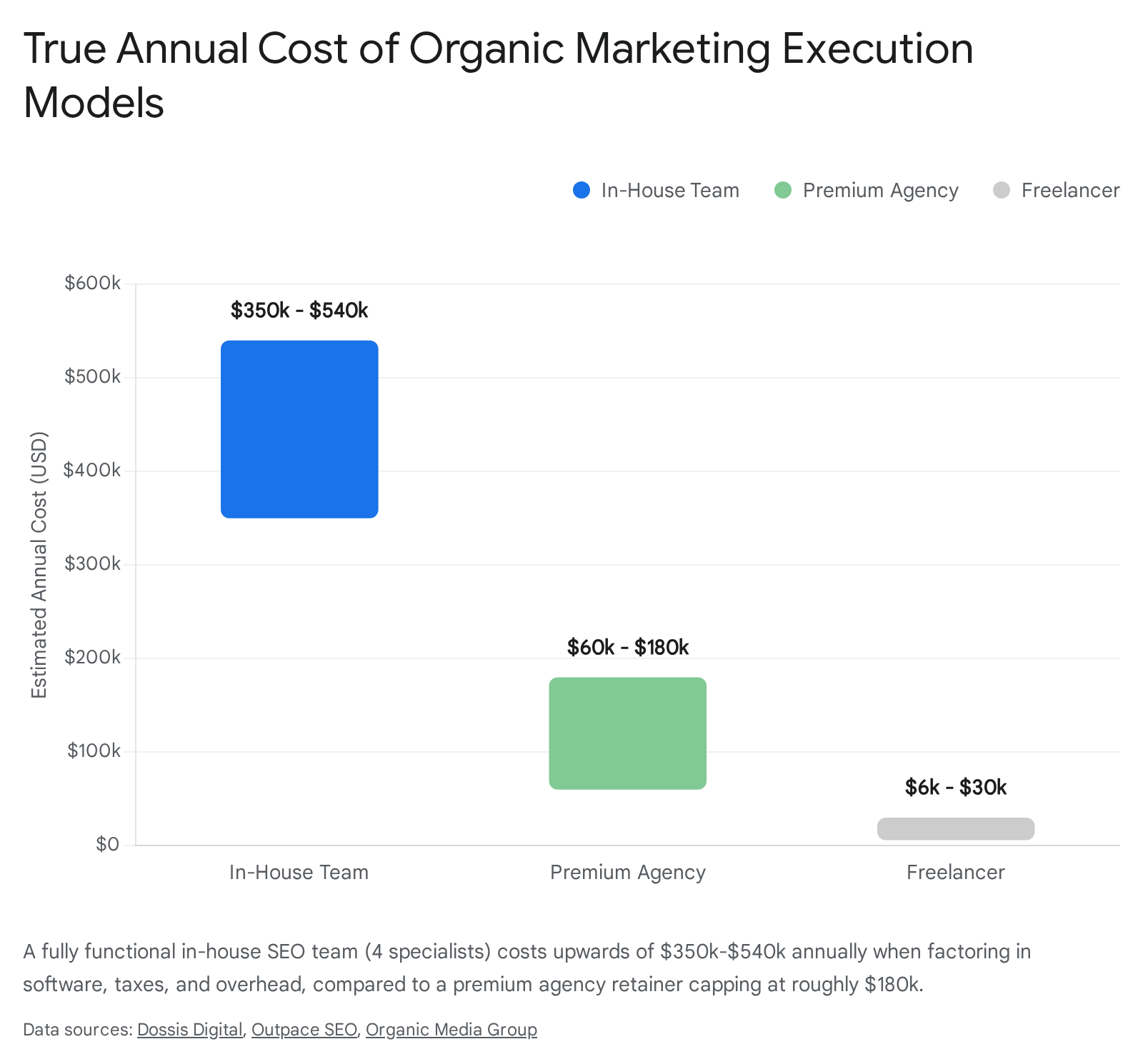
The most common mistake stakeholders make when calculating in-house costs is looking solely at the base salary of a single marketing hire 12. A marketer on a $75,000 base salary in Australia, for example, actually costs the business between $96,000 and $106,000 annually 13. This true cost encompasses legally required superannuation (12%), payroll tax, workcover, essential software tools ($4,000 - $8,000), and amortised recruitment and onboarding expenses 13.
Furthermore, a functional, high-performing in-house SEO programme requires a multi-disciplinary team, not a single generalist. A proper in-house SEO team for a mid-size company costs between $350,000 and $540,000 per year 12. This figure covers an SEO manager or strategist ($85,000 - $120,000), a specialised content writer, a technical SEO expert, and a link builder, plus $18,000 to $48,000 in enterprise software, entirely before factoring in hiring risk, onboarding time, and staff turnover 12. While in-house teams win on institutional knowledge, brand alignment, and speed of cross-departmental execution, they are undeniably the most capital-intensive option and carry significant key-person risk 1213.
The Agility and Risk of Freelance Contractors
Freelancers offer the lowest financial entry point, making them particularly attractive for startups, small businesses, or those testing a channel for the first time 1415. For SEO, freelancers typically charge between $50 and $150 per hour, or offer monthly retainers ranging from $500 to $2,500 14. Social media freelancers operate on similar scales: entry-level community managers handling basic posting charge $15 - $50 per hour, mid-level content creators charge $50 - $100 per hour, and advanced strategists command $120 - $250 per hour 16. Standard freelance social media packages range from $500 to $1,400 per month for basic multi-platform management 17.
While freelancers are highly cost-effective and flexible, they carry the highest consistency and scalability risk 13. They are limited by solo capacity, may struggle with large-scale, multi-faceted campaigns, and often require the business owner to spend significant unbilled hours managing the overarching strategy and coordinating between different specialists (e.g., managing a freelance designer, a video editor, and a freelance copywriter separately) 1314.
The Scalability of Specialised Agency Retainers
Marketing agencies sit in the middle of the pricing spectrum, providing immediate access to a broad spectrum of expertise - strategists, videographers, copywriters, and technical SEOs - without the overhead of recruitment, benefits, or software licensing 131418.
- SEO Agencies: Monthly retainers typically range from $3,000 to $15,000 for comprehensive campaigns 14. A high-quality full-service SEO agency engagement runs $60,000 to $180,000 per year, which is a fraction of the cost of an equivalent full in-house team 12.
- Social Media Agencies: For small to mid-sized businesses, standard social media retainers range from $1,000 to $5,000 per month 1920. Instagram-specific marketing agencies charge between $800 and $12,000 per month, heavily dependent on the volume of high-quality visual production (such as Reels) and influencer collaboration required 21. Enterprise-level social retainers that include custom video production frequently exceed $25,000 per month 1920.
- The Hybrid Model: For companies scaling past $5 million in revenue, a hybrid model has emerged as highly effective. This involves hiring one strong in-house SEO strategist ($85,000 - $120,000) paired with a quality agency for execution, running $150,000 to $250,000 per year total. This structure consistently outperforms a fully internal team at twice the cost while maintaining institutional knowledge internally 12.
Agencies deliver superior value per dollar spent by distributing highly specialised skills and expensive enterprise software across multiple accounts, but their formal processes can result in slower onboarding and less direct, informal communication compared to in-house teams 1214.
SEO in 2026: The Capital-Intensive, High-Durability Engine
Search Engine Optimisation remains one of the most lucrative long-term organic channels, boasting an average conversion rate of 14.6% from organic leads, compared to a mere 1.7% from traditional outbound methods 22. Once a site ranks well, it captures high-intent traffic without the need to pay per click, making it significantly more cost-effective in the long term than performance marketing, which resets spending every month 23. However, the landscape has been drastically altered by the proliferation of Generative AI, global labour dynamics, and the escalating requirements for technical maintenance.
The Impact of Generative AI on SEO Costs
The advent of Generative AI has permanently bifurcated the SEO cost structure. On one hand, AI significantly reduces the baseline cost of raw content generation; industry data indicates that human-written content costs roughly 4.7 times more than AI-generated content 1. On the other hand, this has triggered an unprecedented flood of commoditised, low-value content, forcing search engines to radically raise the bar for E-E-A-T (Experience, Expertise, Authoritativeness, and Trustworthiness).
Consequently, a new sub-industry of "AI SEO Agencies" has emerged. Some of these firms charge premium retainers (up to $10,000 per month) simply for operating ChatGPT and Semrush workflows that a business could technically set up in-house for $500 25. However, legitimate top-tier agencies justify these costs by providing proprietary testing frameworks, AI-driven Answer Engine Optimisation (AEO), and rigorous human editorial oversight to ensure content avoids algorithmic penalties and actually converts 25. The true cost of SEO in 2026 is no longer writing the text itself, but rather the strategic curation, technical structuring, and authority building required to rise above the automated noise. As the definition of search expands, these agencies are also tasked with optimizing content to appear in AI Overviews, ensuring that specific video segments and long-tail phrases are correctly indexed 26.
Geographic Dimension: The Global Labour Arbitrage in SEO
Because SEO operates primarily on universal technical standards and global search algorithms, it is highly susceptible to global labour arbitrage. Agencies in the US, UK, and Australia frequently white-label their SEO fulfilment to highly skilled contractors in India, Nigeria, Mexico, and the Philippines 2728. White-label SEO packages - including technical audits, content creation, and link building - can be procured for as little as $250 to $500 per month per client 27. High-tier white-label deliverables, which include DR60+ backlinks and complex technical audits, stretch to $700 - $900 per month 27. The hourly rate for legitimate, experienced overseas SEO professionals (not basic virtual assistants) ranges from $11 to $14 27.
This arbitrage allows domestic agencies to charge end-clients $1,500 to $5,000 per month, capturing substantial profit margins while the actual technical labour is executed offshore 2729. However, this model carries significant risks regarding content nuance, particularly in highly regulated YMYL (Your Money or Your Life) sectors like healthcare or finance. In these industries, poor offshore execution or a lack of understanding of strict compliance laws (like HIPAA) can lead to severe brand damage and ranking failures, meaning specialists are often preferred over generalist offshore firms 30.
The Hidden Labour of Maintenance
SEO is fundamentally not a "set-and-forget" asset. In 2026, content freshness is a critical ranking factor, rating highly in algorithmic importance due to features like "Query Deserves Freshness," which boosts recently updated pages 3. A high-quality blog post requires ongoing maintenance to retain its position against competitors who are constantly updating their own assets.
Monthly maintenance tasks are extensive. They include analysing Google Search Console for indexing errors, disavowing toxic backlinks, updating outdated statistics, identifying new internal linking opportunities, monitoring Core Web Vitals, fixing 404 redirects, and refreshing underperforming meta titles 23431. For a standard e-commerce site, minimum effective SEO maintenance requires 5 to 8 hours per week (consisting of 2 - 3 hours on content strategy and 1 - 2 hours on technical monitoring) 9. Ignoring this maintenance turns a website into a static archive, rapidly depreciating the value of the initial content investment and causing hard-earned rankings to slip within 90 days 39.
Instagram Organic (Reels): High Velocity, High Production, Low Durability
Instagram's organic ecosystem in 2026 represents a sharp operational contrast to SEO. While SEO focuses on long-term intent capture and durability, Instagram demands continuous, high-velocity output and aesthetic perfection to maintain algorithmic relevance.
The Algorithmic Demands and Format Shifts
The shift toward short-form video has drastically altered the baseline costs of social media marketing. Overall Instagram engagement tightened significantly, dropping approximately 24% year-over-year 2. Static image posts continue to decline in both engagement (dropping 17% YoY) and posting volume, heavily deprioritised by the platform 2. In 2026, Carousels maintain the highest engagement rate (holding steady at 0.52% to 0.55%), closely followed by Reels (0.50%) 2. Reels have become absolute table stakes for brands, offering stable reach but requiring immense effort to generate incremental gains 2.
The Cost of Short-Form Video Production
Producing high-performing Reels is incredibly labour-intensive. Creating a single 90-second Reel takes a creator upwards of five hours, encompassing scripting, filming, audio recording, editing, adding subtitles, and platform formatting 1. In contrast, a static post takes only 45 to 60 minutes 1. Because of this intense production burden, agencies explicitly charge premiums for short-form video; adding Reels to a standard management package typically increases the monthly budget by $250 to $500 per campaign 33.
To maintain this production velocity, marketers rely on a complex and expensive software stack. Mobile-first video editing requires tools like CapCut (which offers seamless TikTok music library integration and advanced AI background removal), Splice (optimised for rapid, mobile-first social-ready edits without the friction of desktop transfers), and InShot for quick trims and text overlays 343536. For static and carousel designs, Canva remains ubiquitous for its vast template library, while advanced users leverage Adobe Premiere Rush or Picsart for sophisticated visual effects 343637. The emergence of AI tools like Trend Watchers - which claims to format, edit, and sync Reels in under 90 seconds - is attempting to lower these production hours, though premium brand aesthetics still require human refinement and artistic oversight 38.
The Illusion of Volume and "Comment Velocity"
A common misconception that destroys organic social budgets is the belief that posting more frequently equates to faster growth. Recent data analyzing over 25,000 profiles reveals that engagement rates on Instagram actually peak at one to two intentional posts per week; grinding out seven posts a week often flatlines growth and dilutes overall content quality 3940.
The hidden labour of Instagram marketing lies heavily in "comment velocity." Instagram's algorithm heavily rewards accounts that respond to every comment within the critical early distribution window of 30 to 60 minutes post-publishing 40. Therefore, a social media manager is not just paid to schedule a post, but to actively monitor the account and engage in real-time. This requirement makes Instagram management highly disruptive to a standard workday, validating the need for dedicated retainers ($1,000 - $3,000/month for standard packages) to ensure a brand is actively participating during these crucial windows 1941. One case study showed that reducing posting frequency from seven times a week to three, but redirecting those saved hours into rapid comment replies and hook research, tripled Reel views and increased engagement from 0.3% to 2.1% 40.
Reddit Organic: Culturally Nuanced Community Management
Reddit has emerged as a powerhouse for B2B and SaaS organic marketing, but its cost structure, tooling, and operational model are entirely distinct from both SEO and Instagram. Reddit marketing revolves around hyper-targeted community management, deep social listening, and establishing authentic, long-term authority within highly specific niches.
Why Global Labour Arbitrage Fails on Reddit
Unlike SEO, which can be easily offshored to lower-cost economies based on universal technical parameters, Reddit community management is fiercely resistant to global labour arbitrage 2842. The platform is famous for its strict anti-promotion culture and highly sensitive user base that aggressively downvotes, reports, and bans accounts exhibiting corporate, automated, or inauthentic behaviour 743.
Effective Reddit marketing requires deep cultural nuance, a flawless grasp of native industry slang, and an intimate understanding of specific subreddit micro-cultures. Attempting to offshore this operation to a $5/hour virtual assistant navigating language barriers and cultural disconnects inevitably results in tone-deaf posts, rapid account bans, and severe, sometimes permanent, brand damage 4244. Successful Reddit management requires domestic or highly acculturated industry specialists who command standard Western freelance rates (e.g., $40 - $50 per hour for niche community management in sectors like gaming or tech) 45.
2026 Platform Changes and the New Software Stack
Recent, highly publicized API pricing changes on Reddit have fundamentally altered the marketing landscape, shutting down many legacy research tools (such as GummySearch) and shifting the software stack toward a new generation of specialised platforms 4647. A functional Reddit marketing stack in 2026 includes: 1. Social Listening and Monitoring: Tools like F5Bot (a free email alert system) or Brand24 ($79/mo) are used to monitor competitor names and core industry pain points across the platform in real-time 4748. 2. Intent Scoring & Safe Execution: Platforms like Leadmore AI ($25/mo) or Reppit AI ($25/mo) have become essential infrastructure 4749. These tools bypass strict subreddit karma-gating and algorithmic account bans by providing safe publishing infrastructure. Crucially, they score leads based on active buying intent (using a 0-100 scale) rather than just broad keyword matching, ensuring marketers focus only on users actively seeking solutions 4749. 3. Content Drafting: Marketers frequently use LLMs like Claude 3.5 Sonnet or Perplexity AI to adjust the tone of their drafted replies, ensuring they align perfectly with native Reddit culture and avoid sounding like generic marketing bots 48.
The time-to-impact on Reddit is distinctly a long game. Success is defined not by dropping links and hoping for immediate traffic, but by becoming the most helpful, consistent voice on a specific topic over several months 7. While it takes immense upfront labour to build this reputation, the resulting leads are highly qualified and convert at exceptional rates 7. Furthermore, due to recent Google algorithmic updates (such as the "Hidden Gems" update) that heavily favour forum and user-generated content, highly upvoted Reddit threads frequently rank at the top of Google search results 43. Thus, a well-placed, highly authoritative Reddit comment can act as a permanent backlink and traffic driver for years, giving it a durability closer to technical SEO than standard ephemeral social media 43.
Vendor Bias Analysis: Deconstructing Industry Benchmarks
When evaluating the cost and efficacy of organic marketing, all data must be filtered carefully through the lens of vendor bias. Major software providers routinely publish benchmark reports that subtly position their own channels and methodologies as superior, shaping the narrative to drive software subscriptions.
Ahrefs ($99 - $999/month), a premier SEO tool suite, publishes extensive data heavily promoting SEO as the ultimate marketing channel. Their reports emphasise that "websites, blogs, and SEO" consistently generate the highest ROI, boasting 14.6% conversion rates 2213. Ahrefs prominently highlights their own proprietary research demonstrating that human-written content is vastly more expensive than AI; this narrative subtly encourages users to invest in Ahrefs' advanced technical auditing and backlink tools to outmanoeuvre cheap, AI-generated spam through superior technical structure 13.
Sprout Social ($249 - $499/month per user) focuses its research entirely on social media efficiency. Their benchmark reports continually emphasise the necessity of cross-platform intelligence, Smart Inbox features, and complex competitive analytics dashboards 34. Sprout's data naturally advocates for heavy, continuous investment in social media management - and the premium software required to untangle it - often downplaying the transient, ephemeral nature of social content in favour of immediate engagement metrics 35.
HubSpot (ranging from Free to $3,600+/month for enterprise hubs) publishes broad marketing statistics that ultimately drive users toward their unified "Customer Platform" and CRM ecosystem 67. HubSpot's data frequently highlights the dangers of disjointed marketing efforts, noting that over 27% of marketers identify sales-marketing alignment as a top operational challenge 6. By explicitly claiming that their platform replaces multiple point solutions, HubSpot uses its research to justify its massive enterprise pricing structure. The underlying narrative suggests that siloed SEO tools (like Ahrefs) or isolated social tools (like Sprout Social) are inherently insufficient without a central CRM to track the full customer journey 7.
Analysts must recognize these inherent biases: an SEO tool will always declare search the king of ROI, a social platform will prioritize engagement velocity, and a CRM provider will insist that centralized data is the only path to accurate attribution.
Comparative Synthesis: Cost, Effort, and Durability
To synthesise the disparate operational realities, financial costs, and strategic timelines of SEO, Instagram, and Reddit, the following tables rigorously quantify the requirements and asset lifespans of each channel.
Table 1: Channel Operational Requirements
| Channel | Monthly Financial Cost (Agency/Freelance) | Weekly Time Investment (In-House/Management) | Required Software Stack | Typical Time-to-Impact |
|---|---|---|---|---|
| SEO | $500 - $2,500 (Freelance) $3,000 - $15,000 (Agency) |
5 - 15 Hours (Content strategy, technical audits, fixing 404s, backlink tracking) 9 | Ahrefs, Semrush, Screaming Frog, Google Search Console | 3 to 6 months (traction) 6 to 12 months (ROI) 5 |
| Instagram Organic (Reels) | $1,000 - $3,000 (Standard) +$250-$500 per Reel campaign |
15 - 25+ Hours (5 hrs per Reel, daily story management, real-time comment replies) 140 | Sprout Social / HubSpot, Canva, CapCut, Splice, Trend Watchers | 1 to 3 months (engagement) 3 to 6 months (trust/sales) 5 |
| Reddit Organic | $40-$50/hr (Niche Freelancer) / Software Subscriptions | 5 - 10 Hours (Active social listening, drafting nuanced replies, relationship building) | Leadmore AI / Reppit AI, F5Bot, Brand24, Claude 3.5 474849 | 3 to 6+ months (requires sustained community trust) 7 |
Mapping Upfront Cost and Effort Against Content Lifespan
The true differentiator between these marketing channels is the relationship between the upfront labour required to create an asset and the duration that asset continues to yield returns (its durability).
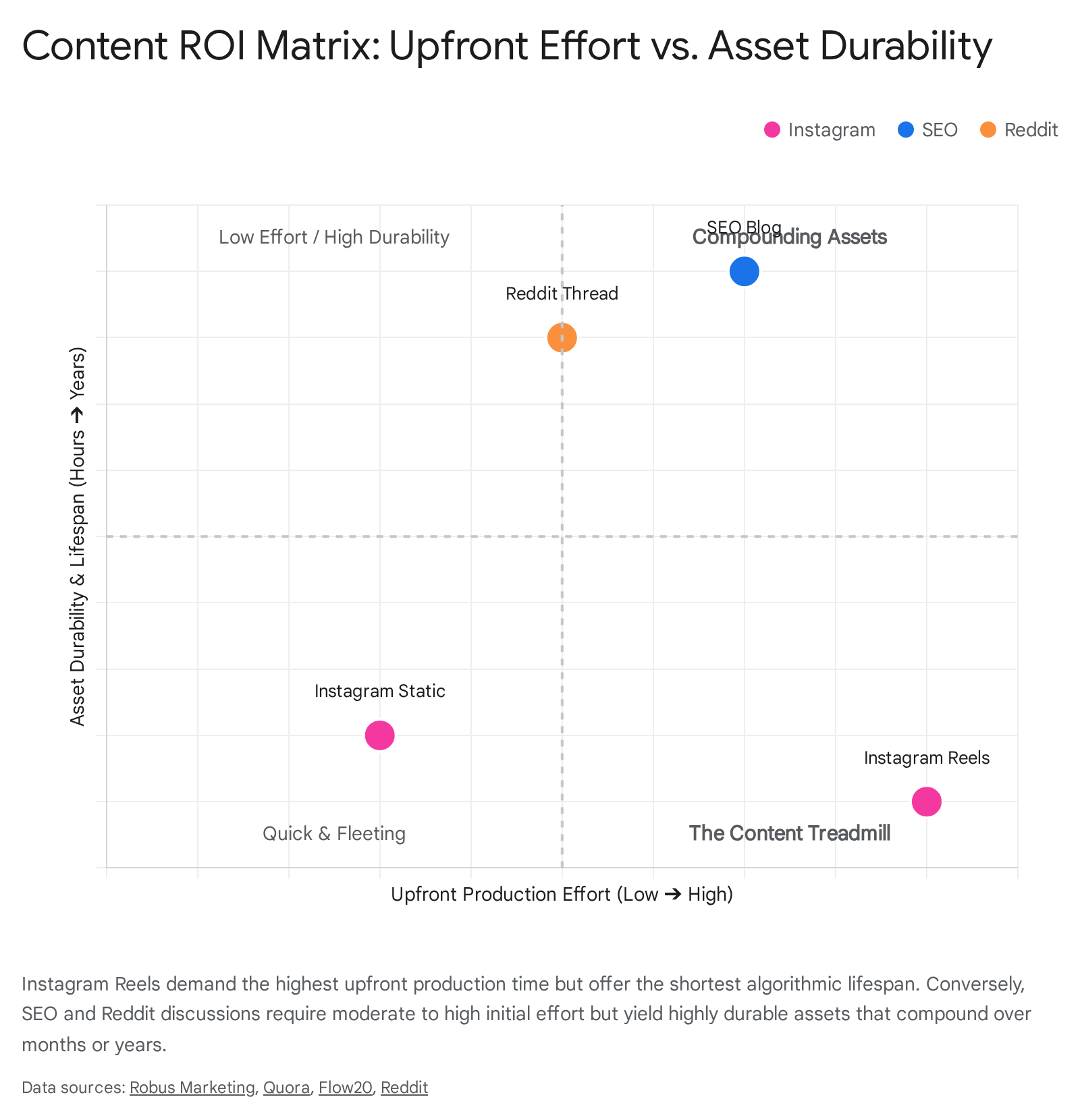
- SEO (High Upfront Effort / Very High Durability): An authoritative, well-researched SEO article requires significant upfront investment in keyword mapping, copywriting, schema markup, and technical integration. However, once that asset secures a high ranking, it can drive passive, high-intent traffic for years with only minimal monthly maintenance (e.g., updating dates or internal links) 2355. The asset essentially compounds over time.
- Instagram Reels (Very High Upfront Effort / Very Low Durability): A Reel requires intense upfront labour (scripting, filming, audio syncing, editing) 1. Despite this high cost, its lifespan is notoriously short. The algorithm pushes the content for 24 to 72 hours; after a week, the asset is practically dead, requiring the creator to immediately begin the gruelling 5-hour production cycle again just to maintain baseline visibility 156.
- Reddit Threads (Medium Upfront Effort / High Durability): Crafting a highly valuable Reddit response requires moderate upfront effort (researching the specific user's pain point and writing a nuanced, non-salesy reply) 748. However, due to its indexability on Google, a highly upvoted Reddit thread frequently ranks at the top of organic search results for long-tail queries. Thus, a well-placed Reddit comment can act as a permanent backlink and traffic driver for years, possessing a durability far closer to SEO than standard social media 43.
Table 2: Upfront Effort vs. Asset Durability
| Platform / Content Type | Upfront Production Effort | Asset Lifespan / Durability | Maintenance Requirement |
|---|---|---|---|
| SEO (Core Pages/Blogs) | High (Writing, keyword mapping, schema markup, technical integration) | Very High (Years, compounds over time, captures continuous high-intent search) 5556 | Medium (Monthly refreshes, link checks, technical health) 3 |
| Instagram (Reels) | Very High (5+ hours per video: script, shoot, audio sync, edit) 1 | Very Low (24-72 hours algorithmic peak, rarely searched later) 56 | Very High (Requires immediate real-time comment engagement within 60 mins) 40 |
| Instagram (Static/Carousel) | Low to Medium (45-60 mins for design, captioning) 1 | Low (Rapidly buried in feed, though Carousels drive higher saves) 2 | High (Requires constant new output to maintain visibility) |
| Reddit (Comments/Threads) | Medium (Requires deep reading, cultural alignment, intent scoring) 748 | High (Stays visible in niche community; indexes highly on Google Search) 43 | Low (Once posted, requires little to no ongoing maintenance) |
Conclusion
The persistent assertion that organic marketing is a cost-free endeavour is a dangerous strategic fallacy that routinely destroys corporate marketing budgets. In 2026, the cost of organic marketing is heavily paid in highly skilled, specialised labour, sophisticated SaaS subscriptions, and the sheer financial patience required to survive the initial time-to-impact valley.
SEO remains a highly capital-intensive engine requiring $3,000 to $15,000 monthly agency retainers or $100,000+ in-house salaries, yielding highly durable, compounding assets. While deeply susceptible to global labour arbitrage, its reliance on continuous technical maintenance and rigorous defence against AI-generated spam makes it a necessary long-term strategic play. Instagram organic marketing, driven heavily by the algorithmic dominance of Reels, operates as a relentless content treadmill. It demands massive upfront production hours (often 5+ hours per post) for assets that effectively expire within 72 hours, requiring continuous financial input just to maintain baseline visibility. Finally, Reddit offers a unique operational hybrid: it strictly resists cheap global offshoring due to its demand for precise cultural nuance, yet offers a highly durable, high-intent lead generation channel for brands willing to invest the requisite time in genuine community integration.
Ultimately, businesses must stop choosing channels based on theoretical CPMs and instead allocate budgets based on a channel's Total Cost of Ownership (TCO) relative to the durability of the assets it produces. Failing to quantify the hidden labour, necessary software, and opportunity costs will inevitably lead to underfunded campaigns and missed revenue targets.