
Organic social media growth and algorithm mechanics in 2026
Evolution of Content Distribution Models
The fundamental architecture governing organic social media growth has undergone a complete structural transformation by 2026. For the first decade of modern social media, platforms operated on a distribution model known as the "social graph," which prioritized the display of content based on explicit user connections, friendships, and follower relationships 122. Within that legacy ecosystem, organic reach was inherently constrained by audience size; brands and creators accumulated followers to guarantee a baseline level of distribution, relying on early engagement from that owned audience to trigger wider virality 35.
This paradigm has been systematically deprecated in favor of the "interest graph" - a predictive, algorithmic curation model that distributes content based on inferred user behavior, semantic relevance, and historical engagement patterns rather than explicit network connections 2567. The interest graph decouples reach from follower counts.
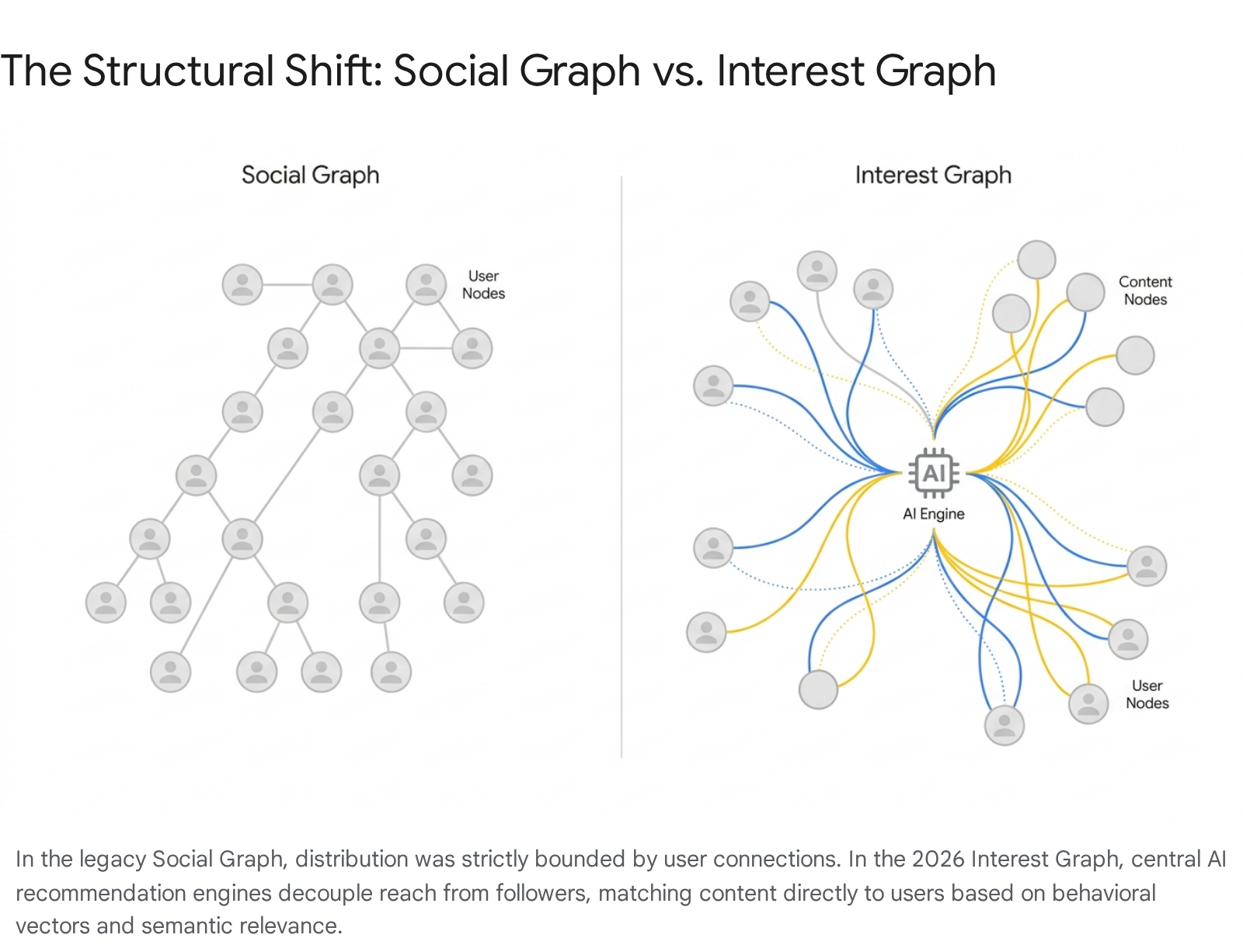
Modern recommendation systems, frequently referred to as RecSys in computational literature, evaluate content against micro-cohorts of users and expand distribution based strictly on the velocity and quality of engagement 28. Consequently, the traditional concept of a "follower" has been architecturally demoted across major platforms, serving merely as a secondary or tertiary signal in the ranking hierarchy 94.
The transition to the interest graph relies heavily on mapping users and content into complex, high-dimensional vector spaces. When a user interacts with a platform, the algorithms measure granular behavioral signals, including passive dwell time, pause duration, audio toggles, rewind behavior, and interaction depth 711. Over time, the recommendation engine builds a probabilistic mathematical model of the user's current interests, updating in real-time. Rather than categorizing content by basic metadata, large language models (LLMs) process the visual, audio, and textual components of every post, predicting the statistical probability that a specific user will engage meaningfully with a specific piece of content at a given time 5131415.
Algorithmic Evaluation of High-Intent Signals
To achieve distribution in the 2026 interest graph, publishers must align their operations with the specific hierarchy of ranking signals utilized by central AI systems. Platforms have universally restructured their mathematical weighting to prioritize "high-intent" signals while filtering out vanity metrics, engagement pods, and low-intent interactions 65166. An interaction is classified as high-intent when a user expends significant effort or indicates a desire for long-term utility.
Across platforms like LinkedIn, Instagram, and TikTok, the "save" or "bookmark" function has become one of the most heavily weighted signals in the ranking architecture 69136. Algorithms interpret a save as a definitive marker of content quality, indicating that the post contains evergreen, utilitarian value that the user wishes to revisit. This action frequently triggers broader distribution into out-of-network explore feeds and adjacent semantic interest clusters 96.
Equally critical is the measurement of direct message (DM) shares, often referred to in digital marketing research as "dark social" routing 1696. Instagram's Content Graph and TikTok's recommendation engine place extreme weight on these private shares, as they signal that a piece of content is highly relevant to a specific social tie or sub-community. Sends per reach is currently one of the strongest predictive indicators of algorithmic expansion available to modern systems 9.
For passive consumption formats, algorithms evaluate dwell time and completion rates. Dwell time measures how long a user pauses their scroll to view a static post or read a textual caption. On text-centric platforms like LinkedIn, dwell time serves as a primary variable in determining the semantic value and depth of a post 6518. For short-form video on TikTok, Instagram Reels, and YouTube Shorts, the algorithm evaluates the specific percentage of the video that was completed. Videos that achieve completion rates exceeding 90%, or that trigger automatic looping (rewatches), secure massive algorithmic distribution multipliers 68919.
Conversely, basic "likes" are now treated as low-intent signals. Because users habitually tap to like content with minimal cognitive investment, algorithms weigh these interactions very lightly during the candidate ranking phase, and a high volume of likes without corresponding saves or shares is insufficient to trigger viral scaling 681320.
| Ranking Signal | Algorithmic Interpretation | 2026 Distribution Impact |
|---|---|---|
| Saves / Bookmarks | Evergreen utility; high intrinsic value. | Very High: Triggers out-of-network recommendation loops. |
| Shares (Direct Message) | High social relevance; community endorsement. | Very High: Acts as a multiplier for candidate retrieval expansion. |
| Completion Rate (Video) | Content successfully holds and sustains attention. | High: Necessary prerequisite for any short-form scaling. |
| Dwell Time (Static/Text) | Depth of discourse; reading comprehension. | High: Primary metric for text-based platform algorithms. |
| Comments (Substantive) | Community building; conversational density. | Medium: Weighted if threaded, lengthy, or from authoritative accounts. |
| Likes / Reactions | Passive acknowledgment; habitual action. | Low: Insufficient to trigger algorithmic expansion on its own. |
Session Contribution and Platform Retention
A pivotal development in the engineering of 2026 algorithms is the concept of "session contribution." Platforms prioritize aggregate network retention, measuring not just the performance of individual posts, but the overarching behavioral trajectory of the user session 197823. Recommendation models actively monitor whether a specific piece of content causes a user to consume additional content, or if it prompts them to abandon the application 723.
On video-first networks like YouTube and TikTok, content that successfully initiates a "binge path" - a behavioral loop where a user navigates from a single video to the creator's profile to watch multiple consecutive videos - earns significant algorithmic favor 723. Conversely, videos that routinely act as the final touchpoint before a user ends their session are actively suppressed in suggested feeds and future retrieval layers, regardless of how strong their individual click-through or engagement metrics might be 723.
Core Architectural Frameworks by Platform
While the overarching philosophy of the interest graph governs the entire social media sector, the technical execution of recommendation systems varies significantly. In 2026, major platform engineering teams have deployed massive, foundational AI models to handle retrieval, pre-ranking, fine-ranking, and re-ranking tasks with unprecedented mathematical complexity.
LinkedIn and the 360Brew Foundation Model
In a profound shift beginning in late 2024 and scaling fully across platform surfaces by 2026, LinkedIn executed a complete overhaul of its recommendation infrastructure. The network deprecated thousands of specialized, ID-based ranking models in favor of a single, unified artificial intelligence system named 360Brew 5131418209.
The 360Brew model is a 150-billion parameter, decoder-only foundation model built upon the LLaMA 3 architecture and fine-tuned exclusively on LinkedIn's proprietary professional dataset, encompassing member profiles, posts, job descriptions, and interaction histories 5141810. Historically, LinkedIn operated a "feature factory" - a pipeline where disparate machine learning models calculated isolated numerical features, such as click-through rates or sender-receiver affinity 139. While that legacy system could effectively measure engagement volume, it lacked the capacity to comprehend semantic meaning 5139.
The integration of 360Brew introduces deep semantic reasoning to the professional feed. Operating natively as a large language model, the system literally "reads" the textual content of a post, cross-references it with the author's profile credentials, and evaluates the behavioral history of the viewing member via a continuous textual prompt 13209. The model relies on zero-shot reasoning capabilities to predict whether a specific user will find a post professionally valuable, bypassing the need for heavy feature engineering 1420.
This architectural transition has fundamentally altered organic growth mechanics on LinkedIn. First, 360Brew's semantic capabilities allow it to detect the generic, superficial comments indicative of coordinated "engagement pods." By recognizing that the interactions lack substantive contextual depth, the algorithm actively suppresses the post's distribution, severely penalizing synthetic engagement 51618.
Second, the algorithm relies on strict topical confinement. The system categorizes users into specific topic clusters based on 60 to 90 days of historical data 5169. To achieve organic reach, a creator's content must semantically align with their profile's stated expertise, including their headline and "About" section. Posts that deviate from the established semantic cluster suffer immediate reach penalties 5169. The initial deployment of 360Brew resulted in a reported 47% drop in median post reach and a 72% reduction in video reach, terminating the viability of generic viral templates and shifting platform incentives entirely toward quality, consistency, and professional depth 209.
Meta Recommendation Systems and Content Graph
Meta's 2026 infrastructure across Facebook, Instagram, and Threads represents the culmination of a multi-year transition toward an AI-driven discovery engine 415. At the core of this environment is the Generative Ads Recommendation Model (GEM) and the Adaptive Ranking Model 1112.
Meta processes content delivery through a massive "two-tower" neural network architecture. One neural network tower constructs a dynamic embedding of the user's current interests, while the second tower constructs vector embeddings for every available piece of content across the platform 15. By determining the mathematical proximity between these two vectors, Meta predicts user engagement with extreme precision. The Adaptive Ranking Model systematically prunes unused embeddings to maximize learning capacity within strict memory budgets, yielding highly efficient real-time processing 12.
For organic Instagram growth, the critical development is the formalization of the "Content Graph." Meta no longer relies primarily on the Social Graph to populate the main feed; in 2026, the majority of content served to a user - particularly within Reels and the Explore page - originates from accounts they do not actively follow 1913. Instagram does not operate a single algorithm; rather, it utilizes distinct AI systems for Feed, Stories, Reels, and Explore, each prioritizing different user behaviors 169.
Reels optimization relies heavily on raw completion rate and DM sends to non-followers 169. The Explore page algorithm prioritizes topic matching, early engagement velocity, and total saves 169. Furthermore, Instagram captions serve a dual purpose in 2026. Because Meta indexes public creator accounts for external search engines and utilizes on-screen text for internal semantic clustering, keyword-rich captions operate as vital metadata for the Content Graph, entirely replacing the legacy function of hashtags 19. Furthermore, Threads has emerged as the text-based equivalent of the interest graph, offering higher organic reach for text-based discourse as it captures new behavioral signals 14.
TikTok and Real-Time Multi-Objective Optimization
TikTok's organic growth mechanics are governed by its proprietary deep learning framework, Monolith 1516173318. Architected explicitly to handle massive data sparsity, shifting cultural trends, and rapid content iteration, Monolith differentiates itself from Western systems primarily through its capacity for real-time online training 153318.
While traditional recommendation systems historically relied on batch-training models - updating parameters every few hours or days - Monolith updates its model parameters on the fly, synchronizing them to the serving models every minute 1533. This architectural design solves the problem of "concept drift," allowing TikTok to identify, scale, and discard micro-trends instantaneously based on immediate user reaction 1533.
To manage billions of unique user and video IDs, Monolith utilizes an advanced hash table methodology known as Cuckoo Hashing 151733. This mechanism prevents hash collisions within the embedding tables, ensuring that the system maintains a mathematically distinct representation of every user, rather than blending similar users together into generalized categories 151733. This precision is the foundation of TikTok's hyper-personalized For You Page.
Furthermore, TikTok does not optimize for a single metric. The algorithm utilizes a Multi-gate Mixture-of-Experts (MMoE) architecture to engage in multi-objective optimization 151617. The system simultaneously predicts the probability of multiple competing objectives for every user-video pair: watch time, likes, shares, follows, and "not interested" skips 151617. The final ranking score is a weighted mathematical product of these probabilities. In 2026, the algorithmic weights heavily skew toward watch time relative to video length, loop rate, and off-platform shares 6819.
Content distribution on TikTok is dictated by a strict test-and-expand loop. Every new video is seeded to a tiny micro-audience determined by audio mapping, text parsing, and historical similarity 819. If the video meets strict retention and completion thresholds within this initial cohort, it expands to progressively larger clusters. Follower count has zero computational impact on this initial retrieval phase 5819.
YouTube and Bifurcated Session Trajectories
In 2026, YouTube evaluates content primarily as a driver of overall platform retention 23. Operating decoupled recommendation systems for Search, Suggested Videos, the Home Feed, and Shorts, organic growth on the platform is dictating a bifurcation of content strategies 823.
The network actively rewards what analysts term the "binge path" format. YouTube Shorts are surfaced aggressively on the Home Feed and search results, operating on a swipe-velocity and completion-rate algorithm similar to TikTok 823. Shorts function effectively for top-of-funnel reach, yet empirical data indicates that Shorts audiences rarely convert to long-form subscribers 2335.
Conversely, the algorithm disproportionately rewards highly structured, deep content (ranging from 20 to 60+ minutes) that generates massive raw watch time and high session contribution 23. Videos that hold a viewer's attention and subsequently lead them to watch additional content are boosted heavily in the "Suggested" sidebar 723. YouTube's recommendation logic in 2026 mimics traditional television broadcasting, favoring long-term habituation and deep immersion over frantic, high-volume uploading 623.
Integration of Asian Super-App Mechanics
In Eastern digital markets, algorithms heavily intersect with social commerce, direct conversion data, and super-app ecosystems, driving unique forms of organic visibility that diverge from Western interest graphs.
| Platform | Core Algorithmic Logic | Primary Engagement Action | Traffic Source Architecture |
|---|---|---|---|
| Douyin | Behavioral Prediction Model | Content Collection / Revisit | Neural Network Predictive Scoring |
| Xiaohongshu (XHS) | Community Engagement Score (CES) | Substantive Comments / Shares | Search + Algorithmic Recommendation Pool |
| WeChat Channels | Social Relationship Chain | Endorsement (Friends' Likes) | Private Domain Assets + Social Recommendation |
Douyin, while sharing technical foundations with TikTok, utilizes a Behavioral Prediction Model that heavily weights long-term engagement actions, such as "Collection" (saving content to specialized folders) and "Following Updates" 736. The algorithm actively prioritizes content demonstrating high "information density," rewarding in-depth product education and live-stream integration over purely entertaining, transient clips 736.
Xiaohongshu (XHS), operating as a massive "seeding engine" for consumer products, utilizes a Community Engagement Score (CES) 36. The CES mathematical formula applies asymmetric weight to interactions: follows, shares, and comments carry computational weights up to eight times higher than a standard "like" 36. The XHS algorithm functions similarly to a vector-based search engine, strictly penalizing content that misuses intent-driven hashtags or publishes short, low-value text 36.
Conversely, WeChat Channels explicitly blends the legacy social graph back into its distribution model. Its algorithm prioritizes the "Social Relationship Chain," aggressively pushing content into a user's feed if their primary contacts have previously engaged with it 36. WeChat views social endorsement as the ultimate proxy for trust, allowing brands to utilize their private domain assets (such as WeChat Work contacts) to jumpstart the algorithmic traffic engine 36.
Similarly, the Southeast Asian super-app Grab has transitioned its discovery mechanisms toward AI-driven recommendations 1920. With the rollout of its "Everyday AI Companions," Grab utilizes data from over 20 billion transactions to suggest restaurants and travel options, merging the discovery phase traditionally held by Google or Meta directly into a transactional, closed-loop ecosystem 2021.
Empirical Engagement Benchmarks
Evaluating organic growth requires an understanding of what constitutes statistical success in a mathematically declining engagement environment. As global active social media users reach 5.4 to 5.66 billion in 2026, severe content saturation has forced baseline engagement rates downward across older, established networks 134041.
Cross-Platform Performance Discrepancies
Because platforms calculate distributions and impressions differently, cross-platform metric comparisons are inherently flawed unless contextualized 2243. Engagement Rate (ER) - typically calculated as total interactions divided by total follower count, though methodologies vary - shows massive statistical variance across the industry. Reports from major analytics firms such as Hootsuite, RivalIQ, and Socialinsider reveal significant shifts in what constitutes an average baseline 22234546.
| Platform | Average Organic ER (2026 Estimate) | Contextual Variables |
|---|---|---|
| 3.85% - 6.50% | Driven by text dwell time and high professional intent; Document carousels perform exceptionally well 134647. | |
| TikTok | 3.70% - 4.20% | ER benefits from uncapped reach and hyper-targeted algorithmic routing 134624. |
| 0.45% - 1.80% | Deep saturation; heavily reliant on Reels (1.48% average) to sustain baseline engagement metrics 134647. | |
| X (Twitter) | 0.035% - 0.90% | Highly fragmented; characterized by rapid chronological decay of content relevance 1345. |
| 0.15% - 0.20% | Organic Page reach effectively throttled (~5.2%); Group reach remains relatively viable (14.8%) 134724. |
Note: Benchmarks reflect median distributions. Outliers exist based on specific content formats, such as LinkedIn PDF Carousels achieving upwards of 21% ER due to forced click-through dwell time, and higher education accounts maintaining elevated ER due to institutional loyalty 182249. Furthermore, researchers express calibrated uncertainty regarding unified industry averages, as firms like Hootsuite and RivalIQ employ diverging mathematical methodologies to calculate engagement, leading to overlapping but distinct data models 2245.
Creator Accounts Versus Brand Pages
A critical statistical anomaly in the 2026 landscape is the stark performance gap between corporate brand accounts and individual creator accounts. Algorithms heavily favor human-centric signals, recognizing that users exhibit higher dwell times and interaction rates with identifiable individuals than with corporate entities 495025.
On Instagram, data indicates that average fashion brand accounts yield a 0.15% engagement rate, whereas individual fashion creators secure between 1.24% and 2.5% 49. Similarly, on LinkedIn, personal profiles command an average ER of 2.8%, dwarfing the 0.35% average of standard company pages 13.
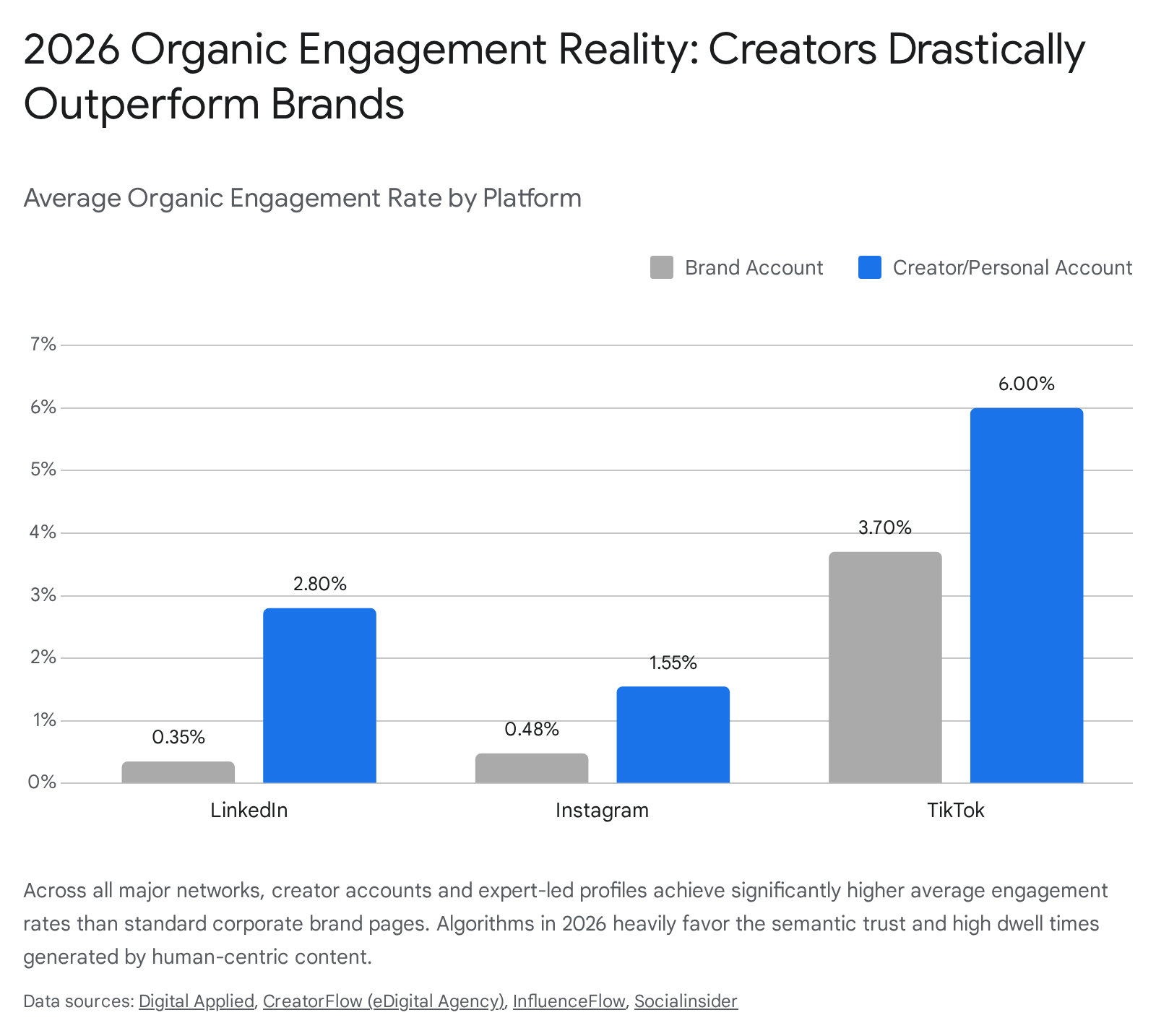
This disparity underscores why founder-led content and employee advocacy programs generate higher algorithmic reach than centralized corporate broadcasting 2526.
Influencer Tier Performance Metrics
The inverse correlation between audience size and engagement rate remains a defining characteristic of social media mathematics in 2026. As an account scales, its engagement rate mechanically decays, both due to audience fatigue and the algorithmic dilution of reaching less-invested cohorts.
| Influencer Tier | Audience Size | Average Cross-Platform ER | Performance Characteristics |
|---|---|---|---|
| Nano-Influencers | 1K - 10K | 2.71% - 8.00% | Generates the highest absolute ER. High community trust; frequently achieves virality via algorithmic interest matching 475027. |
| Micro-Influencers | 10K - 100K | 1.81% - 4.00% | Balances reliable reach with strong community engagement. Highly effective for targeted product seeding 4750. |
| Mid-Tier Accounts | 100K - 1M | 1.24% - 2.50% | Sweet spot for brand partnerships. ER begins to decay as the audience broadens beyond core niches 4750. |
| Mega/Celebrity | 1M+ | 0.50% - 1.20% | Generates massive absolute interaction volume, but low percentage engagement. Operates primarily as broadcast media 4750. |
Strategic Misalignments in Brand Operations
Despite the transparent shift in how recommendation systems evaluate data, many marketing operations continue to execute legacy strategies built for the 2018 - 2022 digital landscape, resulting in widespread algorithmic suppression.
The Fallacy of Automation-First Marketing
The most pervasive operational failure is treating the 2026 interest graph as a volume-driven social graph. Brands frequently assess ROI based on follower acquisition and rely on high-frequency programmatic posting to appease a broad subscriber base 3525. However, because algorithms test each piece of content on its independent merit through behavioral prediction, generic, high-volume content fails the initial micro-cohort retention tests 5825.
Algorithms actively penalize content dilution. For instance, LinkedIn's 360Brew demotes accounts that post frequently but fail to generate deep dwell time, shifting the strategic imperative from daily posting to publishing 2 - 3 highly authoritative pieces per week 16189. Automation has become basic infrastructure, rendering sheer content volume ineffective as a competitive advantage 25.
Diminishing Returns of High-Production Content
In 2026, exorbitant production value often serves as a negative signal to consumers, triggering algorithmically detrimental swipe-aways. As the ecosystem becomes flooded with synthesized media and advertisements, audiences have developed a heightened sensitivity to "corporate polish," viewing it as inherently inauthentic 2528.
Brands err by treating social feeds like broadcast television. Empirical data indicates that human-centric, slightly imperfect, expert-led content - such as raw founder commentary or unscripted behind-the-scenes footage - vastly outperforms studio-grade commercial assets 252628. On platforms like TikTok and Instagram Reels, a lo-fi, 15-second video that blends natively into the vertical feed will consistently capture higher watch-through rates, and thus higher algorithmic distribution, than a highly edited advertisement 2629.
Misapplication of Generative Artificial Intelligence
The widespread accessibility of generative AI has led to an exponential surge in automated content production. However, platform engineering teams have adapted their retrieval systems to detect and de-prioritize low-effort, AI-generated material. On networks like LinkedIn, if the LLM-based ranking system detects a post that utilizes generic, rehearsed AI structures, it lowers the distribution score regardless of the post's structural engagement 5.
User sentiment directly mirrors this algorithmic penalty; content identified by users as purely AI-generated suffers an average engagement drop of 12% 1326. Conversely, studies demonstrate that human-generated content receives up to 5.44 times more organic traffic than fully AI-generated content 2829. Brands fail when they use AI as the final author. The algorithmic reward lies in using AI for structural synthesis, data analysis, and workflow efficiency, while relying on human subject-matter experts to inject the distinct perspective and nuance that algorithms require to categorize the content as high-value 2529.
Neglect of Social Search Optimization
Brands consistently misallocate resources by viewing social media strictly as top-of-funnel entertainment, neglecting its rapid evolution into a primary search engine. In 2026, platforms like TikTok, Instagram, and YouTube collectively account for over 60% of initial product discovery, often bypassing traditional search engines like Google entirely 4130. Nearly one in three consumers, and over 50% of Generation Z, utilize social platforms as their default search environment 41.
Brands fail to capture this organic search traffic because they do not optimize their content metadata - captions, on-screen text, spoken audio, and hashtags - for semantic search engines. In an interest graph ecosystem, algorithms parse the actual spoken words in a video to match it to a user's hidden search intent 82333. Implementing Generative Engine Optimization (GEO) - structuring content with clear answer blocks, entity authority, and precise keywords - is now essential for visibility 29. Failing to clearly define the topical cluster of a post results in the algorithm failing to categorize it, leading to near-zero distribution.
Future Pathways for Organic Visibility
To achieve sustainable organic growth in 2026, digital publishers must align their operational playbooks with the mathematical realities of AI-driven recommendation architectures.
Because recommendation engines classify profiles into strict topical vectors, attempting to appeal to a mass audience actively damages algorithmic trust 1618239. Publishers must define a narrow area of expertise and consistently publish within that semantic cluster to establish high-confidence entity mapping. Content must be engineered to capture and retain attention instantly, optimizing for high completion rates on video and maximum dwell time on text 61843. Furthermore, content must be designed explicitly for "dark social" routing, transitioning from promotional broadcasting to utilitarian resource creation to maximize the high-weight "save" and "share" signals 96.
The algorithms of 2026 - whether Meta's Andromeda, TikTok's Monolith, or LinkedIn's 360Brew - are fundamentally vast pattern-recognition engines designed to map human interest and semantic meaning. They cannot be bypassed with superficial engagement hacks or brute-force posting frequencies. Sustained organic growth is achieved solely by providing dense, highly relevant, human-centric signals to the network, allowing the interest graph to autonomously route the content to the audiences mathematically primed to receive it.