
Kraken vs Coinbase: What's the Difference
Kraken is a security-first exchange built for active traders, featuring some of the lowest fees in the industry and a massive selection of advanced financial instruments. Coinbase is a highly regulated, publicly traded platform that prioritizes a seamless, beginner-friendly experience, though its convenience comes at the cost of significantly higher trading fees. Ultimately, choosing between the two depends on whether you value Kraken's cost-efficiency and professional tools, or Coinbase's unparalleled brand trust and streamlined simplicity.
Two Different Paths to Crypto Dominance
The cryptocurrency landscape has evolved dramatically over the last decade, and no two exchanges reflect this maturation better than Kraken and Coinbase. Both platforms were forged in the earliest days of the digital asset revolution, yet they took divergent paths to become industry titans by 2026. Understanding their founding philosophies helps contextualize every feature, fee, and security protocol they offer today.
Founded in 2011 by Jesse Powell - shortly after he consulted on the catastrophic security failures of the Mt. Gox exchange - Kraken was built with a cypherpunk ethos and an uncompromising focus on security 12. It was designed from the ground up for serious, active traders who needed deep liquidity, advanced charting, and reliable execution 13. Today, Kraken remains a powerhouse for crypto-native investors. Following a massive period of growth, the company generated an all-time high of $648 million in net revenue for the third quarter of 2025, processed $561.9 billion in trading volume, and reported 5.2 million funded accounts 4. Propelled by a $500 million funding round that valued the company at $15 billion, Kraken filed confidentially for a 2026 Initial Public Offering (IPO) in the United States 456.
Coinbase, founded in 2012 by Brian Armstrong and Fred Ehrsam, took a distinctly different approach. Often dubbed the "Apple of Crypto," Coinbase aimed to be the most accessible, frictionless bridge between traditional fiat banking and the blockchain 78. The company prioritized a clean, intuitive user interface and heavy regulatory compliance, eventually becoming a publicly traded company on the NASDAQ under the ticker COIN 569. By 2026, Coinbase holds custody over a staggering $500 billion in customer assets and boasts more than 100 million verified users globally 15. In June 2026, Coinbase achieved a monumental milestone by becoming the first crypto-native firm added to the prestigious S&P 500 index, forcing passive index funds and 401(k)s across America to buy its shares 10.
While both platforms share the core mission of facilitating cryptocurrency trades, they cater to entirely different user personas. Coinbase serves as the premium gateway for newcomers and institutional investors who require public financial transparency, while Kraken acts as the destination for cost-conscious, active traders who view cryptocurrency markets through a professional lens.
The Fee Divide: Where the Platforms Truly Separate
For anyone trading more than a few dollars a month, the fee structure is the most critical differentiator between Kraken and Coinbase. Both platforms utilize a bifurcated pricing model that heavily penalizes users of their "standard" beginner interfaces while rewarding those who navigate their advanced, order-book systems. The gap between these two models is so vast that it can single-handedly determine a trader's long-term profitability.
The "Convenience Tax" on Standard Platforms
Both exchanges offer simplified standard interfaces designed for absolute beginners. These screens - often labeled "Simple Trade" or "Instant Buy" - allow users to acquire Bitcoin, Ethereum, or hundreds of other assets with just a few taps. However, this aesthetic simplicity obscures a heavy financial toll.
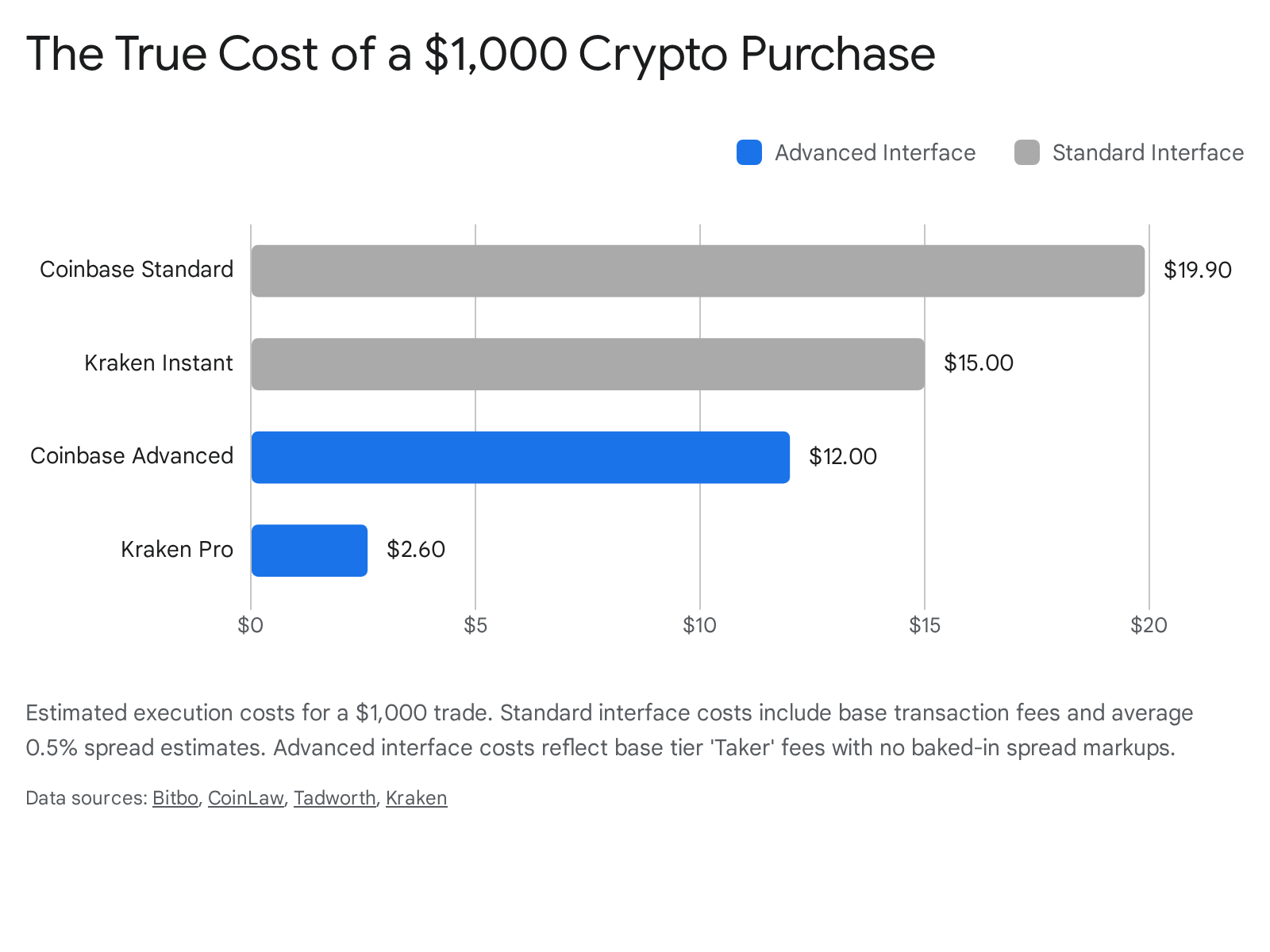
On Coinbase's standard platform, the fee structure is opaque and bundled. Users typically pay a variable spread of approximately 0.50%, which represents the markup between the actual market price and the execution price quoted to the user 1112. During periods of high market volatility, Coinbase's documentation notes that this spread can widen to 2% or more 12. On top of this hidden spread, Coinbase applies either a flat fee or a percentage-based charge, whichever is greater. For micro-transactions under $10, the flat fee is $0.99 11. This flat fee scales up to $1.49 for trades between $10 and $25, $1.99 for trades up to $50, and $2.99 for transactions up to $200 1113. For purchases exceeding $200, Coinbase abandons the flat fee and instead applies a percentage-based base fee of 1.49% for standard bank transfers 11. If a user funds the transaction with a debit or credit card, the fee skyrockets to 3.99% 11. Consequently, a standard retail user executing a simple trade on Coinbase can easily lose 2% to 4.5% of their investment capital to fees the moment they tap the purchase button 1114.
Kraken's standard Instant Buy interface is similarly expensive, making the fee difference between its basic and pro interfaces one of the largest in the industry 15. Kraken charges a flat 1.5% fee for standard cryptocurrency purchases, or a slightly reduced 1% fee for stablecoins 161. This flat percentage is layered on top of a variable conversion spread that typically adds another 0.50% to 1.50% to the cost, depending on liquidity and market conditions 16. If a user decides to fund the instant purchase directly with a credit or debit card, Kraken tacks on an additional 3.75% processing charge plus a small fixed fee 18.
Because of these extreme costs, active investors and financial analysts universally advise against using the standard interfaces on either platform for anything other than emergency, immediate liquidity needs. The true battleground for fees lies in their professional trading environments.
Advanced Trading: Coinbase Advanced vs. Kraken Pro
When migrating to the professional interfaces - Coinbase Advanced (formerly Coinbase Pro) and Kraken Pro - the pricing models discard spreads and flat fees in favor of a "maker-taker" structure 1920. This structure is based on a rolling 30-day trading volume measured in U.S. dollars 121. In this model, "makers" are traders who provide liquidity to the exchange by placing limit orders that rest on the order book until the market reaches their specified price. "Takers" are traders who remove liquidity by placing market orders that execute immediately against the existing resting orders 22. Exchanges uniformly prefer makers, as they deepen the order book, and thus charge them lower fees.
Kraken Pro is significantly cheaper than Coinbase Advanced across almost every retail and mid-market volume tier. For a trader processing under $50,000 a month, Kraken Pro charges a base taker fee of 0.26% and a maker fee of 0.16% 152023. Notably, this is an inverted structure compared to some exchanges, where makers pay more than takers at the absolute lowest tiers, but it remains incredibly competitive overall 16.
Conversely, Coinbase Advanced charges a massive 1.20% taker fee and a 0.60% maker fee for users trading under $1,000 a month 1213. To reach the first meaningful fee reduction on Coinbase, a user must trade over $10,000 in a 30-day period, which drops the maker fee to 0.25% and the taker fee to 0.40% 1324. Even at this elevated tier, Coinbase is still more expensive than Kraken's base entry level 5.
The cost gap has visceral consequences for retail investors building long-term portfolios. If a user buys $10,000 worth of Bitcoin using a market order, they will pay roughly $120 on Coinbase Advanced at the entry tier, compared to just $26 on Kraken Pro 51323. Over a year of regular buying, that gap compounds substantially. Analysts note that below $100,000 in monthly volume, Kraken saves users roughly $340 per $100,000 traded 25.
| 30-Day USD Trading Volume | Kraken Pro (Maker / Taker) | Coinbase Advanced (Maker / Taker) |
|---|---|---|
| $0 - $1,000 | 0.16% / 0.26% | 0.60% / 1.20% |
| $1,000 - $10,000 | 0.16% / 0.26% | 0.35% / 0.75% |
| $10,000 - $50,000 | 0.16% / 0.26% | 0.25% / 0.40% |
| $50,000 - $100,000 | 0.14% / 0.24% | 0.15% / 0.25% |
| $500,000+ | 0.12% / 0.22% | 0.10% / 0.20% |
| $100,000,000+ | 0.00% / 0.08% | 0.00% / 0.08% |
(Note: Data reflects 2026 fee schedules for standard spot trading 513161. High-frequency trading firms and market makers can negotiate even lower customized rates through institutional desks.)
As volumes scale into the tens of millions, the fee gap between the two platforms narrows considerably. Above the $100 million monthly threshold, both platforms offer 0.00% maker fees, allowing institutional algorithmic traders to operate virtually free of execution costs 131. Coinbase also provides deep liquidity and tight spreads on major pairs; a $50,000 market buy of BTC on Coinbase Advanced typically sees only 0.01% to 0.02% slippage, whereas Kraken's depth on certain pairs might result in 0.02% to 0.04% slippage 25. However, for the vast majority of active retail traders, Kraken Pro offers industry-leading affordability.
The Subscription Wars: Kraken+ vs. Coinbase One
Recognizing that many retail users are intimidated by the complex charting and order books of Advanced and Pro interfaces, both exchanges have introduced premium monthly subscription models. These services are designed to offer the simplicity of the standard app without the punishing transaction fees, while bundling additional ecosystem perks.
Inside Coinbase One
Coinbase One represents Coinbase's premium subscription tier and has expanded into a multi-tiered offering in 2026. The most popular "Preferred" tier is priced at $29.99 per month (or $299.99 annually) 2627. The primary draw is zero-fee trading on the standard Coinbase app for up to $10,000 in monthly volume 828.
Beyond fee waivers, the $29.99 subscription provides an unlimited 3.5% Annual Percentage Yield (APY) on USDC stablecoin holdings, a 10% boost to standard staking rewards, and priority 24/7 "concierge" customer support that connects users to specialists in minutes 262728. Security is also a major selling point; the Preferred tier includes account protection insurance coverage up to $10,000 for eligible losses resulting from security breaches on Coinbase's end 2628. The subscription also bundles third-party software deals, such as free or heavily discounted access to crypto tax reporting platforms like CoinTracker and Summ 28.
Coinbase also offers a $4.99/month "Basic" tier, which limits zero-fee trading to just $500 a month and drops account protection to $1,000, as well as a $299.99/month "Premium" tier aimed at high-net-worth individuals, featuring unlimited zero-fee standard trading and $250,000 in account protection 2728.
To break even on the standard $29.99 monthly cost purely through trading savings, a user needs to actively trade roughly $6,000 to $8,000 a month on the basic platform 26. As such, it remains a niche product for frequent retail buyers who refuse to learn the Advanced interface.
Inside Kraken+
Introduced in early 2025 as a direct, aggressive competitor to Coinbase One, Kraken+ undercuts its rival significantly, priced at just $4.99 per month (or $49.99 annually) 2930.
Like its rival, Kraken+ waives standard trading fees on up to $10,000 in monthly volume for instant buy, sell, convert, and custom orders executed through the basic Kraken app or web interface 2931. It also offers up to 4.25% APY on USDG stablecoin holdings (more than double the rate offered to non-subscribers) and elevated priority support routing 29.
A unique feature of Kraken+ is its integration with the platform's token launchpad. Subscribers receive exclusive access to "Kraken Drops," which grants them early access and higher allocations of free airdropped tokens from vetted, new cryptocurrency projects launching on the exchange 32. For tax season, Kraken partnered with Koinly to give subscribers free tax reports for up to 800 transactions 32.
Crucially, on both Kraken+ and Coinbase One, the "zero-fee" perk only waives the explicit transaction fee. The platforms still apply the built-in market spread and payment processing fees to every trade 262933.
| Feature | Kraken+ | Coinbase One (Preferred Tier) |
|---|---|---|
| Monthly Cost | $4.99 | $29.99 |
| Zero-Fee Trading Cap | $10,000 / month | $10,000 / month |
| Stablecoin Yield Boost | Up to 4.25% (USDG) | 3.50% (USDC) |
| Account Protection | None specified | Up to $10,000 coverage |
| Tax Software Partner | Koinly (800 transactions free) | CoinTracker / Summ |
| Unique Perks | "Kraken Drops" early airdrops | Concierge support, 10% staking boost |
(Note: Features and yields are based on 2026 data and vary by regional eligibility 27282932.)
Asset Selection, Networks, and Trading Tools
While both exchanges offer deep liquidity for foundational assets like Bitcoin (BTC), Ethereum (ETH), and Solana (SOL), Kraken is the definitive winner for traders looking for broad market access and advanced financial instruments.
Cryptocurrency Variety and Layer 2 Ecosystems
As of 2026, Kraken lists over 530 cryptocurrencies and supports more than 1,270 trading pairs 35. This extensive catalog makes Kraken ideal for users looking to invest in smaller-cap altcoins, emerging decentralized finance (DeFi) tokens, and niche blockchain ecosystems before they reach mainstream saturation 6.
Coinbase takes a much more curated and compliance-focused approach, supporting roughly 270 cryptocurrencies 534. Because Coinbase operates under the strict scrutiny of the U.S. Securities and Exchange Commission (SEC) as a publicly traded company, it is historically slower and more conservative when listing new or legally ambiguous tokens 67. If a user's strategy revolves around trading the absolute newest tokens, Kraken provides superior optionality.
Both exchanges have also expanded beyond mere trading platforms by deploying their own proprietary "Layer 2" blockchain networks. Built on the Optimism (OP) Stack to scale Ethereum transactions with faster speeds and lower fees, these networks host vast decentralized ecosystems. Coinbase's "Base" network launched first and has accumulated massive DeFi total value locked (TVL) and developer adoption. Kraken's "Ink" network, also built on the Superchain standard, is a newer but rapidly growing competitor aimed at capturing similar on-chain activity 6.
Margin, Futures, and Traditional Equities
If a trading strategy requires leverage or derivatives, Kraken Pro offers a vastly superior suite of tools for a global audience. Through its professional interface, Kraken provides up to 5x leverage on spot margin trading for eligible users 36. More significantly, it offers up to 50x leverage on perpetual futures contracts for over 350 digital assets 36. Kraken Futures operates on a separate, highly competitive fee structure that scales down with volume, starting at 0.02% for makers and 0.05% for takers 1635. The platform supports multi-collateral margin accounts, allowing traders to use various cryptocurrencies as collateral to back their futures positions 16.
Coinbase has historically shied away from high-leverage retail derivatives due to U.S. regulatory friction. However, as regulatory clarity improved in 2026, Coinbase expanded its offerings, providing futures trading with up to 20x leverage on crypto and 5x on certain commodities to eligible U.S. users 6. Despite this expansion, the depth of Coinbase's derivatives market and its global availability pale in comparison to Kraken's established futures ecosystem.
Furthermore, Kraken has distinguished itself by blurring the line between cryptocurrency and traditional finance. Following its acquisition of several brokerages and integration efforts, eligible U.S. clients (excluding certain states like New York) can now trade over 11,000 traditional U.S. stocks and ETFs commission-free directly through the Kraken interface 336. This "xStocks" feature positions Kraken as a holistic financial dashboard, allowing users to manage traditional equities and digital assets side-by-side 1. Coinbase remains strictly focused on digital assets and tokenized instruments.
Moving Money: Fiat Deposits and Withdrawals
The ease, speed, and cost with which an investor can move fiat currency (U.S. Dollars, Euros, British Pounds) into and out of an exchange is a major friction point. Both platforms operate as highly connected financial entities, but their fee structures for traditional banking rails vary by region.
Coinbase excels at onboarding U.S. and European users. In the United States, Automated Clearing House (ACH) deposits and withdrawals are entirely free and generally clear within 1 to 3 business days 3738. European users benefit from free SEPA deposits and withdrawals costing just €0.15, while UK users have access to free Faster Payments for nearly instant GBP transfers 3738. However, if a user requires large, same-day liquidity via domestic wire transfers in the U.S., Coinbase charges a steep $10 incoming deposit fee and a $25 outgoing withdrawal fee 3738. Coinbase also supports direct withdrawals to PayPal for a 2.5% fee 39.
Kraken provides equally robust global payment rails, often with a slight edge in international currency support. Kraken handles 9 major fiat currencies, including the Swiss Franc (CHF), Australian Dollar (AUD), and Japanese Yen (JPY), offering highly localized payment methods like PIX in Brazil or Interac in Canada 4041. Like Coinbase, ACH transfers are free for U.S. users on Kraken. However, Kraken's domestic wire withdrawals are significantly cheaper; utilizing banking partners like FedWire (Customers Bank or Dart Bank), wire withdrawals cost roughly $4, compared to Coinbase's $25 2. International SWIFT withdrawals on Kraken carry a $13 to $25 fee depending on the routing bank 2.
A critical note for new users on both platforms: first-time fiat deposits, particularly those made via ACH, debit cards, or digital wallets, will trigger an automatic security hold - often lasting 72 hours to 7 days - during which time funds or purchased crypto cannot be withdrawn off the platform 392.
Staking, Yields, and the Regulatory Landscape
Staking - the process of locking up cryptocurrency to help validate and secure a Proof-of-Stake blockchain network in exchange for a yield - has been a major battleground for both exchanges. The ability to offer these yields has been heavily influenced by shifting political and regulatory winds in the United States.
The SEC and the Staking Crackdown
In early 2023, under the leadership of then-SEC Chair Gary Gensler, the regulatory agency launched a massive crackdown on centralized exchange staking programs. Kraken was forced to shut down its U.S. "staking-as-a-service" operation and pay a $30 million penalty to settle allegations that it failed to register the program as a securities offering 344. During this period, Kraken maintained its staking services for international users through a subsidiary, but U.S. clients were entirely cut off from this passive income stream 44.
Coinbase, facing similar threats, chose a different path. The company aggressively fought the SEC in federal court, refusing to shutter its staking operations for U.S. customers and arguing that staking rewards did not meet the definition of an investment contract 645.
The regulatory landscape shifted seismically following the inauguration of President Donald Trump in early 2025 3. The new administration immediately pivoted toward a pro-crypto stance, and acting SEC Chairman Mark T. Uyeda established a Crypto Task Force aimed at developing transparent policy 46. On February 27, 2025, the SEC officially filed a joint stipulation to voluntarily dismiss its civil enforcement action against Coinbase, functionally ending the years-long legal battle and saving the company an estimated $50 million annually in legal costs 1046.
Capitalizing on the thawed regulatory environment, Kraken triumphantly relaunched its on-chain staking program for U.S. clients on January 30, 2025 47. The revamped service is initially available in 37 states and two territories, with plans for expansion as local state regulations permit 4447.
Yields and Commissions
Today, Kraken users can stake 17 different Proof-of-Stake assets, including Ethereum (ETH), Solana (SOL), Cosmos (ATOM), and Polkadot (DOT) 4447. The platform offers both "bonded" staking, which locks assets to a network for a specific period to generate higher yields, and "flexible" staking, which allows for instant unstaking 7. To ease investor anxiety, Kraken provides third-party "slashing insurance" to protect user assets against potential losses resulting from network penalties or validator errors 48.
Both platforms operate their staking services by taking a commission on the gross rewards generated by the blockchain before passing the net yield back to the user. Kraken is generally more cost-effective, taking a 20% to 30% commission on rewards depending on the asset 31. Coinbase, prioritizing automation and ease of use, typically commands a higher 25% to 35% commission 749. Consequently, while both platforms remove the technical complexity of running validator nodes, active investors seeking to maximize their passive income will generally find slightly higher net APYs on Kraken.
Security, Custody, and Trust Models
No cryptocurrency exchange can survive without establishing profound trust with its users. The spectacular collapses of platforms like FTX and Mt. Gox serve as permanent reminders of the custodial risks inherent in centralized finance. Interestingly, Kraken and Coinbase have built their pristine security reputations using two entirely different philosophical approaches.
Coinbase: Institutional Compliance and Wall Street Transparency
Coinbase's security model is deeply rooted in traditional, institutional Wall Street transparency 7. Because it is a publicly traded company, it operates under intense regulatory scrutiny and must file rigorous quarterly financial statements audited by traditional accounting firms with the SEC 57. The public knows exactly how much revenue Coinbase generates, how much cash it holds on its balance sheet, and its specific risk factors. As one analyst noted, this provides a "level of accountability no private company can match" 5.
Furthermore, Coinbase offers FDIC pass-through insurance up to $250,000 for U.S. Dollar (fiat) balances held on the platform, offering a safety net identical to a traditional bank 67. While this insurance does not cover cryptocurrency assets, Coinbase stores 98% of customer digital assets offline in geographically distributed cold storage vaults to mitigate hacking risks 6.
Kraken: Cryptography and Proof of Reserves
Kraken, operating as a private company, bypasses traditional financial bureaucracy by relying on cryptographic truth. The platform is widely considered one of the safest exchanges in the world, holding the incredibly rare distinction of never having lost customer funds to a platform-wide hack since its inception in 2011 17. In 2020, Kraken further cemented its regulatory legitimacy by becoming the first crypto firm to receive a Special Purpose Depository Institution (SPDI) banking charter from the state of Wyoming 50.
Rather than relying solely on traditional corporate audits, Kraken proves it holds the assets it claims through a pioneering "Proof of Reserves" (PoR) program 51. Utilizing a cryptographic data structure known as a Merkle tree, an independent accounting firm regularly verifies that Kraken's on-chain wallet holdings match or exceed its total client liabilities 453. Users are given a personalized Merkle root hash, allowing them to independently and privately verify that their exact account balance was included in the audit, without compromising privacy 453.
Kraken's Proof of Reserves is notably rigorous; it encompasses not just spot balances, but also margin accounts, futures holdings, and staked assets 4. In Kraken's philosophy, "Take our word for it" is insufficient for the crypto era; the platform demands that users verify the math cryptographically 53. This cryptographic Proof of Reserves stands in stark contrast to Coinbase, which leverages the traditional public-market transparency of SEC-audited corporate financials to establish trust.
Both platforms maintain exceptional operational security protocols, enforcing mandatory Two-Factor Authentication (2FA), supporting hardware security keys (FIDO2), and offering withdrawal whitelisting to prevent unauthorized transfers 50. Furthermore, both exchanges hold comprehensive MiCA (Markets in Crypto-Assets) licenses in the European Union, ensuring full regulatory compliance across all 27 member states 5.
Global Availability and Customer Support
The geographic reach and customer service infrastructure of an exchange dictate its usability during periods of high market stress.
Regional Restrictions
Kraken currently operates in over 190 countries, offering a massive global footprint 54. However, due to complex international sanctions, anti-money laundering mandates, and local licensing requirements, Kraken restricts services in 16 jurisdictions, including Japan, Russia, India, and regions like North Korea and Syria 54. Within the United States, Kraken is available in 48 states, but services are currently restricted for residents of New York and Maine 31.
Coinbase operates in over 100 countries 9. While its global footprint is numerically smaller than Kraken's, it maintains near-universal coverage in the United States, servicing all 50 states without operational gaps 1.
Resolving Issues: Chat, Phone, and Agents
Historically, centralized crypto exchanges have been notorious for poor customer service, often trapping users in automated email ticket loops that take days to resolve. By 2026, both Kraken and Coinbase have vastly improved their support infrastructures.
Kraken is frequently lauded for having the best customer service in the industry, largely due to its massive 24/7 global support team 55. Live human chat boasts average response times of just 1 to 2 minutes 50. To protect users from sophisticated impersonation scams, Kraken does not publish a public phone number 56. Instead, authenticated users can initiate a secure voice call directly from within the Kraken mobile app. During the call, an in-app banner appears, allowing the user to verify in real-time that they are speaking with a legitimate Kraken Support specialist rather than a scammer spoofing caller ID 56.
Coinbase has aggressively expanded its support capabilities to shed its past reputation for unresponsiveness 57. The platform now offers 24/7 live phone and chat support across more than 115 countries, providing assistance in five languages 57. Unlike Kraken, Coinbase clearly publishes toll-free local phone numbers for users in the US, UK, EU, Germany, India, Spain, and Brazil, making it exceptionally easy for mainstream users to reach a human representative 58.
Bottom line
Kraken is the superior platform for anyone who plans to trade cryptocurrency regularly or professionally. Its Kraken Pro interface offers substantially lower maker and taker fees, access to over 500 digital assets, advanced margin and futures features, and an impeccable 14-year security record backed by rigorous cryptographic Proof of Reserves audits. Conversely, Coinbase remains the optimal choice for complete beginners and traditional investors who prioritize the simplest possible user interface, FDIC-insured fiat balances, and the supreme financial transparency of a publicly traded S&P 500 company. What remains uncertain is how aggressively Coinbase will lower its base tier fees to remain competitive as the retail market becomes increasingly educated on the hidden costs of "Instant Buy" spreads.