How Silicon Valley Became Silicon Valley
Silicon Valley's transformation from agricultural orchards to the global epicenter of technology was not a spontaneous triumph of the free market, but the result of massive Cold War military spending combined with Stanford University's industry-focused research programs. This state-subsidized foundation seeded the semiconductor manufacturing industry, which in turn birthed the modern venture capital ecosystem on Sand Hill Road and enabled the region's successive, highly lucrative pivots into personal computing, internet software, and artificial intelligence.
The Mythology of the Garage Versus the Reality of the State
Every dominant economic regime cultivates a founding myth to confer legitimacy upon its leaders, and Silicon Valley is no exception 1. For decades, the dominant cultural narrative of the region has celebrated the "lone genius" - the scrappy, libertarian entrepreneur who retreats to a sun-drenched suburban garage to invent world-changing technology with nothing but code, caffeine, and conviction 12. In this telling, the free market naturally rewarded brilliant risk-takers like Steve Jobs, Bill Gates, and Mark Zuckerberg, and the best thing the government ever did was stay out of their way 112.
This archetype of the "tech bro" or "disruptor CEO" positions technology founders as singular visionaries whose raw intelligence single-handedly revolutionizes industries 3. The mythology begets a culture of superiority that frequently demands deference from political systems, promoting concepts like "permissionless innovation" while casting government regulation as an enemy of progress 13.
However, economic historians note that this narrative is largely a fiction that obscures the true structural engines of the Valley's success 12. As historian Margaret O'Mara points out, the "pull yourself up by your bootstraps" ethos is a corrosive American myth; the reality is that the entire Silicon Valley tech sector was engineered and heavily subsidized by public policy and aggressive government intervention 11. The true story of Silicon Valley is one of deliberate alignment between government funding, academic infrastructure, and private industry over several decades 2. Long before venture capital became a formalized industry, the region was essentially a project of the state, carefully cultivated by national ambition, war-fueled urgency, and the pursuit of military supremacy 5.
Understanding how Silicon Valley actually came to be requires looking past the mythology of the disruptor CEO and examining the complex, decades-long ecosystem that made those garage startups possible in the first place.
The Seed of Innovation: Stanford University and Fred Terman
Before it was a global center of software and internet services, the Santa Clara Valley was an agricultural patchwork affectionately known as the "Valley of Heart's Delight" 2. Its transformation into a technological powerhouse began not with an entrepreneur, but with an academic administrator: Frederick Terman, a professor of electrical engineering who later became the dean of Stanford University's engineering school and its provost 245.
Often referred to as the "father of Silicon Valley," Terman recognized in the 1930s and 1940s that Stanford was suffering from a localized brain drain. Exceptional engineering students were migrating to the East Coast upon graduation to find work with established industrial firms 28. Terman believed that universities should do more than grant degrees; they should actively spawn industries and act as a regional economic engine 29. He actively encouraged his best students to commercialize their research and start companies locally 24.
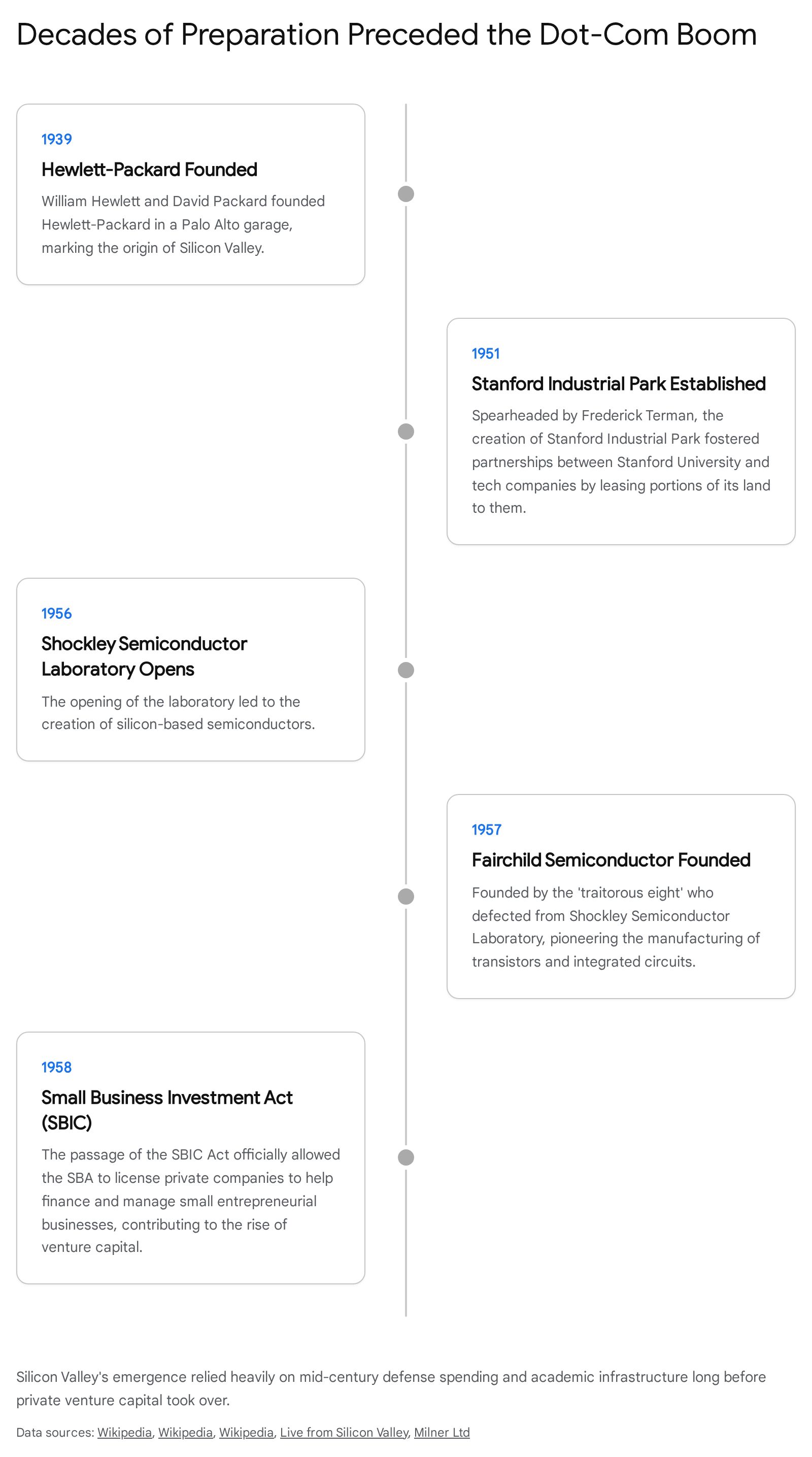
The most famous early beneficiaries of Terman's philosophy were William Hewlett and David Packard, who launched their audio-oscillator company in a Palo Alto garage in 1939 with Terman's encouragement 2410. Similarly, Terman supported Stanford professor William Hansen and the Varian brothers in developing the klystron tube, a critical component for radar technology that led to the founding of Varian Associates 410.
The Stanford Industrial Park
In 1951, Terman institutionalized this vision by spearheading the creation of the Stanford Industrial Park (now the Stanford Research Park) 24. The university leased portions of its vast land holdings to high-tech companies such as Varian Associates, Eastman Kodak, General Electric, and later the Lockheed Corporation 410.
This initiative was revolutionary because it collapsed the distance between academic research, highly trained talent, and commercial industry 2. By actively bringing corporations onto the campus perimeter, Terman created a feedback loop of knowledge and capital that anchored the region's earliest network effects 2. Terman did not just build a campus extension; he built the structural template for the modern technology hub 2.
The Cold War and the "Mother of All Venture Capital Firms"
Stanford's initiative coincided perfectly with the geopolitical anxieties of the era. In the aftermath of World War II and the onset of the Cold War, the United States government was desperate to maintain a technological edge over the Soviet Union 16. Knowing that overt, state-led industrial projects might appear uncomfortably "Communist" to the American public, the federal government funneled massive research and development funding through defense companies and universities 1.
The U.S. Department of Defense and the intelligence community became the primary financial engines of the region, acting as what Yale School of Management professor Paul Bracken calls the "mother of all venture capital firms" 7. Military contracting for microwave electronics, aerospace, and satellite technology fueled enormous regional growth 814. The demand for electronic intelligence drove much of the region's early research and development work 7.
Aerospace and Military Contracting
When the Lockheed Corporation relocated its Missile Systems Division to Sunnyvale in 1956, it rapidly became the region's largest industrial employer 69. Lockheed's growth was driven by highly lucrative government projects, most notably the Polaris Fleet Ballistic Missile program, which earned the company billions of dollars and established it as the exclusive producer of Navy strategic missiles 9.
This influx of military capital encouraged regional contractors to embark on a course of flexible specialization and continuous innovation to meet the Pentagon's exacting standards 8. By the early 1960s, the Defense Advanced Research Projects Agency (DARPA) was funding over 70% of all computer technology research in the United States, and military contracts accounted for nearly 60% of the Santa Clara Valley's electronics revenue 1617.
Putting the "Silicon" in the Valley
While military aerospace contracts paid the bills and expanded the region's technical infrastructure, the technological revolution that ultimately gave the region its name originated with a specific piece of hardware: the transistor.
Prior to the transistor, early computing relied on vacuum tubes. Machines like the ENIAC required tens of thousands of vacuum tubes, filled entire rooms, and broke down constantly due to the immense heat the tubes generated 18. The invention of the transistor at Bell Labs in 1947 proved that electronics could be exponentially smaller, faster, and more reliable 10.
In 1956, William Shockley, a co-inventor of the transistor and a Nobel Prize laureate in physics, returned to Palo Alto to establish the Shockley Semiconductor Laboratory 101112. Shockley successfully recruited a team of brilliant young Ph.D. graduates from across the country to pioneer the mass production of advanced semiconductor devices 12.
The Traitorous Eight
Despite his brilliance as a physicist, Shockley was widely regarded as a paranoid and authoritarian manager 1012. He stifled his team's creativity by insisting on pursuing flawed, unfruitful research paths 1012. In 1957, eight of his top researchers decided they had endured enough of his erratic leadership.
Julius Blank, Victor Grinich, Jean Hoerni, Eugene Kleiner, Jay Last, Gordon Moore, Robert Noyce, and Sheldon Roberts secretly banded together and resigned en masse 1812. Shockley, furious at the defection, bitterly branded them the "traitorous eight" 12.
Needing capital to start their own semiconductor venture, the group partnered with an East Coast investment banker named Arthur Rock 1813. After pitching their idea to over 30 companies without success, Rock secured a $1.4 million loan and a $3 million buyout option from Sherman Fairchild, an eastern entrepreneur with deep military contracting ties 181314. With this funding, the eight scientists launched Fairchild Semiconductor in San Jose 1415.
Fairchild Semiconductor and the Integrated Circuit
Fairchild Semiconductor completely revolutionized the computing industry. Under Robert Noyce's leadership, the company shifted away from germanium to focus entirely on silicon substrates, realizing that utilizing a material primarily derived from sand would drastically reduce manufacturing scale costs 1014. Shortly after, team member Jean Hoerni developed the planar process, a monumental manufacturing breakthrough 1213. This innovation allowed Fairchild to create the first commercially viable integrated circuits, which combined entire collections of transistors and other components onto a single silicon chip 1014.
Crucially, Fairchild Semiconductor's first major customers were the U.S. military and NASA 916. The integrated circuits were essential for the miniaturized electronics required by the Apollo space program and the Minuteman missile guidance systems, where strict weight and reliability requirements made older technologies obsolete 1912. A $1.5 million contract for the Minuteman program in 1958 provided Fairchild with the necessary profits to finance the continued development of the planar process 9.
The "Fairchildren"
Beyond its hardware breakthroughs, Fairchild's greatest legacy was cultural. The company established a regional precedent for entrepreneurial risk-taking, technological freedom, and corporate spin-offs 1710.
Over the next decade, employees repeatedly left Fairchild to start their own competing tech companies 1025. These spin-offs, affectionately dubbed the "Fairchildren," became the bedrock of the modern tech industry 12. In 1968, Robert Noyce and Gordon Moore left to found Intel; Jerry Sanders left to found AMD; and Eugene Kleiner co-founded the venture capital firm Kleiner Perkins 1225.
It is estimated that more than 2,000 tech companies trace their lineage directly back to the original Fairchild team 26. This dense concentration of silicon microchip manufacturers forever sealed the region's identity as "Silicon Valley" - a term first coined by journalist Don Hoefler in a 1971 trade publication 2616.
The Genesis of Venture Capital and Sand Hill Road
As the semiconductor industry matured in the 1960s, the mechanisms for funding these capital-intensive hardware startups evolved alongside it. Once again, the federal government played an invisible but critical role in establishing the financial infrastructure of the Valley.
The passage of the Small Business Investment Act of 1958 was a direct policy response to the Soviet launch of the Sputnik satellite 1718. The act officially allowed the U.S. Small Business Administration (SBA) to license and subsidize private Small Business Investment Companies (SBICs), offering tax breaks and highly favorable leverage (allowing them to borrow up to four dollars for every one dollar they invested) to firms that funded small entrepreneurial ventures 1718.
This legislative push catalyzed the creation of a professionally managed private equity and venture capital industry 1719. It effectively created hundreds of venture capitalists overnight, serving as a training ground for the industry's pioneers 19. Arthur Rock, the financier who had brokered the Fairchild deal, relocated to the West Coast and is widely credited with popularizing the term "venture capitalist" 1817.
Rock and his contemporaries pioneered a new model of investing characterized by high-risk, high-reward bets. Venture capital became a "hits" business, where the exceptional payoffs of a few highly successful outlier companies compensated for the inevitable failure of the vast majority of startups in a portfolio 31.
The Rise of Sand Hill Road
In 1972, this nascent industry found its geographic anchor. The newly formed firm Kleiner Perkins established its first office on Sand Hill Road in Menlo Park, a quiet arterial road strategically located near Stanford University 2021. The stellar returns of Kleiner Perkins's initial $8 million fund quickly attracted other pioneering firms, such as Sequoia Capital (founded by Don Valentine, another former Fairchild employee), to the exact same tree-lined stretch 252022.
Sand Hill Road soon became the undisputed global capital of venture funding, an address as synonymous with private equity as Wall Street is with global finance 2023.
Regulatory Shifts and the Apple IPO
Venture capital experienced another massive surge in the late 1970s due to shifts in federal regulation. In 1978, the U.S. Labor Department relaxed restrictions under the Employee Retirement Income Security Act (ERISA) 1719. By modifying the "prudent man rule," the government allowed massive corporate pension funds to invest in high-risk asset classes, opening a floodgate of institutional capital into venture funds 1719. Capital gains tax reductions further fueled this growth 17.
The defining moment that validated this new financial ecosystem arrived in December 1980 with the initial public offering (IPO) of Apple Computer. Founded by Steve Jobs and Steve Wozniak in 1976, Apple's IPO generated $1.3 billion and instantly minted hundreds of millionaires 161624. This event definitively proved the viability of the VC-backed startup model to the broader financial world 24. The sheer volume of wealth generated attracted an unprecedented influx of private capital to Sand Hill Road, shifting the Valley's financial reliance away from slow-moving government defense contracts and entirely into the agile hands of private investors 1637.
Why Silicon Valley Won: The Battle Against Route 128
It is important to note that in the 1970s and 1980s, Silicon Valley was not the only high-tech hub in the United States. Its primary rival was the Route 128 corridor outside of Boston, Massachusetts. Anchored by MIT and a robust ecosystem of established defense contractors and minicomputer firms, Route 128 was considered equally poised to dominate the future of technology 3825.
Yet, by the 1990s, Silicon Valley had decisively outpaced Boston 2526. Economists, sociologists, and legal scholars attribute this divergence not just to the weather or venture capital, but to fundamental differences in organizational culture and state law 3725.
The Non-Compete Ban and Knowledge Spillovers
A critical, often overlooked factor in Silicon Valley's triumph was California's steadfast refusal to enforce post-employment non-compete agreements 2527. In Massachusetts, restrictive covenants were strictly enforced by the courts. This meant that an engineer leaving a major Route 128 firm could be sued for attempting to join a competitor or start a new business in the same field 3842.
California's legal framework, conversely, allowed tech workers to move freely between employers 25. This sparked a regional culture of rampant job-hopping 3725. It was common for engineers in the Valley to quit on a Thursday and start at a rival startup on Monday 37.
While deeply frustrating to individual employers trying to retain talent, this hyper-mobility created massive "knowledge spillovers" across the region 2527. Tacit knowledge, engineering breakthroughs, and best practices flowed freely through informal social networks, local bars, and professional meetups, cross-pollinating the entire regional ecosystem 3738.
Open Networks vs. Corporate Silos
This legal distinction fostered two distinct corporate cultures. Route 128 operated on a "closed network" model 38. Companies were secretive, hierarchically organized, vertically integrated, and highly dependent on long-term government contracts that discouraged rapid iteration 3738. Loyalty to the firm was paramount, and leaving a company carried a heavy social stigma 37.
Silicon Valley operated as an "open network" 38. Engineers felt a stronger allegiance to the broader technological community and the pursuit of innovation than to any single employer 37. Furthermore, the Valley developed a unique tolerance for failure 3843. Unlike in European markets or Boston's conservative corporate culture - where a failed venture carried severe social and financial penalties - venture capitalists on Sand Hill Road viewed a failed startup as a valuable educational experience 173843. A founder who failed fast and learned from their mistakes was often funded again, creating a resilient ecosystem of serial entrepreneurship 3843.
Structural Differences: Silicon Valley vs. Route 128
| Feature | Silicon Valley (California) | Route 128 (Massachusetts) |
|---|---|---|
| Legal Framework | Non-compete agreements banned and legally unenforceable 42. | Non-compete agreements strictly enforced by state courts 42. |
| Corporate Structure | "Open network"; highly collaborative; decentralized agile startups 38. | "Closed network"; secretive; vertically integrated large corporations 38. |
| Employee Mobility | Extremely high; job-hopping encouraged rapid knowledge spillover 3725. | Low; company loyalty prioritized; moving to rivals heavily stigmatized 3738. |
| Attitude Toward Failure | Celebrated as a necessary stepping stone to success; serial founding encouraged 38. | Viewed conservatively; risk-averse culture focused on stability and career longevity 38. |
| Primary Funding Shift | Transitioned heavily to high-risk Venture Capital by the 1980s 37. | Remained heavily reliant on slow, long-term government defense contracts 37. |
The Internet Boom and the Pivot to Software
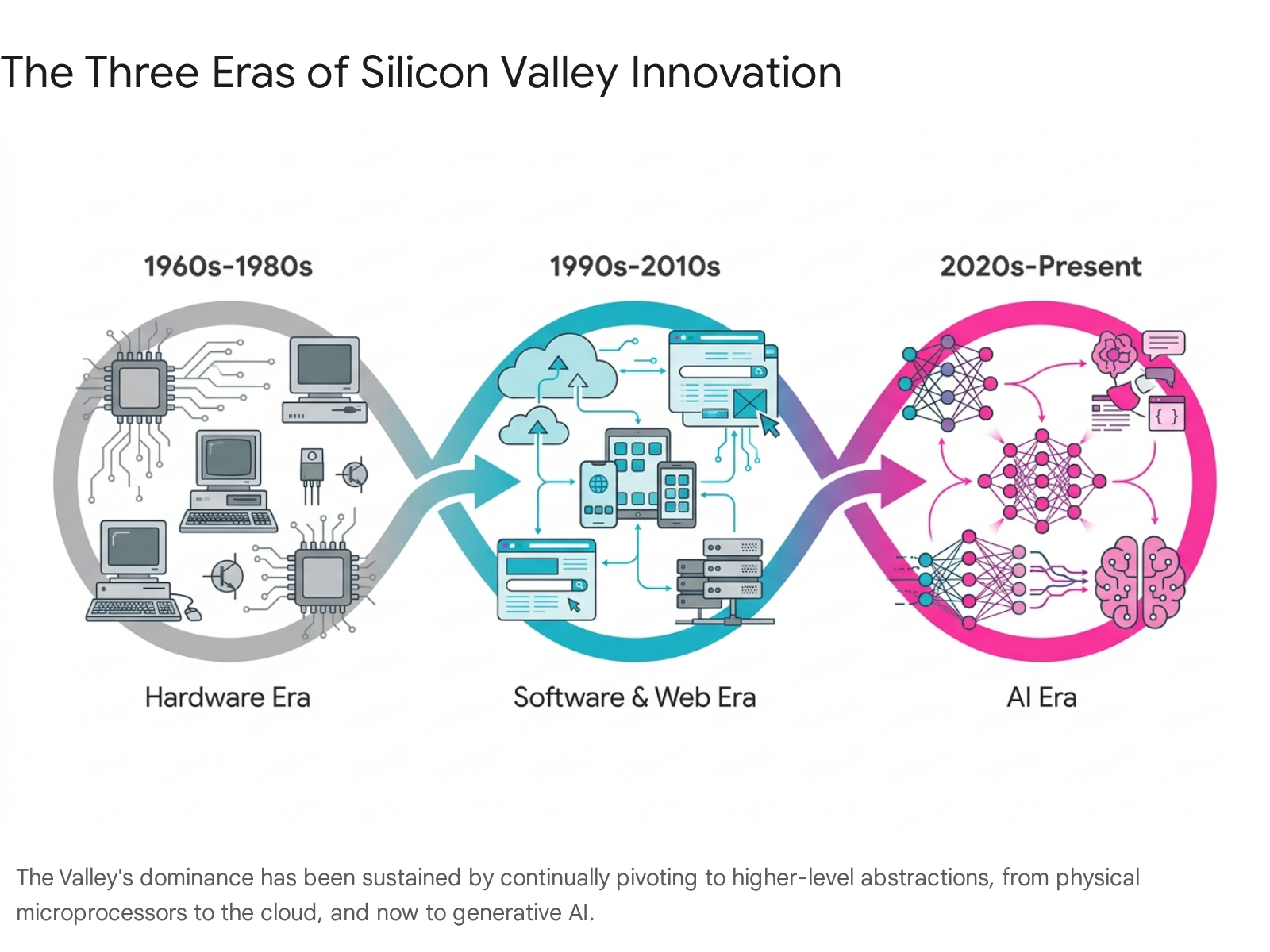
As the 1990s arrived, the foundational hardware - the microprocessors and personal computers engineered in the preceding decades - had become powerful and ubiquitous enough to support a new layer of innovation: the internet. Drawing on early ARPANET node research funded by DARPA at Stanford years earlier, the Valley transitioned rapidly from a hardware manufacturing hub into a software and web services epicenter 164445.
Software offered immense economic advantages over hardware. It required no expensive physical fabrication plants, possessed infinite digital scalability, and could be iterated upon and distributed instantly across the globe 45. Recognizing this, venture capital flooded into internet startups in the late 1990s, driving the Nasdaq Composite index up an astonishing 600% between 1995 and 2000 in what became known as the dot-com bubble 28.
During this period of irrational exuberance, investors, intoxicated by the promise of the "Information Age," routinely ignored traditional business metrics like price-to-earnings ratios 28. Funding was showered on companies that lacked viable revenue models, and a startup's lifespan was frequently measured purely by its "burn rate" - how fast it spent its existing venture capital 28.
The bubble burst spectacularly, peaking on March 10, 2000. By October 2002, the Nasdaq had lost 78% of its value, wiping out trillions of dollars in market capitalization 2228. High-profile startups like Webvan and Pets.com collapsed under massive burn rates, poor financial planning, and unsustainable marketing budgets, becoming cautionary symbols of Silicon Valley excess 2829.
However, the crash ultimately matured the ecosystem. The venture capitalists who survived the carnage became much more discerning, shifting their focus back to robust business fundamentals and sustainable growth trajectories 2248. Companies that weathered the storm through extreme determination and sound unit economics - such as Amazon, Google, and eBay - emerged as monolithic tech giants that would define the next two decades of the internet 2228.
The Post-IPO Era and the "Uber Round"
In the post-bubble era of the 2010s, a new phenomenon emerged on Sand Hill Road that fundamentally altered public markets: the "uber round." Driven by massive venture funds holding billions in capital, VCs began writing checks for hundreds of millions of dollars to late-stage private companies 23.
Startups like Uber, Airbnb, and Lyft utilized this private capital to delay their initial public offerings indefinitely, staying private much longer than companies of previous generations 2329. This structural shift allowed venture capitalists on Sand Hill Road to capture the lion's share of a company's massive growth phase before an IPO, effectively turning the region into the Wall Street of the West Coast 23. While highly lucrative for private equity, this dynamic left retail public investors locked out of the steepest valuation climbs that had previously defined the 1990s internet boom 23.
The Silicon Valley Clones: Why Replication Often Fails
For decades, governments and urban planners worldwide have attempted to replicate the staggering economic output of Silicon Valley. From New York's "Silicon Alley" to London's "Silicon Roundabout," administrators have tried to force innovation clusters into existence by building technology parks and offering tax incentives 49.
However, most state-directed attempts to build a Silicon Valley clone from scratch have failed miserably. Planners frequently misunderstand that the Valley is a complex, organic ecosystem that relies on cultural norms - like a high tolerance for failure, decentralized networks, and a disregard for rigid corporate hierarchy - just as much as it relies on physical infrastructure and venture capital 4330.
Skolkovo: A Lesson in Top-Down Failure
Russia's attempt to build a tech hub, the Skolkovo Innovation Center, serves as a prime cautionary tale of how top-down planning cannot manufacture an entrepreneurial culture. Launched in 2010 by then-President Dmitry Medvedev with a $4 billion budget, the project aimed to build a sprawling tech utopia just outside Moscow 5152. In its early days, it successfully attracted partnerships with Western institutions like MIT, IBM, and Cisco 5253.
However, Skolkovo failed to produce a single "unicorn" startup or globally recognized technology company 51. The project was heavily managed from the top down and quickly became mired in the systemic issues of the Russian state: rampant corruption, embezzlement scandals, and heavy-handed intervention by security services that terrified prospective founders 5153.
Following geopolitical escalations and the annexation of Crimea, Western corporate partners quietly scaled back or fled entirely 5152. The Russian state subsequently pivoted the hub's remaining resources toward military technologies like drones and cybersecurity, effectively killing its commercial startup ecosystem and finalizing its failure as a Silicon Valley competitor 52.
Shenzhen: A Different Kind of Success
Conversely, China's Shenzhen represents a wildly successful tech hub, but one built on a fundamentally different model than California's 5431. Transforming from a quiet fishing village into a metropolis of 12 million people, Shenzhen initially leveraged low-cost manufacturing before climbing the value chain to indigenous innovation 3156.
While Silicon Valley obsesses over software scalability, disruptive breakthroughs, and strict intellectual property (IP) protection via patents, Shenzhen thrives on hardware, manufacturing speed, and open collaboration 5456. Often described as a "farmer's market of entrepreneurs," Shenzhen companies routinely share component designs and iterate on physical products in weeks rather than years, unburdened by western IP thickets 54.
Shenzhen represents a state-directed, semi-market economy that plays to its regional strength in supply-chain density and rapid manufacturing, rather than attempting a hollow copy of Silicon Valley's venture-capital-heavy software model 175431.
Comparing Global Technology Hubs
| Metric / Characteristic | Silicon Valley (USA) | Shenzhen (China) | Skolkovo (Russia) |
|---|---|---|---|
| Primary Economic Engine | Venture Capital, Software, AI, strict IP protection 54. | High-tech manufacturing, Hardware, open IP collaboration 5456. | State subsidies, top-down funding 5152. |
| Ecosystem Origin | Semi-organic; catalyzed by Cold War defense & Stanford 27. | State-planned; established as China's first Special Economic Zone 5456. | State-planned; built from scratch outside Moscow in 2010 51. |
| Innovation Style | Radical disruption; software scalability; failure tolerated 1738. | Rapid iteration; hardware supply-chain density; high customization 1754. | Bureaucratic; heavily regulated; stifled by corruption 5153. |
| Current Status | Global leader navigating shift to AI; managing excess capital 5657. | Tech powerhouse rivaling the US, but facing foreign investment scarcity 56. | Largely defunct commercial hub; repurposed for military tech 52. |
The Generative AI Boom and the Fracturing of the Valley
By early 2023, proclamations of Silicon Valley's demise had become highly fashionable in the business press. The shift to remote work during the COVID-19 pandemic caused a mass exodus of tech workers to cheaper locales across the country, sending San Francisco's commercial real estate market plunging and leaving massive downtown vacancies 32. Concurrently, the end of the "cheap money" era of the 2010s triggered harsh labor-market corrections, resulting in the loss of an estimated half a million tech jobs globally as companies reined in their pandemic-era overhiring 57.
However, reports of the Valley's death were decidedly premature. The sudden explosion of generative artificial intelligence has injected massive new life and capital into the region 5732. Despite mainstream theories that AI would rapidly automate coding and reduce corporate headcount, leading AI companies are currently engaged in a hiring frenzy 32.
As of late 2023, 59% of all AI-related job postings in the United States were for companies based in and around Silicon Valley - more than every other American city combined 57. Because developing foundational AI models requires solving incredibly complex algorithmic challenges, AI startups are aggressively leasing premium office space in San Francisco, betting heavily on the necessity of in-person collaboration and density 32.
A Tale of Two Tech Trends
Yet, this transition from the web era to the AI era is proving bumpy and unequal. The current boom is generating staggering, lottery-like wealth for a concentrated few - mostly founders and early employees at elite AI firms like OpenAI, Anthropic, and Nvidia - while simultaneously eroding the job security of traditional software engineers 60.
Industry observers estimate that roughly 10,000 Bay Area residents have accumulated retirement-level wealth (exceeding $20 million in net worth) strictly from the AI boom 60. Conversely, many highly paid traditional tech professionals face intense career anxiety, uncertain if their legacy coding skills will remain relevant as AI takes over entry-level programming tasks 6033. Ultimately, Silicon Valley is transitioning into a new era where critical thinking and complex systems design will outvalue traditional software engineering 33.
Bottom line
The history of Silicon Valley thoroughly shatters the myth of the lone genius operating in a vacuum. The region's absolute dominance is the product of a highly specific, mid-century alignment of massive government defense spending, academic foresight at Stanford University, and the eventual creation of a unique, risk-tolerant venture capital ecosystem. While other nations have tried and largely failed to clone this exact model by throwing money at empty science parks, the Valley itself continues to survive its own boom-and-bust cycles - transitioning fluidly from silicon chips to internet software, and now to artificial intelligence - proving that its true competitive advantage is an entrenched, highly adaptable culture of innovation that cannot be easily legislated into existence.