
How Rolling Admissions Changes Your Application Timeline
Rolling admissions is a college application policy where universities evaluate applications and release decisions continuously upon receipt, rather than waiting to review the entire applicant pool after a single, hard deadline. While this system offers students significantly more flexibility and the psychological relief of faster results, applying early is highly strategic; available spots in competitive programs, campus housing, and merit-based financial aid are awarded strictly on a first-come, first-served basis.
The Mechanics of Continuous Evaluation
For decades, the standard college admissions process operated on a rigid batch system. Students submitted their materials by a firm winter deadline - typically in early January - and colleges spent the next three months reading every file simultaneously. Admissions officers would then release their decisions in a massive, coordinated wave in the late spring, comparing every applicant against the entire incoming pool 1.
Rolling admissions completely changes this operational flow and the underlying philosophy of application evaluation.
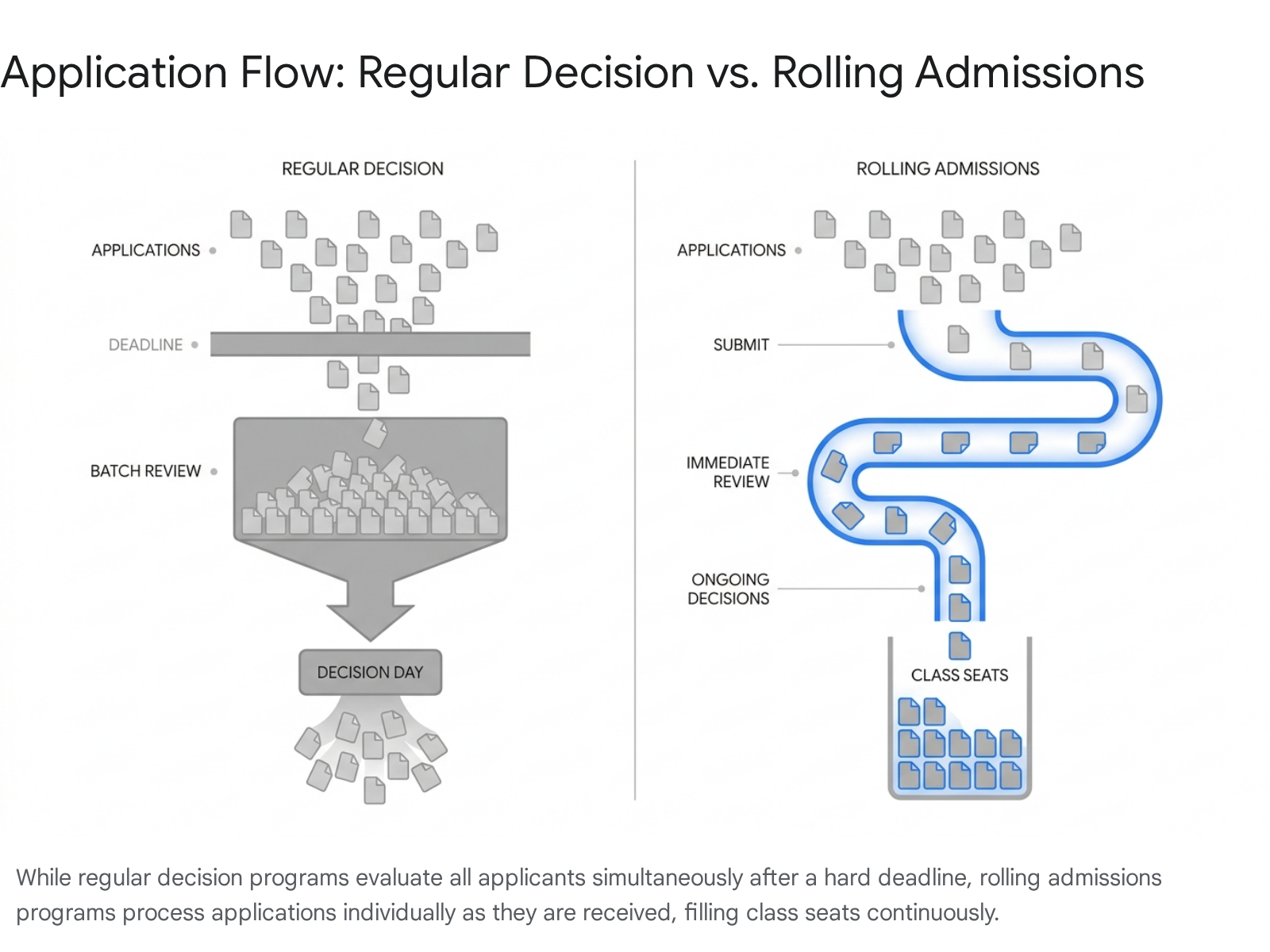
Institutions that utilize this continuous method typically open their application portals in the late summer or early fall. From that point forward, admissions officers assess files individually as soon as a student's submission is complete 23. Instead of comparing an applicant directly to tens of thousands of peers at the exact same moment, the university assesses whether the student independently meets the institution's historical academic standards and enrollment goals 4.
If the student is a strong fit, the admissions office generates an acceptance letter quickly, often notifying the applicant within four to eight weeks of submission 11. This continuous cycle operates smoothly until the university reaches its target enrollment for the incoming freshman class, at which point the application window closes indefinitely 2.
This process drastically alters the psychological and strategic experience of applying to higher education. A high school senior who submits an application to a rolling admissions school in late August can reasonably expect to have an official acceptance in hand by early October 1. This effectively secures a viable college option months before regular decision deadlines even arrive, providing a significant emotional safety net. With a guaranteed admission secured early in the fall, the student can spend the remainder of the year carefully polishing applications for more selective, fixed-deadline institutions without the looming anxiety of a potential complete rejection 78.
However, the inherent flexibility of the rolling timeline has fostered a pervasive and dangerous myth among applicants: the belief that an open, non-fixed deadline means there is no rush to apply.
Comparing Application Deadlines and Strategic Advantages
To fully comprehend the strategic implications of rolling admissions, it is necessary to contextualize how it fits into the broader ecosystem of college admissions deadlines. Universities in the United States generally offer four primary application pathways, each carrying vastly different commitments, timelines, and statistical advantages 91011.
| Admission Type | Typical Deadline | Typical Decision Date | Binding Commitment? | Strategic Advantage & Considerations |
|---|---|---|---|---|
| Rolling Admission | None (Closes when full) | 4 - 8 weeks after submission | No | Offers immediate results and immense flexibility. Highly favorable for early applicants before institutional spots and funding fill up. |
| Early Decision (ED) | Early to Mid-November | Mid-December | Yes | Offers the highest statistical acceptance rate advantage, but requires a strict, legally binding commitment to attend if accepted, preventing financial aid comparison. |
| Early Action (EA) | Early to Mid-November | Mid-December to January | No | Provides early notification of acceptance without a binding commitment. Allows students to compare financial aid offers across multiple universities. |
| Regular Decision (RD) | Early January | Late March to April | No | Gives students maximum time to raise standardized test scores and polish essays, but forces them to compete in the largest and most highly competitive applicant pool. |
It is critically important to note that rolling admissions and Early Decision are entirely separate mechanisms that serve different institutional and student goals. Because early action, early decision, and rolling admissions all encourage students to submit their materials in the fall, applicants frequently confuse the terms. Rolling admissions are entirely non-binding 12. A student can receive an acceptance letter from a rolling admissions university in October and legally hold that offer until the national commitment deadline in May. This non-binding nature allows the student ample time to secure other acceptances and carefully compare financial aid packages from competing universities before making a final enrollment deposit 212.
By contrast, Early Decision requires a binding contract. If a student applies Early Decision and is accepted, they must withdraw all other college applications and commit to attending that institution, regardless of the financial aid package offered 113.
The allure of Early Decision lies purely in its statistical advantage. Data consistently shows that Early Decision acceptance rates are two to five times higher than Regular Decision rates at highly selective universities 14. For example, data for the Class of 2029 shows that Brown University admitted 17.9% of its Early Decision applicants compared to a mere 4% in the Regular Decision round 1415. Vanderbilt University demonstrated an even wider gap, admitting 13.2% of Early Decision applicants versus only 3.3% in the regular round 14. At the Massachusetts Institute of Technology (MIT), which utilizes non-binding Early Action rather than Early Decision, the early acceptance rate for the Class of 2030 hovered at roughly 5.5%, which was slightly higher than its overall historical acceptance rate of 4.6% 154.
However, this statistical boost is partially illusory. A significant portion of Early Decision acceptances are reserved for recruited athletes, who must apply through the binding early round because Ivy League and Division III schools are prohibited from offering traditional athletic scholarships 35. When these recruited athletes are removed from the data pool, the actual advantage for a standard applicant shrinks considerably, though a slight mathematical edge remains 3. Because Early Decision prevents families from comparing financial aid offers, it is often an unviable pathway for lower- and middle-income students who require competitive merit scholarships to afford tuition 518. For these students, utilizing rolling admissions early in the fall becomes the optimal strategy to secure a spot at a reputable university while maintaining the freedom to hunt for the best financial package.
The Myth of the "No Deadline" Application
While a rolling admissions application window might technically stay open from September through the following June, submitting an application in February is a fundamentally different and far more difficult experience than applying in October 1.
The defining characteristic of rolling admissions is that seats in the incoming freshman class are allocated continuously. As the months pass, the university steadily accepts more students, and the mathematical denominator of available spots physically shrinks 78. If a large state university has 5,000 spots in its freshman class, an applicant who submits their materials in September is competing for one of 5,000 vacant spots. The admissions committee can afford to be generous because their class is entirely empty. An equally qualified applicant who waits until March may be competing for one of only a few hundred remaining spots 7.
Admissions officers become inherently more selective and protective of their remaining inventory later in the cycle 19. A strong application submitted late in the spring may be routinely rejected or waitlisted simply due to a lack of physical space, whereas the exact same application submitted six months earlier would have resulted in an immediate acceptance 20.
This first-come, first-served scarcity dynamic extends far beyond mere acceptance to the university. It dictates the entirety of the student's collegiate experience, heavily impacting access to specific academic programs, geographic campus locations, and residential life.
Priority Deadlines Versus Final Deadlines
To manage the continuous flow of applications and create a sense of urgency, most universities with rolling admissions institute what are known as "priority deadlines." These are soft deadlines - usually falling between November 1 and February 1 - that serve as strict administrative cutoff points for the most critical institutional benefits 622.
If a student misses a priority deadline, the university will still read their application for general admission 6. However, the student is effectively cut off from the supplementary benefits tied to that specific date 9. These depleted resources typically include:
Merit-based scholarships are perhaps the most critical resource lost by late applicants. Universities operate with fixed annual financial aid budgets, which they begin distributing to the earliest accepted students 822. By the time the spring semester arrives, the institution's discretionary scholarship funds are often completely exhausted, meaning a highly qualified student admitted in April might receive zero merit aid simply because the budget was drained by students who applied in October 7.
Similarly, highly sought-after academic enclosures, such as university honors colleges, operate with severely limited faculty resources and small cohort sizes. These programs often close their applications at the priority deadline to secure the top tier of the early applicant pool 6.
Finally, competitive majors within larger universities reach capacity incredibly quickly. High-demand fields such as nursing, business administration, computer science, and engineering are notoriously difficult to transfer into once the academic year begins. Universities will fill these specific colleges early in the rolling cycle, meaning a student who applies late might be admitted to the university's general college of arts and sciences but rejected from their intended major in engineering 724. Furthermore, on-campus housing is frequently distributed in the order that enrollment deposits are received, leaving late applicants relegated to less desirable dormitories or forced to seek off-campus apartments 7.
Institutional Case Studies: University of Pittsburgh and Penn State
The functional reality of priority deadlines is best understood by examining how major public research universities implement them.
The University of Pittsburgh utilizes a rolling admissions policy that officially opens in August. Students are encouraged to apply as early as possible because the admissions committee begins releasing decisions in late September 25. However, the university enforces strict priority deadlines for specific benefits. Domestic students seeking priority consideration for merit-based scholarships and the Frederick Honors College must submit their applications by November 1, while December 1 serves as the final cutoff for automatic academic scholarship consideration 258. For international students, the university maintains a firm February 1 deadline to be reviewed for international merit scholarships, which can amount to up to $10,000 per year 9. Missing these specific dates removes the applicant from the respective funding pools, regardless of their academic profile.
Pennsylvania State University (Penn State) operates on a similar hybrid model. While the university officially accepts applications on a rolling basis until July 28 for the fall semester, it strongly enforces an Early Action and priority deadline of November 1 1029. The university explicitly warns students that after November 1, admission becomes significantly more competitive, particularly for the highly coveted University Park main campus 10. Furthermore, specific high-demand programs have independent timelines. The nursing program at University Park, for example, has a final hard deadline of December 1, but the university strongly recommends applying by the November 1 priority date because the cohort fills up almost immediately 2410.
The Financial Strategy: Merit Aid and the "Chasing Merit" Phenomenon
The mechanics of rolling admissions and priority deadlines play a massive role in modern college financial planning, particularly for middle-income families. As tuition prices at elite private institutions soar past $80,000 per year, many families find themselves caught in a financial squeeze: they earn too much to qualify for substantial need-based federal or institutional aid, but lack the liquid wealth to pay the full sticker price out of pocket 18.
This economic reality has given rise to a strategic application approach known as "chasing merit" 18. Families utilizing this strategy intentionally build a college list heavily populated by institutions known for offering generous non-need-based merit scholarships to attract high-achieving students.
Crucially, the "chasing merit" strategy fundamentally conflicts with applying via binding Early Decision. Highly selective universities that utilize Early Decision are fully aware that admitted students are legally bound to attend. Consequently, these universities have little to no incentive to offer lucrative merit scholarships to Early Decision admits, as the institution does not need to financially entice the student to enroll 18. Furthermore, many of the most elite universities have eliminated merit aid entirely, relying exclusively on need-based formulas 18.
Because Early Decision is financially unviable for families chasing merit, rolling admissions becomes their most powerful strategic tool. By applying to reputable rolling admissions universities in September or October, a high-achieving student positions themselves at the very front of the line for the university's finite merit scholarship budget 830. These institutions are often eager to secure top-tier talent early in the cycle to boost their institutional profile, and will therefore offer substantial tuition discounts to early applicants. The student can then hold these lucrative rolling admissions offers in their back pocket throughout the winter and spring, using them as financial leverage or a reliable safety net while waiting to see if Regular Decision schools offer comparable aid packages.
The FAFSA Crisis and Its Impact on Rolling Timelines
Historically, the strategic timeline for rolling admissions was highly synchronized with federal financial aid timelines. A student would apply to a rolling admissions school in September, fill out the Free Application for Federal Student Aid (FAFSA) when it opened on October 1, and receive a comprehensive financial aid package from the university shortly after receiving their academic acceptance letter. This allowed families to make immediate, informed decisions about college affordability.
However, this synchronized system collapsed entirely during the 2024-2025 academic cycle, and the ensuing chaos continues to disrupt the admissions landscape.
The 2024 - 2025 FAFSA Rollout Failure
The crisis originated from a well-intentioned legislative mandate by the United States Congress to overhaul and simplify the FAFSA, a form that had not seen a major update in nearly forty years 31. The redesign aimed to reduce the number of questions, directly integrate data from the Internal Revenue Service, and expand Pell Grant eligibility by introducing a new Student Aid Index (SAI) formula to replace the antiquated Expected Family Contribution (EFC) metric 3211.
Unfortunately, the implementation of this new system by the U.S. Department of Education was plagued by catastrophic technical failures. Instead of launching on the traditional October 1 date, the form was delayed by three months, executing a "soft launch" on December 30 that was riddled with system crashes and lockouts 31. A severe glitch prevented students in mixed-citizenship status families from completing the form entirely, while a massive math error failed to account for historic inflation, a mistake that would have incorrectly cost students an estimated $1.8 billion in aid if left uncorrected 313234.
Because the Department of Education had to continually take the system offline to correct these compounding errors, universities did not begin receiving the actual financial data (the Institutional Student Information Records, or ISIRs) required to build financial aid packages until mid-March 321213.
This unprecedented delay severely paralyzed students relying on rolling admissions. A student might have received an academic acceptance letter in October, but they were flying completely blind regarding the actual cost of attendance until late April or May 14. Lower- and middle-income families simply cannot commit to a university without knowing their exact out-of-pocket costs, rendering early academic acceptances practically useless for immediate decision-making 5.
The disruption forced universities across the country to take drastic measures. Recognizing that families could not make informed choices by the traditional May 1 National College Decision Day, hundreds of institutions - including the University of California system and the California State University system - pushed their commitment deadlines back to May 15, June 1, or suspended them indefinitely 31341214.
Looking Ahead to the 2025 - 2026 Phased Rollout
The turbulence of the FAFSA overhaul is expected to continue impacting the rolling admissions timeline. Seeking to avoid a repeat of the previous year's catastrophic crashes, the U.S. Department of Education announced a highly cautious, phased rollout for the 2025-2026 FAFSA cycle.
Rather than opening the form to the general public on October 1, the Department restricted access to a limited beta-testing group of students and community-based organizations throughout October and November to identify software bugs 3815. The form was officially released to the general public on November 21, 2024, slightly ahead of the initial December 1 target, after the Department reported that no critical bugs were found during the testing phase 4041.
While the software stability appears to have improved, the permanent shift of the FAFSA timeline from October to late November or December functionally breaks the traditional rolling admissions timeline. Students applying to rolling admissions programs must now adapt to a permanently bifurcated timeline: they must submit their academic applications in September or October to secure their seat and priority merit consideration, but they must possess the patience to wait until the spring semester to see the actual federal and institutional financial aid offers 16. Applicants must treat academic admission and financial clarity as two entirely separate events separated by several months.
Test-Optional Policies and the Surge in Application Volume
The urgency to apply as early as possible in a rolling admissions cycle has been dramatically exacerbated by the widespread, permanent adoption of test-optional admissions policies across the United States.
Prior to the COVID-19 pandemic, the vast majority of four-year universities required applicants to submit SAT or ACT scores. When testing centers shut down globally in 2020, thousands of institutions temporarily waived these requirements. However, as the logistical challenges of the pandemic faded, the vast majority of universities opted to keep their test-optional policies in place permanently, recognizing that standardized testing requirements often served as an artificial barrier for low-income and first-generation students who lacked access to expensive test preparation services 4317. By 2023, more than 80% of U.S. colleges and universities did not require standardized tests for admissions 17.
The removal of this barrier had an immediate and profound impact on applicant behavior. A comprehensive study titled "Defining Access: How Test-Optional Works," published by the National Association of College Admission Counseling (NACAC), analyzed data from nearly one million applicants across 28 institutions 4318. The study found that every single institution observed an increase in total application volume after adopting test-optional policies. Furthermore, nearly half of the enrolled students who chose not to submit scores were underrepresented minorities, first-generation college students, or Pell Grant recipients 43.
Another localized study of a midwestern private university found that applications rose by an astonishing 26 percent immediately following the shift to a test-optional model 19.
For universities utilizing rolling admissions, this massive, system-wide surge in application volume presents a severe structural challenge. Because there are significantly more applications entering the admissions funnel overall, the available spots in the freshman class, campus housing, and merit aid budgets are being depleted much faster than they were a decade ago.
Interestingly, the data reveals a distinct strategic advantage for students who choose to submit strong test scores in a test-optional environment. The NACAC study and independent researchers found that applicants who submitted test scores were generally admitted at higher rates and received larger average scholarship packages than their peers who withheld scores, even though the non-submitters who were accepted ultimately yielded and enrolled at higher rates 431920.
Therefore, a student who possesses strong standardized test scores and submits their complete application in September has a profound, compounding statistical advantage in a rolling admissions environment. They are entering a less crowded early pool, demonstrating quantitative academic readiness, and securing their spot before the massive wave of test-optional applications completely fills the university's capacity.
A Strategic Month-by-Month Timeline for Rolling Admissions
Given the compounding complexities of priority deadlines, shrinking class capacities, delayed federal financial aid, and surging test-optional application volumes, successfully navigating rolling admissions requires months of meticulous advance preparation. The most successful applicants do not view rolling admissions as a process without a deadline; rather, they treat the opening day of the application portal as their personal, fixed deadline.
The strategy must begin in June and July, during the summer preceding the student's senior year of high school. During this period, applicants should actively identify which of their target institutions utilize rolling admissions and determine the specific priority deadlines for each school's honors colleges and merit scholarship programs 1. Because applications must be entirely complete to trigger a rolling review, students must spend the summer drafting and revising their personal statements, assembling their activity resumes, and registering for late summer SAT or ACT dates if they intend to submit scores 12. Furthermore, students must secure firm commitments from high school teachers and counselors for letters of recommendation before the academic year begins, as waiting until the fall risks having recommendations delayed in a backlog of requests 2048.
In August and September, as soon as the university application portals officially open, students should begin submitting their materials. Submitting a complete application in September is the single most effective action a student can take to leverage a rolling admissions policy 1. In the early fall, the application pool is at its smallest, the university has maximum capacity in all of its majors and housing facilities, and admissions officers have ample time to read the file carefully before they suffer from reader fatigue 148. However, students should stagger their submissions strategically. Rather than rushing to submit a dozen unpolished applications in a single weekend, applicants should apply to two or three rolling schools early to secure initial acceptances, thereby building momentum and reducing anxiety while they continue to refine essays for more selective institutions 48.
Throughout October and November, students must ensure that all remaining rolling applications are submitted before the major wave of priority deadlines, which historically cluster between November 1 and November 30 1. Missing these dates heavily limits access to institutional merit aid and elite academic programs 9. Concurrently, students should prepare their financial documentation to submit the FAFSA as soon as it becomes available 3816.
From December through the spring semester, early applicants will have their rolling admissions acceptances securely in hand. They can utilize this period to focus entirely on Regular Decision applications at highly selective, fixed-deadline schools without the existential dread of potential universal rejection 1. As the winter turns to spring, students must vigilantly monitor their university portals and email accounts for financial aid packages, carefully evaluating the true cost of attendance across all of their accepted institutions before committing by the May deadline 1649.
Transatlantic Differences: US Rolling Admissions versus the UK UCAS System
The concept of rolling admissions behaves very differently outside of the United States. For students comparing domestic educational options with international universities, understanding the rigid, centralized application system of the United Kingdom is critical, as assuming the UK follows American rolling timelines will result in immediate disqualification.
In the United States, college admissions are highly decentralized. Students apply directly to individual universities or utilize aggregation portals like the Common Application, and each independent university sets its own timeline - whether that is Early Decision, Regular Decision, or rolling 5021. The review process is overwhelmingly holistic, heavily factoring in extracurricular activities, demonstrated leadership, deeply personal essays, and the student's perceived cultural fit within the institution 212253.
By stark contrast, domestic and international undergraduate students applying to universities in the United Kingdom must process their applications through a single, government-backed centralized platform known as the Universities and Colleges Admissions Service (UCAS) 5022. The UCAS system limits applicants to a maximum of five university choices, and the evaluation is strictly academic. UK universities are primarily concerned with a student's predicted examination grades, test scores, and their demonstrated, subject-specific aptitude outlined in a single, highly focused personal statement 50215455.
The UK system does not utilize "rolling admissions" in the American sense during the primary application window. Instead, UCAS operates on firm, legally enforced equal-consideration deadlines.
The UCAS Equal Consideration Deadline
The UK admissions cycle is anchored by two critical dates. First, there is a hard deadline in mid-October - specifically October 15, 2025, for the 2026 entry cycle - for all applications to the Universities of Oxford and Cambridge, as well as all highly competitive programs in medicine, veterinary science, and dentistry across the country 50235724.
For the vast majority of other undergraduate courses, the primary deadline falls in January, commonly referred to as the "Equal Consideration Deadline." For students applying for entry in the fall of 2026, this deadline is set for January 14, 2026 23572425.
The concept of "equal consideration" is the antithesis of rolling admissions. The UCAS system legally guarantees that every single application submitted before 6:00 PM on the January deadline date will be evaluated fairly against the exact same academic criteria as all other on-time applicants 576026. This provides absolute assurance that admission to UK universities during the main cycle is not granted on a first-come, first-served basis. An application submitted on September 2 will be treated with the exact same weight and consideration as an application submitted on January 13 27.
How the UK Shifts to Rolling Admissions After January
It is only after the January Equal Consideration Deadline has passed that the UK higher education system adopts characteristics that resemble American rolling admissions.
If a student misses the January deadline, they are not entirely locked out of the system. They can still submit a UCAS late application until the final system closure on June 30 23242563. However, at this point, universities begin processing applications precisely like an American rolling system: they are no longer obligated to consider the applicant and will only review late submissions if there are still physically empty seats remaining in that specific degree program 232526.
Furthermore, the UK system provides two specific mechanisms for students who are either rejected or apply very late in the cycle, both of which operate on rolling principles:
UCAS Extra: If an applicant uses all five of their initial university choices but receives zero offers, or chooses to decline all received offers, they become eligible for UCAS Extra, which opens in late February 572563. This system allows the student to apply to one additional course at a time on a rolling basis, waiting for a decision before applying to another, provided the target university still advertises vacancies 25.
Clearing: Finally, over the summer, the UK system enters "Clearing." Opening in early July and running through September, Clearing is an aggressive, fast-paced, first-come, first-served rolling scramble 5763. Universities use Clearing to fill their absolute last remaining vacancies in the weeks immediately following the national release of A-level and other qualification exam results in August. During Clearing, students frantically contact universities directly to negotiate spots on a rolling, real-time basis until the academic term begins 5727.
Bottom line
Rolling admissions offer a distinct psychological and strategic advantage by allowing high school students to secure college acceptances early in the fall, significantly reducing the anxiety of the admissions cycle. However, the perception that rolling admissions lack a deadline is a dangerous illusion; applying early is heavily rewarded, while waiting results in depleted merit scholarship funds, full campus housing, and closed competitive academic programs. Given the recent and ongoing complexities surrounding delayed federal financial aid data and the surge in test-optional application volumes, the most effective strategy is to submit fully polished applications by September to secure a seat, while remaining flexible and patient for the financial realities of the offer to crystallize in the spring.