
How Deepfakes and Synthetic Media Will Shape Trust by 2035
The proliferation of generative artificial intelligence has fundamentally severed the historical link between sensory perception and objective reality. For over a century, a photograph or an audio recording served as an empirical anchor - a proxy for truth. By the year 2035, this assumption will be entirely obsolete across all domains of public, corporate, and private life. The direct answer regarding the state of trust by 2035 is unequivocal: trust will no longer be an implicit human reflex; it must become an engineered, cryptographic infrastructure. As deepfake technology aggressively crosses the "uncanny valley," the burden of verification has decisively shifted from human intuition to defense-in-depth technological and regulatory frameworks 12. Preparing for the landscape of 2035 requires discarding the persistent illusion that a single technological silver bullet - such as digital watermarking - will restore the pre-generative information environment 34. Instead, societies, global enterprises, and legal systems must rapidly adopt a zero-trust architecture where authenticity is mathematically proven, continuously monitored, and globally regulated 345.
What Defines the Generative Arms Race Leading Up to 2035?
The narrative of synthetic media is frequently framed in public discourse as a sudden, unpredictable crisis. However, domain analysis reveals it is the result of a meticulously documented, decade-long asymmetric arms race between content generation and detection capabilities 268.
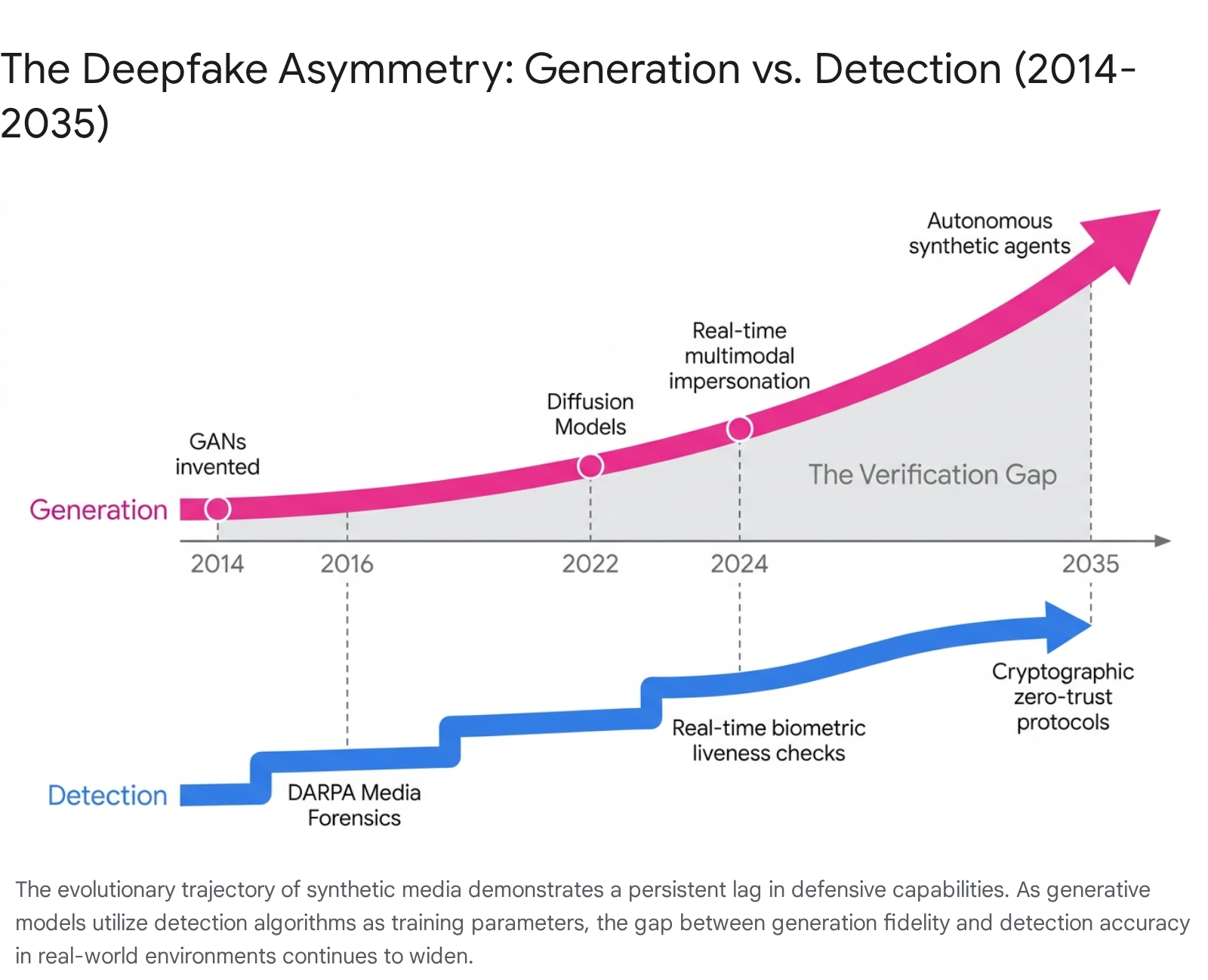
The modern deepfake era began in earnest in 2014 with the introduction of Generative Adversarial Networks (GANs), a framework that pitted a generator algorithm against a discriminator algorithm to iteratively improve synthetic outputs until the discriminator could no longer distinguish fake from real 6. By 2017, these tools had escaped academic laboratories and entered the public sphere, initially manifesting as non-consensual synthetic pornography and rudimentary political parodies shared across platforms like Reddit 89.
The leap from rudimentary face-swaps to hyper-realistic, real-time multimodal synthesis occurred with the advent of diffusion models and advanced voice cloning neural networks over the subsequent half-decade 61011. The turning point for enterprise risk materialized in early 2024, providing a chilling everyday hook that illustrates the modern synthetic threat. A finance employee at the multinational engineering firm Arup, based in Hong Kong, joined a routine video conference. On the screen appeared the company's Chief Financial Officer, flanked by several other recognized colleagues. The CFO issued an urgent, confidential directive to transfer funds. It was only after $25.5 million had been dispersed that the employee realized every participant on the call - save for themselves - was an AI-generated, real-time deepfake 2127.
This incident underscores a critical inflection point: synthetic media has definitively crossed the uncanny valley 1. The term "uncanny valley," coined by Japanese robotics engineer Masahiro Mori in the 1970s, describes the dip in human acceptance of near-human replicas; synthesized media has successfully bridged this gap, replacing initial human distrust with active acceptance 1. The visual and auditory cues that humans evolved to rely upon are now actively weaponized against them. Fraudsters no longer need extensive technical expertise or massive server farms; state-of-the-art voice cloning now requires merely 20 to 30 seconds of reference audio to effectively mimic pitch, timbre, and emotion 12. Convincing video deepfakes can be rendered in under 45 minutes using commercial, off-the-shelf software 2.
Consequently, the financial impact has been staggering, scaling exponentially year over year. Deepfake-related fraud increased by 1,740% in North America and 1,530% in the Asia-Pacific region between 2022 and 2023 212. The volume of voice deepfakes alone saw a 680% year-over-year rise in 2024, with major financial institutions reporting up to a 12x increase in deepfake activity targeting contact centers 114. Current economic models project that deepfake-enabled fraud will drive total fraud losses in the United States to an unprecedented $40 billion by 2027, severely impacting corporate operations, brand reputations, and global financial stability 8.
Why Are Current Detection Systems and Human Intuition Failing?
The core dilemma driving the synthetic arms race toward 2035 is structural asymmetry 2. Generating a deepfake is a localized, computationally manageable task designed to exploit specific visual or auditory vulnerabilities in human perception or single-point authentication systems. Detecting a deepfake, conversely, requires generalizing across an infinite permutation of potential synthetic artifacts, across diverse models that the detector may have never encountered in its training data 3. As each step forward in detection technology is published - such as the US Defense Advanced Research Projects Agency's (DARPA) Media Forensics and Semantic Forensics (SemaFor) programs - generators utilize those very detection models as loss functions to train superior fakes, creating a continuous loop of escalating sophistication 6.
The forensic landscape relies on three primary paradigms: artifact-based detectors that identify technical inconsistencies (e.g., unnatural blending boundaries or visual noise), behavioral detectors that analyze unnatural facial movements or speech prosody (e.g., viseme-phoneme mismatches), and provenance schemes 99. In highly controlled laboratory settings, these technologies perform exceptionally well. For example, Intel's FakeCatcher 3.0 platform demonstrated 99.7% detection accuracy on current-generation video content by utilizing biological signal detection - identifying the absence of subtle cardiovascular pulse signals in synthetic faces that authentic human faces naturally display 17.
However, operational deployment gaps are severe. Laboratory performance does not reliably predict real-world effectiveness due to profound distribution shifts 3. When state-of-the-art automated detection systems are confronted with "in-the-wild" deepfakes - those subjected to real-world compression, social media transcoding, adversarial cleaning, or generation by unseen "out-of-distribution" AI models - their accuracy routinely plummets by 45% to 50% 2310. Adversarial vulnerabilities are significant; even top-tier systems experience 15% to 25% accuracy degradation simply when content is processed through common platform transformations like uploading to a messaging app 3. More alarmingly, the human baseline ability to identify modern deepfakes hovers at a mere 55% to 60%, barely better than a random coin toss 2.
Can We Rely on Watermarking and Provenance Standards?
As synthetic media saturates the digital ecosystem, policymakers, media executives, and technology developers frequently point to "watermarking" as the ultimate, frictionless panacea. This represents a dangerous misconception that conflates an indicator of origin with a guarantor of authenticity 3. Watermarking - embedding imperceptible signals or metadata into generated content at the time of creation - is theoretically sound but practically fragile in open environments 34.
The primary vulnerability of digital watermarking is that it is fundamentally an opt-in system that relies on the cooperation of the generating platform. While responsible, highly regulated actors may dutifully embed metadata into their outputs, malicious actors utilizing customized, open-source models will intentionally bypass these protocols 3. Furthermore, post-generation watermarks are highly susceptible to adversarial attacks. Simple transformations - such as cropping an image, adding digital noise, compressing a video for distribution, or simply taking an analog screenshot of a digital display - can easily strip, corrupt, or bypass embedded metadata and watermarks 34.
The industry's most prominent and well-funded response to this challenge is the Coalition for Content Provenance and Authenticity (C2PA) 518. Supported by a massive industrial coalition, C2PA seeks to establish a standardized, interoperable framework for embedding cryptographic manifests into digital assets, tracking the chain of custody from the initial camera sensor to the final publishing platform 4518. The C2PA standard embeds signed manifests, hash-chained edit histories, and tamper-evident thumbnails directly into media headers, allowing browser-level verification interfaces to display "nutrition labels" for media 45.
However, rigorous independent security analyses have revealed that C2PA, in its current iteration, falls substantially short of its claimed security goals 18. A notable real-world failure occurred when the BBC utilized C2PA to verify a video, only to discover inconsistent timestamps - the metadata suggested a different creation time than the actual content, highlighting vulnerabilities in the framework's reliance on centralized time-stamping and off-chain data structures 4. Formal methods analyses indicate that relying prematurely on C2PA for high-stakes uses, such as financial disclosures, legal evidence, or critical journalism, may mislead users and policymakers by providing a false sense of security 18.
Therefore, the expectation that an end-user in 2035 will simply look for a "watermark" to effortlessly determine objective reality is fundamentally flawed. Detection and provenance must be viewed through a paradigm of "defense in depth" 3. No single detection approach is sufficient. Effective synthetic media governance requires an ensemble approach: deploying multiple classification models, requiring consensus for high-confidence categorization, incorporating non-content signals like account history and distribution networks, and implementing robust cryptographic provenance 317. Relying solely on metadata watermarks masks the deeper epistemological rot caused by synthetic saturation.
How Do Institutional Verification Frameworks Compare to Decentralized Networks?
The technological infrastructure deployed to verify digital reality by 2035 will fall into distinct architectural models, each attempting to balance the core trilemma of security, scalability, and trust. The central architectural debate centers on whether the source of truth should be mandated by institutional authorities or guaranteed by decentralized, cryptographic consensus 192021. As multi-cloud enterprise strategies mature, organizations face complex governance challenges for AI-powered data, demanding sophisticated approaches to maintain consistent security 2122.
The Institutional (Centralized) Framework relies heavily on trusted third parties (TTPs), such as major technology consortiums, government registries, or proprietary enterprise platforms 1922. In data governance, a centralized model features a central authority overseeing policies across the organization 22. This model is highly efficient, allowing for rapid updates, lower operational costs regarding transaction latency, and immediate, uniform policy enforcement 2123. For instance, multi-cloud enterprises utilizing centralized governance frameworks for AI report 73% higher confidence in their regulatory compliance status and experience 43% fewer cloud misconfigurations compared to decentralized approaches 21. However, institutional frameworks inherently create highly vulnerable single points of failure. If the central authority is compromised by hackers, exhibits structural bias, or yields to political pressure, the entire verification chain is invalidated or censored 192324.
Conversely, the Decentralized Framework leverages blockchain and distributed ledger technologies (DLT) to establish trust without a central arbiter. In this model, provenance metadata is anchored to an immutable blockchain via smart contracts 41920. This approach ensures that once a piece of content's origin is recorded, it cannot be retroactively altered, tampered with, or removed without leaving an immutable trace 4. Advanced projects utilizing decentralized architectures have demonstrated the ability to create durable audit trails by combining off-chain storage systems like IPFS with on-chain evaluation metadata minted as "trust badges" on networks like Polygon Amoy, completely avoiding the storage of personally identifiable information on the blockchain itself 19. The primary drawbacks of fully decentralized systems are latency, coordination complexity, transaction costs (gas fees), and the pervasive "oracle problem" - the challenge of ensuring that the data initially fed onto the blockchain accurately reflects the off-chain reality 192125.
| Feature / Capability | Institutional/Centralized Frameworks (e.g., Standard C2PA, Proprietary APIs) | Decentralized/Blockchain Frameworks (e.g., Web3 Provenance, ERC-7053) |
|---|---|---|
| Trust Model | Relies on Trusted Third Parties (TTPs); trust is vested in the governing organization 1922. | Trustless/Cryptographic; trust is vested in mathematical consensus and distributed ledgers 419. |
| Data Immutability | High, but vulnerable to server-level breaches, insider threats, or metadata stripping 423. | Absolute; recorded provenance cannot be retroactively altered without network consensus 419. |
| Scalability & Latency | High scalability; near-zero latency, ideal for real-time social media filtering 2325. | Historically lower, causing latency delays, though Layer-2 solutions and frameworks like Substrate/EOS are mitigating this 2526. |
| Censorship Resistance | Low; central authorities can revoke certificates or alter records based on policy or state pressure 2324. | High; distributed nodes prevent single entities from unilaterally removing provenance data 23. |
| Implementation Cost | Lower initial computational cost, but requires ongoing subscription or API maintenance fees 1923. | Higher initial implementation complexity; involves transaction costs depending on the consensus mechanism 1925. |
The optimal scenario for enterprise adoption by 2035 is widely considered to be a Federated Hybrid Model. In this system, standard institutional frameworks handle the immediate metadata embedding and user-facing browser warnings for high-throughput daily interactions, while critical, high-stakes media (e.g., legal evidence, journalistic source material, corporate financial disclosures) are simultaneously anchored to decentralized blockchains for long-term, immutable, and censorship-resistant preservation 42022.
How Are Global Jurisdictions Approaching Synthetic Media Regulation?
Technological frameworks are inert without the regulatory scaffolding required to enforce them. By 2035, the global landscape for synthetic media regulation will have fractured into deeply distinct geopolitical models. A comparative analysis of emerging regulations across the European Union, East Asia, and India reveals fundamentally different philosophies regarding innovation pacing, systemic risk, and state control over information 2728.
The European Union has established itself as the global vanguard of strict, risk-based regulation through the EU AI Act, which became fully enforceable regarding high-risk obligations in 2026 2729. The EU model categorizes AI systems into four distinct risk levels 2729. Unacceptable-risk systems, such as emotion recognition in workplaces and manipulative subliminal techniques, are banned entirely 2729. High-risk systems require fundamental rights impact assessments, rigorous cybersecurity standards, and continuous human oversight 2729. Crucially for synthetic media, the EU imposes strict transparency obligations on limited-risk systems: deepfakes and AI-generated media intended to inform the public must be explicitly labeled 2729. The EU enforces these rules through the European AI Office, wielding the most severe penalty structure globally: violations regarding prohibited practices can result in fines of up to €35 million or 7% of a company's global annual turnover 2930. Furthermore, the EU actively combats information manipulation through state-supported networks like the European Digital Media Observatory (EDMO) and the European Fact-Checking Standards Network (EFSCN), institutionalizing fact-checking as a core defense against foreign interference 1011.
In stark contrast, Japan has consciously adopted a "soft-law," innovation-first approach. The Japanese Act on Promotion of Research and Development and Utilization of AI-Related Technologies, passed in May 2025, operates as a fundamental law aimed at securing international competitiveness, economic development, and social well-being 3012341314. Unlike the EU's prescriptive, punitive prohibitions, Japan's AI Promotion Act establishes strategic frameworks, multi-stakeholder guidelines, and massive government investment in compute infrastructure, governed centrally by an AI Strategy Headquarters led by the Prime Minister 301213. Crucially, the Japanese act relies on voluntary compliance; it intentionally omits specific monetary penalties for non-compliance, seeking instead to avoid stifling technological development 123437. While a supplementary parliamentary resolution specifically urges the government to adopt stronger measures against the rise of sexual deepfakes, the overall national posture remains highly permissive, relying on existing frameworks like the Penal Code to manage extreme misuse 123438.
China represents the most assertive, state-controlled regulatory model in the APAC region. The Chinese approach explicitly ties AI governance to national security and socialist values. Through the Interim AI Measures Act and subsequent cybersecurity standardizations led by the Cyberspace Administration of China (CAC), China requires all AI platforms to undergo strict security self-assessments, register their algorithms with the state, and apply mandatory, explicit labeling to all AI-generated content 2829. Furthermore, service providers are held strictly accountable for the content created on their platforms, ensuring data and foundation models originate from state-approved sources, effectively outsourcing state censorship mechanisms directly to generative AI developers 28.
South Korea has aggressively targeted the output of synthetic media through the lens of liability and media control. Following political turmoil exacerbated by YouTube disinformation that spurred President Yoon Suk Yeol to declare martial law in 2024, South Korea introduced sweeping legislation imposing heavy punitive damages against traditional news and internet media for publishing false or fabricated information 15. Under these laws, courts can award damages up to five times the proven losses against organizations that disseminate illegal deepfakes that cause verifiable damage, and regulators can fine outlets up to 1 billion won for repeated offenses 15. This aggressive stance has raised profound concerns regarding press self-censorship and has drawn sharp criticism from the US administration over potential constraints on online freedom 15.
India approaches synthetic media regulation through a complex blend of data protection and specific technological mandates. While comprehensive AI laws are currently undergoing iteration, India utilizes the Digital Personal Data Protection (DPDP) Act to regulate the personal data used to train and execute models 28. Furthermore, India's Ministry of Electronics and Information Technology (MeitY) has introduced strict directives requiring mandatory labeling of synthetic content and prompt removal of deepfakes 29. These directives place significant, immediate compliance burdens on social media intermediaries, leveraging the threat of losing safe harbor protections to force rapid moderation of synthetic manipulation 2829.
| Jurisdiction | Primary Legislation & Frameworks | Regulatory Philosophy | Deepfake/Synthetic Media Stance | Enforcement Mechanisms & Penalties |
|---|---|---|---|---|
| European Union | EU AI Act (2024/2026) 2729 | Risk-based, human-rights-centric, pre-market regulation 2730. | Mandatory transparency; deepfakes must be clearly labeled for users 2729. | Very High. Fines up to €35M or 7% of global annual turnover 29. |
| Japan | AI Promotion Act (2025) 1213 | Soft-law, innovation & promotion-led, infrastructure focus 3013. | Supplementary resolutions address sexual deepfakes; relies on voluntary transparency 1234. | None specific to the AI Act; relies on existing Penal/Copyright codes 123437. |
| China | Interim AI Measures (2023), CAC Standards 28 | State-controlled, security-focused, content-restrictive 28. | Mandatory algorithm registration and strict explicit content labeling 2829. | High. Strict platform accountability; service shutdowns and administrative fines 28. |
| South Korea | AI Basic Act, Disinformation Bills 2915 | Liability-focused, aggressive content moderation, state intervention 15. | Heavy focus on curbing false news, synthetic likenesses, and political deepfakes 15. | Very High. Punitive damages up to 5x losses; fines up to 1 billion won 15. |
| India | DPDP Act (2023), MeitY Directives 2829 | Intermediary liability, data protection, reactionary mandates 28. | Mandatory labeling; platforms must rapidly remove reported deepfakes 29. | Moderate to High. Threat of losing safe harbor status for platforms; privacy fines 28. |
Is the Judicial System Prepared for Deepfakes in the Courtroom?
While policymakers debate national frameworks at the macro level, the immediate, pragmatic crisis of synthetic media is unfolding daily within the judicial system. The foundational premise of digital evidence - that a video or audio recording accurately captures reality - has been profoundly compromised. Courts are currently grappling with an epistemological crisis driven by two intertwined phenomena: the presentation of sophisticated deepfaked evidence as authentic, and the equally disruptive "liar's dividend," where parties baselessly claim that genuine, damning evidence is actually an AI-generated deepfake 1617.
The introduction of Generative AI into litigation has severe consequences for evidence authenticity, witness credibility, and the fundamental integrity of the judicial process. In a highly publicized UK child custody dispute, a mother submitted a heavily doctored audio recording to falsely portray the father as violent and threatening; the manipulation was only uncovered because the father's legal team was technologically aware enough to specifically hire experts to challenge it, prompting warnings that most judges would never suspect such material to be synthetic 18.
Conversely, the potency of the deepfake defense - the liar's dividend - has already been tested at the highest levels of corporate litigation. In a wrongful death lawsuit against Tesla, plaintiffs submitted a request for Tesla to admit the authenticity of a video wherein Elon Musk made statements about the safety of the Autopilot feature. Tesla's defense team refused to admit authenticity, arguing that Musk's public figure status made him the subject of many deepfake attempts. The court rightfully rejected this argument, unwilling to set a precedent where individuals could operate with impunity under the guise of synthetic deniability, noting that "Mr. Musk, and others in his position, can simply say whatever they like in the public domain" and then use the deepfake defense to avoid accountability 1718.
The legal system is attempting to adapt, primarily through the evaluation and amendment of evidence rules. Traditionally, under Federal Rule of Evidence (FRE) 901 in the United States, evidence is deemed authentic if there is a "sufficient basis" for a reasonable jury to find it is what the proponent claims - a historically low bar heavily reliant on extrinsic evidence like a witness recognizing a voice 1719. In response to the generative threat, the Advisory Committee on Evidence Rules has considered proposed Rule 901(c), specifically governing potentially fabricated or altered electronic evidence 1618. Under this proposed framework, if a challenging party can successfully demonstrate that a reasonable jury could find the evidence has been altered by AI, the burden shifts back to the proponent to prove that its probative value substantially outweighs the risk of unfair prejudice 161820.
However, this procedural shift introduces a secondary crisis: the explosion of litigation costs and delays 1618. Adjudicating these claims requires complex pretrial Daubert-like evidentiary hearings, relying heavily on advanced digital forensic tools and expert testimonies 1620. Because the current generation of AI-detection software is widely acknowledged by computer scientists to be unreliable and potentially biased in isolation, courts cannot simply run evidence through an automated scanner 1619. They must rely on highly compensated forensic analysts. Consequently, the proliferation of deepfakes threatens to price individuals out of the justice system entirely, as authenticating a simple piece of video evidence becomes a financially prohibitive battle of competing experts, ultimately eroding public trust in legal outcomes 161718.
How Do We Apply Calibrated Uncertainty to 2035 Synthetic Media Forecasts?
Forecasts regarding the future of artificial intelligence frequently suffer from a critical lack of "calibrated uncertainty." In the domains of machine learning and Bayesian statistics, a calibrated model is one where the confidence of its predictions perfectly aligns with the actual probability of the outcome - meaning a prediction made with 90% confidence should be correct exactly 90% of the time 452122. However, deep learning models, while highly accurate on in-distribution data, frequently fail to provide uncertainties that consistently reflect a lack of experimental evidence when presented with novel, out-of-distribution (OOD) data points, often displaying extreme overconfidence 454849.
This technical failure mirrors human forecasting. When analysts and institutions forecast the societal impact of AI by 2035, they often exhibit high epistemic uncertainty - uncertainty stemming from a lack of knowledge about future structural breakthroughs or unmapped societal reactions - yet they speak with unwarranted, deterministic confidence 50515253. They fail to distinguish between what technology could theoretically achieve and how complex socio-political systems, human behavior, and black swan events will actually integrate or reject it 5054. Recent studies evaluating Large Language Models (LLMs) used as "scientific forecasting agents" reveal that while AI can retrieve evidence and mimic the linguistic structure of probability, it often produces a "theater of uncertainty" rather than genuine probability calibration, struggling to align its confidence with actual realization paths 515223.
Therefore, applying calibrated uncertainty to 2035 requires discarding linear, deterministic predictions in favor of structured speculative media and scenario planning. Speculative scenario planning does not promise certainty; rather, it makes visible the structures, assumptions, and stakes that determine divergent paths, cultivating readiness for multiple potential realities 5024.
What Are the Plausible Scenarios for Trust by 2035?
To accurately map the landscape of 2035 without falling victim to uncalibrated overconfidence, we must rely on scenario planning based on two critical, intersecting uncertainties: the effectiveness of technological and regulatory policy, and the societal demand for verified information 2425.
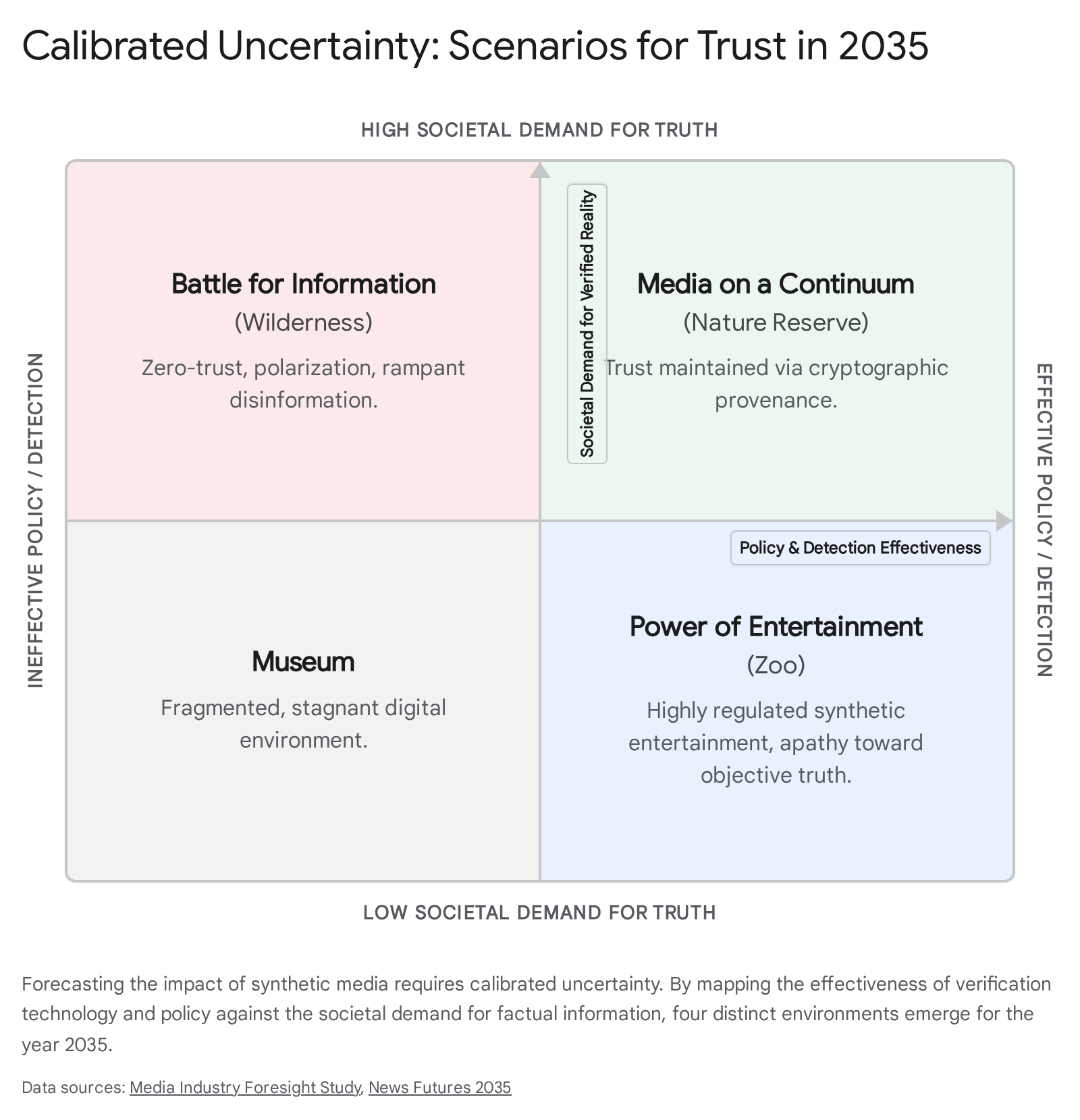
Based on comprehensive media foresight studies, four highly distinct environments emerge for the year 2035 2425:
Scenario 1: Media on a Continuum (The 'Nature Reserve') This scenario assumes that global regulations like the EU AI Act prove highly effective, and cryptographic provenance standards achieve ubiquitous, frictionless integration across all devices and platforms 2425. Deepfakes exist but are largely relegated to the margins of the internet or strictly categorized as entertainment. Institutional trust is maintained through a seamless, automated verification layer embedded in all major web browsers. Synthetically generated content is clearly, automatically labeled, and public media literacy acts as a robust secondary defense. Changes in the media industry align with historical expectations, prioritizing verified, public-interest news 2425. The primary vulnerability here is the assumption that highly fragmented global jurisdictions can effectively synchronize their technological standards.
Scenario 2: The Battle for Information (The 'Wilderness') In this scenario, detection technology fundamentally fails to keep pace with generative advancements, and regulatory efforts are either bypassed by decentralized open-source models or weaponized by authoritarian states 2425. The internet suffers a severe, continuous "content surge" of AI pollution and misinformation. Geopolitical crises are routinely exacerbated by hyper-realistic synthetic operations and targeted cognitive warfare. As a result, public trust in digital media collapses entirely 24. Citizens retreat into highly polarized, closed-network "echo chambers" where truth is defined solely by tribal affiliation rather than objective verification. The "liar's dividend" dominates all public discourse, as any inconvenient truth is easily dismissed as an AI fabrication 242526.
Scenario 3: Renaissance of Journalism (The Institutional Retreat) Operating under conditions of moderate technological failure but high societal demand for truth, this scenario sees a massive bifurcation in media consumption 24. The open internet is largely surrendered to synthetic noise, algorithms, and deepfakes. In response, a stark divide emerges: a "paywall elite" forms, comprising individuals and organizations who can afford high-quality, human-verified journalism and exclusive, closed-loop information networks 24. Blockchain-backed, zero-trust frameworks secure the communications of governments, major corporations, and premium media outlets, while the broader "digital precariat" is left to navigate an algorithmic landscape saturated with unverified, often manipulative synthetic content 24.
Scenario 4: The Power of Entertainment (The 'Zoo') Here, policy is highly effective but overly restrictive, protecting legacy technology and media providers while stifling open innovation 2425. The population is pacified by highly personalized, algorithmically generated synthetic entertainment that caters to every individual preference. The distinction between real and fake ceases to matter to the vast majority of the population, as synthetic media provides hyper-engaging, tailored, and addictive experiences 24. Objective truth is relegated below the value of entertainment; trust is no longer a metric of reality, but a metric of brand loyalty to the specific AI agents and platforms providing the content 2425.
The Bottom Line: Practical Takeaways for 2035 Readiness
The trajectory toward 2035 indicates that synthetic media will not merely complicate the digital landscape; it will force a foundational restructuring of how organizations, governments, and citizens process reality. The ongoing, asymmetric arms race guarantees that AI-generated audio and video will remain functionally indistinguishable from authentic media to the unaided human senses 12. Navigating this epistemological shift requires moving decisively beyond reactive, inherently flawed solutions like basic watermarking, and adopting proactive, multi-layered, and strategically calibrated defensive postures.
To prepare for this future, organizations must fundamentally alter their operational paradigms by adopting a zero-trust media posture across all communications. Institutions can no longer operate on the default assumption that visual or auditory evidence - even in live, real-time interactions - is inherently authentic. Enterprise security, particularly concerning high-stakes financial workflows, executive communications, and data governance, must mandate continuous, multi-factor cryptographic authentication 242259. If an executive issues a directive via a video conference, the video itself is entirely insufficient as verification; out-of-band authentication protocols must be rigidly enforced to prevent massive financial fraud.
Furthermore, reliance on single-point AI detection software must be abandoned in favor of defense-in-depth verification strategies. The data explicitly demonstrates that automated detectors degrade severely when facing novel generation techniques, adversarial cleaning, or standard platform compression 23. A robust verification ecosystem requires synthesizing multiple signals: anomaly detection algorithms, biological and behavioral biometric analysis, contextual platform monitoring, and rigorous cryptographic provenance protocols - such as integrating C2PA standards with decentralized, immutable blockchain ledgers for long-term preservation 34172022.
Global operations must also aggressively prepare for a highly fractured, multi-jurisdictional compliance landscape. A uniform global policy for synthetic media will not materialize by 2035. Multinational entities must engineer their AI deployment and communication workflows to adapt dynamically to deeply divergent regulatory environments 2728. Platforms operating globally will have to simultaneously satisfy the European Union's punitive, rights-based AI Act, China's strict algorithmic registry and explicit labeling mandates, South Korea's aggressive liability and punitive damage frameworks, and Japan's flexible, infrastructure-focused soft-law guidelines 2728291215. Failure to navigate this patchwork will result in severe financial penalties, loss of safe harbor protections, or outright operational bans.
Finally, the most sophisticated technological defenses will ultimately fail without the integration of the "human-in-the-loop." Automated detection models and cryptographic labels cannot interpret geopolitical context, societal satire, or the nuanced human intent behind a digital alteration 312. The most resilient and effective verification frameworks of the future will utilize artificial intelligence to filter noise and flag anomalies at massive scale, but will explicitly reserve final adjudication for highly trained human analysts capable of evaluating the broader implications of the media 312.
The future of trust does not depend solely on the impossible task of building a flawless deepfake detector. It depends entirely on engineering an information ecosystem where the authenticity of data is cryptographically secured at the point of origin, aggressively protected by dynamic, localized policy, and critically evaluated by a society that fully understands the inherent uncertainty of the digital realm.