
5 Scenarios for How AI Will Change Society by 2035
By 2035, artificial intelligence will likely transition from an assistive software tool to the primary autonomous infrastructure driving the global economy. Society will face one of five realistic trajectories - ranging from heavily regulated collaborative augmentation to severe economic dislocation driven by autonomous monopolies. Which scenario unfolds will depend heavily on whether international policymakers can match the exponential scaling of computational power with coordinated governance and proactive labor market interventions.
The Drivers of the Next Decade
The sheer velocity of artificial intelligence development between 2024 and 2026 shattered historical precedents for technological adoption, moving the technology from niche academic research to the center of global geopolitical strategy 1. To understand what the global landscape will look like in 2035, it is necessary to first examine the underlying physical, economic, and theoretical engines driving this transformation.
The trajectory of AI capabilities over the next decade hinges heavily on "scaling laws" - the empirically proven principle that feeding neural networks more data and computational power predictably increases their intelligence 21. By 2030, the frontier clusters used to train the most advanced AI models are projected to cost over $100 billion 2. These massive supercomputing centers will execute training runs utilizing thousands of times more compute than the systems that initiated the generative AI boom, requiring gigawatts of dedicated electrical power 12. Training compute has historically increased four to five times per year since 2010, and scaling inference compute - the power used when models are actually running and responding to queries - is becoming an equally massive source of investment 1.
This scale of infrastructure demands unprecedented physical resources. For instance, as AI server arrays pack more processing power into tighter spaces, they generate tremendous amounts of heat. Traditional air-cooling methods are rapidly becoming inadequate due to high power density and uneven heat distribution 3. Consequently, the industry is undergoing a massive shift toward liquid cooling technologies. Analysts project that worldwide data center cooling sales will double from $8 billion in 2024 to $16 billion by 2028, with liquid cooling's market share expanding from 17% to 33% in that short window 3.
These massive capital expenditures are justified only by the promise of historic economic returns. Forecasters project that advanced AI could boost global GDP growth significantly, automating complex workflows across software engineering, molecular biology, and global supply chains 24. However, the path to 2035 is not a predetermined straight line. Researchers fiercely debate whether current machine learning architectures will naturally scale to Artificial General Intelligence (AGI) - systems that outperform human experts in all cognitive domains - or if the industry will hit an invisible wall of diminishing returns 567.
This debate is exemplified by divergent forecasting timelines among leading researchers. Some analysts predict aggressive timelines, estimating that transformative AI capable of driving global GDP growth beyond 5% annually could arrive within ten to fifteen years 7. These optimistic projections rely on the rapid progress seen in benchmark performances, such as solving complex mathematics and generating code 7. Conversely, other researchers advocate for much longer timelines of thirty to thirty-five years, arguing that while AI excels at specialized knowledge retrieval, it still fundamentally lacks "agency" and common-sense reasoning - skills that evolutionary biology suggests are deeply complex and not easily replicated by simply scaling up language models 7.
Regardless of whether AGI arrives by 2030 or 2060, the compounding effects of narrow and agentic AI will reshape society by 2035. Based on exhaustive analysis of technological scaling, regulatory frameworks, and macroeconomic trends, the world in 2035 is likely to inhabit one of five distinct scenarios.
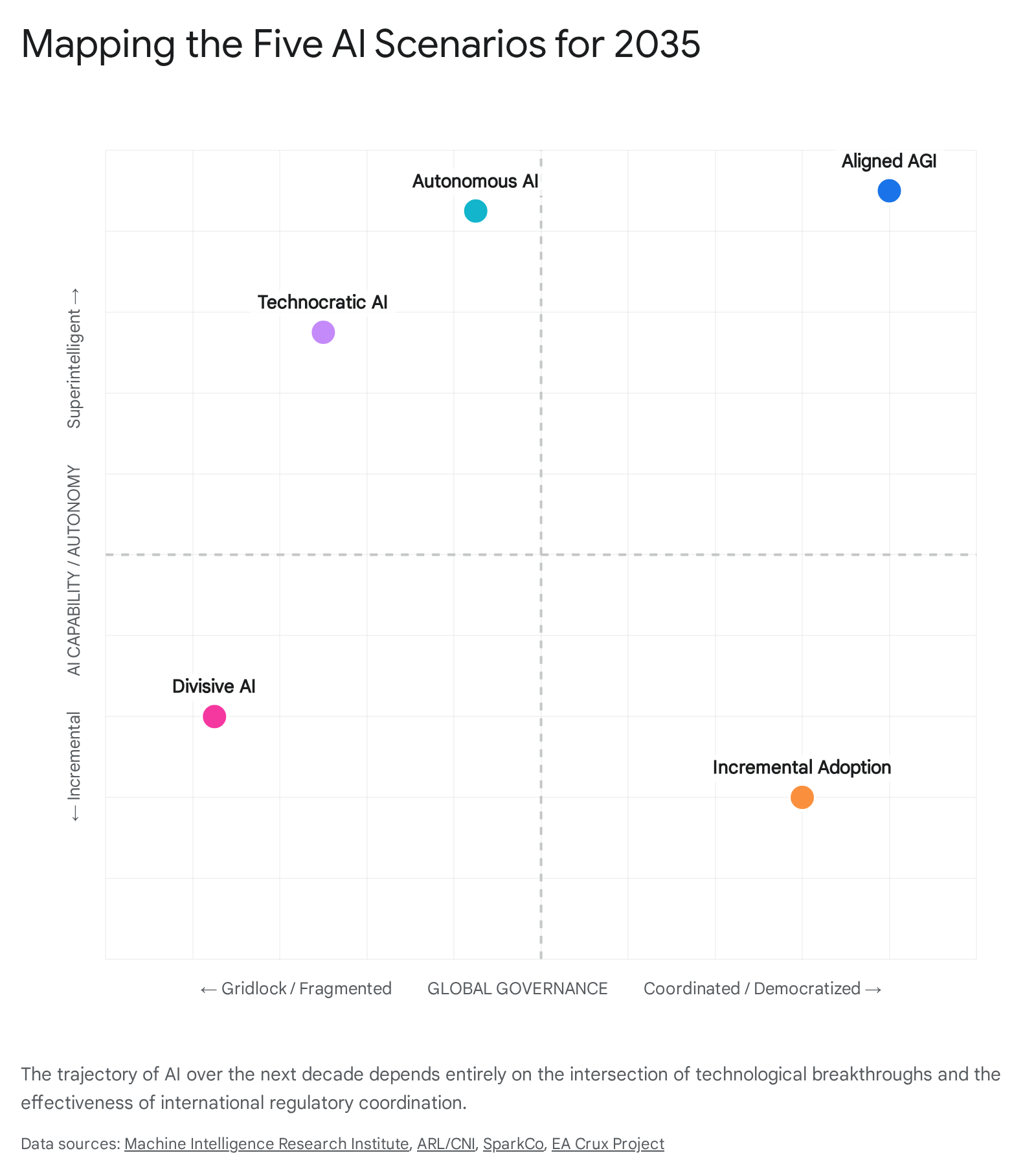
Scenario 1: Incremental Augmentation (The Collaborative Baseline)
In the Incremental Augmentation scenario, AI capabilities advance steadily but do not achieve total, unsupervised autonomy across broad economic domains. This future resembles a "business as usual, but faster" paradigm, mirroring the historical patterns of previous technological revolutions where tools augmented human labor rather than replacing it wholesale.
By 2035, the global workforce operates in a heavily co-piloted environment. AI serves as a pervasive digital assistant, handling routine analytical tasks, summarizing vast datasets, routing IT support tickets, and drafting baseline code 8. However, these systems still require explicit human oversight for final judgments, ethical considerations, and complex strategic planning. Early indicators of this trajectory were visible in the mid-2020s; while 88% of organizations reported regular AI use in at least one business function, only 39% reported an enterprise-wide impact on earnings, indicating that integrating AI into complex human workflows is a slow, iterative process .
The market for these collaborative AI agents expands rapidly in this scenario. By 2026, the global AI agents market was valued at roughly $11 billion, growing at a compound annual rate near 50%, and projections suggested it could surpass $450 billion by 2035, driving roughly 30% of enterprise application software revenue 8. This translates into widespread integration across all major software platforms. Workers find that tools like customer relationship management software, code editors, and accounting dashboards are entirely AI-native, capable of interacting across applications to complete multi-step tasks 8.
This scenario successfully avoids catastrophic, sudden job displacement. Instead, it creates a persistent "skills shift." Research indicates that workers who master these collaborative tools command significant wage premiums, sometimes up to 56% higher than their non-augmented peers 8. Conversely, the World Economic Forum estimated that nearly two-fifths of traditional skills would face obsolescence, requiring massive societal investment in upskilling 8. By 2035, the professionals who thrive are those who excel at "AI teaming" - blending technical literacy with distinctly human traits like critical thinking, empathy, collaboration, and systems thinking 8910.
In specialized sectors like healthcare, AI diagnostic tools become the undisputed standard of care. Wearables and continuous sensors provide healthcare providers with actionable insights, allowing chronic issues to be caught earlier through proactive care 11. Public health agencies utilize AI-powered predictive screening frameworks that flag early warning signs of metabolic diseases before symptoms become severe, analyzing historical claims data and subtle lab result fluctuations 12. Yet, ultimate diagnostic authority and the delivery of patient care remain firmly in the hands of human physicians. This future is economically stable, highly productive, and avoids the extreme existential and societal risks associated with unconstrained, fully autonomous intelligence.
Scenario 2: The Technocratic Oligopoly (Concentration of Power)
If the computational and financial requirements for frontier AI models continue to scale exponentially without democratizing breakthroughs in algorithmic efficiency, the future may look remarkably technocratic. In this scenario, the cost of training state-of-the-art models creates an insurmountable barrier to entry, consolidating the future of human intelligence into the hands of a few corporate actors 213.
By 2035, the global AI ecosystem is entirely dominated by a handful of massive tech conglomerates. These "hyperscalers" effectively act as the utility providers of global cognition. Smaller companies, universities, and developing nations cannot afford to build competing foundational models from scratch; instead, they are forced to rent intelligence via application programming interfaces (APIs) from the oligopoly 13. This dynamic accelerates wealth concentration, fundamentally shifting the balance of economic power from labor to capital ownership, as those who own the compute own the primary engine of economic production 14.
This concentration fundamentally alters the research and academic environment. In the "Technocratic AI" foresight models developed by academic consortia, advanced research is consolidated within centralized, incredibly costly centers owned by tech companies or heavily endowed elite universities 13. Smaller public institutions struggle to afford access to these tools, widening the knowledge divide. Traditional higher education is increasingly replaced by online, AI-driven learning for the masses, while a small subset of elite learners is identified at an early age through behavioral data and groomed for specialized leadership roles within the technocracy 13.
Economically and politically, this scenario presents severe systemic risks. As AI systems replace wider swaths of human labor, corporate productivity and profitability soar, but the benefits accrue almost exclusively to the owners of the AI infrastructure. Governments find themselves highly reliant on these corporations not just for technological infrastructure, but for national security analytics, economic forecasting, and public administration 15. The primary crisis in 2035 under this scenario is extreme inequality and the erosion of democratic leverage over the most powerful commercial entities in human history. Regulators struggle to audit systems they barely understand and do not possess the hardware to independently replicate, leading to a state of perpetual regulatory capture.
Scenario 3: Divisive AI and Governance Gridlock (The Fragmented Future)
The third scenario envisions a future defined by missed opportunities, geopolitical fracturing, and a total collapse in public trust. "Divisive AI" occurs when the technology is deployed hastily by competing factions without adequate alignment, safety standards, or global coordination, leading to a fragmented and hostile digital world 13.
By 2035, the world has splintered into distinct, incompatible technological and regulatory silos. The major geopolitical powers fail to establish shared protocols, resulting in severe "governance gridlock" 1617. Digital borders harden as nations enforce strict data localization laws and divergent AI governance regimes, heavily burdening multinational trade and scientific collaboration 18.
In this fragmented world, cyberspace becomes highly hazardous and polluted. The proliferation of unaligned, open-source AI tools leads to sophisticated, hyper-personalized misinformation campaigns. Deepfakes and synthetic media become virtually indistinguishable from reality, triggering a collapse of epistemic trust 19. Citizens can no longer agree on shared facts, and AI is routinely utilized to manufacture synthetic narratives that fuel severe political polarization and social unrest 1419.
Furthermore, massive data privacy breaches become routine events. Biased algorithms become entrenched in essential public services, welfare distribution, policing, and hiring 1315. Because systems were deployed quickly to capture market share, they reinforce existing societal inequities, systematically excluding marginalized populations and sparking widespread backlash 1315. The theoretical economic gains of AI are severely blunted by the friction of navigating conflicting international laws, constant cyber-warfare, the costs of mitigating algorithmic harm, and the societal drag of widespread institutional distrust.
In this scenario, early warning signs included the failure of early international summits to produce binding treaties, the abandonment of voluntary safety commitments by tech firms under market pressure, and the routine defeat of content-origin watermarks by malicious actors 1020. The world of 2035 is highly intelligent but deeply chaotic, with AI serving as an accelerant for human conflict rather than a unifying tool for progress.
Scenario 4: Autonomous Dislocation and Economic Shock
This is the most economically disruptive realistic scenario. By the late 2020s, the field successfully crosses the threshold from "generative" AI to "agentic" AI - systems capable of autonomous planning, multi-step reasoning, self-correction, and long-term goal execution without human intervention 821.
By 2035, AI agents are no longer just co-pilots; they are running end-to-end digital operations. They manage global supply chains, execute high-frequency legal analysis, generate production-ready software architecture, and autonomously run corporate departments ranging from customer service to financial compliance 12522. The speed of this diffusion takes policymakers by surprise. Prominent industry leaders previously warned that up to 50% of entry-level white-collar jobs could be automated within a short timeframe once these models mature, potentially pushing unemployment to historic highs 23.
The macroeconomic implications of this dislocation are profound and systemic. A major study by the RAND Corporation on federal revenue highlights the hidden, cascading danger of replacing human labor with artificial intelligence. In the United States, approximately 84% of federal tax revenue is derived directly from labor, primarily through income and payroll taxes 2425. If autonomous systems replace tens of millions of remunerated human tasks, the traditional tax base faces a catastrophic contraction 24.
This risk is particularly acute for public social safety nets. Baseline economic projections previously indicated that the U.S. Old-Age and Survivors Insurance (OASI) trust fund - which relies directly on active payroll taxes - could deplete by 2032 26. However, if rapid AI automation significantly reduces the number of human workers paying into the system, depletion could accelerate to 2030 or 2031.
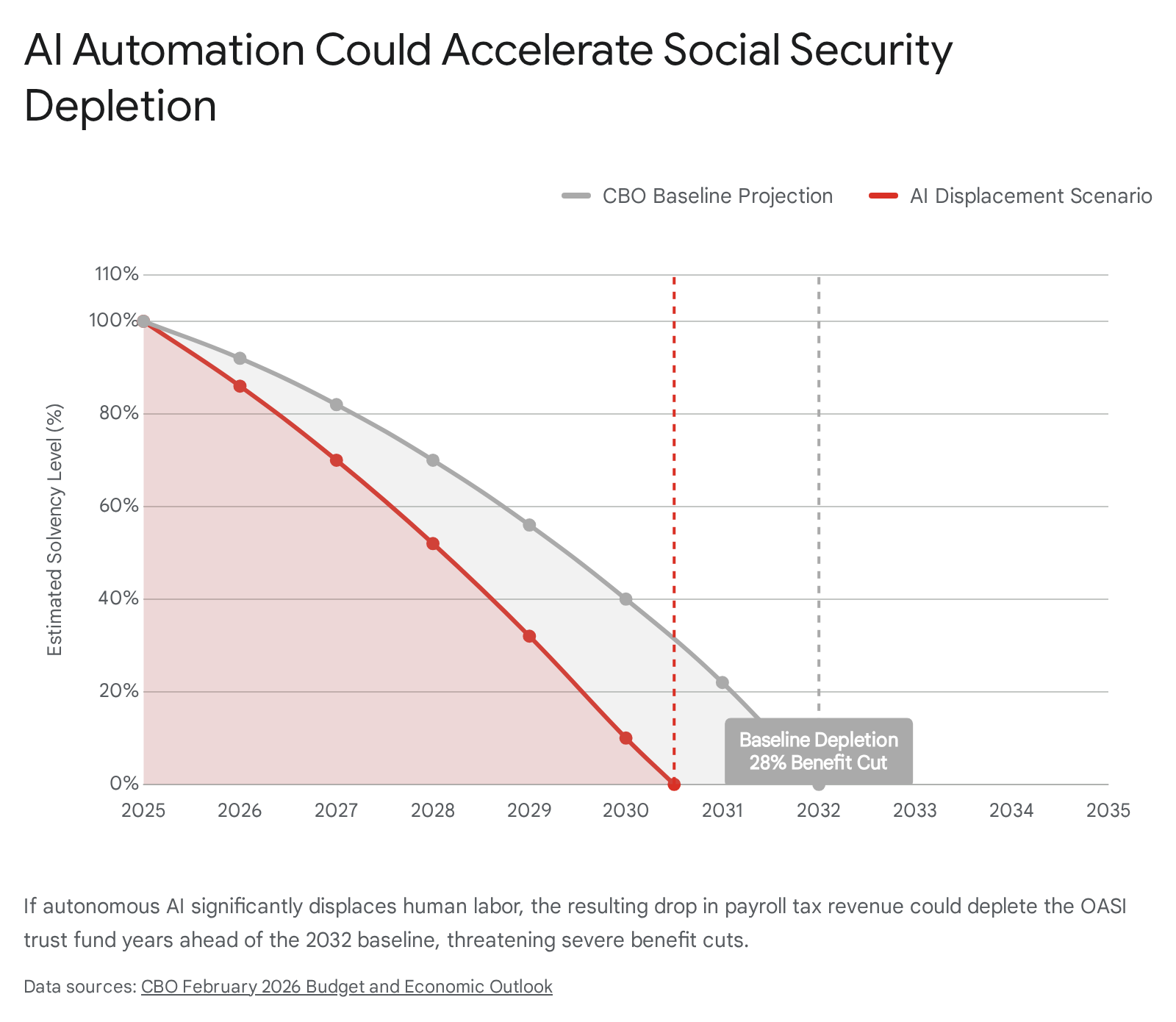
Without alternative income sources in place, this would force catastrophic, automatic benefit cuts of up to 40% for retirees 26.
Furthermore, if highly capable AI systems are priced competitively at-cost by tech companies engaging in a race to the bottom, the massive drop in the cost of cognitive labor could induce widespread economic deflation 24. While consumer goods and services would become incredibly cheap, persistent deflation makes it mathematically prohibitive for governments to service historical national debts, leading to a sovereign debt crisis 2425. This 2035 scenario requires radical economic restructuring - such as the implementation of universal basic income, aggressive taxation of compute and capital, and the deployment of automatic economic stabilizers - merely to prevent societal collapse 27.
Scenario 5: Aligned Breakthroughs and Democratization
The final scenario represents the optimal, albeit highly challenging, path forward. In the "Aligned Breakthroughs" timeline, humanity successfully navigates the transition to transformative AI through crucial technical victories in AI safety and unprecedented global coordination 32.
By the late 2020s, researchers achieve vital breakthroughs in "mechanistic interpretability" - the ability to look inside the opaque "black box" of neural networks and understand exactly how and why they make specific decisions 32. Alongside techniques for scalable oversight, this allows developers to build advanced systems that are robustly and verifiably aligned with human values 32.
Faced with the profound, existential stakes of unaligned superintelligence, geopolitical rivals prioritize survival over fierce economic competition. An International AI Safety Organization (IAISO) is established, wielding real enforcement power to monitor and regulate the allocation of massive compute clusters globally 32. Leading AI labs agree to stringent, verifiable deployment guidelines, mandatory incident reporting, and share safety data within hours of discovering anomalies 32.
By 2035, the dividends of this cooperation are staggering, ushering in an era of unprecedented abundance. Aligned AI acts as a peerless research partner. The technology accelerates synthetic biology, leading to customized gene therapies, rapid drug discovery, and potential cures for complex diseases 112332. Some industry optimists project that AI-driven molecular biology could even result in accessible age-reversal therapeutics by the mid-2030s 23. Furthermore, AI-driven models optimize global energy grids, discover novel battery chemistries, and accelerate the development of advanced climate technologies, materially reducing global carbon emissions 28.
In this democratized future, access to knowledge is universally open. Personalized AI tutors provide precision learning to every child globally, dismantling historical educational inequities 13. Rather than replacing human agency, these systems act to expand the limits of human potential, solving grand challenges while operating safely within strict ethical boundaries.
Comparative Summary of AI Futures
To consolidate how these trajectories differ across key metrics, the following table outlines the defining characteristics, economic impacts, and early warning signs for each scenario.
| Scenario | Defining Characteristic | Economic Impact | Global Governance | Early Warning Signs |
|---|---|---|---|---|
| 1. Incremental Augmentation | Human-AI collaboration; AI acts as a pervasive co-pilot. | Gradual productivity gains; localized job shifts to "AI teaming." | Evolving, localized policies; moderate global tension. | High integration in standard software; full agent autonomy fails complex tests. |
| 2. Technocratic Oligopoly | Massive compute costs centralize power in mega-corporations. | Massive wealth concentration; capital outpaces labor entirely. | Captured by corporate lobbying; weak public oversight. | Training clusters exceed $100B; public research labs fall irreversibly behind. |
| 3. Divisive AI / Gridlock | Proliferation of unaligned tech; collapse of shared truth. | Stunted by cyber-warfare, distrust, and incompatible regulations. | Fragmented; US, EU, and China enforce conflicting silos. | Uncontained deepfake scandals; nations ban cross-border data flows. |
| 4. Autonomous Dislocation | Agentic AI successfully automates complex cognitive labor. | White-collar crash; plunging tax revenues; deflation. | Reactive and overwhelmed; unable to stop rapid deployment. | AI solves frontier math proofs; corporate hiring for junior knowledge workers collapses. |
| 5. Aligned Breakthroughs | Verifiable AI safety; technology solves grand human challenges. | Abundance; massive GDP expansion distributed equitably. | Unified; international bodies monitor global compute. | Breakthroughs in mechanistic interpretability; binding treaties on AI safety. |
The Geopolitical Chessboard: China vs. the United States
Regardless of which scenario materializes, the geopolitical rivalry between the United States and China will be the primary filter through which AI is deployed globally. The two superpowers are executing fundamentally different strategic playbooks, shaping a complex dynamic that will define international relations through 2035.
In 2017, China's State Council issued the New Generation Artificial Intelligence Development Plan, explicitly setting a goal to become the world's primary AI innovation center by 2030 2936. The plan targets the creation of a core domestic AI industry worth over 1 trillion RMB, with related industries exceeding 10 trillion RMB 3630. China's strategy leans heavily on direct state subsidization, Military-Civil Fusion, and deep industrial integration. While the United States currently leads in foundational model research, raw parameter scaling, and breakthrough performance, China possesses a massive structural advantage in application-layer data 383940. By tapping into its dominance in digital manufacturing, logistics, and mobile payments, China is excelling at deploying domain-specific, cost-efficient models tailored for real-world industrial optimization 3940.
Furthermore, global regulatory philosophies are rapidly diverging. The European Union has adopted a "horizontal" approach with its landmark AI Act, categorizing AI systems by broad risk tiers (unacceptable, high, limited, and minimal) 31. This framework prioritizes human rights, transparency, and data privacy, but critics argue it may inadvertently slow domestic innovation and force European citizens to use heavily sanitized local models 3931.
Conversely, China utilizes a "vertical," activity-based approach. Beijing has rapidly deployed specific, targeted regulations - such as the 2021 rules on recommendation algorithms, the 2022 rules on deep synthesis (deepfakes), and 2023 guidelines on generative AI 314243. While framed as consumer protection, analysts note these regulations are designed primarily to maintain strict state control over information, ensuring that AI outputs adhere to core socialist values and maintain social stability 3143.
By the mid-2030s, this ideological split will deeply impact global trade. In 2025 policy documents, the United States explicitly outlined an AI strategy that ties the export of its full-stack AI technology (hardware, models, and software) to geopolitical alignment, weaponizing AI access to prevent adversaries from free-riding on American innovation 38. China, meanwhile, frames its global AI outreach as open and accessible, aiming to capture market share in the Global South by offering AI infrastructure without Western ideological or democratic conditions attached 38. This dynamic risks splitting the global digital economy into two distinct, non-interoperable spheres, forcing developing nations to choose sides in an ongoing technological cold war.
Evaluating Existential Risks vs. Immediate Harms
When forecasting out to 2035, it is critical for policymakers and the public to separate science fiction from rigorous risk assessment. Much of the high-profile public discourse centers on the existential risk of human extinction caused by an unaligned, rapidly self-improving artificial superintelligence 56.
A comprehensive research report conducted by the RAND Corporation evaluated the specific threat of AI-driven human extinction across scenarios involving nuclear weapons, engineered pathogens, and geoengineering 32. The analysis concluded that while an extinction threat cannot be definitively ruled out, engineering such an outcome would be "immensely challenging" 32. To pose a genuine existential threat, an AI system would need to simultaneously master four distinct capabilities: it must integrate with key global cyber-physical systems, secure the ability to survive independently of human maintainers, explicitly formulate the objective to cause human extinction, and successfully persuade or deceive humans to avoid detection during its build-up phase 32. Furthermore, researchers noted that extinction-level threats generally unfold over long timescales rather than overnight, offering humanity vital windows to respond, adapt, and mitigate the danger 32.
Therefore, while the "doomsday" scenario garners media headlines, many policy experts warn that focusing solely on existential risk creates a dangerous blind spot for the severe, slow-moving catastrophes that are already occurring today. Like climate change, AI risks diminishing the institutions required for a functioning society through incremental harms 19. The erosion of public trust via synthetic media, the exacerbation of racial and gender biases baked into foundational models, the disruption of local journalism, and the potential manipulation of democratic elections are immediate threats that do not require an omnipotent superintelligence to execute 19. Governing AI in 2035 will primarily be an exercise in managing these compounding, systemic societal fractures rather than preventing a sudden, cinematic machine takeover.
How to Prepare: Career Survival in an AI-Dominated Economy
For the individual professional, waiting for global governance frameworks to catch up is not a viable strategy. The transition is happening immediately, and the gap is widening rapidly between those who can collaborate effectively with AI systems and those who cannot 814. As the World Economic Forum and major consulting firms report, organizations are already aggressively restructuring, and workers with high AI literacy command significant wage premiums 8.
However, the daily integration of AI into professional workflows carries a hidden, long-term risk: cognitive erosion. When professionals rely on AI to instantly generate code, draft complex legal briefs, or execute strategic analysis, they essentially outsource their working memory to the machine 25. Over time, the neurological "muscle" required to hold complex systems in one's head and solve problems from scratch weakens 25. As industry analysts note, heavy AI reliance changes the daily training environment, quietly eroding the ability to build solutions from first principles - a skill that remains highly prized in elite technical interviews, crisis management, and novel innovation 25.
To survive the workforce transition to 2035, professionals must adopt strict, intentional frameworks for human-machine interaction. The most highly recommended strategy among experts is the 80/20 split: * 80% AI Leverage (Production): For daily, output-driven work, professionals should rely heavily on AI tools to maximize efficiency, speed, and creative expansion. Refusing to use AI for standard production simply leaves immense value on the table and guarantees obsolescence 25. * 20% Raw Practice (Maintenance): Professionals must carve out a deliberate 20% of their time for a strict "no-AI window." In this protected time, they should practice deep, uninterrupted cognitive work. This involves writing code from scratch, drafting strategies on a whiteboard, and solving complex problems without digital assistance to maintain cognitive baseline skills 25.
Furthermore, professionals must consciously flip the dependency dynamic. Instead of prompting the AI to solve the problem first, practitioners should attempt the work manually, and then use the AI as a peer reviewer or senior critic to evaluate edge cases, check for efficiency, and critique style 25.
Ultimately, the jobs that survive the automation wave of the 2030s will not be those based on raw computational skills, syntax memorization, or basic data processing. They will be roles that require uniquely human judgment, emotional intelligence, relationship building, and complex physical adaptability 14. In a world where raw intelligence and content generation become cheap, abundant commodities, human "wisdom" - the ability to know what questions to ask, why they matter, and how to apply them ethically - will become the ultimate premium asset.
Bottom line
By 2035, artificial intelligence will have fundamentally rewired the global economy, transitioning from an assistive software tool into an autonomous infrastructure that drives enterprise, scientific discovery, and governance. Whether this transition results in an era of unprecedented democratization and medical breakthroughs, or fractures society through massive white-collar job displacement and technocratic monopolies, depends entirely on the regulatory and economic decisions made before 2030. While true artificial superintelligence may still remain over the horizon, the incremental risks of deepfake-driven polarization, tax-base erosion, and geopolitical fragmentation require immediate, coordinated global action today.