
Flow State and Peak Cognitive Performance in Elite Athletes
Neurobiological Frameworks of the Flow State
The phenomenon of the athletic flow state is defined objectively as a condition of optimal experience characterized by complete task absorption, a perception of effortlessness, altered time processing, and a transient loss of self-consciousness 112. Modern cognitive neuroscience has transitioned away from relying exclusively on subjective self-report tools, such as the Dispositional Flow State Scale, toward mapping the distinct neural correlates that govern this state. Current research indicates that flow relies on a highly orchestrated interplay of large-scale cortical networks, specific frequency oscillations, and neurochemical modulations.
Network Reconfiguration and Transient Hypofrontality
For over a decade, the dominant neurological model for understanding the flow state was the Transient Hypofrontality Hypothesis (THH). The THH posited that optimal task execution requires a temporary, widespread downregulation of the prefrontal cortex (PFC), allowing implicit, automated sensorimotor systems to execute complex actions without the computational overhead of conscious, explicit executive oversight 356. While this model explains the loss of self-consciousness, high-resolution neuroimaging studies suggest a more complex, network-level reconfiguration rather than blanket hypofrontality.
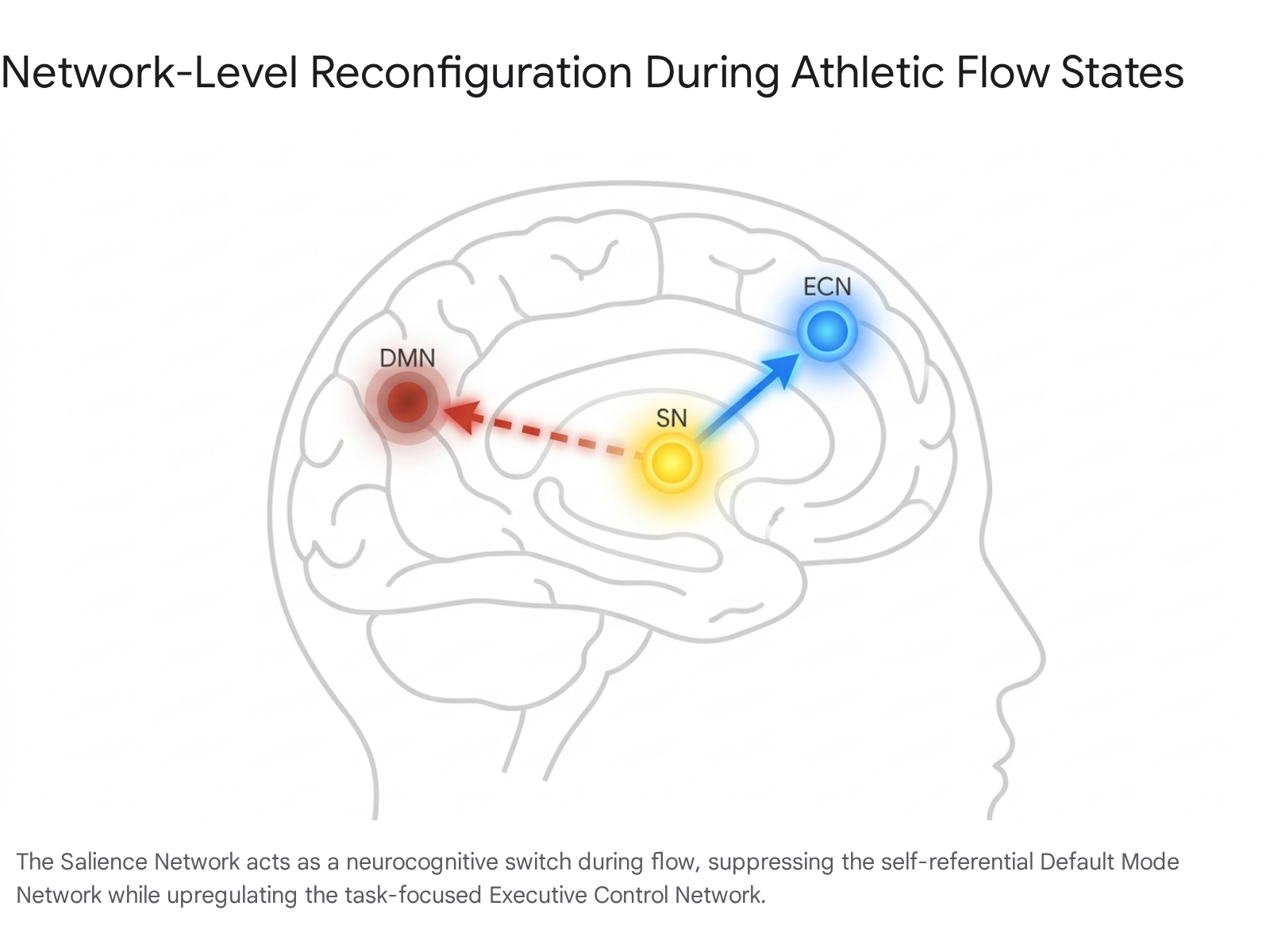
Evidence indicates that flow is regulated via Menon's triple network model, which encompasses the Default Mode Network (DMN), the Executive Control Network (ECN), and the Salience Network (SN) 45. During a flow state, the Salience Network acts as a neurocognitive switch. It significantly downregulates the DMN, particularly the medial prefrontal cortex (mPFC) and posterior cingulate cortex, which are responsible for self-referential thought, rumination, and internal criticism 136. Simultaneously, the SN upregulates the ECN, specifically engaging the dorsolateral prefrontal cortex (DLPFC) and the anterior insula, enabling hyper-focus and advanced cognitive control 310.
This targeted suppression yields measurable psychological benefits. Longitudinal research links high flow proneness with significant reductions in psychopathology, including a 16% reduced risk of depression, a 16% reduction in anxiety, and a 15% lower risk of schizophrenia 6. To reliably trigger this specific neural state, sports psychologists emphasize the "4% rule," which dictates that an activity's challenge should exceed the athlete's current skill level by roughly 4% 7. A task that is too easy reactivates the DMN, resulting in boredom; a task that is too difficult overstimulates the amygdala, resulting in performance-inhibiting anxiety 67.
Neural Efficiency Versus Neural Proficiency
Closely related to flow is the study of how elite athletes process sport-specific cognitive tasks over long-term development. The Neural Efficiency Hypothesis (NEH) proposes that as psychomotor skills reach expertise levels, task execution becomes automated, leading to a measurable decrease in overall cortical activation 89. Meta-analyses of electroencephalography (EEG) and functional magnetic resonance imaging (fMRI) data indicate that expert athletes typically exhibit lower frontal midline (Fm) theta power and reduced bilateral occipital lobe recruitment compared to novices 614.
This efficiency has been documented across various sports. For instance, electrophysiological studies on table tennis athletes demonstrate significantly lower event-related potential (ERP) amplitudes in the P2, N1, and N2 components during visuospatial tasks 9. This reduction implies that elite athletes process complex perceptual stimuli with less cognitive strain, optimizing brain resource use and minimizing metabolic fatigue 910.
However, the NEH is contested in contexts requiring dynamic, open-skill decision-making. The Neural Proficiency Hypothesis posits that elite athletes do not simply experience blanket reductions in brain activity; rather, they allocate neural resources with extreme precision. In tasks involving deception identification (such as a soccer player predicting a fake pass), expert athletes display significantly greater activation in the action observation network, the inferior parietal lobe, and the inferior frontal gyrus compared to less-skilled counterparts 810. This suggests a highly specialized utilization of neural circuits rather than a universal deactivation.
| Cognitive Framework | Core Mechanism | Primary Cortical Signatures | Context of Application |
|---|---|---|---|
| Transient Hypofrontality | Deactivation of the prefrontal cortex bypassing explicit self-monitoring. | Reduced activation in mPFC and self-referential executive regions. | Intense, continuous psychomotor immersion and flow states. |
| Neural Efficiency | Automation of skills resulting in reduced metabolic and cognitive strain. | Decreased Fm theta power; reduced overall cortical recruitment. | Highly practiced, predictable, closed-skill tasks. |
| Neural Proficiency | Targeted recruitment of highly specialized networks to solve complex problems. | Increased activation in the action observation network and ECN. | Complex, open-skill decision-making and deception anticipation. |
Electroencephalographic Signatures of Optimal Experience
Objective measurements of optimal cognitive performance using EEG have identified reliable frequency band signatures associated with flow. As an individual enters a flow state, there is a marked increase in frontal theta activity (4 - 7 Hz), which is typically associated with working memory engagement and concentration 71611. Concurrently, there is an increase in moderate alpha power (8 - 12 Hz) in the frontal and right-central areas, reflecting sensory gating and the inhibition of task-irrelevant information 71612.
Conversely, beta wave activity (13 - 30 Hz), which indicates active, conscious overthinking, drops significantly during peak performance 712. Advanced frequency correlation analysis further reveals that optimal task engagement enhances alpha-theta cross-frequency coupling, establishing a precise neuroelectrical equilibrium between relaxed readiness and focused effort 19. These frequency band signatures differentiate flow from similar states; for example, boredom is characterized by a distinct increase in parietal alpha and DMN activation, while cognitive overload is marked by hyperactive frontal beta without corresponding alpha synchronization 312.
Neurochemical Drivers and the Challenge-Skill Balance
Neurochemically, the athletic flow state is driven by a potent, synergistic cascade of catecholamines. High-level task engagement triggers dopaminergic activity in the nucleus accumbens 5. This dopamine release serves a dual purpose: it suppresses central fatigue mechanisms, allowing athletes to maintain relentless focus over extended periods, and it provides an intrinsic reward loop that makes the flow experience autotelic (rewarding in and of itself) 57.
Simultaneously, the brain's locus coeruleus regulates the release of norepinephrine. Norepinephrine dictates central arousal levels. During flow, norepinephrine concentrations are maintained within a narrow, optimal window that enhances vigilance and pattern recognition speed without spilling over into the acute stress responses mediated by the amygdala 520. This chemical cascade fundamentally lowers the brain's signal-to-noise ratio, enhancing the processing of task-relevant stimuli 20.
Physiological Mechanisms of Cognitive Enhancement
While transient flow states govern real-time athletic execution, the foundational cognitive capacity required to achieve such states is highly dependent on long-term physical conditioning. Research into neuroplasticity indicates that the physiological mechanisms driving synaptic adaptation differ significantly between systemic aerobic exercise and targeted computerized cognitive training.
Aerobic Exercise and the FNDC5-Irisin-BDNF Pathway
Aerobic exercise (AE) induces widespread structural and functional neuroplasticity through complex endocrinological pathways. Sustained cardiovascular exertion stimulates skeletal muscle tissue to upregulate the expression of fibronectin type III domain-containing protein 5 (FNDC5) 131415. FNDC5 is subsequently cleaved to release the myokine irisin into the peripheral bloodstream. Irisin crosses the blood-brain barrier, triggering a robust upregulation of Brain-Derived Neurotrophic Factor (BDNF) within the hippocampus 1314.
BDNF acts upon its primary receptor, Tropomyosin receptor kinase B (TrkB), to promote neurogenesis, enhance synaptic plasticity, and increase cerebral vascularization 131617. Preclinical animal models utilizing senescence-accelerated mice (SAM-P8) demonstrate that activation of the FNDC5/Irisin/BDNF pathway via treadmill running directly mitigates age-related cognitive decline, increasing spatial memory and object recognition capabilities 1314. In human meta-analyses, moderate-to-vigorous aerobic exercise correlates strongly with expanded hippocampal volume and decreased rates of neuronal apoptosis 16. Furthermore, high-intensity interval training (HIIT) elicits an even more pronounced acute BDNF and lactate response compared to moderate steady-state exercise, providing rapid neuroplastic priming 17. Notably, genetic variables such as the BDNF Val66Met polymorphism can modulate an individual's neurotrophic response to exercise, indicating a genetic basis for exercise-induced cognitive enhancement 17.
Synergies with Computerized Cognitive Training
In contrast to the systemic neurochemical flooding caused by aerobic exertion, computerized cognitive training (CCT) promotes neuroplasticity through localized, use-dependent functional connectivity enhancements. Task-based fMRI studies demonstrate that sustained CCT increases connectivity within the frontoparietal networks and alters resting-state functional connectivity within the Default Mode Network, reinforcing the neural scaffolding required for specific executive tasks 1827.
When evaluating clinical efficacy, research shows that AE predominantly enhances generalized neuroplasticity and mitigates systemic stress, often measured by significant reductions in salivary cortisol levels 1920. CCT, conversely, drives targeted improvements in working memory, processing speed, and localized brain efficiency 1920. Multimodal interventions combining aerobic exercise with targeted cognitive training (COMB) consistently yield the most robust cognitive adaptations. The COMB approach generates a synergistic effect: AE primes the brain's neuroplastic potential by elevating systemic BDNF, while CCT guides that plasticity to strengthen specific executive networks 152719.
| Training Modality | Primary Physiological Mechanism | Core Cognitive Outcomes | Systemic vs. Localized Impact |
|---|---|---|---|
| Aerobic Exercise (AE) | FNDC5/Irisin/BDNF pathway; cardiovascular angiogenesis. | Increased hippocampal volume; generalized memory retention; stress mitigation. | Highly systemic; widespread endocrinological and neurotrophic changes. |
| Cognitive Training (CCT) | Use-dependent synaptic strengthening; functional connectivity modulation. | Enhanced working memory; specific executive function improvements. | Localized; targets specific neural circuits (e.g., frontoparietal networks). |
| Combined (COMB) | Synergistic integration of BDNF upregulation with targeted synaptic use. | Maximum protection against cognitive decline; robust executive functioning. | Integrated; systemic neurochemical priming supporting targeted neural scaffolding. |
Technological Measurement in Ecological Settings
The transition of cognitive and physiological monitoring from strictly controlled laboratory environments to dynamic, real-world sporting arenas relies entirely on rapid advancements in wearable biosensor technology.
Advancements in Wearable Electroencephalography
Traditional clinical-grade EEG setups require Faraday cages to isolate signals from electrical noise, extensive participant immobility, and the application of 32 to 256 wet electrodes 1630. The average setup time for wet systems is roughly 12 minutes, though it can exceed 19 minutes depending on the montage, rendering naturalistic sports monitoring nearly impossible 30.
The advent of dry-electrode wearable EEG headsets and in-ear systems has profoundly altered field research capabilities. Modern dry electrodes utilize ultra-high impedance amplifiers (>47 GOhms) capable of handling contact impedances up to 1-2 MOhms, successfully capturing signals through hair without skin preparation 30. Consequently, setup times for dry EEG headsets average just 4.02 minutes 30. Portable technologies integrated into headphones or headbands (e.g., Muse 2) demonstrate substantial agreement with clinical polysomnography (PSG) in detecting basic sleep architecture and cognitive states 3021.
By coupling these wearable sensors with machine learning architectures, researchers can objectively measure athletic cognitive states in real-time. For example, utilizing the EEGNet deep learning model alongside frontal theta and alpha band inputs, researchers have achieved 65% accuracy in classifying the mental states of participants (boredom, flow, overload) during tasks 16.
Artifacts and Limitations of Field-Based Biometrics
Despite the democratization of neurophysiological data, wearable applications in elite sports face significant technical and methodological limitations.
First, dry electrodes are exceptionally susceptible to motion artifacts generated by sweating and biomechanical impact during athletic movement 3021. Correcting these artifacts requires aggressive algorithmic filtering, which risks inadvertently discarding genuine neural data. Second, commercial headbands suffer from topographical constraints, typically featuring only forehead montages. While adequate for capturing the frontal theta activity indicative of executive load, they are largely blind to the temporal and parietal brain regions, precluding comprehensive neural network analysis 21.
Finally, a major barrier in sports science is algorithmic opacity. Many consumer-grade wearables operate using proprietary "black-box" algorithms to compute indices like Heart Rate Variability (HRV) or sleep staging. Because researchers often cannot access raw, unfiltered data, independent scientific validation is restricted, making it difficult to aggregate physiological findings reliably across different studies or device models 22.
Biomarkers of Autonomic Regulation and Affect
In addition to EEG, sports scientists increasingly utilize photoplethysmography (PPG) and HRV to monitor the autonomic nervous system's response to training loads. HRV analysis can differentiate between an athlete's states of positive and negative affect. Interestingly, while standard HRV metrics adequately track overall physiological recovery, they often fail to distinguish between high-arousal positive affect (HAPA) and low-arousal positive affect (LAPA) 23.
During flow states, researchers have documented a distinct U-shaped characteristic in HRV, reflecting a dynamic balance between sympathetic task engagement and parasympathetic emotional regulation 34. Combining motion tracking, HRV, and EEG data offers a multi-modal digital biomarker profile, providing coaches with real-time feedback on an athlete's cognitive readiness and systemic fatigue.
Methodologies in Elite High-Performance Institutions
The application of cognitive conditioning and physiological monitoring is highly centralized within state-funded high-performance sports institutes globally. These organizations utilize multi-million-dollar budgets to deploy bespoke training methodologies tailored to international competition.
Data Integration and Virtual Simulation at INSEP
In preparation for the Paris 2024 Olympic and Paralympic Games, the French National Institute of Sport, Expertise, and Performance (INSEP) integrated cognitive and physiological data at an unprecedented scale. Funded by a €20 million government priority research program targeting ultra-high performance, INSEP launched several advanced technological initiatives 352425.
To circumvent the limitations of wearable field data collection, INSEP developed the REVEA project, an immersive Virtual Reality (VR) initiative designed to optimize perceptual-motor sub-skills in combat sports 352426. Relying on 3D kinematic tracking, REVEA allows Olympic boxers to spar against virtual avatars governed by deep reinforcement learning algorithms. By analyzing historical video footage, the artificial intelligence perfectly replicates the biomechanical tells, movement cadences, and strategic patterns of real-world Olympic opponents 26. This enables targeted cognitive conditioning, allowing athletes to hone their decision-making and anticipation speed without incurring the physical damage of continuous sparring.
Furthermore, INSEP developed PerfAnalytics, a video analysis suite used to quantify kinematic performance indicators, and Paraperf, a project dedicated to utilizing movement sciences to optimize the customized fit and material dynamics of wheelchair equipment based on individual parasports athlete physiology 352425. INSEP also applies psychophysiological principles to recovery. Recognizing that overnight sleep can yield a ~20% improvement in motor speed consolidation without accuracy loss, their clinical trials investigated the impact of training overload on sleep architecture, assessing tools like high-heat-capacity mattress toppers (HMT) to facilitate core temperature drops during rest 39.
Psychophysiological Diagnostics at DSHS Cologne
The German Sport University Cologne (DSHS Cologne) applies a robust psychophysiological methodology, grounded heavily in the Neurovisceral Integration Model and Vagal Tank Theory 27. Their research framework emphasizes the bidirectional communication between the central nervous system's cognitive appraisal processes and autonomic physiological indices.
DSHS Cologne is notable for advancing basic sports-psychological diagnostics, designing scalable assessment tools to routinely screen youth athletes across North Rhine-Westphalia 28. These screenings ensure the early identification of cognitive deficits and psychological vulnerabilities, alongside elite athletic potential. Furthermore, DSHS researchers investigate the phenomenon of "group flow" in team sports. Their studies map how individual transient hypofrontality, shared goal orientations, and autonomic synchrony aggregate across multiple athletes simultaneously to create optimized collective performance states 28. Their MentalGestärkt project focuses explicitly on destigmatizing and preserving mental health in competitive sports, integrating physiological recovery data to prevent burnout 28. DSHS has also pioneered longitudinal tracking of post-viral cognitive and physical fatigue in elite athletes, demonstrating the necessity of psychophysiological rehabilitation following conditions such as COVID-19 29.
Neuromodulation and Transcranial Magnetic Stimulation
Beyond simulation and autonomic monitoring, European institutions are actively attempting to induce optimal cognitive states using non-invasive neuromodulation. Techniques such as Transcranial Magnetic Stimulation (TMS) and transcranial Direct Current Stimulation (tDCS) are deployed to manipulate the brain's cortical excitability artificially 3044.
By applying targeted magnetic fields or mild electrical currents to specific areas - such as anodal stimulation over the medial prefrontal cortex - researchers aim to artificially facilitate the neural network reconfigurations characteristic of the flow state 2. Commercial high-performance programs, such as the Neuroperformance protocol, utilize EEG-guided TMS to map baseline neural activity, subsequently stimulating targeted regions to enhance reaction times, spatial awareness, and neural efficiency at a cellular level 44. While some researchers dub this potential application "mental doping," parallel projects - such as the collaboration between the Universitat Oberta de Catalunya (UOC) and Neuros - are exploring neuromodulation not only for professional surfers and elite athletes but also to build cognitive reserve and combat neurodegenerative decline in the general population 30.
Eastern Philosophical Integration in Olympic Training
In contrast to Western technological reductionism, the Japanese Olympic Committee (JOC) relies heavily on the integration of traditional Eastern philosophy with modern neuroscience, viewing mental skill development as an inseparable component of physical mastery.
Zen Mindfulness and Mind-Body Unity
The concept of "shin-shin ichinyo" (mind-body unity), deeply rooted in Zen Buddhism, is a fundamental paradigm in Japanese cognitive conditioning 4. Traditional Zen mindfulness (nen) requires complete, non-judgmental attention to present-moment experience, deliberately reducing conceptual overlays and internal narratives 45.
Neuroscientific evaluations validate the efficacy of these traditional practices. Functional MRI studies of practitioners engaged in Kendo - a martial art heavily steeped in Zen philosophy - reveal that extensive training biologically rewires the brain. Compared to non-athletes, experienced Kendo practitioners demonstrate a significantly enhanced capacity to efficiently switch brain networks from the resting Default Mode Network to the Central Executive Network via the Salience Network 4. Zen mindfulness directly targets the neurological bottlenecks of athletic performance by downregulating amygdala activation, which decreases anxiety and stress reactivity, while simultaneously increasing prefrontal cortex activity to improve executive function and emotional regulation 45.
Institutional Implementation at the Paris 2024 Games
The efficacy of Eastern mindfulness paradigms was heavily institutionalized for the Paris 2024 Olympic Games. Recognizing the severe mental toll of Olympic competition - highlighted prominently during the Tokyo 2020 Games - organizers created the "Athlete365 Mind Zone" 46. Located within the Olympic Village, this space offered a Zen-like, low-stimulation environment equipped with sleep pods and VR meditation headsets to combat the sensory overload and social media fatigue common to modern athletes 46.
Furthermore, specific Eastern mindfulness protocols have proven highly effective in maintaining the flow states required for East Asian-dominant sports. Techniques such as the Chan-based Dejian Mind-Body Intervention (DMBI), Mindfulness-Based Cognitive Therapy (MBCT), and Acceptance and Commitment Therapy (ACT) are routinely deployed 47. These interventions have been empirically shown to improve match performance in table tennis, bolster sustained focus levels in archery, and trigger flow states in martial artists by mitigating the cognitive interference caused by pre-competition anxiety 47.
Cross-Domain Transferability of Athletic Mental Skills
The cognitive architecture developed through elite athletic training exhibits significant transferability to high-stakes, non-athletic domains. Skills pertaining to arousal control, visual-spatial reasoning, and flow-state initiation are increasingly recognized as critical competencies in medical and corporate environments.
Cognitive Skill Transfer to Robotic Surgery
The surgical theater shares acute psychological and physical demands with elite athletics. Systematic reviews evaluating the transferability of psychomotor skills reveal striking parallels between sports visualization techniques and minimally invasive robotic surgery training 3132.
The transition from traditional laparoscopy to advanced platforms like the Da Vinci surgical system requires high-level hand-eye coordination, spatial awareness in 3D environments, and the ability to maintain cognitive efficiency under severe time constraints 3233. Studies demonstrate that mental imagery training and structured, feedback-driven video analysis - techniques pioneered in competitive swimming and gymnastics - drastically improve a surgical trainee's precision, grasping efficiency, and overall instrument coordination 32.
When evaluated using standardized surgical metrics such as GEARS (Global Evaluative Assessment of Robotic Skills), OSATS, and GOALS, novices utilizing virtual reality robotic surgery simulators demonstrate significantly faster task completion and fewer mechanical errors 34. Furthermore, robotic surgical simulators utilizing haptic feedback accelerate the learning curve by allowing trainees to build implicit motor models, mirroring the use of VR combat simulators at INSEP 3132. Just as athletes rely on neural efficiency to minimize cortical energy expenditure, experienced surgeons demonstrate reduced cognitive fatigue and greater autonomic stability when utilizing these advanced visualization and haptic feedback tools 3235.
Mental Performance Consulting in Corporate Environments
The corporate and executive sectors have increasingly recognized the value of the psychological frameworks developed in elite sports. Certified Mental Performance Consultants (CMPCs), accredited by organizations such as the Association for Applied Sport Psychology (AASP), are routinely deployed to adapt athletic arousal control techniques for corporate executives, first responders, and military personnel 36.
Techniques designed to induce flow - such as establishing unambiguous goals, providing immediate feedback, and matching a challenge to slightly exceed an individual's current skill level - are applied to organizational behavior to maximize executive focus and prevent corporate burnout 737. By teaching executives to recognize their own physiological markers of stress, such as shallow breathing or elevated resting heart rates, consultants apply the same mindfulness interventions used by Olympic athletes to downregulate the amygdala, thereby improving strategic decision-making and cognitive resilience in high-pressure scenarios 4538.
Psychological Safety and Talent Transfer Models
The transfer of these skills relies heavily on the concept of psychological safety. Research indicates that athletic mental health and elite performance are highly dependent on micro and macro-environmental factors 3739. In sports, psychologically safe environments - characterized by mutual trust, a mastery-oriented climate, and reduced stigma surrounding mental health - encourage athletes to take calculated risks and enter flow states without the fear of punitive consequences 3739.
Corporate human resources and talent analytics departments actively study these athletic talent transfer models. By understanding how an athlete's psychosocial skills and resilience generalize to non-athletic domains, organizations can better identify high-potential candidates and construct professional environments that inherently support basic psychological needs (autonomy, competence, and relatedness) 4041. Ultimately, the synthesis of physiological monitoring, cognitive training, and mindfulness provides a comprehensive framework for human performance - a framework whose utility is proving equally transformative in surgical theaters and corporate boardrooms as it is on the Olympic podium.