
Neuroscience and Psychology of Flow States
The psychological construct of flow refers to an optimal state of consciousness characterized by absolute immersion, focused attention, and the seamless merging of action and awareness. Originally formalized in the 1970s by Mihaly Csikszentmihalyi, the study of flow began as an inquiry into autotelic activities - behaviors performed purely for their intrinsic reward, devoid of external compensation 1234. Over the subsequent decades, flow research has expanded from qualitative psychological observation into a rigorously quantified domain of cognitive neuroscience, utilizing electroencephalography (EEG), functional magnetic resonance imaging (fMRI), and autonomic nervous system monitoring to demystify peak human performance 567.
Contemporary neurobiological models indicate that flow is not merely an extreme degree of ordinary focus, but a distinct biological state marked by the dynamic reconfiguration of large-scale cortical networks, specific harmonic brainwave oscillations, and precise autonomic modulation 568. Simultaneously, the translation of flow research into the commercial sector has spawned a subculture of productivity optimization. This intersection of rigorous science and commercial "biohacking" necessitates a thorough, empirical assessment of what modern psychology and neuroscience actually demonstrate regarding the induction, mechanics, and limitations of flow states 1910.
Psychological Foundations and Core Dimensions
The foundational architecture of flow theory rests upon a nine-dimensional framework that distinguishes between the preconditions required to enter the state and the subjective characteristics experienced during it 341112. The experiential dimensions include intense concentration on the present task, a sense of absolute control, an altered perception of time, the temporary suspension of reflective self-consciousness, and an overarching feeling of intrinsic reward 41314.
The Challenge-Skill Balance
The primary antecedent and operational gateway to flow is the challenge-skill balance. According to the Experience Fluctuation Model, flow occurs exclusively when an individual perceives both the demands of an activity and their own capabilities to be high and perfectly matched 41213. When perceived challenges surpass skill, the individual experiences anxiety or frustration; conversely, when skills greatly exceed the challenge, the result is relaxation or boredom 1215.
Meta-analytical research systematically validates the centrality of this balance. A comprehensive meta-analysis encompassing 28 studies measured the relationship between the challenge-skill balance, flow, and intrinsic motivation 13. The data revealed a moderate to strong correlation between the challenge-skill equilibrium and the onset of flow (overall effect sizes ranging from $0.52$ to $0.56$ depending on the statistical model) 13. However, the analysis highlighted significant moderating variables that dictate the strength of this relationship. The correlation is exceptionally robust in leisure contexts ($0.73$) and significantly weaker in structured educational or occupational environments ($0.32$) 13.
Furthermore, demographic and cultural factors modulate this dynamic. Older cohorts (aged 30 and above) demonstrate a stronger reliance on the challenge-skill balance to achieve flow ($0.73$) compared to younger demographics ($0.50$) 13. Culturally, individuals from individualistic societies (such as the United States and Western Europe) exhibit weaker correlations between skill-challenge matching and flow onset than individuals from collectivistic cultures, indicating that the cognitive appraisal of "challenge" is partially culturally constructed 13.
Flow Preconditions and Goal Structures
Alongside the balance of challenge and skill, the induction of flow is heavily dependent on two structural preconditions: clear goals and immediate, unambiguous feedback 11131415. These elements establish the cognitive boundaries of the task, allowing the brain's executive networks to filter out extraneous stimuli 14.
In highly structured activities like competitive sports or computerized gaming, goals and feedback are inherent to the environment, resulting in high rates of reported flow 71617. The immediate feedback loop ensures that the individual can continuously calibrate their actions, maintaining the delicate equilibrium within the "flow channel" before errors accumulate and trigger anxiety 51415. In contrast, open-ended knowledge work or divergent creative tasks require the individual to artificially construct these proximal goals to prevent cognitive drift and maintain the sustained attention required for flow 141819.
The Autotelic Personality and Intrinsic Motivation
Flow theory aligns closely with Self-Determination Theory (SDT), emphasizing the role of intrinsic motivation. Csikszentmihalyi proposed the existence of an "autotelic personality" - individuals possessing a dispositional trait characterized by innate curiosity, persistence, and a low self-centeredness 15. Individuals scoring high on autotelic measures are more adept at transforming mundane or externally mandated tasks into intrinsically rewarding challenges, thereby increasing their frequency of flow experiences 415. This trait allows attentional resources to be fully invested in the execution of the task rather than being consumed by concerns over external rewards, peer evaluation, or failure 1517.
Neurobiological Mechanisms and Brain Network Dynamics
The transition of flow research from psychological phenomenology to neurobiological mapping has redefined the scientific understanding of optimal performance. The neurocognitive consensus has evolved from theories of broad cortical deactivation to sophisticated models of selective network synchronization and dynamic reconfiguration.
Evolution of the Transient Hypofrontality Hypothesis
In 2004, cognitive neuroscientist Arne Dietrich introduced the Transient Hypofrontality Hypothesis (THH) as the first unified neurocognitive model of flow 2021. The THH posited that flow states require the temporary downregulation of the prefrontal cortex (PFC), the region responsible for explicit rule-based processing, working memory, and conscious self-monitoring 62021. Because the PFC demands immense metabolic resources, Dietrich theorized that the brain achieves peak efficiency by inhibiting these higher-order executive functions, shifting the cognitive load to rapid, implicit, basal ganglia-driven automaticity 21.
Early clinical studies supported the THH. Functional MRI (fMRI) studies of professional jazz pianists engaged in spontaneous improvisation revealed significant decreases in frontal lobe activity compared to when they played memorized scales 620. However, as neuroimaging research expanded to encompass a wider variety of tasks, the THH proved insufficient. Recent systematic reviews indicate that while simple, highly automated tasks may induce hypofrontality, complex problem-solving and knowledge work actually require sustained or increased prefrontal engagement to maintain focus and execute complex cognitive manipulation 62223.
Large-Scale Brain Network Dynamics
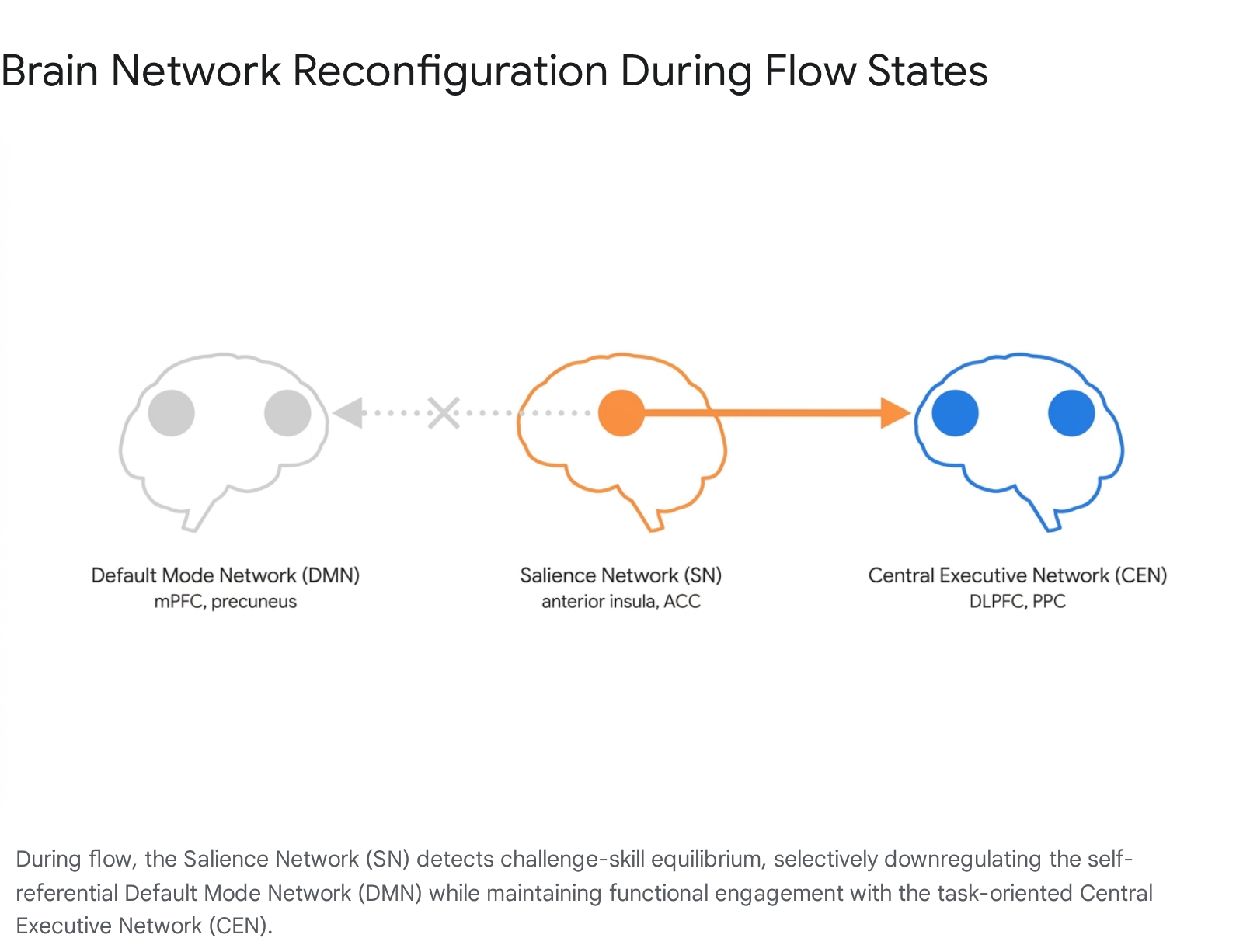
To reconcile these contradictory findings, modern network neuroscience conceptualizes flow through the dynamic interactions of three distinct large-scale brain networks: the Default Mode Network (DMN), the Central Executive Network (CEN), and the Salience Network (SN) 562425.
The Salience Network as the Switch Mechanism
Comprising the anterior insular cortex (AIC) and the anterior cingulate cortex (ACC), the Salience Network operates as the critical mediator in flow state induction 56. The SN continuously evaluates external stimuli against internal states, monitoring performance to determine if a task matches the individual's skill profile. When the SN detects salient, task-relevant stimuli aligning with optimal challenge, it signals the brain to engage the CEN and suppress the DMN 5. If the task becomes overwhelmingly difficult, the SN detects the accumulation of errors, triggering a reversal of this network configuration, which rapidly breaks the flow state and restores conscious self-monitoring 5.
Suppression of the Default Mode Network
The DMN, which includes the medial prefrontal cortex (mPFC), posterior cingulate cortex (PCC), and precuneus, governs mind-wandering, rumination, and self-referential thinking 5624. The hallmark "loss of self-consciousness" and silencing of the internal critic reported during flow are directly attributable to the downregulation of these core DMN hubs 56. This provides a more precise and accurate mechanism than the original THH: rather than global hypofrontality, flow involves selective attenuation of the medial self-monitoring nodes, a process driven by resource competition as cognitive bandwidth is diverted to task execution 56.
The Central Executive Network and Creative Synergy
The CEN, anchored by the dorsolateral prefrontal cortex (DLPFC) and posterior parietal cortex (PPC), manages working memory, controlled processing, and goal-directed attention 56. During cognitively demanding flow states, CEN activation remains highly elevated to inhibit distractions 5.
Most remarkably, fMRI studies of divergent thinking and creative flow reveal an integrated functional connectivity between the DMN and the CEN 624. Typically, these two networks are strictly anti-correlated; activation of one suppresses the other. However, during high-flow creative states, researchers observe "network synergy," where spontaneous idea generation (driven by residual DMN activity) is seamlessly shaped and evaluated in real-time by task constraints (driven by the CEN) 6. This highly unusual whole-brain neural integration provides the biological basis for fluid, rapid creative output 624.
Physiological and Electrophysiological Correlates
The macro-level network reconfigurations of flow are accompanied by highly specific electrophysiological signatures and autonomic nervous system modulations, providing objective biomarkers for optimal experience.
Electroencephalography Patterns in Flow
EEG studies demonstrate that flow is characterized by a distinct configuration of frequency bands, primarily involving alpha (8 - 13 Hz) and theta (4 - 8 Hz) oscillations 782627. During cognitive flow induced by gamified arithmetic or object-tracking tasks, researchers consistently observe increased frontal theta activity combined with moderate frontocentral and parietal alpha activity 726.
Theta waves are generally associated with deep internal focus, memory encoding, and states bordering the subconscious, while alpha waves are linked to relaxed alertness and the suppression of irrelevant sensory processing 72728. Research into cross-frequency dynamics reveals that during sustained working memory tasks and flow, alpha and theta oscillations frequently form a 2:1 harmonic ratio 8. This alpha-theta harmonicity represents a highly efficient state of inter-areal connectivity, bridging conscious directed attention with automated subconscious processing, enabling the sensation of "effortless action" 82628.
Heart Rate Variability and Autonomic Arousal
Autonomic assessments of flow, primarily utilizing Heart Rate Variability (HRV), challenge the misconception that flow is a state of deep physiological relaxation. HRV measures the temporal variance between consecutive heartbeats, serving as a proxy for the balance between the sympathetic (excitatory) and parasympathetic (inhibitory) branches of the autonomic nervous system 729.
Empirical data reveals a U-shaped or inverted-U characteristic for HRV components during flow 7. Specifically, the high-frequency (HF) component of HRV, which reflects vagal tone and parasympathetic relaxation, is significantly reduced during flow states compared to resting baselines 7. The low-frequency (LF) component, reflecting sympathetic arousal, must remain moderately elevated to meet task demands 7. If sympathetic arousal becomes excessive, the subject experiences frustration and anxiety, terminating flow. If parasympathetic tone dominates, the subject experiences boredom 712. Flow, therefore, requires a highly specific, moderate level of physiological stress - enough arousal to sustain deep engagement, but not enough to trigger a threat response 730.
Neurochemical Modulators and Stress Markers
The maintenance of the flow state relies heavily on neuromodulatory systems, notably the dopaminergic reward system and the locus coeruleus-norepinephrine (LC-NE) system 5624. Dopamine pathways projecting to the CEN provide the intrinsic motivation and goal-directed energy necessary to sustain attention, while the LC-NE system regulates arousal levels to prevent distraction 510.
Furthermore, while traditional stress-reduction interventions like Mindfulness-Based Stress Reduction (MBSR) routinely result in significant decreases in systemic cortisol (a primary stress hormone) and resting blood pressure, the acute flow state does not universally suppress cortisol 31. Because flow often involves moderate physical or cognitive exertion, cortisol levels may remain stable or slightly elevated to metabolize the glucose required for sustained prefrontal engagement, distinguishing active flow from passive relaxation 32.
Comparative Analysis of Flow and Related Cognitive States
While flow is an optimized state of focus, it is frequently conflated with clinical conditions and spiritual practices that share descriptive similarities. Rigorous phenomenological and neurobiological distinctions separate flow from hyperfocus, meditative absorption, and philosophical concepts of spontaneous action.
Flow and Clinical Hyperfocus
In psychiatric and cognitive literature, hyperfocus is commonly discussed within the context of Attention Deficit Hyperactivity Disorder (ADHD) 323334. Both flow and hyperfocus share the characteristics of intense, sustained selective attention and a temporarily diminished perception of non-task-relevant environmental stimuli 3233.
However, the states diverge fundamentally in their induction triggers, task flexibility, and physiological outcomes. Flow requires a precise balance of high challenge and high skill, combined with clear goals 1334. Hyperfocus, conversely, is not contingent on the challenge-skill balance; it is often triggered indiscriminately by tasks providing rapid, continuous dopamine stimulation (such as video games or internet browsing), regardless of the task's difficulty or value 3234.
Crucially, an individual in flow retains executive control and can flexibly transition out of the state when task parameters change. A hyperfocused individual experiences severe "locking on" and exhibits profound difficulty with task-switching 34. Because hyperfocus frequently bypasses the brain's internal cues for biological needs (eating, hydration, rest), the state often concludes with severe cognitive fatigue, cortisol depletion, and irritability, making it a potentially maladaptive phenomenon, unlike the inherently positive affect that follows flow 3234.
Flow and Meditative Samadhi
In the Theravada Buddhist tradition, samadhi refers to a state of profound meditative absorption, systematically categorized into progressive stages known as the jhanas 3536. Like flow, samadhi induces a temporary loss of ego, correlating with deep suppression of the Default Mode Network and medial prefrontal cortex 3637. Both states result in intense concentration, altered time perception, and heightened well-being 3637.
The critical distinction lies in the role of external stimuli. Flow is an environmentally dependent, sensorimotor state; it requires active engagement with a task, continuous feedback, and physical or cognitive movement 1336. Samadhi is internally generated. Through practices like anapanasati (mindfulness of breath), the practitioner actively withdraws attention from external sensory inputs (a process of deafferentation), entering a state of content-free awareness 3638. While flow utilizes the dopamine system to achieve task-oriented goals, samadhi utilizes endogenous reward systems to achieve profound bliss and equanimity independent of any external achievement 36.
Flow and Eastern Philosophies of Spontaneous Action
The ancient Daoist concept of wuwei (effortless action) and the Zen martial arts concept of mushin (no-mind) describe states of perfected, spontaneous skill 394041. Phenomenologically, they closely mirror the action-awareness merging seen in flow 394042.
However, comparative philosophy identifies a strict divergence regarding cognitive deliberation. Flow theory accommodates highly rational, deliberative tasks; an engineer or writer can experience flow while heavily utilizing the Central Executive Network for logical deduction 639. Wuwei and mushin, by contrast, explicitly prohibit conscious conceptual thought 394344. They demand a total surrender of rational deliberation in favor of embodied, automated responses cultivated through years of physical discipline 3940. Furthermore, flow is conceptualized as a secular, humanistic state aimed at psychological optimization, whereas wuwei is embedded within a cosmic framework aimed at aligning with the Dao to achieve invulnerability to life's hardships 39.
| Feature | Psychological Flow | Clinical Hyperfocus | Meditative Samadhi | Daoist Wuwei / Zen Mushin |
|---|---|---|---|---|
| Primary Trigger | Challenge-skill balance, clear goals, immediate feedback. | High interest, rapid dopamine reward, unpredictable onset. | Internal attentional control, systematic sensory withdrawal. | Extensive physical discipline, surrender of conscious thought. |
| Task Flexibility | High. Adapts to changing parameters within the activity. | Low. Severe difficulty task-switching ("locked on"). | N/A. The objective is internal stillness. | Absolute. Immediate, spontaneous response to dynamic threats. |
| Cognitive Nature | Deliberative (e.g., coding) or physical (e.g., sports). | Often repetitive or excessively stimulating. | Non-conceptual, object-focused or content-free. | Strictly non-deliberative, embodied physical action. |
| Post-State Affect | Energized, highly satisfied, positive affect. | Often exhausted, irritable, cognitive fatigue. | Profound tranquility, deep neurological equanimity. | Grounded, detached equanimity. |
| Underlying Framework | Secular, humanistic, performance-oriented. | Clinical, frequently associated with neurodivergence (ADHD). | Spiritual, aimed at liberation from suffering (Dukkha). | Philosophical, aimed at harmony with ultimate reality. |
Flow in Occupational and Performance Contexts
The translation of flow theory into occupational and athletic domains has driven significant research into quantifying its impact on objective performance metrics, though academic findings often contrast with commercial claims.
Quantitative Relationships with Task Performance
While individuals subjectively report performing at their absolute peak during flow, meta-analytical data provides a more calibrated perspective. A meta-analysis comprising 28 empirical studies examined the correlation between flow and quantitative performance in sports, gamified mental arithmetic, and spatial tracking tasks 2716. The pooled effect size indicated a reliable, medium-sized relationship ($r = 0.31$, 95% CI [$0.24, 0.38$]) across all domains 216.
This data indicates that while flow provides a statistically significant behavioral advantage, particularly in fluid creativity and rapid task execution, it is not an absolute guarantor of flawless performance 616. The primary benefit of flow often lies in the intense intrinsic motivation and engagement it fosters, which drives long-term persistence, learning, and skill acquisition, rather than immediate, exponential spikes in output quality 615.
Flow in Knowledge Work and Creative Environments
In the context of knowledge work, the pursuit of flow has been highly publicized. A frequently cited statistic in popular business literature claims that executives in flow are "500% more productive" 21304548. This figure originates from a 10-year longitudinal survey by McKinsey & Company 13048. Other defense-funded studies (such as those by DARPA) report learning speed increases of up to 490% for military personnel trained to induce flow-like states during target acquisition 3048.
While these figures highlight the profound subjective impact of flow on focus and efficiency, academic researchers note that assessing knowledge work via self-reported productivity surveys introduces significant methodological limitations 1162149. Nonetheless, the application of flow principles to workplace design - such as minimizing context-switching, establishing uninterrupted deep work blocks, and providing clear proximal goals - consistently yields significant improvements in employee well-being, creative output, and job satisfaction 17184950.
The Flow Cycle and the Necessity of Recovery
A critical area where commercial productivity culture diverges from neurobiological reality is the expectation of continuous, "on-demand" flow. Neurologically, flow is an inherently transient and metabolically expensive state 12046. Researchers conceptualize flow not as a static baseline, but as one phase in a four-part biological cycle: struggle, release, flow, and recovery 146.
The "struggle" phase involves the conscious acquisition of information and skills, requiring intense prefrontal cortex engagement and cognitive friction 146. Without this uncomfortable loading phase, the challenge-skill balance cannot be achieved. Following the flow phase, the nervous system requires profound parasympathetic recovery 152. The "productivity hustle" culture frequently attempts to isolate the flow phase while stigmatizing the necessary struggle and vital rest phases 14652. Ignoring the recovery phase leads to rapid depletion of neurochemical reserves, resulting in diminished executive function, emotional dysregulation, and eventual burnout 13252. Elite performance models dictate that strategic downtime and sleep are not detriments to productivity, but biological prerequisites for achieving subsequent flow states 52.
Critical Assessment of Commercialized Flow Interventions
As flow has become a highly sought-after commodity in the wellness and corporate sectors, numerous interventions and "hacks" have been marketed to artificially induce the state. Scientific scrutiny reveals that many of these interventions lack robust empirical support and misinterpret fundamental neurobiology.
Dopamine Fasting and Behavioral Sensitization
"Dopamine fasting" is a trend wherein individuals abstain from highly stimulating activities (e.g., social media, highly palatable foods, entertainment) under the premise that doing so will "reset" dopamine receptors, thereby making difficult, flow-conducive tasks more rewarding 91047.
Neuroscientists widely criticize this framework as pseudoscientific 104748. Dopamine is a complex neurotransmitter integral to motor control, learning, and motivation; it does not deplete and replenish like a fluid reservoir, nor can a person "fast" from a naturally occurring brain chemical 104748. While the actual behavioral practice - temporarily removing digital distractions to improve sustained attention - is a valid psychological technique rooted in Cognitive Behavioral Therapy (CBT) stimulus control, branding it as a "dopamine detox" misrepresents the brain's neuroplasticity 104748. Researchers caution that established habits are not erased by brief periods of abstinence, and the underlying neurobiology of motivation is far more nuanced than the fasting model suggests 910.
Binaural Beats and Brainwave Entrainment
Another prevalent commercial intervention involves binaural beats - the presentation of two slightly different auditory frequencies to each ear. Proponents claim that this audio technology induces "brainwave entrainment," forcing the brain's EEG oscillations into the alpha or theta frequencies associated with flow states 49.
However, systematic reviews of the neuroscientific literature find the empirical basis for binaural beats to be highly inconsistent 49. While early theoretical work posited that external rhythmic stimuli could synchronize cortical firing (Auditory Steady-State Responses), a significant number of rigorous, controlled studies have failed to demonstrate reliable brainwave entrainment using binaural beats 49. While the audio may serve as a psychological placebo or aid in masking environmental noise (thereby aiding concentration), claims that binaural beats directly and reliably alter neural oscillations to induce a flow state remain unsubstantiated by current neurophysiological data 49.
The Productivity Hustle and Academic Critiques
The broader academic critique of modern flow culture centers on the inherent paradox of instrumentalizing an intrinsically motivated state for extrinsic economic gain 1465057. Organizations such as the Flow Research Collective promote frameworks to scale flow for maximum corporate output 5058.
However, Csikszentmihalyi's original research emphasized that flow is autotelic - it is an end in itself, representing a pinnacle of human flourishing and subjective meaning 14. When flow is reframed primarily as a networking strategy or an industrial extraction model to maximize yield, it becomes severed from purpose 150. Scholars note that attempting to force flow for purely economic reasons introduces extrinsic pressure and self-monitoring, which biologically reactivates the Default Mode Network and disrupts the very network synergy required to achieve the state 164650. The scientific consensus suggests that flow cannot be reliably "hacked" via superficial interventions; it must be systematically cultivated through the alignment of deep skill, meaningful challenge, and comprehensive neurological recovery.