
Does Power Posing Actually Work
Adopting an expansive posture can provide a temporary boost to subjective feelings of confidence and self-esteem. However, extensive replication efforts and large-scale meta-analyses confirm that power posing does not alter hormone levels or reliably change real-world behavior as originally claimed. While standing tall may make individuals feel more powerful internally, the scientific consensus indicates that it does not rewrite their physiology or guarantee success in high-stakes environments.
The Allure of a Simple Life Hack: The 2010 Study
In 2010, the journal Psychological Science published a paper that would quickly escape the confines of academia and become a global cultural phenomenon. Researchers Dana Carney, Amy Cuddy, and Andy Yap posed a compelling question: if human beings and other animals naturally express power through open, expansive postures, could artificially adopting those postures actually cause an individual to become more powerful? 123.
The premise was rooted in the observation that both human and non-human primates universally utilize expansive, open postures to reflect high power, whereas contractive, closed postures reflect low power and submission 3. To test whether this physical expression could work in reverse - causing the internal state rather than just reflecting it - the researchers recruited 42 participants 145. These participants were randomly assigned to hold either high-power, expansive poses (such as sitting with feet on a desk and hands behind the head, or standing with feet apart and hands on hips) or low-power, contractive poses (such as slouching with arms crossed) for two minutes 155.
The participants were told a cover story that the study was about the science of physiological recordings and electrode placements to ensure they were not aware of the true hypothesis 6. The researchers measured the participants' hormone levels using saliva swabs both before and after the two-minute posing exercise 167. Subsequently, the participants were given a gambling task to measure their tolerance for financial risk, and they were asked to rate their subjective feelings of power and dominance on a self-reported scale 267.
The reported results were extraordinary, painting a picture of a profound mind-body connection that could be manipulated in mere minutes.
| Variable Measured | Original 2010 Claim for "High-Power" Posers | Implied Real-World Benefit |
|---|---|---|
| Testosterone | Significant elevation over baseline 25. | Increased dominance, assertiveness, and competitive drive. |
| Cortisol | Significant decrease from baseline 25. | Reduced stress and anxiety; increased resilience under pressure. |
| Risk Tolerance | Higher likelihood of making a risky bet in a gambling task 57. | Improved action orientation and willingness to seize opportunities. |
| Subjective Feeling | Increased self-reported feelings of power and being "in charge" 57. | Greater internal confidence during social evaluations. |
The researchers concluded that posing in powerful displays caused advantaged and adaptive psychological, physiological, and behavioral changes 25. They explicitly stated that embodiment extends beyond mere thinking and feeling to actual physiology and subsequent behavioral choices 25.
The appeal of these findings was immediate. The study suggested a simple, free, and instant biological intervention for navigating high-stakes social evaluations, such as job interviews, public speaking engagements, or salary negotiations 368. If the findings were robust, individuals who were chronically powerless due to systemic lack of resources, low hierarchical rank, or membership in marginalized social groups could literally posture their way to a more level playing field 911.
The research reached critical mass in 2012 when Amy Cuddy presented the findings in a TED Talk. Her presentation, which popularized the empowering mantra "fake it 'til you become it," resonated on a global scale. It rapidly became one of the most-watched TED Talks in history, currently sitting at over 75 million views, and cemented the cultural image of nervous job candidates locking themselves in bathroom stalls to strike a superhero pose before an interview 181110.
The Endocrinology of Leadership: Why the Theory Was Plausible
To understand why the scientific community and the public were initially so receptive to the 2010 claims, it is necessary to examine the biological metrics the researchers targeted. The interplay between the hormones testosterone and cortisol is highly complex and deeply tied to evolutionary biology, social hierarchy, and decision-making under uncertainty 1112.
Testosterone, a steroid hormone, has long been associated with the appetite for risks and rewards, particularly those related to financial gain, peer relationships, and social status 11. Cortisol, conversely, is a glucocorticoid heavily implicated in the body's response to stress. Both hormones bind to large plasma proteins - sex-hormone binding globulin (SHBG) and corticoid binding globulin (CBG) - which regulate how much of the hormone reaches the brain to influence behavior 12.
Endocrinologists and behavioral scientists utilize a framework known as the "dual-hormone hypothesis" to explain how these two chemicals interact to dictate human behavior 131415. This hypothesis posits that the behavioral effects of testosterone - such as risk-taking, status-seeking, and dominant leadership - are highly dependent on the simultaneous presence of cortisol 13.
Research utilizing the Iowa Gambling Task, a standard psychological tool for assessing decision-making, demonstrates this interaction clearly. Testosterone has been shown to improve long-term decision-making and optimal risk calculation, but this improvement is primarily evident when cortisol levels are low 1415. When cortisol levels are high, triggered by acute stress or anxiety, the stress hormone effectively blocks or inhibits the status-enhancing and cognitive-control effects of testosterone 1415. High cortisol levels are associated with impaired working memory, greater impulsivity, and an inability to accurately estimate the costs and benefits of potential success or failure 111215.
Therefore, the optimal hormonal profile for effective leadership and high-stakes performance is universally recognized as high baseline testosterone combined with low baseline cortisol 313. This profile indicates an individual who is assertive, willing to take calculated risks to achieve rewards, yet highly resilient to acute stress and immune to panic 313.
By claiming that a two-minute physical posture could artificially engineer this exact, highly coveted neuroendocrine profile, the original power posing study promised a profound breakthrough. It provided a seemingly elegant biological mechanism for a sociological problem.
The Replication Crisis Hits Social Science
As power posing was permeating corporate training seminars and self-help literature, the broader field of psychology was entering a period of intense, often painful, methodological introspection. Beginning around 2011, researchers started to realize that an alarming number of classic and contemporary findings could not be reproduced when independent laboratories ran the experiments a second time 81617.
This era, which came to be known as the "replication crisis" or the "crisis of confidence," revealed systemic vulnerabilities in how social and behavioral science was conducted, analyzed, and incentivized 161821.
The crisis was not primarily driven by outright fraud, though isolated cases of fabricated data did act as early catalysts. In 2011, Diederik Stapel, a prominent Dutch social psychologist, was dismissed after an investigation found he had invented datasets wholesale across dozens of published studies 22. However, fraud was the wrong explanation for the wider crisis 22. The vast majority of researchers whose findings were collapsing under scrutiny were not fabricating data; they were running studies and writing papers using methods that the field had long accepted, taught, and rewarded 2219.
The true culprits were structural. Academia operates on a "publish or perish" incentive system that heavily rewards novelty and statistically significant discoveries 172025. Confirming an old study or publishing a paper showing that an intervention had no effect was considered unglamorous and rarely resulted in career advancement or prestigious journal placements 2025. This created a massive "file-drawer problem" or publication bias: experiments that yielded null results were quietly filed away and never published, while experiments that produced surprising, positive results were fast-tracked to publication 1726.
Furthermore, psychologists had historically relied on incredibly small sample sizes. When sample sizes are low, the statistical power to detect a true effect is chronically deficient 26. It is a mathematical reality that low statistical power not only renders null results uninformative, but it also renders statistically significant results highly suspicious 26. If the underlying power of a study is low, any significant finding is highly likely to be a "false positive" - a statistical fluke driven by random chance, mathematical noise, or an unrepresentative sample 26.
To illustrate this, statisticians often use a sports analogy. Believing a sweeping behavioral theory is universally correct simply because a researcher reported a statistically significant result in a single 40-person study is akin to believing a baseball player belongs in the Hall of Fame because they hit .300 in a single series at Fenway Park 27. A short burst of success in a small sample is easily achieved by chance; it takes a massive, long-term aggregation of data to prove true, underlying talent or scientific reality 27.
In response to this crisis, researchers formed massive consortiums to stress-test the foundations of their field. The Reproducibility Project, initiated by Brian Nosek and the Open Science Collaboration in 2011, attempted to rigorously replicate 100 published studies from three leading psychology journals 182122. The results, published in the journal Science in 2015, were sobering. While 97% of the original studies claimed significant effects, the replication teams were only able to successfully reproduce the results in roughly 36% of the cases 18252223. Even when studies did replicate, the magnitude of the effect was typically half the size originally reported 2024.
Because of its massive public profile and bold physiological claims, power posing naturally became a high-priority target for independent verification in this new, rigorous era of meta-science.
Attempting to Replicate the Power Pose
The first major empirical challenge to the power posing hypothesis arrived in 2015. A team of researchers led by Eva Ranehill at the University of Zurich published a rigorous, preregistered conceptual replication of the original 2010 experiment 1410.
To ensure high statistical reliability and avoid the pitfalls of the original study, Ranehill and her colleagues utilized a sample size of 200 participants - nearly five times larger than the original study's sample of 42 4510. They utilized similar procedures, having participants hold expansive or contractive poses before measuring hormone levels, risk tolerance, and subjective feelings of power 45.
The results of this highly powered study provided a stark contrast to the initial claims. The Zurich team confirmed that expansive poses successfully increased participants' subjective feelings of power, serving as a successful manipulation check 1425. However, they found absolutely no evidence that the poses altered testosterone levels, changed cortisol levels, or increased actual risk-taking behavior in financial tasks 14510. In their publication, the researchers stated definitively that using a much larger sample size but similar procedures, they failed to confirm any physiological or behavioral effect of power posing 4.
Other independent laboratories quickly followed suit, producing a cascade of null findings. A 2016 study by Katie Garrison and colleagues attempted to replicate and extend the effect by combining expansive body postures with dominant eye gaze 102627. Utilizing an even larger sample of 305 participants, they had subjects adopt high-power or low-power poses while either gazing directly ahead or looking submissively at the ground 27. Afterward, participants played a hypothetical ultimatum game and made gambling decisions. The researchers found that body posture had no influence on gambling decisions or behavior in the ultimatum game 27. Most surprisingly, contrary to the original predictions, adopting an expansive pose actually reduced subjective feelings of power in their sample 1027.
The First Author's Disavowal
As the negative evidence mounted, the scientific community experienced a highly unusual event. In late 2016, Dana Carney, the lead author of the original 2010 paper, published a public statement completely disavowing the research 11028.
Reviewing the burgeoning literature and her own changing views on statistical methodology, Carney wrote plainly: "As evidence has come in over these past 2+ years, my views have updated to reflect the evidence. As such, I do not believe that 'power pose' effects are real" 1029.
Carney noted that the original data was authentic and collected in good faith based on the accepted standards of the field at the time 28. However, she acknowledged that those standards were deeply flawed, pointing to a lack of control groups, small sample sizes, and analytical flexibility that likely manufactured a false positive 11028. She concluded that she was glad the effect was identified as an artifact so that other researchers would not waste precious time and funding pursuing a dead end 28.
Amy Cuddy, conversely, maintained her belief in the phenomenon. She argued that while the specific hormonal effects might not consistently replicate, the improvements to an individual's psychological state and subtle behavioral presence were still valid and supported by other research 12930. She expressed concern that critics were engaging in a "gloating sense of gotcha" that stifled scientific progress, noting that adopting expansive postures genuinely helps people feel more present and confident in stressful situations 30.
Anatomy of a False Positive: Statistical Scrutiny
How could a study published in a prestigious journal, authored by researchers from elite institutions, turn out to be so fundamentally incorrect regarding its physiological claims? The autopsy of the power posing study provides a masterclass in the methodological pitfalls that defined psychological research prior to the replication crisis.
The Danger of Small Sample Sizes
The most glaring vulnerability of the 2010 study was its sample size: 42 participants, divided into two groups of 21 145. In statistical analysis, small sample sizes produce highly volatile, "noisy" data 25.
Whenever a replication fails, statisticians assess how precise the original estimates were. If an original study has a tiny sample, it lacks the "statistical power" required to reliably detect anything but massive, glaringly obvious effects 2625. Later statistical analysis of the power posing data revealed that with only 21 individuals per group, the original study had a meager 5.6% chance of accurately detecting the risk-taking effects it claimed to have found 25.
In other words, the study possessed less than 6% statistical power. When a study with such chronically low power miraculously reports a statistically significant finding, the probability that the finding is a false positive - driven by random chance or a few anomalous outliers - is exceptionally high 2625.
Researcher Degrees of Freedom and P-Hacking
In her 2016 disavowal, Carney candidly admitted to practices that are now recognized as highly problematic. These practices are collectively known as "researcher degrees of freedom," "analytic flexibility," or "p-hacking" 51731.
P-hacking does not imply malicious intent or data falsification. Rather, it occurs when researchers make flexible analytical choices - such as deciding which outliers to drop, which control variables to include, or choosing to stop data collection the moment the numbers look favorable - in order to push their results past the arbitrary threshold of statistical significance (a p-value of less than 0.05) 5172631.
Independent re-analyses of the 2010 data revealed that the conclusions regarding testosterone and cortisol were highly sensitive to exactly how the researchers chose to handle the numbers 31. For example, the original models included specific control variables for gender and pre-manipulation hormone levels. Statisticians Marcus Credé and Leigh Phillips utilized a technique called "multiverse analysis" to run the power posing data through every plausible alternative analytical specification 31. They found that simply changing the outlier identification strategy or altering the control variables erased the hormonal effects entirely 31. The findings only existed under one very specific, highly curated analytical lens.
The P-Curve Analysis
Proponents of power posing initially defended the theory by pointing to dozens of other small published studies that seemed to confirm the effect 2529. However, statisticians Uri Simonsohn and Joseph Simmons applied a sophisticated technique called "p-curve analysis" to evaluate the 33 studies cited as evidence that power posing works 4525.
A p-curve examines the distribution of statistically significant results within a body of literature. If an effect is truly real and robust, the distribution of p-values should be heavily right-skewed - meaning there is a massive concentration of very strong, highly significant results (e.g., p < 0.01) and very few results barely scraping by the boundary of significance 25. Conversely, if an effect is manufactured through publication bias and p-hacking, the curve will be flat or left-skewed, as researchers repeatedly massage their data just enough to cross the p = 0.049 finish line 25.
Simonsohn and Simmons found that the actual p-curve for the power posing literature was completely flat 25. This mathematically demonstrated that the existing body of published evidence possessed no true evidential value 4532. It proved that the cluster of supportive studies was likely the result of selective reporting, where only successful flukes were published while countless failed experiments were buried.
A Field Recalibrates: The 2017 Special Issue and Beyond
To settle the debate decisively, the scientific journal Comprehensive Results in Social Psychology commissioned a special issue in 2017 entirely dedicated to power posing 1926. To prevent any accusations of bias or p-hacking, the journal required all participating research teams to preregister their exact hypotheses, sample sizes, and analytical plans before collecting a single piece of data 126.
The special issue featured diverse, geographically distinct teams testing the theory across various domains. The results were remarkably consistent in their failure to reproduce the original claims: * Klaschinski and colleagues tested power posing on dominance in mock interviews and found no effect 26. * Jackson and colleagues tested the effect on self-concept in a highly powered study and found no effect 26. * Latu and colleagues examined whether power posing improved persuasive messaging and observed zero effect 26. * Ronay and colleagues explicitly tested the mediating role of testosterone on risk-taking and failed to replicate the original neuroendocrine findings 26.
Following this, researchers Joseph Cesario and David Johnson published a series of experiments testing whether power poses had any measurable effects when deployed in realistic, interactive scenarios 911. In one study, participants actively watched Amy Cuddy's famous TED talk, held an expansive pose, and then engaged in a negotiation task with a partner 911. On all measured dependent variables, the participants who power-posed performed no better than their partners who did not 911.
Cesario concluded unequivocally that while feeling powerful might feel good internally, it does not translate into powerful or effective real-world behaviors 11. The physical manipulation simply lacked the potency to override actual situational dynamics, competence, or hierarchical reality.
The Definitive Consensus: The 2022 Meta-Analyses
While individual replication studies are highly informative, the gold standard for scientific truth is the meta-analysis. A meta-analysis aggregates the raw data and effect sizes from dozens or hundreds of individual studies to calculate the true, underlying reality of a phenomenon, entirely stripping away the noise of individual small samples 33343536.
In psychological and medical research, the magnitude of a phenomenon is quantified using metrics like Cohen's d or Hedges' g. As a general benchmark, an effect size of 0.2 is considered a small, barely noticeable effect; 0.5 is a medium effect visible to a careful observer; and 0.8 or above is considered a large, highly impactful effect 243745.
In 2022, the most exhaustive meta-analysis on body positioning to date was published in Psychological Bulletin by Robert Körner and an international team of researchers 38394041. This monumental undertaking aggregated data from 128 experiments encompassing nearly 10,000 participants 3841. To ensure accuracy, the team actively solicited unpublished data to combat publication bias, and they carefully distinguished between "power poses" (expansive gestures representing dominance) and "upright postures" (vertical alignment representing prestige) 3841.
Simultaneously, another major meta-analysis by Elkjær and colleagues synthesized evidence from 48 studies specifically looking at the differences between expansive and contractive displays 4243.
The conclusions of these massive, rigorous syntheses establish the current, definitive scientific consensus on what power posing actually achieves.
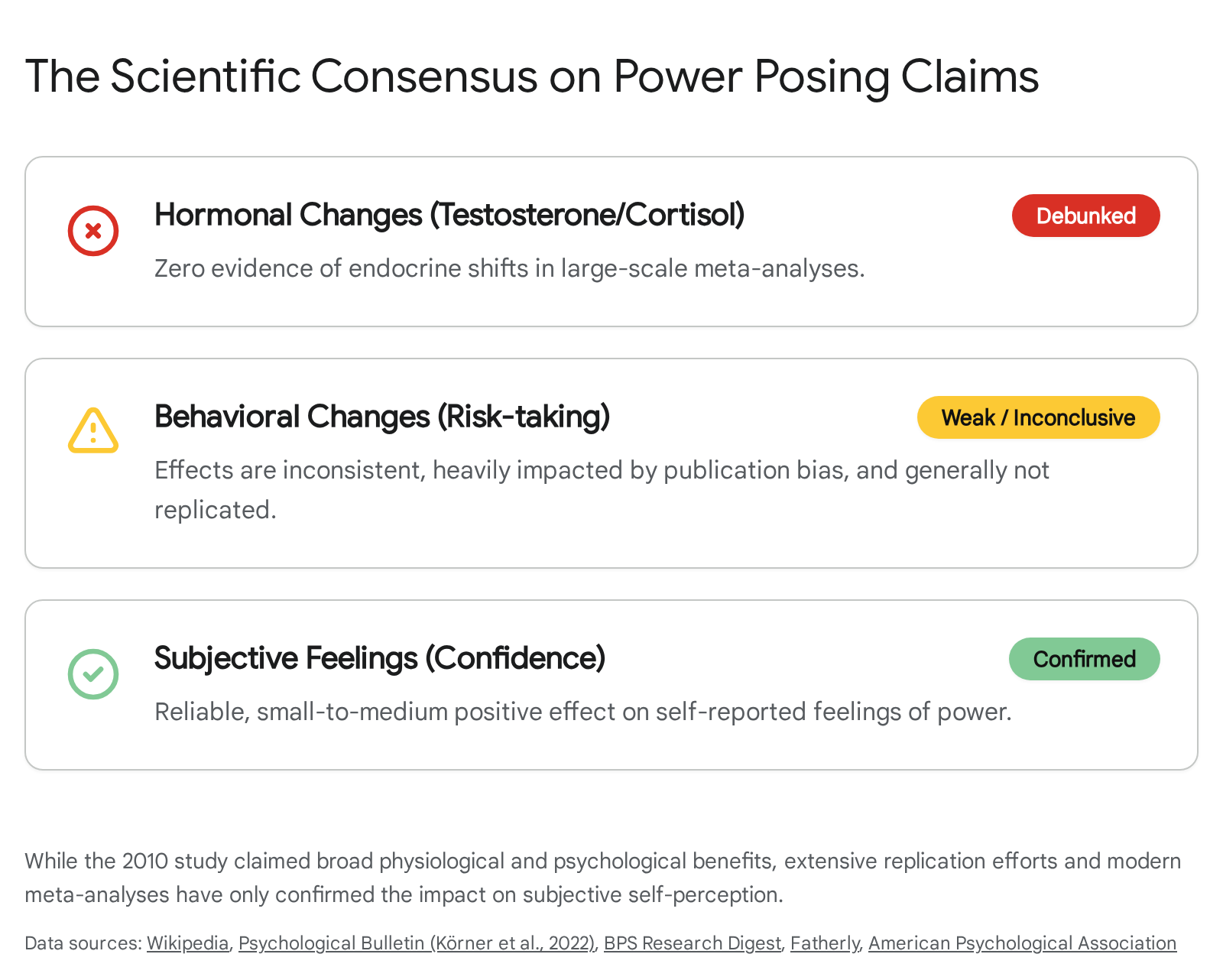
| Claimed Effect Category | Current Scientific Consensus (Meta-Analytic Findings) | Effect Size / Strength |
|---|---|---|
| Hormonal & Physiological Changes | Debunked. There is no reliable evidence that expansive posture alters testosterone, cortisol, heart rate, skin conductance, or any other physiological metric across populations 384142. | Zero |
| Behavioral Changes (e.g., Risk-taking, Negotiation) | Weak / Inconclusive. Minor effects on variables like task persistence have been noted in isolation, but aggregate data is highly inconsistent, heavily compromised by publication bias, and generally not replicated in robust designs 384042. | Negligible / Unreliable |
| Subjective Feelings of Power | Confirmed. Adopting expansive or upright postures reliably increases self-reported feelings of confidence, self-esteem, and internal power 35384044. | Small-to-Medium (g = 0.35) |
The verdict is highly nuanced. The biohacking promised by the original 2010 study and subsequent media coverage is entirely unsupported by the aggregate data; standing like Wonder Woman will not alter an individual's endocrine system 324143. However, the psychological component - the internal feeling of confidence - survives rigorous statistical scrutiny, demonstrating a legitimate, small-to-medium effect size 3844.
Why Do We Feel More Powerful? The Science of Embodied Cognition
If testosterone and cortisol levels are remaining completely static, what explains the reliable, documented boost in subjective confidence? The answer lies in a psychological framework known as "embodied cognition."
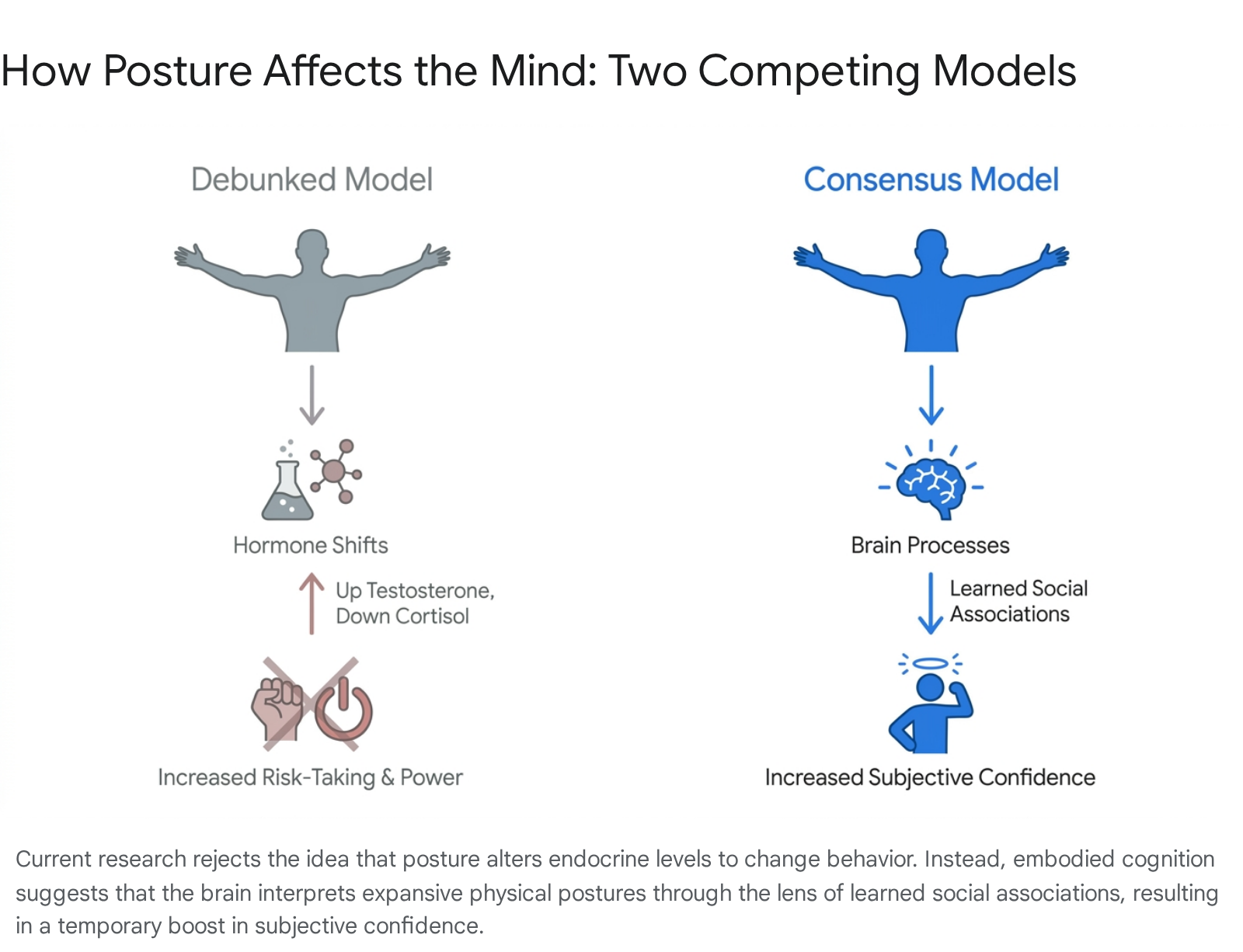
Traditional cognitive science often treated the brain as an isolated computer that simply issued downward commands to the physical body 5345. Embodied cognition challenges this linear model, proposing that the brain, body, and environment are deeply and dynamically intertwined 3653. Just as the brain commands the body to move, the brain also constantly reads the body's physical state and sensory inputs to inform and construct emotional reality 653.
This concept traces its roots back to the 19th-century philosopher and psychologist William James, who theorized that physical expression contributes directly to the consequent feeling of emotion 67. This is the same underlying mechanism behind the well-documented "facial feedback hypothesis" - the finding that the physical act of engaging the zygomaticus major muscle to smile can actually induce mild neurological feelings of happiness 67.
In the specific context of expansive posture, the boost in confidence is largely attributed to deeply ingrained social and cultural conditioning rather than a biological reset. Throughout the human life course, individuals learn to associate large, open, and upright body positions with competence, high status, and self-esteem 40. From the perspective of a child, figures of authority - parents, teachers, and leaders - literally look down from a higher physical elevation 40. Because tallness and physical expansiveness are universally linked to leadership and dominance across cultures, physically adopting those positions triggers the brain's internal psychological schema for competence 40.
However, researchers caution that this subjective boost must be interpreted carefully. Some of the self-reported confidence may be driven by "demand characteristics" - a psychological phenomenon where research participants figure out the underlying purpose of the study and subconsciously report the feelings they know the researchers are looking for 944. When an experimenter explicitly instructs a participant to put their feet on a desk and interlock their hands behind their head like a relaxed executive, the participant is highly likely to report feeling authoritative simply because the social context of the experiment demands it 9.
Furthermore, early studies often failed to include a neutral control group, comparing expansive poses directly against unnaturally contractive, hunched poses 1. Modern analysis suggests that much of the variance in feelings was driven not by the power poses making people feel exceptional, but by the contractive poses making people feel artificially awkward, stressed, and subservient 46.
Science Working as Intended: The Legacy of Power Posing
The saga of power posing is frequently weaponized in the media as a cautionary tale about the unreliability of social science. However, meta-scientists and methodologists argue that the narrative is precisely the opposite: it is a profound success story demonstrating the scientific method's inherent capacity for self-correction 214748.
Science is not a rigid body of facts that emerge perfectly formed, illuminating a linear path to universal truth 2721. Rather, science is a systematic method designed to quantify doubt about a hypothesis and rigorously test assumptions 27. Failure to replicate is not a bug in the system; it is a critical feature 27.
The friction generated by the power posing debate, alongside other high-profile failed replications of the 2010s, forced the field of psychology to completely overhaul its methodologies 5214748. The intense scrutiny catalyzed a "methods revolution" that vastly improved the rigor of behavioral research 30.
Today, top-tier journals increasingly require researchers to engage in "preregistration" - publicly locking in their hypotheses, sample sizes, and step-by-step analytical plans on platforms like the Open Science Framework before collecting a single data point 264849. This practice mathematically prevents the kind of retrospective p-hacking and analytical flexibility that generated the original power pose hormonal data 2631.
Furthermore, the crisis spurred the creation of massive, collaborative replication networks, such as the "Many Labs" projects 1750. Rather than relying on a single isolated laboratory testing 40 undergraduate students, modern psychological effects are now routinely validated by dozens of independent labs across the globe simultaneously, utilizing tens of thousands of participants from diverse geographic, cultural, and socioeconomic backgrounds 50515253. Algorithms and machine-learning models are even being developed to scan the text of thousands of research papers to predict replicability based on methodological transparency and linguistic markers, providing the field with automated self-diagnostic tools 54.
The narrative that "science is broken" is an unwarranted overgeneralization; rather, the mechanisms designed to identify errors, reject weak theories, and aggregate true knowledge are currently operating at unprecedented efficiency 2148.
Bottom Line
The original 2010 claim that holding an expansive posture for two minutes will hack the endocrine system, elevate testosterone, and change real-world behavior has been comprehensively debunked by rigorous replication and meta-analysis. However, the evidence does reliably support the idea that standing tall and utilizing upright postures can induce a small-to-medium boost in subjective confidence and self-esteem, likely due to deep-seated psychological associations between expansiveness and competence. Ultimately, while power posing is not the physiological silver bullet it was once marketed to be, it remains a harmless, accessible psychological tool that may help individuals feel slightly more present and capable in stressful situations.