
Does Cold Water Immersion Actually Work
Cold water immersion acts as a potent physiological stressor that can significantly improve mood, build stress resilience, and accelerate recovery from endurance exercise. However, recent clinical evidence reveals that it actively hinders muscle growth when used after strength training and is not a viable standalone strategy for weight loss. While consistent, brief exposures trigger beneficial adaptations in healthy individuals, the practice carries severe cardiovascular risks for those with underlying heart conditions.
The Deep Roots of Cold Water Therapy
Humans have utilized cold water for its perceived health and therapeutic benefits for thousands of years. While modern wellness influencers, biohackers, and elite athletes have recently popularized the "cold plunge," the practice is deeply rooted in ancient cultural and religious traditions across the globe. Understanding this historical context helps separate the enduring physiological truths from passing wellness fads.
Roman Baths and the Hydrotherapy Movement
Cold therapy has deep historical roots in Europe. The ancient Greeks and Romans were among the first to formalize bathing culture. While Roman baths are often remembered for their luxurious warm pools, they systematically included a frigidarium - a cold plunge pool specifically designed for invigoration and pore-closure after hot immersion 1. Hippocrates, widely regarded as the father of modern medicine, also recommended cold water treatments for alleviating fever and fatigue 1.
In the eighteenth and nineteenth centuries, cold therapy gained renewed medical recognition in Europe, particularly through the hydrotherapy movement 1. The eighteenth century marked the birth of prominent spa towns, and by the nineteenth century, cold bathhouses proliferated along Nordic coasts 2. Pioneers like Sebastian Kneipp, a Bavarian priest, passionately advocated cold-water cures to stimulate circulation and boost immunity 1. In 1814, the Swedish Medical Association officially prescribed "cold, salty baths" for patients 2. It was partly thanks to physicians like Dr. Carl Peter Curman that the link between cold-water swimming, fresh air, and a healthy lifestyle was firmly established in Western medicine 2. By the mid-twentieth century, there was little interest in winter swimming in countries like Sweden, and the tradition almost disappeared before its massive twenty-first-century revival 22.
Nordic Survival and the Viking Tradition
Further north, in Scandinavian cultures, cold immersion was not just a medical prescription; it was inseparable from daily life. Harsh winters and icy lakes made cold exposure a natural necessity before the advent of indoor plumbing and electricity 14. If people wanted to wash regularly without wasting precious firewood on heating water, freezing water was their only option 4.
For the ancient Vikings, plunging into freezing waters was believed to build physical endurance, cardiovascular health, and mental resilience 14. The Vikings eventually adopted the rituals they discovered while invading Russia, bringing the practices home to Scandinavia. They combined a good sweat in a sauna with washing off in the snow or in a freezing lake on Saturdays 2. In fact, the Swedish word for Saturday, Lördag, takes its name directly from this historical bathing custom 2. This cultural attitude survives robustly today in Nordic countries, where alternating sauna use with cold plunges is a widespread practice inextricably tied to both metabolic health and community bonding 14.
Eastern European Epiphany Bathing
In Eastern Europe and Russia, cold water immersion carries profound religious and cultural significance. The tradition of swimming in ice holes dates back to as early as 1525 and was an important court ceremony and folk custom during the tsarist period 34.
Today, this is most visibly manifested in Epiphany bathing, a Christian practice associated with the Feast of Epiphany on January 19 56. To commemorate the baptism of Jesus by John the Baptist in the Jordan River, worshipers plunge into icy rivers, lakes, or cross-shaped holes cut into the ice, known as Iordan 456. Believers immerse themselves three times, invoking the Holy Trinity, with the belief that bathing in the cold, blessed water will purify the soul, renew their faith, and provide good health throughout the coming year 56.
Even during the Soviet era, when the custom lost its overt religious context, the practice remained immensely popular. Practitioners were known as Morzhi (Russian for "walruses"), and ice swimming was considered a highly effective way to "temper" the body against cold and illness 349. Today, the event attracts millions of participants, including non-religious individuals and tourists, who participate with a simple desire to conquer their own mental and physical limits 46.
The Physiology of the Cold Shock Response
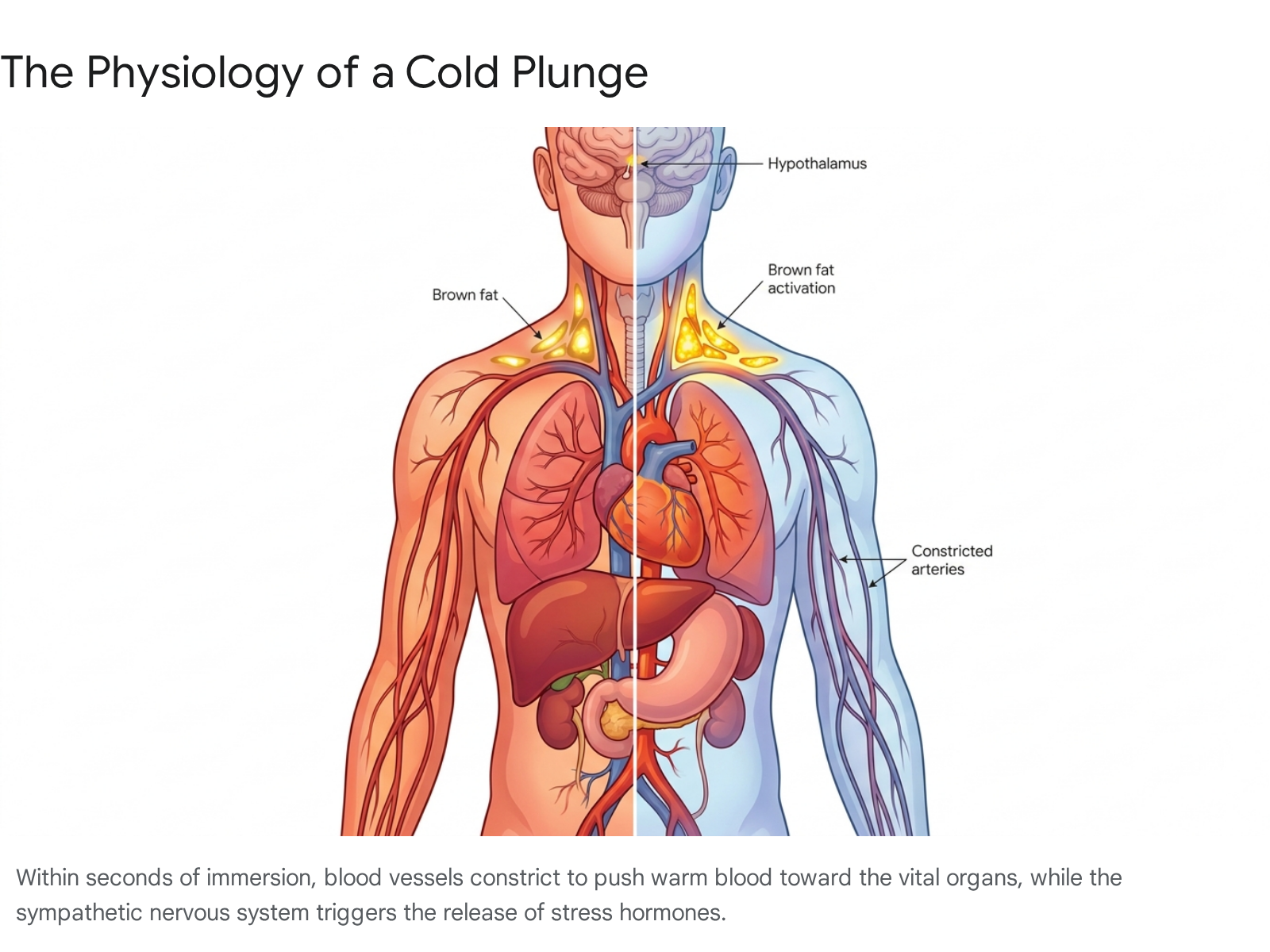
The moment a human body is submerged in water below 59°F (15°C), the nervous and cardiovascular systems launch into a massive, coordinated survival response. This is not a gentle biological nudge; it is a full-system activation that radically alters hemodynamics, hormone levels, and metabolic function 7.
The Initial Neurological Alarm
The first thirty seconds of a cold plunge are characterized by the "cold shock response." Cold receptors densely packed in the skin send overwhelming electrical impulses to the hypothalamus - the brain's temperature-regulating center 11813. This immediately triggers the sympathetic nervous system, initiating the body's fight-or-flight mechanism 111314.
You experience an involuntary gasp reflex, and your breathing rate jumps to three or four times its normal resting pace, often resulting in hyperventilation 1113. This reflex is precisely what makes sudden immersion in very cold open water genuinely dangerous, as the involuntary inhalation can cause a person to aspirate water and drown before they have a chance to react 11139.
Cardiovascular Workout and Shear Stress
To protect your vital organs and preserve your core body temperature, your body rapidly initiates peripheral vasoconstriction 141710. Blood vessels in your skin, arms, and legs narrow significantly, forcing warm blood to retreat inward toward your core 1417.
This sudden vascular squeezing temporarily elevates your blood pressure and increases your heart rate 111411. In laboratory settings, this exact mechanism is replicated using the "cold pressor test," where a subject immerses their hand in ice water to measure cardiovascular reactivity, pulse excitability, and sympathetic nerve activation 1213.
Recent research from the University of Oregon suggests that this rapid constriction and subsequent dilation acts as a "workout" for the circulatory system 1314. By tracking blood movement through participants' vessels using ultrasound, researchers found that the physical stress of cold immersion alters "shear stress" patterns - the physical force that flowing blood exerts on the endothelial cells lining the blood vessels 1415. Over time, this repeated fluctuation in shear stress may improve vascular tone, endothelial function, and overall cardiovascular health 131415.
The Catecholamine Flood
Simultaneously, a potent neurochemical cascade occurs. When the sympathetic nervous system activates, the adrenal glands pump out a massive surge of stress hormones.
A landmark physiological study published in the European Journal of Applied Physiology demonstrated that immersion in 57°F (14°C) water increased blood plasma concentrations of norepinephrine (noradrenaline) by an astonishing 530%, and dopamine by 250% 7. These are not marginal biochemical shifts. Norepinephrine plays a central role in attention, vigilance, and mood regulation, while dopamine is the neurotransmitter responsible for motivation, reward, and the ability to feel pleasure 7.
This profound biochemical flood is directly responsible for the intense feeling of alertness, mental clarity, and mild euphoria that practitioners universally report for hours after exiting the icy water 71617.
Mental Health, Stress Resilience, and Clinical Depression
Because cold water immersion triggers such an extreme release of mood-regulating neurotransmitters, the psychiatric and psychological communities are increasingly investigating its potential as an adjunctive treatment for clinical depression and anxiety disorders 1819.
Neurological Re-wiring and Hormetic Stress
Cold plunging is essentially a form of "hormetic stress" - a brief, controlled, acute stressor that improves systemic resilience over time 132820. By repeatedly exposing yourself to the profound physical discomfort of freezing water and consciously controlling your breathing, you train your autonomic nervous system to better handle real-world emotional and psychological stress 730.
Recent neuroimaging has begun to explain how this feels on a cognitive level. A 2023 functional MRI (fMRI) study demonstrated that a single bout of cold water immersion actively increased the neural connectivity between large-scale brain networks involved in emotional regulation 71819. Specifically, researchers observed enhanced communication between the medial prefrontal cortex, the anterior insula, and the anterior cingulate cortex 719. Participants in the study reported feeling significantly more active, alert, and inspired, with a marked reduction in nervousness and distress 1921. The ratio of positive to negative affect shifted from 1.75 before immersion to 3.00 after - a threshold that researchers associate with flourishing mental wellbeing 7.
Targeting Rumination in Women's Depression
Particularly fascinating is how cold therapy may interrupt specific cognitive patterns associated with mood disorders. A pioneering 2024 randomized controlled trial led by researchers at UCLA's Department of Psychology focused exclusively on testing cold therapy for women's depression 32.
Women are diagnosed with depression at roughly twice the rate of men, yet most cold therapy research had previously been conducted on men in athletic contexts 32. The UCLA trial randomized 84 midlife women into two groups: one practiced fast breathing followed by daily cold showers, while the other practiced slow breathing followed by warm showers 32. After three weeks, both groups saw their overall depression scores drop by 24%, meaning the cold water did not technically beat the warm water on the primary diagnostic outcome 32.
However, the daily diary data revealed a vital secondary finding: the cold group showed a unique and significant reduction in rumination 32. Rumination is the tendency to mentally replay and loop on negative experiences; it is not just a symptom of depression, but the core cognitive pattern most strongly linked to why women develop the disorder 32. The overwhelming sensory input of freezing water essentially forces the brain to short-circuit these depressive thought loops, pulling the subject forcefully into the present moment 32.
Emerging Clinical Trials
The medical community is actively attempting to harness these mechanisms. The CHILL'D study at Vail Health's Behavioral Health Innovation Center is currently evaluating a novel protocol combining Whole Body Hyperthermia (heat therapy) followed immediately by a cold water plunge 2234. Researchers hypothesize that this extreme contrast therapy could rapidly alter brain chemistry and stimulate the body's natural stress response, providing immediate relief for patients with treatment-resistant depression who do not respond well to traditional pharmaceutical antidepressants 2234.
Metabolism, Brown Fat, and the Weight Loss Myth
A pervasive and highly lucrative myth in the modern wellness space is that cold plunging is an effective standalone tool for dramatic weight loss. Social media influencers frequently advertise the calorie-burning effects of shivering in ice water. The reality is that while cold water drastically alters your metabolism, it does not burn enough calories to trigger meaningful fat loss on its own 3536.
White Fat vs. Brown Fat
To understand cold-induced metabolism, you must understand the difference between white adipose tissue (WAT) and brown adipose tissue (BAT).
White fat is the standard fat that accumulates on our bellies, legs, and arms; its primary evolutionary function is to store excess calories as energy reserves 3738. Brown fat, on the other hand, is a specialized, metabolically active tissue located primarily in the neck, upper back, and clavicle regions 3523. Unlike white fat, brown fat is packed with iron-rich mitochondria (which gives it its dark color) 3823.
When the skin's cold receptors detect freezing temperatures, they trigger brown fat to undergo a process called non-shivering thermogenesis 373823. Using a specific uncoupling protein called UCP1, brown fat literally burns through glucose and fatty acids for the sole purpose of generating heat to warm the blood before it returns to the heart 14363723.
The Caloric Reality
For decades, scientists believed that adults lost all their brown fat as they aged. However, landmark studies in 2009 (Virtanen et al.) and 2021 (Søberg et al.) confirmed that human adults do retain active brown fat, and that regular cold exposure - such as winter swimming - dramatically increases both the volume and activity of this tissue 35.
Despite this incredible biological mechanism, the sheer caloric math does not support cold plunging as a weight-loss miracle. A typical 3-to-5-minute session in an ice bath burns approximately 50 to 100 calories - roughly equivalent to taking a short, brisk walk 35. Even the most optimistic meta-analyses evaluating prolonged cold exposure report an average increase in daily energy expenditure of only about 188 kilocalories 3623. Considering that losing one kilogram of body fat requires a deficit of roughly 7,000 calories, sitting in an ice bath will not move the scale in any meaningful way 35.
Furthermore, human trials consistently show that some individuals unconsciously compensate for the cold-induced calorie burn by experiencing an increased appetite and eating more food later in the day 936.
Metabolic Flexibility
While it won't melt away love handles, activating brown fat offers excellent metabolic health benefits. Regular cold exposure improves insulin sensitivity, increases glucose uptake from the bloodstream, and enhances metabolic flexibility - the body's ability to efficiently switch between burning carbohydrates and fats for fuel 1336373823. Therefore, cold plunging is best viewed as a supplement to a healthy diet and exercise routine, not a replacement for them.
The Great Divide: Muscle Recovery vs. Muscle Growth
Perhaps the greatest area of confusion surrounding cold water immersion is its application in sports medicine and athletic training. Athletes have used ice baths for decades to recover from grueling workouts, but modern sports science has revealed a strict dichotomy: the timing and type of your workout dictate whether an ice bath will profoundly help or actively harm your physiological adaptations.
A Powerful Tool for Endurance Athletes
If your primary focus is endurance training - such as long-distance running, cycling, or highly repetitive sports - cold water immersion is highly beneficial.
A 2024 meta-analysis on exercise recovery noted that cold water immersion effectively improves endurance recovery by reducing cardiovascular and thermal strain, decreasing perceived fatigue, and significantly lowering levels of delayed-onset muscle soreness (DOMS) 242526. The immediate vasoconstriction caused by the icy water reduces acute tissue swelling and edema 1526. When you exit the bath and your blood vessels dilate, the rush of fresh, oxygenated blood helps flush out metabolic waste products like lactate 2526.
For endurance athletes, plunging within one to four hours of a grueling session allows them to bounce back faster and perform better in subsequent training sessions on the same day or the next day 172426.
The Enemy of Muscle Hypertrophy
Conversely, if your goal is to build muscle size (hypertrophy) or maximize raw strength, cold plunging immediately after lifting weights is deeply counterproductive.
Lifting heavy weights intentionally causes micro-tears and localized inflammation in the muscle fibers. This acute inflammation is not a bad thing; it is the essential biological signal that tells your body to repair the tissue and build it back larger and stronger 161727. Ice baths actively suppress this necessary inflammatory response 27.
Recent, high-quality studies and meta-analyses show that post-exercise cold water immersion significantly blunts muscle fiber growth 2428293031. The icy water reduces peripheral blood flow, impairing the delivery of vital amino acids and oxygenated blood to the damaged muscle 162830. More importantly, molecular analyses reveal that cold immersion actively blunts the post-exercise increases in several factors essential for muscle accretion, including: * mTORC1 Signaling: The primary cellular pathway responsible for muscle protein synthesis (specifically reducing rps6 phosphorylation) 2831. * Satellite Cell Activity: The cells responsible for repairing damaged muscle fibers 28. * Anabolic Hormones: Blunting the acute post-exercise increases in circulating testosterone and cytokines 2832.
Simultaneously, cold exposure increases basal protein degradation markers, meaning the body is breaking down muscle tissue rather than building it 31. A heavily cited 2015 study tracking weightlifters over three months found that those using post-workout ice baths developed muscles that were up to 20% smaller than the control group who utilized active recovery on a stationary bike 30.
Summary of Athletic Applications
The following table summarizes the divergent impacts of cold water immersion on different training modalities:
| Training Modality | Impact of Cold Water Immersion | Primary Biological Mechanism | Recommended Protocol |
|---|---|---|---|
| Endurance Training (Running, Cycling, HIIT) | Highly Positive: Reduces soreness, perceived fatigue, and cardiovascular strain 2425. | Vasoconstriction flushes metabolic waste and reduces acute edema and tissue swelling 26. | Ideal 10 - 20 minutes post-workout to accelerate recovery for subsequent sessions 1528. |
| Resistance Training (Weightlifting, Hypertrophy) | Highly Negative: Attenuates muscle fiber growth and blunts protein synthesis 283031. | Blunts mTORC1 signaling and reduces nutrient delivery via restricted peripheral blood flow 283031. | Avoid within 4 - 6 hours of lifting. Plunge on rest days or before workouts 173624. |
The Immune System and Systemic Inflammation
Does a daily cold shower prevent you from getting sick? The data regarding cold water immersion and the human immune system is surprisingly mixed and often misrepresented.
The most frequently cited piece of evidence is a Dutch randomized controlled trial showing a 29% reduction in self-reported sickness absences among individuals taking regular cold showers for 30 to 90 seconds a day 91733503435. However, while fewer people called in sick to work, tracking the actual molecular markers of immune function reveals a more complex reality.
In January 2025, a comprehensive systematic review and meta-analysis published in PLOS ONE (Cain et al.) evaluated the physiological effects of cold-water immersion across 11 randomized trials encompassing 3,177 healthy adults 33503536. The researchers found that single, acute bouts of cold water immersion had no significant effect on immune function immediately or one hour post-exposure 33343536.
More surprisingly, the meta-analysis revealed that cold water immersion actually triggers a significant increase in systemic inflammation immediately and one hour after the plunge (Standardized Mean Difference of 1.03 and 1.26, respectively) 3350343536.
This acute inflammatory spike makes sense from an evolutionary perspective. Freezing water is a massive physiological stressor, and the body mounts a short-term inflammatory defense to survive it 139. Over months of consistent practice, however, the immune system adapts to this repeated stress. Researchers theorize that this long-term adaptation - upregulating immune cell production and improving the control of inflammatory responses - is what eventually leads to the long-term reductions in illness reported by regular plungers 1314954. The benefits come from chronic adaptation, not a single miraculous plunge.
The "Afterdrop" and Cardiovascular Risks
Cold water immersion is inherently hazardous. The extreme physical stress it places on the human body can be dangerous, and understanding the physiological transition back to room temperature is critical for safety.
Understanding the Afterdrop Phenomenon
One of the most misunderstood and intensely uncomfortable phenomena in cold water swimming is the "afterdrop." After you exit the freezing water, dry off, and put on warm clothes, your core body temperature will actually continue to drop for the next 10 to 25 minutes, often leading to violent shivering, loss of coordination, and a feeling of deep, bone-chilling cold 1755.
Scientists attribute this dangerous post-swim cooling to two primary thermodynamic mechanisms:
- Conductive Heat Transfer: While in the water, your body cools from the outside in, creating a "thermal gradient." Your outer shell of skin, muscle, and fat becomes very cold, while your central core remains warm 17. When you exit the water, thermodynamics dictate that the heat from your warm core will continue to conduct outward into your freezing peripheral tissues until the temperature gradient is equalized 17105537. This literally drains the heat out of your vital organs even while you are standing fully clothed in a warm room 55.
- Convective Return: When you eventually begin to warm up, the peripheral vasoconstriction ends. Your blood vessels open back up (vasodilation), and the trapped, freezing blood from your arms and legs rushes back into your central circulation, further chilling your heart and core organs 111737.
If you jump straight into a hot shower immediately after a severe cold plunge, you force the blood vessels in your skin to rapidly dilate. This dumps a massive volume of cold peripheral blood into your core too fast, which can cause your core temperature to plummet further and your blood pressure to crash, leading to fainting, ventricular arrhythmias, or cardiovascular distress 38. Safe rewarming requires slow, gradual layers of clothing and warm ambient air, allowing the body to shivering to generate its own heat 11.
Absolute Medical Contraindications
Because cold water immersion triggers immediate, massive spikes in blood pressure (often increasing by 30 to 50 mmHg) and heart rate, it acts much like an extreme cardiac stress test 121538. Therefore, it is entirely unsafe for certain populations.
Medical experts explicitly warn against cold plunging for individuals with the following conditions: * Cardiovascular Disease: Anyone with a history of coronary artery disease, recent heart attacks, arrhythmias, heart failure, or uncontrolled hypertension 38. The sudden, intense workload on the heart combined with profound vasoconstriction can easily trigger a severe hypertensive crisis or cardiac arrest within seconds of immersion 11112838. * Circulatory Disorders: Conditions like Peripheral Artery Disease, venous insufficiency, or Raynaud's syndrome, where blood vessels already constrict abnormally or blood flow is compromised 938. * Severe Respiratory Conditions: The involuntary gasp reflex triggered by the initial cold shock can cause rapid airway narrowing and bronchospasms in those with severe asthma or COPD 38. * Cold Urticaria: A condition that causes hives, swelling, and potentially life-threatening anaphylaxis strictly from cold exposure 92838.
How to Cold Plunge Safely: The Evidence-Based Protocol
More cold and more time do not equal better results. The scientific consensus points to a "minimum effective dose" that provides the maximum biological benefits without overtaxing the nervous system. Treating cold therapy as a structured recovery system rather than an extreme test of mental toughness yields the most sustainable outcomes 58.
- Optimal Temperature: You do not need to break through literal ice to see benefits. Research consistently indicates that water temperatures between 50°F and 59°F (10°C - 15°C) are sufficient to trigger the cold shock response, activate brown fat, and release massive amounts of dopamine 920305439.
- Session Duration: The physiological benefits plateau quickly. Studies show that 3 minutes at 50°F provides similar metabolic and immune benefits to 15 minutes 20. Staying in longer than 10 to 11 minutes per session offers diminishing returns and dangerously increases the accumulation of stress hormones and the risk of hypothermia 20.
- Weekly Frequency: Daily plunging is popular among biohackers, but evidence suggests it is rarely optimal. Constantly spiking your sympathetic nervous system every single day can lead to systemic nervous system fatigue and blunted hormonal responses 2058. The ideal "sweet spot" for maximum adaptation is 2 to 4 times per week 1720545860.
- Minimum Effective Dose: Aim for a total accumulation of just 11 to 15 minutes of cold exposure spread across the entire week to reap the maximum metabolic and psychological rewards 2054.
Bottom line
Cold water immersion offers legitimate, science-backed health benefits, most notably in its ability to trigger massive dopamine and norepinephrine releases that elevate mood, build psychological resilience to stress, and actively reduce symptoms of depression. It is also a highly effective tool for flushing metabolic waste and accelerating recovery from endurance exercise. However, it is fundamentally a physiological stressor; it is not a standalone weight-loss strategy, and incorporating it directly after weightlifting will actively sabotage muscle growth. For the average healthy adult, plunging into 50°F water for a few minutes, two to three times a week, is optimal - but anyone with a history of cardiovascular or circulatory issues must avoid the practice entirely to prevent serious cardiac events.